Tympanometry
7th semester mbbs
Nischal Shrestha
8/12/2019 Nischal Shrestha 1
8/12/2019 Nischal Shrestha 2
• This test is a measure of the condition of middle ear with intact
tympanic membrane.
• It measures the impedance (resistance) to the flow of sound energy
through middle ear on pressure changes in the external
auditory canal (EAC).
• Objective test
• It is a type of impedance audiometry.
8/12/2019 Nischal Shrestha 3
8/12/2019 Nischal Shrestha 4
• The 3rd channel changes the pressure of EAC from + 200 to -400.
• When the pressure of EAC and middle ear becomes equal , maximum
mobility of TM happens & therefore max. flow of acoustic energy
(sound) occurs to middle ear.
8/12/2019 Nischal Shrestha 5
• In tympanometry we measure 2 factors:
- Compliance (opposite of resistance/ impedance)
- Middle ear pressure
8/12/2019 Nischal Shrestha 6
i) Compliance
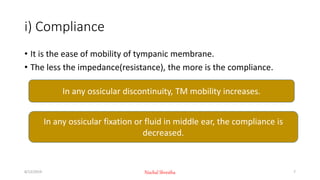
• It is the ease of mobility of tympanic membrane.
• The less the impedance(resistance), the more is the compliance.
In any ossicular discontinuity, TM mobility increases.
In any ossicular fixation or fluid in middle ear, the compliance is
decreased.
8/12/2019 Nischal Shrestha 7
ii) Middle ear pressure
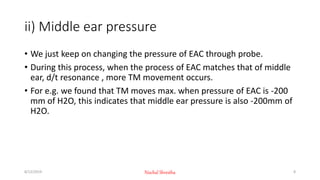
• We just keep on changing the pressure of EAC through probe.
• During this process, when the process of EAC matches that of middle
ear, d/t resonance , more TM movement occurs.
• For e.g. we found that TM moves max. when pressure of EAC is -200
mm of H2O, this indicates that middle ear pressure is also -200mm of
H2O.
8/12/2019 Nischal Shrestha 8
Significance of middle ear pressure
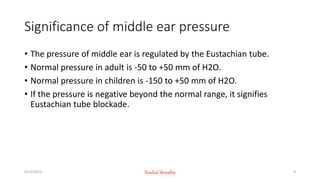
• The pressure of middle ear is regulated by the Eustachian tube.
• Normal pressure in adult is -50 to +50 mm of H2O.
• Normal pressure in children is -150 to +50 mm of H2O.
• If the pressure is negative beyond the normal range, it signifies
Eustachian tube blockade.
8/12/2019 Nischal Shrestha 9
cases
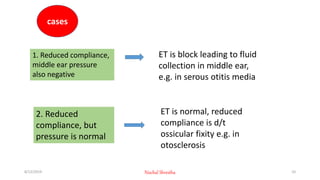
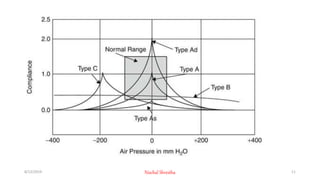
1. Reduced compliance,
middle ear pressure
also negative
ET is block leading to fluid
collection in middle ear,
e.g. in serous otitis media
2. Reduced
compliance, but
pressure is normal
ET is normal, reduced
compliance is d/t
ossicular fixity e.g. in
otosclerosis
8/12/2019 Nischal Shrestha 10
8/12/2019 Nischal Shrestha 11
8/12/2019 Nischal Shrestha 12
8/12/2019 Nischal Shrestha 13
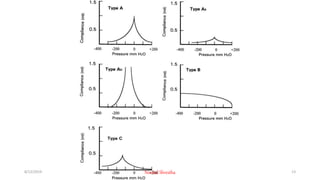
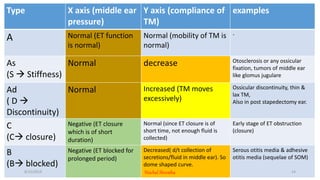
Type X axis (middle ear
pressure)
Y axis (compliance of
TM)
examples
A Normal (ET function
is normal)
Normal (mobility of TM is
normal)
-
As
(S  Stiffness)
Normal decrease Otosclerosis or any ossicular
fixation, tumors of middle ear
like glomus jugulare
Ad
( D 
Discontinuity)
Normal Increased (TM moves
excessively)
Ossicular discontinuity, thin &
lax TM,
Also in post stapedectomy ear.
C
(C closure)
Negative (ET closure
which is of short
duration)
Normal (since ET closure is of
short time, not enough fluid is
collected)
Early stage of ET obstruction
(closure)
B
(B blocked)
Negative (ET blocked for
prolonged period)
Decreased( d/t collection of
secretions/fluid in middle ear). So
dome shaped curve.
Serous otitis media & adhesive
otitis media (sequelae of SOM)
8/12/2019 Nischal Shrestha 14
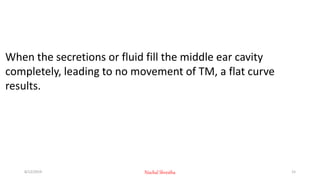
When the secretions or fluid fill the middle ear cavity
completely, leading to no movement of TM, a flat curve
results.
8/12/2019 Nischal Shrestha 15

Tympanometry

  • 1.
    Tympanometry 7th semester mbbs NischalShrestha 8/12/2019 Nischal Shrestha 1
  • 2.
  • 3.
    • This testis a measure of the condition of middle ear with intact tympanic membrane. • It measures the impedance (resistance) to the flow of sound energy through middle ear on pressure changes in the external auditory canal (EAC). • Objective test • It is a type of impedance audiometry. 8/12/2019 Nischal Shrestha 3
  • 4.
  • 5.
    • The 3rdchannel changes the pressure of EAC from + 200 to -400. • When the pressure of EAC and middle ear becomes equal , maximum mobility of TM happens & therefore max. flow of acoustic energy (sound) occurs to middle ear. 8/12/2019 Nischal Shrestha 5
  • 6.
    • In tympanometrywe measure 2 factors: - Compliance (opposite of resistance/ impedance) - Middle ear pressure 8/12/2019 Nischal Shrestha 6
  • 7.
    i) Compliance • Itis the ease of mobility of tympanic membrane. • The less the impedance(resistance), the more is the compliance. In any ossicular discontinuity, TM mobility increases. In any ossicular fixation or fluid in middle ear, the compliance is decreased. 8/12/2019 Nischal Shrestha 7
  • 8.
    ii) Middle earpressure • We just keep on changing the pressure of EAC through probe. • During this process, when the process of EAC matches that of middle ear, d/t resonance , more TM movement occurs. • For e.g. we found that TM moves max. when pressure of EAC is -200 mm of H2O, this indicates that middle ear pressure is also -200mm of H2O. 8/12/2019 Nischal Shrestha 8
  • 9.
    Significance of middleear pressure • The pressure of middle ear is regulated by the Eustachian tube. • Normal pressure in adult is -50 to +50 mm of H2O. • Normal pressure in children is -150 to +50 mm of H2O. • If the pressure is negative beyond the normal range, it signifies Eustachian tube blockade. 8/12/2019 Nischal Shrestha 9
  • 10.
    cases 1. Reduced compliance, middleear pressure also negative ET is block leading to fluid collection in middle ear, e.g. in serous otitis media 2. Reduced compliance, but pressure is normal ET is normal, reduced compliance is d/t ossicular fixity e.g. in otosclerosis 8/12/2019 Nischal Shrestha 10
  • 11.
  • 12.
  • 13.
  • 14.
    Type X axis(middle ear pressure) Y axis (compliance of TM) examples A Normal (ET function is normal) Normal (mobility of TM is normal) - As (S  Stiffness) Normal decrease Otosclerosis or any ossicular fixation, tumors of middle ear like glomus jugulare Ad ( D  Discontinuity) Normal Increased (TM moves excessively) Ossicular discontinuity, thin & lax TM, Also in post stapedectomy ear. C (C closure) Negative (ET closure which is of short duration) Normal (since ET closure is of short time, not enough fluid is collected) Early stage of ET obstruction (closure) B (B blocked) Negative (ET blocked for prolonged period) Decreased( d/t collection of secretions/fluid in middle ear). So dome shaped curve. Serous otitis media & adhesive otitis media (sequelae of SOM) 8/12/2019 Nischal Shrestha 14
  • 15.
    When the secretionsor fluid fill the middle ear cavity completely, leading to no movement of TM, a flat curve results. 8/12/2019 Nischal Shrestha 15