Otosclerosis  Hongyan  Jiang  MD&PhD Otorhinolaryngology Hospital,The First Affiliated Hospital of Sun Yat-sen University
Background  Definition  primary metabolic bone disease of the otic capsule and ossicles otosclerosis is recognized as an alteration in bony metabolism of the endochondral bone of the otic capsule.   It causes fixation of the ossicles (stapes) It results in conductive or mixed hearing loss.  It is genetically-mediated via autosomal dominant transmission The term otosclerosis is derived from the Greek words for “hardening of the ear.” Politzer first recognized otosclerosis in 1893
PREVALENCE Race   prevalence rate Caucasian   8.3% Asian 1% African American   0.5% Native American   0% In postmortem examinations of temporal bones
PREVALENCE Sex variation (M:F=1:2.5) Women more commonly seek medical attention for hearing loss secondary to otosclerosis,  histologic studies prevalence of otosclerosis show no difference in men versus women.
PREVALENCE Age  The incidence of otosclerosis increases with age.  The most common age group presenting with hearing loss from otosclerosis is 15-45 years,  however it has been reported to manifest as early as 7 years and as late as the mid 50s.
Etiology  Many theories have been proposed such as  hereditary, 54% of patients present with family history  & endocrine, women with pregnancy worse her hearing metabolic, enzyme abnormal was pathogen infectious, virus was identified in the lesion  ( measles virus) vascular, autoimmune,  none have be proven.  Hormonal factors have been suggested to play a role in otosclerosis based on the observation that pregnancy sometimes accelerates the progression of the disease.
Pathophysiology The otosclerotic process is divided into two phases histologically. the early phase-otospongiosis(spongy-like appearance) ----Bone resorption and increased vascularity. “ Schwartze's sign”: The  increased vascularity is similar to hyperemia, it  can be seen grossly as red hue behind the TM the late stage- otosclerosis ----The reabsorbed bone is replaced with dense sclerotic  bone.
Pathophysiology If only the footplate is involved, it is sometimes referred to as a “ stapedial otosclerosis ”.  When the entire footplate and annular ligament are involved it is known as an “  obliterated footplate  ” or “  obliterative otosclerosis  ”.  If  the cochlea or the labyrinthine  is involved is named “ cochlea or labyrinthine  otosclerosis  ” The round window is involved in approximately 30% to 50% of cases
Symptoms  Hearing loss : Slowly progressive, bilateral (80%), asymmetric, conductive hearing loss. Tinnitus : is associated with 75% patients Vestibular symptoms:are uncommon. Paracusis of Willis :Some patients report improved speech understanding in a noisy environment. The age of onset of hearing loss is young History of significant ear infections makes the diagnosis of otosclerosis less likely.  25% of patients present with some vestibular complaints
Examination Physical examination A normal appearance of the external auditory canal  TM appears normal in the majority of patients. Schwartze’s sign: a reddish hue over the promontory caused by increased vascularity of the bone immediately under the periosteum.  ----may be seen in the early stages of the disease  ---- is not present in all patients.
Examination Tests Rinne test: negative  Early in the disease, low frequency CHL will predominate resulting in a negative Rinne test with the 256-Hz only.  As progression occurs, the 512 and then the 1,024-Hz TF will become negative. Weber test: laterization to poor HL Schwabach test: prolonged bone conduction Gelle test: negative
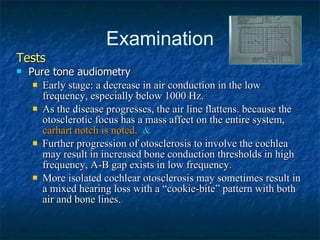
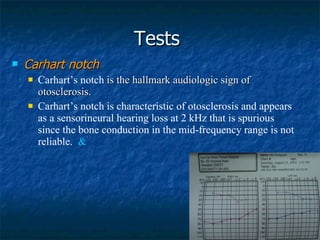
Examination Tests Pure tone audiometry Early stage: a decrease in air conduction in the low frequency, especially below 1000 Hz.  As the disease progresses, the air line flattens. because the otosclerotic focus has a mass affect on the entire system,  carhart notch is noted.  & Further progression of otosclerosis to involve the cochlea may result in increased bone conduction thresholds in high frequency, A-B gap exists in low frequency.  More isolated cochlear otosclerosis may sometimes result in a mixed hearing loss with a “cookie-bite” pattern with both air and bone lines.
Tests Type As (s-stiffness curve) tympanogram and is characteristic of advanced otosclerosis but more commonly, malleus fixation.  Examination
Image study  CT can characterize the extent of the otosclerotic focus at the oval window  CT scan can exclude capsular involvement when patients have significant mixed hearing loss  An enlarged cochlear aqueduct may be seen which potential causes perilymph gusher during footplate fenestration or removal.  It reveal normal round window and normal mastoid pneumatization.
Diagnosis According to Symptoms  and examination,it is easy to make the clinical diagnosis. Other assisted events: low-volume speech.   conductive nature of their hearing loss, they perceive there voice as louder than it actually is.  Two-thirds of patients will report a  family history of hearing loss.  Women with pregnancy worse her hearing
Differential diagnosis Ossicular discontinuity conductive loss of 60 db usually without sensorineural component flaccid tympanic membrane on pneumatic otoscopy type Ad tympanogram
Differential diagnosis Congenital stapes fixation Family history less likely (10%) usually detected in the first decade of life 25% incidence of other congenital anomalies (3% for juvenile otosclerosis) non-progressive CHL
Differential diagnosis Malleus head fixation when  congenital , associated with other stigmata (aural atresia) presence of  tympanosclerosis pneumatic otoscopy almost always associated with type As tympanogram (only in advanced otosclerosis)
Differential diagnosis Paget’s disease - diffuse involvement of the bony skeleton - elevated alkaline phosphatase - CT  - diffuse, bilateral, petrous bone involvement with extensive  -de-mineralization - More commonly crowds the ossicles in the epitympanum, partially fixing  the ossicular chain
Differential diagnosis Osteogenesis imperfecta presence of blue sclera multiple bone fractures CT – more common involves the otic capsule and to a greater extent
Surgical interventions The best surgical candidate  good health with a socially unacceptable ABG,  a negative Rinne test,  excellent discrimination,  the desire for surgery after an appropriate period of time for deliberation. Younger patients are more likely to develop re-ossification of the stapes footplate over their lifetime.
Surgical interventions Most authors discourage performing stapes surgery in patients with Meniere's disease, especially when it is active.
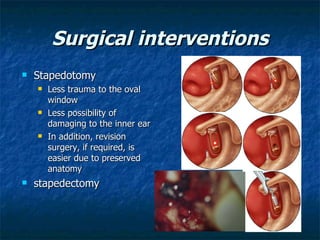
Surgical interventions Stapedotomy Less trauma to the oval window Less possibility of damaging to the inner ear In addition, revision surgery, if required, is easier due to preserved anatomy stapedectomy
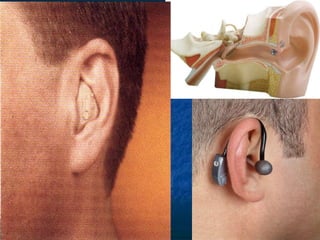
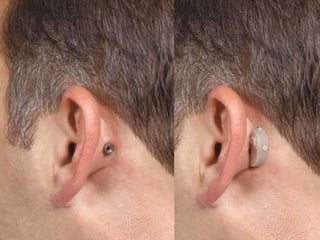
Non-surgical interventions Amplification:  hearing aide  Patients who do not want to undergo surgery for otosclerosis patients who are not fit for surgery.
Non-surgical interventions Medical treatment: Usual dose is about 20-120mg of fluoride a day Efficacy of the treatment can be evaluated 2 years later.  Schwartze’s sign, and the degree of tinnitus and imbalance are reassessed, and a CT scan is repeated.  Once the disease was stable, the patient is placed on a life-ling maintenance dose of about 25mg of fluoride a day.  50% of patients have stabilization of their disease, 30% improve, and the rest continue to progress.
Non-surgical interventions Indications for medical treatment  Not surgical candidates,  Decide against surgery,  Patient with SNHL or vestibular symptoms  positive Schwartze’s sign may be given fluoride treatments for 6-12 months prior to surgery to induce the focus to mature and potentially prevent the progression of disease after surgery. determined to be active during surgery, postoperative treatment can be initiated.
Etiology  hereditary A genetic component has long been recognized Transmission has generally been accepted to be autosomal dominant with incomplete penetrance. The gene for otosclerosis has not been clearly identified ----authors in one study narrowed its location to  chromosome 15q25-26 ----Others have related otosclerosis to the  COL1A1  gene  that encodes for type 1 collagen.  &
Tests  Carhart notch   Carhart’s notch  is the hallmark audiologic sign of otosclerosis.  Carhart’s notch is characteristic of otosclerosis and appears as a sensorineural hearing loss at 2 kHz that is spurious since the bone conduction in the mid-frequency range is not reliable.  &
Meniere’s Disease Hongyan  Jiang  MD&PhD Otorhinolaryngology Hospital,The First Affiliated Hospital of Sun Yat-sen University
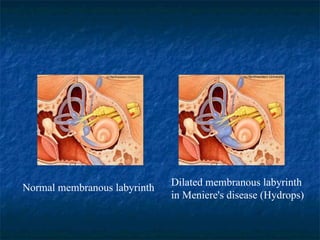
What is Meniere’s Disease? In 1861 Prosper Meniere described a syndrome characterized by  deafness, tinnitus, and episodic vertigo . He linked this condition to a disorder of the inner ear. In 1938 Hallpike and Cairns described the underlying pathology of Meniere’s disease as being  endolymphatic hydrops  but the precise etiology still remains elusive.
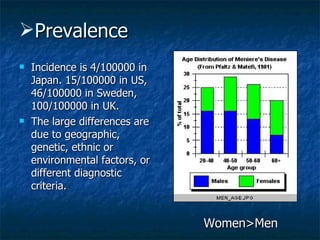
Incidence is 4/100000 in Japan. 15/100000 in US, 46/100000 in Sweden, 100/100000 in UK. The large differences are due to geographic, genetic, ethnic or environmental factors, or different diagnostic criteria. Prevalence Women>Men
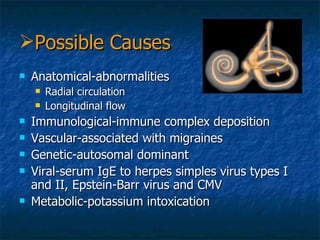
Anatomical-abnormalities Radial circulation Longitudinal flow Immunological-immune complex deposition Vascular-associated with migraines Genetic-autosomal dominant  Viral-serum IgE to herpes simples virus types I and II, Epstein-Barr virus and CMV Metabolic-potassium intoxication Possible Causes
Normal membranous labyrinth  Dilated membranous labyrinth in Meniere's disease (Hydrops)
Periodic episodes of rotatory  vertigo  or  dizziness Fluctuating, progressive, low-frequency  hearing loss Tinnitus Fullness/pressure Symptoms
Diagnosis The diagnosis of Meniere disease is made based on a careful history and physical exam. If the work-up is normal and the classic symptoms continue, the diagnosis of Meniere disease is made.
History Most important part of the diagnosis  Pattern of symptoms  Association between hearing loss, tinnitus, and vertigo
Physical Examination Examination results vary, depending upon the phase of disease.  During remission , physical examination findings may be completely normal, particularly if the patient is symptom free. During an  acute attack , the patient has severe vertigo. Spontaneous nystagmus  directed toward affected ear is typical during an acute attack.
Physical Examination (con’t) The  Romberg test  generally shows significant instability and worsening when the eyes are closed. The Weber tuning fork test usually lateralizes away from the affected ear. The Rinne test usually indicates that air conduction remains better than bone conduction. Complete neurologic evaluation is important. New-onset vertigo might be an early sign of stroke, migraine, or brainstem compression that may require emergent evaluation and care.
Lab studies No lab studies are specific for Meniere disease. CT scans  reveal dehiscent superior semicircular canals and/or widened cochlear and vestibular aqueducts Audiometry  is particularly helpful to document present hearing acuity and to detect future change. ----Typically, the lower frequencies are affected  more severely.
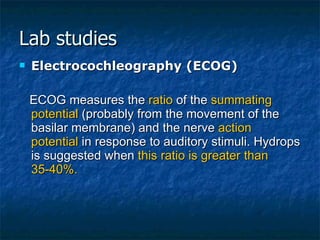
Lab studies Electrocochleography (ECOG) ECOG measures the  ratio  of the  summating potential  (probably from the movement of the basilar membrane) and the nerve  action potential  in response to auditory stimuli. Hydrops is suggested when  this ratio is greater than 35-40%.
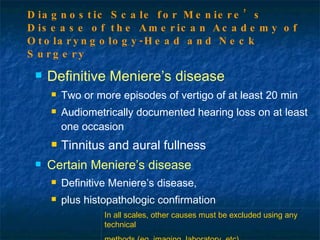
Possible Meniere’s disease Episodic vertigo without documented hearing loss Sensorineural hearing loss, fluctuating or fixed Probable Meniere’s disease One definite episode of vertigo Audiometrically documented hearing loss on at least one occasion Tinnitus and aural fullness Diagnostic Scale for Meniere’s Disease of the American Academy of Otolaryngology-Head and Neck Surgery
Definitive Meniere’s disease Two or more episodes of vertigo of at least 20 min Audiometrically documented hearing loss on at least one occasion Tinnitus and aural fullness Certain Meniere’s disease Definitive Meniere’s disease, plus histopathologic confirmation Diagnostic Scale for Meniere’s Disease of the American Academy of Otolaryngology-Head and Neck Surgery In all scales, other causes must be excluded using any technical methods (eg, imaging, laboratory, etc).
Differential Diagnosis The differential diagnosis is broad and includes: perilymph fistula, recurrent labyrinthitis, otosclerosis, migraine , congenital ear malformations of many kinds,viral meningitis, viral encephalitis, neurosyphilis, stroke, tumors, trauma, autoimmune disorders, MS, etc.
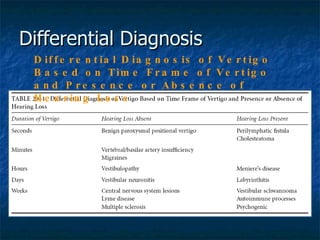
Differential Diagnosis Differential Diagnosis of Vertigo Based on Time Frame of Vertigo and Presence or Absence of Hearing Loss
Treatment Salt restriction Sedative The key is to use sedative briefly Prolonged use of sedative impair compensation, prolongs symptoms and produces  a suboptimal result. Diuretic
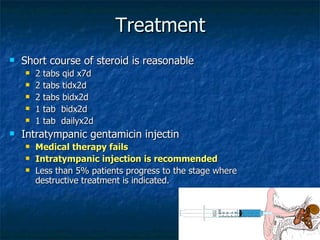
Treatment Short course of steroid is reasonable 2 tabs qid x7d  2 tabs tidx2d 2 tabs bidx2d 1 tab  bidx2d 1 tab  dailyx2d Intratympanic gentamicin injectin Medical therapy fails Intratympanic injection is recommended Less than 5% patients progress to the stage where destructive treatment is indicated.
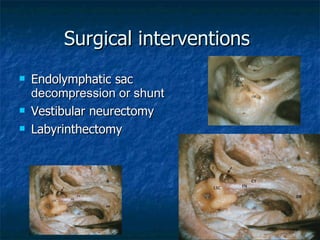
Surgical interventions  Endolymphatic sac  decompression or shunt Vestibular neurectomy Labyrinthectomy
Prognosis Prognosis is variable , since the disease pattern of exacerbation and remission makes evaluation of treatment and prognosis difficult to predict. In general, Ménière symptoms tend to stabilize spontaneously with time. With regard to vertigo, about half of patients stabilize over several years. Patients tend to "burn out" over time and with residual poor balance and hearing.
Prognosis  Cont’d Ménière disease can be classified into several stages of progression. Early stages involve cochlear hydrops, which proceeds to affect the vestibular system. Ménière disease is most bothersome during these early stages. As patients progress to later stages, the hydrops fills the vestibule so completely that no further room is available for pressure fluctuation and the vertigo spells disappear. The acute attacks are replaced by constant imbalance and progressive hearing loss.
House institution experiences ESS is the first line of surgical treatment for MD unresponsive to medical treatment ( diuretic and vasodilator therapy) In case with disable vertigo unresponsive to medical treatment or failing ESS, VNS is recommended and often combine with primary or revision ESS
House institution experiences Concurrent  ESS and VNS does not improvement hearing or tinnitus outcome over vestibular nerve section alone
Karolinska hospital policy Patients with MD still having serviceable hearing were primarily offered ELS In total loss of cochlear function or persisting symptoms after a previous ESS, intratympanic gentamicin injection was chosen.  In patients with normal cochear function and non Menieriform peripheral vestibular dysfunction, vestibular neurectomy was recommended.
Karolinska hospital policy As compared with destructive procedures, such as labyrinthectomy and neurectomy that result in severe vertigo postoperatively. Intratympanic gentamicin injection seldom force the patient to require bed rest and physical inactivity, due to slowly declining vestibular impairment, patients only feel slightly unsteadness.
Labyrinthectomy Transcanal labyrinthectomy Semicircular canals remain intact. Gentamicin us usually placed in the ear as well Transmastoid labytinthectomy Drilling the semicircular canals Opening the vestibule and destroying the saccule and utricle. Gentamicin usually placed in the ear as well
Deafness and its rehabilitation Hongyan  Jiang  MD&PhD Otorhinolaryngology Hospital,The First Affiliated Hospital of Sun Yat-sen University
Background  Speech frequency 500-3000Hz Normal hearing  Sound conduction Sound perception (cochlea)  Sound analysis (retro-cochlea) Deafmutism:  Profound hearing loss.  No language speech perception Language  development quit (6M-6Y) Postlingual deafness deafness present following language developed
Morbidity 1/1000 in new born baby 1/100 in younger 14/100 in middle age 30/100 in 65-75 year old (presbycusis) 50/100 in >75 year old
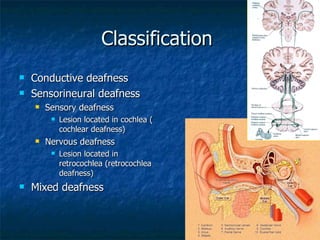
Classification  Conductive deafness Sensorineural deafness Sensory deafness  Lesion located in cochlea ( cochlear deafness) Nervous deafness Lesion located in retrocochlea (retrocochlea deafness) Mixed deafness
Classification Congenital deafness  Hereditary deafness Non hereditary deafness Acquired deafness Prelingual deafness Postlingual deafness
Degree of hearing loss Based on PTA in 500, 1k, 2k Hz (WHO 1980 criteria) Mild HL (<40 dB) Middle HL (41-55dB) Middle-severe HL (56-70 dB) Severe HL (71-90 dB) Profound HL (>90 dB)
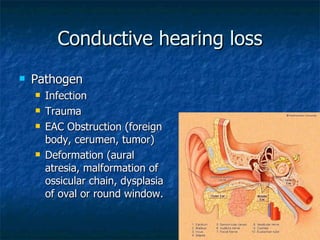
Conductive hearing loss Pathogen Infection  Trauma EAC Obstruction (foreign body, cerumen, tumor) Deformation (aural atresia, malformation of ossicular chain, dysplasia of oval or round window.
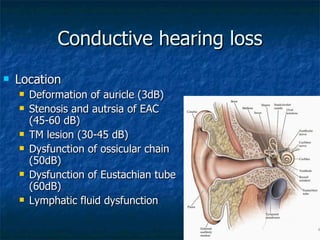
Conductive hearing loss Location  Deformation of auricle (3dB) Stenosis and autrsia of EAC (45-60 dB) TM lesion (30-45 dB) Dysfunction of ossicular chain (50dB) Dysfunction of Eustachian tube (60dB) Lymphatic fluid dysfunction
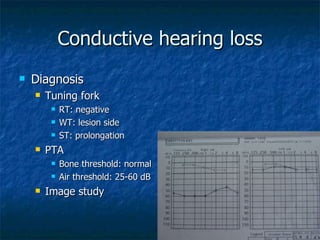
Conductive hearing loss Diagnosis  Tuning fork RT: negative WT: lesion side ST: prolongation PTA Bone threshold: normal  Air threshold: 25-60 dB Image study
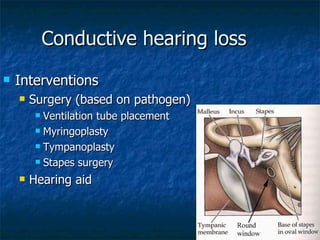
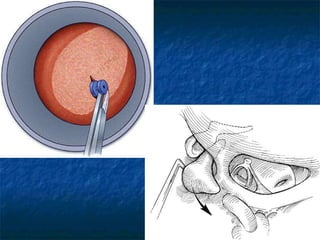
Conductive hearing loss Interventions Surgery (based on pathogen) Ventilation tube placement Myringoplasty Tympanoplasty Stapes surgery Hearing aid


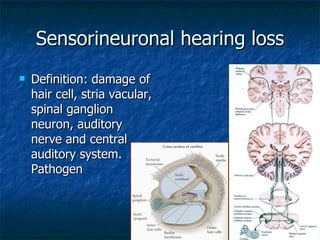
Sensorineuronal hearing loss Definition: damage of hair cell, stria vacular, spinal ganglion neuron, auditory nerve and central auditory system. Pathogen
Sensorineuronal hearing loss Pathogen Congenital hearing loss Hereditary hearing loss Non-syndrome hearing loss Syndrome hearing loss Nonhereditary hearing loss
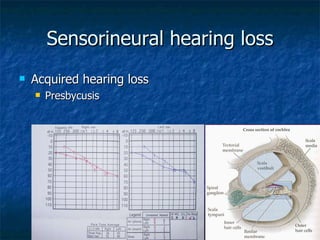
Sensorineural hearing loss Acquired hearing loss Presbycusis
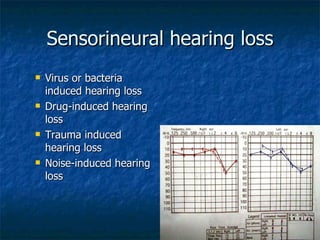
Sensorineural hearing loss Virus or bacteria induced hearing loss Drug-induced hearing loss Trauma induced hearing loss Noise-induced hearing loss
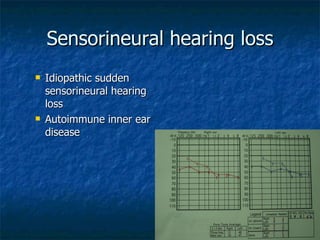
Sensorineural hearing loss Idiopathic sudden sensorineural hearing loss Autoimmune inner ear disease
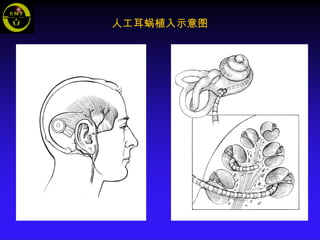
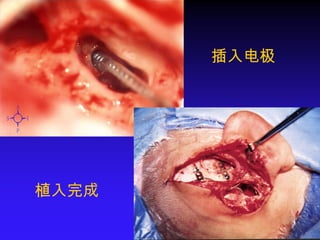
Sensorineural hearing loss Interventions Medical therapy Hypobaroxygen Cochlear implant or auditory brainstem implant Hearing aid Auditory speech training Prevention
 
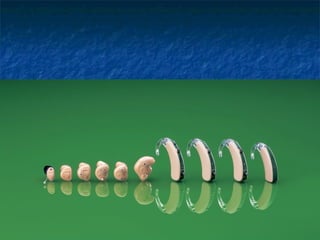
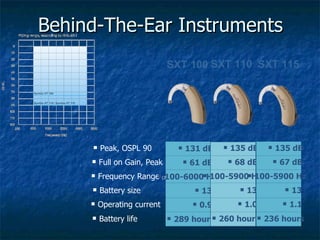
Behind-The-Ear Instruments 1 3 5 dB 67  dB 100- 59 00 Hz 13 1. 1 SXT 115 236  hours Peak, OSPL 90 Full on Gain, Peak Frequency Range  ( 2cc. ) Battery size Operating current Battery life 1 31  dB 61  dB 100-6 0 00 Hz 1 3 0.9 289  hours SXT 100 1 35  dB 6 8 dB 100- 59 00 Hz 1 3 1 . 0 260  hours SXT 110
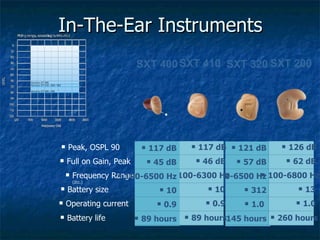
In-The-Ear Instruments Battery size Peak, OSPL 90 Full on Gain, Peak Frequency Range   ( 2cc. ) Operating current Battery life 1 21  dB 57  dB 100-6 5 00 Hz 312 1 . 0   SXT 320 14 5  hours 12 6  dB 62  dB 100-6800 Hz 13 1 . 0 SXT 200 2 60  hours 11 7  dB 46  dB 100-6300 Hz 10 0.9 89  hours SXT 410 11 7  dB 45  dB 100-6 5 00 Hz 10 0.9 89  hours SXT 400
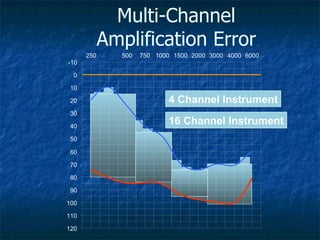
-10 0 10 20 30 40 50 60 70 80 90 100 110 120 250 500 750 1000 1500 2000 3000 4000 6000 4 Channel Instrument 16 Channel Instrument Multi-Channel Amplification Error
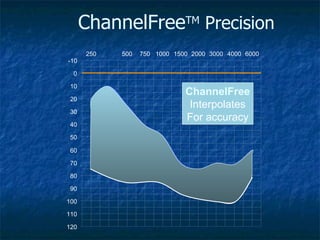
-10 0 10 20 30 40 50 60 70 80 90 100 110 120 250 500 750 1000 1500 2000 3000 4000 6000 ChannelFree Interpolates For accuracy ChannelFree TM  Precision
 
 
Thanks for your attention!

8 otosclerosis

  • 1.
    Otosclerosis Hongyan Jiang MD&PhD Otorhinolaryngology Hospital,The First Affiliated Hospital of Sun Yat-sen University
  • 2.
    Background Definition primary metabolic bone disease of the otic capsule and ossicles otosclerosis is recognized as an alteration in bony metabolism of the endochondral bone of the otic capsule. It causes fixation of the ossicles (stapes) It results in conductive or mixed hearing loss. It is genetically-mediated via autosomal dominant transmission The term otosclerosis is derived from the Greek words for “hardening of the ear.” Politzer first recognized otosclerosis in 1893
  • 3.
    PREVALENCE Race prevalence rate Caucasian 8.3% Asian 1% African American 0.5% Native American 0% In postmortem examinations of temporal bones
  • 4.
    PREVALENCE Sex variation(M:F=1:2.5) Women more commonly seek medical attention for hearing loss secondary to otosclerosis, histologic studies prevalence of otosclerosis show no difference in men versus women.
  • 5.
    PREVALENCE Age The incidence of otosclerosis increases with age. The most common age group presenting with hearing loss from otosclerosis is 15-45 years, however it has been reported to manifest as early as 7 years and as late as the mid 50s.
  • 6.
    Etiology Manytheories have been proposed such as hereditary, 54% of patients present with family history & endocrine, women with pregnancy worse her hearing metabolic, enzyme abnormal was pathogen infectious, virus was identified in the lesion ( measles virus) vascular, autoimmune, none have be proven. Hormonal factors have been suggested to play a role in otosclerosis based on the observation that pregnancy sometimes accelerates the progression of the disease.
  • 7.
    Pathophysiology The otoscleroticprocess is divided into two phases histologically. the early phase-otospongiosis(spongy-like appearance) ----Bone resorption and increased vascularity. “ Schwartze's sign”: The increased vascularity is similar to hyperemia, it can be seen grossly as red hue behind the TM the late stage- otosclerosis ----The reabsorbed bone is replaced with dense sclerotic bone.
  • 8.
    Pathophysiology If onlythe footplate is involved, it is sometimes referred to as a “ stapedial otosclerosis ”. When the entire footplate and annular ligament are involved it is known as an “ obliterated footplate ” or “ obliterative otosclerosis ”. If the cochlea or the labyrinthine is involved is named “ cochlea or labyrinthine otosclerosis ” The round window is involved in approximately 30% to 50% of cases
  • 9.
    Symptoms Hearingloss : Slowly progressive, bilateral (80%), asymmetric, conductive hearing loss. Tinnitus : is associated with 75% patients Vestibular symptoms:are uncommon. Paracusis of Willis :Some patients report improved speech understanding in a noisy environment. The age of onset of hearing loss is young History of significant ear infections makes the diagnosis of otosclerosis less likely. 25% of patients present with some vestibular complaints
  • 10.
    Examination Physical examinationA normal appearance of the external auditory canal TM appears normal in the majority of patients. Schwartze’s sign: a reddish hue over the promontory caused by increased vascularity of the bone immediately under the periosteum. ----may be seen in the early stages of the disease ---- is not present in all patients.
  • 11.
    Examination Tests Rinnetest: negative Early in the disease, low frequency CHL will predominate resulting in a negative Rinne test with the 256-Hz only. As progression occurs, the 512 and then the 1,024-Hz TF will become negative. Weber test: laterization to poor HL Schwabach test: prolonged bone conduction Gelle test: negative
  • 12.
    Examination Tests Puretone audiometry Early stage: a decrease in air conduction in the low frequency, especially below 1000 Hz. As the disease progresses, the air line flattens. because the otosclerotic focus has a mass affect on the entire system, carhart notch is noted. & Further progression of otosclerosis to involve the cochlea may result in increased bone conduction thresholds in high frequency, A-B gap exists in low frequency. More isolated cochlear otosclerosis may sometimes result in a mixed hearing loss with a “cookie-bite” pattern with both air and bone lines.
  • 13.
    Tests Type As(s-stiffness curve) tympanogram and is characteristic of advanced otosclerosis but more commonly, malleus fixation. Examination
  • 14.
    Image study CT can characterize the extent of the otosclerotic focus at the oval window CT scan can exclude capsular involvement when patients have significant mixed hearing loss An enlarged cochlear aqueduct may be seen which potential causes perilymph gusher during footplate fenestration or removal. It reveal normal round window and normal mastoid pneumatization.
  • 15.
    Diagnosis According toSymptoms and examination,it is easy to make the clinical diagnosis. Other assisted events: low-volume speech. conductive nature of their hearing loss, they perceive there voice as louder than it actually is. Two-thirds of patients will report a family history of hearing loss. Women with pregnancy worse her hearing
  • 16.
    Differential diagnosis Ossiculardiscontinuity conductive loss of 60 db usually without sensorineural component flaccid tympanic membrane on pneumatic otoscopy type Ad tympanogram
  • 17.
    Differential diagnosis Congenitalstapes fixation Family history less likely (10%) usually detected in the first decade of life 25% incidence of other congenital anomalies (3% for juvenile otosclerosis) non-progressive CHL
  • 18.
    Differential diagnosis Malleushead fixation when congenital , associated with other stigmata (aural atresia) presence of tympanosclerosis pneumatic otoscopy almost always associated with type As tympanogram (only in advanced otosclerosis)
  • 19.
    Differential diagnosis Paget’sdisease - diffuse involvement of the bony skeleton - elevated alkaline phosphatase - CT - diffuse, bilateral, petrous bone involvement with extensive -de-mineralization - More commonly crowds the ossicles in the epitympanum, partially fixing the ossicular chain
  • 20.
    Differential diagnosis Osteogenesisimperfecta presence of blue sclera multiple bone fractures CT – more common involves the otic capsule and to a greater extent
  • 21.
    Surgical interventions Thebest surgical candidate good health with a socially unacceptable ABG, a negative Rinne test, excellent discrimination, the desire for surgery after an appropriate period of time for deliberation. Younger patients are more likely to develop re-ossification of the stapes footplate over their lifetime.
  • 22.
    Surgical interventions Mostauthors discourage performing stapes surgery in patients with Meniere's disease, especially when it is active.
  • 23.
    Surgical interventions StapedotomyLess trauma to the oval window Less possibility of damaging to the inner ear In addition, revision surgery, if required, is easier due to preserved anatomy stapedectomy
  • 24.
    Non-surgical interventions Amplification: hearing aide Patients who do not want to undergo surgery for otosclerosis patients who are not fit for surgery.
  • 25.
    Non-surgical interventions Medicaltreatment: Usual dose is about 20-120mg of fluoride a day Efficacy of the treatment can be evaluated 2 years later. Schwartze’s sign, and the degree of tinnitus and imbalance are reassessed, and a CT scan is repeated. Once the disease was stable, the patient is placed on a life-ling maintenance dose of about 25mg of fluoride a day. 50% of patients have stabilization of their disease, 30% improve, and the rest continue to progress.
  • 26.
    Non-surgical interventions Indicationsfor medical treatment Not surgical candidates, Decide against surgery, Patient with SNHL or vestibular symptoms positive Schwartze’s sign may be given fluoride treatments for 6-12 months prior to surgery to induce the focus to mature and potentially prevent the progression of disease after surgery. determined to be active during surgery, postoperative treatment can be initiated.
  • 27.
    Etiology hereditaryA genetic component has long been recognized Transmission has generally been accepted to be autosomal dominant with incomplete penetrance. The gene for otosclerosis has not been clearly identified ----authors in one study narrowed its location to chromosome 15q25-26 ----Others have related otosclerosis to the COL1A1 gene that encodes for type 1 collagen. &
  • 28.
    Tests Carhartnotch Carhart’s notch is the hallmark audiologic sign of otosclerosis. Carhart’s notch is characteristic of otosclerosis and appears as a sensorineural hearing loss at 2 kHz that is spurious since the bone conduction in the mid-frequency range is not reliable. &
  • 29.
    Meniere’s Disease Hongyan Jiang MD&PhD Otorhinolaryngology Hospital,The First Affiliated Hospital of Sun Yat-sen University
  • 30.
    What is Meniere’sDisease? In 1861 Prosper Meniere described a syndrome characterized by deafness, tinnitus, and episodic vertigo . He linked this condition to a disorder of the inner ear. In 1938 Hallpike and Cairns described the underlying pathology of Meniere’s disease as being endolymphatic hydrops but the precise etiology still remains elusive.
  • 31.
    Incidence is 4/100000in Japan. 15/100000 in US, 46/100000 in Sweden, 100/100000 in UK. The large differences are due to geographic, genetic, ethnic or environmental factors, or different diagnostic criteria. Prevalence Women>Men
  • 32.
    Anatomical-abnormalities Radial circulationLongitudinal flow Immunological-immune complex deposition Vascular-associated with migraines Genetic-autosomal dominant Viral-serum IgE to herpes simples virus types I and II, Epstein-Barr virus and CMV Metabolic-potassium intoxication Possible Causes
  • 33.
    Normal membranous labyrinth Dilated membranous labyrinth in Meniere's disease (Hydrops)
  • 34.
    Periodic episodes ofrotatory vertigo or dizziness Fluctuating, progressive, low-frequency hearing loss Tinnitus Fullness/pressure Symptoms
  • 35.
    Diagnosis The diagnosisof Meniere disease is made based on a careful history and physical exam. If the work-up is normal and the classic symptoms continue, the diagnosis of Meniere disease is made.
  • 36.
    History Most importantpart of the diagnosis Pattern of symptoms Association between hearing loss, tinnitus, and vertigo
  • 37.
    Physical Examination Examinationresults vary, depending upon the phase of disease. During remission , physical examination findings may be completely normal, particularly if the patient is symptom free. During an acute attack , the patient has severe vertigo. Spontaneous nystagmus directed toward affected ear is typical during an acute attack.
  • 38.
    Physical Examination (con’t)The Romberg test generally shows significant instability and worsening when the eyes are closed. The Weber tuning fork test usually lateralizes away from the affected ear. The Rinne test usually indicates that air conduction remains better than bone conduction. Complete neurologic evaluation is important. New-onset vertigo might be an early sign of stroke, migraine, or brainstem compression that may require emergent evaluation and care.
  • 39.
    Lab studies Nolab studies are specific for Meniere disease. CT scans reveal dehiscent superior semicircular canals and/or widened cochlear and vestibular aqueducts Audiometry is particularly helpful to document present hearing acuity and to detect future change. ----Typically, the lower frequencies are affected more severely.
  • 40.
    Lab studies Electrocochleography(ECOG) ECOG measures the ratio of the summating potential (probably from the movement of the basilar membrane) and the nerve action potential in response to auditory stimuli. Hydrops is suggested when this ratio is greater than 35-40%.
  • 41.
    Possible Meniere’s diseaseEpisodic vertigo without documented hearing loss Sensorineural hearing loss, fluctuating or fixed Probable Meniere’s disease One definite episode of vertigo Audiometrically documented hearing loss on at least one occasion Tinnitus and aural fullness Diagnostic Scale for Meniere’s Disease of the American Academy of Otolaryngology-Head and Neck Surgery
  • 42.
    Definitive Meniere’s diseaseTwo or more episodes of vertigo of at least 20 min Audiometrically documented hearing loss on at least one occasion Tinnitus and aural fullness Certain Meniere’s disease Definitive Meniere’s disease, plus histopathologic confirmation Diagnostic Scale for Meniere’s Disease of the American Academy of Otolaryngology-Head and Neck Surgery In all scales, other causes must be excluded using any technical methods (eg, imaging, laboratory, etc).
  • 43.
    Differential Diagnosis Thedifferential diagnosis is broad and includes: perilymph fistula, recurrent labyrinthitis, otosclerosis, migraine , congenital ear malformations of many kinds,viral meningitis, viral encephalitis, neurosyphilis, stroke, tumors, trauma, autoimmune disorders, MS, etc.
  • 44.
    Differential Diagnosis DifferentialDiagnosis of Vertigo Based on Time Frame of Vertigo and Presence or Absence of Hearing Loss
  • 45.
    Treatment Salt restrictionSedative The key is to use sedative briefly Prolonged use of sedative impair compensation, prolongs symptoms and produces a suboptimal result. Diuretic
  • 46.
    Treatment Short courseof steroid is reasonable 2 tabs qid x7d 2 tabs tidx2d 2 tabs bidx2d 1 tab bidx2d 1 tab dailyx2d Intratympanic gentamicin injectin Medical therapy fails Intratympanic injection is recommended Less than 5% patients progress to the stage where destructive treatment is indicated.
  • 47.
    Surgical interventions Endolymphatic sac decompression or shunt Vestibular neurectomy Labyrinthectomy
  • 48.
    Prognosis Prognosis isvariable , since the disease pattern of exacerbation and remission makes evaluation of treatment and prognosis difficult to predict. In general, Ménière symptoms tend to stabilize spontaneously with time. With regard to vertigo, about half of patients stabilize over several years. Patients tend to &quot;burn out&quot; over time and with residual poor balance and hearing.
  • 49.
    Prognosis Cont’dMénière disease can be classified into several stages of progression. Early stages involve cochlear hydrops, which proceeds to affect the vestibular system. Ménière disease is most bothersome during these early stages. As patients progress to later stages, the hydrops fills the vestibule so completely that no further room is available for pressure fluctuation and the vertigo spells disappear. The acute attacks are replaced by constant imbalance and progressive hearing loss.
  • 50.
    House institution experiencesESS is the first line of surgical treatment for MD unresponsive to medical treatment ( diuretic and vasodilator therapy) In case with disable vertigo unresponsive to medical treatment or failing ESS, VNS is recommended and often combine with primary or revision ESS
  • 51.
    House institution experiencesConcurrent ESS and VNS does not improvement hearing or tinnitus outcome over vestibular nerve section alone
  • 52.
    Karolinska hospital policyPatients with MD still having serviceable hearing were primarily offered ELS In total loss of cochlear function or persisting symptoms after a previous ESS, intratympanic gentamicin injection was chosen. In patients with normal cochear function and non Menieriform peripheral vestibular dysfunction, vestibular neurectomy was recommended.
  • 53.
    Karolinska hospital policyAs compared with destructive procedures, such as labyrinthectomy and neurectomy that result in severe vertigo postoperatively. Intratympanic gentamicin injection seldom force the patient to require bed rest and physical inactivity, due to slowly declining vestibular impairment, patients only feel slightly unsteadness.
  • 54.
    Labyrinthectomy Transcanal labyrinthectomySemicircular canals remain intact. Gentamicin us usually placed in the ear as well Transmastoid labytinthectomy Drilling the semicircular canals Opening the vestibule and destroying the saccule and utricle. Gentamicin usually placed in the ear as well
  • 55.
    Deafness and itsrehabilitation Hongyan Jiang MD&PhD Otorhinolaryngology Hospital,The First Affiliated Hospital of Sun Yat-sen University
  • 56.
    Background Speechfrequency 500-3000Hz Normal hearing Sound conduction Sound perception (cochlea) Sound analysis (retro-cochlea) Deafmutism: Profound hearing loss. No language speech perception Language development quit (6M-6Y) Postlingual deafness deafness present following language developed
  • 57.
    Morbidity 1/1000 innew born baby 1/100 in younger 14/100 in middle age 30/100 in 65-75 year old (presbycusis) 50/100 in >75 year old
  • 58.
    Classification Conductivedeafness Sensorineural deafness Sensory deafness Lesion located in cochlea ( cochlear deafness) Nervous deafness Lesion located in retrocochlea (retrocochlea deafness) Mixed deafness
  • 59.
    Classification Congenital deafness Hereditary deafness Non hereditary deafness Acquired deafness Prelingual deafness Postlingual deafness
  • 60.
    Degree of hearingloss Based on PTA in 500, 1k, 2k Hz (WHO 1980 criteria) Mild HL (<40 dB) Middle HL (41-55dB) Middle-severe HL (56-70 dB) Severe HL (71-90 dB) Profound HL (>90 dB)
  • 61.
    Conductive hearing lossPathogen Infection Trauma EAC Obstruction (foreign body, cerumen, tumor) Deformation (aural atresia, malformation of ossicular chain, dysplasia of oval or round window.
  • 62.
    Conductive hearing lossLocation Deformation of auricle (3dB) Stenosis and autrsia of EAC (45-60 dB) TM lesion (30-45 dB) Dysfunction of ossicular chain (50dB) Dysfunction of Eustachian tube (60dB) Lymphatic fluid dysfunction
  • 63.
    Conductive hearing lossDiagnosis Tuning fork RT: negative WT: lesion side ST: prolongation PTA Bone threshold: normal Air threshold: 25-60 dB Image study
  • 64.
    Conductive hearing lossInterventions Surgery (based on pathogen) Ventilation tube placement Myringoplasty Tympanoplasty Stapes surgery Hearing aid
  • 65.
  • 66.
  • 67.
  • 68.
    Sensorineuronal hearing lossDefinition: damage of hair cell, stria vacular, spinal ganglion neuron, auditory nerve and central auditory system. Pathogen
  • 69.
    Sensorineuronal hearing lossPathogen Congenital hearing loss Hereditary hearing loss Non-syndrome hearing loss Syndrome hearing loss Nonhereditary hearing loss
  • 70.
    Sensorineural hearing lossAcquired hearing loss Presbycusis
  • 71.
    Sensorineural hearing lossVirus or bacteria induced hearing loss Drug-induced hearing loss Trauma induced hearing loss Noise-induced hearing loss
  • 72.
    Sensorineural hearing lossIdiopathic sudden sensorineural hearing loss Autoimmune inner ear disease
  • 73.
    Sensorineural hearing lossInterventions Medical therapy Hypobaroxygen Cochlear implant or auditory brainstem implant Hearing aid Auditory speech training Prevention
  • 74.
  • 75.
    Behind-The-Ear Instruments 13 5 dB 67 dB 100- 59 00 Hz 13 1. 1 SXT 115 236 hours Peak, OSPL 90 Full on Gain, Peak Frequency Range ( 2cc. ) Battery size Operating current Battery life 1 31 dB 61 dB 100-6 0 00 Hz 1 3 0.9 289 hours SXT 100 1 35 dB 6 8 dB 100- 59 00 Hz 1 3 1 . 0 260 hours SXT 110
  • 76.
    In-The-Ear Instruments Batterysize Peak, OSPL 90 Full on Gain, Peak Frequency Range ( 2cc. ) Operating current Battery life 1 21 dB 57 dB 100-6 5 00 Hz 312 1 . 0 SXT 320 14 5 hours 12 6 dB 62 dB 100-6800 Hz 13 1 . 0 SXT 200 2 60 hours 11 7 dB 46 dB 100-6300 Hz 10 0.9 89 hours SXT 410 11 7 dB 45 dB 100-6 5 00 Hz 10 0.9 89 hours SXT 400
  • 77.
    -10 0 1020 30 40 50 60 70 80 90 100 110 120 250 500 750 1000 1500 2000 3000 4000 6000 4 Channel Instrument 16 Channel Instrument Multi-Channel Amplification Error
  • 78.
    -10 0 1020 30 40 50 60 70 80 90 100 110 120 250 500 750 1000 1500 2000 3000 4000 6000 ChannelFree Interpolates For accuracy ChannelFree TM Precision
  • 79.
  • 80.
  • 81.
    Thanks for yourattention!

Editor's Notes

  • #8 The early phase is characterized by multiple active cell groups including osteocytes, osteoblasts, and histiocytes. It develops a spongy appearance because of vascular dilation secondary to osteocyte resorption of bone surrounding blood vessels. This can be seen grossly as red hue behind the tympanic
  • #16 Paracusis of Willis :Patients report improved speech understanding in a noisy environment.
  • #29 Carhart’s notch is characteristic of otosclerosis and appears as a sensorineural hearing loss at 2 kHz that is spurious since the bone conduction in the mid-frequency range is not reliable.
  • #76 Here are some important comments with regard to these figures: 1. The indicated gain values may be reached in full , because of the Adaptive Feedback Canceller. 2. The low battery consumption allows for a total operating time of, approximately: 77 hours for CIC with battery 10 143 hours for ITC with battery 312 255 hours for ITE with battery 13 3. N ote the wide frequency range effectively covering the frequencies which are important for speech understanding.
  • #77 Here are some important comments with regard to these figures: 1. The indicated gain values may be reached in full , because of the Adaptive Feedback Canceller. 2. The low battery consumption allows for a total operating time of, approximately: 77 hours for CIC with battery 10 143 hours for ITC with battery 312 255 hours for ITE with battery 13 3. N ote the wide frequency range effectively covering the frequencies which are important for speech understanding.
  • #78 Let’s look at ChannelFree precision in terms of an audiogram… Here we have the measured thresholds, but in reality the audiogram is probably not a straight line, And in red we have the UCL information. If we try to fit this audiogram with a 4 channel instrument, you can see that we have areas of overamplification and areas of underamplification, If we move to 16 channels, we have a better fit, but we introduce even more temporal smearing as we’ll see a bit later
  • #79 Symbio XT’s ChannelFree system interpolates the gain where it is needed for accuracy. A little later in the talk I’ll show you how you control the gain where needed during a fitting.