Dr kavitha ashok kumar
 FINGER FRICTION TEST
 WATCH TEST
 SPEECH /VOICE TESTS
 Normal person hears a conversation at
12m/40ft
Hears whisper at 6m/20ft in quiet
surroundings
(disadv:lack of stardardisation of pitch,intensity)
 TUNING FORK TESTS
 It is the study of hearing disorders through
hearing evaluation and rehabilitation
 Acoustics:refers to hearing and perception of
sound
 Sound:is a form of energy,which is produced
by any vibrating object.
 Velocity of sound in air is 344m/sec
 Sound travels faster in solids >liquids>gas
 Frequency:is the number of cycles /sec. Its unit is Hertz
(Heinrich Rudolf Hertz).
Ear is sensitive—20-20000Hz,
speech frequency-500-3000Hz,
audiometric testing-125-8000Hz
 Pitch is the subjective sensation produced by frequency.
 Intensity is the strength of sound and determines the
loudness of sound. Its unit is decibel (dB) (Alexander
Graham Bell)
whisper----30dB
conversation---60dB
shouting-----90dB
Pain in the ear---130dB
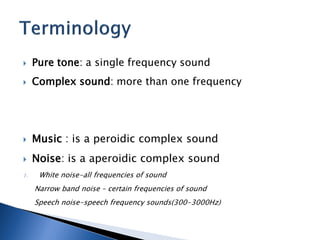
 Pure tone: a single frequency sound
 Complex sound: more than one frequency
 Music : is a peroidic complex sound
 Noise: is a aperoidic complex sound
1. White noise-all frequencies of sound
Narrow band noise – certain frequencies of sound
Speech noise-speech frequency sounds(300-3000Hz)
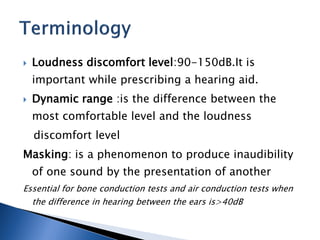
 Loudness discomfort level:90-150dB.It is
important while prescribing a hearing aid.
 Dynamic range :is the difference between the
most comfortable level and the loudness
discomfort level
Masking: is a phenomenon to produce inaudibility
of one sound by the presentation of another
Essential for bone conduction tests and air conduction tests when
the difference in hearing between the ears is>40dB
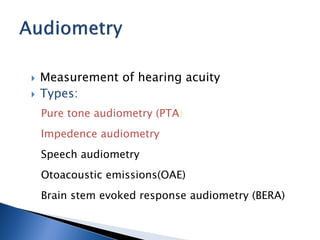
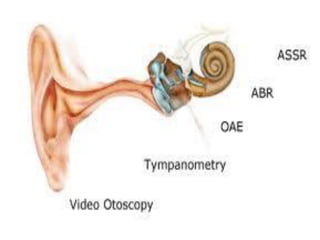
 Measurement of hearing acuity
 Types:
Pure tone audiometry (PTA)
Impedence audiometry
Speech audiometry
Otoacoustic emissions(OAE)
Brain stem evoked response audiometry (BERA)
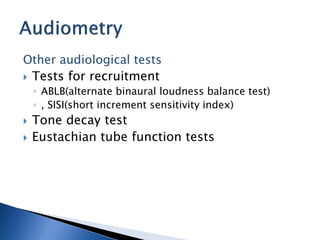
Other audiological tests
 Tests for recruitment
◦ ABLB(alternate binaural loudness balance test)
◦ , SISI(short increment sensitivity index)
 Tone decay test
 Eustachian tube function tests
 Measurement of hearing acuity by
estimation of air conduction and bone
conduction thresholds of hearing for
various frequencies using pure tones
 Pure tone- 125-8000Hz(AC)
250-4000Hz(BC)
 Threshold of hearing: Minimum
perceivable intensity of sound
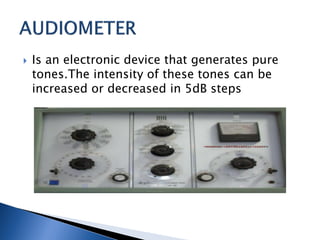
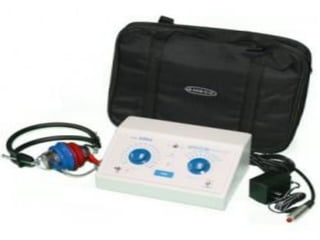
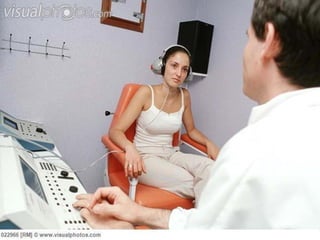
 Is an electronic device that generates pure
tones.The intensity of these tones can be
increased or decreased in 5dB steps
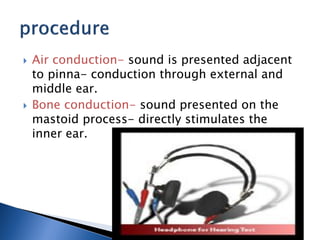
 Air conduction- sound is presented adjacent
to pinna- conduction through external and
middle ear.
 Bone conduction- sound presented on the
mastoid process- directly stimulates the
inner ear.
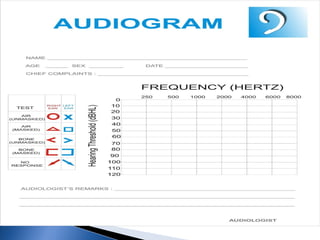
 The threshold for air and bone conduction
for each frequency is noted .
 Bone conduction is a measure of the cochlear
function
 The difference in the thresholds of air and
bone conduction(A-B gap)is a measure of
degree of conductive deafness.
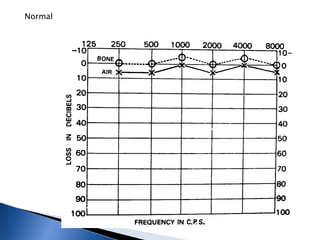
 In a normal person,both air and bone
conduction is at 0dB and A-Bgap is absent
 Pure tone average :is an average of the air
conduction thresholds at 500,1000 and
2000Hz (speech frequencies)
 Masking :air conduction sounds cross over
when >40dB difference exists between the
AC thresholds of the two ears whereas BC
sounds may crossover at even 0dB
difference.A narrow band noise is given to
the non test ear (better ear).This is called
masking.
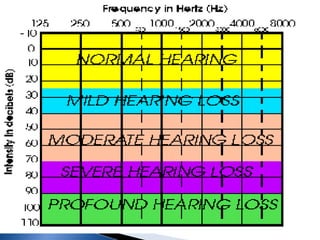
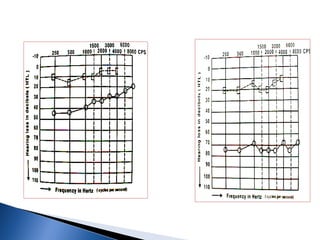
Normal
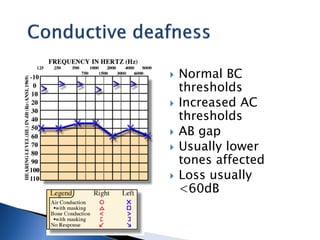
 Normal BC
thresholds
 Increased AC
thresholds
 AB gap
 Usually lower
tones affected
 Loss usually
<60dB
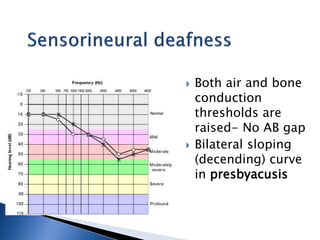
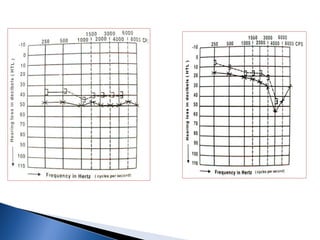
 Both air and bone
conduction
thresholds are
raised- No AB gap
 Bilateral sloping
(decending) curve
in presbyacusis
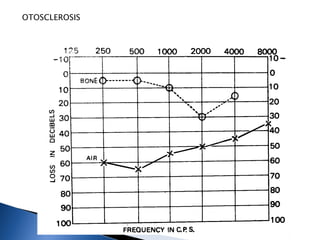
OTOSCLEROSIS
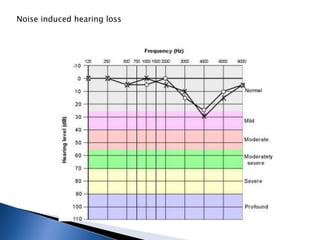
Noise induced hearing loss
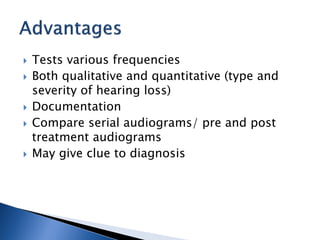
 Tests various frequencies
 Both qualitative and quantitative (type and
severity of hearing loss)
 Documentation
 Compare serial audiograms/ pre and post
treatment audiograms
 May give clue to diagnosis
 Subjective test
 Patient should understand instructions-
cannot be done in children and psychiatric
patients
 Not accurate for medico-legal purposes if
malingering suspected
 Masking to be done to avoid involvement of
non-test ear in the test
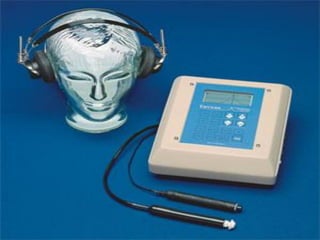
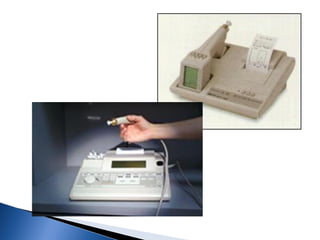
 Impedance = resistance
 Impedance X compliance
 Measurement of the compliance of the middle
ear structures to the sound impulse
 More compliance= middle ear structures
vibrate more freely
 Less compliance= middle ear structures
vibrate less freely (more stiff)
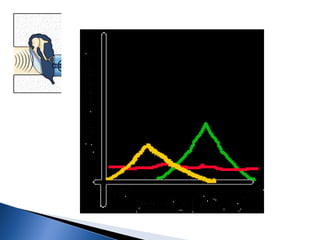
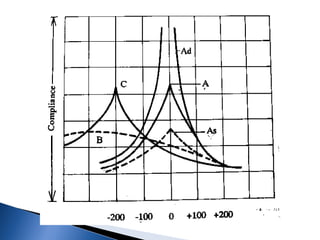
 Tympanometry: measurement of compliance
of middle ear structures to sound impulse at
varying external ear pressures
 Stapedial reflex/ Acoustic reflex :can be
documented as there is reduced compliance
during contraction of stapedius muscle
(normal stapedial reflex threshold: 90dB)
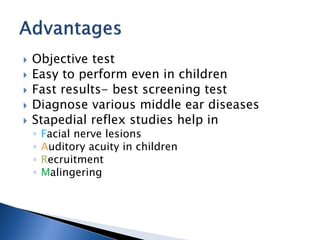
 Objective test
 Easy to perform even in children
 Fast results- best screening test
 Diagnose various middle ear diseases
 Stapedial reflex studies help in
◦ Facial nerve lesions
◦ Auditory acuity in children
◦ Recruitment
◦ Malingering
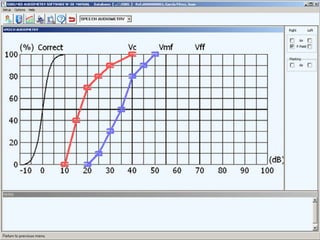
 Speech reception threshold(SRT)
◦ Minimum intensity at which 50% of spondee words
(bisyllables with equal stress on each syllable )are
repeated correctly
◦ Normal:10dB of PTA
 Speech discrimination score(SDS)
◦ Percentage of correctly repeated phonetically
balanced words(single syllable words)given at an
intensity 30-40dB above the SRT.
◦ Normal: 95-100%
◦ Conductive hearing loss:90-100%
◦ Sensorineural hearing loss: is poor
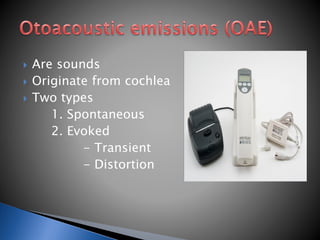
 Are sounds
 Originate from cochlea
 Two types
1. Spontaneous
2. Evoked
- Transient
- Distortion
 Done in quite room
 No patient preparation
 Requires 10 -15 minutes
 Probe placed in the ear canal
 Not painful
 Non-invasive
 Uses:
 Screening test in neonates,uncooperative and
mentally challenged patients
 Helps to distinguish between cochlear and
retrocochlear hearing loss
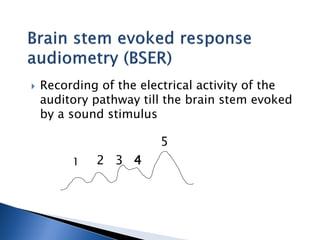
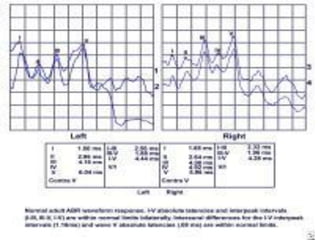
 Recording of the electrical activity of the
auditory pathway till the brain stem evoked
by a sound stimulus
1 2 3 4
5
.
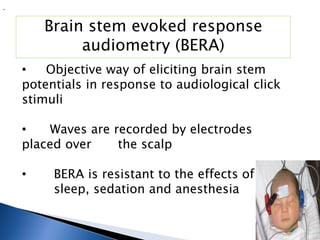
Brain stem evoked response
audiometry (BERA)
• Objective way of eliciting brain stem
potentials in response to audiological click
stimuli
• Waves are recorded by electrodes
placed over the scalp
• BERA is resistant to the effects of
sleep, sedation and anesthesia
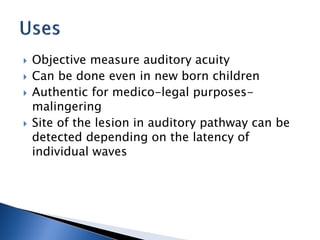
 Objective measure auditory acuity
 Can be done even in new born children
 Authentic for medico-legal purposes-
malingering
 Site of the lesion in auditory pathway can be
detected depending on the latency of
individual waves
 What is Bing’s test?
 What is Gelle’s test?
 Why do we use 512Hz tuning fork for
TuningFork Tests?
 What is roll over phenomenon?
 What is the significance of acoustic reflex?
 What is carhart’s notch?
 Which frequency is most affected in noise
induced hearing loss?
1)In impedence audiometry:
1. “A” wave denotes otosclerosis
2. Patient’s cooperation is essential
3. A 220Hz frequency probe is used
4. “C” wave denotes ossicular discontinuity
5. “B” Wave is seen in serous otitis media
2) Tuning fork tests:
1. Is a subjective test
2. Quantifies the hearing loss
3. Can detect maligering
4. Are clinical tests
5. Detects the type of hearing loss
3) Rinnes test is
1. Negative in acoustic neuroma
2. Positive in Meniere’s disease
3. Negative if minimum deafness is 15-20dB
4. Positive in normal individual
5. Done with 512Hz tuning fork
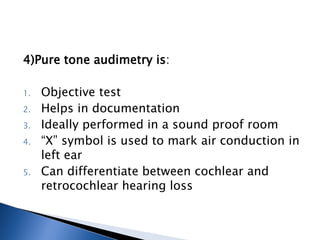
4)Pure tone audimetry is:
1. Objective test
2. Helps in documentation
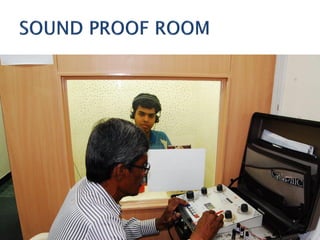
3. Ideally performed in a sound proof room
4. “X” symbol is used to mark air conduction in
left ear
5. Can differentiate between cochlear and
retrocochlear hearing loss
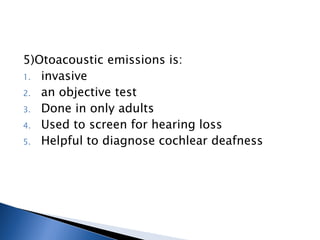
5)Otoacoustic emissions is:
1. invasive
2. an objective test
3. Done in only adults
4. Used to screen for hearing loss
5. Helpful to diagnose cochlear deafness

Audiometry class by Dr. Kavitha Ashok Kumar MSU Malaysia

  • 1.
  • 2.
     FINGER FRICTIONTEST  WATCH TEST  SPEECH /VOICE TESTS  Normal person hears a conversation at 12m/40ft Hears whisper at 6m/20ft in quiet surroundings (disadv:lack of stardardisation of pitch,intensity)  TUNING FORK TESTS
  • 3.
     It isthe study of hearing disorders through hearing evaluation and rehabilitation  Acoustics:refers to hearing and perception of sound  Sound:is a form of energy,which is produced by any vibrating object.  Velocity of sound in air is 344m/sec  Sound travels faster in solids >liquids>gas
  • 4.
     Frequency:is thenumber of cycles /sec. Its unit is Hertz (Heinrich Rudolf Hertz). Ear is sensitive—20-20000Hz, speech frequency-500-3000Hz, audiometric testing-125-8000Hz  Pitch is the subjective sensation produced by frequency.  Intensity is the strength of sound and determines the loudness of sound. Its unit is decibel (dB) (Alexander Graham Bell) whisper----30dB conversation---60dB shouting-----90dB Pain in the ear---130dB
  • 5.
     Pure tone:a single frequency sound  Complex sound: more than one frequency  Music : is a peroidic complex sound  Noise: is a aperoidic complex sound 1. White noise-all frequencies of sound Narrow band noise – certain frequencies of sound Speech noise-speech frequency sounds(300-3000Hz)
  • 6.
     Loudness discomfortlevel:90-150dB.It is important while prescribing a hearing aid.  Dynamic range :is the difference between the most comfortable level and the loudness discomfort level Masking: is a phenomenon to produce inaudibility of one sound by the presentation of another Essential for bone conduction tests and air conduction tests when the difference in hearing between the ears is>40dB
  • 7.
     Measurement ofhearing acuity  Types: Pure tone audiometry (PTA) Impedence audiometry Speech audiometry Otoacoustic emissions(OAE) Brain stem evoked response audiometry (BERA)
  • 8.
    Other audiological tests Tests for recruitment ◦ ABLB(alternate binaural loudness balance test) ◦ , SISI(short increment sensitivity index)  Tone decay test  Eustachian tube function tests
  • 10.
     Measurement ofhearing acuity by estimation of air conduction and bone conduction thresholds of hearing for various frequencies using pure tones  Pure tone- 125-8000Hz(AC) 250-4000Hz(BC)  Threshold of hearing: Minimum perceivable intensity of sound
  • 11.
     Is anelectronic device that generates pure tones.The intensity of these tones can be increased or decreased in 5dB steps
  • 15.
     Air conduction-sound is presented adjacent to pinna- conduction through external and middle ear.  Bone conduction- sound presented on the mastoid process- directly stimulates the inner ear.
  • 17.
     The thresholdfor air and bone conduction for each frequency is noted .  Bone conduction is a measure of the cochlear function  The difference in the thresholds of air and bone conduction(A-B gap)is a measure of degree of conductive deafness.  In a normal person,both air and bone conduction is at 0dB and A-Bgap is absent
  • 18.
     Pure toneaverage :is an average of the air conduction thresholds at 500,1000 and 2000Hz (speech frequencies)  Masking :air conduction sounds cross over when >40dB difference exists between the AC thresholds of the two ears whereas BC sounds may crossover at even 0dB difference.A narrow band noise is given to the non test ear (better ear).This is called masking.
  • 21.
  • 22.
     Normal BC thresholds Increased AC thresholds  AB gap  Usually lower tones affected  Loss usually <60dB
  • 23.
     Both airand bone conduction thresholds are raised- No AB gap  Bilateral sloping (decending) curve in presbyacusis
  • 24.
  • 25.
  • 28.
     Tests variousfrequencies  Both qualitative and quantitative (type and severity of hearing loss)  Documentation  Compare serial audiograms/ pre and post treatment audiograms  May give clue to diagnosis
  • 29.
     Subjective test Patient should understand instructions- cannot be done in children and psychiatric patients  Not accurate for medico-legal purposes if malingering suspected  Masking to be done to avoid involvement of non-test ear in the test
  • 30.
     Impedance =resistance  Impedance X compliance  Measurement of the compliance of the middle ear structures to the sound impulse  More compliance= middle ear structures vibrate more freely  Less compliance= middle ear structures vibrate less freely (more stiff)
  • 32.
     Tympanometry: measurementof compliance of middle ear structures to sound impulse at varying external ear pressures  Stapedial reflex/ Acoustic reflex :can be documented as there is reduced compliance during contraction of stapedius muscle (normal stapedial reflex threshold: 90dB)
  • 36.
     Objective test Easy to perform even in children  Fast results- best screening test  Diagnose various middle ear diseases  Stapedial reflex studies help in ◦ Facial nerve lesions ◦ Auditory acuity in children ◦ Recruitment ◦ Malingering
  • 37.
     Speech receptionthreshold(SRT) ◦ Minimum intensity at which 50% of spondee words (bisyllables with equal stress on each syllable )are repeated correctly ◦ Normal:10dB of PTA  Speech discrimination score(SDS) ◦ Percentage of correctly repeated phonetically balanced words(single syllable words)given at an intensity 30-40dB above the SRT. ◦ Normal: 95-100% ◦ Conductive hearing loss:90-100% ◦ Sensorineural hearing loss: is poor
  • 39.
     Are sounds Originate from cochlea  Two types 1. Spontaneous 2. Evoked - Transient - Distortion
  • 40.
     Done inquite room  No patient preparation  Requires 10 -15 minutes  Probe placed in the ear canal  Not painful  Non-invasive
  • 41.
     Uses:  Screeningtest in neonates,uncooperative and mentally challenged patients  Helps to distinguish between cochlear and retrocochlear hearing loss
  • 42.
     Recording ofthe electrical activity of the auditory pathway till the brain stem evoked by a sound stimulus 1 2 3 4 5
  • 43.
    . Brain stem evokedresponse audiometry (BERA) • Objective way of eliciting brain stem potentials in response to audiological click stimuli • Waves are recorded by electrodes placed over the scalp • BERA is resistant to the effects of sleep, sedation and anesthesia
  • 45.
     Objective measureauditory acuity  Can be done even in new born children  Authentic for medico-legal purposes- malingering  Site of the lesion in auditory pathway can be detected depending on the latency of individual waves
  • 48.
     What isBing’s test?  What is Gelle’s test?  Why do we use 512Hz tuning fork for TuningFork Tests?  What is roll over phenomenon?  What is the significance of acoustic reflex?  What is carhart’s notch?  Which frequency is most affected in noise induced hearing loss?
  • 49.
    1)In impedence audiometry: 1.“A” wave denotes otosclerosis 2. Patient’s cooperation is essential 3. A 220Hz frequency probe is used 4. “C” wave denotes ossicular discontinuity 5. “B” Wave is seen in serous otitis media
  • 50.
    2) Tuning forktests: 1. Is a subjective test 2. Quantifies the hearing loss 3. Can detect maligering 4. Are clinical tests 5. Detects the type of hearing loss
  • 51.
    3) Rinnes testis 1. Negative in acoustic neuroma 2. Positive in Meniere’s disease 3. Negative if minimum deafness is 15-20dB 4. Positive in normal individual 5. Done with 512Hz tuning fork
  • 52.
    4)Pure tone audimetryis: 1. Objective test 2. Helps in documentation 3. Ideally performed in a sound proof room 4. “X” symbol is used to mark air conduction in left ear 5. Can differentiate between cochlear and retrocochlear hearing loss
  • 53.
    5)Otoacoustic emissions is: 1.invasive 2. an objective test 3. Done in only adults 4. Used to screen for hearing loss 5. Helpful to diagnose cochlear deafness