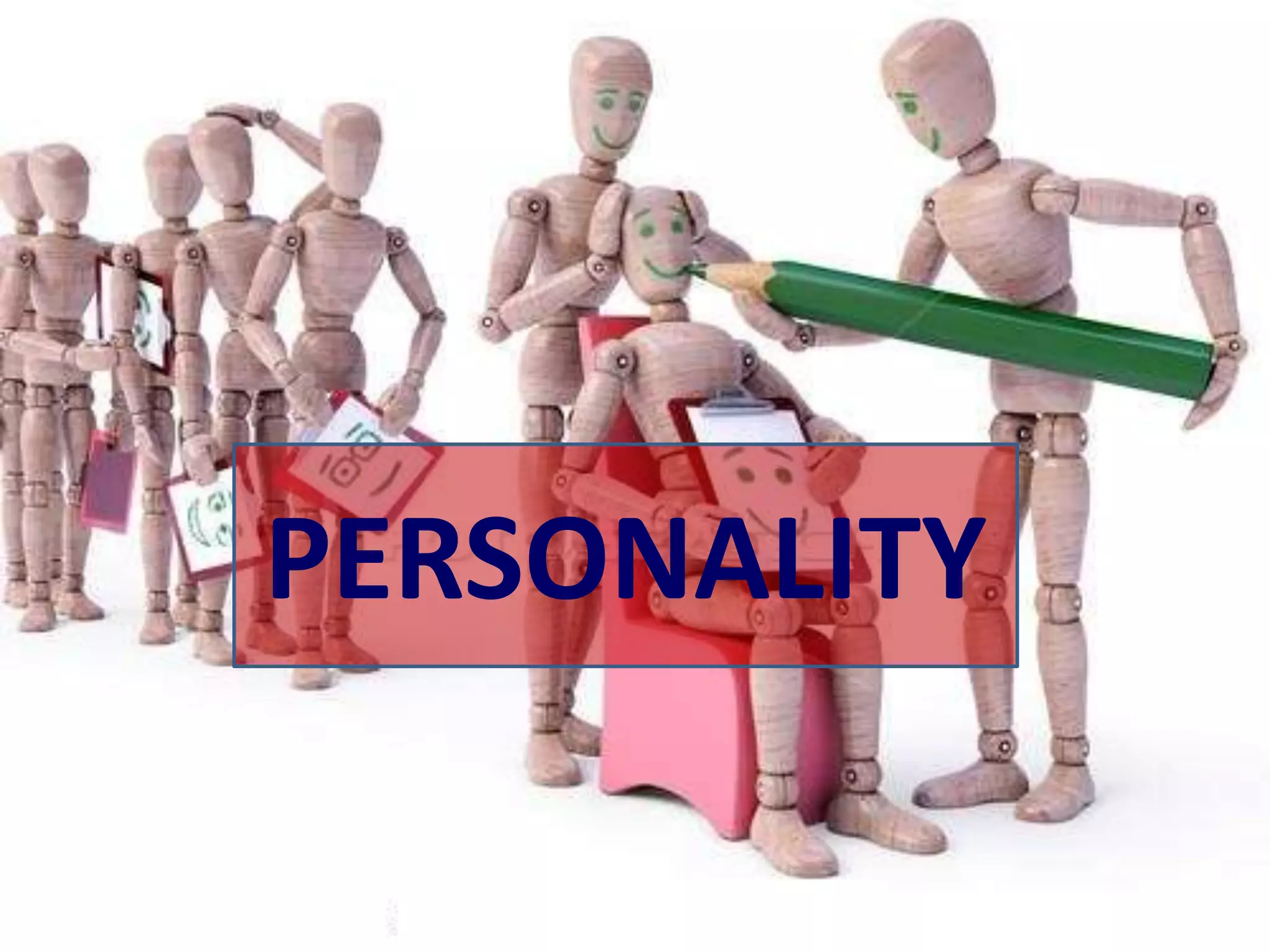
PERSONALITY
What is Personality?
The relatively stable set of
psychological characteristics
that influences the way an
individual interacts with his
or her environment.
Role of Heredity & the Brain
Nature and nurture both
contribute to one’s personality.
The genes affect the brain
functions that in turn affect how
people interacts with their
environment and thus their
personality.
Self-Esteem
The degree to which a person has a
positive self-evaluation.
Self is a product of many interacting
parts may be thought as the
personality viewed from within.
Thus self-esteem can be said to be
an attempt to understand ones self.
Person-situation
Interaction
People are not static, acting the
same in all situations, but instead
are ever changing and flexible.
The Socialization Process
Personality development consists of
continuous process and the sequence is based
largely on the learning opportunities available
and the socialization process. There is
increasing recognition given to the role of
other relevant persons, groups, and especially,
organizations that greatly influence on
individual's personality.
Characteristics of
Organizational Socialization
1.
2.
3.
4.
5.

Change of attitude.
Continuity of socialization over time.
Adjustment to new jobs, work groups,
and organizational practices
Mutual influence between new recruits
and their managers
Criticality of the early socialization
period.
Steps to successful
organizational socialization
1.
2.
3.
4.

Provide a challenging first job.
Provide relevant training.
Provide timely and consistent feedback.
Select a good first supervisor to be in charge of
socialization.
5. Design a relaxed orientation program.
6. Place new recruits in work group with high morale.
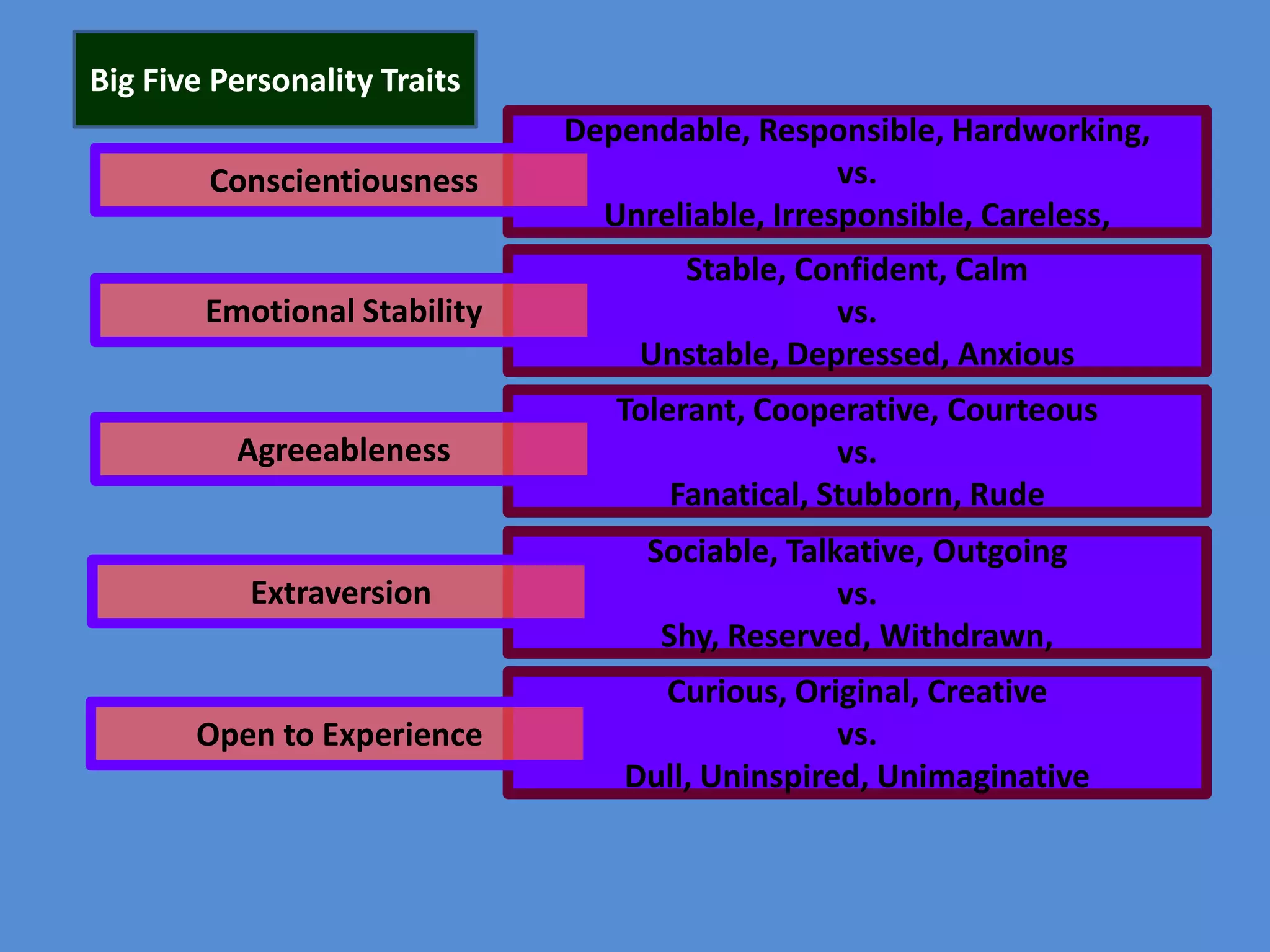
Big Five Personality Traits
Conscientiousness

Dependable, Responsible, Hardworking,
vs.
Unreliable, Irresponsible, Careless,

Emotional Stability

Stable, Confident, Calm
vs.
Unstable, Depressed, Anxious

Agreeableness

Tolerant, Cooperative, Courteous
vs.
Fanatical, Stubborn, Rude

Extraversion

Sociable, Talkative, Outgoing
vs.
Shy, Reserved, Withdrawn,

Open to Experience

Curious, Original, Creative
vs.
Dull, Uninspired, Unimaginative
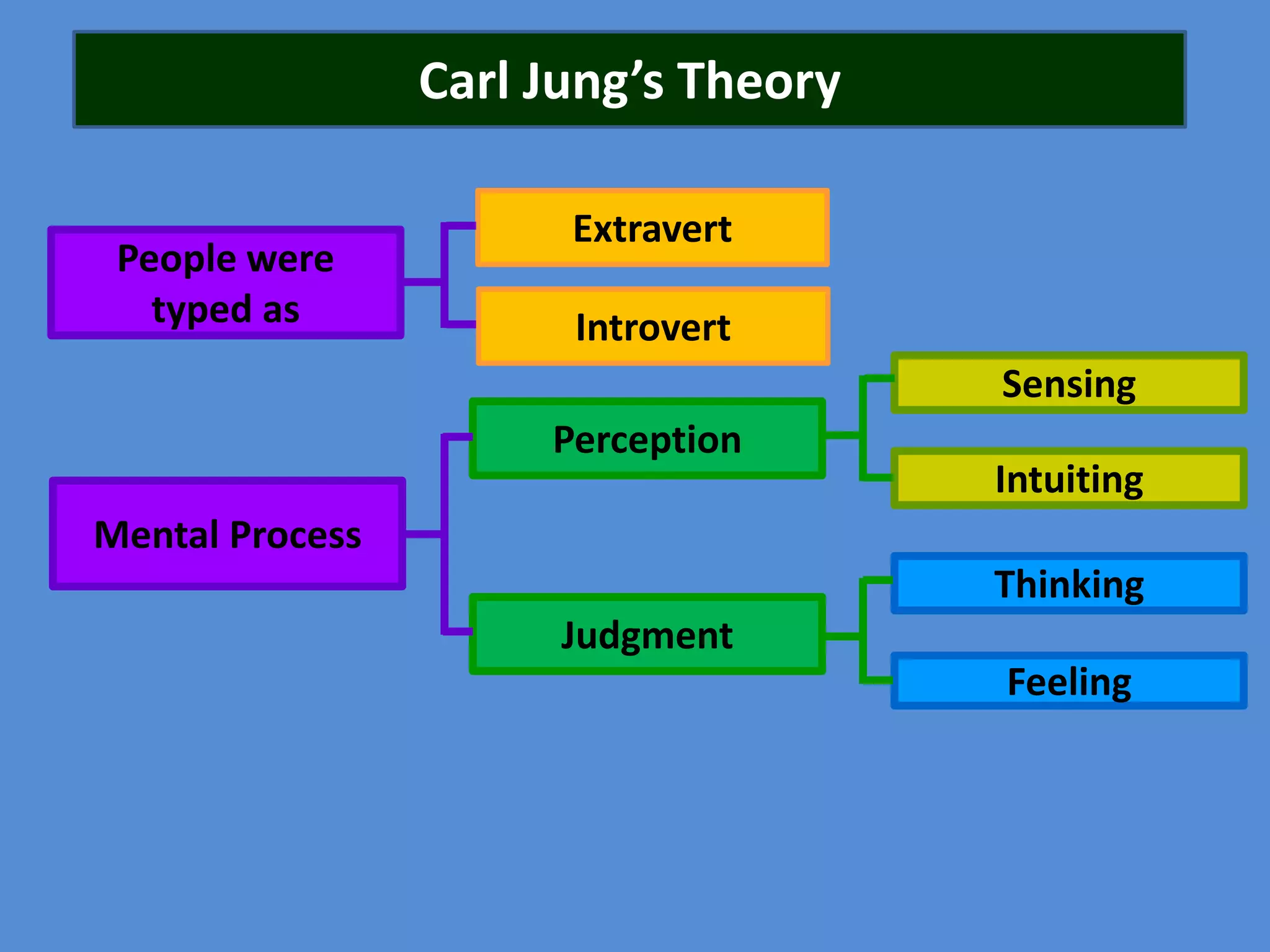
Carl Jung’s Theory
People were
typed as

Extravert
Introvert

Sensing
Perception

Intuiting

Mental Process
Thinking
Judgment

Feeling
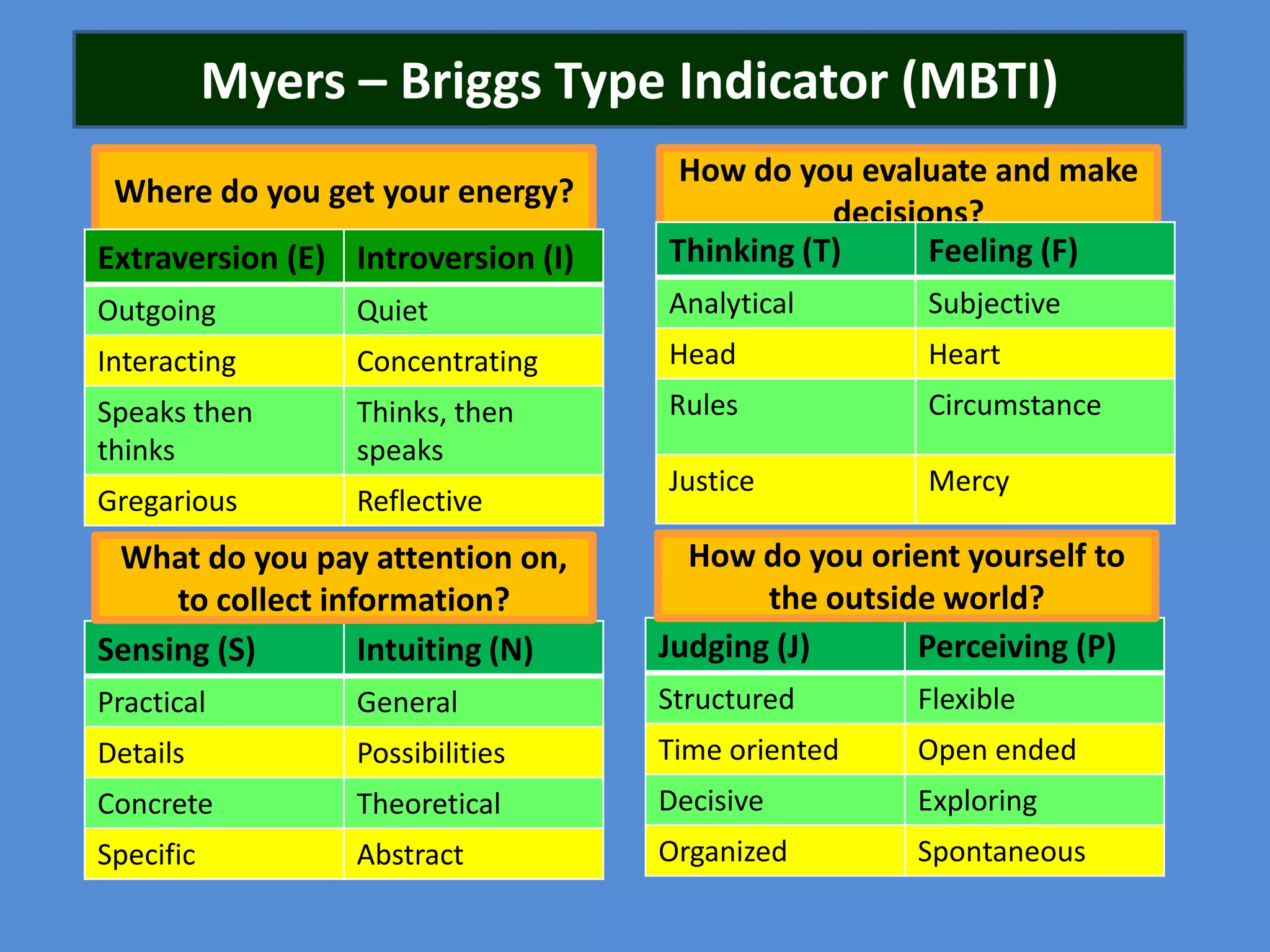
Myers – Briggs Type Indicator (MBTI)
Extraversion (E) Introversion (I)

How do you evaluate and make
decisions?
Thinking (T)
Feeling (F)

Outgoing

Quiet

Analytical

Subjective

Interacting

Concentrating

Head

Heart

Speaks then
thinks

Thinks, then
speaks

Rules

Circumstance

Gregarious

Reflective

Justice

Mercy

Where do you get your energy?

What do you pay attention on,
to collect information?
Sensing (S)
Intuiting (N)

How do you orient yourself to
the outside world?
Judging (J)
Perceiving (P)

Practical

General

Structured

Flexible

Details

Possibilities

Time oriented

Open ended

Concrete

Theoretical

Decisive

Exploring

Specific

Abstract

Organized

Spontaneous
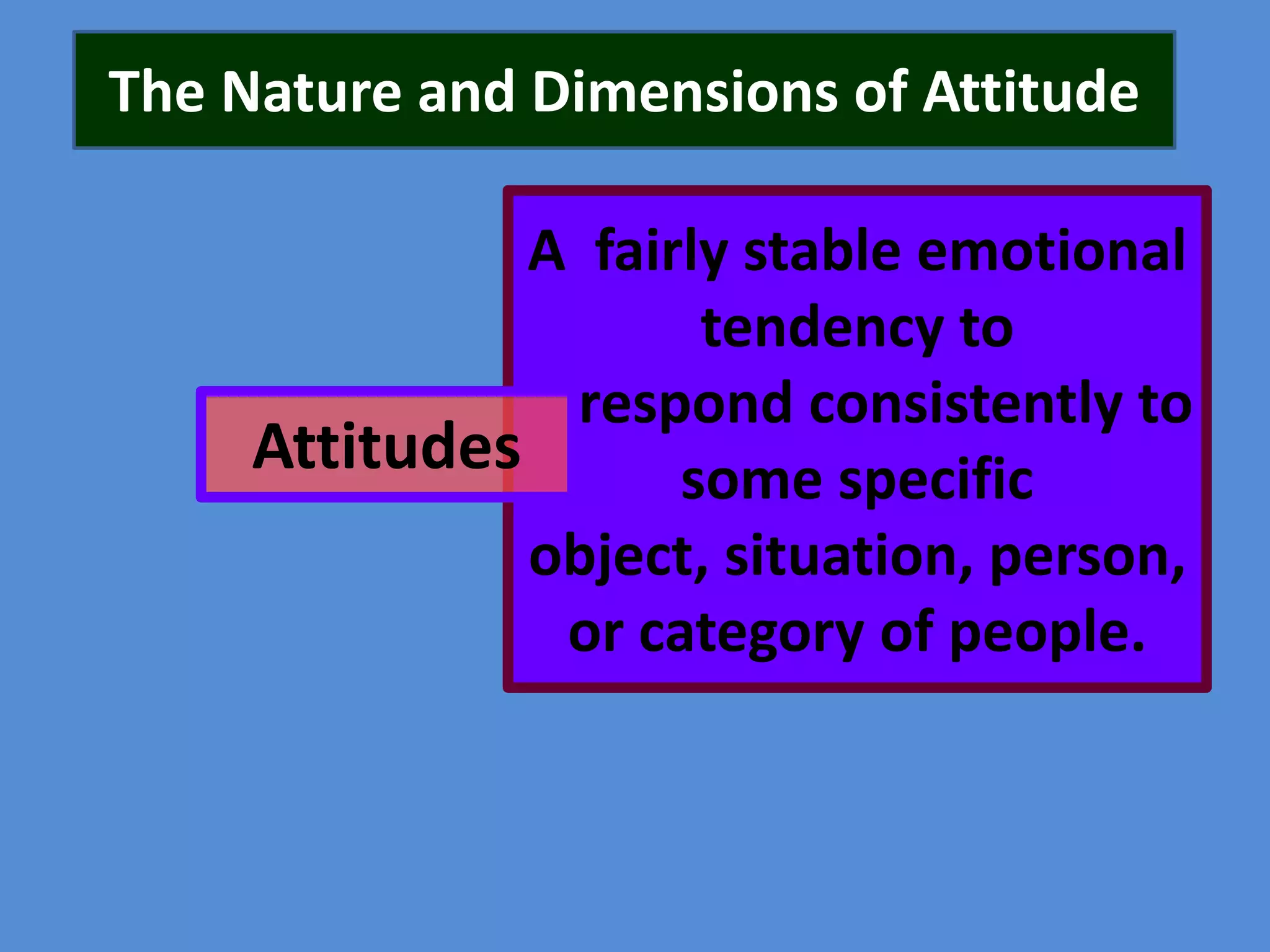
The Nature and Dimensions of Attitude
A fairly stable emotional
tendency to
respond consistently to
Attitudes
some specific
object, situation, person,
or category of people.
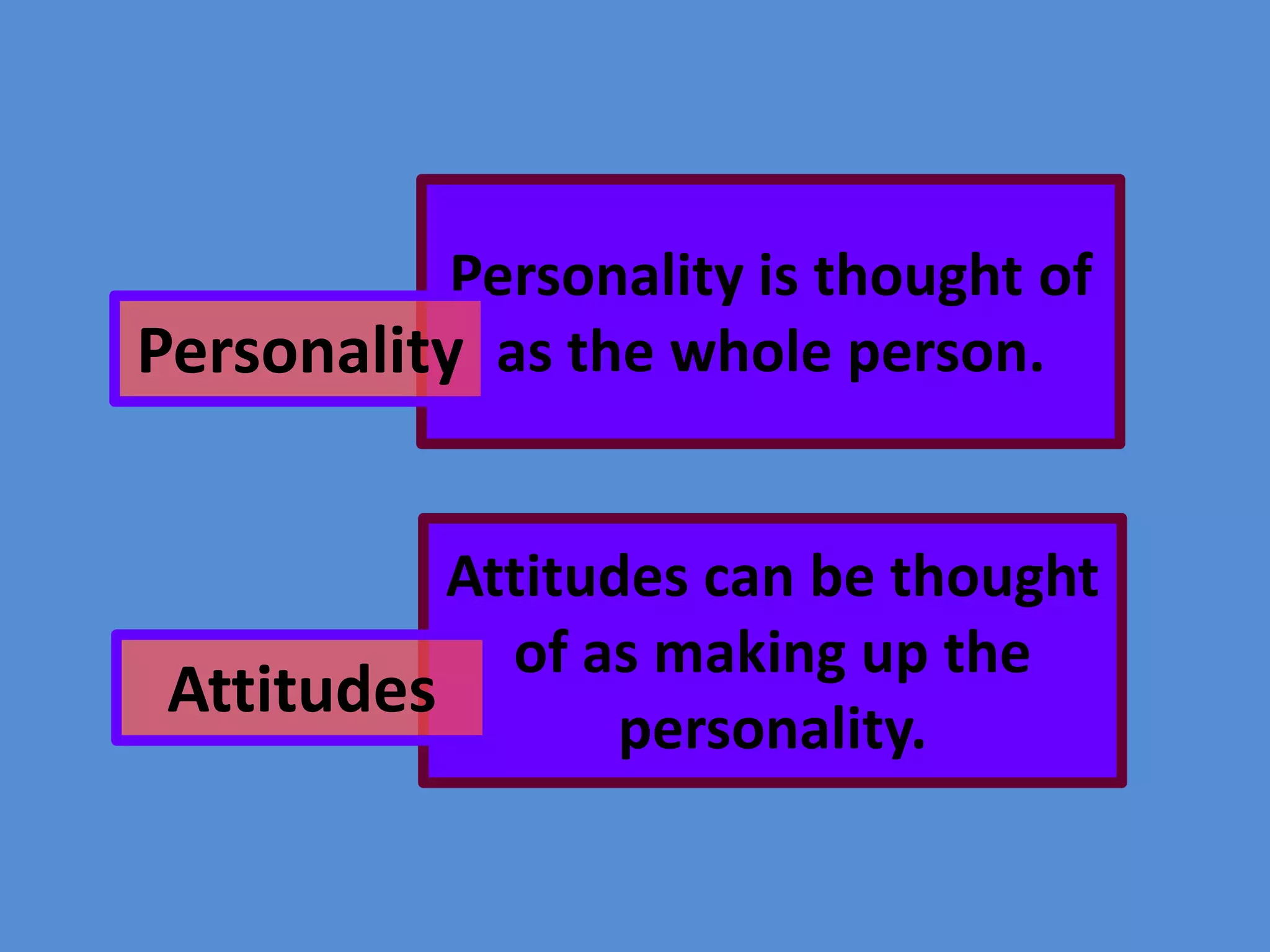
Personality is thought of
Personality as the whole person.
Attitudes can be thought
of as making up the
Attitudes
personality.
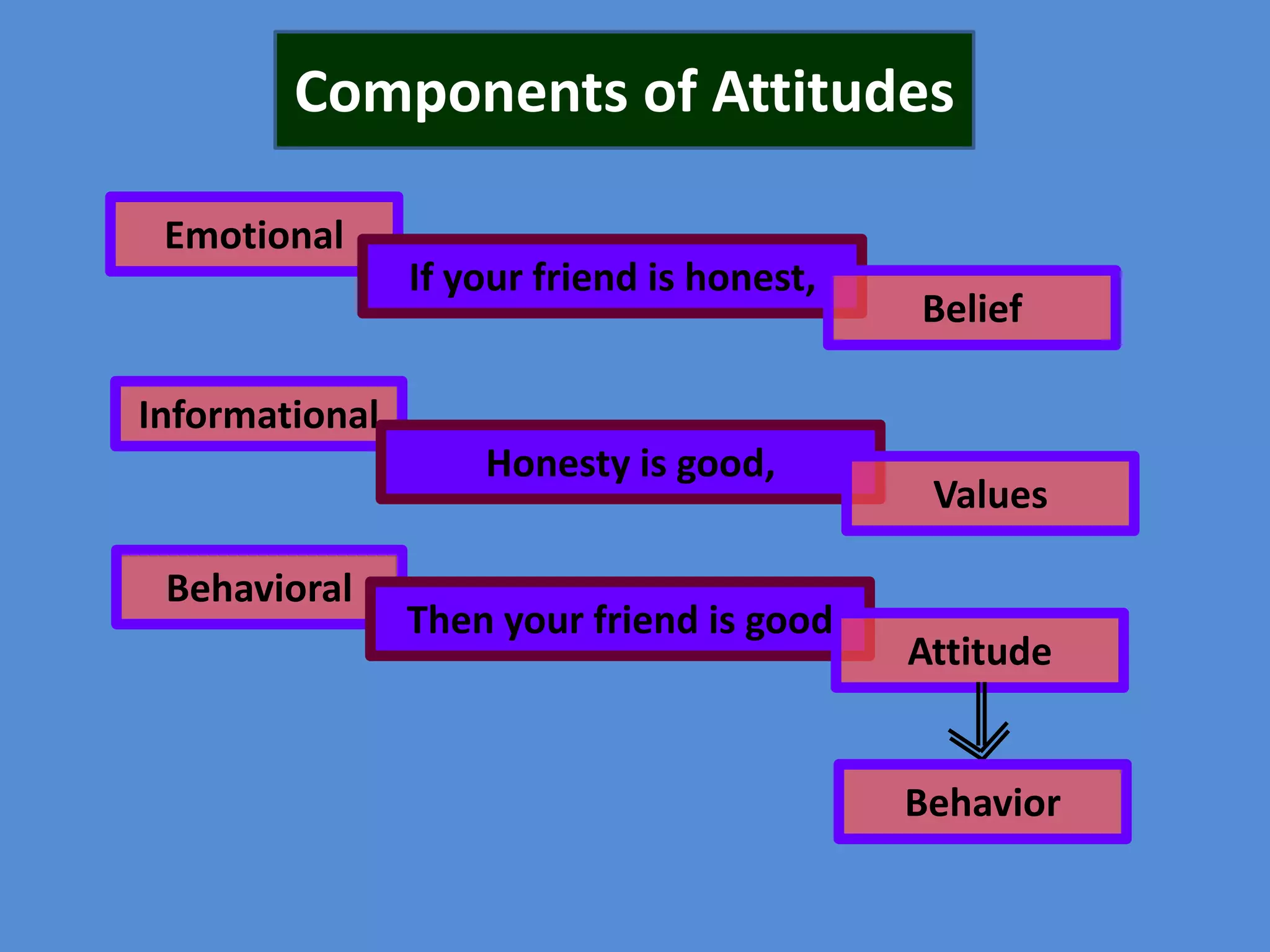
Components of Attitudes
Emotional

If your friend is honest,

Belief

Informational
Honesty is good,
Behavioral

Then your friend is good

Values

Attitude

Behavior
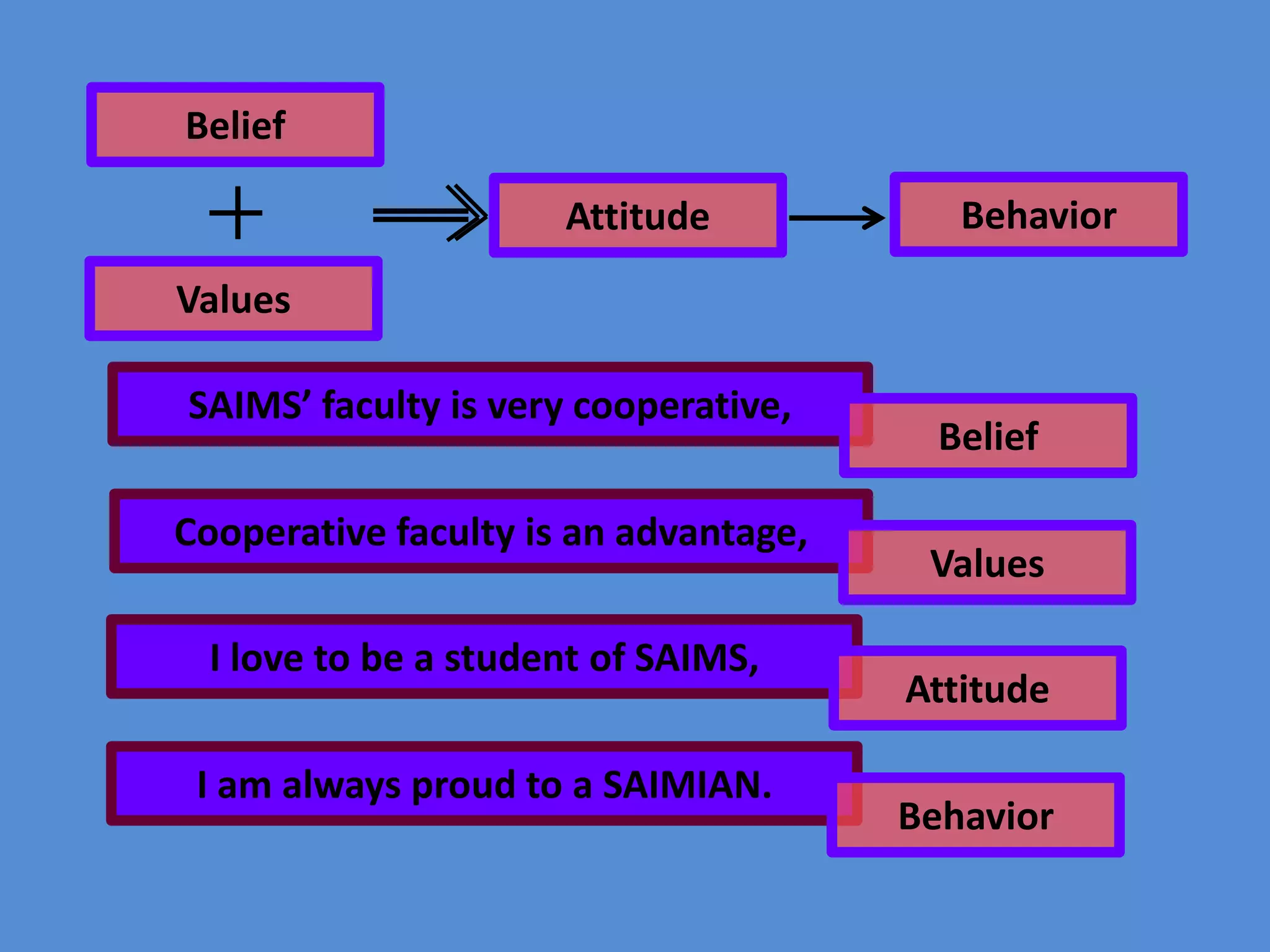
Belief
Attitude

Behavior

Values
SAIMS’ faculty is very cooperative,

Cooperative faculty is an advantage,
I love to be a student of SAIMS,
I am always proud to a SAIMIAN.

Belief
Values
Attitude
Behavior
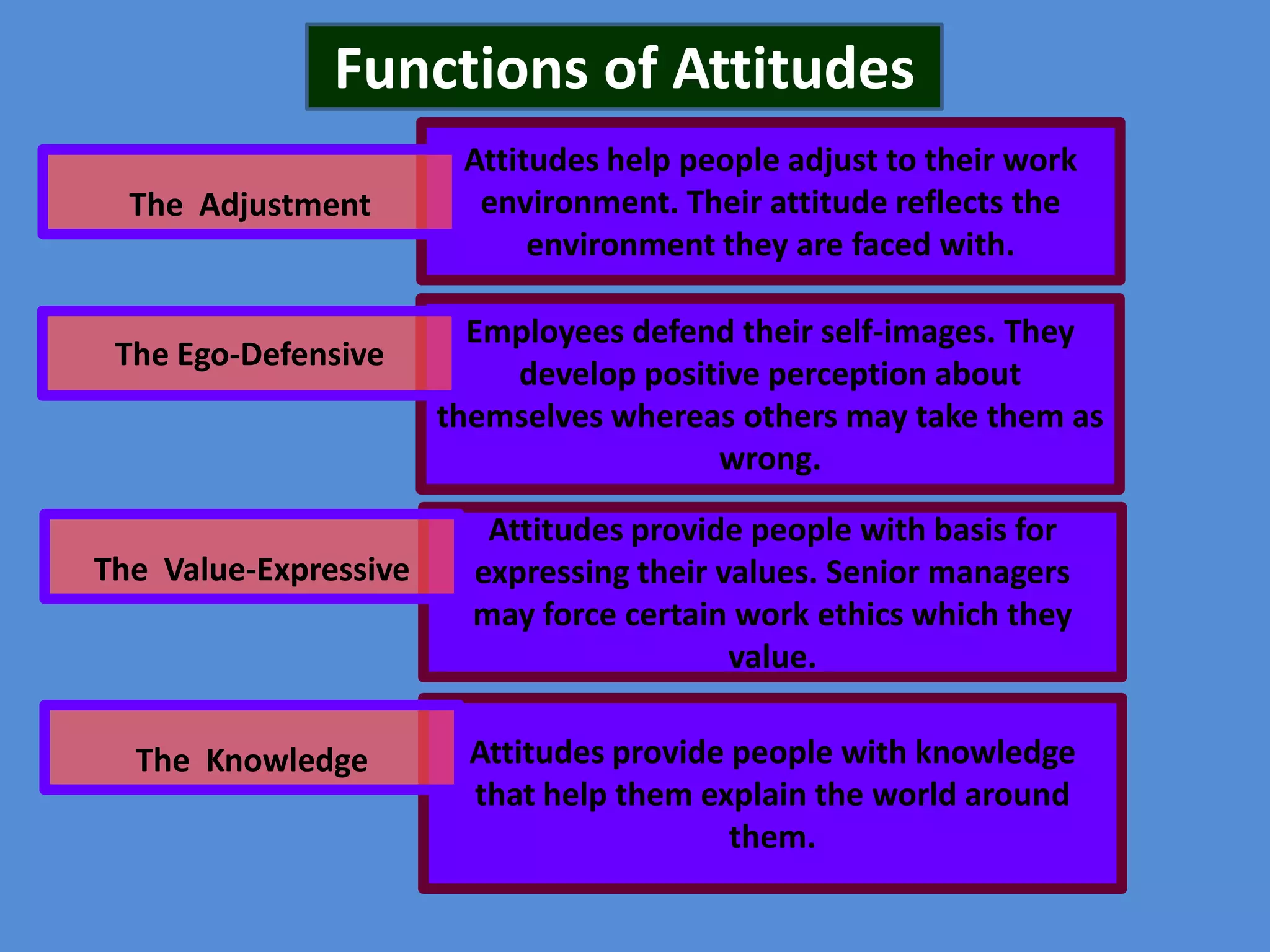
Functions of Attitudes
The Adjustment

The Ego-Defensive

The Value-Expressive

The Knowledge

Attitudes help people adjust to their work
environment. Their attitude reflects the
environment they are faced with.
Employees defend their self-images. They
develop positive perception about
themselves whereas others may take them as
wrong.
Attitudes provide people with basis for
expressing their values. Senior managers
may force certain work ethics which they
value.

Attitudes provide people with knowledge
that help them explain the world around
them.
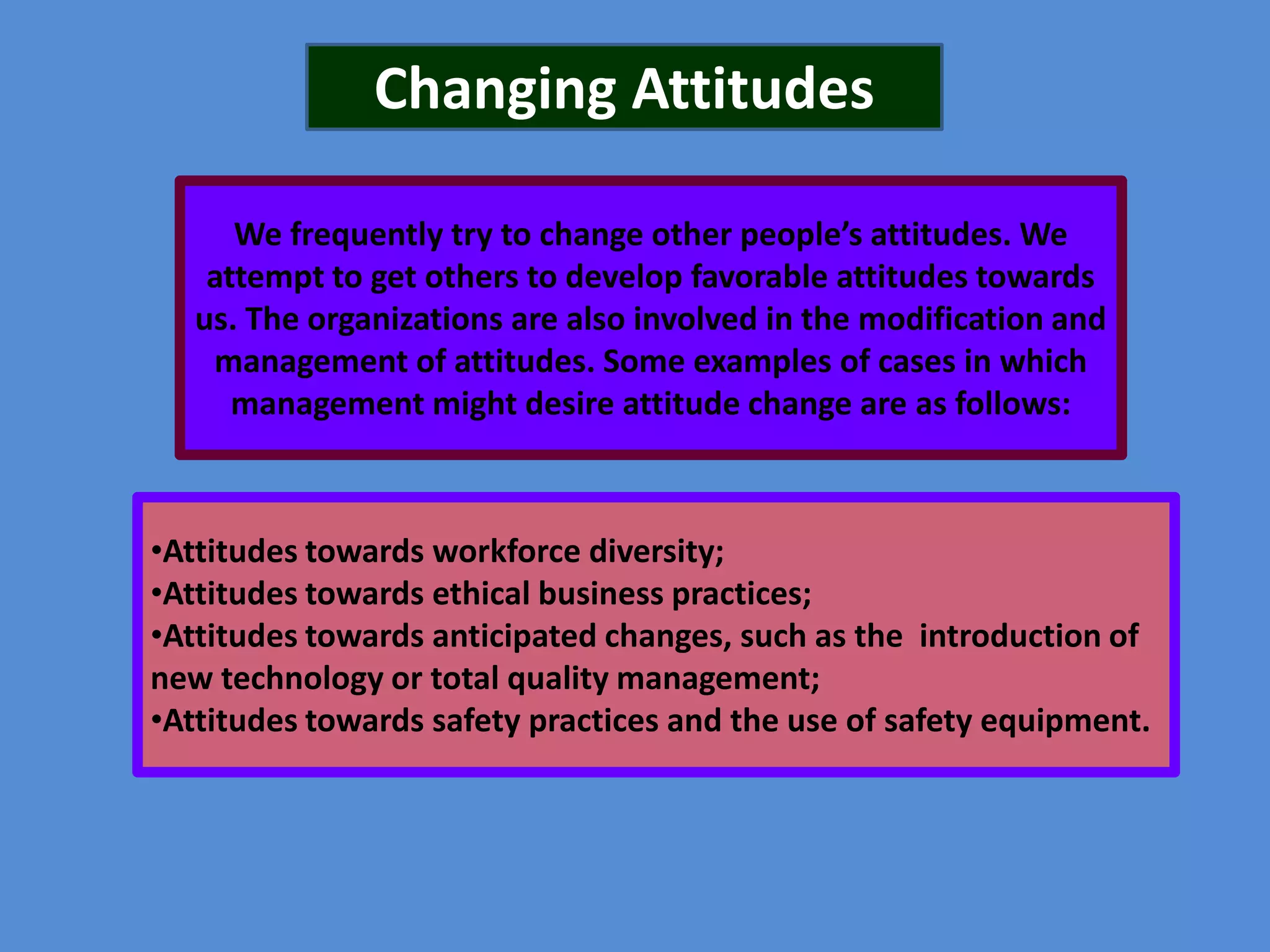
Changing Attitudes
We frequently try to change other people’s attitudes. We
attempt to get others to develop favorable attitudes towards
us. The organizations are also involved in the modification and
management of attitudes. Some examples of cases in which
management might desire attitude change are as follows:

•Attitudes towards workforce diversity;
•Attitudes towards ethical business practices;
•Attitudes towards anticipated changes, such as the introduction of
new technology or total quality management;
•Attitudes towards safety practices and the use of safety equipment.
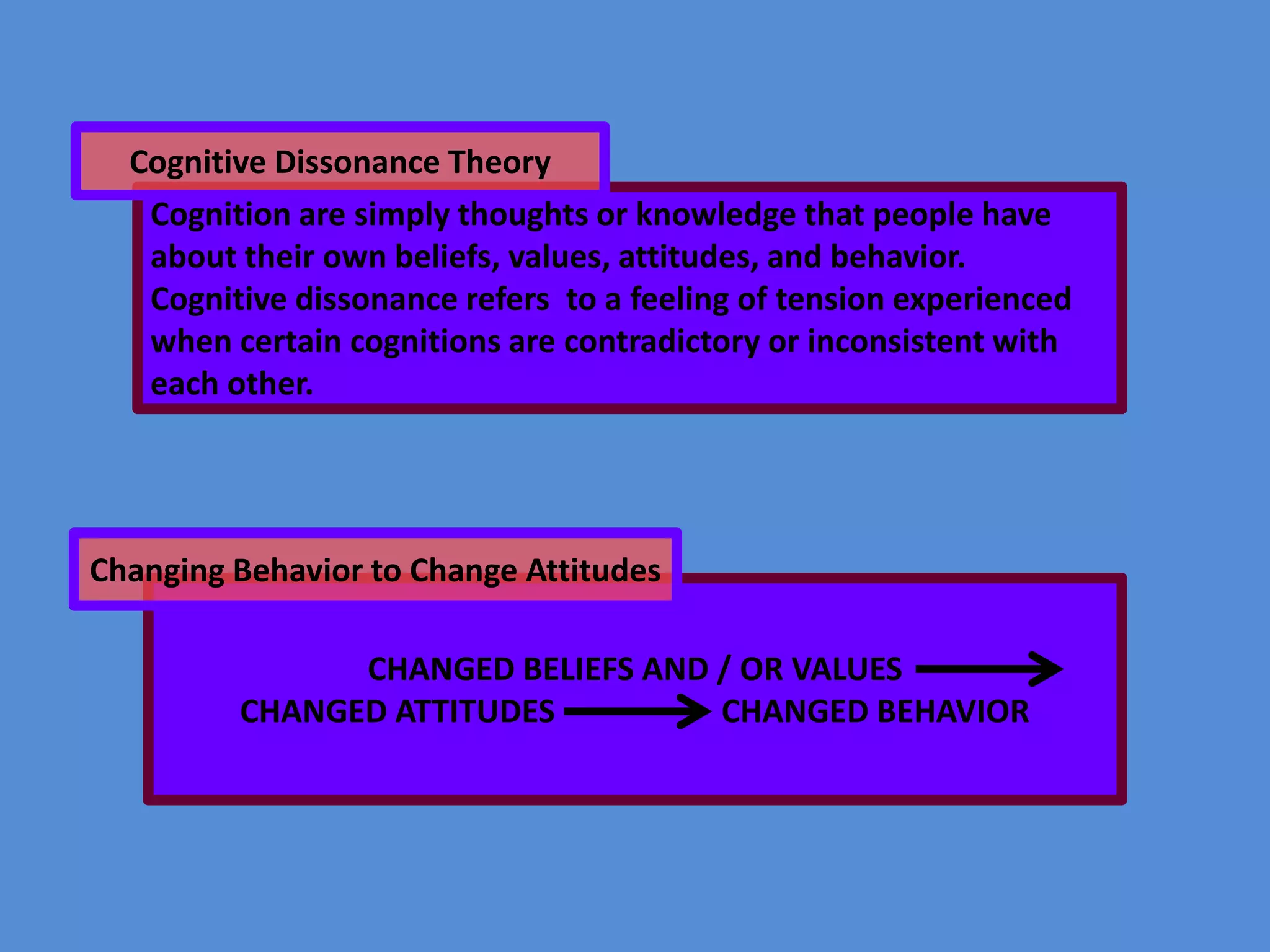
Cognitive Dissonance Theory
Cognition are simply thoughts or knowledge that people have
about their own beliefs, values, attitudes, and behavior.
Cognitive dissonance refers to a feeling of tension experienced
when certain cognitions are contradictory or inconsistent with
each other.

Changing Behavior to Change Attitudes
CHANGED BELIEFS AND / OR VALUES
CHANGED ATTITUDES
CHANGED BEHAVIOR
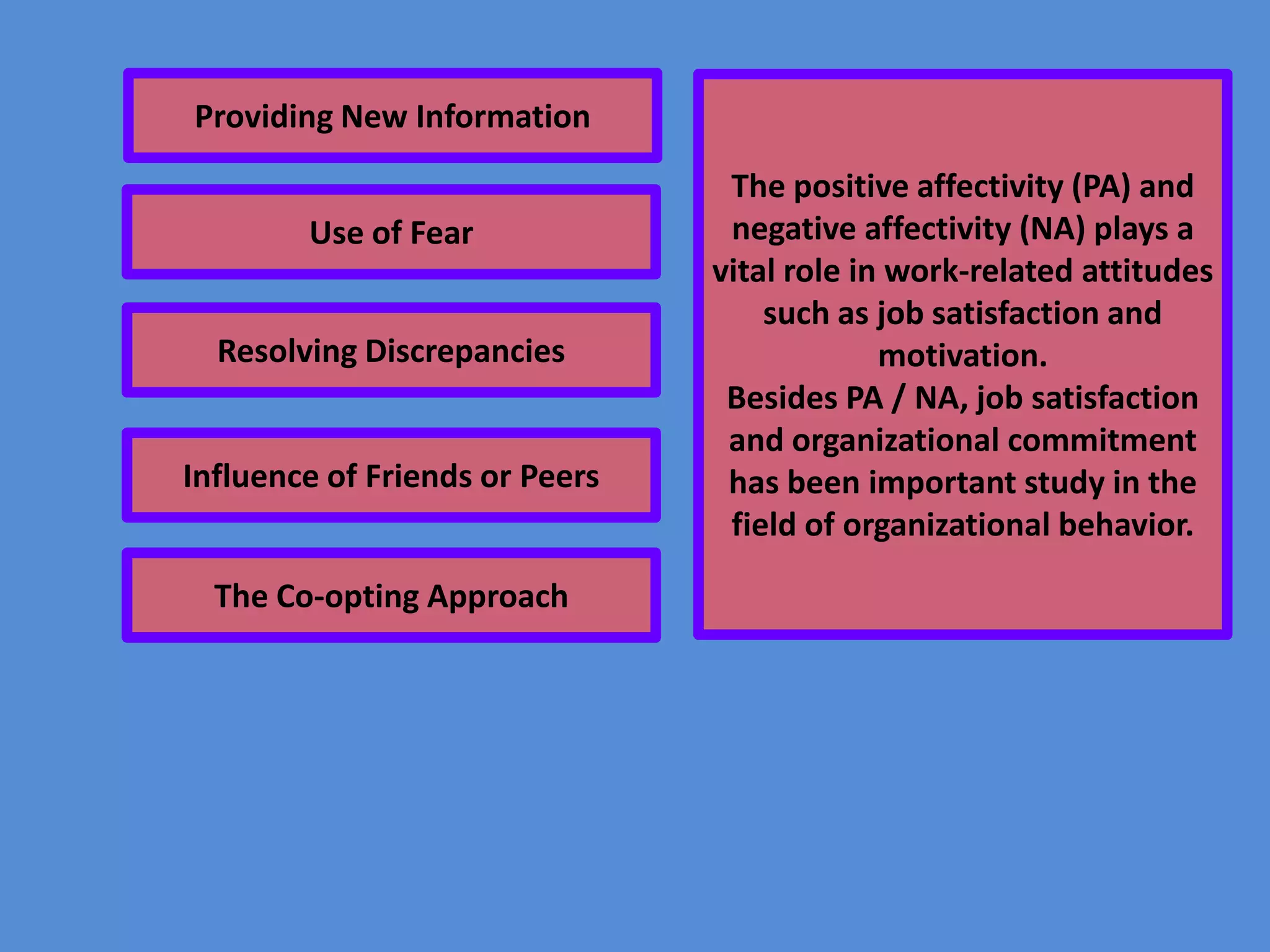
Providing New Information
Use of Fear
Resolving Discrepancies

Influence of Friends or Peers
The Co-opting Approach

The positive affectivity (PA) and
negative affectivity (NA) plays a
vital role in work-related attitudes
such as job satisfaction and
motivation.
Besides PA / NA, job satisfaction
and organizational commitment
has been important study in the
field of organizational behavior.
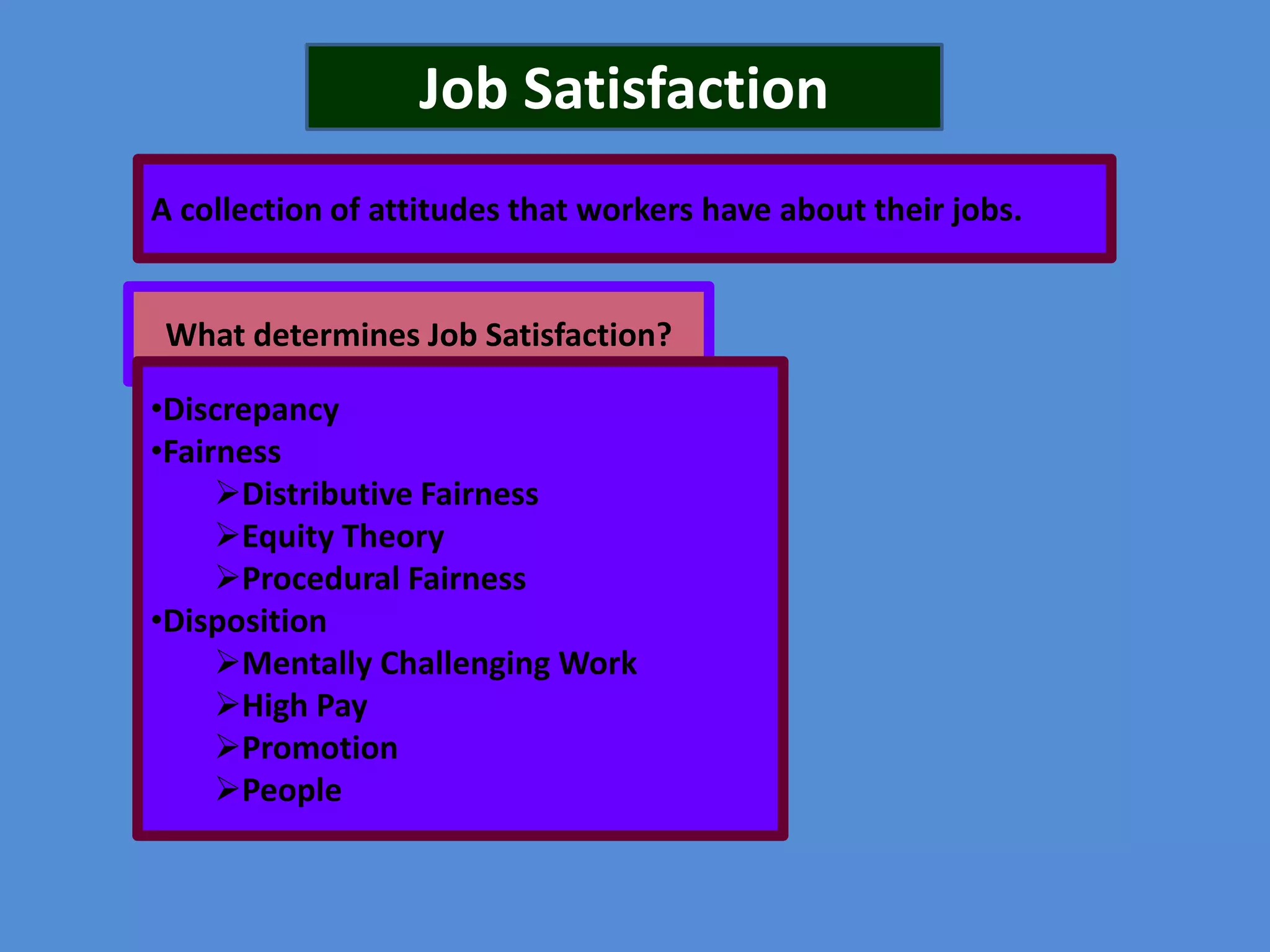
Job Satisfaction
A collection of attitudes that workers have about their jobs.

What determines Job Satisfaction?
•Discrepancy
•Fairness
Distributive Fairness
Equity Theory
Procedural Fairness
•Disposition
Mentally Challenging Work
High Pay
Promotion
People
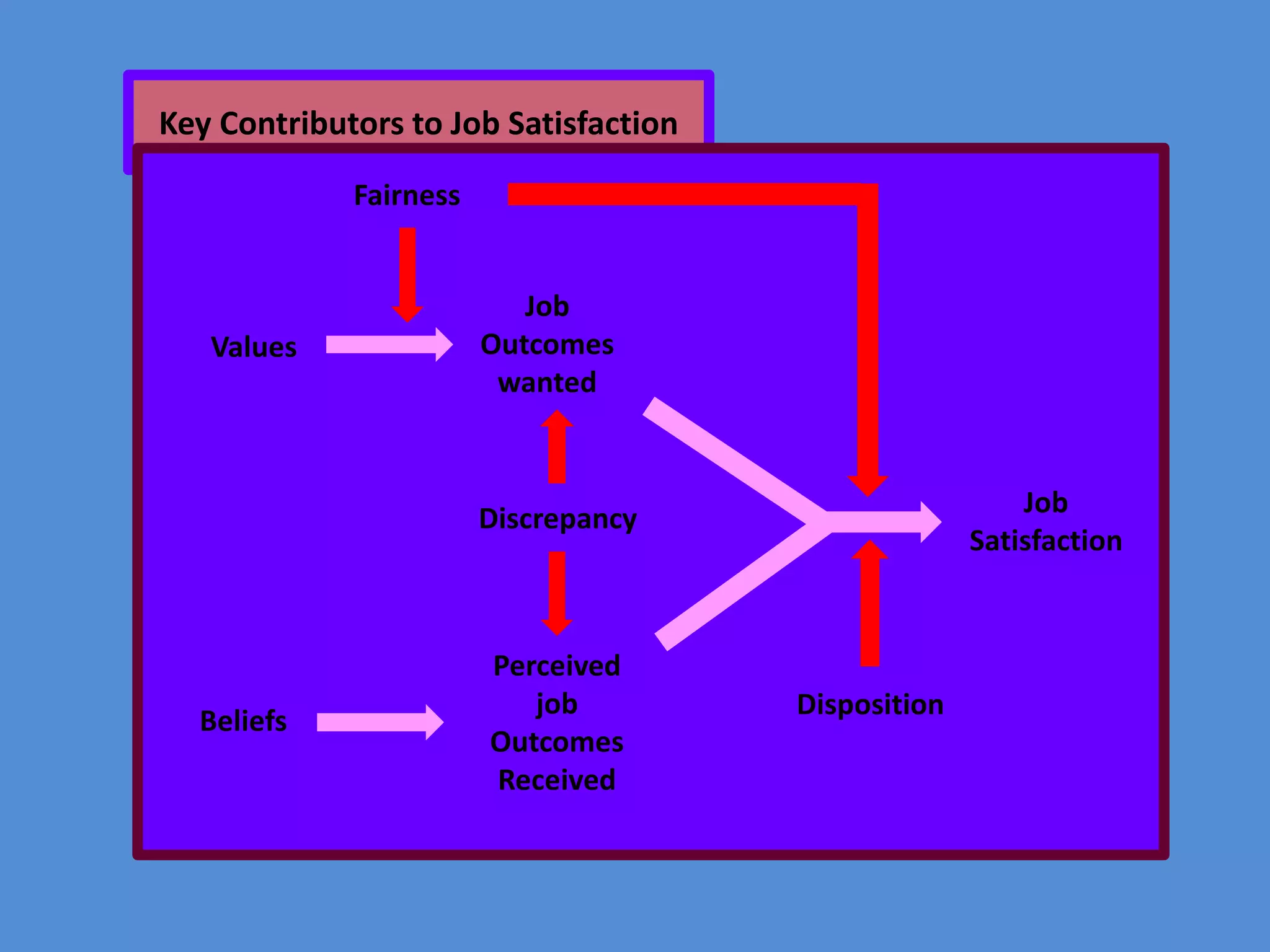
Key Contributors to Job Satisfaction
Fairness

Values

Job
Outcomes
wanted

Job
Satisfaction

Discrepancy

Beliefs

Perceived
job
Outcomes
Received

Disposition
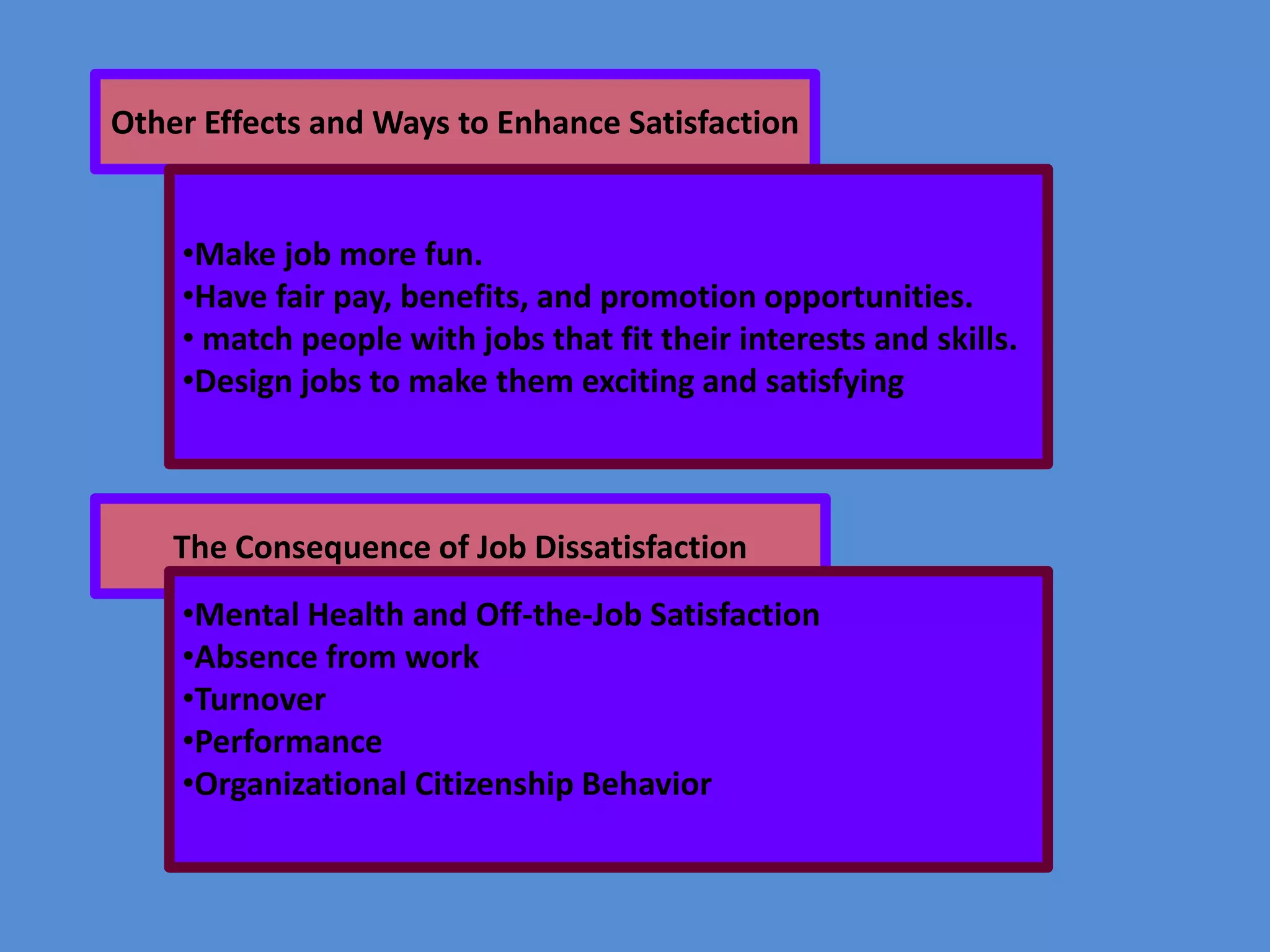
Other Effects and Ways to Enhance Satisfaction

•Make job more fun.
•Have fair pay, benefits, and promotion opportunities.
• match people with jobs that fit their interests and skills.
•Design jobs to make them exciting and satisfying

The Consequence of Job Dissatisfaction
•Mental Health and Off-the-Job Satisfaction
•Absence from work
•Turnover
•Performance
•Organizational Citizenship Behavior
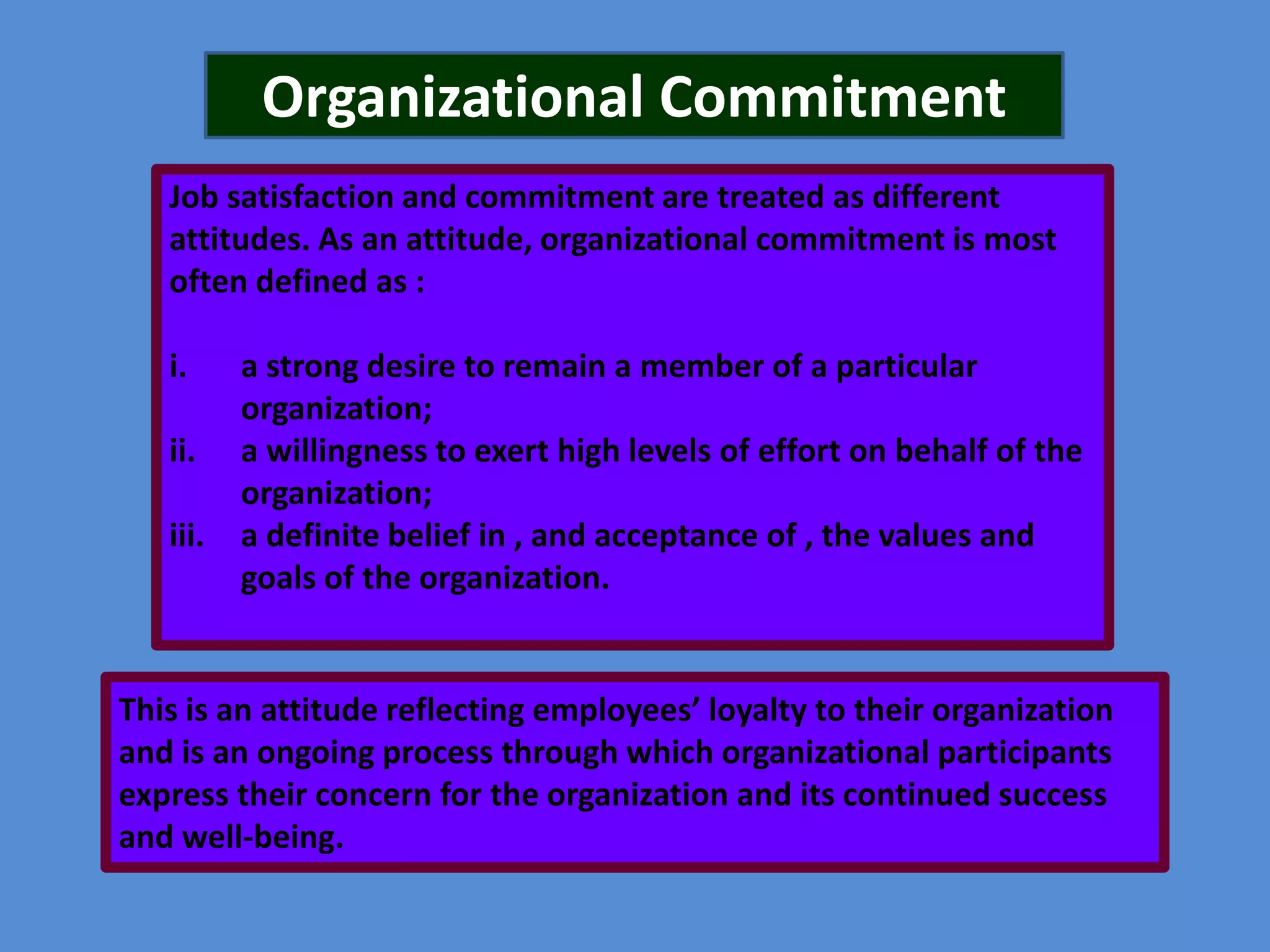
Organizational Commitment
Job satisfaction and commitment are treated as different
attitudes. As an attitude, organizational commitment is most
often defined as :
i.
ii.

iii.

a strong desire to remain a member of a particular
organization;
a willingness to exert high levels of effort on behalf of the
organization;
a definite belief in , and acceptance of , the values and
goals of the organization.

This is an attitude reflecting employees’ loyalty to their organization
and is an ongoing process through which organizational participants
express their concern for the organization and its continued success
and well-being.
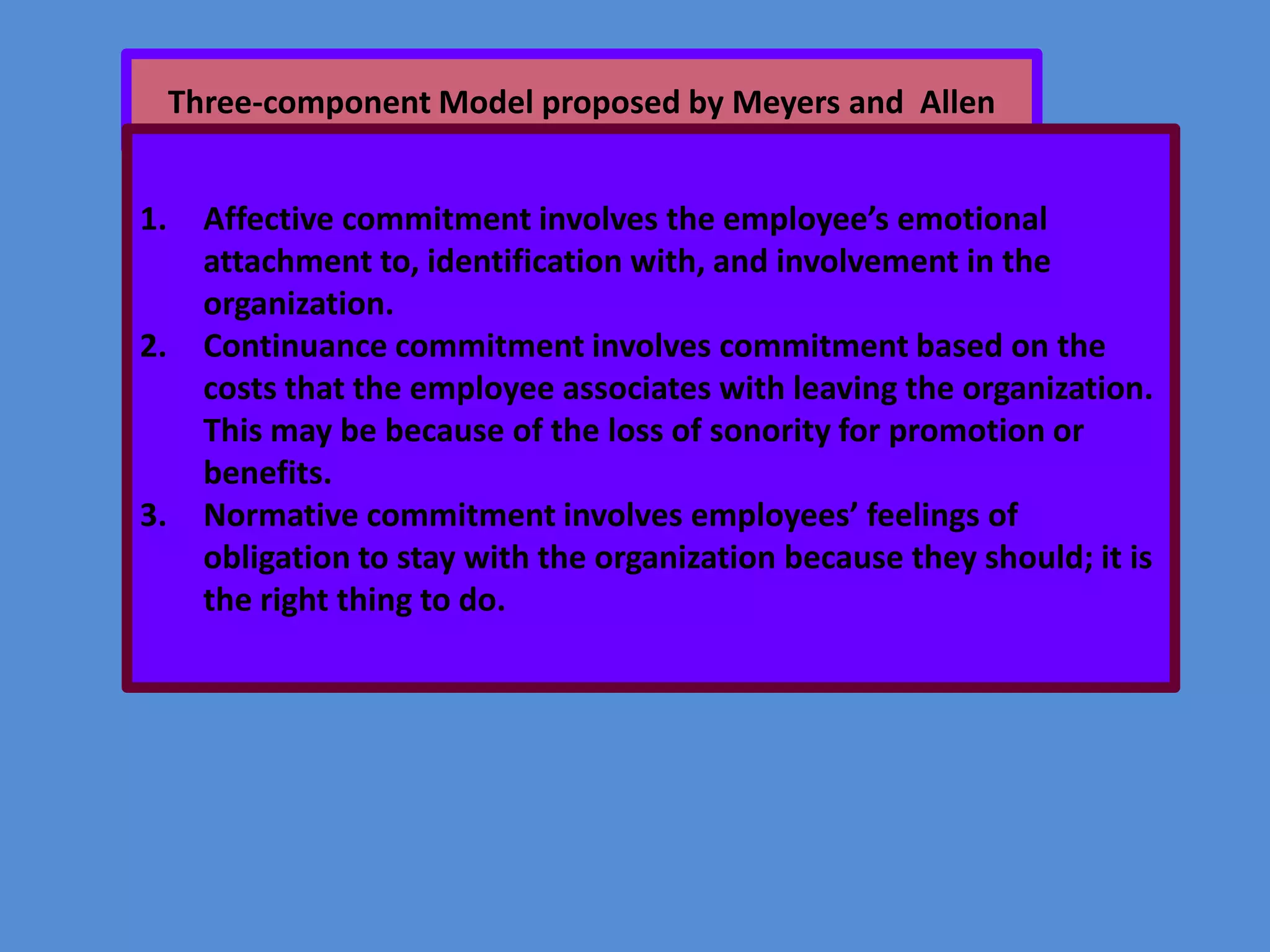
Three-component Model proposed by Meyers and Allen
1.

2.

3.

Affective commitment involves the employee’s emotional
attachment to, identification with, and involvement in the
organization.
Continuance commitment involves commitment based on the
costs that the employee associates with leaving the organization.
This may be because of the loss of sonority for promotion or
benefits.
Normative commitment involves employees’ feelings of
obligation to stay with the organization because they should; it is
the right thing to do.
The Outcomes of Organizational Commitment

1.

2.

There is a positive relationship between organizational
commitment and desirable outcomes such as high performance,
low turnover, and low absenteeism.
It also relates to other desirable outcomes, such as the
perception of a warm, supportive organizational climate and
being a good team member willing to help.

Some studies shows absence of a strong relationship between
performance and other shows moderate relationship.
Guidelines to Enhance Organizational Commitment
1.
2.
3.
4.
5.

Commit to people-first values
Clarify and communicate your mission
Guarantee organizational justice
Create a sense of community
Support employee development
Discussion Question
1.

2.

3.

4.
5.
6.

Critically analyze the statement that “the various psychological
processes can be thought of as pieces of a jigsaw and personality
as the completed puzzle picture.”
What are the “Big Five” personality traits? Which one seems to
have the biggest impact on performance? How would knowledge
of the Big Five help you in your job as a manager?
What are the four major dimensions of the Myers-Briggs Type
Indicator (MBTI) that yield the 16 types? How can the MBTI be
used effectively?
In your own words, what is an attitude? What are three
characteristics and three components of attitudes?
What are some of the conditions under which a person’s
attitudes might not predict his or her work behavior?
What types of barriers prevent people from changing their
attitudes? How can attitude be changed?
Discussion Question

7.

What is meant by the term job satisfaction ? What are some of
the major factors that influence job satisfaction?
8. What are some of the important outcomes of job satisfaction?
9. Many organizations use diversity training to promote favorable
attitudes among employees who differ in gender, age, race or
ethnicity. Given our discussion of attitude change, what factors
would improve the success if such efforts at persuasion? Could
behavior change foster attitude change?
10. Discuss the pros and cons of the argument, “Organizations should
do everything they can to enhance the job satisfaction of their
employees.
11. Explain why workers who are very satisfied with their jobs might
not be better performers than those who are less satisfied.
12. What is organizational commitment? What three components
have emerged to help better explain the complexities of
commitment? Why may an understanding of organizational
commitment be especially important in the years ahead?

Mahmood Qasim slides on Personality for Organizational Behavior students

  • 1.
  • 2.
    What is Personality? Therelatively stable set of psychological characteristics that influences the way an individual interacts with his or her environment.
  • 3.
    Role of Heredity& the Brain Nature and nurture both contribute to one’s personality. The genes affect the brain functions that in turn affect how people interacts with their environment and thus their personality.
  • 4.
    Self-Esteem The degree towhich a person has a positive self-evaluation. Self is a product of many interacting parts may be thought as the personality viewed from within. Thus self-esteem can be said to be an attempt to understand ones self.
  • 5.
    Person-situation Interaction People are notstatic, acting the same in all situations, but instead are ever changing and flexible.
  • 6.
    The Socialization Process Personalitydevelopment consists of continuous process and the sequence is based largely on the learning opportunities available and the socialization process. There is increasing recognition given to the role of other relevant persons, groups, and especially, organizations that greatly influence on individual's personality.
  • 7.
    Characteristics of Organizational Socialization 1. 2. 3. 4. 5. Changeof attitude. Continuity of socialization over time. Adjustment to new jobs, work groups, and organizational practices Mutual influence between new recruits and their managers Criticality of the early socialization period.
  • 8.
    Steps to successful organizationalsocialization 1. 2. 3. 4. Provide a challenging first job. Provide relevant training. Provide timely and consistent feedback. Select a good first supervisor to be in charge of socialization. 5. Design a relaxed orientation program. 6. Place new recruits in work group with high morale.
  • 9.
    Big Five PersonalityTraits Conscientiousness Dependable, Responsible, Hardworking, vs. Unreliable, Irresponsible, Careless, Emotional Stability Stable, Confident, Calm vs. Unstable, Depressed, Anxious Agreeableness Tolerant, Cooperative, Courteous vs. Fanatical, Stubborn, Rude Extraversion Sociable, Talkative, Outgoing vs. Shy, Reserved, Withdrawn, Open to Experience Curious, Original, Creative vs. Dull, Uninspired, Unimaginative
  • 10.
    Carl Jung’s Theory Peoplewere typed as Extravert Introvert Sensing Perception Intuiting Mental Process Thinking Judgment Feeling
  • 11.
    Myers – BriggsType Indicator (MBTI) Extraversion (E) Introversion (I) How do you evaluate and make decisions? Thinking (T) Feeling (F) Outgoing Quiet Analytical Subjective Interacting Concentrating Head Heart Speaks then thinks Thinks, then speaks Rules Circumstance Gregarious Reflective Justice Mercy Where do you get your energy? What do you pay attention on, to collect information? Sensing (S) Intuiting (N) How do you orient yourself to the outside world? Judging (J) Perceiving (P) Practical General Structured Flexible Details Possibilities Time oriented Open ended Concrete Theoretical Decisive Exploring Specific Abstract Organized Spontaneous
  • 12.
    The Nature andDimensions of Attitude A fairly stable emotional tendency to respond consistently to Attitudes some specific object, situation, person, or category of people.
  • 13.
    Personality is thoughtof Personality as the whole person. Attitudes can be thought of as making up the Attitudes personality.
  • 14.
    Components of Attitudes Emotional Ifyour friend is honest, Belief Informational Honesty is good, Behavioral Then your friend is good Values Attitude Behavior
  • 15.
    Belief Attitude Behavior Values SAIMS’ faculty isvery cooperative, Cooperative faculty is an advantage, I love to be a student of SAIMS, I am always proud to a SAIMIAN. Belief Values Attitude Behavior
  • 16.
    Functions of Attitudes TheAdjustment The Ego-Defensive The Value-Expressive The Knowledge Attitudes help people adjust to their work environment. Their attitude reflects the environment they are faced with. Employees defend their self-images. They develop positive perception about themselves whereas others may take them as wrong. Attitudes provide people with basis for expressing their values. Senior managers may force certain work ethics which they value. Attitudes provide people with knowledge that help them explain the world around them.
  • 17.
    Changing Attitudes We frequentlytry to change other people’s attitudes. We attempt to get others to develop favorable attitudes towards us. The organizations are also involved in the modification and management of attitudes. Some examples of cases in which management might desire attitude change are as follows: •Attitudes towards workforce diversity; •Attitudes towards ethical business practices; •Attitudes towards anticipated changes, such as the introduction of new technology or total quality management; •Attitudes towards safety practices and the use of safety equipment.
  • 18.
    Cognitive Dissonance Theory Cognitionare simply thoughts or knowledge that people have about their own beliefs, values, attitudes, and behavior. Cognitive dissonance refers to a feeling of tension experienced when certain cognitions are contradictory or inconsistent with each other. Changing Behavior to Change Attitudes CHANGED BELIEFS AND / OR VALUES CHANGED ATTITUDES CHANGED BEHAVIOR
  • 19.
    Providing New Information Useof Fear Resolving Discrepancies Influence of Friends or Peers The Co-opting Approach The positive affectivity (PA) and negative affectivity (NA) plays a vital role in work-related attitudes such as job satisfaction and motivation. Besides PA / NA, job satisfaction and organizational commitment has been important study in the field of organizational behavior.
  • 20.
    Job Satisfaction A collectionof attitudes that workers have about their jobs. What determines Job Satisfaction? •Discrepancy •Fairness Distributive Fairness Equity Theory Procedural Fairness •Disposition Mentally Challenging Work High Pay Promotion People
  • 21.
    Key Contributors toJob Satisfaction Fairness Values Job Outcomes wanted Job Satisfaction Discrepancy Beliefs Perceived job Outcomes Received Disposition
  • 22.
    Other Effects andWays to Enhance Satisfaction •Make job more fun. •Have fair pay, benefits, and promotion opportunities. • match people with jobs that fit their interests and skills. •Design jobs to make them exciting and satisfying The Consequence of Job Dissatisfaction •Mental Health and Off-the-Job Satisfaction •Absence from work •Turnover •Performance •Organizational Citizenship Behavior
  • 23.
    Organizational Commitment Job satisfactionand commitment are treated as different attitudes. As an attitude, organizational commitment is most often defined as : i. ii. iii. a strong desire to remain a member of a particular organization; a willingness to exert high levels of effort on behalf of the organization; a definite belief in , and acceptance of , the values and goals of the organization. This is an attitude reflecting employees’ loyalty to their organization and is an ongoing process through which organizational participants express their concern for the organization and its continued success and well-being.
  • 24.
    Three-component Model proposedby Meyers and Allen 1. 2. 3. Affective commitment involves the employee’s emotional attachment to, identification with, and involvement in the organization. Continuance commitment involves commitment based on the costs that the employee associates with leaving the organization. This may be because of the loss of sonority for promotion or benefits. Normative commitment involves employees’ feelings of obligation to stay with the organization because they should; it is the right thing to do.
  • 25.
    The Outcomes ofOrganizational Commitment 1. 2. There is a positive relationship between organizational commitment and desirable outcomes such as high performance, low turnover, and low absenteeism. It also relates to other desirable outcomes, such as the perception of a warm, supportive organizational climate and being a good team member willing to help. Some studies shows absence of a strong relationship between performance and other shows moderate relationship.
  • 26.
    Guidelines to EnhanceOrganizational Commitment 1. 2. 3. 4. 5. Commit to people-first values Clarify and communicate your mission Guarantee organizational justice Create a sense of community Support employee development
  • 27.
    Discussion Question 1. 2. 3. 4. 5. 6. Critically analyzethe statement that “the various psychological processes can be thought of as pieces of a jigsaw and personality as the completed puzzle picture.” What are the “Big Five” personality traits? Which one seems to have the biggest impact on performance? How would knowledge of the Big Five help you in your job as a manager? What are the four major dimensions of the Myers-Briggs Type Indicator (MBTI) that yield the 16 types? How can the MBTI be used effectively? In your own words, what is an attitude? What are three characteristics and three components of attitudes? What are some of the conditions under which a person’s attitudes might not predict his or her work behavior? What types of barriers prevent people from changing their attitudes? How can attitude be changed?
  • 28.
    Discussion Question 7. What ismeant by the term job satisfaction ? What are some of the major factors that influence job satisfaction? 8. What are some of the important outcomes of job satisfaction? 9. Many organizations use diversity training to promote favorable attitudes among employees who differ in gender, age, race or ethnicity. Given our discussion of attitude change, what factors would improve the success if such efforts at persuasion? Could behavior change foster attitude change? 10. Discuss the pros and cons of the argument, “Organizations should do everything they can to enhance the job satisfaction of their employees. 11. Explain why workers who are very satisfied with their jobs might not be better performers than those who are less satisfied. 12. What is organizational commitment? What three components have emerged to help better explain the complexities of commitment? Why may an understanding of organizational commitment be especially important in the years ahead?