Topic 7.
Quantitative research: Surveys
Lecturer: E. Tauris, 2011
Course Title: Marketing Research
Topic 7 notes were written using the
following sources:
• Boyce, J. (2007), Marketing Research, 2nd
ed., McGraw Hill, Australia.
• Fletcher, R., & Crawford, H. (2011), International Marketing: an Asia-Pacific
Perspective, 5th
ed., Pearson Australia., Chapter 6.
• Malhotra, N., Hall J., Shaw, M., & Oppelheim, P. (2007), Essentials of Marketing
Research: An Applied Orientation, 2nd
ed., Pearson Education, Australia;
• Olatundun, I.O. (2009). What is Cross-Cultural Research, International Journal
of Psychological Studies, Vol. 1 (2)., pp. 82-95
• Salciuviene, L., Auruskeviciene, V., & Lydeka, Z. (2005). As Assessment of Various
Approaches for Cross-Cultural Consumer Research. Problems & Perspectives in
Management, Vol. 3, pp. 147-159.
• Watkins, L (2010) The Cross-cultural appropriateness of survey-based value(s)
research, International Marketing Review, Vol. 27 (6).
Survey method
• Quantitative method
– Produces a large number of responses suitable for
statistical analysis
• Survey
– A structured questionnaire given to a sample of a
population to elicit specific information from
respondents.
• Structured data collection
– Formal questionnaire;
– Questions in a prearranged order.
• Precoded (fixed alternative) questions
– Respondents choose from a set of predetermined
answers.
Surveys
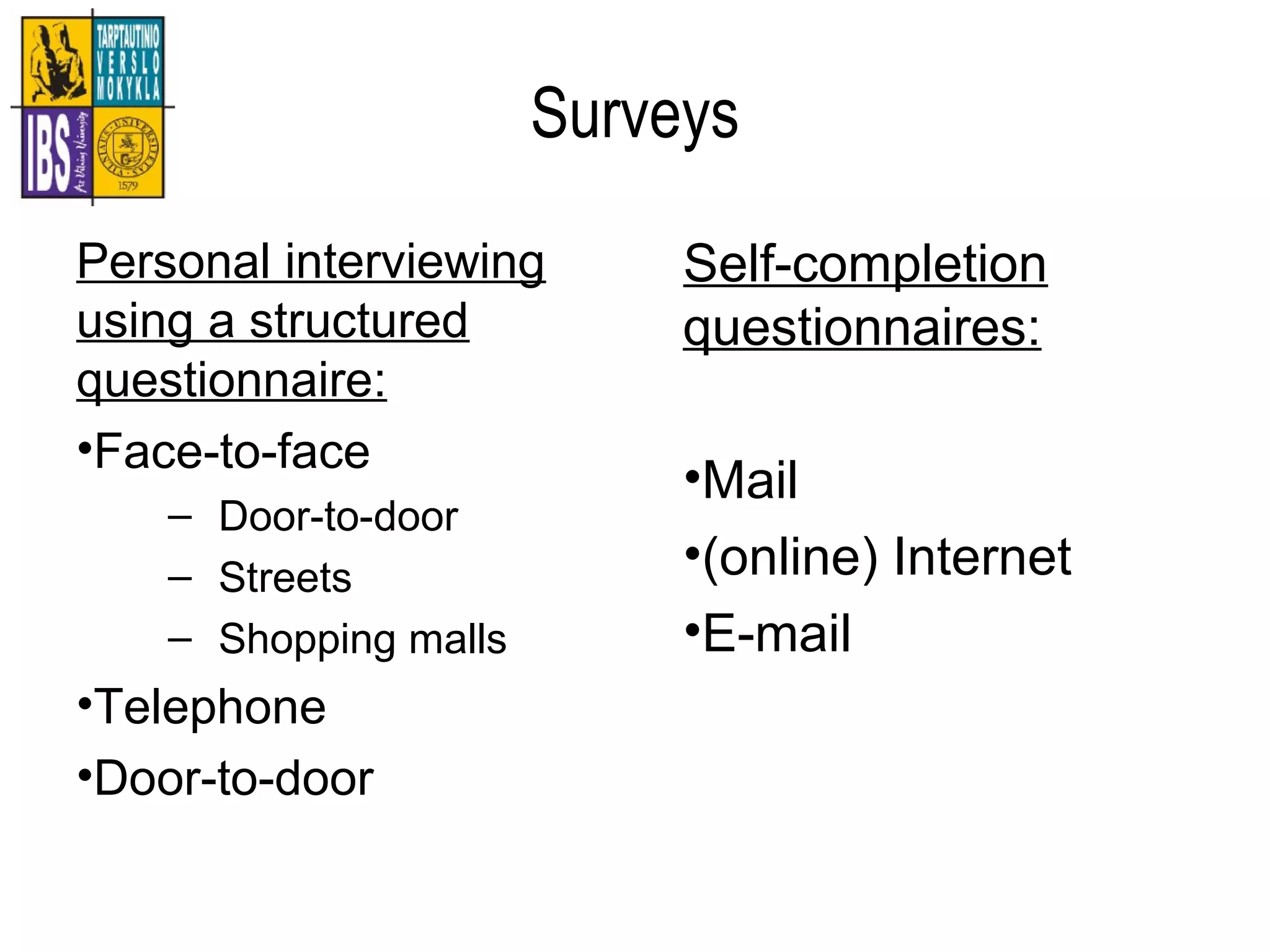
Personal interviewing
using a structured
questionnaire:
•Face-to-face
– Door-to-door
– Streets
– Shopping malls
•Telephone
•Door-to-door
Self-completion
questionnaires:
•Mail
•(online) Internet
•E-mail
Surveys
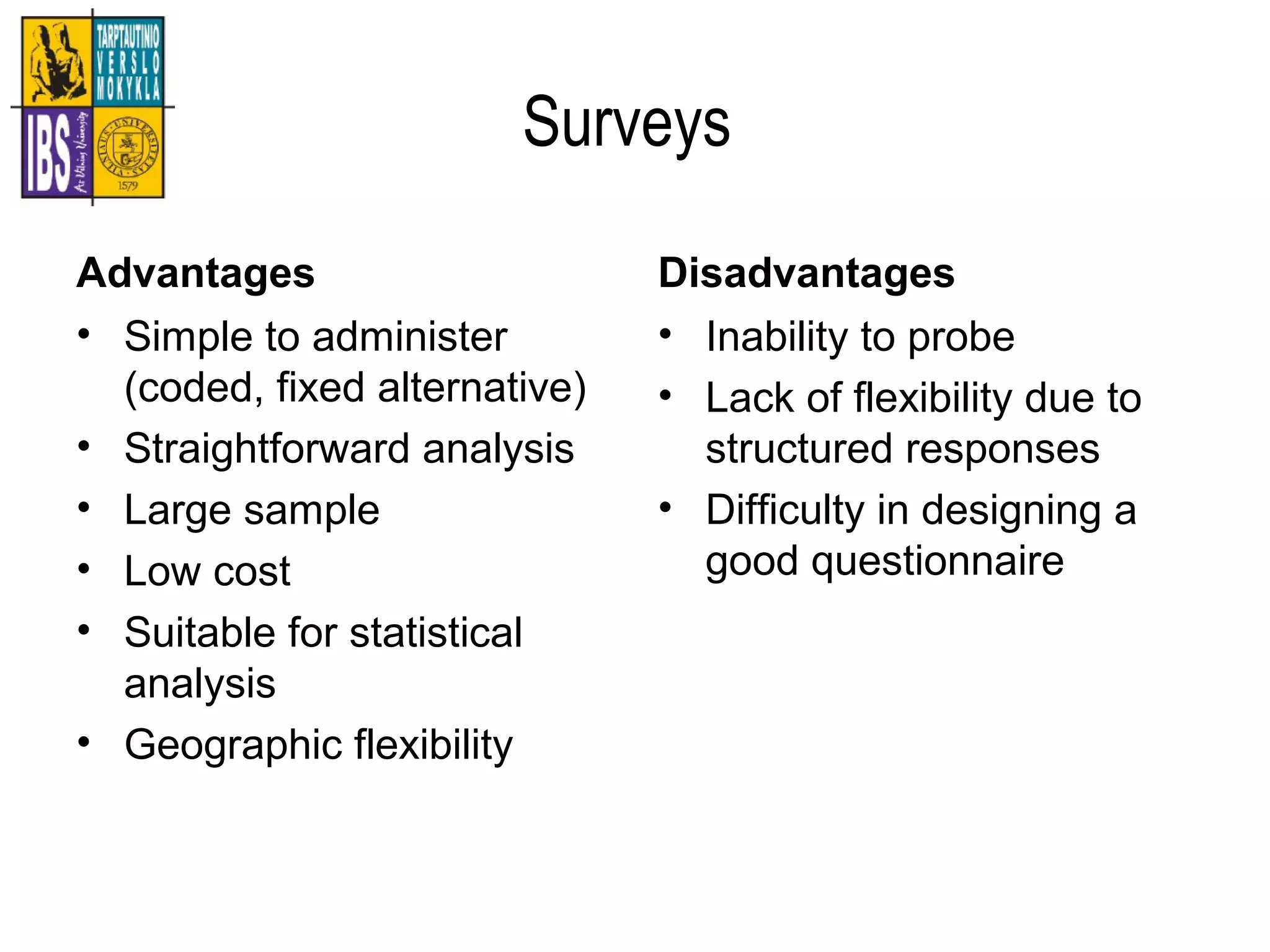
Advantages
• Simple to administer
(coded, fixed alternative)
• Straightforward analysis
• Large sample
• Low cost
• Suitable for statistical
analysis
• Geographic flexibility
Disadvantages
• Inability to probe
• Lack of flexibility due to
structured responses
• Difficulty in designing a
good questionnaire
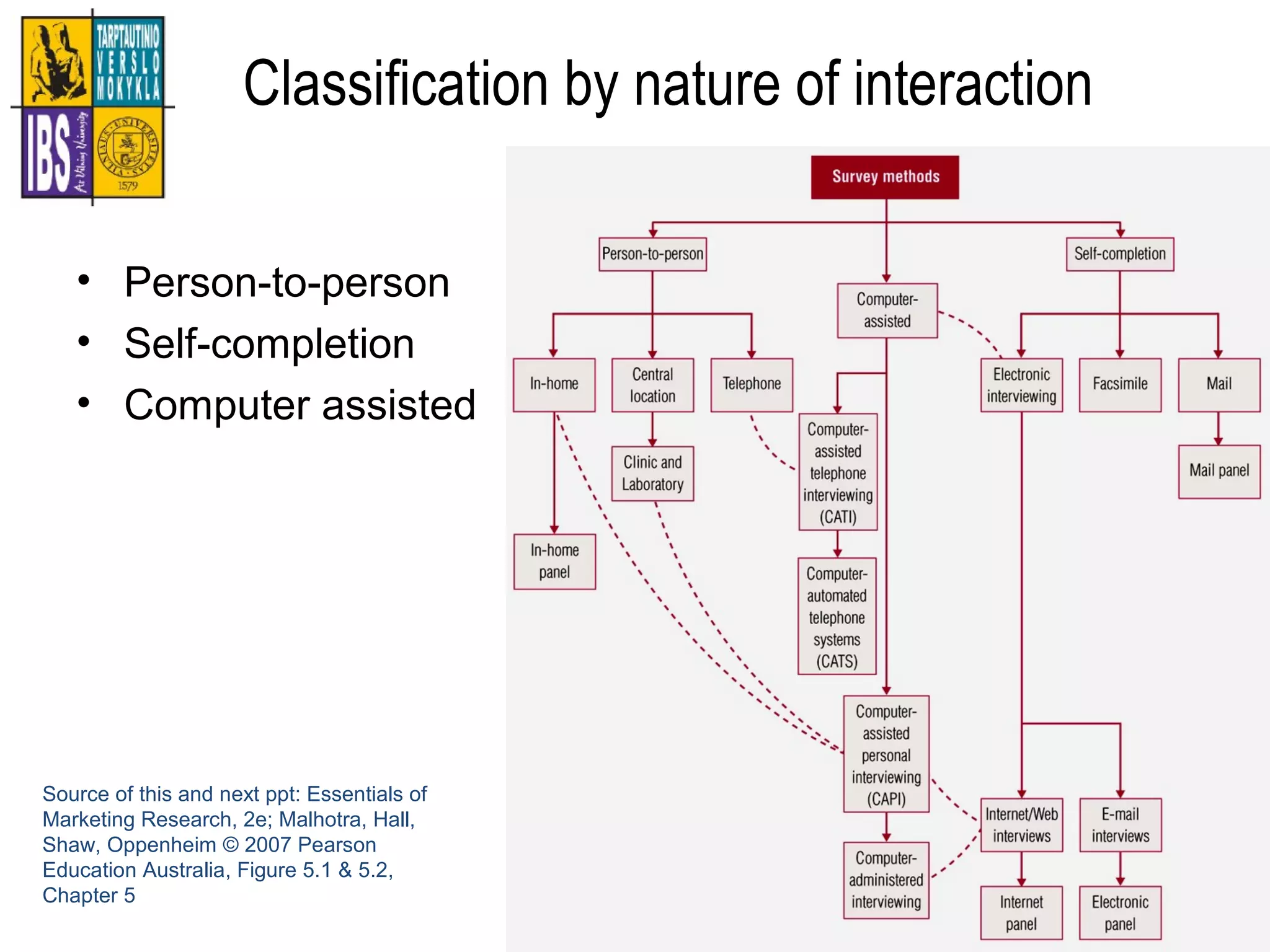
Classification by nature of interaction
• Person-to-person
• Self-completion
• Computer assisted
Source of this and next ppt: Essentials of
Marketing Research, 2e; Malhotra, Hall,
Shaw, Oppenheim © 2007 Pearson
Education Australia, Figure 5.1 & 5.2,
Chapter 5
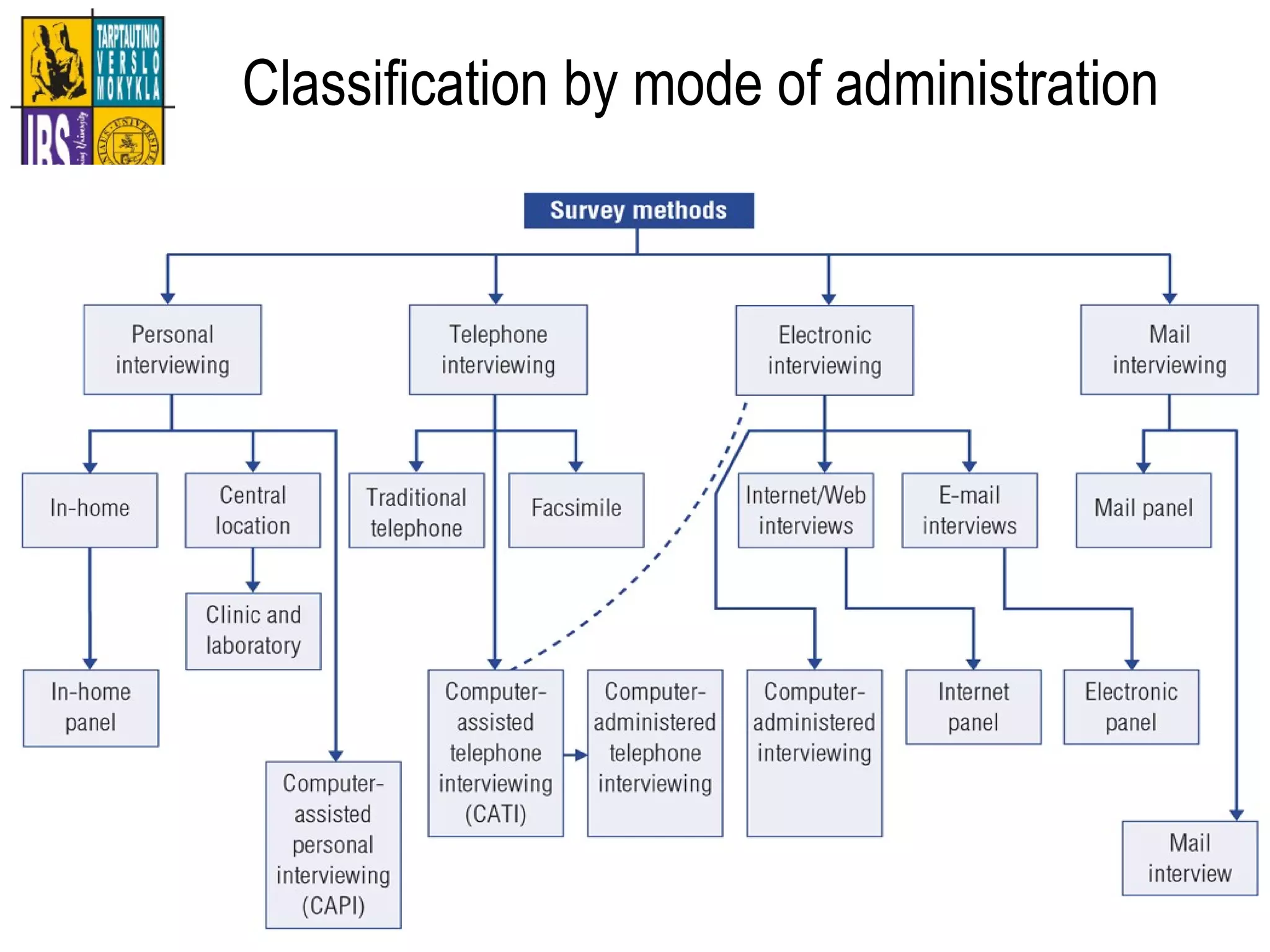
Classification by mode of administration
Personal interviewing: Face-to-face
Advantages
•Interviewer-respondent
rapport
•Reassuring the respondent
•Long interviews
•Visuals
•Overcoming language barriers
•Higher completion rate
required
Disadvantages
•The cost
•Interviewers must be
well trained
•Interviewer bias
•Not anonymous
Personal: location interception
Advantages
• Travel costs are
eliminated
• Interviewer can interact
with respondents
• Ability to show, taste or
handle a product
Disadvantages
• Non-representative
sample
• Uncomfortable
environment (shopping
centre, street, etc.)
Telephone interviewing (CATI)
• The fastest way to interview
• CATI – computer assisted telephone
interviewing (ACNielsen)
• Programming to minimise errors:
• Computer dials phone number
• Computer skips questions
• Can customise questions
• No editing required
• Interviewers can be easily supervised
Telephone Interviewing
Advantages:
•Quick
•Lower cost per interview
•People are used to
telephone calls from
strangers
•Response rate
•No security problems
Disadvantages:
•Silent numbers
•No visuals
•Harder to establish
rapport
•Falling achievement rates
•% of refusals are rising
•Voice-mails
•Mobile phones cause
sampling problems
•Mobile phones:
–Inconvenience (timing &
location)
CATS
• Computer automated telephone systems (CATS)
– Computer-synthesised voices are used to ask
questions over the phone
• Advantages
• Respondents select numbers on the telephone keypad to
answer questions
• Voice recognition is likely to be used in the future to record
and count responses
• Disadvantages
• Not appealing to respondents
• High refusal
Self-completion questionnaires
Advantages
•Usually low total cost of
survey
•Can cover people over a
wide area
•Respond at their own
time
Disadvantages
•Little control of time
frame and respondent
identity
•Low & slow response
•More response errors are
likely answers may be
influenced by the content
of all questionnaire
Response rate problems
Methods used to increase response rate
• Preliminary notification
• Personalisation
• Anonymity
• Response deadline
• Incentives
• Questionnaire size, reproduction, and colour
• Type of postage (return envelopes)
• Follow-ups
Response errors
• Omitted questions
• Misunderstood questions
• Misread instructions
• Incomplete answers
• Insufficient reply to open-ended questions
Issues of cross-cultural research
• Difficulty to communicate an opinion if the
respondent is unfamiliar with the concept
• Willingness to respond
– A male interviewer is not allowed to interview a
female respondent in Muslim countries
• Language and comprehension
– idioms, literacy, dialects, no exact translation,
interpreting answers, and so on. .
• Respondent bias
– Social bias: telling what it is believed the interviewer
wants to hear; Taboo topics.
Cross-cultural survey methodology
• Survey methodology is particularly open to bias
and errors due to cultural differences in the
construction of meaning
• Values research:
– The relationship of values to other constructs are not
easily addressed using survey methodology
– The use of scales is problematic
– The problem with almost exclusively Western cultural
background of theories and instruments used:
• Western cultural values measures are themselves culture
bound. The most important values may not be even
captured.
Cross-cultural response issues
• Different response styles:
– For example, Asian respondents demonstrate
significantly different response patterns to Australian
respondents:
– Asian response style: mild leading to less extreme
points ticked
• Difference in response style may account for up
to 6% variance of the data
• Likert-scales tend to be most problematic
Response bias
• Non-response bias
– Respondents are reluctant to answer (may perceive
the questions as culturally sensitive)
• Extreme response bias
– The answers tend to cluster around some point in the
scale; over-reaction to questions.
It becomes difficult to determine whether the
answers reflect tendencies to answer in a certain
way, or true national differences.
The Internet & Intranet
• The Internet - An extensive international
connection between computer systems that
allows for the transmission of digital data
between household and business computers.
• Intranet - private computer connections and
networks, available internally to company or
organisational members only.
• WWW - A system of using computer language to
allow easy communication between remote
computers in business or the home.
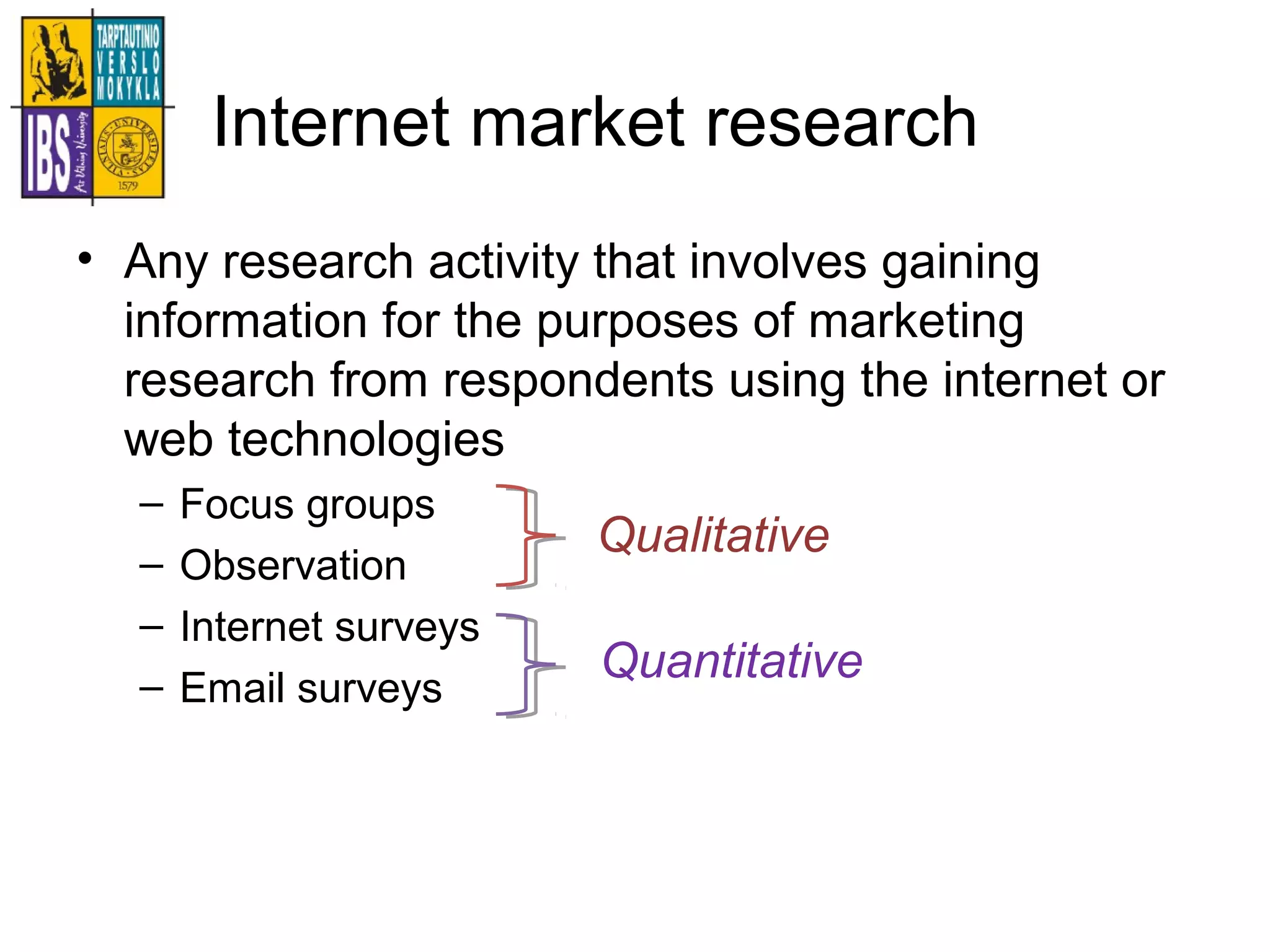
Internet market research
• Any research activity that involves gaining
information for the purposes of marketing
research from respondents using the internet or
web technologies
– Focus groups
– Observation
– Internet surveys
– Email surveys
Qualitative
Quantitative
The Internet future trends
• Improved access to wireless technology
• Improved geographical access
• Mobile Internet : sport, music, video, films and
pictures on mobile internet technology
Internet market research
• When a respondent – either on a single
occasion or as part of a panel:
– completes a questionnaire online
– downloads a questionnaire from a server on the
Internet and returns it by e-mail
– receives the questionnaire incorporated into an e-mail
and returns it
– participates in an online qualitative interview or
discussion
– takes part in a measurement system which tracks
web usage on the user's p.c
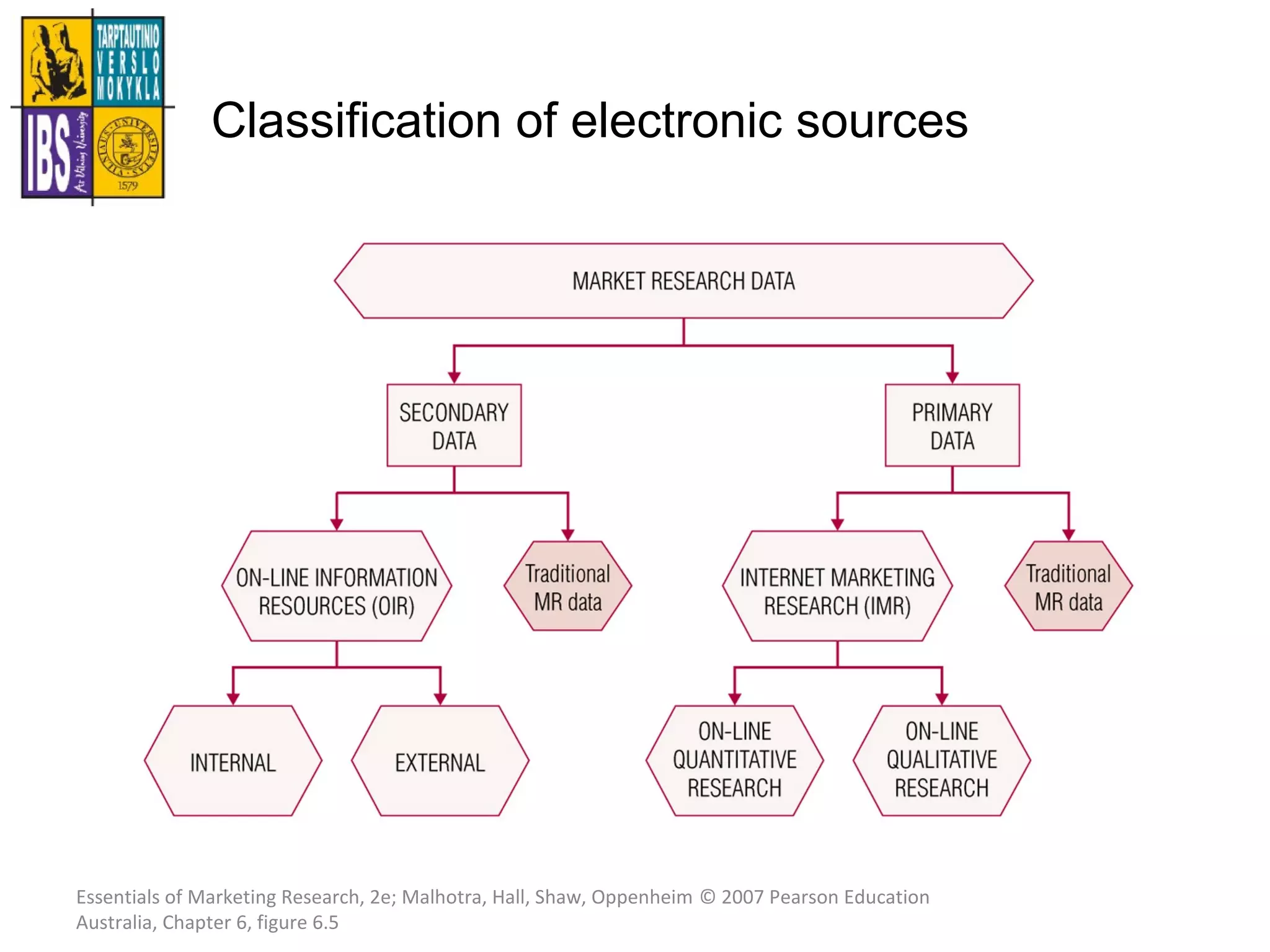
Essentials of Marketing Research, 2e; Malhotra, Hall, Shaw, Oppenheim © 2007 Pearson Education
Australia, Chapter 6, figure 6.5
Classification of electronic sources
OIR- Online information resources
• On-line Information Resources (OIR) are
sources used for secondary data collection that
re accessed using the Internet or the WWW (
scholar.google.com/)
• Key Issues: Accuracy, Reliability and Legality
– Internet data needs to be checked carefully
– Your queries about information:
• Is information right? (accurate, reliable and valid)
• Is it right to use the information? (morally and ethically)
• Do I have the right to use the information? (legally)
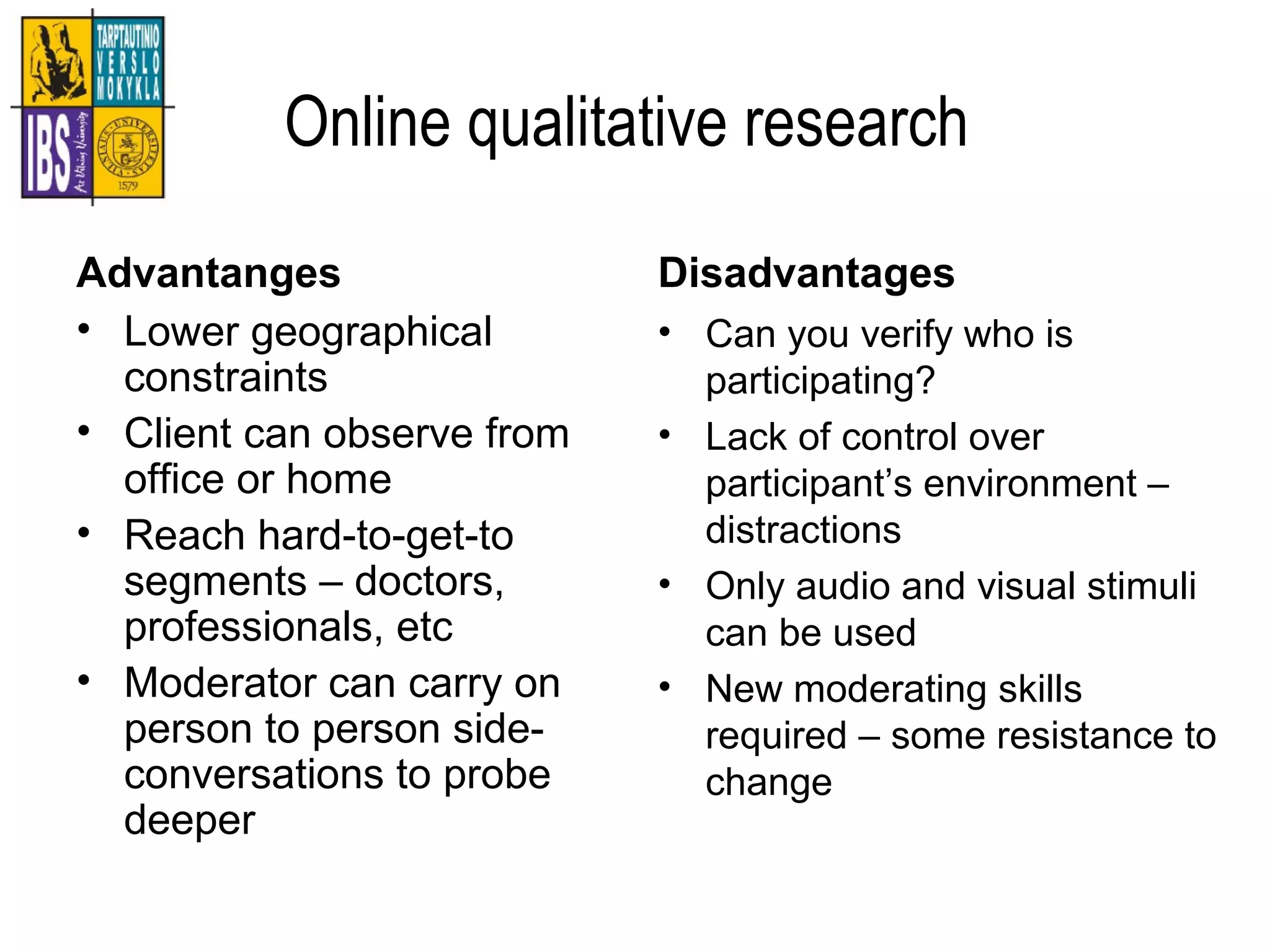
Online qualitative research
1.Moderated online Focus Groups:
• OLCD (online chat discussion) – text-based
exchange of comments and opinions
• OLVD (online video discussion) – video streaming
to provide visual contact between participants
2.Unmoderated online Focus Group
• Newsgroups
• Chat rooms
• Weblogs
• Consumer response sites
Online qualitative research
Advantanges
• Lower geographical
constraints
• Client can observe from
office or home
• Reach hard-to-get-to
segments – doctors,
professionals, etc
• Moderator can carry on
person to person side-
conversations to probe
deeper
Disadvantages
• Can you verify who is
participating?
• Lack of control over
participant’s environment –
distractions
• Only audio and visual stimuli
can be used
• New moderating skills
required – some resistance to
change
Types of Quantitative online research
1. Observation
– Trace measures : Cookies, Page hits, Log files
2. Intranet surveys
– Distributed by company internal networks to
employees and customers
3. Email surveys
– Uses system of personal addresses
Email surveys
• Uses system of personal addresses with the
questions sent to potential respondents
– Direct email survey: Survey questions are distributed
in the body of the message
– Download email attachment: download and print
questionnaire and return by email, fax or mail.
– Visitor lists : visitors to web-site
– Opt-in lists : customers asked to participate
– Purchased lists : from list suppliers
• Two-stage research approach can be used :
– Email contact
– Direction to website or attached form
Email surveys
Advantages
• Ease of transferring
information – both to
and from
• Cost savings
Disadvantages
• Cannot use skip
patterns
• Inappropriate
respondent replies
cannot be blocked
• More post-survey data
cleaning required
• Email system may be
limited
Internet surveys
• Accessed from a website and the responses
entered and added directly to the researcher’s
web site or service
• Respondents recruited online or by traditional
methods
• Passwords may be necessary to limit access to
once only
• Usually conducted by using an Internet panel
Internet survey panels
• Opt-in panels
– Participants have agreed to provide data on a regular basis (f.e.
Loyalty program)
• Pre-recruited panels
– Challenge is to recruit panel that reflects the population
– Researcher tends to set quotas
• Screened panels:
– Variation of pre-recruited panel. Participants selected on specific
relevant criteria
• Web invited participation
– Pop-up or banner invitation
– 1inN Website visitor selection
Disadvantages of Internet surveys
• Self-selection to participate
• Unrepresentative user population
• Multiresponders
• Lack of interpersonal contact
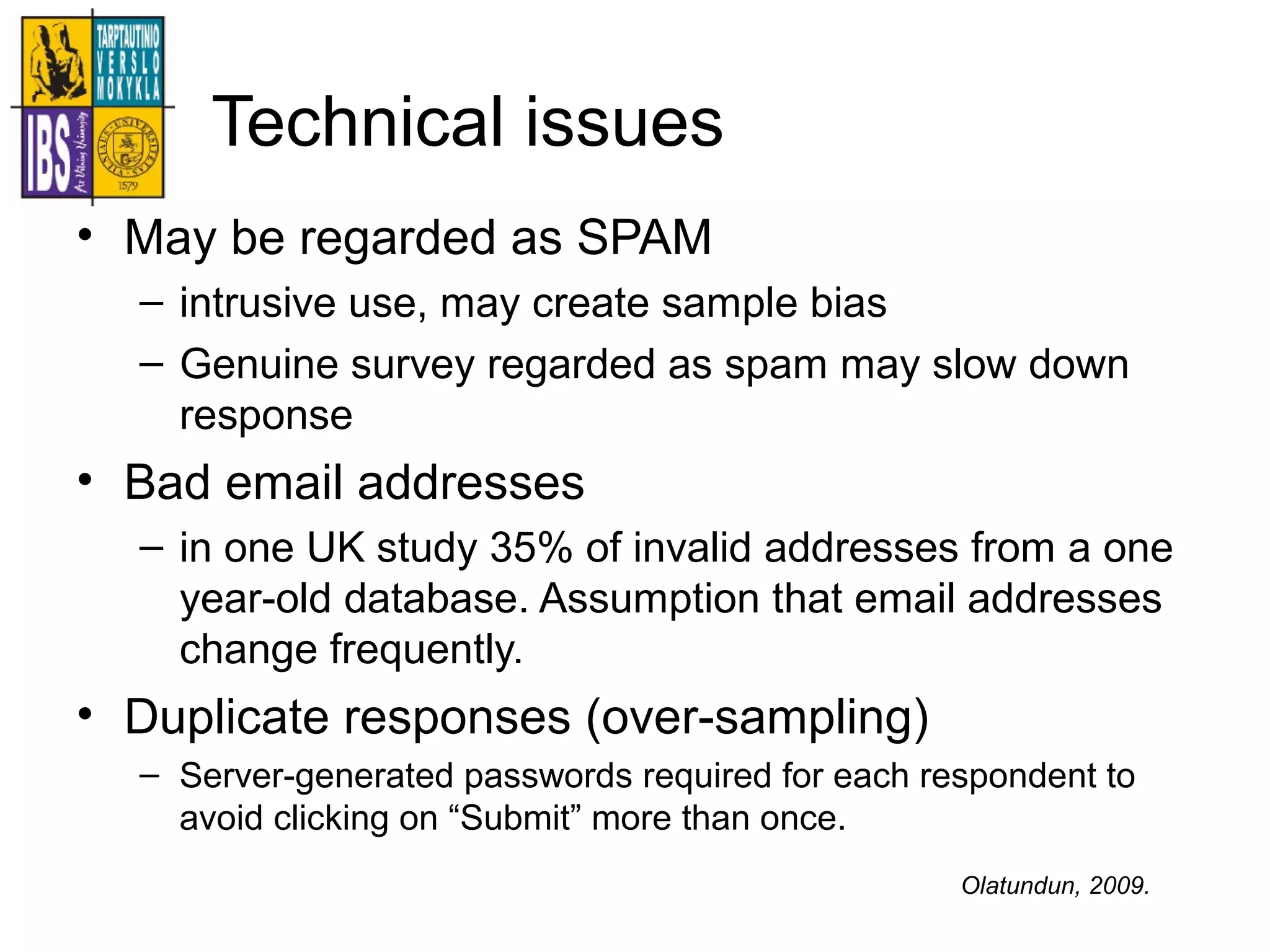
Technical issues
• May be regarded as SPAM
– intrusive use, may create sample bias
– Genuine survey regarded as spam may slow down
response
• Bad email addresses
– in one UK study 35% of invalid addresses from a one
year-old database. Assumption that email addresses
change frequently.
• Duplicate responses (over-sampling)
– Server-generated passwords required for each respondent to
avoid clicking on “Submit” more than once.
Olatundun, 2009.

Quantitativ research survey

  • 1.
    Topic 7. Quantitative research:Surveys Lecturer: E. Tauris, 2011 Course Title: Marketing Research
  • 2.
    Topic 7 noteswere written using the following sources: • Boyce, J. (2007), Marketing Research, 2nd ed., McGraw Hill, Australia. • Fletcher, R., & Crawford, H. (2011), International Marketing: an Asia-Pacific Perspective, 5th ed., Pearson Australia., Chapter 6. • Malhotra, N., Hall J., Shaw, M., & Oppelheim, P. (2007), Essentials of Marketing Research: An Applied Orientation, 2nd ed., Pearson Education, Australia; • Olatundun, I.O. (2009). What is Cross-Cultural Research, International Journal of Psychological Studies, Vol. 1 (2)., pp. 82-95 • Salciuviene, L., Auruskeviciene, V., & Lydeka, Z. (2005). As Assessment of Various Approaches for Cross-Cultural Consumer Research. Problems & Perspectives in Management, Vol. 3, pp. 147-159. • Watkins, L (2010) The Cross-cultural appropriateness of survey-based value(s) research, International Marketing Review, Vol. 27 (6).
  • 3.
    Survey method • Quantitativemethod – Produces a large number of responses suitable for statistical analysis • Survey – A structured questionnaire given to a sample of a population to elicit specific information from respondents. • Structured data collection – Formal questionnaire; – Questions in a prearranged order. • Precoded (fixed alternative) questions – Respondents choose from a set of predetermined answers.
  • 4.
    Surveys Personal interviewing using astructured questionnaire: •Face-to-face – Door-to-door – Streets – Shopping malls •Telephone •Door-to-door Self-completion questionnaires: •Mail •(online) Internet •E-mail
  • 5.
    Surveys Advantages • Simple toadminister (coded, fixed alternative) • Straightforward analysis • Large sample • Low cost • Suitable for statistical analysis • Geographic flexibility Disadvantages • Inability to probe • Lack of flexibility due to structured responses • Difficulty in designing a good questionnaire
  • 6.
    Classification by natureof interaction • Person-to-person • Self-completion • Computer assisted Source of this and next ppt: Essentials of Marketing Research, 2e; Malhotra, Hall, Shaw, Oppenheim © 2007 Pearson Education Australia, Figure 5.1 & 5.2, Chapter 5
  • 7.
    Classification by modeof administration
  • 8.
    Personal interviewing: Face-to-face Advantages •Interviewer-respondent rapport •Reassuringthe respondent •Long interviews •Visuals •Overcoming language barriers •Higher completion rate required Disadvantages •The cost •Interviewers must be well trained •Interviewer bias •Not anonymous
  • 9.
    Personal: location interception Advantages •Travel costs are eliminated • Interviewer can interact with respondents • Ability to show, taste or handle a product Disadvantages • Non-representative sample • Uncomfortable environment (shopping centre, street, etc.)
  • 10.
    Telephone interviewing (CATI) •The fastest way to interview • CATI – computer assisted telephone interviewing (ACNielsen) • Programming to minimise errors: • Computer dials phone number • Computer skips questions • Can customise questions • No editing required • Interviewers can be easily supervised
  • 11.
    Telephone Interviewing Advantages: •Quick •Lower costper interview •People are used to telephone calls from strangers •Response rate •No security problems Disadvantages: •Silent numbers •No visuals •Harder to establish rapport •Falling achievement rates •% of refusals are rising •Voice-mails •Mobile phones cause sampling problems •Mobile phones: –Inconvenience (timing & location)
  • 12.
    CATS • Computer automatedtelephone systems (CATS) – Computer-synthesised voices are used to ask questions over the phone • Advantages • Respondents select numbers on the telephone keypad to answer questions • Voice recognition is likely to be used in the future to record and count responses • Disadvantages • Not appealing to respondents • High refusal
  • 13.
    Self-completion questionnaires Advantages •Usually lowtotal cost of survey •Can cover people over a wide area •Respond at their own time Disadvantages •Little control of time frame and respondent identity •Low & slow response •More response errors are likely answers may be influenced by the content of all questionnaire
  • 14.
    Response rate problems Methodsused to increase response rate • Preliminary notification • Personalisation • Anonymity • Response deadline • Incentives • Questionnaire size, reproduction, and colour • Type of postage (return envelopes) • Follow-ups
  • 15.
    Response errors • Omittedquestions • Misunderstood questions • Misread instructions • Incomplete answers • Insufficient reply to open-ended questions
  • 16.
    Issues of cross-culturalresearch • Difficulty to communicate an opinion if the respondent is unfamiliar with the concept • Willingness to respond – A male interviewer is not allowed to interview a female respondent in Muslim countries • Language and comprehension – idioms, literacy, dialects, no exact translation, interpreting answers, and so on. . • Respondent bias – Social bias: telling what it is believed the interviewer wants to hear; Taboo topics.
  • 17.
    Cross-cultural survey methodology •Survey methodology is particularly open to bias and errors due to cultural differences in the construction of meaning • Values research: – The relationship of values to other constructs are not easily addressed using survey methodology – The use of scales is problematic – The problem with almost exclusively Western cultural background of theories and instruments used: • Western cultural values measures are themselves culture bound. The most important values may not be even captured.
  • 18.
    Cross-cultural response issues •Different response styles: – For example, Asian respondents demonstrate significantly different response patterns to Australian respondents: – Asian response style: mild leading to less extreme points ticked • Difference in response style may account for up to 6% variance of the data • Likert-scales tend to be most problematic
  • 19.
    Response bias • Non-responsebias – Respondents are reluctant to answer (may perceive the questions as culturally sensitive) • Extreme response bias – The answers tend to cluster around some point in the scale; over-reaction to questions. It becomes difficult to determine whether the answers reflect tendencies to answer in a certain way, or true national differences.
  • 20.
    The Internet &Intranet • The Internet - An extensive international connection between computer systems that allows for the transmission of digital data between household and business computers. • Intranet - private computer connections and networks, available internally to company or organisational members only. • WWW - A system of using computer language to allow easy communication between remote computers in business or the home.
  • 21.
    Internet market research •Any research activity that involves gaining information for the purposes of marketing research from respondents using the internet or web technologies – Focus groups – Observation – Internet surveys – Email surveys Qualitative Quantitative
  • 22.
    The Internet futuretrends • Improved access to wireless technology • Improved geographical access • Mobile Internet : sport, music, video, films and pictures on mobile internet technology
  • 23.
    Internet market research •When a respondent – either on a single occasion or as part of a panel: – completes a questionnaire online – downloads a questionnaire from a server on the Internet and returns it by e-mail – receives the questionnaire incorporated into an e-mail and returns it – participates in an online qualitative interview or discussion – takes part in a measurement system which tracks web usage on the user's p.c
  • 24.
    Essentials of MarketingResearch, 2e; Malhotra, Hall, Shaw, Oppenheim © 2007 Pearson Education Australia, Chapter 6, figure 6.5 Classification of electronic sources
  • 25.
    OIR- Online informationresources • On-line Information Resources (OIR) are sources used for secondary data collection that re accessed using the Internet or the WWW ( scholar.google.com/) • Key Issues: Accuracy, Reliability and Legality – Internet data needs to be checked carefully – Your queries about information: • Is information right? (accurate, reliable and valid) • Is it right to use the information? (morally and ethically) • Do I have the right to use the information? (legally)
  • 26.
    Online qualitative research 1.Moderatedonline Focus Groups: • OLCD (online chat discussion) – text-based exchange of comments and opinions • OLVD (online video discussion) – video streaming to provide visual contact between participants 2.Unmoderated online Focus Group • Newsgroups • Chat rooms • Weblogs • Consumer response sites
  • 27.
    Online qualitative research Advantanges •Lower geographical constraints • Client can observe from office or home • Reach hard-to-get-to segments – doctors, professionals, etc • Moderator can carry on person to person side- conversations to probe deeper Disadvantages • Can you verify who is participating? • Lack of control over participant’s environment – distractions • Only audio and visual stimuli can be used • New moderating skills required – some resistance to change
  • 28.
    Types of Quantitativeonline research 1. Observation – Trace measures : Cookies, Page hits, Log files 2. Intranet surveys – Distributed by company internal networks to employees and customers 3. Email surveys – Uses system of personal addresses
  • 29.
    Email surveys • Usessystem of personal addresses with the questions sent to potential respondents – Direct email survey: Survey questions are distributed in the body of the message – Download email attachment: download and print questionnaire and return by email, fax or mail. – Visitor lists : visitors to web-site – Opt-in lists : customers asked to participate – Purchased lists : from list suppliers • Two-stage research approach can be used : – Email contact – Direction to website or attached form
  • 30.
    Email surveys Advantages • Easeof transferring information – both to and from • Cost savings Disadvantages • Cannot use skip patterns • Inappropriate respondent replies cannot be blocked • More post-survey data cleaning required • Email system may be limited
  • 31.
    Internet surveys • Accessedfrom a website and the responses entered and added directly to the researcher’s web site or service • Respondents recruited online or by traditional methods • Passwords may be necessary to limit access to once only • Usually conducted by using an Internet panel
  • 32.
    Internet survey panels •Opt-in panels – Participants have agreed to provide data on a regular basis (f.e. Loyalty program) • Pre-recruited panels – Challenge is to recruit panel that reflects the population – Researcher tends to set quotas • Screened panels: – Variation of pre-recruited panel. Participants selected on specific relevant criteria • Web invited participation – Pop-up or banner invitation – 1inN Website visitor selection
  • 33.
    Disadvantages of Internetsurveys • Self-selection to participate • Unrepresentative user population • Multiresponders • Lack of interpersonal contact
  • 34.
    Technical issues • Maybe regarded as SPAM – intrusive use, may create sample bias – Genuine survey regarded as spam may slow down response • Bad email addresses – in one UK study 35% of invalid addresses from a one year-old database. Assumption that email addresses change frequently. • Duplicate responses (over-sampling) – Server-generated passwords required for each respondent to avoid clicking on “Submit” more than once. Olatundun, 2009.