Chapter 7 Pricing Strategies
You don’t sell through price. You sell the
price.
The Learning Objectives
 Setting Pricing Policy
 Price-adjustment Strategies
 Price changes
1.Pricing objectives
 Survival
 Maximum current profit
 Maximum market share
 Maximum market skimming
 Product-quality leadership
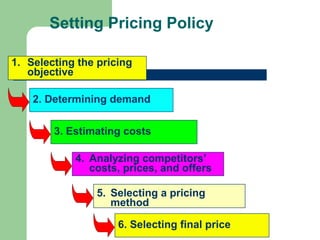
Setting Pricing Policy
1. Selecting the pricing
objective
2. Determining demand
3. Estimating costs
4. Analyzing competitors’
costs, prices, and offers
5. Selecting a pricing
method
6. Selecting final price
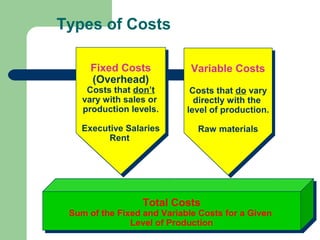
Types of Costs
Total Costs
Sum of the Fixed and Variable Costs for a Given
Level of Production
Total Costs
Sum of the Fixed and Variable Costs for a Given
Level of Production
Fixed Costs
(Overhead)
Costs that don’t
vary with sales or
production levels.
Executive Salaries
Rent
Fixed Costs
(Overhead)
Costs that don’t
vary with sales or
production levels.
Executive Salaries
Rent
Variable Costs
Costs that do vary
directly with the
level of production.
Raw materials
Variable Costs
Costs that do vary
directly with the
level of production.
Raw materials
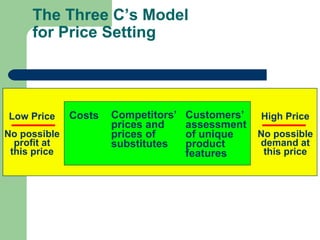
The Three C’s Model
for Price Setting
Costs Competitors’
prices and
prices of
substitutes
Customers’
assessment
of unique
product
features
Low Price
No possible
profit at
this price
High Price
No possible
demand at
this price
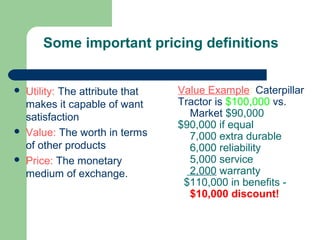
Some important pricing definitions
 Utility: The attribute that
makes it capable of want
satisfaction
 Value: The worth in terms
of other products
 Price: The monetary
medium of exchange.
Value Example: Caterpillar
Tractor is $100,000 vs.
Market $90,000
$90,000 if equal
7,000 extra durable
6,000 reliability
5,000 service
2,000 warranty
$110,000 in benefits -
$10,000 discount!
Examples: new-product pricing
 Market-skimming pricing
 Market-penetration pricing
Market-skimming pricing
 Setting a high price for a new product to skim
maximum revenues layer by layer from the
segments willing to pay the high price: the
company makes fewer but more profitable
sales.
The conditions:
1. A sufficient number of buyers have a high current
demand;
2. The unit costs of producing a small volume are not so
high that they cancel the advantage of charging what
the traffic will bear;
3. The high initial price does not attract more
competitors to market;
4. The high price communicates the image of a superior
product.
Market-penetration pricing
 Setting a low price for a new product in order to
attract a large number of buyers and a large
market share.
The conditions:
1. The market is highly price sensitive,and a low
price stimulates market growth;
2. Production and distribution costs fall with
accumulated production experience;
3. A low price discourages actual and potential
competition.
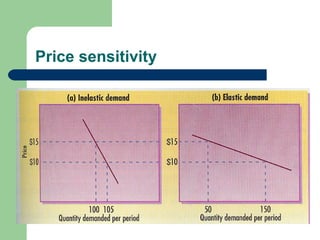
Price sensitivity
Examples: product mix pricing
 Product line pricing
 Optional-product pricing
 Captive-product pricing
 By-product pricing
 Cash rebates
 Low-interest,longer warranties,free
maintenance
2.pricing-adjustment strategies
 Discount and allowance pricing
 Segmented pricing
 Psychological pricing
 Promotional pricing
 Geographical pricing
Discount and allowance pricing
 Cash discount
 Quantity discount
 Functional discount
 Seasonal discount
 allowance
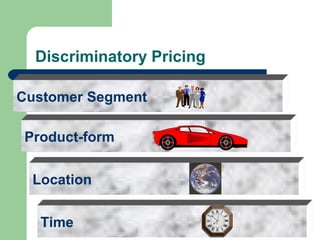
Discriminatory Pricing
Time
Product-form
Customer Segment
Location
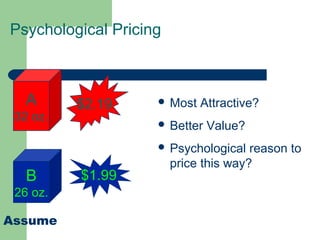
Psychological Pricing
 Most Attractive?
 Better Value?
 Psychological reason to
price this way?
A
32 oz.
$2.19
B
26 oz.
$1.99
Assume Equal Quality
Geographical pricing
 FOB-origin pricing
 Uniform-delivered pricing
 Zone pricing
 Basing-point pricing
 Freight-absorption pricing
Promotional Pricing
 Loss-leader pricing
 Special-event pricing
 Cash rebates
 Low-interest financing
 Longer payment terms
 Warranties & service contracts
 Psychological discounting
3. Pricing changing
 Initiating price cuts
 Initiating price increases
Discussion
 Please explain the reasons for price cuts.
 Please explain the reasons for price increases.
 Please describe the advantage and
disadvantage of price cuts and increases.
The reasons for price cuts
 Excess capacity
 Price competition
The reasons for price increases
 Cost inflation
 overdemand
Reactions to price changes
 Customers’ reactions
 Competitor’s reactions
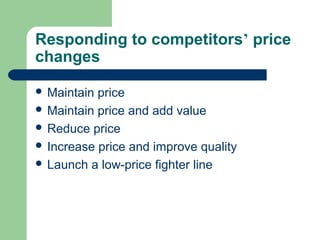
Responding to competitors’ price
changes
 Maintain price
 Maintain price and add value
 Reduce price
 Increase price and improve quality
 Launch a low-price fighter line
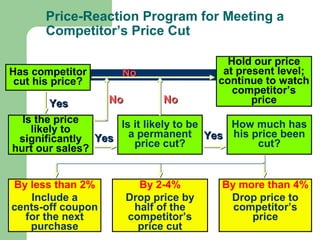
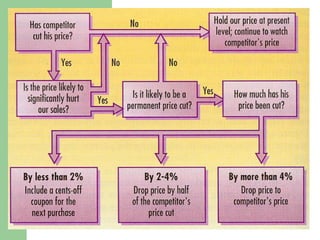
Price-Reaction Program for Meeting a
Competitor’s Price Cut
Has competitor
cut his price?
NoNo
Hold our price
at present level;
continue to watch
competitor’s
price
Is the price
likely to
significantly
hurt our sales?
YesYes
Is it likely to be
a permanent
price cut?YesYes
By more than 4%
Drop price to
competitor’s
price
By 2-4%
Drop price by
half of the
competitor’s
price cut
How much has
his price been
cut?
YesYes
NoNo NoNo
By less than 2%
Include a
cents-off coupon
for the next
purchase
Assignment:
 Read page P411---P415
 Question 2, interactive marketing
applications ,P423

Pricing strategies

  • 1.
    Chapter 7 PricingStrategies You don’t sell through price. You sell the price.
  • 2.
    The Learning Objectives Setting Pricing Policy  Price-adjustment Strategies  Price changes
  • 3.
    1.Pricing objectives  Survival Maximum current profit  Maximum market share  Maximum market skimming  Product-quality leadership
  • 4.
    Setting Pricing Policy 1.Selecting the pricing objective 2. Determining demand 3. Estimating costs 4. Analyzing competitors’ costs, prices, and offers 5. Selecting a pricing method 6. Selecting final price
  • 5.
    Types of Costs TotalCosts Sum of the Fixed and Variable Costs for a Given Level of Production Total Costs Sum of the Fixed and Variable Costs for a Given Level of Production Fixed Costs (Overhead) Costs that don’t vary with sales or production levels. Executive Salaries Rent Fixed Costs (Overhead) Costs that don’t vary with sales or production levels. Executive Salaries Rent Variable Costs Costs that do vary directly with the level of production. Raw materials Variable Costs Costs that do vary directly with the level of production. Raw materials
  • 7.
    The Three C’sModel for Price Setting Costs Competitors’ prices and prices of substitutes Customers’ assessment of unique product features Low Price No possible profit at this price High Price No possible demand at this price
  • 8.
    Some important pricingdefinitions  Utility: The attribute that makes it capable of want satisfaction  Value: The worth in terms of other products  Price: The monetary medium of exchange. Value Example: Caterpillar Tractor is $100,000 vs. Market $90,000 $90,000 if equal 7,000 extra durable 6,000 reliability 5,000 service 2,000 warranty $110,000 in benefits - $10,000 discount!
  • 9.
    Examples: new-product pricing Market-skimming pricing  Market-penetration pricing
  • 10.
    Market-skimming pricing  Settinga high price for a new product to skim maximum revenues layer by layer from the segments willing to pay the high price: the company makes fewer but more profitable sales.
  • 11.
    The conditions: 1. Asufficient number of buyers have a high current demand; 2. The unit costs of producing a small volume are not so high that they cancel the advantage of charging what the traffic will bear; 3. The high initial price does not attract more competitors to market; 4. The high price communicates the image of a superior product.
  • 12.
    Market-penetration pricing  Settinga low price for a new product in order to attract a large number of buyers and a large market share.
  • 13.
    The conditions: 1. Themarket is highly price sensitive,and a low price stimulates market growth; 2. Production and distribution costs fall with accumulated production experience; 3. A low price discourages actual and potential competition.
  • 14.
  • 15.
    Examples: product mixpricing  Product line pricing  Optional-product pricing  Captive-product pricing  By-product pricing  Cash rebates  Low-interest,longer warranties,free maintenance
  • 16.
    2.pricing-adjustment strategies  Discountand allowance pricing  Segmented pricing  Psychological pricing  Promotional pricing  Geographical pricing
  • 17.
    Discount and allowancepricing  Cash discount  Quantity discount  Functional discount  Seasonal discount  allowance
  • 18.
  • 19.
    Psychological Pricing  MostAttractive?  Better Value?  Psychological reason to price this way? A 32 oz. $2.19 B 26 oz. $1.99 Assume Equal Quality
  • 20.
    Geographical pricing  FOB-originpricing  Uniform-delivered pricing  Zone pricing  Basing-point pricing  Freight-absorption pricing
  • 21.
    Promotional Pricing  Loss-leaderpricing  Special-event pricing  Cash rebates  Low-interest financing  Longer payment terms  Warranties & service contracts  Psychological discounting
  • 22.
    3. Pricing changing Initiating price cuts  Initiating price increases
  • 23.
    Discussion  Please explainthe reasons for price cuts.  Please explain the reasons for price increases.  Please describe the advantage and disadvantage of price cuts and increases.
  • 24.
    The reasons forprice cuts  Excess capacity  Price competition
  • 25.
    The reasons forprice increases  Cost inflation  overdemand
  • 26.
    Reactions to pricechanges  Customers’ reactions  Competitor’s reactions
  • 27.
    Responding to competitors’price changes  Maintain price  Maintain price and add value  Reduce price  Increase price and improve quality  Launch a low-price fighter line
  • 28.
    Price-Reaction Program forMeeting a Competitor’s Price Cut Has competitor cut his price? NoNo Hold our price at present level; continue to watch competitor’s price Is the price likely to significantly hurt our sales? YesYes Is it likely to be a permanent price cut?YesYes By more than 4% Drop price to competitor’s price By 2-4% Drop price by half of the competitor’s price cut How much has his price been cut? YesYes NoNo NoNo By less than 2% Include a cents-off coupon for the next purchase
  • 30.
    Assignment:  Read pageP411---P415  Question 2, interactive marketing applications ,P423