MARKET
SEGMENTATION
DEFINATION
According to Dr. Philip Kotler-
“ Market segmentation is sub-dividing a market
into distinct and homogeneous subgroups of
customers, where any group can conceivably
be selected as a target market to be met with
distinct marketing mix.”
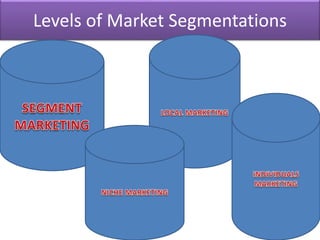
Levels of Market Segmentations
Mass Marketing
As the name suggests , here everything is
performed on macro level i.e. the seller
engages in mass production ,mass
distribution, mass promotion of a single
product for all the buyers . Some claim that
mass marketing is dying as most of the
companies are turning to micromarketing at
one of the 4 levels.
Some Examples are-
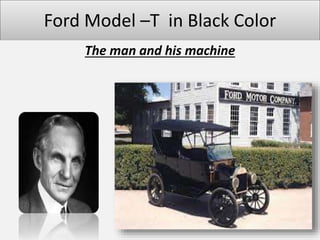
Ford Model –T in Black Color
The man and his machine
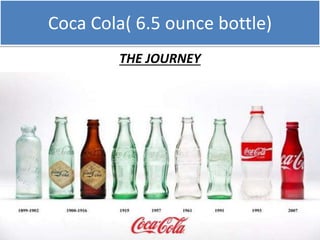
Coca Cola( 6.5 ounce bottle)
THE JOURNEY
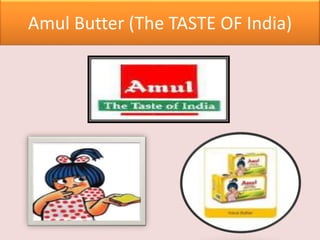
Amul Butter (The TASTE OF India)
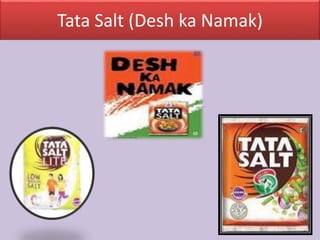
Tata Salt (Desh ka Namak)
• Mass Marketing refers to large , undifferentiated
market of consumers with widely varied
backgrounds.
• Here we talk about only those products which are
needed by almost every member of the society and
are suited for mass market like - electricity or gas or
any other basic necessity that has no close
substitute.
• Henry Ford applied the concept in the automobile
industry and his Model - T was regarded as a
“universal car” one that would meet the needs of
everyone or all the buyers
1. Segment Marketing
• A market segment consists of group of customers
who share a similar set of needs and wants. The
main task of the marketer is not to create the
segment but to identify them and decide the
segment they want to target.
• But what marketer generally tend to offer is a
flexible market offering to all members in 2 parts-
1.Naked Solution :- products and services that all members
of the segment values.
2.Discretionary options :- that some segment members
value. Each option might carry an additional charge.
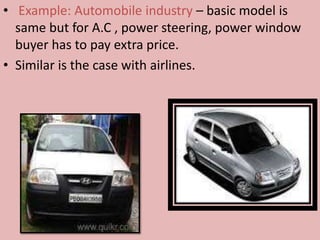
• Example: Automobile industry – basic model is
same but for A.C , power steering, power window
buyer has to pay extra price.
• Similar is the case with airlines.
Different kinds of Market Segments
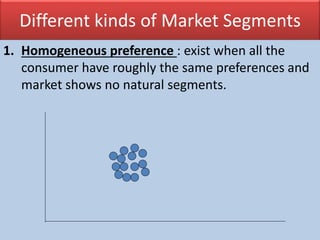
1. Homogeneous preference : exist when all the
consumer have roughly the same preferences and
market shows no natural segments.
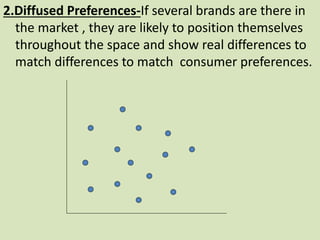
2.Diffused Preferences-If several brands are there in
the market , they are likely to position themselves
throughout the space and show real differences to
match differences to match consumer preferences.
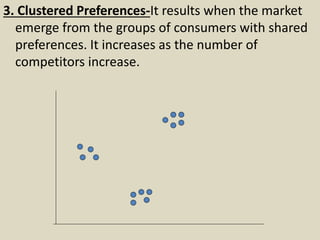
3. Clustered Preferences-It results when the market
emerge from the groups of consumers with shared
preferences. It increases as the number of
competitors increase.
2.Niche Marketing
• Group of customers seeking a distinctive mix of
benefits who are ready to pay extra premium.
• Such segments are divided into sub segments.
• Other Features-
 DISTINCT NEEDS
PAY PREMIUM
SPECIALIZATION
LESS COMPETITION
POTENTIAL
EXAMPLES
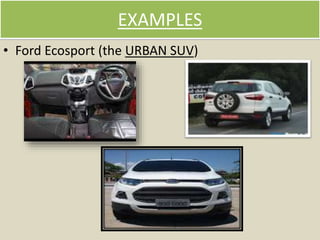
• Ford Ecosport (the URBAN SUV)
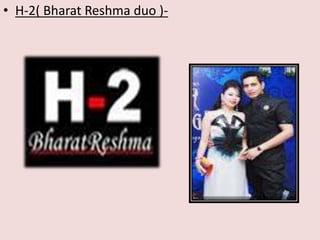
• H-2( Bharat Reshma duo )-
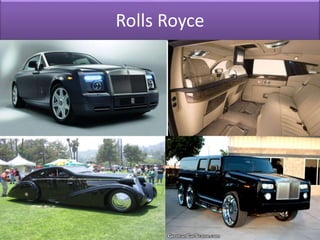
Rolls Royce
Local Marketing
• It can be described as a marketing program tailored
according to the needs of local customer groups in
trading areas , neighborhoods and even individual
stores.
• It is called grass roots marketing.
For Examples-Spiderman 3 was released in 5 different
language in India including bhojpuri , a regional
dialect and because of this effort the movie broke a
number of records for a foreign movie released in
India.
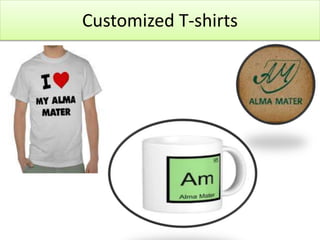
Customized T-shirts
Bharat Matrimony
Bharat Matrimony, the online matrimony service provider is
one of the largest matrimonial website in India. The reason
behind its success has been the realization that in India,
marriages are mostly community based .Therefore the
emphasis was on customizing services according to the
needs of community and as a result of which the service
provider has initiated 15 regional web sites such as
1.bengalmatrimoy.com
2.punjabmatrimony.com
And in addition to it the website is itself readable in 8
different languages and provides the horoscope in 9
different languages.
Individual Marketing
• The ultimate level of segmentation leads to
“segment of one” or “customized marketing” as
today we can all see that market is more tilted
towards the preferences of the consumer and this
all leads to design the products keeping every
individual in mind .
• For Example-
• Customized cars by DC etc
• Customized bikes
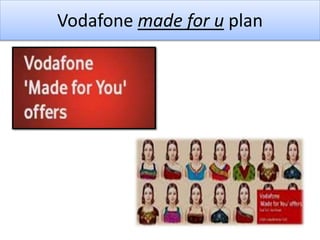
Vodafone made for u plan
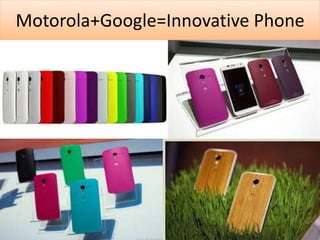
Motorola+Google=Innovative Phone
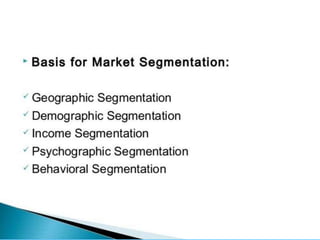
Basis for segmenting Consumer Markets
•Here we try to define certain
segments based on their
descriptive characteristics like
Geographic, demographic
psychographic characteristics.
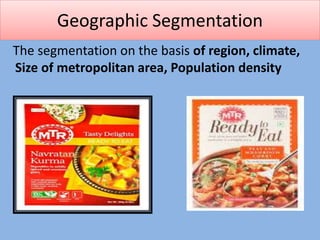
Geographic Segmentation
The segmentation on the basis of region, climate,
Size of metropolitan area, Population density
Demographic Segmentation
• Basically it refers to dividing the market according
to variables like-age , gender , family size , gender ,
income , occupation , education , religion , race ,
generation , nationality etc.
• It also depends upon which stage of life are you at
like-buying a home , sending the child to the school
, taking care of older family members etc.
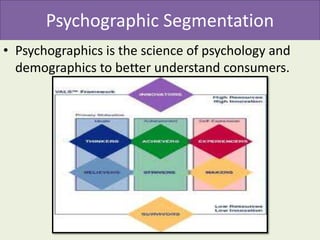
Psychographic Segmentation
• Psychographics is the science of psychology and
demographics to better understand consumers.
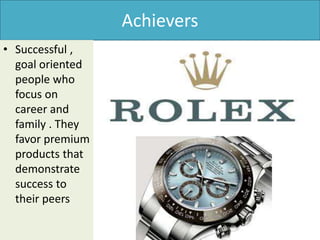
Achievers
• Successful ,
goal oriented
people who
focus on
career and
family . They
favor premium
products that
demonstrate
success to
their peers
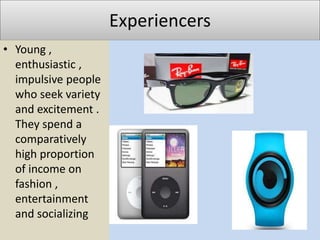
Experiencers
• Young ,
enthusiastic ,
impulsive people
who seek variety
and excitement .
They spend a
comparatively
high proportion
of income on
fashion ,
entertainment
and socializing
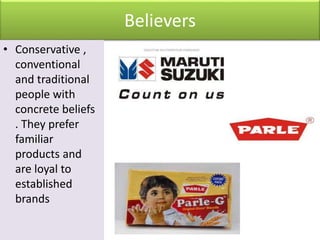
Believers
• Conservative ,
conventional
and traditional
people with
concrete beliefs
. They prefer
familiar
products and
are loyal to
established
brands
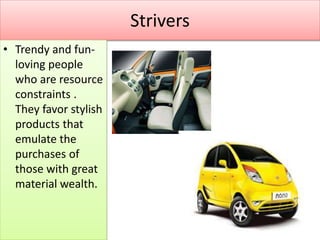
Strivers
• Trendy and fun-
loving people
who are resource
constraints .
They favor stylish
products that
emulate the
purchases of
those with great
material wealth.
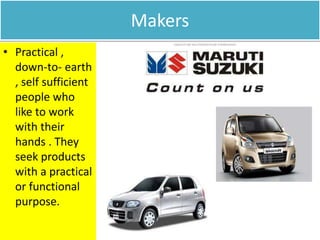
Makers
• Practical ,
down-to- earth
, self sufficient
people who
like to work
with their
hands . They
seek products
with a practical
or functional
purpose.
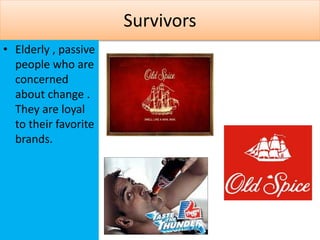
Survivors
• Elderly , passive
people who are
concerned
about change .
They are loyal
to their favorite
brands.
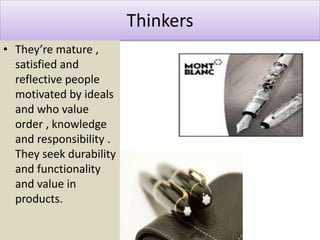
Thinkers
• They’re mature ,
satisfied and
reflective people
motivated by ideals
and who value
order , knowledge
and responsibility .
They seek durability
and functionality
and value in
products.
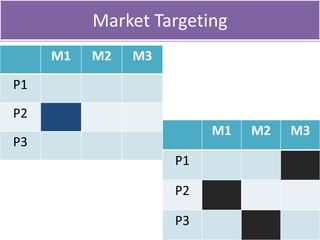
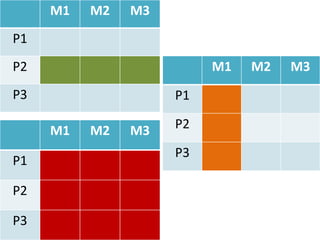
Market Targeting
M1 M2 M3
P1
P2
P3
M1 M2 M3
P1
P2
P3
M1 M2 M3
P1
P2
P3
M1 M2 M3
P1
P2
P3
M1 M2 M3
P1
P2
P3
Company Overview
• HUL, the largest FMCG Company in India by revenues was
formed by merging three subsidiaries of Unilever in 1956.
• At present, Unilever Plc holds a 51.6% stake in the company.
HUL’s portfolio of products covers a wide spectrum including
soaps, detergents, skin creams, shampoos, toothpastes, tea,
coffee and branded flour.
• HUL's brands, spread across 20 distinct consumer categories. It
owns 35 major Indian brands. HUL has consistently had the
most number of brands in the Top 10 list for the most trusted
brands in India from 2003 to 2009.
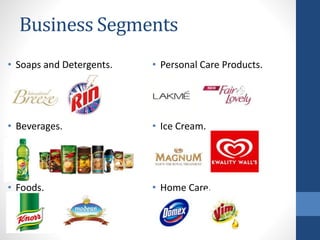
Business Segments
• Soaps and Detergents.
• Beverages.
• Foods.
• Personal Care Products.
• Ice Cream.
• Home Care.
Trends and Forces
• Increasing raw material prices drives HUL to raise its prices
• Increasing per capita income drives FMCG sector growth
• Per Capita consumption of personal care products in India is
one of the lowest among developing economies of the
world.
• Highly Competitive FMCG Sector limits profit margins of HUL.
Competitors
• Procter and Gamble (P&G)
India
• Godrej Consumer Products
Ltd. (GCPL)
• Dabur India Limited
• Marico Limited
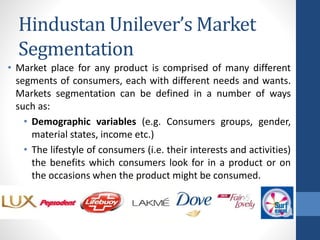
• Market place for any product is comprised of many different
segments of consumers, each with different needs and wants.
Markets segmentation can be defined in a number of ways
such as:
• Demographic variables (e.g. Consumers groups, gender,
material states, income etc.)
• The lifestyle of consumers (i.e. their interests and activities)
the benefits which consumers look for in a product or on
the occasions when the product might be consumed.
Hindustan Unilever’s Market
Segmentation
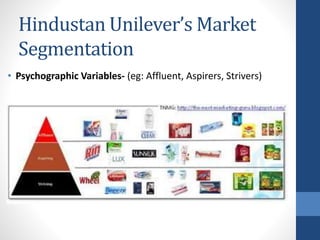
• Psychographic Variables- (eg: Affluent, Aspirers, Strivers)
Hindustan Unilever’s Market
Segmentation
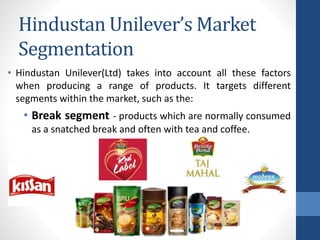
• Hindustan Unilever(Ltd) takes into account all these factors
when producing a range of products. It targets different
segments within the market, such as the:
• Break segment - products which are normally consumed
as a snatched break and often with tea and coffee.
Hindustan Unilever’s Market
Segmentation
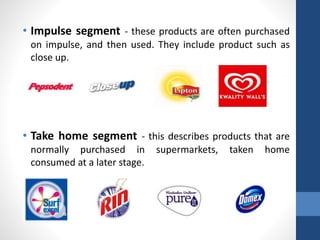
• Impulse segment - these products are often purchased
on impulse, and then used. They include product such as
close up.
• Take home segment - this describes products that are
normally purchased in supermarkets, taken home
consumed at a later stage.
McDonald’s
• McDonald’s is the leading global foodservice
retailer with more than 34,000 local restaurants
serving approximately 69 million people in 118
countries each day. More than 80% of
McDonald’s restaurants worldwide are owned
and operated by independent local men and
women.
GEOGRAPHICAL SEGMENTATION
• Market segmentation strategy whereby the
intended audience for a given product is
divided according to geographic units, such as
nations, states, regions, counties, cities, or
neighborhoods.
• Marketers will tailor marketing programs to fit
the needs of individual geographic areas,
localizing the products, advertising, and sales
effort to geographic differences in needs and
wants. Marketers will also study the population
density or regional climate as factors of
geographic segmentation.
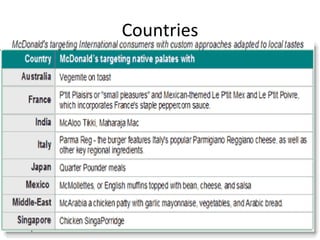
Countries
• Regions- McDonald’s plans to open all-vegetarian
restaurants (by middle of 2013) at various pilgrimage sites
across India. To begin with, the company plans to target
pilgrims at sites like Vaishno Devi in Katra, Jammu and
Kashmir and at the Golden Temple in Amritsar.
• Mcdonalds sell burgers all over the world. But burgers are
made from lamb rather than beef in India because of
religious sentiments. In Mexico, more chilly sauce is added
to burgers and so on.
Demographic Segmentation
• Demographic segmentation consists of market
categorization according to demographic factor
differences, usually with regards to the wants and
needs of multiple consumer groups. It is commonly
used to identify niches in need of specifically targeted
promotional efforts. McDonald offered their services
by segmented their customer based on age, religion,
location, social factor etc.
• Age-Happy meal for kids which includes a free
toy for kids. For families it has made different
outlets and meals which are suitable for
takeaways and drive-thru. McDonalds offers
different products like Happy Meal McDonalds
has made its environment which is suitable for
students of school to hang out with their
friends and can get their lunch at McDonalds.
• Culture-culture influence the consumer behavior,
deeply. A given culture bring in its own unique
pattern of social conduct. A person usually
acquires his cultural attributes right at his
childhood. Culture includes religious, caste,
traditional, language, pattern of social behavior
etc.
• Social factor-social group of varying types exert
influenced on the consumer. Social group include
family, peer group, close colleges. They adopt
their common life style.
• The influences of cultural and social factor are
on consumer behavior. So products are
segmented on the basis of social and cultural
factor.
• In India, McDonald’s does not offer pork or
beef-based products. It’s menu is more than 50
per cent vegetarian. The fast food retail chain
has separate production lines and processes for
its vegetarian and non-vegetarian offerings.
Psychographic segmentation:
• Market segmentation strategy whereby the
intended audience for a given product is
divided according to social class, lifestyle, or
personality characteristics.
• The psychographic characteristics of the market
affect not only advertising copy but also
packaging (travel size, child-proof, decorator
pump) and channels of distribution
(supermarkets, pharmacies, specialty stores).It
is a part of demographic segmentation.
• Convenience and lifestyle
• McDonalds provide the facilities of drive thru
or home delivery to it’s customers according to
their need or convenience.
• They also made McDonalds as a place to relax
and even for entertainment by providing free
wifi and toys.
• McDonald’s provide a place to students to chill
out with friends.
Behavioral segmentation:
• Market segmentation strategy whereby the
division of the target market is made according to
the patterns in which the people in the market live
and spend their time and money. Buyers in a
market will differ in their wants, resources,
locations, buying attitudes, and buying practices,
and any of these variables can be used to divide a
market. In behavior segmentation, potential buyers
of a product are divided into groups based on their
knowledge, attitude, uses, or responses to a
product.
• Loyalty – There are two ways to grow a business. First
is to acquire new customers and second is to retain your
existing customers. The more loyal your customer is to
you, the more your customer base will increase. That’s
one more kind of behavior which marketers target. The
strategies for brand loyal customers is very different from
that used for acquiring new customers.
• The best example of behavioral segmentation by loyalty
is like they give you free coupons to you so that you can
again go and buy the product .For example
• Mc Donald’s on the purchase of burgers give you coupons
for the next purchases. For ex-ice tea free with Mc aloo
tikki .
• Benefits sought – Several products are targeted
towards the benefits sought by the customer. Thus a
marketer can divide a population based on the
benefits thy seek within a product. Recently, there
has been a war between Colgate and sensodyne to
target the people who have sensitive teeth.
• Mc Donald's selling simple consistent and low
priced food.
• Usage rate – In residential or commercial segment,
the usage can be demonstrated in the form of heavy
usage, moderate usage or lesser usage. An example
• There are some customers who like fast food and want
to eat it regularly whereas others do not eat them
frequently. Thus depending on their usage the
customers can be targeted.
• Like in McDonald’s there is an ad campaign called
happy price menu for those who like to eat fast food
regularly at a reasonable rate and general campaigning
for those who don’t prefer it regularly.
MARKET SEGMENTATION
CASE STUDY
OVERSEAS HOLIDAYS
 The UK leisure travel industry is a
large, highly fragmented and
competitive market. In total, UK
consumers take almost 110 million
holiday trips each year. Of these, some
36 million trips are overseas (“Overseas
Holidays”) – a market worth £16 billion.
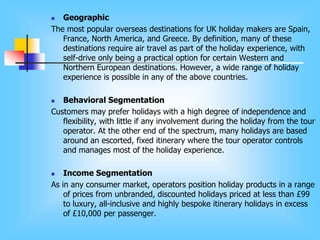
 Geographic
The most popular overseas destinations for UK holiday makers are Spain,
France, North America, and Greece. By definition, many of these
destinations require air travel as part of the holiday experience, with
self-drive only being a practical option for certain Western and
Northern European destinations. However, a wide range of holiday
experience is possible in any of the above countries.
 Behavioral Segmentation
Customers may prefer holidays with a high degree of independence and
flexibility, with little if any involvement during the holiday from the tour
operator. At the other end of the spectrum, many holidays are based
around an escorted, fixed itinerary where the tour operator controls
and manages most of the holiday experience.
 Income Segmentation
As in any consumer market, operators position holiday products in a range
of prices from unbranded, discounted holidays priced at less than £99
to luxury, all-inclusive and highly bespoke itinerary holidays in excess
of £10,000 per passenger.
 Psychographic Segmentation
A number of holidays are designed around offering
a particular type of activity such as scuba diving,
walking or skiing. Such holidays can also offer
expert tuition as part of the package or
alternatively be designed for well-experienced
participants.
Market segmentation
Market segmentation

Market segmentation

  • 1.
  • 2.
    DEFINATION According to Dr.Philip Kotler- “ Market segmentation is sub-dividing a market into distinct and homogeneous subgroups of customers, where any group can conceivably be selected as a target market to be met with distinct marketing mix.”
  • 3.
    Levels of MarketSegmentations
  • 4.
    Mass Marketing As thename suggests , here everything is performed on macro level i.e. the seller engages in mass production ,mass distribution, mass promotion of a single product for all the buyers . Some claim that mass marketing is dying as most of the companies are turning to micromarketing at one of the 4 levels. Some Examples are-
  • 5.
    Ford Model –Tin Black Color The man and his machine
  • 6.
    Coca Cola( 6.5ounce bottle) THE JOURNEY
  • 7.
    Amul Butter (TheTASTE OF India)
  • 8.
    Tata Salt (Deshka Namak)
  • 9.
    • Mass Marketingrefers to large , undifferentiated market of consumers with widely varied backgrounds. • Here we talk about only those products which are needed by almost every member of the society and are suited for mass market like - electricity or gas or any other basic necessity that has no close substitute. • Henry Ford applied the concept in the automobile industry and his Model - T was regarded as a “universal car” one that would meet the needs of everyone or all the buyers
  • 10.
    1. Segment Marketing •A market segment consists of group of customers who share a similar set of needs and wants. The main task of the marketer is not to create the segment but to identify them and decide the segment they want to target. • But what marketer generally tend to offer is a flexible market offering to all members in 2 parts- 1.Naked Solution :- products and services that all members of the segment values. 2.Discretionary options :- that some segment members value. Each option might carry an additional charge.
  • 11.
    • Example: Automobileindustry – basic model is same but for A.C , power steering, power window buyer has to pay extra price. • Similar is the case with airlines.
  • 12.
    Different kinds ofMarket Segments 1. Homogeneous preference : exist when all the consumer have roughly the same preferences and market shows no natural segments.
  • 13.
    2.Diffused Preferences-If severalbrands are there in the market , they are likely to position themselves throughout the space and show real differences to match differences to match consumer preferences.
  • 14.
    3. Clustered Preferences-Itresults when the market emerge from the groups of consumers with shared preferences. It increases as the number of competitors increase.
  • 15.
    2.Niche Marketing • Groupof customers seeking a distinctive mix of benefits who are ready to pay extra premium. • Such segments are divided into sub segments. • Other Features-  DISTINCT NEEDS PAY PREMIUM SPECIALIZATION LESS COMPETITION POTENTIAL
  • 16.
  • 17.
    • H-2( BharatReshma duo )-
  • 18.
  • 19.
    Local Marketing • Itcan be described as a marketing program tailored according to the needs of local customer groups in trading areas , neighborhoods and even individual stores. • It is called grass roots marketing. For Examples-Spiderman 3 was released in 5 different language in India including bhojpuri , a regional dialect and because of this effort the movie broke a number of records for a foreign movie released in India.
  • 20.
  • 21.
    Bharat Matrimony Bharat Matrimony,the online matrimony service provider is one of the largest matrimonial website in India. The reason behind its success has been the realization that in India, marriages are mostly community based .Therefore the emphasis was on customizing services according to the needs of community and as a result of which the service provider has initiated 15 regional web sites such as 1.bengalmatrimoy.com 2.punjabmatrimony.com And in addition to it the website is itself readable in 8 different languages and provides the horoscope in 9 different languages.
  • 22.
    Individual Marketing • Theultimate level of segmentation leads to “segment of one” or “customized marketing” as today we can all see that market is more tilted towards the preferences of the consumer and this all leads to design the products keeping every individual in mind . • For Example- • Customized cars by DC etc • Customized bikes
  • 23.
  • 24.
  • 25.
    Basis for segmentingConsumer Markets •Here we try to define certain segments based on their descriptive characteristics like Geographic, demographic psychographic characteristics.
  • 26.
    Geographic Segmentation The segmentationon the basis of region, climate, Size of metropolitan area, Population density
  • 27.
    Demographic Segmentation • Basicallyit refers to dividing the market according to variables like-age , gender , family size , gender , income , occupation , education , religion , race , generation , nationality etc. • It also depends upon which stage of life are you at like-buying a home , sending the child to the school , taking care of older family members etc.
  • 28.
    Psychographic Segmentation • Psychographicsis the science of psychology and demographics to better understand consumers.
  • 29.
    Achievers • Successful , goaloriented people who focus on career and family . They favor premium products that demonstrate success to their peers
  • 30.
    Experiencers • Young , enthusiastic, impulsive people who seek variety and excitement . They spend a comparatively high proportion of income on fashion , entertainment and socializing
  • 31.
    Believers • Conservative , conventional andtraditional people with concrete beliefs . They prefer familiar products and are loyal to established brands
  • 32.
    Strivers • Trendy andfun- loving people who are resource constraints . They favor stylish products that emulate the purchases of those with great material wealth.
  • 33.
    Makers • Practical , down-to-earth , self sufficient people who like to work with their hands . They seek products with a practical or functional purpose.
  • 34.
    Survivors • Elderly ,passive people who are concerned about change . They are loyal to their favorite brands.
  • 35.
    Thinkers • They’re mature, satisfied and reflective people motivated by ideals and who value order , knowledge and responsibility . They seek durability and functionality and value in products.
  • 36.
    Market Targeting M1 M2M3 P1 P2 P3 M1 M2 M3 P1 P2 P3
  • 37.
    M1 M2 M3 P1 P2 P3 M1M2 M3 P1 P2 P3 M1 M2 M3 P1 P2 P3
  • 39.
    Company Overview • HUL,the largest FMCG Company in India by revenues was formed by merging three subsidiaries of Unilever in 1956. • At present, Unilever Plc holds a 51.6% stake in the company. HUL’s portfolio of products covers a wide spectrum including soaps, detergents, skin creams, shampoos, toothpastes, tea, coffee and branded flour. • HUL's brands, spread across 20 distinct consumer categories. It owns 35 major Indian brands. HUL has consistently had the most number of brands in the Top 10 list for the most trusted brands in India from 2003 to 2009.
  • 40.
    Business Segments • Soapsand Detergents. • Beverages. • Foods. • Personal Care Products. • Ice Cream. • Home Care.
  • 41.
    Trends and Forces •Increasing raw material prices drives HUL to raise its prices • Increasing per capita income drives FMCG sector growth • Per Capita consumption of personal care products in India is one of the lowest among developing economies of the world. • Highly Competitive FMCG Sector limits profit margins of HUL.
  • 42.
    Competitors • Procter andGamble (P&G) India • Godrej Consumer Products Ltd. (GCPL) • Dabur India Limited • Marico Limited
  • 43.
    • Market placefor any product is comprised of many different segments of consumers, each with different needs and wants. Markets segmentation can be defined in a number of ways such as: • Demographic variables (e.g. Consumers groups, gender, material states, income etc.) • The lifestyle of consumers (i.e. their interests and activities) the benefits which consumers look for in a product or on the occasions when the product might be consumed. Hindustan Unilever’s Market Segmentation
  • 44.
    • Psychographic Variables-(eg: Affluent, Aspirers, Strivers) Hindustan Unilever’s Market Segmentation
  • 45.
    • Hindustan Unilever(Ltd)takes into account all these factors when producing a range of products. It targets different segments within the market, such as the: • Break segment - products which are normally consumed as a snatched break and often with tea and coffee. Hindustan Unilever’s Market Segmentation
  • 46.
    • Impulse segment- these products are often purchased on impulse, and then used. They include product such as close up. • Take home segment - this describes products that are normally purchased in supermarkets, taken home consumed at a later stage.
  • 48.
    McDonald’s • McDonald’s isthe leading global foodservice retailer with more than 34,000 local restaurants serving approximately 69 million people in 118 countries each day. More than 80% of McDonald’s restaurants worldwide are owned and operated by independent local men and women.
  • 49.
    GEOGRAPHICAL SEGMENTATION • Marketsegmentation strategy whereby the intended audience for a given product is divided according to geographic units, such as nations, states, regions, counties, cities, or neighborhoods. • Marketers will tailor marketing programs to fit the needs of individual geographic areas, localizing the products, advertising, and sales effort to geographic differences in needs and wants. Marketers will also study the population density or regional climate as factors of geographic segmentation.
  • 50.
  • 51.
    • Regions- McDonald’splans to open all-vegetarian restaurants (by middle of 2013) at various pilgrimage sites across India. To begin with, the company plans to target pilgrims at sites like Vaishno Devi in Katra, Jammu and Kashmir and at the Golden Temple in Amritsar. • Mcdonalds sell burgers all over the world. But burgers are made from lamb rather than beef in India because of religious sentiments. In Mexico, more chilly sauce is added to burgers and so on.
  • 52.
    Demographic Segmentation • Demographicsegmentation consists of market categorization according to demographic factor differences, usually with regards to the wants and needs of multiple consumer groups. It is commonly used to identify niches in need of specifically targeted promotional efforts. McDonald offered their services by segmented their customer based on age, religion, location, social factor etc.
  • 53.
    • Age-Happy mealfor kids which includes a free toy for kids. For families it has made different outlets and meals which are suitable for takeaways and drive-thru. McDonalds offers different products like Happy Meal McDonalds has made its environment which is suitable for students of school to hang out with their friends and can get their lunch at McDonalds.
  • 54.
    • Culture-culture influencethe consumer behavior, deeply. A given culture bring in its own unique pattern of social conduct. A person usually acquires his cultural attributes right at his childhood. Culture includes religious, caste, traditional, language, pattern of social behavior etc. • Social factor-social group of varying types exert influenced on the consumer. Social group include family, peer group, close colleges. They adopt their common life style.
  • 55.
    • The influencesof cultural and social factor are on consumer behavior. So products are segmented on the basis of social and cultural factor. • In India, McDonald’s does not offer pork or beef-based products. It’s menu is more than 50 per cent vegetarian. The fast food retail chain has separate production lines and processes for its vegetarian and non-vegetarian offerings.
  • 56.
    Psychographic segmentation: • Marketsegmentation strategy whereby the intended audience for a given product is divided according to social class, lifestyle, or personality characteristics. • The psychographic characteristics of the market affect not only advertising copy but also packaging (travel size, child-proof, decorator pump) and channels of distribution (supermarkets, pharmacies, specialty stores).It is a part of demographic segmentation.
  • 57.
    • Convenience andlifestyle • McDonalds provide the facilities of drive thru or home delivery to it’s customers according to their need or convenience. • They also made McDonalds as a place to relax and even for entertainment by providing free wifi and toys. • McDonald’s provide a place to students to chill out with friends.
  • 58.
    Behavioral segmentation: • Marketsegmentation strategy whereby the division of the target market is made according to the patterns in which the people in the market live and spend their time and money. Buyers in a market will differ in their wants, resources, locations, buying attitudes, and buying practices, and any of these variables can be used to divide a market. In behavior segmentation, potential buyers of a product are divided into groups based on their knowledge, attitude, uses, or responses to a product.
  • 59.
    • Loyalty –There are two ways to grow a business. First is to acquire new customers and second is to retain your existing customers. The more loyal your customer is to you, the more your customer base will increase. That’s one more kind of behavior which marketers target. The strategies for brand loyal customers is very different from that used for acquiring new customers. • The best example of behavioral segmentation by loyalty is like they give you free coupons to you so that you can again go and buy the product .For example • Mc Donald’s on the purchase of burgers give you coupons for the next purchases. For ex-ice tea free with Mc aloo tikki .
  • 60.
    • Benefits sought– Several products are targeted towards the benefits sought by the customer. Thus a marketer can divide a population based on the benefits thy seek within a product. Recently, there has been a war between Colgate and sensodyne to target the people who have sensitive teeth. • Mc Donald's selling simple consistent and low priced food.
  • 61.
    • Usage rate– In residential or commercial segment, the usage can be demonstrated in the form of heavy usage, moderate usage or lesser usage. An example • There are some customers who like fast food and want to eat it regularly whereas others do not eat them frequently. Thus depending on their usage the customers can be targeted. • Like in McDonald’s there is an ad campaign called happy price menu for those who like to eat fast food regularly at a reasonable rate and general campaigning for those who don’t prefer it regularly.
  • 62.
  • 63.
     The UKleisure travel industry is a large, highly fragmented and competitive market. In total, UK consumers take almost 110 million holiday trips each year. Of these, some 36 million trips are overseas (“Overseas Holidays”) – a market worth £16 billion.
  • 68.
     Geographic The mostpopular overseas destinations for UK holiday makers are Spain, France, North America, and Greece. By definition, many of these destinations require air travel as part of the holiday experience, with self-drive only being a practical option for certain Western and Northern European destinations. However, a wide range of holiday experience is possible in any of the above countries.  Behavioral Segmentation Customers may prefer holidays with a high degree of independence and flexibility, with little if any involvement during the holiday from the tour operator. At the other end of the spectrum, many holidays are based around an escorted, fixed itinerary where the tour operator controls and manages most of the holiday experience.  Income Segmentation As in any consumer market, operators position holiday products in a range of prices from unbranded, discounted holidays priced at less than £99 to luxury, all-inclusive and highly bespoke itinerary holidays in excess of £10,000 per passenger.
  • 69.
     Psychographic Segmentation Anumber of holidays are designed around offering a particular type of activity such as scuba diving, walking or skiing. Such holidays can also offer expert tuition as part of the package or alternatively be designed for well-experienced participants.