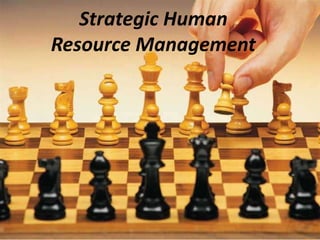
Strategic Human
Resource Management
Human Resource Management
Human resource management (HRM, or simply HR) is the
management process of an organization's workforce or human
resources. It is responsible for the attraction, selection, training,
assessment, and rewarding of employees, while also overseeing
organizational leadership and culture and ensuring compliance
with employment and labor laws.
Why is HR critical to firm performance?
• Service is delivered by people.
• Low quality HR leads to low quality customer
service.
• In the 21st century effective knowledge
management translates into competitive
advantage and profits.
• Knowledge comes from a firm’s people.
Introduction
 A strategy:
 Indicates what an organization's key executives hope to
accomplish in the long run
 Is concerned with competition and aligning the resources
of the firm
 Good HR strategy results in a fit between
organizational strategy and HRM policies and
programs
 Recruitment, selection, outsourcing, telecommuting,
performance evaluation, compensation
Human Resource Management 4
Strategic human resource management
Formulating and executing HR systems that produce the
employee competencies and behaviors the company needs to
achieve its strategic aims
 Taking a strategic HRM approach means:
 Making human resources management a top priority
 Integrating HRM with the company’s strategy, mission, and
goals
 HRM can make significant contributions if included in
the strategic planning process from the outset
 The strategic management process helps determine:
 What must be done to achieve priority objectives
 How they will be achieved
Strategic HRM: A Key to Success
 Strategic HRM planning leads to:
 Growth
 Profits
 Survival
 Planning also:
 Expands awareness of possibilities
 Identifies strengths and weaknesses
 Reveals opportunities
 Points to the need to evaluate the impact of internal and
external forces
Human Resource Management 6
The Strategic Management Process
The process of identifying and executing the
organization’s mission by matching its capabilities
with the demands of its environment.
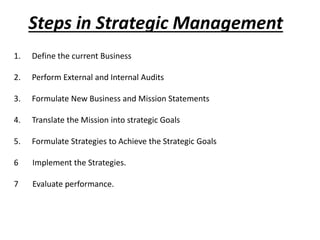
Steps in Strategic Management
1. Define the current Business
2. Perform External and Internal Audits
3. Formulate New Business and Mission Statements
4. Translate the Mission into strategic Goals
5. Formulate Strategies to Achieve the Strategic Goals
6 Implement the Strategies.
7 Evaluate performance.
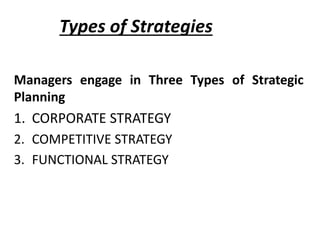
Types of Strategies
Managers engage in Three Types of Strategic
Planning
1. CORPORATE STRATEGY
2. COMPETITIVE STRATEGY
3. FUNCTIONAL STRATEGY
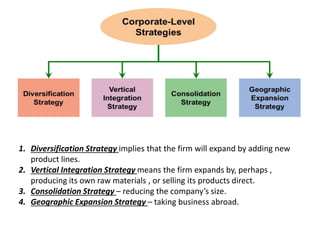
1. Diversification Strategy implies that the firm will expand by adding new
product lines.
2. Vertical Integration Strategy means the firm expands by, perhaps ,
producing its own raw materials , or selling its products direct.
3. Consolidation Strategy – reducing the company’s size.
4. Geographic Expansion Strategy – taking business abroad.
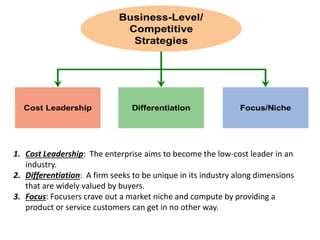
1. Cost Leadership: The enterprise aims to become the low-cost leader in an
industry.
2. Differentiation: A firm seeks to be unique in its industry along dimensions
that are widely valued by buyers.
3. Focus: Focusers crave out a market niche and compute by providing a
product or service customers can get in no other way.
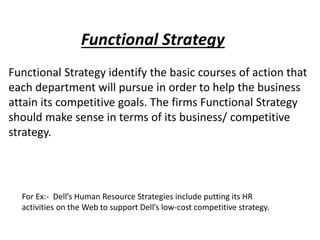
Functional Strategy
Functional Strategy identify the basic courses of action that
each department will pursue in order to help the business
attain its competitive goals. The firms Functional Strategy
should make sense in terms of its business/ competitive
strategy.
For Ex:- Dell’s Human Resource Strategies include putting its HR
activities on the Web to support Dell’s low-cost competitive strategy.
Strategic
Fit
Strategic planning expert Michael Porter emphasizes the “fit” point of
view. He says, All of the firm’s activities must be tailored to or fit the
chosen strategy such that the firm’s functional strategies support its
corporate and competitive strategies.
Leverage
“Stretch” in leveraging resources—supplementing what you have and
doing more with what you have—can be more important than just
fitting the strategic plan to current resources
14
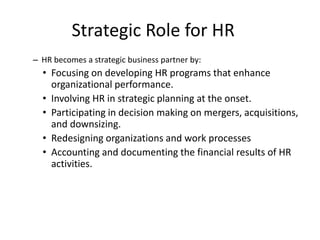
Strategic Role for HR
– HR becomes a strategic business partner by:
• Focusing on developing HR programs that enhance
organizational performance.
• Involving HR in strategic planning at the onset.
• Participating in decision making on mergers, acquisitions,
and downsizing.
• Redesigning organizations and work processes
• Accounting and documenting the financial results of HR
activities.
1 •Workplace Safety
Creating a work environment free from unnecessary hazards is a
strategic role of every human resources manager. Strategic
development for workplace safety entails risk management and
mitigating potential losses from on-the-job injuries and
fatalities. Workers' compensation insurance is an area in which
a strategic plan helps lower company expense for insurance
coverage. Reducing accidents through training employees on
the proper use of complex machinery and equipment is one of
the functional tasks associated with creating a safe work
environment
2
•Compensation and Benefits
An employer's compensation and benefits structure partly
determines the company's business reputation and image. In
addition, the decisions that human resources managers make
regarding pay scales and employee benefits can impact employee
satisfaction, as well as the organization's ability to recruit talented
workers. Job evaluation, labor market conditions, workforce
shortages and budget constraints are factors that HR managers
consider in a strategic plan for pay and benefits. In addition, a
strategy includes weighing an employer's choices between
satisfying its workforce and pleasing the company's stakeholders.
Pursuant to the health care reform law passed in 2010, human
resources managers for companies with more than 50 employees
must decide between offering group health coverage and paying
fines, beginning in 2014
3 •Employee Training
Human resources managers' strategic role with respect to
employee training and development prepares the workforce for
future positions within the company. Succession planning,
promotion-from-within policies and performance evaluation
factor into the human resources manager's role. Training and
development motivate employees, and in some cases, improve
employee retention.
4 •Recruitment and Selection
Employee recruitment and selection is as much a part of
employee relations as it is a separate discipline unto itself.
Therefore, a human resources manager's strategic role is to
combine elements of employee relations into the employer's
recruitment and selection strategy. Integrating employee
recognition programs into promotion-from-within policies is
an effective form of employee motivation that combines the
employee relations and recruitment and selection areas of
human resources.
5 •Employee Relations
Some human resources managers believe that strengthening
the employer-employee relationship rests solely in the
employee relations areas of the HR department. This isn't true.
Nevertheless, employee relations is such a large part of every
discipline -- including salaries, benefits, safety, training and
employee development -- that sustaining an employee relations
program is an important element of human resources strategy.
Implementing a workplace investigation process and enforcing
fair employment practices are two components of an employee
relations program. The strategic role of a human resources
manager is to determine how to identify and resolve workplace
issues, as well as how best to attract a diverse pool of applicants
through effective recruitment and selection processes.
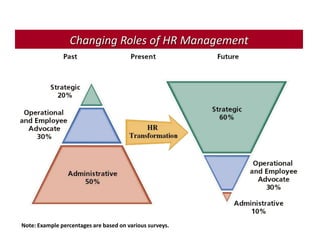
20
Changing Roles of HR Management
Note: Example percentages are based on various surveys.
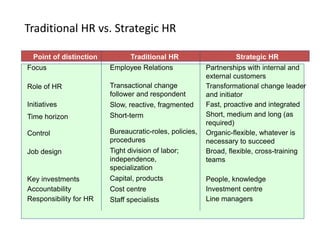
Traditional HR vs. Strategic HR
Point of distinction
Focus
Role of HR
Initiatives
Time horizon
Control
Job design
Key investments
Accountability
Responsibility for HR
Traditional HR
Employee Relations
Transactional change
follower and respondent
Slow, reactive, fragmented
Short-term
Bureaucratic-roles, policies,
procedures
Tight division of labor;
independence,
specialization
Capital, products
Cost centre
Staff specialists
Strategic HR
Partnerships with internal and
external customers
Transformational change leader
and initiator
Fast, proactive and integrated
Short, medium and long (as
required)
Organic-flexible, whatever is
necessary to succeed
Broad, flexible, cross-training
teams
People, knowledge
Investment centre
Line managers
Human Resource Management 21
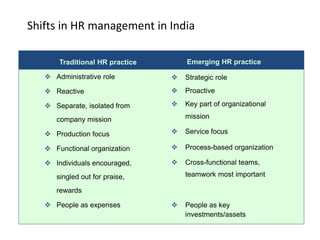
Shifts in HR management in India
Emerging HR practice
 Strategic role
 Proactive
 Key part of organizational
mission
 Service focus
 Process-based organization
 Cross-functional teams,
teamwork most important
 People as key
investments/assets
Traditional HR practice
 Administrative role
 Reactive
 Separate, isolated from
company mission
 Production focus
 Functional organization
 Individuals encouraged,
singled out for praise,
rewards
 People as expenses
Human Resource Management 22
23
Strategic Role for HR
– HR becomes a strategic business partner by:
• Focusing on developing HR programs that enhance
organizational performance.
• Involving HR in strategic planning at the onset.
• Participating in decision making on mergers, acquisitions,
and downsizing.
• Redesigning organizations and work processes
• Accounting and documenting the financial results of HR
activities.
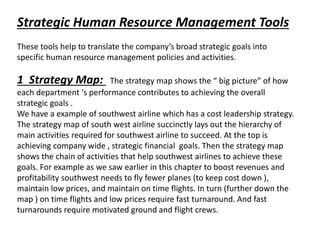
Strategic Human Resource Management Tools
These tools help to translate the company’s broad strategic goals into
specific human resource management policies and activities.
1 Strategy Map: The strategy map shows the “ big picture” of how
each department ‘s performance contributes to achieving the overall
strategic goals .
We have a example of southwest airline which has a cost leadership strategy.
The strategy map of south west airline succinctly lays out the hierarchy of
main activities required for southwest airline to succeed. At the top is
achieving company wide , strategic financial goals. Then the strategy map
shows the chain of activities that help southwest airlines to achieve these
goals. For example as we saw earlier in this chapter to boost revenues and
profitability southwest needs to fly fewer planes (to keep cost down ),
maintain low prices, and maintain on time flights. In turn (further down the
map ) on time flights and low prices require fast turnaround. And fast
turnarounds require motivated ground and flight crews.
The HR Scorecard: The HR scorecard is not a score card.
It is process for assigning financial and non financial goals or
metrics to the human resource management related chain of
activities required for achieving company strategic aims and for
monitoring results.
Digital Dashboards: The saying “ a picture is worth a
thousand words”. A digital Dashboard presents the manager
with desktop graphs and charts , and so a computerised picture
of where the company stands on all those metrics from the HR
Scorecard process.
As in the illustration a top manager dashboard for for
southwest airline might display on the PC screen real time
trends fpr strategy map activities such as fast turnaround,
attracting and keeping customers and on time flights . This
gives the manager time to take corrective action.
Copyright © 2005 South-
Western. All rights reserved.
1–26
Benefits of a Strategic Approach to
HR
• Facilitates development of high-quality
workforce through focus on types of people &
skills needed
• Facilitates cost-effective utilization of labor,
particularly in service industries where labor is
generally greatest cost
• Facilitates planning & assessment of
environmental uncertainty & adaptation of
organization to external forces
Shanghai Portman Hotel
Over several years ago, the Ritz Carlton company took over managing the Portman Hotel in
Shanghai. The new Management decided
Questions
1 what are steps of strategic management ?
2 What are different types of strategies?
3 what is strategic role of HRM?
4 What are strategic tools of HRM?
5 Traditional HRM v/s Strategic HRM?
Hrm strategies(2)

Hrm strategies(2)

  • 1.
  • 2.
    Human Resource Management Humanresource management (HRM, or simply HR) is the management process of an organization's workforce or human resources. It is responsible for the attraction, selection, training, assessment, and rewarding of employees, while also overseeing organizational leadership and culture and ensuring compliance with employment and labor laws.
  • 3.
    Why is HRcritical to firm performance? • Service is delivered by people. • Low quality HR leads to low quality customer service. • In the 21st century effective knowledge management translates into competitive advantage and profits. • Knowledge comes from a firm’s people.
  • 4.
    Introduction  A strategy: Indicates what an organization's key executives hope to accomplish in the long run  Is concerned with competition and aligning the resources of the firm  Good HR strategy results in a fit between organizational strategy and HRM policies and programs  Recruitment, selection, outsourcing, telecommuting, performance evaluation, compensation Human Resource Management 4
  • 5.
    Strategic human resourcemanagement Formulating and executing HR systems that produce the employee competencies and behaviors the company needs to achieve its strategic aims  Taking a strategic HRM approach means:  Making human resources management a top priority  Integrating HRM with the company’s strategy, mission, and goals  HRM can make significant contributions if included in the strategic planning process from the outset  The strategic management process helps determine:  What must be done to achieve priority objectives  How they will be achieved
  • 6.
    Strategic HRM: AKey to Success  Strategic HRM planning leads to:  Growth  Profits  Survival  Planning also:  Expands awareness of possibilities  Identifies strengths and weaknesses  Reveals opportunities  Points to the need to evaluate the impact of internal and external forces Human Resource Management 6
  • 7.
    The Strategic ManagementProcess The process of identifying and executing the organization’s mission by matching its capabilities with the demands of its environment.
  • 8.
    Steps in StrategicManagement 1. Define the current Business 2. Perform External and Internal Audits 3. Formulate New Business and Mission Statements 4. Translate the Mission into strategic Goals 5. Formulate Strategies to Achieve the Strategic Goals 6 Implement the Strategies. 7 Evaluate performance.
  • 9.
    Types of Strategies Managersengage in Three Types of Strategic Planning 1. CORPORATE STRATEGY 2. COMPETITIVE STRATEGY 3. FUNCTIONAL STRATEGY
  • 10.
    1. Diversification Strategyimplies that the firm will expand by adding new product lines. 2. Vertical Integration Strategy means the firm expands by, perhaps , producing its own raw materials , or selling its products direct. 3. Consolidation Strategy – reducing the company’s size. 4. Geographic Expansion Strategy – taking business abroad.
  • 11.
    1. Cost Leadership:The enterprise aims to become the low-cost leader in an industry. 2. Differentiation: A firm seeks to be unique in its industry along dimensions that are widely valued by buyers. 3. Focus: Focusers crave out a market niche and compute by providing a product or service customers can get in no other way.
  • 12.
    Functional Strategy Functional Strategyidentify the basic courses of action that each department will pursue in order to help the business attain its competitive goals. The firms Functional Strategy should make sense in terms of its business/ competitive strategy. For Ex:- Dell’s Human Resource Strategies include putting its HR activities on the Web to support Dell’s low-cost competitive strategy.
  • 13.
    Strategic Fit Strategic planning expertMichael Porter emphasizes the “fit” point of view. He says, All of the firm’s activities must be tailored to or fit the chosen strategy such that the firm’s functional strategies support its corporate and competitive strategies. Leverage “Stretch” in leveraging resources—supplementing what you have and doing more with what you have—can be more important than just fitting the strategic plan to current resources
  • 14.
    14 Strategic Role forHR – HR becomes a strategic business partner by: • Focusing on developing HR programs that enhance organizational performance. • Involving HR in strategic planning at the onset. • Participating in decision making on mergers, acquisitions, and downsizing. • Redesigning organizations and work processes • Accounting and documenting the financial results of HR activities.
  • 15.
    1 •Workplace Safety Creatinga work environment free from unnecessary hazards is a strategic role of every human resources manager. Strategic development for workplace safety entails risk management and mitigating potential losses from on-the-job injuries and fatalities. Workers' compensation insurance is an area in which a strategic plan helps lower company expense for insurance coverage. Reducing accidents through training employees on the proper use of complex machinery and equipment is one of the functional tasks associated with creating a safe work environment
  • 16.
    2 •Compensation and Benefits Anemployer's compensation and benefits structure partly determines the company's business reputation and image. In addition, the decisions that human resources managers make regarding pay scales and employee benefits can impact employee satisfaction, as well as the organization's ability to recruit talented workers. Job evaluation, labor market conditions, workforce shortages and budget constraints are factors that HR managers consider in a strategic plan for pay and benefits. In addition, a strategy includes weighing an employer's choices between satisfying its workforce and pleasing the company's stakeholders. Pursuant to the health care reform law passed in 2010, human resources managers for companies with more than 50 employees must decide between offering group health coverage and paying fines, beginning in 2014
  • 17.
    3 •Employee Training Humanresources managers' strategic role with respect to employee training and development prepares the workforce for future positions within the company. Succession planning, promotion-from-within policies and performance evaluation factor into the human resources manager's role. Training and development motivate employees, and in some cases, improve employee retention.
  • 18.
    4 •Recruitment andSelection Employee recruitment and selection is as much a part of employee relations as it is a separate discipline unto itself. Therefore, a human resources manager's strategic role is to combine elements of employee relations into the employer's recruitment and selection strategy. Integrating employee recognition programs into promotion-from-within policies is an effective form of employee motivation that combines the employee relations and recruitment and selection areas of human resources.
  • 19.
    5 •Employee Relations Somehuman resources managers believe that strengthening the employer-employee relationship rests solely in the employee relations areas of the HR department. This isn't true. Nevertheless, employee relations is such a large part of every discipline -- including salaries, benefits, safety, training and employee development -- that sustaining an employee relations program is an important element of human resources strategy. Implementing a workplace investigation process and enforcing fair employment practices are two components of an employee relations program. The strategic role of a human resources manager is to determine how to identify and resolve workplace issues, as well as how best to attract a diverse pool of applicants through effective recruitment and selection processes.
  • 20.
    20 Changing Roles ofHR Management Note: Example percentages are based on various surveys.
  • 21.
    Traditional HR vs.Strategic HR Point of distinction Focus Role of HR Initiatives Time horizon Control Job design Key investments Accountability Responsibility for HR Traditional HR Employee Relations Transactional change follower and respondent Slow, reactive, fragmented Short-term Bureaucratic-roles, policies, procedures Tight division of labor; independence, specialization Capital, products Cost centre Staff specialists Strategic HR Partnerships with internal and external customers Transformational change leader and initiator Fast, proactive and integrated Short, medium and long (as required) Organic-flexible, whatever is necessary to succeed Broad, flexible, cross-training teams People, knowledge Investment centre Line managers Human Resource Management 21
  • 22.
    Shifts in HRmanagement in India Emerging HR practice  Strategic role  Proactive  Key part of organizational mission  Service focus  Process-based organization  Cross-functional teams, teamwork most important  People as key investments/assets Traditional HR practice  Administrative role  Reactive  Separate, isolated from company mission  Production focus  Functional organization  Individuals encouraged, singled out for praise, rewards  People as expenses Human Resource Management 22
  • 23.
    23 Strategic Role forHR – HR becomes a strategic business partner by: • Focusing on developing HR programs that enhance organizational performance. • Involving HR in strategic planning at the onset. • Participating in decision making on mergers, acquisitions, and downsizing. • Redesigning organizations and work processes • Accounting and documenting the financial results of HR activities.
  • 24.
    Strategic Human ResourceManagement Tools These tools help to translate the company’s broad strategic goals into specific human resource management policies and activities. 1 Strategy Map: The strategy map shows the “ big picture” of how each department ‘s performance contributes to achieving the overall strategic goals . We have a example of southwest airline which has a cost leadership strategy. The strategy map of south west airline succinctly lays out the hierarchy of main activities required for southwest airline to succeed. At the top is achieving company wide , strategic financial goals. Then the strategy map shows the chain of activities that help southwest airlines to achieve these goals. For example as we saw earlier in this chapter to boost revenues and profitability southwest needs to fly fewer planes (to keep cost down ), maintain low prices, and maintain on time flights. In turn (further down the map ) on time flights and low prices require fast turnaround. And fast turnarounds require motivated ground and flight crews.
  • 25.
    The HR Scorecard:The HR scorecard is not a score card. It is process for assigning financial and non financial goals or metrics to the human resource management related chain of activities required for achieving company strategic aims and for monitoring results. Digital Dashboards: The saying “ a picture is worth a thousand words”. A digital Dashboard presents the manager with desktop graphs and charts , and so a computerised picture of where the company stands on all those metrics from the HR Scorecard process. As in the illustration a top manager dashboard for for southwest airline might display on the PC screen real time trends fpr strategy map activities such as fast turnaround, attracting and keeping customers and on time flights . This gives the manager time to take corrective action.
  • 26.
    Copyright © 2005South- Western. All rights reserved. 1–26 Benefits of a Strategic Approach to HR • Facilitates development of high-quality workforce through focus on types of people & skills needed • Facilitates cost-effective utilization of labor, particularly in service industries where labor is generally greatest cost • Facilitates planning & assessment of environmental uncertainty & adaptation of organization to external forces
  • 27.
    Shanghai Portman Hotel Overseveral years ago, the Ritz Carlton company took over managing the Portman Hotel in Shanghai. The new Management decided
  • 28.
    Questions 1 what aresteps of strategic management ? 2 What are different types of strategies? 3 what is strategic role of HRM? 4 What are strategic tools of HRM? 5 Traditional HRM v/s Strategic HRM?