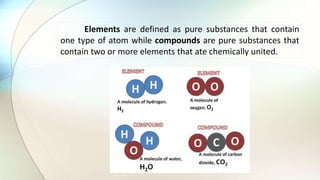
Elements are defined as pure substances that contain
one type of atom while compounds are pure substances that
contain two or more elements that ate chemically united.
Let’s Learn
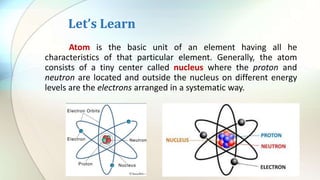
Atom is the basic unit of an element having all he
characteristics of that particular element. Generally, the atom
consists of a tiny center called nucleus where the proton and
neutron are located and outside the nucleus on different energy
levels are the electrons arranged in a systematic way.
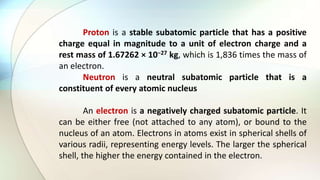
Proton is a stable subatomic particle that has a positive
charge equal in magnitude to a unit of electron charge and a
rest mass of 1.67262 × 10⁻²⁷ kg, which is 1,836 times the mass of
an electron.
Neutron is a neutral subatomic particle that is a
constituent of every atomic nucleus
An electron is a negatively charged subatomic particle. It
can be either free (not attached to any atom), or bound to the
nucleus of an atom. Electrons in atoms exist in spherical shells of
various radii, representing energy levels. The larger the spherical
shell, the higher the energy contained in the electron.
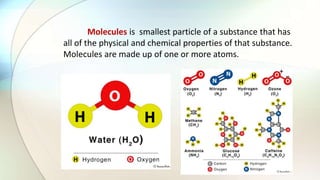
Molecules is smallest particle of a substance that has
all of the physical and chemical properties of that substance.
Molecules are made up of one or more atoms.
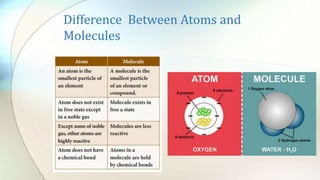
Difference Between Atoms and
Molecules
Dalton’s Atomic theory
• Matter consists of individual particles called atoms.
• Atoms cannot be created, divided, destroyed, nor converted to
another atom.
• Atoms of the same elements have identical sets of properties
but atoms of different elements differ in property.
• Compounds are composed of atoms of elements that combine in
single whole ratios.
• A chemical reaction involves only in separation, combination, or
rearrangements of atoms and does not involve creation or
destructions of atoms.
Structure of the Atom
• The atoms has two distinct regions:
a. the nucleus, which is very small, dense, and positively
charged, and where the protons and neutrons reside
b. the region outside the nucleus where electrons are
located
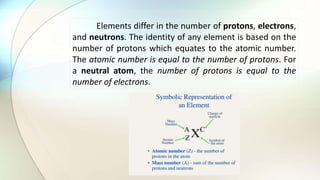
Elements differ in the number of protons, electrons,
and neutrons. The identity of any element is based on the
number of protons which equates to the atomic number.
The atomic number is equal to the number of protons. For
a neutral atom, the number of protons is equal to the
number of electrons.
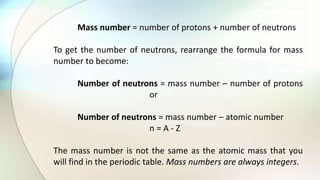
Mass number = number of protons + number of neutrons
To get the number of neutrons, rearrange the formula for mass
number to become:
Number of neutrons = mass number – number of protons
or
Number of neutrons = mass number – atomic number
n = A - Z
The mass number is not the same as the atomic mass that you
will find in the periodic table. Mass numbers are always integers.
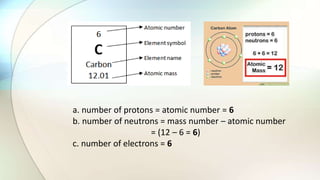
a. number of protons = atomic number = 6
b. number of neutrons = mass number – atomic number
= (12 – 6 = 6)
c. number of electrons = 6
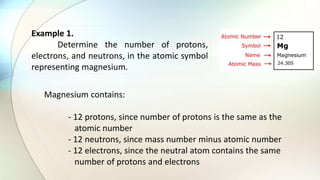
Example 1.
Determine the number of protons,
electrons, and neutrons, in the atomic symbol
representing magnesium.
Magnesium contains:
- 12 protons, since number of protons is the same as the
atomic number
- 12 neutrons, since mass number minus atomic number
- 12 electrons, since the neutral atom contains the same
number of protons and electrons
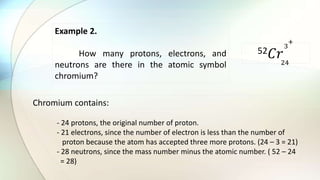
Example 2.
How many protons, electrons, and
neutrons are there in the atomic symbol
chromium?
52𝐶𝑟24
3
+
Chromium contains:
- 24 protons, the original number of proton.
- 21 electrons, since the number of electron is less than the number of
proton because the atom has accepted three more protons. (24 – 3 = 21)
- 28 neutrons, since the mass number minus the atomic number. ( 52 – 24
= 28)

Atoms and Molecules.pptx

  • 2.
    Elements are definedas pure substances that contain one type of atom while compounds are pure substances that contain two or more elements that ate chemically united.
  • 3.
    Let’s Learn Atom isthe basic unit of an element having all he characteristics of that particular element. Generally, the atom consists of a tiny center called nucleus where the proton and neutron are located and outside the nucleus on different energy levels are the electrons arranged in a systematic way.
  • 4.
    Proton is astable subatomic particle that has a positive charge equal in magnitude to a unit of electron charge and a rest mass of 1.67262 × 10⁻²⁷ kg, which is 1,836 times the mass of an electron. Neutron is a neutral subatomic particle that is a constituent of every atomic nucleus An electron is a negatively charged subatomic particle. It can be either free (not attached to any atom), or bound to the nucleus of an atom. Electrons in atoms exist in spherical shells of various radii, representing energy levels. The larger the spherical shell, the higher the energy contained in the electron.
  • 5.
    Molecules is smallestparticle of a substance that has all of the physical and chemical properties of that substance. Molecules are made up of one or more atoms.
  • 6.
  • 7.
    Dalton’s Atomic theory •Matter consists of individual particles called atoms. • Atoms cannot be created, divided, destroyed, nor converted to another atom. • Atoms of the same elements have identical sets of properties but atoms of different elements differ in property. • Compounds are composed of atoms of elements that combine in single whole ratios. • A chemical reaction involves only in separation, combination, or rearrangements of atoms and does not involve creation or destructions of atoms.
  • 8.
    Structure of theAtom • The atoms has two distinct regions: a. the nucleus, which is very small, dense, and positively charged, and where the protons and neutrons reside b. the region outside the nucleus where electrons are located
  • 9.
    Elements differ inthe number of protons, electrons, and neutrons. The identity of any element is based on the number of protons which equates to the atomic number. The atomic number is equal to the number of protons. For a neutral atom, the number of protons is equal to the number of electrons.
  • 10.
    Mass number =number of protons + number of neutrons To get the number of neutrons, rearrange the formula for mass number to become: Number of neutrons = mass number – number of protons or Number of neutrons = mass number – atomic number n = A - Z The mass number is not the same as the atomic mass that you will find in the periodic table. Mass numbers are always integers.
  • 11.
    a. number ofprotons = atomic number = 6 b. number of neutrons = mass number – atomic number = (12 – 6 = 6) c. number of electrons = 6
  • 12.
    Example 1. Determine thenumber of protons, electrons, and neutrons, in the atomic symbol representing magnesium. Magnesium contains: - 12 protons, since number of protons is the same as the atomic number - 12 neutrons, since mass number minus atomic number - 12 electrons, since the neutral atom contains the same number of protons and electrons
  • 13.
    Example 2. How manyprotons, electrons, and neutrons are there in the atomic symbol chromium? 52𝐶𝑟24 3 + Chromium contains: - 24 protons, the original number of proton. - 21 electrons, since the number of electron is less than the number of proton because the atom has accepted three more protons. (24 – 3 = 21) - 28 neutrons, since the mass number minus the atomic number. ( 52 – 24 = 28)