Chapter 8  Matter
Atoms Section 8-1 pg. 222 ques. 2 What are atoms? - Atoms  are the building blocks of  matter . So, what is matter? - Matter is anything that has a mass and takes up space. Matter surrounds us, and could take the form of solid, liquid or gas. What are some examples of matter? Rocks Desks Air Water
Atoms (continued) Is fire matter? No. What about light? No. Neither one of these things is matter because they don’t take up any space.
Atoms (continued) Is all matter visible? No. Air is matter as well as other colorless gasses like butane, or propane. What causes matter to take these various forms and shapes?  Its all depends on the way their atoms are put together and also the shape that their atoms take on. In your body has several types of atoms that combine in different ways.  These atoms form proteins, DNA, tissues and other things that makes you a person.
Also, many other objects you see around you are composed of many different types of atoms. However thee are things that are only made up of one type of atom.  These things are called the  elements. Elements are substances that are made of only one type of atom and cannot be broken down into simpler substances by ordinary chemical means.
The Atomic Model H.W. pg 229 1-2 If you cant see atoms, then how are we able to study them. We use something called an  atomic model, a theory proposed by John Dalton . All atoms of an element contain the same type of atom. Ex: All atoms of the element Carbon are carbon atoms.
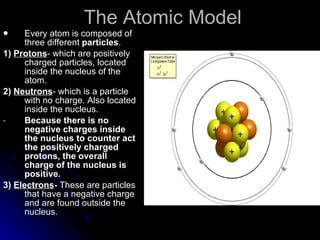
The Atomic Model Every atom is composed of three different  particles . 1)  Protons - which are positively charged particles, located inside the nucleus of the atom. 2)  Neutrons - which is a particle with no charge. Also located inside the nucleus. Because there is no negative charges inside the nucleus to counter act the positively charged protons, the overall charge of the nucleus is positive. 3)  Electrons -  These are particles that have a negative charge and are found outside the nucleus.
Electrons Electrons have some special features that we need to look at. First, we need to know that they are grouped into energy levels, and that each level contains a specific number of electrons. Second, electrons float in a kind of cloud around the nucleus of the atom. Try to think of it like a beehive.  The hive is the nucleus and all the swarming bees around the hive are the electrons .
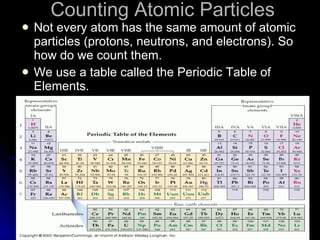
Counting Atomic Particles Not every atom has the same amount of atomic particles (protons, neutrons, and electrons). So how do we count them. We use a table called the Periodic Table of Elements.
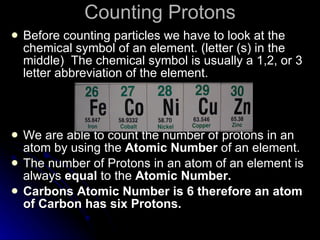
Counting Protons Before counting particles we have to look at the chemical symbol of an element. (letter (s) in the middle)  The chemical symbol is usually a 1,2, or 3 letter abbreviation of the element. We are able to count the number of protons in an atom by using the  Atomic Number  of an element. The number of Protons in an atom of an element is always  equal  to the  Atomic Number. Carbons Atomic Number is 6 therefore an atom of Carbon has six Protons.
How to count electrons In a neutral atom, the number of electrons will always be equal to the number of protons. However, some atoms can lose or gain electrons and continue to remain the same element.. If you lose an electron the overall charge of the atom becomes positive.  If you lose a proton the overall charge of the atom becomes negative.
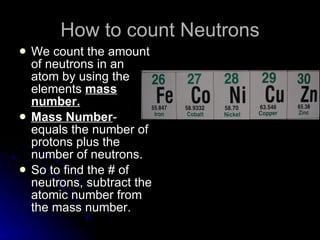
How to count Neutrons We count the amount of neutrons in an atom by using the elements  mass number. Mass Number - equals the number of protons plus the number of neutrons. So to find the # of neutrons, subtract the atomic number from the mass number.
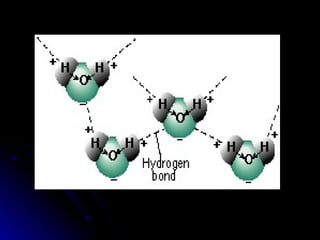
Compounds A compound is formed when atoms of two or more elements combine. Ex: 2 hydrogen atoms combine with 1 oxygen atom to produce H 2 O. Water is a compound. And H 2 O is what we call the chemical formula of water. A chemical formula is made up of symbols and numbers that tell what elements are in a compound and in what ratio they are in. What elements are in ammonia NH 3
 
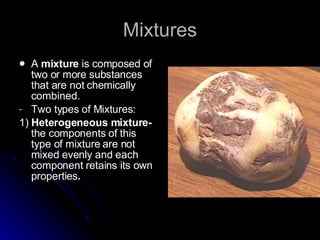
Mixtures A  mixture  is composed of two or more substances that are not chemically combined. Two types of Mixtures: 1)  Heterogeneous mixture-  the components of this type of mixture are not mixed evenly and each component retains its own properties .
Mixtures 2)  Homogeneous Mixture-  These types of mixtures are evenly mixed throughout. And individual components cannot be seen. -They are also called solutions. An Example would be how salt dissolves in water.
Separating Mixtures & Compounds Componants of a compound or a mixture can be separated by either physical or chemical means. If you boil a salt water mixture, the water will evaporate away and the salt will remain in the glass. (Physical) The components of a compound must be separated by chemical means. Ex: HCl + CaCO3 --------   CO2
Test on Chapter 8 in one week!!!!!!!

6th Grade Chapter 8

  • 1.
    Chapter 8 Matter
  • 2.
    Atoms Section 8-1pg. 222 ques. 2 What are atoms? - Atoms are the building blocks of matter . So, what is matter? - Matter is anything that has a mass and takes up space. Matter surrounds us, and could take the form of solid, liquid or gas. What are some examples of matter? Rocks Desks Air Water
  • 3.
    Atoms (continued) Isfire matter? No. What about light? No. Neither one of these things is matter because they don’t take up any space.
  • 4.
    Atoms (continued) Isall matter visible? No. Air is matter as well as other colorless gasses like butane, or propane. What causes matter to take these various forms and shapes? Its all depends on the way their atoms are put together and also the shape that their atoms take on. In your body has several types of atoms that combine in different ways. These atoms form proteins, DNA, tissues and other things that makes you a person.
  • 5.
    Also, many otherobjects you see around you are composed of many different types of atoms. However thee are things that are only made up of one type of atom. These things are called the elements. Elements are substances that are made of only one type of atom and cannot be broken down into simpler substances by ordinary chemical means.
  • 6.
    The Atomic ModelH.W. pg 229 1-2 If you cant see atoms, then how are we able to study them. We use something called an atomic model, a theory proposed by John Dalton . All atoms of an element contain the same type of atom. Ex: All atoms of the element Carbon are carbon atoms.
  • 7.
    The Atomic ModelEvery atom is composed of three different particles . 1) Protons - which are positively charged particles, located inside the nucleus of the atom. 2) Neutrons - which is a particle with no charge. Also located inside the nucleus. Because there is no negative charges inside the nucleus to counter act the positively charged protons, the overall charge of the nucleus is positive. 3) Electrons - These are particles that have a negative charge and are found outside the nucleus.
  • 8.
    Electrons Electrons havesome special features that we need to look at. First, we need to know that they are grouped into energy levels, and that each level contains a specific number of electrons. Second, electrons float in a kind of cloud around the nucleus of the atom. Try to think of it like a beehive. The hive is the nucleus and all the swarming bees around the hive are the electrons .
  • 9.
    Counting Atomic ParticlesNot every atom has the same amount of atomic particles (protons, neutrons, and electrons). So how do we count them. We use a table called the Periodic Table of Elements.
  • 10.
    Counting Protons Beforecounting particles we have to look at the chemical symbol of an element. (letter (s) in the middle) The chemical symbol is usually a 1,2, or 3 letter abbreviation of the element. We are able to count the number of protons in an atom by using the Atomic Number of an element. The number of Protons in an atom of an element is always equal to the Atomic Number. Carbons Atomic Number is 6 therefore an atom of Carbon has six Protons.
  • 11.
    How to countelectrons In a neutral atom, the number of electrons will always be equal to the number of protons. However, some atoms can lose or gain electrons and continue to remain the same element.. If you lose an electron the overall charge of the atom becomes positive. If you lose a proton the overall charge of the atom becomes negative.
  • 12.
    How to countNeutrons We count the amount of neutrons in an atom by using the elements mass number. Mass Number - equals the number of protons plus the number of neutrons. So to find the # of neutrons, subtract the atomic number from the mass number.
  • 13.
    Compounds A compoundis formed when atoms of two or more elements combine. Ex: 2 hydrogen atoms combine with 1 oxygen atom to produce H 2 O. Water is a compound. And H 2 O is what we call the chemical formula of water. A chemical formula is made up of symbols and numbers that tell what elements are in a compound and in what ratio they are in. What elements are in ammonia NH 3
  • 14.
  • 15.
    Mixtures A mixture is composed of two or more substances that are not chemically combined. Two types of Mixtures: 1) Heterogeneous mixture- the components of this type of mixture are not mixed evenly and each component retains its own properties .
  • 16.
    Mixtures 2) Homogeneous Mixture- These types of mixtures are evenly mixed throughout. And individual components cannot be seen. -They are also called solutions. An Example would be how salt dissolves in water.
  • 17.
    Separating Mixtures &Compounds Componants of a compound or a mixture can be separated by either physical or chemical means. If you boil a salt water mixture, the water will evaporate away and the salt will remain in the glass. (Physical) The components of a compound must be separated by chemical means. Ex: HCl + CaCO3 --------  CO2
  • 18.
    Test on Chapter8 in one week!!!!!!!