SCIENCE 8
ATOMIC STRUCTURE
EDEM IRISH S. RIVERA
T-I
What was our topic last meeting?
 Matter undergo physical and chemical changes. Physical
change occurs when a substance changes its appearance
without changing its composition.
 Chemical change on the other hand, occurs when a
substance is transformed into another substance.
At the end of a 60-minute period, at least
80% the learners should be able to:
 Identify protons, neutrons and electrons in a particular atoms;
 Determine the differences of protons, neutrons and electrons in a
particular atoms;
 Appreciate protons, neutrons and electrons in a particular atom in
different activities in real life situation.
 Do you know that all the elements in the periodic table can
be found in nature and some are discovered in the
laboratory.
 For example: water composed of 2 hydrogen and 1 oxygen,
salt composed of 1 sodium and 1 chlorine.
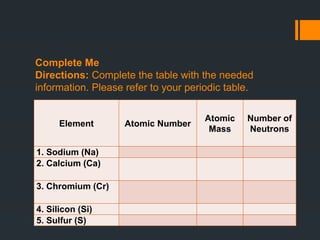
Complete Me
Directions: Complete the table with the needed
information. Please refer to your periodic table.
Element Atomic Number
Atomic
Mass
Number of
Neutrons
1. Sodium (Na)
2. Calcium (Ca)
3. Chromium (Cr)
4. Silicon (Si)
5. Sulfur (S)
Guide Questions:
1. How did you identify the atomic number and atomic mass?
2. How would you know the number of neutrons if you know
the mass number and the atomic number?
The Protons, Electrons and
Neutrons
Matter is made up of atoms which are too
small to see with the unaided eye. The
ancient Greek Philosophers thought that
atoms has no parts. However, during the
latter part of 19th
century and early half of
the 20th
century the scientist discovered
that atoms composed of three types
namely: protons, neutrons and electrons.
The Protons, Electrons and
Neutrons
Protons carries a positively charged.
Electrons carries a negatively
charged.
Neutrons which does not carry any
charge.
The Protons, Electrons and
Neutrons
An atom is identified by two numbers
 atomic number and
 mass number
ZxA
A – Mass Number,
Z – Atomic number;
x – an element
The Protons, Electrons and
Neutrons
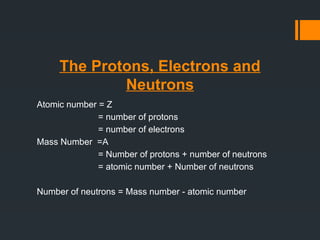
Atomic number = Z
= number of protons
= number of electrons
Mass Number =A
= Number of protons + number of neutrons
= atomic number + Number of neutrons
Number of neutrons = Mass number - atomic number
Example
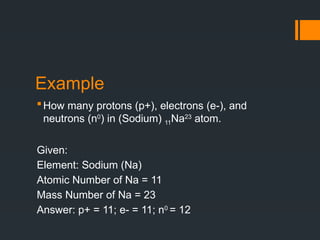
How many protons (p+), electrons (e-), and
neutrons (n0
) in (Sodium) 11Na23
atom.
Given:
Element: Sodium (Na)
Atomic Number of Na = 11
Mass Number of Na = 23
Answer: p+ = 11; e- = 11; n0
= 12
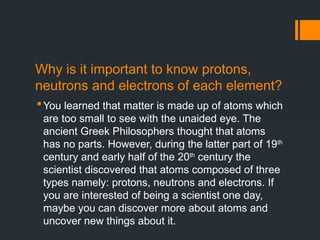
Why is it important to know protons,
neutrons and electrons of each element?
You learned that matter is made up of atoms which
are too small to see with the unaided eye. The
ancient Greek Philosophers thought that atoms
has no parts. However, during the latter part of 19th
century and early half of the 20th
century the
scientist discovered that atoms composed of three
types namely: protons, neutrons and electrons. If
you are interested of being a scientist one day,
maybe you can discover more about atoms and
uncover new things about it.
Atoms are composed of three types
and what are they?
Protons, neutrons and electrons
How did you identify the atomic
mass and atomic number?
Atomic number is located at the lower
left and the mass number is at the
upper right.
How did you identify the protons,
neutrons and electrons?
Protons and electrons is the atomic
number while the neutrons is the
difference of atomic mass and atomic
number.
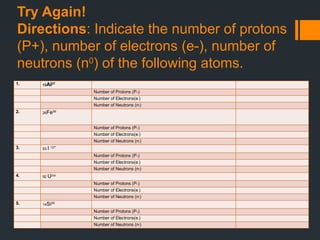
Try Again!
Directions: Indicate the number of protons
(P+), number of electrons (e-), number of
neutrons (n0
) of the following atoms.
1. 13Al27
Number of Protons (P+)
Number of Electrons(e-)
Number of Neutrons (n0
)
2. 26Fe56
Number of Protons (P+)
Number of Electrons(e-)
Number of Neutrons (n0
)
3. 53 I 127
Number of Protons (P+)
Number of Electrons(e-)
Number of Neutrons (n0
)
4. 92 U235
Number of Protons (P+)
Number of Electrons(e-)
Number of Neutrons (n0
)
5. 14Si29
Number of Protons (P+)
Number of Electrons(e-)
Number of Neutrons (n0
)
Guide Questions
Q1. If you know the number of protons of
an atom, what other particle would you
automatically know the number? And, why?
Q2. How will you compute for the number
of neutrons?
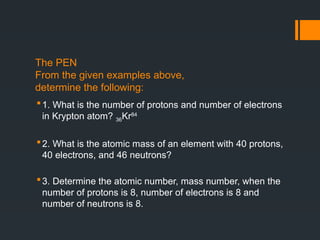
The PEN
From the given examples above,
determine the following:
1. What is the number of protons and number of electrons
in Krypton atom? 36Kr84
2. What is the atomic mass of an element with 40 protons,
40 electrons, and 46 neutrons?
3. Determine the atomic number, mass number, when the
number of protons is 8, number of electrons is 8 and
number of neutrons is 8.
The PEN
From the given examples above,
determine the following:
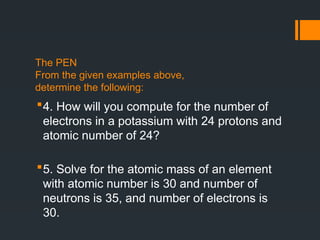
4. How will you compute for the number of
electrons in a potassium with 24 protons and
atomic number of 24?
5. Solve for the atomic mass of an element
with atomic number is 30 and number of
neutrons is 35, and number of electrons is
30.
Assignment (Individual activity)
THIS IS IT!
Direction: Write at least 5 examples of
situations in work related activities that you
had experienced which you think the
protons (the positive charged particle),
electrons (the negative charged particle),
and neutrons (the neutral charged of atom)
was applied.
THANK YOU!!!

SCIENCE 8 COT, ATOMIC STRUCTURE 3RD QUARTER

  • 1.
  • 2.
    What was ourtopic last meeting?  Matter undergo physical and chemical changes. Physical change occurs when a substance changes its appearance without changing its composition.  Chemical change on the other hand, occurs when a substance is transformed into another substance.
  • 4.
    At the endof a 60-minute period, at least 80% the learners should be able to:  Identify protons, neutrons and electrons in a particular atoms;  Determine the differences of protons, neutrons and electrons in a particular atoms;  Appreciate protons, neutrons and electrons in a particular atom in different activities in real life situation.
  • 5.
     Do youknow that all the elements in the periodic table can be found in nature and some are discovered in the laboratory.  For example: water composed of 2 hydrogen and 1 oxygen, salt composed of 1 sodium and 1 chlorine.
  • 6.
    Complete Me Directions: Completethe table with the needed information. Please refer to your periodic table. Element Atomic Number Atomic Mass Number of Neutrons 1. Sodium (Na) 2. Calcium (Ca) 3. Chromium (Cr) 4. Silicon (Si) 5. Sulfur (S)
  • 7.
    Guide Questions: 1. Howdid you identify the atomic number and atomic mass? 2. How would you know the number of neutrons if you know the mass number and the atomic number?
  • 9.
    The Protons, Electronsand Neutrons Matter is made up of atoms which are too small to see with the unaided eye. The ancient Greek Philosophers thought that atoms has no parts. However, during the latter part of 19th century and early half of the 20th century the scientist discovered that atoms composed of three types namely: protons, neutrons and electrons.
  • 10.
    The Protons, Electronsand Neutrons Protons carries a positively charged. Electrons carries a negatively charged. Neutrons which does not carry any charge.
  • 11.
    The Protons, Electronsand Neutrons An atom is identified by two numbers  atomic number and  mass number ZxA A – Mass Number, Z – Atomic number; x – an element
  • 12.
    The Protons, Electronsand Neutrons Atomic number = Z = number of protons = number of electrons Mass Number =A = Number of protons + number of neutrons = atomic number + Number of neutrons Number of neutrons = Mass number - atomic number
  • 13.
    Example How many protons(p+), electrons (e-), and neutrons (n0 ) in (Sodium) 11Na23 atom. Given: Element: Sodium (Na) Atomic Number of Na = 11 Mass Number of Na = 23 Answer: p+ = 11; e- = 11; n0 = 12
  • 14.
    Why is itimportant to know protons, neutrons and electrons of each element? You learned that matter is made up of atoms which are too small to see with the unaided eye. The ancient Greek Philosophers thought that atoms has no parts. However, during the latter part of 19th century and early half of the 20th century the scientist discovered that atoms composed of three types namely: protons, neutrons and electrons. If you are interested of being a scientist one day, maybe you can discover more about atoms and uncover new things about it.
  • 15.
    Atoms are composedof three types and what are they? Protons, neutrons and electrons
  • 16.
    How did youidentify the atomic mass and atomic number? Atomic number is located at the lower left and the mass number is at the upper right.
  • 17.
    How did youidentify the protons, neutrons and electrons? Protons and electrons is the atomic number while the neutrons is the difference of atomic mass and atomic number.
  • 18.
    Try Again! Directions: Indicatethe number of protons (P+), number of electrons (e-), number of neutrons (n0 ) of the following atoms. 1. 13Al27 Number of Protons (P+) Number of Electrons(e-) Number of Neutrons (n0 ) 2. 26Fe56 Number of Protons (P+) Number of Electrons(e-) Number of Neutrons (n0 ) 3. 53 I 127 Number of Protons (P+) Number of Electrons(e-) Number of Neutrons (n0 ) 4. 92 U235 Number of Protons (P+) Number of Electrons(e-) Number of Neutrons (n0 ) 5. 14Si29 Number of Protons (P+) Number of Electrons(e-) Number of Neutrons (n0 )
  • 19.
    Guide Questions Q1. Ifyou know the number of protons of an atom, what other particle would you automatically know the number? And, why? Q2. How will you compute for the number of neutrons?
  • 21.
    The PEN From thegiven examples above, determine the following: 1. What is the number of protons and number of electrons in Krypton atom? 36Kr84 2. What is the atomic mass of an element with 40 protons, 40 electrons, and 46 neutrons? 3. Determine the atomic number, mass number, when the number of protons is 8, number of electrons is 8 and number of neutrons is 8.
  • 22.
    The PEN From thegiven examples above, determine the following: 4. How will you compute for the number of electrons in a potassium with 24 protons and atomic number of 24? 5. Solve for the atomic mass of an element with atomic number is 30 and number of neutrons is 35, and number of electrons is 30.
  • 23.
    Assignment (Individual activity) THISIS IT! Direction: Write at least 5 examples of situations in work related activities that you had experienced which you think the protons (the positive charged particle), electrons (the negative charged particle), and neutrons (the neutral charged of atom) was applied.
  • 24.