CHAPTER 2: CHEMISTRY
SUPPLEMENTAL INSTRUCTION SESSION
MATTER
• All organisms are composed of matter
• In fact, anything that takes up space is matter
• Matter has mass
• Matter is made up of elements
• We’ve all probably seen a periodic table, right? The periodic table shows all existing chemical
elements
• Each little block on the periodic table represents a single element
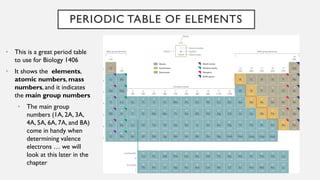
PERIODIC TABLE OF ELEMENTS
• This is a great period table
to use for Biology 1406
• It shows the elements,
atomic numbers, mass
numbers, and it indicates
the main group numbers
• The main group
numbers (1A, 2A, 3A,
4A, 5A, 6A, 7A, and 8A)
come in handy when
determining valence
electrons … we will
look at this later in the
chapter
ESSENTIAL & TRACE ELEMENTS
• In Biology 1406, we’re going to be talking a lot about a handful of elements,
especially later when we learn about biomolecules (carbohydrates, lipids,
proteins, & nucleic acids)
• There are four elements that make up 96% of all matter; all living things must have
these essential elements:
• Carbon
• Hydrogen
• Oxygen
• Nitrogen
• There are other elements, trace elements (such as Calcium or Potassium), that
we need in super small amounts
BASIC CHEMISTRY TERMS
*KEEP THESE STRAIGHT!
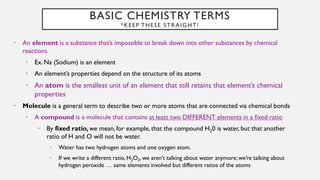
• An element is a substance that’s impossible to break down into other substances by chemical
reactions
• Ex. Na (Sodium) is an element
• An element’s properties depend on the structure of its atoms
• An atom is the smallest unit of an element that still retains that element’s chemical
properties
• Molecule is a general term to describe two or more atoms that are connected via chemical bonds
• A compound is a molecule that contains at least two DIFFERENT elements in a fixed ratio
• By fixed ratio, we mean, for example, that the compound H20 is water, but that another
ratio of H and O will not be water.
• Water has two hydrogen atoms and one oxygen atom.
• If we write a different ratio, H2O2, we aren’t talking about water anymore; we’re talking about
hydrogen peroxide … same elements involved but different ratios of the atoms
ALL COMPOUNDS ARE MOLECULES, BUT
ALL MOLECULES AREN’T COMPOUNDS!
• It’s true to say “all compounds are molecules”
• However, it’s NOT true to say “all molecules are compounds”
• Is H2O a molecule or compound?
ALL COMPOUNDS ARE MOLECULES, BUT
ALL MOLECULES AREN’T COMPOUNDS!
• It’s true to say “all compounds are molecules”
• It’s NOT true to say “all molecules are compounds”
• Is H2O (water) a molecule or compound? Be able to tell the difference!
• H2O is a compound!
• Why??
• Water is made of two elements– Hydrogen and Oxygen
• The criteria for defining a compound is simply if it has two or more
DIFFERENT elements
ALL COMPOUNDS ARE MOLECULES, BUT
ALL MOLECULES AREN’T COMPOUNDS!
• What about 02, is it a compound or molecule?
ALL COMPOUNDS ARE MOLECULES, BUT
ALL MOLECULES AREN’T COMPOUNDS!
• What about 02, is it a compound or molecule?
• 02 (Oxygen) is a molecule but not a compound!
• Why?
• O2, molecular oxygen, is simply two atoms of oxygen bonded together
• It doesn’t fit the criteria for compound because both atoms of the molecule
are the same!
ATOMS-- SUBATOMIC PARTICLES
• Remember, an atom are the smallest unit of an element that still retains the chemical
properties of that element
• Atoms are composed of subatomic particles
• There are three subatomic particles that we care about in basic chemistry and in this class
• Protons
• Electrons
• Neutrons
• With these three subatomic particles, you’ll want to memorize:
• The charge of each
• The mass of each
• The location of each
SUBATOMIC PARTICLES– ATOMIC MASSES
• A proton has a mass of 1 Dalton
• An electron has a mass of 0 Dalton
• A neutron has a mass of 1 Dalton
*FYI:
• These are actually relative masses. You don’t need to know what this means, but just a point to keep
in the back of your mind if you’re taking chemistry in the future!
• Also, we measure the masses of subatomic particles in unified atomic mass units (u), atomic
mass units (amu), or, as the Lecture PowerPoint states, daltons (Da), or but you’ll often see the
mass represented without using a unit designation
• *You don’t need to remember all of this, just don’t be confused to see u, amu, or Da … it all means the
same!
SUBATOMIC PARTICLES-- CHARGES
• A proton has a charge of +1
• An electron has a charge of -1
• A neutron has a charge of 0
SUBATOMIC PARTICLES-- LOCATION
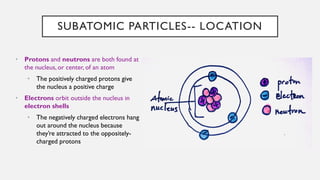
• Protons and neutrons are both found at
the nucleus, or center, of an atom
• The positively charged protons give
the nucleus a positive charge
• Electrons orbit outside the nucleus in
electron shells
• The negatively charged electrons hang
out around the nucleus because
they’re attracted to the oppositely-
charged protons
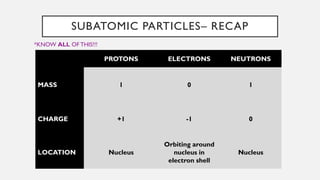
SUBATOMIC PARTICLES– RECAP
PROTONS ELECTRONS NEUTRONS
MASS 1 0 1
CHARGE +1 -1 0
LOCATION Nucleus
Orbiting around
nucleus in
electron shell
Nucleus
*KNOW ALL OF THIS!!!
ELEMENTS– THINGS WE WANT TO KNOW
• There are some basic things a very simple periodic table will tell you about an element
• Atomic number
• The atomic number shows how many protons are in the nucleus of a
particular element
• An element will always have the same number of protons and electrons; these
numbers, for a specific element will never change
• So, the atomic number tells you BOTH the number or protons AND the
number of electrons for an atom
• Mass number
• The mass number will approximate atomic mass, an atom’s total mass
• The mass number = number of protons + number of neutrons in the nucleus
WHICH IS WHICH?
• Each little block on the periodic table represents a single element
• FYI: Something to watch out for … periodic tables are not always consistent in
how they present information. It’s important to know that they may flip flop the
atomic number and mass number.
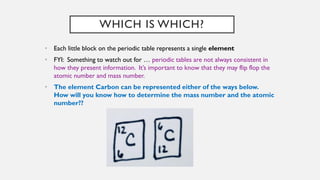
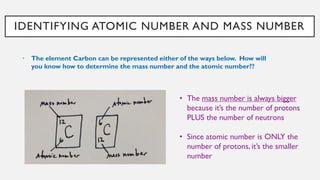
• The element Carbon can be represented either of the ways below.
How will you know how to determine the mass number and the atomic
number??
IDENTIFYING ATOMIC NUMBER AND MASS NUMBER
• The element Carbon can be represented either of the ways below. How will
you know how to determine the mass number and the atomic number??
• The mass number is always bigger
because it’s the number of protons
PLUS the number of neutrons
• Since atomic number is ONLY the
number of protons, it’s the smaller
number
IF GIVEN AN ELEMENT FROM THE PERIODIC TABLE
(AND THIS WILL HAPPEN TO YOU!), BE ABLE TO …
✓ Identify the atomic number
✓ Identify the mass number
✓ State how many protons, electrons, and neutrons are in that element
ELEMENTS ON THE PERIODIC TABLE-- RECAP
• The atomic number is the smaller number
• The atomic number tells you how many protons
• The atomic number also tells you how many electrons
• The mass number is the larger number
• The mass number will allow you to calculate how many neutrons
• The number of neutrons = mass number - atomic number
• In other words, the mass number is the number of protons plus the
number of neutrons
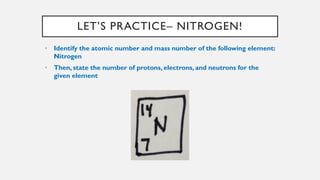
LET’S PRACTICE– NITROGEN!
• Identify the atomic number and mass number of the following element:
Nitrogen
• Then, state the number of protons, electrons, and neutrons for the
given element
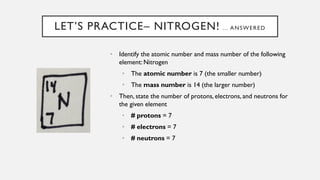
LET’S PRACTICE– NITROGEN! … ANSWERED
• Identify the atomic number and mass number of the following
element: Nitrogen
• The atomic number is 7 (the smaller number)
• The mass number is 14 (the larger number)
• Then, state the number of protons, electrons, and neutrons for
the given element
• # protons = 7
• # electrons = 7
• # neutrons = 7
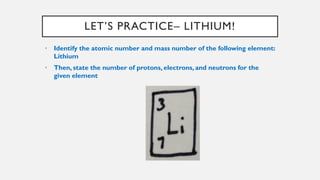
LET’S PRACTICE– LITHIUM!
• Identify the atomic number and mass number of the following element:
Lithium
• Then, state the number of protons, electrons, and neutrons for the
given element
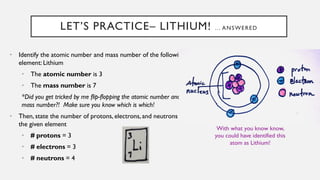
LET’S PRACTICE– LITHIUM! ... ANSWERED
• Identify the atomic number and mass number of the following
element: Lithium
• The atomic number is 3
• The mass number is 7
*Did you get tricked by me flip-flopping the atomic number and
mass number?! Make sure you know which is which!
• Then, state the number of protons, electrons, and neutrons for
the given element
• # protons = 3
• # electrons = 3
• # neutrons = 4
With what you know know,
you could have identified this
atom as Lithium!
MORE PRACTICE
• To practice more, just look at the periodic table and answer those same questions
(atomic number, atomic mass, # protons, # electrons, # neutrons) for random
elements
• You can google “what’s the atomic number for ______”,“how many protons does
______ have?”, etc. to check your work
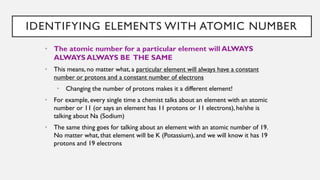
IDENTIFYING ELEMENTS WITH ATOMIC NUMBER
• The atomic number for a particular element will ALWAYS
ALWAYS ALWAYS BE THE SAME
• This means, no matter what, a particular element will always have a constant
number or protons and a constant number of electrons
• Changing the number of protons makes it a different element!
• For example, every single time a chemist talks about an element with an atomic
number or 11 (or says an element has 11 protons or 11 electrons), he/she is
talking about Na (Sodium)
• The same thing goes for talking about an element with an atomic number of 19.
No matter what, that element will be K (Potassium), and we will know it has 19
protons and 19 electrons
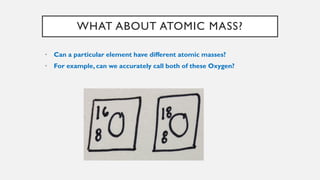
WHAT ABOUT ATOMIC MASS?
• Can a particular element have different atomic masses?
• For example, can we accurately call both of these Oxygen?
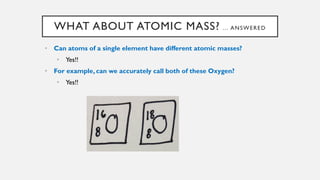
WHAT ABOUT ATOMIC MASS? … ANSWERED
• Can atoms of a single element have different atomic masses?
• Yes!!
• For example, can we accurately call both of these Oxygen?
• Yes!!
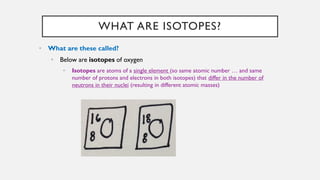
WHAT ARE ISOTOPES?
• What are these called?
• Below are isotopes of oxygen
• Isotopes are atoms of a single element (so same atomic number … and same
number of protons and electrons in both isotopes) that differ in the number of
neutrons in their nuclei (resulting in different atomic masses)
UNDERSTANDING ISOTOPES CAN BE SIMPLE!
• Because isotopes have a different number of neutrons, isotopes of a single
element will have different atomic mass numbers
• Isotopes can seem intimidating,but they really aren’t, I promise!
ISOTOPES– ANALOGY
• Imagine that I have have a little bakery out of my house and sell cookies
• I know some people may want to know how big my cookies are
• I’m a pretty consistent baker and decide to weigh 30 of my cookies
• Some weigh 15 grams; some weigh 16 grams; some weigh 17 grams
• I count and find that most of the 30 cookies weigh 16 grams, so this is what I list on my
website
• If we want to apply our chemistry terms to my cookies, we could say my cookies have three
isotopes: Cookie-15, Cookie-16, and Cookie-17
• Back to the Oxygen example, Oxygen has stable isotopes Oxyten-18, Oxyten-16, Oxygen-17
• Oxygen-16 is the most frequently occurring isotope, and that’s why the periodic table lists
Oxygen like this! For some elements, the periodic table may show a weighted average of isotopes ... but you
don’t need to know this for Biology 1406!
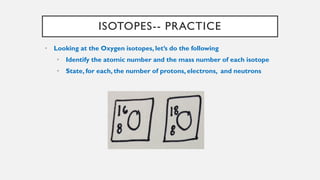
ISOTOPES-- PRACTICE
• Looking at the Oxygen isotopes, let’s do the following
• Identify the atomic number and the mass number of each isotope
• State, for each, the number of protons, electrons, and neutrons
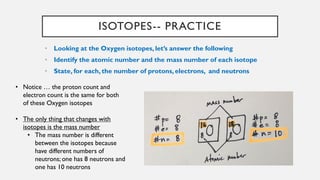
ISOTOPES-- PRACTICE
• Looking at the Oxygen isotopes, let’s answer the following
• Identify the atomic number and the mass number of each isotope
• State, for each, the number of protons, electrons, and neutrons
• Notice … the proton count and
electron count is the same for both
of these Oxygen isotopes
• The only thing that changes with
isotopes is the mass number
• The mass number is different
between the isotopes because
have different numbers of
neutrons; one has 8 neutrons and
one has 10 neutrons
POTENTIAL ENERGY
• First, know that energy means “capacity to cause change”
• When we say potential energy, we mean the energy that matter has due to its location or structure
• Imagine if I have a box of books and hold it 4” above the ground and drop it
• Imagine the same but that I drop the box from 100 feet above the ground
• The box 100 feet above has much more potential energy. Think about how that box is really
going to explode when it hits the ground, but the box that’s only 4 inches off the ground will be
virtually unaffected. This is because of differences in potential energy.
• Potential energy isn’t talking about what matter is doing at this moment; it’s talking about
what matter is capable of doing
• Atoms store potential energy in electron shells
• The farther away an electron is from the atom’s nucleus, the more potential energy it has
ELECTRONS AND ENERGY
• The numbers and distribution of electrons tell us important things about different atoms– their energy levels
and how they behave
• It was mentioned earlier that electrons hang out outside of the nucleus in electron shells
• The very outside electron shell is called the valence shell
• Valence electrons are those found in the valence shell
DETERMINING HOW MANY VALENCE ELECTRONS
• We need to know (for the exam and lab quiz/practical!) how to determine how
many valence electrons an atom has
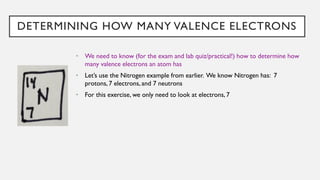
• Let’s use the Nitrogen example from earlier. We know Nitrogen has: 7
protons, 7 electrons, and 7 neutrons
• For this exercise, we only need to look at electrons, 7
ELECTRON SHELL MODELS-- NITROGEN
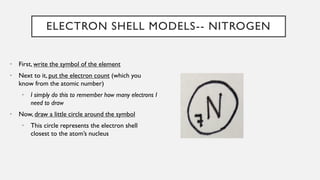
• First, write the symbol of the element
• Next to it, put the electron count (which you
know from the atomic number)
• I simply do this to remember how many electrons I
need to draw
• Now, draw a little circle around the symbol
• This circle represents the electron shell
closest to the atom’s nucleus
ELECTRON SHELL MODELS– NITROGEN’S DOTS
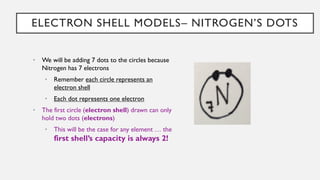
• We will be adding 7 dots to the circles because
Nitrogen has 7 electrons
• Remember each circle represents an
electron shell
• Each dot represents one electron
• The first circle (electron shell) drawn can only
hold two dots (electrons)
• This will be the case for any element … the
first shell’s capacity is always 2!
ELECTRON SHELL MODELS– MORE DOTS
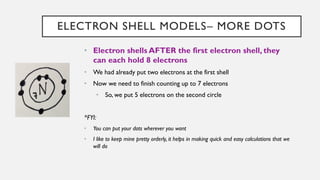
• Electron shells AFTER the first electron shell, they
can each hold 8 electrons
• We had already put two electrons at the first shell
• Now we need to finish counting up to 7 electrons
• So, we put 5 electrons on the second circle
*FYI:
• You can put your dots wherever you want
• I like to keep mine pretty orderly, it helps in making quick and easy calculations that we
will do
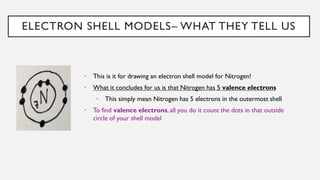
ELECTRON SHELL MODELS– WHAT THEY TELL US
• This is it for drawing an electron shell model for Nitrogen!
• What it concludes for us is that Nitrogen has 5 valence electrons
• This simply mean Nitrogen has 5 electrons in the outermost shell
• To find valence electrons, all you do it count the dots in that outside
circle of your shell model
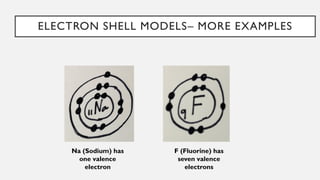
ELECTRON SHELL MODELS– MORE EXAMPLES
Na (Sodium) has
one valence
electron
F (Fluorine) has
seven valence
electrons
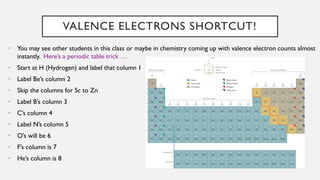
VALENCE ELECTRONS SHORTCUT!
• You may see other students in this class or maybe in chemistry coming up with valence electron counts almost
instantly. Here’s a periodic table trick …
• Start at H (Hydrogen) and label that column 1
• Label Be’s column 2
• Skip the columns for Sc to Zn
• Label B’s column 3
• C’s column 4
• Label N’s column 5
• O’s will be 6
• F’s column is 7
• He’s column is 8
VALENCE ELECTRONS SHORTCUT! CONTINUED
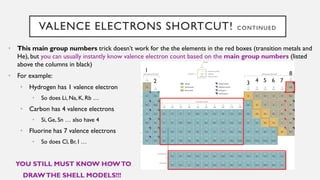
• This main group numbers trick doesn’t work for the the elements in the red boxes (transition metals and
He), but you can usually instantly know valence electron count based on the main group numbers (listed
above the columns in black)
• For example:
• Hydrogen has 1 valence electron
• So does Li, Na, K, Rb …
• Carbon has 4 valence electrons
• Si, Ge, Sn … also have 4
• Fluorine has 7 valence electrons
• So does Cl, Br, I …
YOU STILL MUST KNOW HOWTO
DRAWTHE SHELL MODELS!!!
1
2 3 4 5 6 7
8
HAPPY ATOMS
• To be “happy” (stable), an atom wants to have its outermost shell full
• Atoms team up with other atoms, through chemical bonding, to get to their happy places!
• Atoms can share or transfer electrons to other atoms to have complete valence shells
• Most atoms follow the Octet Rule and need 8 electrons in their outermost shell to be complete
• Something to know but not worry about for this class is that there are a few exceptions
• H, He, Li, and Be never follow the Octet Rule
• Sometimes B, S, or P don’t follow it either
• In this chapter, we will look at covalent bonds, ionic bonds, and hydrogen bonds
• These bonds help atoms to become happy!
VALENCY *NOT THE SAME THING AS VALENCE ELECTRONS!
• Valence electrons are the electrons in an atom’s valence shell
• Valency refers to the number of electrons an atom gains, looses, or shares to become stable
• Valency tells us an atom’s bonding capacity– the number of bonds (connections) an atom is
able to make
• With the Octet Rule, we know most atoms wants to have 8 electrons in their valence shells
• When bonding, atoms can gain, lose, or share electrons to be at that magic number 8 where they’re
stable
CALCULATING VALENCY
• To figure out the bonding potential/valency (same thing) of an atom:
• Either use the main group elements shortcut or draw out a shell model to find the
number of valence electrons
• Once you know the number of valence electrons, the Octet Rule makes it simple
• The Octet Rule says most atoms want 8 electrons in their valence shells to be stable
• After finding the number of valence electrons, calculate how many more electrons an atom
would need to have to be at 8. That answer will tell you how many bonds an atom is capable
of making!
• Valency = 8 – the # of valence electrons
CALCULATING VALENCY--CARBON
• What’s the bonding capacity for Carbon (C)?
CALCULATING VALENCY—CARBON ANSWERED
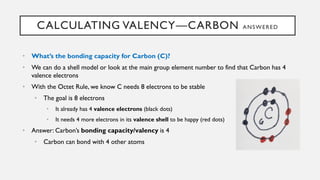
• What’s the bonding capacity for Carbon (C)?
• We can do a shell model or look at the main group element number to find that Carbon has 4
valence electrons
• With the Octet Rule, we know C needs 8 electrons to be stable
• The goal is 8 electrons
• It already has 4 valence electrons (black dots)
• It needs 4 more electrons in its valence shell to be happy (red dots)
• Answer: Carbon’s bonding capacity/valency is 4
• Carbon can bond with 4 other atoms
COVALENT BONDS
• In covalent bonding, two atoms (both non-metals) SHARE a pair or pairs of valence electrons
• The shared electrons count as part of each atom’s valence shell … and both atoms get to be happy
• In a single covalent bond, one pair of electrons is being shared, so a total of 2 atoms are shared
• A single bond is indicated by one line between two atoms
• In a double covalent bond, two pairs of electrons are being shared, so a total of 4 atoms are being
shared
• A double bond is represented by two lines connecting the atoms
STRUCTURAL VS MOLECULAR FORMULAS
• A structural formula uses lines between joined atoms to show bonding
• For example, Nitrogen Gas, N-N
• Again, the line joining the molecules indicates they are sharing a pair of electrons
• I like to envision, or sometimes even draw, dots at the end to remind me how many electrons
• A molecular formula is a further abbreviation
• The molecular formula of Nitrogen Gas is N2
• Nitrogen gas is only a molecule; it’s not a compound
• The molecular formulas are what most of us are used to seeing for molecules such as water, H2O
• Remember, water is both a molecule and a compound … because it’s composed of two or more different elements
ELECTRONEGATIVITY
• A molecule’s atoms may be more attracted or less attracted to electrons than other atoms of that
same molecule are
• Electronegativity is a measure of an atom’s attraction for the electrons within a covalent bond
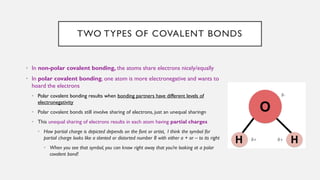
TWO TYPES OF COVALENT BONDS
• In non-polar covalent bonding, the atoms share electrons nicely/equally
• In polar covalent bonding, one atom is more electronegative and wants to
hoard the electrons
• Polar covalent bonding results when bonding partners have different levels of
electronegativity
• Polar covalent bonds still involve sharing of electrons, just an unequal sharingn
• This unequal sharing of electrons results in each atom having partial charges
• How partial charge is depicted depends on the font or artist, I think the symbol for
partial charge looks like a slanted or distorted number 8 with either a + or – to its right
• When you see that symbol, you can know right away that you’re looking at a polar
covalent bond!
IONIC BONDS
• Metals and non-metals are attracted to each other’s opposite charges and form ionic bonds
• Ionic bonds form salts in the form of crystals, such as NaCl (table salt)
• In ionic bonding, atoms sometimes STRIP/transfer electrons away from their bonding partners
• This electron transfer results in both atoms having charges– positive or negative
• A charged atom is called an ion, and there are two types of ions
• A cation is a positively charged ion
• An anion is a negatively charged ion
WEAK CHEMICAL BONDS
• Chapter 2 talks about a couple types of weak chemical bonds
• Hydrogen bonds
• Van derWaals Interactions
• Weak bonds can offer an advantage in situations where molecules need to bond
and then be able to quickly separate
HYDROGEN BONDS
• A Hydrogen Bond forms with a Hydrogen atom that’s bonded to one electronegative atom is also
attracted to another electronegative atom
• Typically, in living cells, the electronegative partner to Hydrogen is Oxygen or Nitrogen
• Hydrogen bonds will be discussed much more in Chapter 3
MOLECULAR SHAPE & FUNCTION
• A molecule’s shape is determined by the positions of the atoms’ electron orbitals
• Molecular shape is something we care lots about because this is what determines how biologicals
molecules recognize and respond to each other
CHEMICAL EQUILIBRIUM
• Many reactions are reversible
• For such reactions, the products become the reactants and vice versa
• A chemical reaction will continue as long as products don’t run out
• We say that chemical equilibrium is reached when the forward and reverse reactions occur at the
same rate
• At equilibrium, the relative concentrations of reactants and products do not change

Chapter 2 Chemistry - SUPPLEMENTAL INSTRUCTION SESSION

  • 1.
  • 2.
    MATTER • All organismsare composed of matter • In fact, anything that takes up space is matter • Matter has mass • Matter is made up of elements • We’ve all probably seen a periodic table, right? The periodic table shows all existing chemical elements • Each little block on the periodic table represents a single element
  • 3.
    PERIODIC TABLE OFELEMENTS • This is a great period table to use for Biology 1406 • It shows the elements, atomic numbers, mass numbers, and it indicates the main group numbers • The main group numbers (1A, 2A, 3A, 4A, 5A, 6A, 7A, and 8A) come in handy when determining valence electrons … we will look at this later in the chapter
  • 4.
    ESSENTIAL & TRACEELEMENTS • In Biology 1406, we’re going to be talking a lot about a handful of elements, especially later when we learn about biomolecules (carbohydrates, lipids, proteins, & nucleic acids) • There are four elements that make up 96% of all matter; all living things must have these essential elements: • Carbon • Hydrogen • Oxygen • Nitrogen • There are other elements, trace elements (such as Calcium or Potassium), that we need in super small amounts
  • 5.
    BASIC CHEMISTRY TERMS *KEEPTHESE STRAIGHT! • An element is a substance that’s impossible to break down into other substances by chemical reactions • Ex. Na (Sodium) is an element • An element’s properties depend on the structure of its atoms • An atom is the smallest unit of an element that still retains that element’s chemical properties • Molecule is a general term to describe two or more atoms that are connected via chemical bonds • A compound is a molecule that contains at least two DIFFERENT elements in a fixed ratio • By fixed ratio, we mean, for example, that the compound H20 is water, but that another ratio of H and O will not be water. • Water has two hydrogen atoms and one oxygen atom. • If we write a different ratio, H2O2, we aren’t talking about water anymore; we’re talking about hydrogen peroxide … same elements involved but different ratios of the atoms
  • 6.
    ALL COMPOUNDS AREMOLECULES, BUT ALL MOLECULES AREN’T COMPOUNDS! • It’s true to say “all compounds are molecules” • However, it’s NOT true to say “all molecules are compounds” • Is H2O a molecule or compound?
  • 7.
    ALL COMPOUNDS AREMOLECULES, BUT ALL MOLECULES AREN’T COMPOUNDS! • It’s true to say “all compounds are molecules” • It’s NOT true to say “all molecules are compounds” • Is H2O (water) a molecule or compound? Be able to tell the difference! • H2O is a compound! • Why?? • Water is made of two elements– Hydrogen and Oxygen • The criteria for defining a compound is simply if it has two or more DIFFERENT elements
  • 8.
    ALL COMPOUNDS AREMOLECULES, BUT ALL MOLECULES AREN’T COMPOUNDS! • What about 02, is it a compound or molecule?
  • 9.
    ALL COMPOUNDS AREMOLECULES, BUT ALL MOLECULES AREN’T COMPOUNDS! • What about 02, is it a compound or molecule? • 02 (Oxygen) is a molecule but not a compound! • Why? • O2, molecular oxygen, is simply two atoms of oxygen bonded together • It doesn’t fit the criteria for compound because both atoms of the molecule are the same!
  • 10.
    ATOMS-- SUBATOMIC PARTICLES •Remember, an atom are the smallest unit of an element that still retains the chemical properties of that element • Atoms are composed of subatomic particles • There are three subatomic particles that we care about in basic chemistry and in this class • Protons • Electrons • Neutrons • With these three subatomic particles, you’ll want to memorize: • The charge of each • The mass of each • The location of each
  • 11.
    SUBATOMIC PARTICLES– ATOMICMASSES • A proton has a mass of 1 Dalton • An electron has a mass of 0 Dalton • A neutron has a mass of 1 Dalton *FYI: • These are actually relative masses. You don’t need to know what this means, but just a point to keep in the back of your mind if you’re taking chemistry in the future! • Also, we measure the masses of subatomic particles in unified atomic mass units (u), atomic mass units (amu), or, as the Lecture PowerPoint states, daltons (Da), or but you’ll often see the mass represented without using a unit designation • *You don’t need to remember all of this, just don’t be confused to see u, amu, or Da … it all means the same!
  • 12.
    SUBATOMIC PARTICLES-- CHARGES •A proton has a charge of +1 • An electron has a charge of -1 • A neutron has a charge of 0
  • 13.
    SUBATOMIC PARTICLES-- LOCATION •Protons and neutrons are both found at the nucleus, or center, of an atom • The positively charged protons give the nucleus a positive charge • Electrons orbit outside the nucleus in electron shells • The negatively charged electrons hang out around the nucleus because they’re attracted to the oppositely- charged protons
  • 14.
    SUBATOMIC PARTICLES– RECAP PROTONSELECTRONS NEUTRONS MASS 1 0 1 CHARGE +1 -1 0 LOCATION Nucleus Orbiting around nucleus in electron shell Nucleus *KNOW ALL OF THIS!!!
  • 15.
    ELEMENTS– THINGS WEWANT TO KNOW • There are some basic things a very simple periodic table will tell you about an element • Atomic number • The atomic number shows how many protons are in the nucleus of a particular element • An element will always have the same number of protons and electrons; these numbers, for a specific element will never change • So, the atomic number tells you BOTH the number or protons AND the number of electrons for an atom • Mass number • The mass number will approximate atomic mass, an atom’s total mass • The mass number = number of protons + number of neutrons in the nucleus
  • 16.
    WHICH IS WHICH? •Each little block on the periodic table represents a single element • FYI: Something to watch out for … periodic tables are not always consistent in how they present information. It’s important to know that they may flip flop the atomic number and mass number. • The element Carbon can be represented either of the ways below. How will you know how to determine the mass number and the atomic number??
  • 17.
    IDENTIFYING ATOMIC NUMBERAND MASS NUMBER • The element Carbon can be represented either of the ways below. How will you know how to determine the mass number and the atomic number?? • The mass number is always bigger because it’s the number of protons PLUS the number of neutrons • Since atomic number is ONLY the number of protons, it’s the smaller number
  • 18.
    IF GIVEN ANELEMENT FROM THE PERIODIC TABLE (AND THIS WILL HAPPEN TO YOU!), BE ABLE TO … ✓ Identify the atomic number ✓ Identify the mass number ✓ State how many protons, electrons, and neutrons are in that element
  • 19.
    ELEMENTS ON THEPERIODIC TABLE-- RECAP • The atomic number is the smaller number • The atomic number tells you how many protons • The atomic number also tells you how many electrons • The mass number is the larger number • The mass number will allow you to calculate how many neutrons • The number of neutrons = mass number - atomic number • In other words, the mass number is the number of protons plus the number of neutrons
  • 20.
    LET’S PRACTICE– NITROGEN! •Identify the atomic number and mass number of the following element: Nitrogen • Then, state the number of protons, electrons, and neutrons for the given element
  • 21.
    LET’S PRACTICE– NITROGEN!… ANSWERED • Identify the atomic number and mass number of the following element: Nitrogen • The atomic number is 7 (the smaller number) • The mass number is 14 (the larger number) • Then, state the number of protons, electrons, and neutrons for the given element • # protons = 7 • # electrons = 7 • # neutrons = 7
  • 22.
    LET’S PRACTICE– LITHIUM! •Identify the atomic number and mass number of the following element: Lithium • Then, state the number of protons, electrons, and neutrons for the given element
  • 23.
    LET’S PRACTICE– LITHIUM!... ANSWERED • Identify the atomic number and mass number of the following element: Lithium • The atomic number is 3 • The mass number is 7 *Did you get tricked by me flip-flopping the atomic number and mass number?! Make sure you know which is which! • Then, state the number of protons, electrons, and neutrons for the given element • # protons = 3 • # electrons = 3 • # neutrons = 4 With what you know know, you could have identified this atom as Lithium!
  • 24.
    MORE PRACTICE • Topractice more, just look at the periodic table and answer those same questions (atomic number, atomic mass, # protons, # electrons, # neutrons) for random elements • You can google “what’s the atomic number for ______”,“how many protons does ______ have?”, etc. to check your work
  • 25.
    IDENTIFYING ELEMENTS WITHATOMIC NUMBER • The atomic number for a particular element will ALWAYS ALWAYS ALWAYS BE THE SAME • This means, no matter what, a particular element will always have a constant number or protons and a constant number of electrons • Changing the number of protons makes it a different element! • For example, every single time a chemist talks about an element with an atomic number or 11 (or says an element has 11 protons or 11 electrons), he/she is talking about Na (Sodium) • The same thing goes for talking about an element with an atomic number of 19. No matter what, that element will be K (Potassium), and we will know it has 19 protons and 19 electrons
  • 26.
    WHAT ABOUT ATOMICMASS? • Can a particular element have different atomic masses? • For example, can we accurately call both of these Oxygen?
  • 27.
    WHAT ABOUT ATOMICMASS? … ANSWERED • Can atoms of a single element have different atomic masses? • Yes!! • For example, can we accurately call both of these Oxygen? • Yes!!
  • 28.
    WHAT ARE ISOTOPES? •What are these called? • Below are isotopes of oxygen • Isotopes are atoms of a single element (so same atomic number … and same number of protons and electrons in both isotopes) that differ in the number of neutrons in their nuclei (resulting in different atomic masses)
  • 29.
    UNDERSTANDING ISOTOPES CANBE SIMPLE! • Because isotopes have a different number of neutrons, isotopes of a single element will have different atomic mass numbers • Isotopes can seem intimidating,but they really aren’t, I promise!
  • 30.
    ISOTOPES– ANALOGY • Imaginethat I have have a little bakery out of my house and sell cookies • I know some people may want to know how big my cookies are • I’m a pretty consistent baker and decide to weigh 30 of my cookies • Some weigh 15 grams; some weigh 16 grams; some weigh 17 grams • I count and find that most of the 30 cookies weigh 16 grams, so this is what I list on my website • If we want to apply our chemistry terms to my cookies, we could say my cookies have three isotopes: Cookie-15, Cookie-16, and Cookie-17 • Back to the Oxygen example, Oxygen has stable isotopes Oxyten-18, Oxyten-16, Oxygen-17 • Oxygen-16 is the most frequently occurring isotope, and that’s why the periodic table lists Oxygen like this! For some elements, the periodic table may show a weighted average of isotopes ... but you don’t need to know this for Biology 1406!
  • 31.
    ISOTOPES-- PRACTICE • Lookingat the Oxygen isotopes, let’s do the following • Identify the atomic number and the mass number of each isotope • State, for each, the number of protons, electrons, and neutrons
  • 32.
    ISOTOPES-- PRACTICE • Lookingat the Oxygen isotopes, let’s answer the following • Identify the atomic number and the mass number of each isotope • State, for each, the number of protons, electrons, and neutrons • Notice … the proton count and electron count is the same for both of these Oxygen isotopes • The only thing that changes with isotopes is the mass number • The mass number is different between the isotopes because have different numbers of neutrons; one has 8 neutrons and one has 10 neutrons
  • 33.
    POTENTIAL ENERGY • First,know that energy means “capacity to cause change” • When we say potential energy, we mean the energy that matter has due to its location or structure • Imagine if I have a box of books and hold it 4” above the ground and drop it • Imagine the same but that I drop the box from 100 feet above the ground • The box 100 feet above has much more potential energy. Think about how that box is really going to explode when it hits the ground, but the box that’s only 4 inches off the ground will be virtually unaffected. This is because of differences in potential energy. • Potential energy isn’t talking about what matter is doing at this moment; it’s talking about what matter is capable of doing • Atoms store potential energy in electron shells • The farther away an electron is from the atom’s nucleus, the more potential energy it has
  • 34.
    ELECTRONS AND ENERGY •The numbers and distribution of electrons tell us important things about different atoms– their energy levels and how they behave • It was mentioned earlier that electrons hang out outside of the nucleus in electron shells • The very outside electron shell is called the valence shell • Valence electrons are those found in the valence shell
  • 35.
    DETERMINING HOW MANYVALENCE ELECTRONS • We need to know (for the exam and lab quiz/practical!) how to determine how many valence electrons an atom has • Let’s use the Nitrogen example from earlier. We know Nitrogen has: 7 protons, 7 electrons, and 7 neutrons • For this exercise, we only need to look at electrons, 7
  • 36.
    ELECTRON SHELL MODELS--NITROGEN • First, write the symbol of the element • Next to it, put the electron count (which you know from the atomic number) • I simply do this to remember how many electrons I need to draw • Now, draw a little circle around the symbol • This circle represents the electron shell closest to the atom’s nucleus
  • 37.
    ELECTRON SHELL MODELS–NITROGEN’S DOTS • We will be adding 7 dots to the circles because Nitrogen has 7 electrons • Remember each circle represents an electron shell • Each dot represents one electron • The first circle (electron shell) drawn can only hold two dots (electrons) • This will be the case for any element … the first shell’s capacity is always 2!
  • 38.
    ELECTRON SHELL MODELS–MORE DOTS • Electron shells AFTER the first electron shell, they can each hold 8 electrons • We had already put two electrons at the first shell • Now we need to finish counting up to 7 electrons • So, we put 5 electrons on the second circle *FYI: • You can put your dots wherever you want • I like to keep mine pretty orderly, it helps in making quick and easy calculations that we will do
  • 39.
    ELECTRON SHELL MODELS–WHAT THEY TELL US • This is it for drawing an electron shell model for Nitrogen! • What it concludes for us is that Nitrogen has 5 valence electrons • This simply mean Nitrogen has 5 electrons in the outermost shell • To find valence electrons, all you do it count the dots in that outside circle of your shell model
  • 40.
    ELECTRON SHELL MODELS–MORE EXAMPLES Na (Sodium) has one valence electron F (Fluorine) has seven valence electrons
  • 41.
    VALENCE ELECTRONS SHORTCUT! •You may see other students in this class or maybe in chemistry coming up with valence electron counts almost instantly. Here’s a periodic table trick … • Start at H (Hydrogen) and label that column 1 • Label Be’s column 2 • Skip the columns for Sc to Zn • Label B’s column 3 • C’s column 4 • Label N’s column 5 • O’s will be 6 • F’s column is 7 • He’s column is 8
  • 42.
    VALENCE ELECTRONS SHORTCUT!CONTINUED • This main group numbers trick doesn’t work for the the elements in the red boxes (transition metals and He), but you can usually instantly know valence electron count based on the main group numbers (listed above the columns in black) • For example: • Hydrogen has 1 valence electron • So does Li, Na, K, Rb … • Carbon has 4 valence electrons • Si, Ge, Sn … also have 4 • Fluorine has 7 valence electrons • So does Cl, Br, I … YOU STILL MUST KNOW HOWTO DRAWTHE SHELL MODELS!!! 1 2 3 4 5 6 7 8
  • 43.
    HAPPY ATOMS • Tobe “happy” (stable), an atom wants to have its outermost shell full • Atoms team up with other atoms, through chemical bonding, to get to their happy places! • Atoms can share or transfer electrons to other atoms to have complete valence shells • Most atoms follow the Octet Rule and need 8 electrons in their outermost shell to be complete • Something to know but not worry about for this class is that there are a few exceptions • H, He, Li, and Be never follow the Octet Rule • Sometimes B, S, or P don’t follow it either • In this chapter, we will look at covalent bonds, ionic bonds, and hydrogen bonds • These bonds help atoms to become happy!
  • 44.
    VALENCY *NOT THESAME THING AS VALENCE ELECTRONS! • Valence electrons are the electrons in an atom’s valence shell • Valency refers to the number of electrons an atom gains, looses, or shares to become stable • Valency tells us an atom’s bonding capacity– the number of bonds (connections) an atom is able to make • With the Octet Rule, we know most atoms wants to have 8 electrons in their valence shells • When bonding, atoms can gain, lose, or share electrons to be at that magic number 8 where they’re stable
  • 45.
    CALCULATING VALENCY • Tofigure out the bonding potential/valency (same thing) of an atom: • Either use the main group elements shortcut or draw out a shell model to find the number of valence electrons • Once you know the number of valence electrons, the Octet Rule makes it simple • The Octet Rule says most atoms want 8 electrons in their valence shells to be stable • After finding the number of valence electrons, calculate how many more electrons an atom would need to have to be at 8. That answer will tell you how many bonds an atom is capable of making! • Valency = 8 – the # of valence electrons
  • 46.
    CALCULATING VALENCY--CARBON • What’sthe bonding capacity for Carbon (C)?
  • 47.
    CALCULATING VALENCY—CARBON ANSWERED •What’s the bonding capacity for Carbon (C)? • We can do a shell model or look at the main group element number to find that Carbon has 4 valence electrons • With the Octet Rule, we know C needs 8 electrons to be stable • The goal is 8 electrons • It already has 4 valence electrons (black dots) • It needs 4 more electrons in its valence shell to be happy (red dots) • Answer: Carbon’s bonding capacity/valency is 4 • Carbon can bond with 4 other atoms
  • 48.
    COVALENT BONDS • Incovalent bonding, two atoms (both non-metals) SHARE a pair or pairs of valence electrons • The shared electrons count as part of each atom’s valence shell … and both atoms get to be happy • In a single covalent bond, one pair of electrons is being shared, so a total of 2 atoms are shared • A single bond is indicated by one line between two atoms • In a double covalent bond, two pairs of electrons are being shared, so a total of 4 atoms are being shared • A double bond is represented by two lines connecting the atoms
  • 49.
    STRUCTURAL VS MOLECULARFORMULAS • A structural formula uses lines between joined atoms to show bonding • For example, Nitrogen Gas, N-N • Again, the line joining the molecules indicates they are sharing a pair of electrons • I like to envision, or sometimes even draw, dots at the end to remind me how many electrons • A molecular formula is a further abbreviation • The molecular formula of Nitrogen Gas is N2 • Nitrogen gas is only a molecule; it’s not a compound • The molecular formulas are what most of us are used to seeing for molecules such as water, H2O • Remember, water is both a molecule and a compound … because it’s composed of two or more different elements
  • 50.
    ELECTRONEGATIVITY • A molecule’satoms may be more attracted or less attracted to electrons than other atoms of that same molecule are • Electronegativity is a measure of an atom’s attraction for the electrons within a covalent bond
  • 51.
    TWO TYPES OFCOVALENT BONDS • In non-polar covalent bonding, the atoms share electrons nicely/equally • In polar covalent bonding, one atom is more electronegative and wants to hoard the electrons • Polar covalent bonding results when bonding partners have different levels of electronegativity • Polar covalent bonds still involve sharing of electrons, just an unequal sharingn • This unequal sharing of electrons results in each atom having partial charges • How partial charge is depicted depends on the font or artist, I think the symbol for partial charge looks like a slanted or distorted number 8 with either a + or – to its right • When you see that symbol, you can know right away that you’re looking at a polar covalent bond!
  • 52.
    IONIC BONDS • Metalsand non-metals are attracted to each other’s opposite charges and form ionic bonds • Ionic bonds form salts in the form of crystals, such as NaCl (table salt) • In ionic bonding, atoms sometimes STRIP/transfer electrons away from their bonding partners • This electron transfer results in both atoms having charges– positive or negative • A charged atom is called an ion, and there are two types of ions • A cation is a positively charged ion • An anion is a negatively charged ion
  • 53.
    WEAK CHEMICAL BONDS •Chapter 2 talks about a couple types of weak chemical bonds • Hydrogen bonds • Van derWaals Interactions • Weak bonds can offer an advantage in situations where molecules need to bond and then be able to quickly separate
  • 54.
    HYDROGEN BONDS • AHydrogen Bond forms with a Hydrogen atom that’s bonded to one electronegative atom is also attracted to another electronegative atom • Typically, in living cells, the electronegative partner to Hydrogen is Oxygen or Nitrogen • Hydrogen bonds will be discussed much more in Chapter 3
  • 55.
    MOLECULAR SHAPE &FUNCTION • A molecule’s shape is determined by the positions of the atoms’ electron orbitals • Molecular shape is something we care lots about because this is what determines how biologicals molecules recognize and respond to each other
  • 56.
    CHEMICAL EQUILIBRIUM • Manyreactions are reversible • For such reactions, the products become the reactants and vice versa • A chemical reaction will continue as long as products don’t run out • We say that chemical equilibrium is reached when the forward and reverse reactions occur at the same rate • At equilibrium, the relative concentrations of reactants and products do not change