1
Atomic Absorption
Atomic Absorption
Spectroscopy (AAS)
Spectroscopy (AAS)
Dr. Bahzad Afzal
2
Atomic Absorption
Atomic Absorption
Spectroscopy (AAS)
Spectroscopy (AAS)
• AAS was developed in the 1950’s by Dr. Alan
Walsh of the CSIRO Division of Chemical Physics
• It uses the narrow atomic absorbance lines to
uniquely identify and measure the concentrations of
atoms in a sample that may contain a complex mixture
• Each element is measured separately by a hollow
cathode lamp that uses the same element to produce
emission lines with its own unique wavelengths. In this
way one element can be singled out of many
• The hollow cathode lamp works like a cathode ray
tube
An electrical discharge is used to ionize gaseous atoms
(+ve), which then impact onto a metal cathode (-ve).
The metal is vaporised and electronically excited, and
hence emits its characteristic wavelengths when it
returns to its ground state
3
Atomic Absorption
Atomic Absorption
Spectroscopy (AAS)…
Spectroscopy (AAS)…
4
Atomic Absorption
Atomic Absorption
Spectroscopy (AAS)…
Spectroscopy (AAS)…
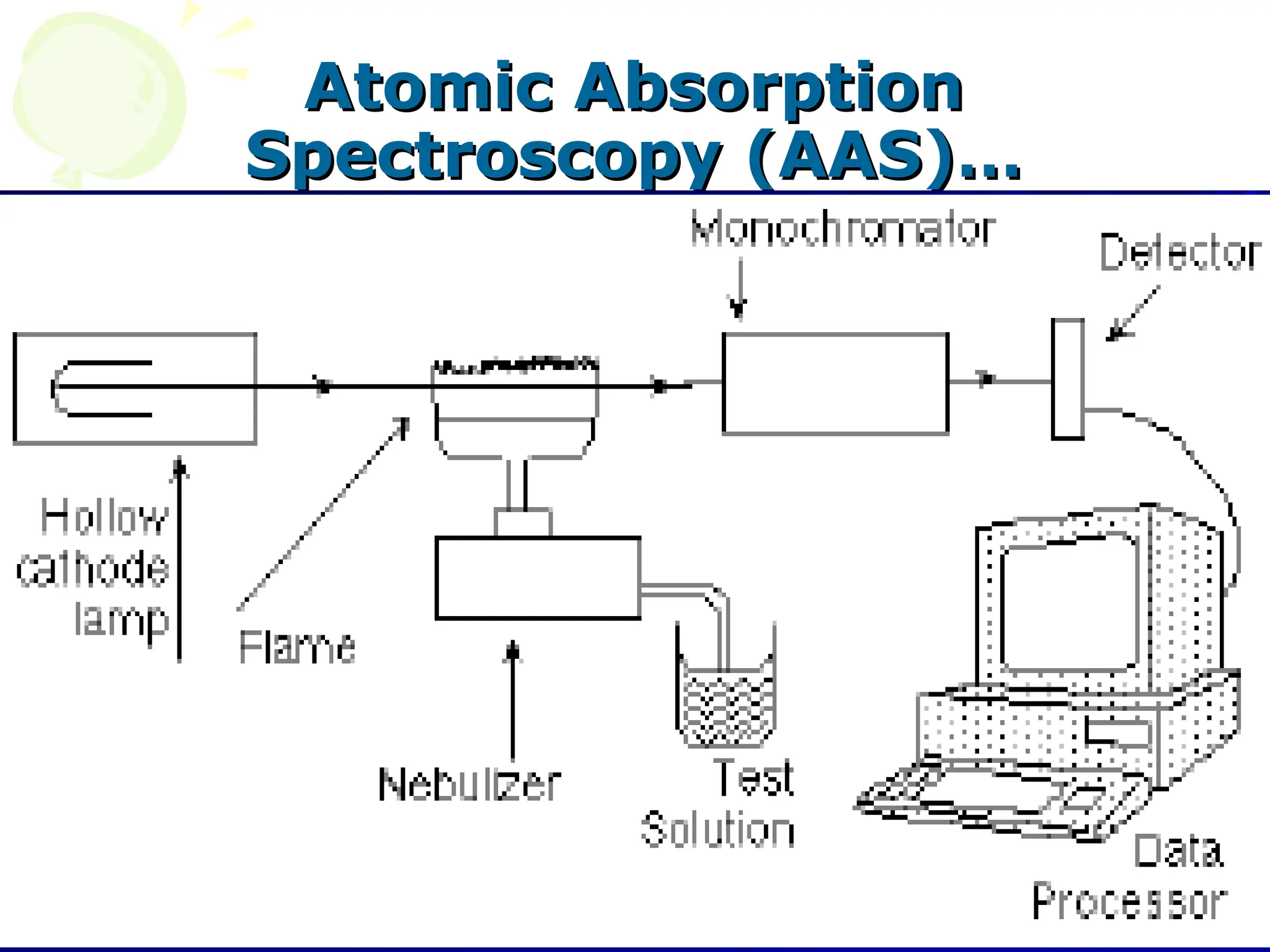
• Samples for AAS analysis must be vaporized and
atomized, so that they are not present as molecules
or strongly interacting with other atoms or molecules,
as these affect the electronic energy levels and hence
the transition wavelengths
• This is achieved in two ways
1. Flame
– Flame atomization heats the sample to ~1000°C, which
can vapourise solutions. Flame atomizers typically use a
vacuum aspirator to suck solution with the element to be
analyzed into a slit flame (~5cm long)
2. Graphite Furnace
– A graphite furnace can work with solid or liquid samples,
and smaller volumes than a flame. They also provide a
better controlled environment. E.g. the furnace can be
oxygen-free to prevent oxidation of the element of
interest
5
Conti…
Conti…
• Cylindrical shape of the cathode gives direction
to emerging beam, and helps re-deposit
sputtered atoms back on cathode
• Monochromator
– Isolates particular spectral line & eliminates stray
radiation e.g., emissions from inert gas in lamp
• Modulation
– Of light beam upstream of flame (by rotating
chopper) allows detector to reject emission generated
within flame
6
Conti…
Conti…
AAS is used quantitatively, to measure the
concentration of one or more elements using the
appropriate lamp.
7
Hollow Cathode Lamp
Hollow Cathode Lamp
• Absorption in the flame is by vapor phase atoms, giving
line spectra in this case absorption lines
• A continuous spectrum light source, even with high
quality mono-chromator cannot achieve sufficiently
narrow band pass width for absorption line spectra
• Use special lamps, each emitting line spectrum matched
to the line spectrum of the analyte atoms in the flame.
The type of lamp is a hollow cathode lamp
• At high voltage, ions of He or Ar gas form at anode and
bombard cathode
• SPUTTERING occurs - atoms dislodged from the surface
and produce an atomic cloud. Some sputtered atoms are
in excited state and emit their characteristic line
spectrum as they revert to the ground state.
8
Ar
Ar
Ar
Ar
Ar
+
-
Cathode
(made of metalto be measured)
Ar+
anode
window
Hollow Cathode Lamp…
9
Hollow Cathode Lamps Uncoded
Multi-Element
Multi-Element
• Lamp is QA/QC tested for maximum
lifetime
• Low noise,
• Optimum stability
• These solid-cathode Uni-element
coded lamps
10
Hollow Cathode Lamps Coded
Multi-Element
Multi-Element
• Lamp is QA/QC tested for maximum
lifetime
• Low noise
• Optimum stability
• These solid-cathode multi-element
coded lamps feature unique
combinations of compatible
elements that extend the
versatility of any AA spectrometer
11
Trace Analysis of Elements by
AAS
AAS
• The concentration of an element in a
sample can be determined from its absorbance
by comparing with one or more standard
solutions
• This uses Beer-Lambert Law, that
absorbance, A, is directly proportional to
the optical path length, l, and
concentration, c.
A =ε cl
A slit flame is used to define
and the optical path length
12
Experimental Aspects of AAS
• Metallic elements (Ca & Mg) in clinical labs
• Heavy metal pollutants ( Pb, Hg, Cu etc) in
environmental labs
• Strong metalcomplexes (not easily decomposed to
atoms in the flame) low result eg,
• Ca interference by phosphate, overcome by adding
lanthanum chloride (LaCl3) to samples (&
standards & blank). La3+ ions are a RELEASING
AGENT for Ca
• Phosphate ions trapped as more stable lanthanum
phosphate complexes; calcium released as free
Ca2+ ions - more easily reduced to atoms in the
flame.
• Flame is most common but not the only way of forming
atomic vapor of an element to make use of its
absorption.
13
Sample Introduction
Sample Introduction
• Nothing special for gas samples
• Liquid
– Pneumatic
– Microconcentric, self-aspirating
– Ultrasonic
– Desolvating
• Solid
– Heat
– Laser Ablation
– Laser Desorption (matrix assisted and non-
assisted)
14
Applications of AAS
Applications of AAS
1. Flame AAS is routinely used to determine
the concentrations of metals in particular
in various water environments, and whether
these exceed safe levels
• e.g. The US Environmental Protection
Agency limits lead in drinking water to a
maximum of 15 parts per billion (ppb)
1 part per million (ppm) = 1 mg/kg
ppb = 1 mg/1000kg
15
Applications of AAS…
2. AAS can be used to in studies of toxicity,
again particularly for heavy metals
– Heavy metals like mercury, arsenic,
lead, and chromium are not easily
stored within the body, so they
accumulate in the hair and fingernails
– These can be prepared for flame AAS
analysis by digestion in concentrated
acid, or combusted in an oven
16

L11-AASpectoscopy techniques for food.ppt

  • 1.
    1 Atomic Absorption Atomic Absorption Spectroscopy(AAS) Spectroscopy (AAS) Dr. Bahzad Afzal
  • 2.
    2 Atomic Absorption Atomic Absorption Spectroscopy(AAS) Spectroscopy (AAS) • AAS was developed in the 1950’s by Dr. Alan Walsh of the CSIRO Division of Chemical Physics • It uses the narrow atomic absorbance lines to uniquely identify and measure the concentrations of atoms in a sample that may contain a complex mixture • Each element is measured separately by a hollow cathode lamp that uses the same element to produce emission lines with its own unique wavelengths. In this way one element can be singled out of many • The hollow cathode lamp works like a cathode ray tube An electrical discharge is used to ionize gaseous atoms (+ve), which then impact onto a metal cathode (-ve). The metal is vaporised and electronically excited, and hence emits its characteristic wavelengths when it returns to its ground state
  • 3.
    3 Atomic Absorption Atomic Absorption Spectroscopy(AAS)… Spectroscopy (AAS)…
  • 4.
    4 Atomic Absorption Atomic Absorption Spectroscopy(AAS)… Spectroscopy (AAS)… • Samples for AAS analysis must be vaporized and atomized, so that they are not present as molecules or strongly interacting with other atoms or molecules, as these affect the electronic energy levels and hence the transition wavelengths • This is achieved in two ways 1. Flame – Flame atomization heats the sample to ~1000°C, which can vapourise solutions. Flame atomizers typically use a vacuum aspirator to suck solution with the element to be analyzed into a slit flame (~5cm long) 2. Graphite Furnace – A graphite furnace can work with solid or liquid samples, and smaller volumes than a flame. They also provide a better controlled environment. E.g. the furnace can be oxygen-free to prevent oxidation of the element of interest
  • 5.
    5 Conti… Conti… • Cylindrical shapeof the cathode gives direction to emerging beam, and helps re-deposit sputtered atoms back on cathode • Monochromator – Isolates particular spectral line & eliminates stray radiation e.g., emissions from inert gas in lamp • Modulation – Of light beam upstream of flame (by rotating chopper) allows detector to reject emission generated within flame
  • 6.
    6 Conti… Conti… AAS is usedquantitatively, to measure the concentration of one or more elements using the appropriate lamp.
  • 7.
    7 Hollow Cathode Lamp HollowCathode Lamp • Absorption in the flame is by vapor phase atoms, giving line spectra in this case absorption lines • A continuous spectrum light source, even with high quality mono-chromator cannot achieve sufficiently narrow band pass width for absorption line spectra • Use special lamps, each emitting line spectrum matched to the line spectrum of the analyte atoms in the flame. The type of lamp is a hollow cathode lamp • At high voltage, ions of He or Ar gas form at anode and bombard cathode • SPUTTERING occurs - atoms dislodged from the surface and produce an atomic cloud. Some sputtered atoms are in excited state and emit their characteristic line spectrum as they revert to the ground state.
  • 8.
    8 Ar Ar Ar Ar Ar + - Cathode (made of metaltobe measured) Ar+ anode window Hollow Cathode Lamp… Hollow Cathode Lamp…
  • 9.
    9 Hollow Cathode LampsUncoded Hollow Cathode Lamps Uncoded Multi-Element Multi-Element • Lamp is QA/QC tested for maximum lifetime • Low noise, • Optimum stability • These solid-cathode Uni-element coded lamps
  • 10.
    10 Hollow Cathode LampsCoded Hollow Cathode Lamps Coded Multi-Element Multi-Element • Lamp is QA/QC tested for maximum lifetime • Low noise • Optimum stability • These solid-cathode multi-element coded lamps feature unique combinations of compatible elements that extend the versatility of any AA spectrometer
  • 11.
    11 Trace Analysis ofElements by Trace Analysis of Elements by AAS AAS • The concentration of an element in a sample can be determined from its absorbance by comparing with one or more standard solutions • This uses Beer-Lambert Law, that absorbance, A, is directly proportional to the optical path length, l, and concentration, c. A =ε cl A slit flame is used to define and the optical path length
  • 12.
    12 Experimental Aspects ofAAS Experimental Aspects of AAS • Metallic elements (Ca & Mg) in clinical labs • Heavy metal pollutants ( Pb, Hg, Cu etc) in environmental labs • Strong metalcomplexes (not easily decomposed to atoms in the flame) low result eg, • Ca interference by phosphate, overcome by adding lanthanum chloride (LaCl3) to samples (& standards & blank). La3+ ions are a RELEASING AGENT for Ca • Phosphate ions trapped as more stable lanthanum phosphate complexes; calcium released as free Ca2+ ions - more easily reduced to atoms in the flame. • Flame is most common but not the only way of forming atomic vapor of an element to make use of its absorption.
  • 13.
    13 Sample Introduction Sample Introduction •Nothing special for gas samples • Liquid – Pneumatic – Microconcentric, self-aspirating – Ultrasonic – Desolvating • Solid – Heat – Laser Ablation – Laser Desorption (matrix assisted and non- assisted)
  • 14.
    14 Applications of AAS Applicationsof AAS 1. Flame AAS is routinely used to determine the concentrations of metals in particular in various water environments, and whether these exceed safe levels • e.g. The US Environmental Protection Agency limits lead in drinking water to a maximum of 15 parts per billion (ppb) 1 part per million (ppm) = 1 mg/kg ppb = 1 mg/1000kg
  • 15.
    15 Applications of AAS… Applicationsof AAS… 2. AAS can be used to in studies of toxicity, again particularly for heavy metals – Heavy metals like mercury, arsenic, lead, and chromium are not easily stored within the body, so they accumulate in the hair and fingernails – These can be prepared for flame AAS analysis by digestion in concentrated acid, or combusted in an oven
  • 16.