Prepared and presented by:
             Pinak R. Patel
          Assistant Professor
Department of pharmaceutical Chemistry
   Dharmaj, degree pharmacy college
• The Spectrophotometric assay of drugs rarely
  involves the measurement of absorbance of samples
  containing only one absorbing component.

• The pharmaceutical analyst frequently encounters
  the situation where the concentration of one or
  more substances is required in samples known to
  contain other absorbing substances, which
  potentially interfere in the assay.

• If the formula of the samples is known, the identity
  and concentration of the interferents are known and
  the extent of interference in the assay may be
  determined.
Some of the commonly used Spectrophotometric
 methods are as follows,
1. Simultaneous equation method (Vierdott’s method)

2. Derivative Spectrophotometric method

3. Absorbance ratio method ( Q-Absorbance method)

4. Solvent extraction method

5. Dual wavelength method

6. Geometric correction method

7. Orthogonal poly nominal method

8. H-point standard addition method

9. Least square approximation method
The basis of all the Spectrophotometric           techniques   for
  multicomponent samples is the property that

at all wavelengths:

•  The absorbance of a solution is the sum of absorbance of the
  individual components
   or
• The measured absorbance is the difference between the total
 absorbance of the solution in the sample cell and that of the
 solution in the reference cell.

And most importantly the excipients present in the formulation are
  not absorbing at the wavelength of experiment.

If all of these conditions are satisfied than we can apply these
   methods satisfactorily.
1. Simultaneous equation method
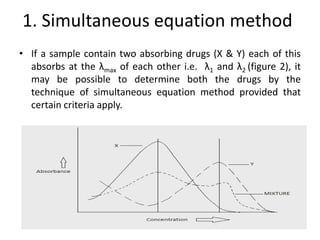
• If a sample contain two absorbing drugs (X & Y) each of this
  absorbs at the λmax of each other i.e. λ1 and λ2 (figure 2), it
  may be possible to determine both the drugs by the
  technique of simultaneous equation method provided that
  certain criteria apply.
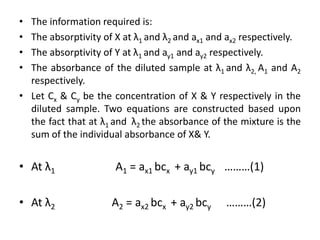
• The information required is:
• The absorptivity of X at λ1 and λ2 and ax1 and ax2 respectively.
• The absorptivity of Y at λ1 and ay1 and ay2 respectively.
• The absorbance of the diluted sample at λ1 and λ2, A1 and A2
  respectively.
• Let Cx & Cy be the concentration of X & Y respectively in the
  diluted sample. Two equations are constructed based upon
  the fact that at λ1 and λ2 the absorbance of the mixture is the
  sum of the individual absorbance of X& Y.


• At λ1               A1 = ax1 bcx + ay1 bcy ………(1)

• At λ2              A2 = ax2 bcx + ay2 bcy     ………(2)
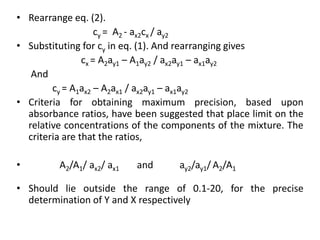
• Rearrange eq. (2).
                    cy = A2 - ax2cx / ay2
• Substituting for cy in eq. (1). And rearranging gives
                cx = A2ay1 – A1ay2 / ax2ay1 – ax1ay2
   And
        cy = A1ax2 – A2ax1 / ax2ay1 – ax1ay2
• Criteria for obtaining maximum precision, based upon
  absorbance ratios, have been suggested that place limit on the
  relative concentrations of the components of the mixture. The
  criteria are that the ratios,

•        A2/A1/ ax2/ ax1   and      ay2/ay1/ A2/A1

• Should lie outside the range of 0.1-20, for the precise
  determination of Y and X respectively
• These criteria are satisfied only when the λmax of the two
  components are reasonably dissimilar. An additional criterion
  is that the two components must not interact
  chemically, thereby negating the initial assumption that the
  total absorbance is the sum of individual absorbance.

Multicomponant analysis

  • 1.
    Prepared and presentedby: Pinak R. Patel Assistant Professor Department of pharmaceutical Chemistry Dharmaj, degree pharmacy college
  • 2.
    • The Spectrophotometricassay of drugs rarely involves the measurement of absorbance of samples containing only one absorbing component. • The pharmaceutical analyst frequently encounters the situation where the concentration of one or more substances is required in samples known to contain other absorbing substances, which potentially interfere in the assay. • If the formula of the samples is known, the identity and concentration of the interferents are known and the extent of interference in the assay may be determined.
  • 3.
    Some of thecommonly used Spectrophotometric methods are as follows, 1. Simultaneous equation method (Vierdott’s method) 2. Derivative Spectrophotometric method 3. Absorbance ratio method ( Q-Absorbance method) 4. Solvent extraction method 5. Dual wavelength method 6. Geometric correction method 7. Orthogonal poly nominal method 8. H-point standard addition method 9. Least square approximation method
  • 4.
    The basis ofall the Spectrophotometric techniques for multicomponent samples is the property that at all wavelengths: • The absorbance of a solution is the sum of absorbance of the individual components or • The measured absorbance is the difference between the total absorbance of the solution in the sample cell and that of the solution in the reference cell. And most importantly the excipients present in the formulation are not absorbing at the wavelength of experiment. If all of these conditions are satisfied than we can apply these methods satisfactorily.
  • 5.
    1. Simultaneous equationmethod • If a sample contain two absorbing drugs (X & Y) each of this absorbs at the λmax of each other i.e. λ1 and λ2 (figure 2), it may be possible to determine both the drugs by the technique of simultaneous equation method provided that certain criteria apply.
  • 6.
    • The informationrequired is: • The absorptivity of X at λ1 and λ2 and ax1 and ax2 respectively. • The absorptivity of Y at λ1 and ay1 and ay2 respectively. • The absorbance of the diluted sample at λ1 and λ2, A1 and A2 respectively. • Let Cx & Cy be the concentration of X & Y respectively in the diluted sample. Two equations are constructed based upon the fact that at λ1 and λ2 the absorbance of the mixture is the sum of the individual absorbance of X& Y. • At λ1 A1 = ax1 bcx + ay1 bcy ………(1) • At λ2 A2 = ax2 bcx + ay2 bcy ………(2)
  • 7.
    • Rearrange eq.(2). cy = A2 - ax2cx / ay2 • Substituting for cy in eq. (1). And rearranging gives cx = A2ay1 – A1ay2 / ax2ay1 – ax1ay2 And cy = A1ax2 – A2ax1 / ax2ay1 – ax1ay2 • Criteria for obtaining maximum precision, based upon absorbance ratios, have been suggested that place limit on the relative concentrations of the components of the mixture. The criteria are that the ratios, • A2/A1/ ax2/ ax1 and ay2/ay1/ A2/A1 • Should lie outside the range of 0.1-20, for the precise determination of Y and X respectively
  • 8.
    • These criteriaare satisfied only when the λmax of the two components are reasonably dissimilar. An additional criterion is that the two components must not interact chemically, thereby negating the initial assumption that the total absorbance is the sum of individual absorbance.