DEVIPRIYA P V
M PHARM
ENVIRONMENT AND
HEALTH
Air
 Most important component of environment.
 Vital to maintain life .
 Serves to ensure constant supply of oxygen to
the body through the process of respiration.
 Carries sound and smell.
 Helps in regulating body temperature
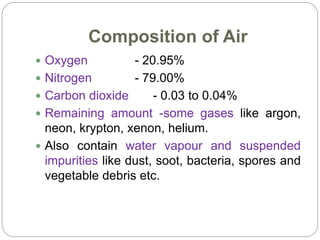
Composition of Air
 Oxygen - 20.95%
 Nitrogen - 79.00%
 Carbon dioxide - 0.03 to 0.04%
 Remaining amount -some gases like argon,
neon, krypton, xenon, helium.
 Also contain water vapour and suspended
impurities like dust, soot, bacteria, spores and
vegetable debris etc.
 The composition of air generally remains
constant because:
 Movement of air takes away the impurities.
 Temperature and UV rays of sunlight kills the
bacteria
 Rain helps in removing impurities and clean
the atmosphere.
 Plants helps in purification of air as it takes
CO2 and give off O2
Air pollution
 Presence of excessive amount of foreign
matter in air which are harmful to health.
Causes of air pollution:
 Urbanisation and industrialisation.
 Industries- specially chemical , fertilizer and
mettalurgical industries.
 Release of CO2 by humans into air.
 Burning of coal, oilor agricultre waste
produces gases like SO2, CO2 and smoke.
 Vehicles emit poisonous gasesx like carbin
monoxide.
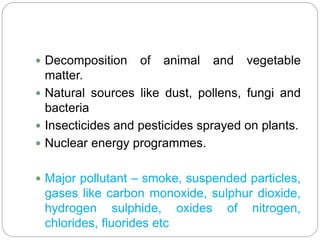
 Decomposition of animal and vegetable
matter.
 Natural sources like dust, pollens, fungi and
bacteria
 Insecticides and pesticides sprayed on plants.
 Nuclear energy programmes.
 Major pollutant – smoke, suspended particles,
gases like carbon monoxide, sulphur dioxide,
hydrogen sulphide, oxides of nitrogen,
chlorides, fluorides etc
Air Borne Diseases
 Common diseases- Chronic bronchitis.
 Symptoms: headache, giddiness, depression,
chest pain, cough, fever and weakness.
 If air pollution is intense, death can occur due
to suffocation.
 Other air borne diseases: tuberculosis,
diphteria, smallpox, chicken pox, measles,
whooping cough, dermatitis, conjunctivitis,
pneumonia, common cold etc
Prevention and control of air
pollution
1. Public should be educated through health education
programmes.
2. Proper ventillators in crowded rooms.
3. Avoid burning of coal , agricultural waste as fuel ( use gas
or electricity)
4. Stop burning of agricultural waste in fields.
5. Stop cutting of trees.
6. Green belts- The open where vegetation is grown for
purification of air.
7. Smoking at public places should be prohibited.
8. Emission of smoke and toxic substances from industries
must be checked by enforcing legal measures.
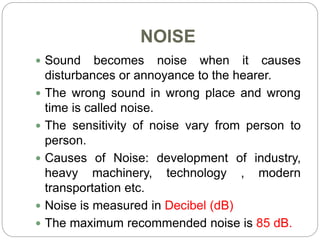
NOISE
 Sound becomes noise when it causes
disturbances or annoyance to the hearer.
 The wrong sound in wrong place and wrong
time is called noise.
 The sensitivity of noise vary from person to
person.
 Causes of Noise: development of industry,
heavy machinery, technology , modern
transportation etc.
 Noise is measured in Decibel (dB)
 The maximum recommended noise is 85 dB.
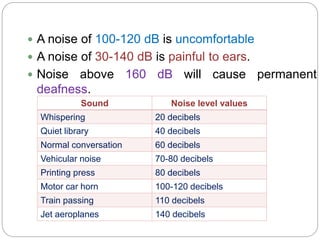
 A noise of 100-120 dB is uncomfortable
 A noise of 30-140 dB is painful to ears.
 Noise above 160 dB will cause permanent
deafness.
Sound Noise level values
Whispering 20 decibels
Quiet library 40 decibels
Normal conversation 60 decibels
Vehicular noise 70-80 decibels
Printing press 80 decibels
Motor car horn 100-120 decibels
Train passing 110 decibels
Jet aeroplanes 140 decibels
Effects of Noise
1. Cause direct injury to the ear, resulting in
deafness.
2. Prolonged exposure to noise of 80 dB or more
can produce fatigue, headache, tinnitus, vertigo
and deafness.
3. Annoyance and irritability.
4. Interferes with speech
5. Inability to concentrate.
6. Sleep is disturbed
7. Habit of loud speaking develops.
8. Accidents in industries.
9. Increase in blood pressure, heart rate, sweat,
Prevention and Control of Noise
 Control the source of noise. (use of sound
proof rooms, the parts of machines that
produces unwanted sound should be properly
oiled, repaired or replaced).
 Use of Sound absorbers in industries
 Provide ear plugs to workers and periodic
examination of workers who are exposed to
noises.
 No horns or silent zones boards to be placed
near schools, hospitals etc (fine the offenders)
 Loudspeakers should be banned from 9 pm to
 Ban the use of pressure horns
 Should not allow the heavy traffic in
residential areas
 Play TV, radio etc in low volume tolerable to
all
 Noise pollution by vehicles should be
checked.
 Automobile workshops should be away from
residential areas.
 Grow green vegetation and plants.
 Legal measures to check noise pollution
 Educate the public about the hazards of noise
LIGHTING
 Good lighting is necessary for proper visibility.
 Should neither be strong nor dim.
 Bad lighting leads to eye strain , head ache,
irritability, loss of temper and accidents.
 The light source should emit uniform light.
 No shadows in field of work to interfere with
vision.
 Fluorescent lighting should be provided for
workers as far as possible because it is
economical, consumes less electricity, avoid
shadows, provide cool and efficient light.
 Lighting can be Natural or Artificial.
Natural Lighting:
 Natural lighting is from sunlight.
 The intensity of natural lighting depends upon the
time of day, season and weather.
 It is economical and has beneficial effects on
health as the sun rays contain light, heat and
ultraviolet rays.
 It does not cause any pollution.
 Cannot depend on natural lighting all time(night,
cloudy days).
 The following points are to be remembered
when using natural lighting:
1. The objects which obstructs the light should
be removed.
2. Proper windows regarding their location,
number, size and shape should be provided.
3. Too many screens and curtains obstruct the
natural light.
4. All glazings and window panes should be
kept clean.
5. Rooms should be white washed rather than
color washed for better reflection of light.
Artificial Lighting:
 Common sources: candles, kerosene lamps, gas
lighting and electric lighting.
 Electric lighting does not involve combustion and
therefore no oxygen is taken and no waste is
produced.
 Various types of vapor lamps like neon filled
sodium discharged lamps are used.
 These gives monochromatic yellow light which is
suitable in highways.
 Tube lights are commonly used as it consumes
they consume less electricity , economical,
provide cool and efficient lighting.
 Use of direct lighting like table lamps should be
avoided as it cause eye strain.
 Indirect light is good for illumination.
 The light is directed to ceiling or upper parts of
walls and get reflected to working area.
 Intensity of artificial light is measured in foot
candles.
 A foot candle is the intensity of light received at a
point which is placed at a distance of one foot from
the source of light of a standard candle power.
 A standard candle weighs 75.6 gms and burns 7.2
gms of wax per hour.
 A minimum 6 foot candles illumination is required
for clear visibility.
 For continuous reading it should be 10 to 15 foot
candles.
 The intensity of day light is measured in terms of
Daylight factor (DF).
 DF is measured by using daylight factor meter.
 For clear visibility at least 1% DF should be
present in rooms.
20

Air, noise, lighting

  • 1.
    DEVIPRIYA P V MPHARM ENVIRONMENT AND HEALTH
  • 2.
    Air  Most importantcomponent of environment.  Vital to maintain life .  Serves to ensure constant supply of oxygen to the body through the process of respiration.  Carries sound and smell.  Helps in regulating body temperature
  • 3.
    Composition of Air Oxygen - 20.95%  Nitrogen - 79.00%  Carbon dioxide - 0.03 to 0.04%  Remaining amount -some gases like argon, neon, krypton, xenon, helium.  Also contain water vapour and suspended impurities like dust, soot, bacteria, spores and vegetable debris etc.
  • 4.
     The compositionof air generally remains constant because:  Movement of air takes away the impurities.  Temperature and UV rays of sunlight kills the bacteria  Rain helps in removing impurities and clean the atmosphere.  Plants helps in purification of air as it takes CO2 and give off O2
  • 5.
    Air pollution  Presenceof excessive amount of foreign matter in air which are harmful to health. Causes of air pollution:  Urbanisation and industrialisation.  Industries- specially chemical , fertilizer and mettalurgical industries.  Release of CO2 by humans into air.  Burning of coal, oilor agricultre waste produces gases like SO2, CO2 and smoke.  Vehicles emit poisonous gasesx like carbin monoxide.
  • 6.
     Decomposition ofanimal and vegetable matter.  Natural sources like dust, pollens, fungi and bacteria  Insecticides and pesticides sprayed on plants.  Nuclear energy programmes.  Major pollutant – smoke, suspended particles, gases like carbon monoxide, sulphur dioxide, hydrogen sulphide, oxides of nitrogen, chlorides, fluorides etc
  • 7.
    Air Borne Diseases Common diseases- Chronic bronchitis.  Symptoms: headache, giddiness, depression, chest pain, cough, fever and weakness.  If air pollution is intense, death can occur due to suffocation.  Other air borne diseases: tuberculosis, diphteria, smallpox, chicken pox, measles, whooping cough, dermatitis, conjunctivitis, pneumonia, common cold etc
  • 8.
    Prevention and controlof air pollution 1. Public should be educated through health education programmes. 2. Proper ventillators in crowded rooms. 3. Avoid burning of coal , agricultural waste as fuel ( use gas or electricity) 4. Stop burning of agricultural waste in fields. 5. Stop cutting of trees. 6. Green belts- The open where vegetation is grown for purification of air. 7. Smoking at public places should be prohibited. 8. Emission of smoke and toxic substances from industries must be checked by enforcing legal measures.
  • 9.
    NOISE  Sound becomesnoise when it causes disturbances or annoyance to the hearer.  The wrong sound in wrong place and wrong time is called noise.  The sensitivity of noise vary from person to person.  Causes of Noise: development of industry, heavy machinery, technology , modern transportation etc.  Noise is measured in Decibel (dB)  The maximum recommended noise is 85 dB.
  • 10.
     A noiseof 100-120 dB is uncomfortable  A noise of 30-140 dB is painful to ears.  Noise above 160 dB will cause permanent deafness. Sound Noise level values Whispering 20 decibels Quiet library 40 decibels Normal conversation 60 decibels Vehicular noise 70-80 decibels Printing press 80 decibels Motor car horn 100-120 decibels Train passing 110 decibels Jet aeroplanes 140 decibels
  • 11.
    Effects of Noise 1.Cause direct injury to the ear, resulting in deafness. 2. Prolonged exposure to noise of 80 dB or more can produce fatigue, headache, tinnitus, vertigo and deafness. 3. Annoyance and irritability. 4. Interferes with speech 5. Inability to concentrate. 6. Sleep is disturbed 7. Habit of loud speaking develops. 8. Accidents in industries. 9. Increase in blood pressure, heart rate, sweat,
  • 12.
    Prevention and Controlof Noise  Control the source of noise. (use of sound proof rooms, the parts of machines that produces unwanted sound should be properly oiled, repaired or replaced).  Use of Sound absorbers in industries  Provide ear plugs to workers and periodic examination of workers who are exposed to noises.  No horns or silent zones boards to be placed near schools, hospitals etc (fine the offenders)  Loudspeakers should be banned from 9 pm to
  • 13.
     Ban theuse of pressure horns  Should not allow the heavy traffic in residential areas  Play TV, radio etc in low volume tolerable to all  Noise pollution by vehicles should be checked.  Automobile workshops should be away from residential areas.  Grow green vegetation and plants.  Legal measures to check noise pollution  Educate the public about the hazards of noise
  • 14.
    LIGHTING  Good lightingis necessary for proper visibility.  Should neither be strong nor dim.  Bad lighting leads to eye strain , head ache, irritability, loss of temper and accidents.  The light source should emit uniform light.  No shadows in field of work to interfere with vision.  Fluorescent lighting should be provided for workers as far as possible because it is economical, consumes less electricity, avoid shadows, provide cool and efficient light.
  • 15.
     Lighting canbe Natural or Artificial. Natural Lighting:  Natural lighting is from sunlight.  The intensity of natural lighting depends upon the time of day, season and weather.  It is economical and has beneficial effects on health as the sun rays contain light, heat and ultraviolet rays.  It does not cause any pollution.  Cannot depend on natural lighting all time(night, cloudy days).
  • 16.
     The followingpoints are to be remembered when using natural lighting: 1. The objects which obstructs the light should be removed. 2. Proper windows regarding their location, number, size and shape should be provided. 3. Too many screens and curtains obstruct the natural light. 4. All glazings and window panes should be kept clean. 5. Rooms should be white washed rather than color washed for better reflection of light.
  • 17.
    Artificial Lighting:  Commonsources: candles, kerosene lamps, gas lighting and electric lighting.  Electric lighting does not involve combustion and therefore no oxygen is taken and no waste is produced.  Various types of vapor lamps like neon filled sodium discharged lamps are used.  These gives monochromatic yellow light which is suitable in highways.  Tube lights are commonly used as it consumes they consume less electricity , economical, provide cool and efficient lighting.
  • 18.
     Use ofdirect lighting like table lamps should be avoided as it cause eye strain.  Indirect light is good for illumination.  The light is directed to ceiling or upper parts of walls and get reflected to working area.  Intensity of artificial light is measured in foot candles.  A foot candle is the intensity of light received at a point which is placed at a distance of one foot from the source of light of a standard candle power.  A standard candle weighs 75.6 gms and burns 7.2 gms of wax per hour.
  • 19.
     A minimum6 foot candles illumination is required for clear visibility.  For continuous reading it should be 10 to 15 foot candles.  The intensity of day light is measured in terms of Daylight factor (DF).  DF is measured by using daylight factor meter.  For clear visibility at least 1% DF should be present in rooms.
  • 20.