ENVIRONMENT AND HEALTH
DEVIPRIYA P V
M PHARM
MEDICAL ENTAMOLOGY
MEDICAL ENTAMOLOGY
 The study of arthropods (mainly insects) is known
as Medical Entomology.
 The word arthropod is derived from 2 words artho
means jointed and pods means legs
 Arthropods constitute the largest group of
invertebrates.
 Many of them are harmful, some are useful and
others are of no significance.
Classification of arthropods:
1. Class Insecta
2. Class Arachinda
3. Class Crustacia
Class Insecta
 The body of insect is divided into 3 parts: head, thorax
and abdomen.
 The winged insects undergo 4 stages of development:
egg, larva, pupa and adult.
 The body part is divided into head, thorax and
abdomen.
 They have 3 pair of legs and one or two pair of wings
 Eg: mosquitoes, flies, lice and fleas
Class Arachinda
 These are wingless insects and the body has 2
parts: cephalothorax and abdomen.
 They have 4 pair of legs and no antennae
 Eg: ticks and mites
Class Crustacia
 Body is divided into cephalothorax & abdomen and
no wings.
 Eg: cyclops
 They have 5 pairs of legs and two pairs of antennae
Arthropod Borne Diseases
 Play an important role in the transmission of diseases.
 They transmit the diseases by:
Direct contact:
 Spread diseases by close personal contact
 Eg: scabies caused and spread by itch mite
Mechanical transmission:
 Arthropods carry infectious agents on their legs and
wings and transfer to food & thus they act as
mechanical carriers
 Eg: housefly spreading diarrhoea and dysentry
Biological transmission:
 The disease agent undergo multiplication in the insect
host and carried to humans
 Eg: malaria spread by mosquitoes
Mosquito
 Female mosquitoes bites and sucks blood which is
necessary for producing eggs.
 They lay 100-200 eggs or even more at a time.
 They have 4 stages in their life cycle: egg, larva,
pupa and adult.
 The life of male mosquito is not more than 1-3 weeks
while the females live up to 4 months.
 Mosquitoes prefer to live in dark places.
 More active after sunset and just before sunrise.
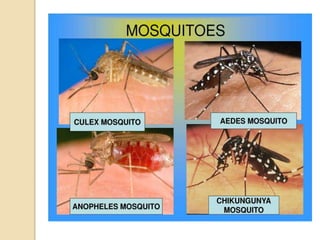
 There are 3 types of mostquitoes . They are:
Anopheles :
 Female anopheles spread malaria.
 They breed in clean water
Culex:
 Female culex spread filaria and viral encephalitis
 They breed in dirty and polluted water
 Aedes mosquito (Tiger mosquito)
 They have white strips on a black body.
 most abundant in rainy season.
 They freed in artificial collection of water(broken
bottles, flower pots, fire buckets etc)
 Spread dengue fever, haemorrhagic fever, yellow
fever
Control of mosquitoes
1. Do not allow water to stagnate near the houses.
2. Sprinkle oil on the surface of water which can kill
mosquito larvae and pupa.
3. Fishes like Gambusia, Barbados, lebister are
grown in water.
4. Spray houses and cattle shed with insecticides.
5. Use mosquito repellents
6. Use mosquito nets.
7. Doors , windows and ventilators of buildings
should be fitted with fine gauge so that
mosquitoes and other insects cannot enter.
8. Regular cleaning of houses should be done
Flies
 Among files house flies are most important
 The body is divided into head , thorax and abdomen.
 They have 3 pairs of legs and a pair of wings.
 The body and legs are covered with short hairs which
secrete a sticky substance that helps in spreading of
diseases.
 They spread disease mechanically- carry pathogenic
germs and contaminate the food.
 It breeds on human excreta, cow dung, waste,
decaying & fermenting vegetable and animal wastes.
 The house flies can live for 15-25 days.
 They spread diseases like diarrhoea, dysentry,
cholera, typhoid, polio, worm infestations etc
Control of flies
1. Prevention of breeding of flies
2. Prevention of flies to reach human excreta
3. Protection of food from flies
4. Killing of adult flies
 Prevention of breeding of flies
 Remove and properly dispose excreta, cow dung,
manure, waste and organic matter.
 Do not allow accumulation of waste. Clean them.
 Do not throw waste in open places. Use dust bins.
 Destroy egg, larvae and pupae by applying DDT,
borax etc
 Keep cleanliness
HOUSE
FLY
Prevention of flies to reach human excreta
 Dispose excreta by water carriage system
 Use of fly proof privies and latrines.
 Collect and dispose excreta in sanitary manner.
 Do not defecate in open.
Protection of food from flies
 Cover with wire gauge or muslin cloth
 The stall owners should cover the eatables with wire
gauge or should in glass cases, or fly proof almirahs.
 The doors, windows and ventilators should be fitted
with wire mesh.
 Use of fans which prevent the flies to settle on food
products
Killing of adult flies :
 Sticky fly papers can be prepared by spraying hot
mixture of castor oil and resin.
 Use of fly traps
 Use of electric insect killers.
 In small numbers it can be killed using wire mesh
 2% solution of formalin with sugar and milk is
placed in rooms to attract flies. They die after
drinking the poisonous solution
Lice
 Small wingless electroparasites.
 They live on mammalian blood outside the body of
human or animal host .
 3 types:
1. Head louse : infests hair of head
2. Body louse : found in clothes, beddings, hair of
chest & armpits
3. Public or crab louse : found in public and anal
region.
 Body is divided into head, thorax & abdomen.
 They suck mammalian blood and breed on the body,
hair, clothes of the host
 Life span- 35-58 days.
 Egg, larva and adult are the 3 stages of life cycle.
Louse borne diseases:
 Infection is by direct contact through combs, brushes,
clothings etc.
 Typhus, relapsing fever and trench fever.
 The louse infections are due to the poor personal
hygiene of the host.
Control of lice:
 Improvement of personal hygiene, cleanliness of body,
hair , clothes and household articles.
 Daily bath with soap and water.
 Long hairs should be washed frequently
 The clothing, bed sheets , towels should be washed
with soap and hot water and iron it after drying.
 Autoclave highly infested clothes.
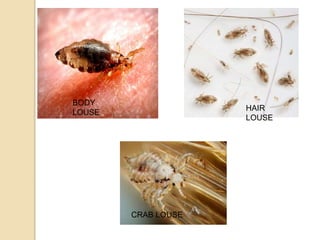
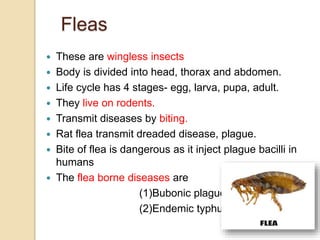
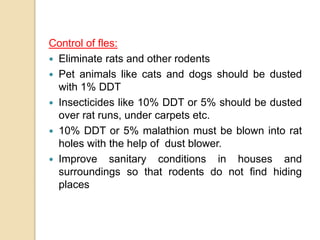
BODY
LOUSE
HAIR
LOUSE
CRAB LOUSE
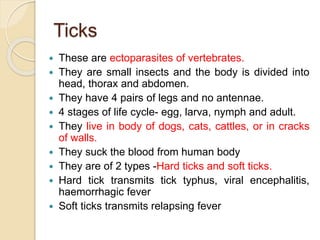
Fleas
 These are wingless insects
 Body is divided into head, thorax and abdomen.
 Life cycle has 4 stages- egg, larva, pupa, adult.
 They live on rodents.
 Transmit diseases by biting.
 Rat flea transmit dreaded disease, plague.
 Bite of flea is dangerous as it inject plague bacilli in
humans
 The flea borne diseases are
(1)Bubonic plague
(2)Endemic typhus
Control of fles:
 Eliminate rats and other rodents
 Pet animals like cats and dogs should be dusted
with 1% DDT
 Insecticides like 10% DDT or 5% should be dusted
over rat runs, under carpets etc.
 10% DDT or 5% malathion must be blown into rat
holes with the help of dust blower.
 Improve sanitary conditions in houses and
surroundings so that rodents do not find hiding
places
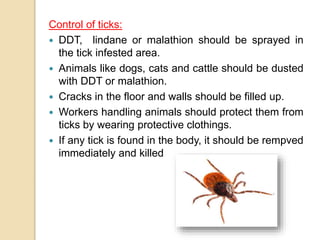
Ticks
 These are ectoparasites of vertebrates.
 They are small insects and the body is divided into
head, thorax and abdomen.
 They have 4 pairs of legs and no antennae.
 4 stages of life cycle- egg, larva, nymph and adult.
 They live in body of dogs, cats, cattles, or in cracks
of walls.
 They suck the blood from human body
 They are of 2 types -Hard ticks and soft ticks.
 Hard tick transmits tick typhus, viral encephalitis,
haemorrhagic fever
 Soft ticks transmits relapsing fever
Control of ticks:
 DDT, lindane or malathion should be sprayed in
the tick infested area.
 Animals like dogs, cats and cattle should be dusted
with DDT or malathion.
 Cracks in the floor and walls should be filled up.
 Workers handling animals should protect them from
ticks by wearing protective clothings.
 If any tick is found in the body, it should be rempved
immediately and killed
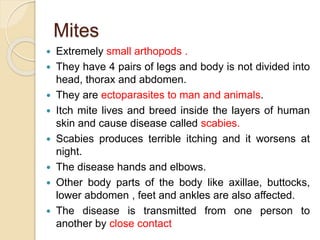
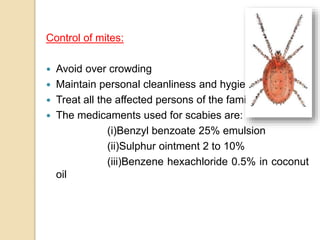
Mites
 Extremely small arthopods .
 They have 4 pairs of legs and body is not divided into
head, thorax and abdomen.
 They are ectoparasites to man and animals.
 Itch mite lives and breed inside the layers of human
skin and cause disease called scabies.
 Scabies produces terrible itching and it worsens at
night.
 The disease hands and elbows.
 Other body parts of the body like axillae, buttocks,
lower abdomen , feet and ankles are also affected.
 The disease is transmitted from one person to
another by close contact
Control of mites:
 Avoid over crowding
 Maintain personal cleanliness and hygiene.
 Treat all the affected persons of the family.
 The medicaments used for scabies are:
(i)Benzyl benzoate 25% emulsion
(ii)Sulphur ointment 2 to 10%
(iii)Benzene hexachloride 0.5% in coconut
oil
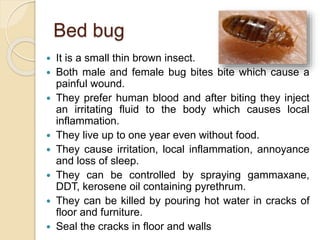
Bed bug
 It is a small thin brown insect.
 Both male and female bug bites bite which cause a
painful wound.
 They prefer human blood and after biting they inject
an irritating fluid to the body which causes local
inflammation.
 They live up to one year even without food.
 They cause irritation, local inflammation, annoyance
and loss of sleep.
 They can be controlled by spraying gammaxane,
DDT, kerosene oil containing pyrethrum.
 They can be killed by pouring hot water in cracks of
floor and furniture.
 Seal the cracks in floor and walls
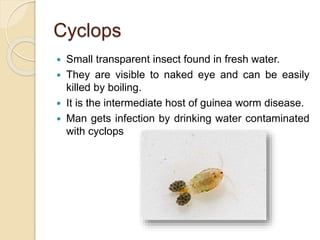
Cyclops
 Small transparent insect found in fresh water.
 They are visible to naked eye and can be easily
killed by boiling.
 It is the intermediate host of guinea worm disease.
 Man gets infection by drinking water contaminated
with cyclops
Rodents
 There are two types of rodents ie, domestic and wild.
 Eg: rats
 They damage the food crops, fertile land and banks of
water channels by making burrows.
 The rodents spread diseases like plague, rat bite
fever, leptospirosis, haemorrhagic fever, amoebiais,
encephelitis etc.
 They can be destroyed and eliminated by:
(1)Trapping
(2)Using rat poisons or rodenticides
(3)Fumigating the rat burrows
(4)Improving the sanitation
Medical entamology

Medical entamology

  • 1.
    ENVIRONMENT AND HEALTH DEVIPRIYAP V M PHARM MEDICAL ENTAMOLOGY
  • 2.
    MEDICAL ENTAMOLOGY  Thestudy of arthropods (mainly insects) is known as Medical Entomology.  The word arthropod is derived from 2 words artho means jointed and pods means legs  Arthropods constitute the largest group of invertebrates.  Many of them are harmful, some are useful and others are of no significance.
  • 3.
    Classification of arthropods: 1.Class Insecta 2. Class Arachinda 3. Class Crustacia Class Insecta  The body of insect is divided into 3 parts: head, thorax and abdomen.  The winged insects undergo 4 stages of development: egg, larva, pupa and adult.  The body part is divided into head, thorax and abdomen.  They have 3 pair of legs and one or two pair of wings  Eg: mosquitoes, flies, lice and fleas
  • 4.
    Class Arachinda  Theseare wingless insects and the body has 2 parts: cephalothorax and abdomen.  They have 4 pair of legs and no antennae  Eg: ticks and mites Class Crustacia  Body is divided into cephalothorax & abdomen and no wings.  Eg: cyclops  They have 5 pairs of legs and two pairs of antennae
  • 5.
    Arthropod Borne Diseases Play an important role in the transmission of diseases.  They transmit the diseases by: Direct contact:  Spread diseases by close personal contact  Eg: scabies caused and spread by itch mite Mechanical transmission:  Arthropods carry infectious agents on their legs and wings and transfer to food & thus they act as mechanical carriers  Eg: housefly spreading diarrhoea and dysentry Biological transmission:  The disease agent undergo multiplication in the insect host and carried to humans  Eg: malaria spread by mosquitoes
  • 6.
    Mosquito  Female mosquitoesbites and sucks blood which is necessary for producing eggs.  They lay 100-200 eggs or even more at a time.  They have 4 stages in their life cycle: egg, larva, pupa and adult.  The life of male mosquito is not more than 1-3 weeks while the females live up to 4 months.  Mosquitoes prefer to live in dark places.  More active after sunset and just before sunrise.
  • 7.
     There are3 types of mostquitoes . They are: Anopheles :  Female anopheles spread malaria.  They breed in clean water Culex:  Female culex spread filaria and viral encephalitis  They breed in dirty and polluted water  Aedes mosquito (Tiger mosquito)  They have white strips on a black body.  most abundant in rainy season.  They freed in artificial collection of water(broken bottles, flower pots, fire buckets etc)  Spread dengue fever, haemorrhagic fever, yellow fever
  • 9.
    Control of mosquitoes 1.Do not allow water to stagnate near the houses. 2. Sprinkle oil on the surface of water which can kill mosquito larvae and pupa. 3. Fishes like Gambusia, Barbados, lebister are grown in water. 4. Spray houses and cattle shed with insecticides. 5. Use mosquito repellents 6. Use mosquito nets. 7. Doors , windows and ventilators of buildings should be fitted with fine gauge so that mosquitoes and other insects cannot enter. 8. Regular cleaning of houses should be done
  • 10.
    Flies  Among fileshouse flies are most important  The body is divided into head , thorax and abdomen.  They have 3 pairs of legs and a pair of wings.  The body and legs are covered with short hairs which secrete a sticky substance that helps in spreading of diseases.  They spread disease mechanically- carry pathogenic germs and contaminate the food.  It breeds on human excreta, cow dung, waste, decaying & fermenting vegetable and animal wastes.  The house flies can live for 15-25 days.  They spread diseases like diarrhoea, dysentry, cholera, typhoid, polio, worm infestations etc
  • 11.
    Control of flies 1.Prevention of breeding of flies 2. Prevention of flies to reach human excreta 3. Protection of food from flies 4. Killing of adult flies  Prevention of breeding of flies  Remove and properly dispose excreta, cow dung, manure, waste and organic matter.  Do not allow accumulation of waste. Clean them.  Do not throw waste in open places. Use dust bins.  Destroy egg, larvae and pupae by applying DDT, borax etc  Keep cleanliness HOUSE FLY
  • 12.
    Prevention of fliesto reach human excreta  Dispose excreta by water carriage system  Use of fly proof privies and latrines.  Collect and dispose excreta in sanitary manner.  Do not defecate in open. Protection of food from flies  Cover with wire gauge or muslin cloth  The stall owners should cover the eatables with wire gauge or should in glass cases, or fly proof almirahs.  The doors, windows and ventilators should be fitted with wire mesh.  Use of fans which prevent the flies to settle on food products
  • 13.
    Killing of adultflies :  Sticky fly papers can be prepared by spraying hot mixture of castor oil and resin.  Use of fly traps  Use of electric insect killers.  In small numbers it can be killed using wire mesh  2% solution of formalin with sugar and milk is placed in rooms to attract flies. They die after drinking the poisonous solution
  • 14.
    Lice  Small winglesselectroparasites.  They live on mammalian blood outside the body of human or animal host .  3 types: 1. Head louse : infests hair of head 2. Body louse : found in clothes, beddings, hair of chest & armpits 3. Public or crab louse : found in public and anal region.  Body is divided into head, thorax & abdomen.  They suck mammalian blood and breed on the body, hair, clothes of the host  Life span- 35-58 days.  Egg, larva and adult are the 3 stages of life cycle.
  • 15.
    Louse borne diseases: Infection is by direct contact through combs, brushes, clothings etc.  Typhus, relapsing fever and trench fever.  The louse infections are due to the poor personal hygiene of the host. Control of lice:  Improvement of personal hygiene, cleanliness of body, hair , clothes and household articles.  Daily bath with soap and water.  Long hairs should be washed frequently  The clothing, bed sheets , towels should be washed with soap and hot water and iron it after drying.  Autoclave highly infested clothes.
  • 16.
  • 17.
    Fleas  These arewingless insects  Body is divided into head, thorax and abdomen.  Life cycle has 4 stages- egg, larva, pupa, adult.  They live on rodents.  Transmit diseases by biting.  Rat flea transmit dreaded disease, plague.  Bite of flea is dangerous as it inject plague bacilli in humans  The flea borne diseases are (1)Bubonic plague (2)Endemic typhus
  • 18.
    Control of fles: Eliminate rats and other rodents  Pet animals like cats and dogs should be dusted with 1% DDT  Insecticides like 10% DDT or 5% should be dusted over rat runs, under carpets etc.  10% DDT or 5% malathion must be blown into rat holes with the help of dust blower.  Improve sanitary conditions in houses and surroundings so that rodents do not find hiding places
  • 19.
    Ticks  These areectoparasites of vertebrates.  They are small insects and the body is divided into head, thorax and abdomen.  They have 4 pairs of legs and no antennae.  4 stages of life cycle- egg, larva, nymph and adult.  They live in body of dogs, cats, cattles, or in cracks of walls.  They suck the blood from human body  They are of 2 types -Hard ticks and soft ticks.  Hard tick transmits tick typhus, viral encephalitis, haemorrhagic fever  Soft ticks transmits relapsing fever
  • 20.
    Control of ticks: DDT, lindane or malathion should be sprayed in the tick infested area.  Animals like dogs, cats and cattle should be dusted with DDT or malathion.  Cracks in the floor and walls should be filled up.  Workers handling animals should protect them from ticks by wearing protective clothings.  If any tick is found in the body, it should be rempved immediately and killed
  • 21.
    Mites  Extremely smallarthopods .  They have 4 pairs of legs and body is not divided into head, thorax and abdomen.  They are ectoparasites to man and animals.  Itch mite lives and breed inside the layers of human skin and cause disease called scabies.  Scabies produces terrible itching and it worsens at night.  The disease hands and elbows.  Other body parts of the body like axillae, buttocks, lower abdomen , feet and ankles are also affected.  The disease is transmitted from one person to another by close contact
  • 22.
    Control of mites: Avoid over crowding  Maintain personal cleanliness and hygiene.  Treat all the affected persons of the family.  The medicaments used for scabies are: (i)Benzyl benzoate 25% emulsion (ii)Sulphur ointment 2 to 10% (iii)Benzene hexachloride 0.5% in coconut oil
  • 23.
    Bed bug  Itis a small thin brown insect.  Both male and female bug bites bite which cause a painful wound.  They prefer human blood and after biting they inject an irritating fluid to the body which causes local inflammation.  They live up to one year even without food.  They cause irritation, local inflammation, annoyance and loss of sleep.  They can be controlled by spraying gammaxane, DDT, kerosene oil containing pyrethrum.  They can be killed by pouring hot water in cracks of floor and furniture.  Seal the cracks in floor and walls
  • 24.
    Cyclops  Small transparentinsect found in fresh water.  They are visible to naked eye and can be easily killed by boiling.  It is the intermediate host of guinea worm disease.  Man gets infection by drinking water contaminated with cyclops
  • 25.
    Rodents  There aretwo types of rodents ie, domestic and wild.  Eg: rats  They damage the food crops, fertile land and banks of water channels by making burrows.  The rodents spread diseases like plague, rat bite fever, leptospirosis, haemorrhagic fever, amoebiais, encephelitis etc.  They can be destroyed and eliminated by: (1)Trapping (2)Using rat poisons or rodenticides (3)Fumigating the rat burrows (4)Improving the sanitation