DEVIPRIYA P V
M PHARM
Arthropod borne
infections
CONTENTS
 Plague
 Malaria
 Filariases
PLAGUE
Causative agent:
 Yersinia Pseudotuberculous Pestis (a gram negative, non-
motile, cocco bacillus).
 Vector: The vector of plague is rat flea
 Reservoir of infection: Wild rodents
 Sources of infection are infected rodents, fleas and cases
of pneumonic plague (severe lung infection caused by the
bacterium Yersinia pestis).
Mode of transmission:
 The Y pestis is transmitted between rodents by fleas .
 After the death of rat, affected flea leave the rat & bite a
man.
 The infection spread from man to man by droplets.
Prevention and control:
 Control can be done by early diagnosis, notification, isolation ,
disinfection of patient’s sputum and treatment.
 In adults tetracycline 500 mg q.i.d orally is the drug of choice.
 Cotrimoxazole is given for children.
 In several cases , streptomycin is given intramuscularly in the
dose of 30 mg/kg body weight per day in two divided doses for
10 days in addition to either of the drugs,
 Control of fleas can be done by their destruction, by spraying
DDT & BHC.
 Control is done by mass destruction, improvement of housing.
 Vaccination is a valuable prevention
 Plague vaccine (formalin killed plague bacilli) is given
subcutaneously in two doses of 0.5 and 1.0 ml at 1 to 2 weeks
interval.
 Booster dose is given for every 6 months for those who are at
MALARIA
 A group of infection caused by infection with specific
sporozoan parasites of genus plasmodium and transmitted
to man by infected female Anopheles mosquito.
 Characterized by episodes of chills and fever with periods of
latency(delay), enlargement of spleen and secondary
anaemia.
Stages of malaria:
(A)Cold stage (B)Hot stage (C)Sweating stage.
Cold stage :
 Sudden onset of fever with rigor and chills.
 This stage lasts between 15 minutes to one hour
Hot stage:
 Headache & burning hot & the casts off clothes
 This stage lasts from 2 to 6 hours.
Sweating stage:
 Profuse sweating.
 This stage lasts from 2 to 4 hours.
 Febrile paroxysms occurs repeatedly after a period of 2 to 3
days depending on the type of the malarial parasite.
Causative agent:
 Caused by 4 species of malaria parasite.
1. Plasmodium vivax (responsible for 70% cases in India),
2. Plasmodium falciparum,
3. Plasmodium malarae,
4. Plasmodium ovole
 The malarial parasite undergoes two cycles of development-
asexual cycle in man and sexual cycle in mosquito
Mode of transmission:
(a)Vector transmission:
 Transmitted by the bite of female Anopheles mosquitoes
(b)Direct transmission:
 Transmitted by infected needles, blood transfusions etc
(c)Congenital infection:
 Occur in new born from infected mother.
Incubation period:
 The time between mosquito bite and the appearance of fever
is more than 10 days ranging from 12 to 40 days
Prevention and control:
 WHO expert Committee on Malaria (1979)
Measures to be taken by the individual:
 Prevention of man / vector contact by using repellents,
protective clothing , bed nets etc.
 Destruction of adult mosquitoes by domestic sprays.
 Destruction of mosquito larvae by peridomestic sanitation,
intermittent drying of water containers.
 Source reduction of mosquitoes by filling, small scale
drainage and other forms of water management.
 Measures against malaria parasite include
chemoprophylaxis and chemotherapy
Measures to be taken by the community.
 Prevention of man / vector contact- site selection and
screening of houses.
 Destruction of adult mosquitoes- spraying insecticides.
 Destruction of mosquito larvae- using larvicides
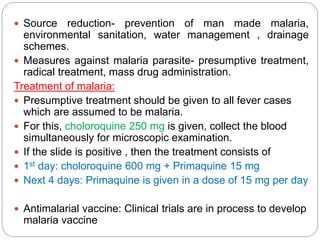
 Source reduction- prevention of man made malaria,
environmental sanitation, water management , drainage
schemes.
 Measures against malaria parasite- presumptive treatment,
radical treatment, mass drug administration.
Treatment of malaria:
 Presumptive treatment should be given to all fever cases
which are assumed to be malaria.
 For this, choloroquine 250 mg is given, collect the blood
simultaneously for microscopic examination.
 If the slide is positive , then the treatment consists of
 1st day: choloroquine 600 mg + Primaquine 15 mg
 Next 4 days: Primaquine is given in a dose of 15 mg per day
 Antimalarial vaccine: Clinical trials are in process to develop
malaria vaccine
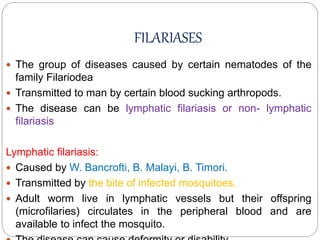
FILARIASES
 The group of diseases caused by certain nematodes of the
family Filariodea
 Transmitted to man by certain blood sucking arthropods.
 The disease can be lymphatic filariasis or non- lymphatic
filariasis
Lymphatic filariasis:
 Caused by W. Bancrofti, B. Malayi, B. Timori.
 Transmitted by the bite of infected mosquitoes.
 Adult worm live in lymphatic vessels but their offspring
(microfilaries) circulates in the peripheral blood and are
available to infect the mosquito.
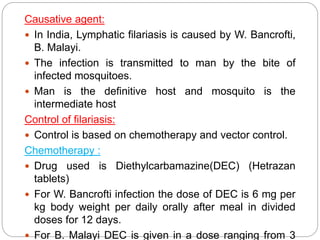
Causative agent:
 In India, Lymphatic filariasis is caused by W. Bancrofti,
B. Malayi.
 The infection is transmitted to man by the bite of
infected mosquitoes.
 Man is the definitive host and mosquito is the
intermediate host
Control of filariasis:
 Control is based on chemotherapy and vector control.
Chemotherapy :
 Drug used is Diethylcarbamazine(DEC) (Hetrazan
tablets)
 For W. Bancrofti infection the dose of DEC is 6 mg per
kg body weight per daily orally after meal in divided
doses for 12 days.
 For B. Malayi DEC is given in a dose ranging from 3
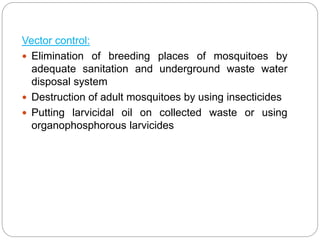
Vector control:
 Elimination of breeding places of mosquitoes by
adequate sanitation and underground waste water
disposal system
 Destruction of adult mosquitoes by using insecticides
 Putting larvicidal oil on collected waste or using
organophosphorous larvicides

Arthropod borne infections

  • 1.
    DEVIPRIYA P V MPHARM Arthropod borne infections
  • 2.
  • 3.
    PLAGUE Causative agent:  YersiniaPseudotuberculous Pestis (a gram negative, non- motile, cocco bacillus).  Vector: The vector of plague is rat flea  Reservoir of infection: Wild rodents  Sources of infection are infected rodents, fleas and cases of pneumonic plague (severe lung infection caused by the bacterium Yersinia pestis). Mode of transmission:  The Y pestis is transmitted between rodents by fleas .  After the death of rat, affected flea leave the rat & bite a man.  The infection spread from man to man by droplets.
  • 4.
    Prevention and control: Control can be done by early diagnosis, notification, isolation , disinfection of patient’s sputum and treatment.  In adults tetracycline 500 mg q.i.d orally is the drug of choice.  Cotrimoxazole is given for children.  In several cases , streptomycin is given intramuscularly in the dose of 30 mg/kg body weight per day in two divided doses for 10 days in addition to either of the drugs,  Control of fleas can be done by their destruction, by spraying DDT & BHC.  Control is done by mass destruction, improvement of housing.  Vaccination is a valuable prevention  Plague vaccine (formalin killed plague bacilli) is given subcutaneously in two doses of 0.5 and 1.0 ml at 1 to 2 weeks interval.  Booster dose is given for every 6 months for those who are at
  • 5.
    MALARIA  A groupof infection caused by infection with specific sporozoan parasites of genus plasmodium and transmitted to man by infected female Anopheles mosquito.  Characterized by episodes of chills and fever with periods of latency(delay), enlargement of spleen and secondary anaemia. Stages of malaria: (A)Cold stage (B)Hot stage (C)Sweating stage. Cold stage :  Sudden onset of fever with rigor and chills.  This stage lasts between 15 minutes to one hour Hot stage:  Headache & burning hot & the casts off clothes  This stage lasts from 2 to 6 hours.
  • 6.
    Sweating stage:  Profusesweating.  This stage lasts from 2 to 4 hours.  Febrile paroxysms occurs repeatedly after a period of 2 to 3 days depending on the type of the malarial parasite. Causative agent:  Caused by 4 species of malaria parasite. 1. Plasmodium vivax (responsible for 70% cases in India), 2. Plasmodium falciparum, 3. Plasmodium malarae, 4. Plasmodium ovole  The malarial parasite undergoes two cycles of development- asexual cycle in man and sexual cycle in mosquito
  • 7.
    Mode of transmission: (a)Vectortransmission:  Transmitted by the bite of female Anopheles mosquitoes (b)Direct transmission:  Transmitted by infected needles, blood transfusions etc (c)Congenital infection:  Occur in new born from infected mother. Incubation period:  The time between mosquito bite and the appearance of fever is more than 10 days ranging from 12 to 40 days
  • 8.
    Prevention and control: WHO expert Committee on Malaria (1979) Measures to be taken by the individual:  Prevention of man / vector contact by using repellents, protective clothing , bed nets etc.  Destruction of adult mosquitoes by domestic sprays.  Destruction of mosquito larvae by peridomestic sanitation, intermittent drying of water containers.  Source reduction of mosquitoes by filling, small scale drainage and other forms of water management.  Measures against malaria parasite include chemoprophylaxis and chemotherapy Measures to be taken by the community.  Prevention of man / vector contact- site selection and screening of houses.  Destruction of adult mosquitoes- spraying insecticides.  Destruction of mosquito larvae- using larvicides
  • 9.
     Source reduction-prevention of man made malaria, environmental sanitation, water management , drainage schemes.  Measures against malaria parasite- presumptive treatment, radical treatment, mass drug administration. Treatment of malaria:  Presumptive treatment should be given to all fever cases which are assumed to be malaria.  For this, choloroquine 250 mg is given, collect the blood simultaneously for microscopic examination.  If the slide is positive , then the treatment consists of  1st day: choloroquine 600 mg + Primaquine 15 mg  Next 4 days: Primaquine is given in a dose of 15 mg per day  Antimalarial vaccine: Clinical trials are in process to develop malaria vaccine
  • 10.
    FILARIASES  The groupof diseases caused by certain nematodes of the family Filariodea  Transmitted to man by certain blood sucking arthropods.  The disease can be lymphatic filariasis or non- lymphatic filariasis Lymphatic filariasis:  Caused by W. Bancrofti, B. Malayi, B. Timori.  Transmitted by the bite of infected mosquitoes.  Adult worm live in lymphatic vessels but their offspring (microfilaries) circulates in the peripheral blood and are available to infect the mosquito.
  • 11.
    Causative agent:  InIndia, Lymphatic filariasis is caused by W. Bancrofti, B. Malayi.  The infection is transmitted to man by the bite of infected mosquitoes.  Man is the definitive host and mosquito is the intermediate host Control of filariasis:  Control is based on chemotherapy and vector control. Chemotherapy :  Drug used is Diethylcarbamazine(DEC) (Hetrazan tablets)  For W. Bancrofti infection the dose of DEC is 6 mg per kg body weight per daily orally after meal in divided doses for 12 days.  For B. Malayi DEC is given in a dose ranging from 3
  • 12.
    Vector control:  Eliminationof breeding places of mosquitoes by adequate sanitation and underground waste water disposal system  Destruction of adult mosquitoes by using insecticides  Putting larvicidal oil on collected waste or using organophosphorous larvicides