
POLYMERASE CHAIN
REACTION
SUBMITTED BY,
MANU MOHAN
2016041032
PCR
Its an in vitro technique for the amplification of a region of DNA, which lies between two
regions of known sequence.
Using PCR, a single copy (or more) of a DNA sequence is exponentially amplified to generate
thousands to millions of more copies of that particular DNA segment.
 PCR is now a common and often indispensable technique used in medical
laboratory and clinical laboratory research for a broad variety of applications including
biomedical research and criminal forensics.
HISTORY
1971- H.Gobind Khorana described a method to replicate short DNA templates with primers
invitro
1976 –discovered Taq Polymerase from Thermus aquatics
1983 –Kary Mullis discovered PCR
1993 – won Nobel Prize for Chemistry
REQUIREMENTS FOR PCR
DNA TEMPLATE – which contain region to amplify
DNA POLYMERASE – enzyme which synthesizes new dna strands –Taq Polymerase
[heat resistant] from Thermis aquaticus
DNA PRIMER – Intiate DNA synthesis
dNTPs -- deoxynucleotide triphosphates -the building blocks from which the DNA
polymerase synthesizes a new DNA strand
BUFFER SOLUTION -- providing a suitable chemical environment for optimum activity
and stability of the DNA polymerase
BIVALENT CATIONS – mainly Mg or Mn ions
STEPS FOR PCR
DENATURATION
PRIMER ANNEALING
PRIMER EXTENSION/ELONGATION
DENATURATION
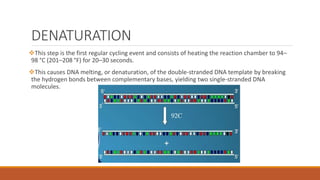
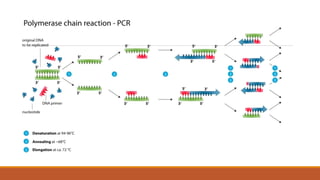
This step is the first regular cycling event and consists of heating the reaction chamber to 94–
98 °C (201–208 °F) for 20–30 seconds.
This causes DNA melting, or denaturation, of the double-stranded DNA template by breaking
the hydrogen bonds between complementary bases, yielding two single-stranded DNA
molecules.
ANNEALING
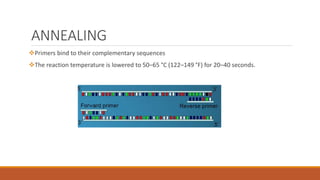
Primers bind to their complementary sequences
The reaction temperature is lowered to 50–65 °C (122–149 °F) for 20–40 seconds.
EXTENSION
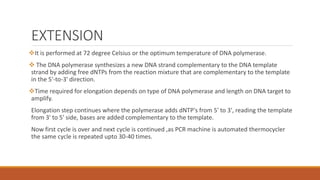
It is performed at 72 degree Celsius or the optimum temperature of DNA polymerase.
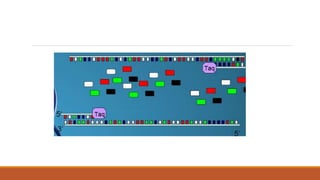
 The DNA polymerase synthesizes a new DNA strand complementary to the DNA template
strand by adding free dNTPs from the reaction mixture that are complementary to the template
in the 5'-to-3' direction.
Time required for elongation depends on type of DNA polymerase and length on DNA target to
amplify.
Elongation step continues where the polymerase adds dNTP's from 5' to 3', reading the template
from 3' to 5' side, bases are added complementary to the template.
Now first cycle is over and next cycle is continued ,as PCR machine is automated thermocycler
the same cycle is repeated upto 30-40 times.
NUMBER OF CYCLES
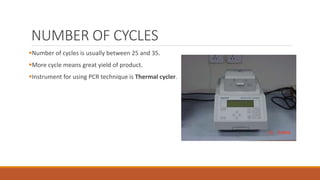
Number of cycles is usually between 25 and 35.
More cycle means great yield of product.
Instrument for using PCR technique is Thermal cycler.
APPLICATIONS OF PCR
It could be used for DNA fingerprinting and Paternity testing.
It could identify infectious diseases which are even non culturable.
It allows isolation of DNA fragments from genomic DNA by selective amplification of a specific
region of DNA.
Helps in detecting mutation that occur in cancer.
It help to amplify DNA from fossils.
It can act as an alternative to cloning.
THANK YOU

Polymerase chain reaction

  • 1.
  • 2.
    PCR Its an invitro technique for the amplification of a region of DNA, which lies between two regions of known sequence. Using PCR, a single copy (or more) of a DNA sequence is exponentially amplified to generate thousands to millions of more copies of that particular DNA segment.  PCR is now a common and often indispensable technique used in medical laboratory and clinical laboratory research for a broad variety of applications including biomedical research and criminal forensics.
  • 3.
    HISTORY 1971- H.Gobind Khoranadescribed a method to replicate short DNA templates with primers invitro 1976 –discovered Taq Polymerase from Thermus aquatics 1983 –Kary Mullis discovered PCR 1993 – won Nobel Prize for Chemistry
  • 4.
    REQUIREMENTS FOR PCR DNATEMPLATE – which contain region to amplify DNA POLYMERASE – enzyme which synthesizes new dna strands –Taq Polymerase [heat resistant] from Thermis aquaticus DNA PRIMER – Intiate DNA synthesis dNTPs -- deoxynucleotide triphosphates -the building blocks from which the DNA polymerase synthesizes a new DNA strand BUFFER SOLUTION -- providing a suitable chemical environment for optimum activity and stability of the DNA polymerase BIVALENT CATIONS – mainly Mg or Mn ions
  • 5.
    STEPS FOR PCR DENATURATION PRIMERANNEALING PRIMER EXTENSION/ELONGATION
  • 6.
    DENATURATION This step isthe first regular cycling event and consists of heating the reaction chamber to 94– 98 °C (201–208 °F) for 20–30 seconds. This causes DNA melting, or denaturation, of the double-stranded DNA template by breaking the hydrogen bonds between complementary bases, yielding two single-stranded DNA molecules.
  • 7.
    ANNEALING Primers bind totheir complementary sequences The reaction temperature is lowered to 50–65 °C (122–149 °F) for 20–40 seconds.
  • 8.
    EXTENSION It is performedat 72 degree Celsius or the optimum temperature of DNA polymerase.  The DNA polymerase synthesizes a new DNA strand complementary to the DNA template strand by adding free dNTPs from the reaction mixture that are complementary to the template in the 5'-to-3' direction. Time required for elongation depends on type of DNA polymerase and length on DNA target to amplify. Elongation step continues where the polymerase adds dNTP's from 5' to 3', reading the template from 3' to 5' side, bases are added complementary to the template. Now first cycle is over and next cycle is continued ,as PCR machine is automated thermocycler the same cycle is repeated upto 30-40 times.
  • 10.
    NUMBER OF CYCLES Numberof cycles is usually between 25 and 35. More cycle means great yield of product. Instrument for using PCR technique is Thermal cycler.
  • 12.
    APPLICATIONS OF PCR Itcould be used for DNA fingerprinting and Paternity testing. It could identify infectious diseases which are even non culturable. It allows isolation of DNA fragments from genomic DNA by selective amplification of a specific region of DNA. Helps in detecting mutation that occur in cancer. It help to amplify DNA from fossils. It can act as an alternative to cloning.
  • 13.