AN ASSIGNMENT ON
DNA LIBRARIES
Submitted by:
Donga Akhil R.
Reg.no.: 04-AGRMA-2215-2020
Dept.of Genetics & Plant Breeding
SDAU, SKnagar
Date of Submission: 13 Jan., 2021
Course: GP 501
Why DNA Libraries required ?
Introduction
 In molecular biology, a library is a mixture of DNA
molecules. In most cases, the DNA molecules are short to
medium sized DNA fragments.
 A library contains a large variety of different DNA
molecules from a common source.
 In most cases, the DNA fragments are added to a
common carrier DNA such as a plasmid or bacteriophage
genome (vectors).
 Libraries allow the isolation of small subsets of the total
DNA.
 Libraries are there to represent a genomic sequence
information into multiple small fragments.
.
 There are two ways to represent a genomic sequence information
into the multiple small fragments in the form of a library: -
(1) Genomic library
(2) cDNA library.
 Genomic libraries are libraries of genomic DNA sequences.
 These can be produced using DNA from any organism (prokaryotic
or eukaryotic).
 cDNA libraries are produced only from higher eukaryotes.
 cDNA is "complementary DNA"; it is produced by reverse
transcribing mRNA. Because mRNA has the introns removed,
cDNA, like its parent mRNA, consists of continuous coding
sequences.
 The vast majority of higher eukaryotic mRNA molecules have
poly(A) tails, and therefore can be purified from cells using an
oligo-T resin.
Genomic library
 A genomic library is an organism specific
collection of DNA covering the entire genome of
an organism.
 It contains all DNA sequences such as expressed
genes, non-expressed genes, exons and introns,
promoter and terminator regions and intervening
DNA sequences.
Construction of genomic library
 Construction of a genomic DNA library involves isolation,
purification and fragmentation of genomic DNA followed by
cloning of the fragmented DNA using suitable vectors.
 The eukaryotic cell nuclei are purified by digestion with
protease and organic (phenol-chloroform) extraction.
 The derived genomic DNA is too large to incorporate into a
vector and needs to be broken up into desirable fragment sizes.
 Fragmentation of DNA can be achieved by physical method
and enzymatic method.
 The library created contains representative copies of all DNA
fragments present within the genome.
Physical Method
 It involves mechanical shearing of genomic DNA
using a narrow-gauge syringe needle or sonication
to break up the DNA into suitable size fragments
that can be cloned.
 Typically, an average DNA fragment size of about
20 kb is desirable for cloning into λ based vectors.
 DNA fragmentation is random which may result in
variable sized DNA fragments.
 This method requires large quantities of DNA.
Enzymatic Method
 It involves use of restriction enzyme for the fragmentation of purified DNA.
 This method is limited by distribution probability of site prone to the action of
restriction enzymes which will generate shorter DNA fragments than the desired
size.
 If, a gene to be cloned contains multiple recognition sites for a particular restriction
enzyme, the complete digestion will generate fragments that are generally too small
to clone.
 As a consequence, the gene may not be represented within a library.
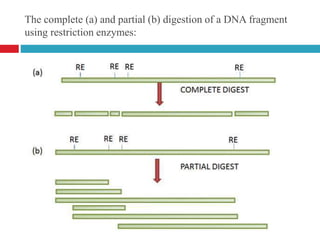
 To overcome this problem, partial digestion of the DNA molecule is usually carried
out using known quantity of restriction enzyme to obtain fragments of ideal size.
 The two factors which govern the selection of the restriction enzymes are- type of
ends (blunt or sticky) generated by the enzyme action and susceptibility of the
enzyme to chemical modification of bases like methylation which can inhibit the
enzyme activity.
 The fragments of desired size can be recovered by either agarose gel
electrophoresis or sucrose gradient technique and ligated to suitable vectors.
 Partial restriction digestion is achieved using restriction enzymes that produce
blunt or sticky ends.
The complete (a) and partial (b) digestion of a DNA fragment
using restriction enzymes:
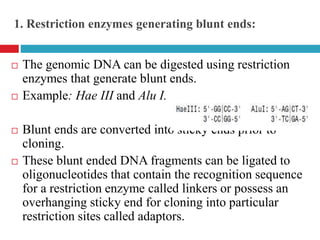
1. Restriction enzymes generating blunt ends:
 The genomic DNA can be digested using restriction
enzymes that generate blunt ends.
 Example: Hae III and Alu I.
 Blunt ends are converted into sticky ends prior to
cloning.
 These blunt ended DNA fragments can be ligated to
oligonucleotides that contain the recognition sequence
for a restriction enzyme called linkers or possess an
overhanging sticky end for cloning into particular
restriction sites called adaptors.
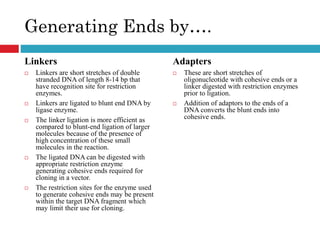
Generating Ends by….
Linkers
 Linkers are short stretches of double
stranded DNA of length 8-14 bp that
have recognition site for restriction
enzymes.
 Linkers are ligated to blunt end DNA by
ligase enzyme.
 The linker ligation is more efficient as
compared to blunt-end ligation of larger
molecules because of the presence of
high concentration of these small
molecules in the reaction.
 The ligated DNA can be digested with
appropriate restriction enzyme
generating cohesive ends required for
cloning in a vector.
 The restriction sites for the enzyme used
to generate cohesive ends may be present
within the target DNA fragment which
may limit their use for cloning.
Adapters
 These are short stretches of
oligonucleotide with cohesive ends or a
linker digested with restriction enzymes
prior to ligation.
 Addition of adaptors to the ends of a
DNA converts the blunt ends into
cohesive ends.
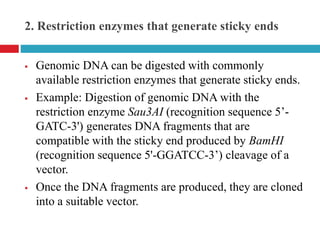
2. Restriction enzymes that generate sticky ends
 Genomic DNA can be digested with commonly
available restriction enzymes that generate sticky ends.
 Example: Digestion of genomic DNA with the
restriction enzyme Sau3AI (recognition sequence 5’-
GATC-3') generates DNA fragments that are
compatible with the sticky end produced by BamHI
(recognition sequence 5'-GGATCC-3’) cleavage of a
vector.
 Once the DNA fragments are produced, they are cloned
into a suitable vector.
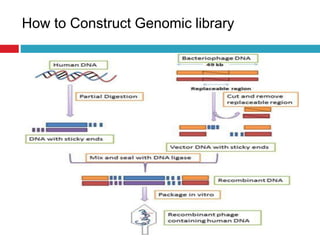
How to Construct Genomic library
.
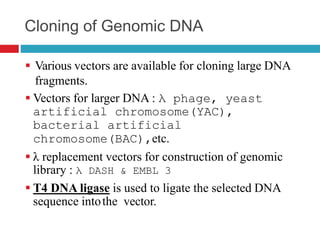
Cloning of Genomic DNA
 Various vectors are available for cloning large DNA
fragments.
 Vectors for larger DNA : λ phage, yeast
artificial chromosome(YAC),
bacterial artificial
chromosome(BAC),etc.
 λ replacement vectors for construction of genomic
library : λ DASH & EMBL 3
 T4 DNA ligase is used to ligate the selected DNA
sequence intothe vector.
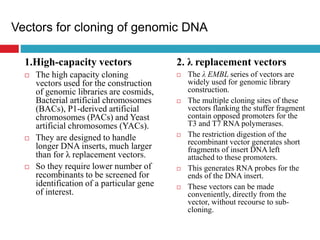
Vectors for cloning of genomic DNA
2. λ replacement vectors
 The λ EMBL series of vectors are
widely used for genomic library
construction.
 The multiple cloning sites of these
vectors flanking the stuffer fragment
contain opposed promoters for the
T3 and T7 RNA polymerases.
 The restriction digestion of the
recombinant vector generates short
fragments of insert DNA left
attached to these promoters.
 This generates RNA probes for the
ends of the DNA insert.
 These vectors can be made
conveniently, directly from the
vector, without recourse to sub-
cloning.
1.High-capacity vectors
 The high capacity cloning
vectors used for the construction
of genomic libraries are cosmids,
Bacterial artificial chromosomes
(BACs), P1-derived artificial
chromosomes (PACs) and Yeast
artificial chromosomes (YACs).
 They are designed to handle
longer DNA inserts, much larger
than for λ replacement vectors.
 So they require lower number of
recombinants to be screened for
identification of a particular gene
of interest.
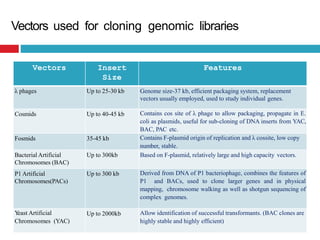
Vectors used for cloning genomic libraries
Vectors Insert
Size
Features
λ phages Up to 25-30 kb Genome size-37 kb, efficient packaging system, replacement
vectors usually employed, used to study individual genes.
Cosmids Up to 40-45 kb Contains cos site of λ phage to allow packaging, propagate in E.
coli as plasmids, useful for sub-cloning of DNA inserts from YAC,
BAC, PAC etc.
Fosmids 35-45 kb Contains F-plasmid origin of replication and λ cossite, low copy
number, stable.
Bacterial Artificial
Chromosomes (BAC)
Up to 300kb Based on F-plasmid, relatively large and high capacity vectors.
P1 Artificial
Chromosomes(PACs)
Up to 300 kb Derived from DNA of P1 bacteriophage, combines the features of
P1 and BACs, used to clone larger genes and in physical
mapping, chromosome walking as well as shotgun sequencing of
complex genomes.
Y
east Artificial
Chromosomes (YAC)
Up to 2000kb Allow identification of successful transformants. (BAC clones are
highly stable and highly efficient)
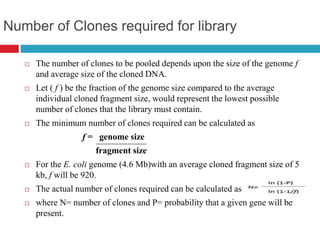
Number of Clones required for library
 The number of clones to be pooled depends upon the size of the genome f
and average size of the cloned DNA.
 Let ( f ) be the fraction of the genome size compared to the average
individual cloned fragment size, would represent the lowest possible
number of clones that the library must contain.
 The minimum number of clones required can be calculated as
f = genome size
fragment size
 For the E. coli genome (4.6 Mb)with an average cloned fragment size of 5
kb, f will be 920.
 The actual number of clones required can be calculated as
 where N= number of clones and P= probability that a given gene will be
present.
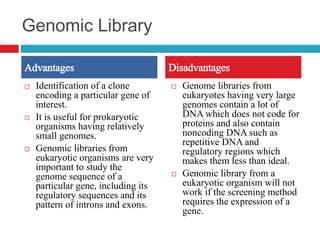
Genomic Library
 Identification of a clone
encoding a particular gene of
interest.
 It is useful for prokaryotic
organisms having relatively
small genomes.
 Genomic libraries from
eukaryotic organisms are very
important to study the
genome sequence of a
particular gene, including its
regulatory sequences and its
pattern of introns and exons.
 Genome libraries from
eukaryotes having very large
genomes contain a lot of
DNA which does not code for
proteins and also contain
noncoding DNA such as
repetitive DNA and
regulatory regions which
makes them less than ideal.
 Genomic library from a
eukaryotic organism will not
work if the screening method
requires the expression of a
gene.
Disadvantages
Advantages
Applications:
 To determine the complete genome sequence of a
given organism.
 To study and generate transgenic animals through
genetic engineering, serving as a source of genomic
sequence.
 To study the function of regulatory sequences
in vitro.
 To study the genetic mutations.
 Used for genome mapping, sequencing and the
assembly of clone contigs.
C - DNA LIBRARY
Chromosomal DNA library
Introduction
 In higher eukaryotes, gene expression is tissue-specific.
Only certain cell types show moderate to high
expression of a single gene or a group of genes.
 Example: The genes encoding globin proteins are
expressed only in erythrocyte precursor cells, called
reticulocytes.
 Using this information a target gene can be cloned by
isolating the mRNA from a specific tissue.
 The specific DNA sequences are synthesized as copies
from mRNAs of a particular cell type, and cloned into
bacteriophage vectors.
 cDNA (complementary DNA) is produced from a fully
transcribed mRNA which contains only the expressed
genes of an organism.
.
 Clones of such DNA copies of mRNAs are called
cDNA clones.
 A cDNA library is a combination of cloned cDNA
fragments constituting some portion of the
transcriptome of an organism which are inserted into a
number of host cells.
 In eukaryotic cells, the mRNA is spliced before
translation into protein.
 The DNA synthesized from the spliced mRNA doesn't
have introns or non-coding regions of the gene.
 As a result, the protein under expression can be
sequenced from the DNA which is the main advantage
of cDNA cloning over genomic DNA cloning.
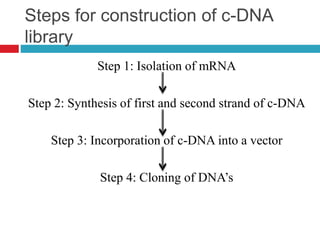
Steps for construction of c-DNA
library
Step 1: Isolation of mRNA
Step 2: Synthesis of first and second strand of c-DNA
Step 3: Incorporation of c-DNA into a vector
Step 4: Cloning of DNA’s
 It involves the isolation of total mRNA from a cell type
or tissue of interest. The amount of desired mRNA can
be increased by following ways-
 Chromatographic purification of mRNA using oligo-dT
column, which retains mRNA molecules, resulting in
their enrichment.
 Spinning down mRNA by density gradient
centrifugation.
 mRNA preparation from specialized cell types, e.g.
developing seeds, chicken oviduct, erythrocytes, β cells
of pancreas etc.
Step:1
Isolation of mRNA
.
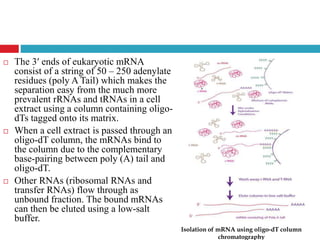
 The 3′ ends of eukaryotic mRNA
consist of a string of 50 – 250 adenylate
residues (poly A Tail) which makes the
separation easy from the much more
prevalent rRNAs and tRNAs in a cell
extract using a column containing oligo-
dTs tagged onto its matrix.
 When a cell extract is passed through an
oligo-dT column, the mRNAs bind to
the column due to the complementary
base-pairing between poly (A) tail and
oligo-dT.
 Other RNAs (ribosomal RNAs and
transfer RNAs) flow through as
unbound fraction. The bound mRNAs
can then be eluted using a low-salt
buffer.
Isolation of mRNA using oligo-dT column
chromatography
Step-2 :
Synthesis of first & second strand c-
DNA
 mRNA being single-stranded cannot be cloned as such and is not a
substrate for DNA ligase. It is first converted into DNA before
insertion into a suitable vector which can be achieved using reverse
transcriptase (RNA-dependent DNA polymerase or RTase) obtained
from avian myeloblastosis virus (AMV).
 A short oligo (dT) primer is annealed to the Poly (A) tail on the
mRNA.
 Reverse transcriptase extends the 3´-end of the primer using mRNA
molecule as a template producing a cDNA: mRNA hybrid.
 The mRNA from the cDNA: mRNA hybrid can be removed by
RNase H or Alkaline hydrolysis to give a ss-cDNA molecule.
 No primer is required as the 3´end of this ss-cDNA serves as its
own primer generating a short hairpin loop at this end. This free 3´-
OH is required for the synthesis of its complementary strand
.
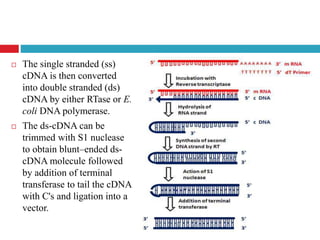
 The single stranded (ss)
cDNA is then converted
into double stranded (ds)
cDNA by either RTase or E.
coli DNA polymerase.
 The ds-cDNA can be
trimmed with S1 nuclease
to obtain blunt–ended ds-
cDNA molecule followed
by addition of terminal
transferase to tail the cDNA
with C's and ligation into a
vector.
Step-3:
Incorporation of cDNA into a vector
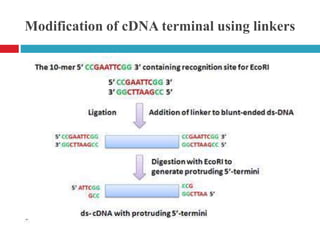
 The blunt-ended cDNA termini are modified in order to
ligate into a vector to prepare ds-cDNA for cloning.
 Since blunt-end ligation is inefficient, short restriction-site
linkers are first ligated to both ends.
Linker
 It is a double-stranded DNA segment with a recognition site
for a particular restriction enzyme.
 It is 10-12 base pairs long prepared by hybridizing
chemically synthesized complementary oligonucleotides.
 The blunt ended ds-DNAs are ligated with the linkers by
the DNA ligase from T4 Bacteriophage.
Modification of cDNA terminal using linkers
.
 The resulting double-stranded cDNAs with linkers at both ends are treated
with a restriction enzyme specific for the linker generating cDNA
molecules with sticky ends.
 Problems arise, when cDNA itself has a site for the restriction enzyme
cleaving the linkers.
 This can be overcome using an appropriate modification enzyme
(methylase) to protect any internal recognition site from digestion which
methylates specific bases within the restriction site sequence, thereby,
preventing the restriction enzyme binding
 Ligation of the digested ds-cDNA into a vector is the final step in the
construction of a cDNA library.
 The vectors (e.g. plasmid or bacteriophage) should be restricted with the
same restriction enzyme used for linkers.
 The E. coli cells are transformed with the recombinant vector, producing a
library of plasmid or λ clones.
 These clones contain cDNA corresponding to a particular mRNA.
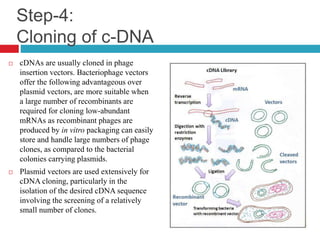
Step-4:
Cloning of c-DNA
 cDNAs are usually cloned in phage
insertion vectors. Bacteriophage vectors
offer the following advantageous over
plasmid vectors, are more suitable when
a large number of recombinants are
required for cloning low-abundant
mRNAs as recombinant phages are
produced by in vitro packaging can easily
store and handle large numbers of phage
clones, as compared to the bacterial
colonies carrying plasmids.
 Plasmid vectors are used extensively for
cDNA cloning, particularly in the
isolation of the desired cDNA sequence
involving the screening of a relatively
small number of clones.
C-DNA Library
 It is enriched with fragments
from actively transcribing genes.
 Introns do not interrupt the
cloned sequences. Introns would
pose a problem when their goal
is to produce eukaryotic protein
in bacteria, since they lack
mechanism of removing introns.
 cDNA maybe inserted into
vectors and then cloned.
 cDNA libraries contain only the
parts of genes found in mature
mRNA. However, the sequences
before and after the gene,
for example, those involved in
the regulation of gene
expression, will not occur in a
cDNA library.
 Construction of a cDNA library
cannot be used for isolating the
genes expressed at low levels as
there will be very little mRNA
for it in any cell type and may
completely be out manoeuvred
by the more abundant species
Disadvantages
Advantages
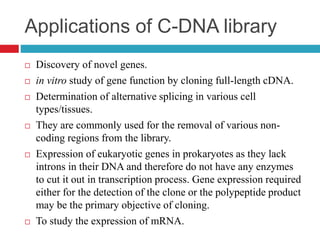
Applications of C-DNA library
 Discovery of novel genes.
 in vitro study of gene function by cloning full-length cDNA.
 Determination of alternative splicing in various cell
types/tissues.
 They are commonly used for the removal of various non-
coding regions from the library.
 Expression of eukaryotic genes in prokaryotes as they lack
introns in their DNA and therefore do not have any enzymes
to cut it out in transcription process. Gene expression required
either for the detection of the clone or the polypeptide product
may be the primary objective of cloning.
 To study the expression of mRNA.
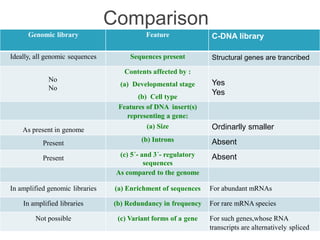
Comparison
Genomic library Feature C-DNA library
Ideally, all genomic sequences Sequences present Structural genes are trancribed
No
No
Contents affected by :
(a) Developmental stage
(b) Cell type
Yes
Yes
Features of DNA insert(s)
representing a gene:
As present in genome (a) Size Ordinarlly smaller
Present (b) Introns Absent
Present (c) 5´- and 3´- regulatory
sequences
Absent
As compared to the genome
In amplified genomic libraries (a) Enrichment of sequences For abundant mRNAs
In amplified libraries (b) Redundancy in frequency For rare mRNA species
Not possible (c) Variant forms of a gene For such genes,whose RNA
transcripts are alternatively spliced
THANK YOU !
Have a Nice Day!
References From:
•Primose SB, Twyman RM, Old RW 2001.Principles of Gene Manipulation.
Oxford. Blackwell Scientific
•Singh BD. 2008. Biotechnology ; Expanding Horizons. 2nd ed. Kalyani
Publishers.

DNA Library

  • 1.
    AN ASSIGNMENT ON DNALIBRARIES Submitted by: Donga Akhil R. Reg.no.: 04-AGRMA-2215-2020 Dept.of Genetics & Plant Breeding SDAU, SKnagar Date of Submission: 13 Jan., 2021 Course: GP 501
  • 2.
  • 3.
    Introduction  In molecularbiology, a library is a mixture of DNA molecules. In most cases, the DNA molecules are short to medium sized DNA fragments.  A library contains a large variety of different DNA molecules from a common source.  In most cases, the DNA fragments are added to a common carrier DNA such as a plasmid or bacteriophage genome (vectors).  Libraries allow the isolation of small subsets of the total DNA.  Libraries are there to represent a genomic sequence information into multiple small fragments.
  • 4.
    .  There aretwo ways to represent a genomic sequence information into the multiple small fragments in the form of a library: - (1) Genomic library (2) cDNA library.  Genomic libraries are libraries of genomic DNA sequences.  These can be produced using DNA from any organism (prokaryotic or eukaryotic).  cDNA libraries are produced only from higher eukaryotes.  cDNA is "complementary DNA"; it is produced by reverse transcribing mRNA. Because mRNA has the introns removed, cDNA, like its parent mRNA, consists of continuous coding sequences.  The vast majority of higher eukaryotic mRNA molecules have poly(A) tails, and therefore can be purified from cells using an oligo-T resin.
  • 5.
    Genomic library  Agenomic library is an organism specific collection of DNA covering the entire genome of an organism.  It contains all DNA sequences such as expressed genes, non-expressed genes, exons and introns, promoter and terminator regions and intervening DNA sequences.
  • 6.
    Construction of genomiclibrary  Construction of a genomic DNA library involves isolation, purification and fragmentation of genomic DNA followed by cloning of the fragmented DNA using suitable vectors.  The eukaryotic cell nuclei are purified by digestion with protease and organic (phenol-chloroform) extraction.  The derived genomic DNA is too large to incorporate into a vector and needs to be broken up into desirable fragment sizes.  Fragmentation of DNA can be achieved by physical method and enzymatic method.  The library created contains representative copies of all DNA fragments present within the genome.
  • 7.
    Physical Method  Itinvolves mechanical shearing of genomic DNA using a narrow-gauge syringe needle or sonication to break up the DNA into suitable size fragments that can be cloned.  Typically, an average DNA fragment size of about 20 kb is desirable for cloning into λ based vectors.  DNA fragmentation is random which may result in variable sized DNA fragments.  This method requires large quantities of DNA.
  • 8.
    Enzymatic Method  Itinvolves use of restriction enzyme for the fragmentation of purified DNA.  This method is limited by distribution probability of site prone to the action of restriction enzymes which will generate shorter DNA fragments than the desired size.  If, a gene to be cloned contains multiple recognition sites for a particular restriction enzyme, the complete digestion will generate fragments that are generally too small to clone.  As a consequence, the gene may not be represented within a library.  To overcome this problem, partial digestion of the DNA molecule is usually carried out using known quantity of restriction enzyme to obtain fragments of ideal size.  The two factors which govern the selection of the restriction enzymes are- type of ends (blunt or sticky) generated by the enzyme action and susceptibility of the enzyme to chemical modification of bases like methylation which can inhibit the enzyme activity.  The fragments of desired size can be recovered by either agarose gel electrophoresis or sucrose gradient technique and ligated to suitable vectors.  Partial restriction digestion is achieved using restriction enzymes that produce blunt or sticky ends.
  • 9.
    The complete (a)and partial (b) digestion of a DNA fragment using restriction enzymes:
  • 10.
    1. Restriction enzymesgenerating blunt ends:  The genomic DNA can be digested using restriction enzymes that generate blunt ends.  Example: Hae III and Alu I.  Blunt ends are converted into sticky ends prior to cloning.  These blunt ended DNA fragments can be ligated to oligonucleotides that contain the recognition sequence for a restriction enzyme called linkers or possess an overhanging sticky end for cloning into particular restriction sites called adaptors.
  • 11.
    Generating Ends by…. Linkers Linkers are short stretches of double stranded DNA of length 8-14 bp that have recognition site for restriction enzymes.  Linkers are ligated to blunt end DNA by ligase enzyme.  The linker ligation is more efficient as compared to blunt-end ligation of larger molecules because of the presence of high concentration of these small molecules in the reaction.  The ligated DNA can be digested with appropriate restriction enzyme generating cohesive ends required for cloning in a vector.  The restriction sites for the enzyme used to generate cohesive ends may be present within the target DNA fragment which may limit their use for cloning. Adapters  These are short stretches of oligonucleotide with cohesive ends or a linker digested with restriction enzymes prior to ligation.  Addition of adaptors to the ends of a DNA converts the blunt ends into cohesive ends.
  • 12.
    2. Restriction enzymesthat generate sticky ends  Genomic DNA can be digested with commonly available restriction enzymes that generate sticky ends.  Example: Digestion of genomic DNA with the restriction enzyme Sau3AI (recognition sequence 5’- GATC-3') generates DNA fragments that are compatible with the sticky end produced by BamHI (recognition sequence 5'-GGATCC-3’) cleavage of a vector.  Once the DNA fragments are produced, they are cloned into a suitable vector.
  • 13.
    How to ConstructGenomic library .
  • 14.
    Cloning of GenomicDNA  Various vectors are available for cloning large DNA fragments.  Vectors for larger DNA : λ phage, yeast artificial chromosome(YAC), bacterial artificial chromosome(BAC),etc.  λ replacement vectors for construction of genomic library : λ DASH & EMBL 3  T4 DNA ligase is used to ligate the selected DNA sequence intothe vector.
  • 15.
    Vectors for cloningof genomic DNA 2. λ replacement vectors  The λ EMBL series of vectors are widely used for genomic library construction.  The multiple cloning sites of these vectors flanking the stuffer fragment contain opposed promoters for the T3 and T7 RNA polymerases.  The restriction digestion of the recombinant vector generates short fragments of insert DNA left attached to these promoters.  This generates RNA probes for the ends of the DNA insert.  These vectors can be made conveniently, directly from the vector, without recourse to sub- cloning. 1.High-capacity vectors  The high capacity cloning vectors used for the construction of genomic libraries are cosmids, Bacterial artificial chromosomes (BACs), P1-derived artificial chromosomes (PACs) and Yeast artificial chromosomes (YACs).  They are designed to handle longer DNA inserts, much larger than for λ replacement vectors.  So they require lower number of recombinants to be screened for identification of a particular gene of interest.
  • 16.
    Vectors used forcloning genomic libraries Vectors Insert Size Features λ phages Up to 25-30 kb Genome size-37 kb, efficient packaging system, replacement vectors usually employed, used to study individual genes. Cosmids Up to 40-45 kb Contains cos site of λ phage to allow packaging, propagate in E. coli as plasmids, useful for sub-cloning of DNA inserts from YAC, BAC, PAC etc. Fosmids 35-45 kb Contains F-plasmid origin of replication and λ cossite, low copy number, stable. Bacterial Artificial Chromosomes (BAC) Up to 300kb Based on F-plasmid, relatively large and high capacity vectors. P1 Artificial Chromosomes(PACs) Up to 300 kb Derived from DNA of P1 bacteriophage, combines the features of P1 and BACs, used to clone larger genes and in physical mapping, chromosome walking as well as shotgun sequencing of complex genomes. Y east Artificial Chromosomes (YAC) Up to 2000kb Allow identification of successful transformants. (BAC clones are highly stable and highly efficient)
  • 17.
    Number of Clonesrequired for library  The number of clones to be pooled depends upon the size of the genome f and average size of the cloned DNA.  Let ( f ) be the fraction of the genome size compared to the average individual cloned fragment size, would represent the lowest possible number of clones that the library must contain.  The minimum number of clones required can be calculated as f = genome size fragment size  For the E. coli genome (4.6 Mb)with an average cloned fragment size of 5 kb, f will be 920.  The actual number of clones required can be calculated as  where N= number of clones and P= probability that a given gene will be present.
  • 18.
    Genomic Library  Identificationof a clone encoding a particular gene of interest.  It is useful for prokaryotic organisms having relatively small genomes.  Genomic libraries from eukaryotic organisms are very important to study the genome sequence of a particular gene, including its regulatory sequences and its pattern of introns and exons.  Genome libraries from eukaryotes having very large genomes contain a lot of DNA which does not code for proteins and also contain noncoding DNA such as repetitive DNA and regulatory regions which makes them less than ideal.  Genomic library from a eukaryotic organism will not work if the screening method requires the expression of a gene. Disadvantages Advantages
  • 19.
    Applications:  To determinethe complete genome sequence of a given organism.  To study and generate transgenic animals through genetic engineering, serving as a source of genomic sequence.  To study the function of regulatory sequences in vitro.  To study the genetic mutations.  Used for genome mapping, sequencing and the assembly of clone contigs.
  • 20.
    C - DNALIBRARY Chromosomal DNA library
  • 21.
    Introduction  In highereukaryotes, gene expression is tissue-specific. Only certain cell types show moderate to high expression of a single gene or a group of genes.  Example: The genes encoding globin proteins are expressed only in erythrocyte precursor cells, called reticulocytes.  Using this information a target gene can be cloned by isolating the mRNA from a specific tissue.  The specific DNA sequences are synthesized as copies from mRNAs of a particular cell type, and cloned into bacteriophage vectors.  cDNA (complementary DNA) is produced from a fully transcribed mRNA which contains only the expressed genes of an organism.
  • 22.
    .  Clones ofsuch DNA copies of mRNAs are called cDNA clones.  A cDNA library is a combination of cloned cDNA fragments constituting some portion of the transcriptome of an organism which are inserted into a number of host cells.  In eukaryotic cells, the mRNA is spliced before translation into protein.  The DNA synthesized from the spliced mRNA doesn't have introns or non-coding regions of the gene.  As a result, the protein under expression can be sequenced from the DNA which is the main advantage of cDNA cloning over genomic DNA cloning.
  • 23.
    Steps for constructionof c-DNA library Step 1: Isolation of mRNA Step 2: Synthesis of first and second strand of c-DNA Step 3: Incorporation of c-DNA into a vector Step 4: Cloning of DNA’s
  • 24.
     It involvesthe isolation of total mRNA from a cell type or tissue of interest. The amount of desired mRNA can be increased by following ways-  Chromatographic purification of mRNA using oligo-dT column, which retains mRNA molecules, resulting in their enrichment.  Spinning down mRNA by density gradient centrifugation.  mRNA preparation from specialized cell types, e.g. developing seeds, chicken oviduct, erythrocytes, β cells of pancreas etc. Step:1 Isolation of mRNA .
  • 25.
     The 3′ends of eukaryotic mRNA consist of a string of 50 – 250 adenylate residues (poly A Tail) which makes the separation easy from the much more prevalent rRNAs and tRNAs in a cell extract using a column containing oligo- dTs tagged onto its matrix.  When a cell extract is passed through an oligo-dT column, the mRNAs bind to the column due to the complementary base-pairing between poly (A) tail and oligo-dT.  Other RNAs (ribosomal RNAs and transfer RNAs) flow through as unbound fraction. The bound mRNAs can then be eluted using a low-salt buffer. Isolation of mRNA using oligo-dT column chromatography
  • 26.
    Step-2 : Synthesis offirst & second strand c- DNA  mRNA being single-stranded cannot be cloned as such and is not a substrate for DNA ligase. It is first converted into DNA before insertion into a suitable vector which can be achieved using reverse transcriptase (RNA-dependent DNA polymerase or RTase) obtained from avian myeloblastosis virus (AMV).  A short oligo (dT) primer is annealed to the Poly (A) tail on the mRNA.  Reverse transcriptase extends the 3´-end of the primer using mRNA molecule as a template producing a cDNA: mRNA hybrid.  The mRNA from the cDNA: mRNA hybrid can be removed by RNase H or Alkaline hydrolysis to give a ss-cDNA molecule.  No primer is required as the 3´end of this ss-cDNA serves as its own primer generating a short hairpin loop at this end. This free 3´- OH is required for the synthesis of its complementary strand
  • 27.
    .  The singlestranded (ss) cDNA is then converted into double stranded (ds) cDNA by either RTase or E. coli DNA polymerase.  The ds-cDNA can be trimmed with S1 nuclease to obtain blunt–ended ds- cDNA molecule followed by addition of terminal transferase to tail the cDNA with C's and ligation into a vector.
  • 28.
    Step-3: Incorporation of cDNAinto a vector  The blunt-ended cDNA termini are modified in order to ligate into a vector to prepare ds-cDNA for cloning.  Since blunt-end ligation is inefficient, short restriction-site linkers are first ligated to both ends. Linker  It is a double-stranded DNA segment with a recognition site for a particular restriction enzyme.  It is 10-12 base pairs long prepared by hybridizing chemically synthesized complementary oligonucleotides.  The blunt ended ds-DNAs are ligated with the linkers by the DNA ligase from T4 Bacteriophage.
  • 29.
    Modification of cDNAterminal using linkers
  • 30.
    .  The resultingdouble-stranded cDNAs with linkers at both ends are treated with a restriction enzyme specific for the linker generating cDNA molecules with sticky ends.  Problems arise, when cDNA itself has a site for the restriction enzyme cleaving the linkers.  This can be overcome using an appropriate modification enzyme (methylase) to protect any internal recognition site from digestion which methylates specific bases within the restriction site sequence, thereby, preventing the restriction enzyme binding  Ligation of the digested ds-cDNA into a vector is the final step in the construction of a cDNA library.  The vectors (e.g. plasmid or bacteriophage) should be restricted with the same restriction enzyme used for linkers.  The E. coli cells are transformed with the recombinant vector, producing a library of plasmid or λ clones.  These clones contain cDNA corresponding to a particular mRNA.
  • 31.
    Step-4: Cloning of c-DNA cDNAs are usually cloned in phage insertion vectors. Bacteriophage vectors offer the following advantageous over plasmid vectors, are more suitable when a large number of recombinants are required for cloning low-abundant mRNAs as recombinant phages are produced by in vitro packaging can easily store and handle large numbers of phage clones, as compared to the bacterial colonies carrying plasmids.  Plasmid vectors are used extensively for cDNA cloning, particularly in the isolation of the desired cDNA sequence involving the screening of a relatively small number of clones.
  • 32.
    C-DNA Library  Itis enriched with fragments from actively transcribing genes.  Introns do not interrupt the cloned sequences. Introns would pose a problem when their goal is to produce eukaryotic protein in bacteria, since they lack mechanism of removing introns.  cDNA maybe inserted into vectors and then cloned.  cDNA libraries contain only the parts of genes found in mature mRNA. However, the sequences before and after the gene, for example, those involved in the regulation of gene expression, will not occur in a cDNA library.  Construction of a cDNA library cannot be used for isolating the genes expressed at low levels as there will be very little mRNA for it in any cell type and may completely be out manoeuvred by the more abundant species Disadvantages Advantages
  • 33.
    Applications of C-DNAlibrary  Discovery of novel genes.  in vitro study of gene function by cloning full-length cDNA.  Determination of alternative splicing in various cell types/tissues.  They are commonly used for the removal of various non- coding regions from the library.  Expression of eukaryotic genes in prokaryotes as they lack introns in their DNA and therefore do not have any enzymes to cut it out in transcription process. Gene expression required either for the detection of the clone or the polypeptide product may be the primary objective of cloning.  To study the expression of mRNA.
  • 34.
    Comparison Genomic library FeatureC-DNA library Ideally, all genomic sequences Sequences present Structural genes are trancribed No No Contents affected by : (a) Developmental stage (b) Cell type Yes Yes Features of DNA insert(s) representing a gene: As present in genome (a) Size Ordinarlly smaller Present (b) Introns Absent Present (c) 5´- and 3´- regulatory sequences Absent As compared to the genome In amplified genomic libraries (a) Enrichment of sequences For abundant mRNAs In amplified libraries (b) Redundancy in frequency For rare mRNA species Not possible (c) Variant forms of a gene For such genes,whose RNA transcripts are alternatively spliced
  • 35.
    THANK YOU ! Havea Nice Day! References From: •Primose SB, Twyman RM, Old RW 2001.Principles of Gene Manipulation. Oxford. Blackwell Scientific •Singh BD. 2008. Biotechnology ; Expanding Horizons. 2nd ed. Kalyani Publishers.