A Talk on Genomic Library
By
ABDUR RASHID KHAN & IFTEKHAR RASOOL
Department of Plant Protection
King Saud University Riyadh, Saudi Arabia
DNA LIBRARY
The term “library” refers a population of organism, each of which carries a DNA
molecule inserted into a cloning vector.
Collection of DNA fragments that have been cloned into vectors so that researchers
can identify and isolate the DNA fragment or gene of interest.
For ease of purification, storage and analysis.
Types of DNA Library
Genomic library
(made from chromosomal DNA)
DNA Library
cDNA Library
(made from mRNA)
What is Genomic Library
Contains DNA fragments representing entire genome of an organism.
Created using molecular cloning.
Genome size is expressed in terms of no. of base pairs (bp).
The sizes of genomes in different species are variable.
Difference in prokaryotic and eukaryotic genes.
• In prokaryotes, the genes are continuous.
• Eukaryotes, the coding regions (exons) are separated by non-coding regions (introns).
Therefore, the construction of gene libraries for eukaryotes is more complicated.
Importance of Genomic Library
Used to explore the genome of an organism and to learn more about the genomic
structure and function.
Used to create a genomic map and to identify the locations of specific genes.
Used to study the genetic variations such as mutations (Cancer).
Useful in recombinant DNA technology, like transgenic plants or animals through genetic
engineering (B.T cotton).
It is the first step in any DNA sequencing projects.
Steps of Genomic Library construction
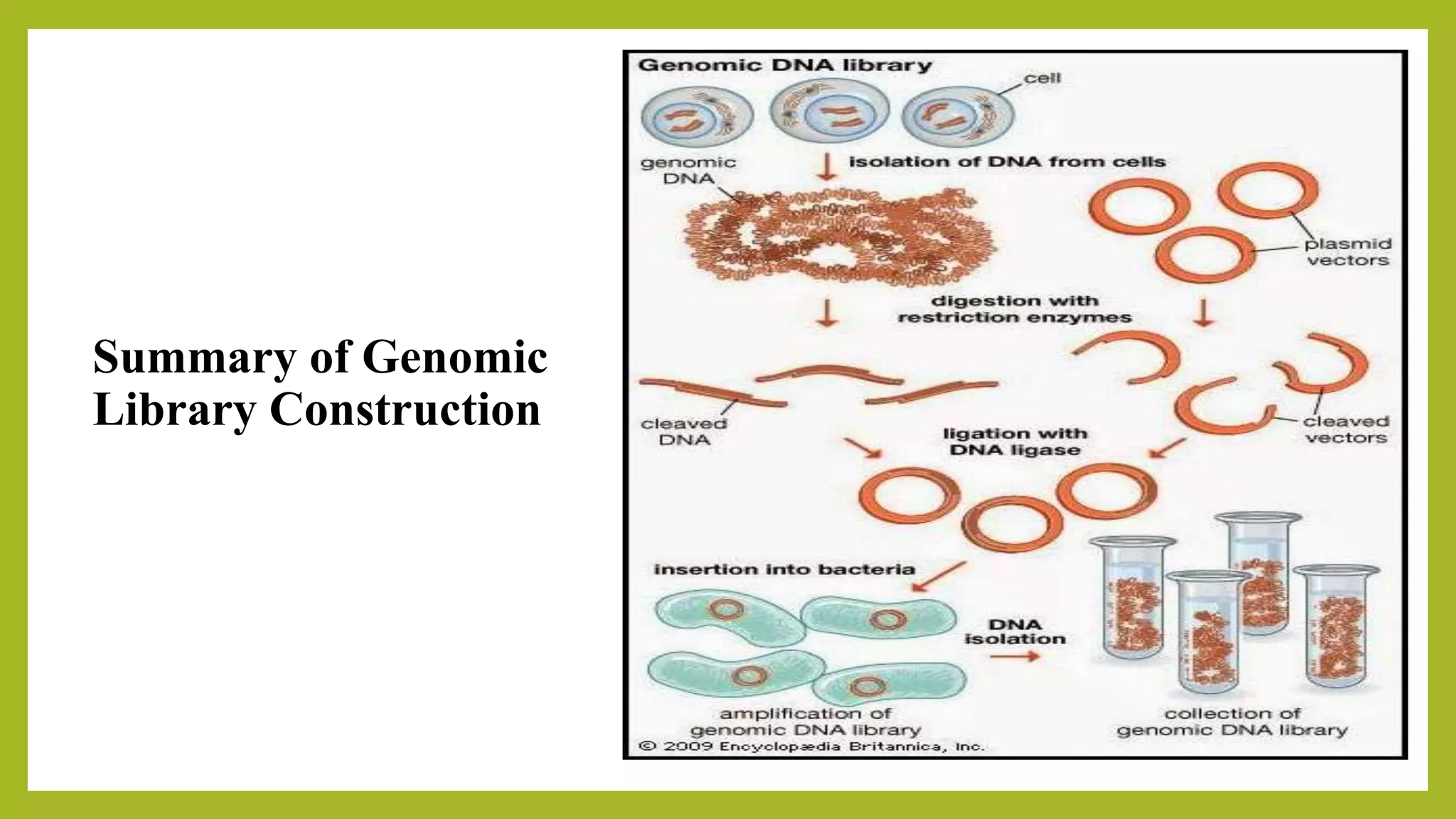
Isolation of DNA from cells.
Digestion into small fragments.
Introduction into suitable vectors.
Insertion into bacteria.
DNA isolation.
Collection of Genomic DNA library.
Chromosomal DNA
Gene Fragments
Recombinant DNA
Recombinant DNA in E. Coli
Restriction endonuclease
Vector
E.Coli
Vectors used for Genomic Library
Vector of Prokaryotic or eukaryotic, can be selected Depending upon the size
of genome
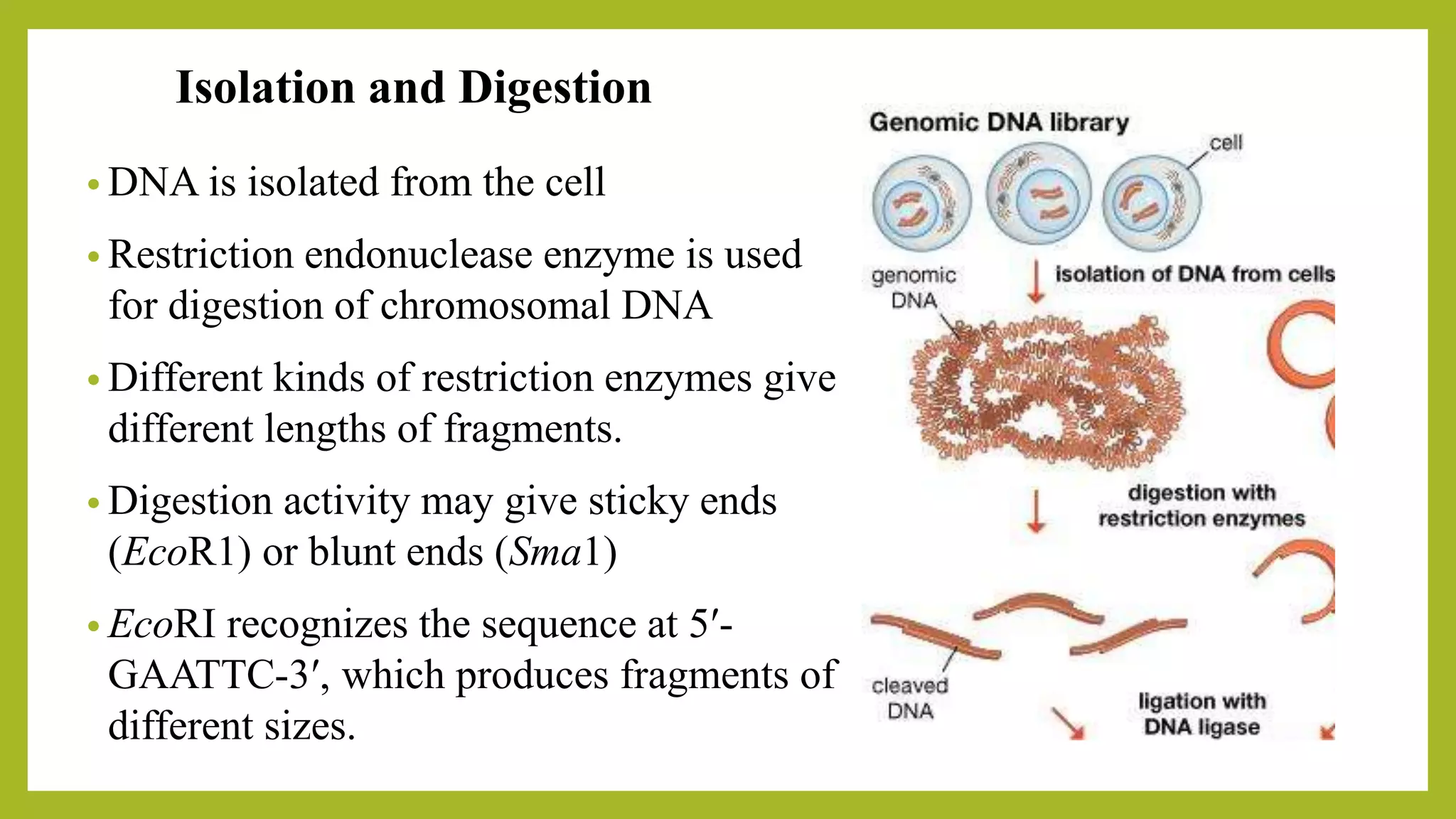
Isolation and Digestion
• DNA is isolated from the cell
• Restriction endonuclease enzyme is used
for digestion of chromosomal DNA
• Different kinds of restriction enzymes give
different lengths of fragments.
• Digestion activity may give sticky ends
(EcoR1) or blunt ends (Sma1)
• EcoRI recognizes the sequence at 5′-
GAATTC-3′, which produces fragments of
different sizes.
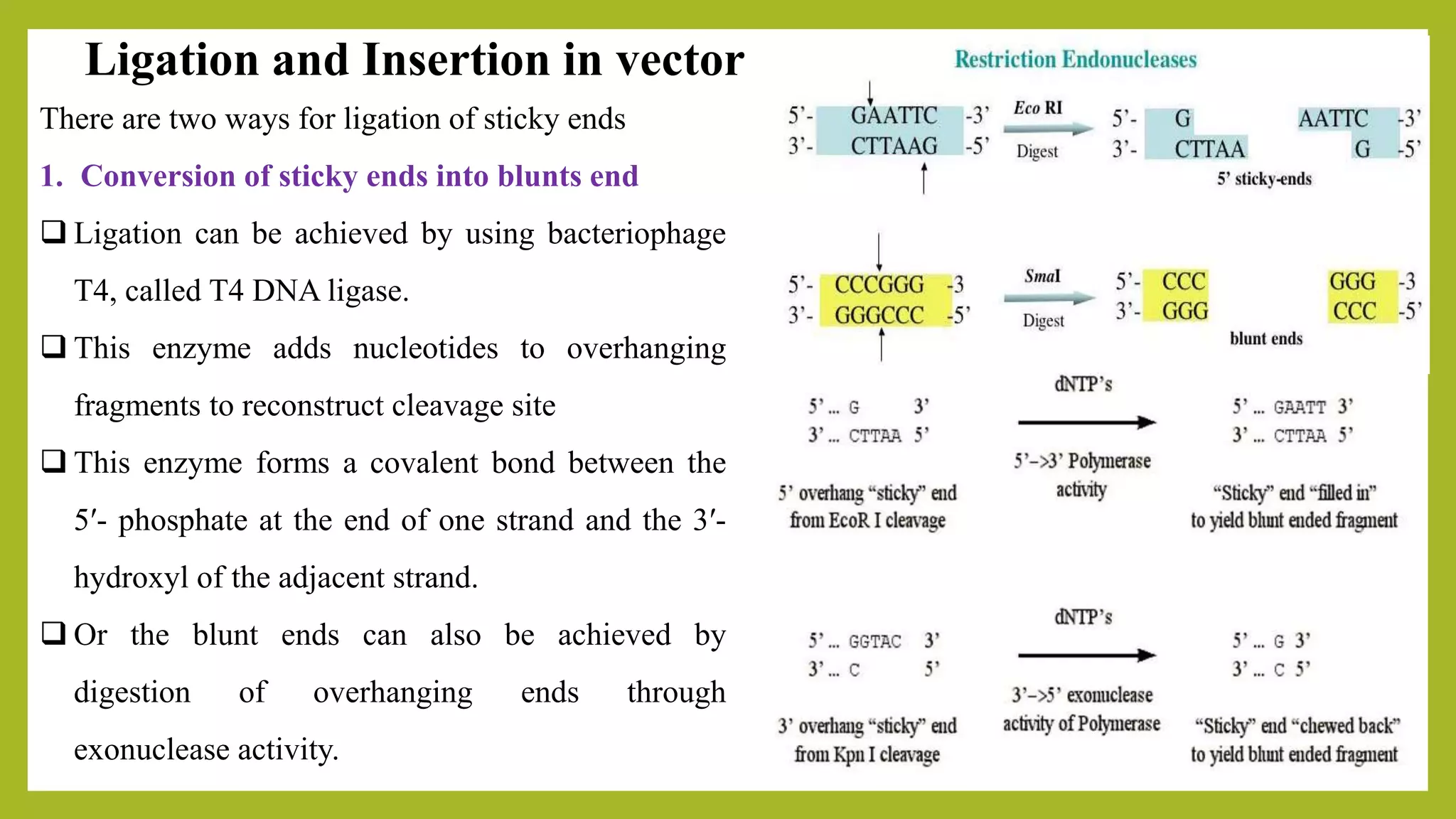
Ligation and Insertion in vector
There are two ways for ligation of sticky ends
1. Conversion of sticky ends into blunts end
 Ligation can be achieved by using bacteriophage
T4, called T4 DNA ligase.
 This enzyme adds nucleotides to overhanging
fragments to reconstruct cleavage site
 This enzyme forms a covalent bond between the
5′- phosphate at the end of one strand and the 3′-
hydroxyl of the adjacent strand.
 Or the blunt ends can also be achieved by
digestion of overhanging ends through
exonuclease activity.
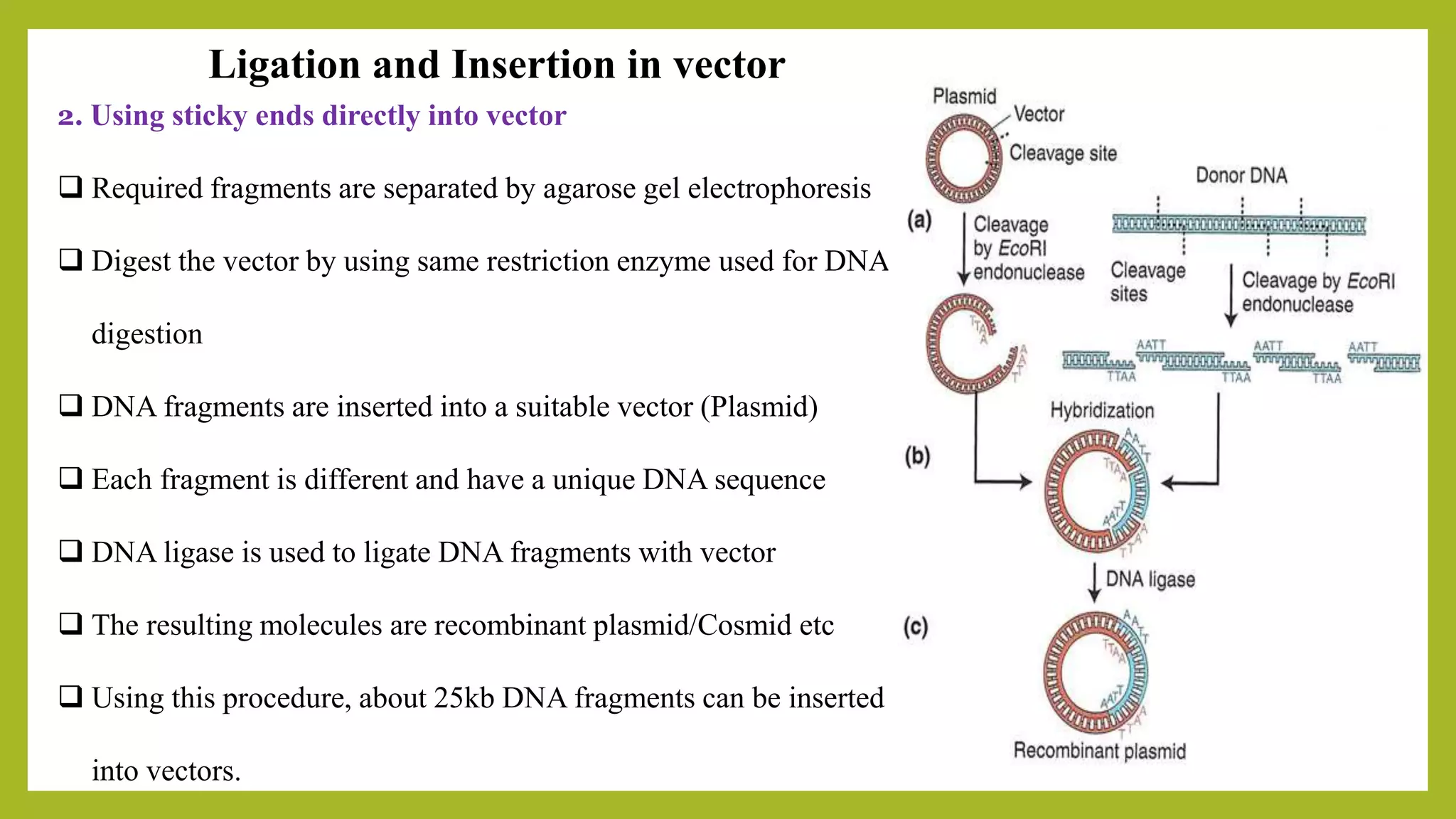
Ligation and Insertion in vector
2. Using sticky ends directly into vector
 Required fragments are separated by agarose gel electrophoresis
 Digest the vector by using same restriction enzyme used for DNA
digestion
 DNA fragments are inserted into a suitable vector (Plasmid)
 Each fragment is different and have a unique DNA sequence
 DNA ligase is used to ligate DNA fragments with vector
 The resulting molecules are recombinant plasmid/Cosmid etc
 Using this procedure, about 25kb DNA fragments can be inserted
into vectors.
Insertion and Replication in Bacteria
Recombinant plasmid are inserted into host bacteria (E.coli )
Recombinant bacteria are grown in culture to take up the
DNA.
They replicate their genome along with the vector genome
and produce clones of the original genome.
This collection of clones which contains all the sequences
found in the original source, including the sequence of
interest that forms the genomic library.
Multiplication and Production of clones
Independent plasmid
replication
 Host cell replication
Summary of Genomic
Library Construction
Problems and Solutions of Genomic Library
1. Problem in Genome Library
The gene may be cut internally with the restriction enzyme used, therefore a single
required sequence is not obtained.
The gene of interest obtained by the restriction enzyme may be larger than the vector.
2. Solution
Random cloning of DNA fragments of large size ≥ 20 kb
Screening Strategies of Gene Libraries
(1) Screening by Colony Hybridization
(2) Screening by DNA Hybridization
(3) Screening by PCR
(4) Screening by Immunological Assay and
(5) Screening by Protein Function.
Screening by Colony Hybridization
Genomic library

Genomic library

  • 1.
    A Talk onGenomic Library By ABDUR RASHID KHAN & IFTEKHAR RASOOL Department of Plant Protection King Saud University Riyadh, Saudi Arabia
  • 2.
    DNA LIBRARY The term“library” refers a population of organism, each of which carries a DNA molecule inserted into a cloning vector. Collection of DNA fragments that have been cloned into vectors so that researchers can identify and isolate the DNA fragment or gene of interest. For ease of purification, storage and analysis.
  • 3.
    Types of DNALibrary Genomic library (made from chromosomal DNA) DNA Library cDNA Library (made from mRNA)
  • 4.
    What is GenomicLibrary Contains DNA fragments representing entire genome of an organism. Created using molecular cloning. Genome size is expressed in terms of no. of base pairs (bp). The sizes of genomes in different species are variable. Difference in prokaryotic and eukaryotic genes. • In prokaryotes, the genes are continuous. • Eukaryotes, the coding regions (exons) are separated by non-coding regions (introns). Therefore, the construction of gene libraries for eukaryotes is more complicated.
  • 5.
    Importance of GenomicLibrary Used to explore the genome of an organism and to learn more about the genomic structure and function. Used to create a genomic map and to identify the locations of specific genes. Used to study the genetic variations such as mutations (Cancer). Useful in recombinant DNA technology, like transgenic plants or animals through genetic engineering (B.T cotton). It is the first step in any DNA sequencing projects.
  • 6.
    Steps of GenomicLibrary construction Isolation of DNA from cells. Digestion into small fragments. Introduction into suitable vectors. Insertion into bacteria. DNA isolation. Collection of Genomic DNA library. Chromosomal DNA Gene Fragments Recombinant DNA Recombinant DNA in E. Coli Restriction endonuclease Vector E.Coli
  • 7.
    Vectors used forGenomic Library Vector of Prokaryotic or eukaryotic, can be selected Depending upon the size of genome
  • 8.
    Isolation and Digestion •DNA is isolated from the cell • Restriction endonuclease enzyme is used for digestion of chromosomal DNA • Different kinds of restriction enzymes give different lengths of fragments. • Digestion activity may give sticky ends (EcoR1) or blunt ends (Sma1) • EcoRI recognizes the sequence at 5′- GAATTC-3′, which produces fragments of different sizes.
  • 9.
    Ligation and Insertionin vector There are two ways for ligation of sticky ends 1. Conversion of sticky ends into blunts end  Ligation can be achieved by using bacteriophage T4, called T4 DNA ligase.  This enzyme adds nucleotides to overhanging fragments to reconstruct cleavage site  This enzyme forms a covalent bond between the 5′- phosphate at the end of one strand and the 3′- hydroxyl of the adjacent strand.  Or the blunt ends can also be achieved by digestion of overhanging ends through exonuclease activity.
  • 10.
    Ligation and Insertionin vector 2. Using sticky ends directly into vector  Required fragments are separated by agarose gel electrophoresis  Digest the vector by using same restriction enzyme used for DNA digestion  DNA fragments are inserted into a suitable vector (Plasmid)  Each fragment is different and have a unique DNA sequence  DNA ligase is used to ligate DNA fragments with vector  The resulting molecules are recombinant plasmid/Cosmid etc  Using this procedure, about 25kb DNA fragments can be inserted into vectors.
  • 11.
    Insertion and Replicationin Bacteria Recombinant plasmid are inserted into host bacteria (E.coli ) Recombinant bacteria are grown in culture to take up the DNA. They replicate their genome along with the vector genome and produce clones of the original genome. This collection of clones which contains all the sequences found in the original source, including the sequence of interest that forms the genomic library.
  • 12.
    Multiplication and Productionof clones Independent plasmid replication  Host cell replication
  • 13.
  • 14.
    Problems and Solutionsof Genomic Library 1. Problem in Genome Library The gene may be cut internally with the restriction enzyme used, therefore a single required sequence is not obtained. The gene of interest obtained by the restriction enzyme may be larger than the vector. 2. Solution Random cloning of DNA fragments of large size ≥ 20 kb
  • 15.
    Screening Strategies ofGene Libraries (1) Screening by Colony Hybridization (2) Screening by DNA Hybridization (3) Screening by PCR (4) Screening by Immunological Assay and (5) Screening by Protein Function.
  • 16.
    Screening by ColonyHybridization