BY;
SELVAM G
I-M.SC
BOTANY
BHARTHIDASAN UNIVERSITY
TRICHY, TAMILNADU
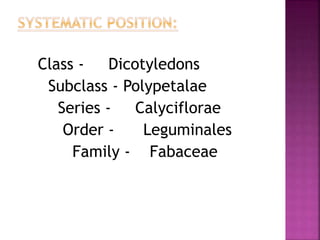
Class - Dicotyledons
Subclass - Polypetalae
Series - Calyciflorae
Order - Leguminales
Family - Fabaceae
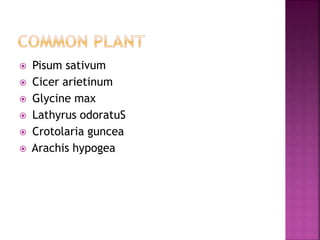
 Pisum sativum
 Cicer arietinum
 Glycine max
 Lathyrus odoratuS
 Crotolaria guncea
 Arachis hypogea
 The family is also known as Fabaceae. It includes 600 genera
and 1200 spices.
 It is regarded as the second largest family of dicotyledons.
 In India the family is represented by 1100 species and 100
genera.
 The family divided into 3 sub-families .
 Faboideae
 Caesalpinoideae
 mimosoidceae
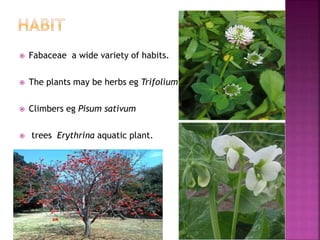
 Fabaceae a wide variety of habits.
 The plants may be herbs eg Trifolium.
 Climbers eg Pisum sativum
 trees Erythrina aquatic plant.
 Stem: herbaceous, weak or woody branched
cylindrical or angular.
 Leaves: Alternate and stipulate leafbase is
swollen (pulvinus).
 Leaves are pinnately or palmately compound.
In Pisum sativum the upper leaflets are
modified to tendril.
 Raceme or panicle raceme sometimes solitary axillary.
 Flowers
 Flowers are bracteates, bracteolate, pedicillate,
complete, bisexual, zygomerphic usually Hypogynous
or slightly perigynous.
 Calyx
 Usually 5 sepals, gamosepalous, aestivation is valvate
or imbricate, odd sepal is anterior
 Corolla:
 5 petals, polypetolous, corolla is papilionaceous.
 The odd posterior petal is called standard or Vexillum is
the largest petal.
 The two lateral ones, called wing, two innermost are
smallest united to shaped structure called Keel.
 Stamens 10, usually diadelphous e.g. 1+ (9), sometimes
monadelphous, rarely polyandrous, anthers are dithecous,
dorsifixed and introrse.
 Gynoecium:
 Monocarpellary, ovary superior, unilocular with many
ovules at ventral sutures.
 Placentation is marginal. The style is long stigma capitate.
 Fruit:
 It is a legume (pod) or lomentum.
 Habit climbing herb.
 Root Tap, branched.
 Stem herbaceous, weak, fistular, branched, hairy.
 Leaf alternate, petiolate, stipulate, stipules leafy,
pinnately compound, imparipinnate, upper leaflets are
modified into tendrils and help in climbing.
 Leaflets opposite, ovate-elliptical, wavy margin, acute
apex unicostate, reticulate venation.
 Racemose or solitary axillary.
Flower
 Bracteate, pedicellate, complete, hermaphrodite,
zygomorphic pentamerous, hypogynous.
Calyx
 Sepals 5, gamosepalous, pentapartite, companulate, odd
sepal anterior, imbricate aestivation, green, hairy.
Corolla
 Petals 5, polypetalous, papilionaceous, consisting of a
large posterior petal – the vexillum or standard, two
lateral-alae or wings and two inner fused to form a boat
shaped structure the keel or carnia, vexillary aestivation.
 Stamens 10, diadelphous, nine are fused by the lower
halves of their filaments to form a tube round the
ovary and tenth posterior one free, anthers basifixed,
introrse, dithecous, enclosed in the keel.
Gynoecium
 Monocarpellary, ovary superior, unilocular, hairy,
elongated, laterally compressed, marginal
placentation ovules many, style long, stigma hairy.
Fruit
 Legume or pod or lomentum.
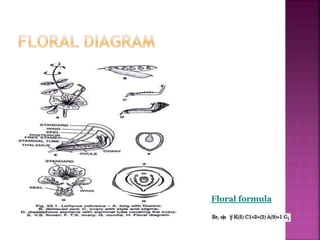
Floral formula
 Plants used as food:
 the family contains many food plants including
Cajanuscajans Pisum sativum Soyabean Glycine max
ect.
 Plant used for oils Arachis hypogea Glycene soya.
 Plant used ornmamental purposes Sesbania
grandiflora Lathyrus odoretam monosperma etc.
 plants timber and fibres Shishum (Dalbargia sisso),
Sunn hemp (Crotolaria juncea).
Fabaceae  IN TAXONOMY

Fabaceae IN TAXONOMY

  • 1.
  • 2.
    Class - Dicotyledons Subclass- Polypetalae Series - Calyciflorae Order - Leguminales Family - Fabaceae
  • 3.
     Pisum sativum Cicer arietinum  Glycine max  Lathyrus odoratuS  Crotolaria guncea  Arachis hypogea
  • 4.
     The familyis also known as Fabaceae. It includes 600 genera and 1200 spices.  It is regarded as the second largest family of dicotyledons.  In India the family is represented by 1100 species and 100 genera.  The family divided into 3 sub-families .  Faboideae  Caesalpinoideae  mimosoidceae
  • 5.
     Fabaceae awide variety of habits.  The plants may be herbs eg Trifolium.  Climbers eg Pisum sativum  trees Erythrina aquatic plant.
  • 6.
     Stem: herbaceous,weak or woody branched cylindrical or angular.  Leaves: Alternate and stipulate leafbase is swollen (pulvinus).  Leaves are pinnately or palmately compound. In Pisum sativum the upper leaflets are modified to tendril.
  • 7.
     Raceme orpanicle raceme sometimes solitary axillary.  Flowers  Flowers are bracteates, bracteolate, pedicillate, complete, bisexual, zygomerphic usually Hypogynous or slightly perigynous.  Calyx  Usually 5 sepals, gamosepalous, aestivation is valvate or imbricate, odd sepal is anterior
  • 8.
     Corolla:  5petals, polypetolous, corolla is papilionaceous.  The odd posterior petal is called standard or Vexillum is the largest petal.  The two lateral ones, called wing, two innermost are smallest united to shaped structure called Keel.
  • 9.
     Stamens 10,usually diadelphous e.g. 1+ (9), sometimes monadelphous, rarely polyandrous, anthers are dithecous, dorsifixed and introrse.  Gynoecium:  Monocarpellary, ovary superior, unilocular with many ovules at ventral sutures.  Placentation is marginal. The style is long stigma capitate.  Fruit:  It is a legume (pod) or lomentum.
  • 10.
     Habit climbingherb.  Root Tap, branched.  Stem herbaceous, weak, fistular, branched, hairy.  Leaf alternate, petiolate, stipulate, stipules leafy, pinnately compound, imparipinnate, upper leaflets are modified into tendrils and help in climbing.  Leaflets opposite, ovate-elliptical, wavy margin, acute apex unicostate, reticulate venation.
  • 11.
     Racemose orsolitary axillary. Flower  Bracteate, pedicellate, complete, hermaphrodite, zygomorphic pentamerous, hypogynous. Calyx  Sepals 5, gamosepalous, pentapartite, companulate, odd sepal anterior, imbricate aestivation, green, hairy. Corolla  Petals 5, polypetalous, papilionaceous, consisting of a large posterior petal – the vexillum or standard, two lateral-alae or wings and two inner fused to form a boat shaped structure the keel or carnia, vexillary aestivation.
  • 12.
     Stamens 10,diadelphous, nine are fused by the lower halves of their filaments to form a tube round the ovary and tenth posterior one free, anthers basifixed, introrse, dithecous, enclosed in the keel. Gynoecium  Monocarpellary, ovary superior, unilocular, hairy, elongated, laterally compressed, marginal placentation ovules many, style long, stigma hairy. Fruit  Legume or pod or lomentum.
  • 13.
  • 14.
     Plants usedas food:  the family contains many food plants including Cajanuscajans Pisum sativum Soyabean Glycine max ect.  Plant used for oils Arachis hypogea Glycene soya.  Plant used ornmamental purposes Sesbania grandiflora Lathyrus odoretam monosperma etc.  plants timber and fibres Shishum (Dalbargia sisso), Sunn hemp (Crotolaria juncea).