Effective Corrective Action (C/A) Program Presented by David Barber, General Manager of Omnex Canada for ASQ, Toronto, January 10, 2007
Omnex provides training, consulting and software to the international market with offices in the USA, Canada, Mexico, China (PRC), Germany, India, the Middle East and Thailand. Omnex offers over 55 training courses in business, quality, environmental, and health & safety management systems worldwide. Internet email:  [email_address] Web:  www.omnex.com
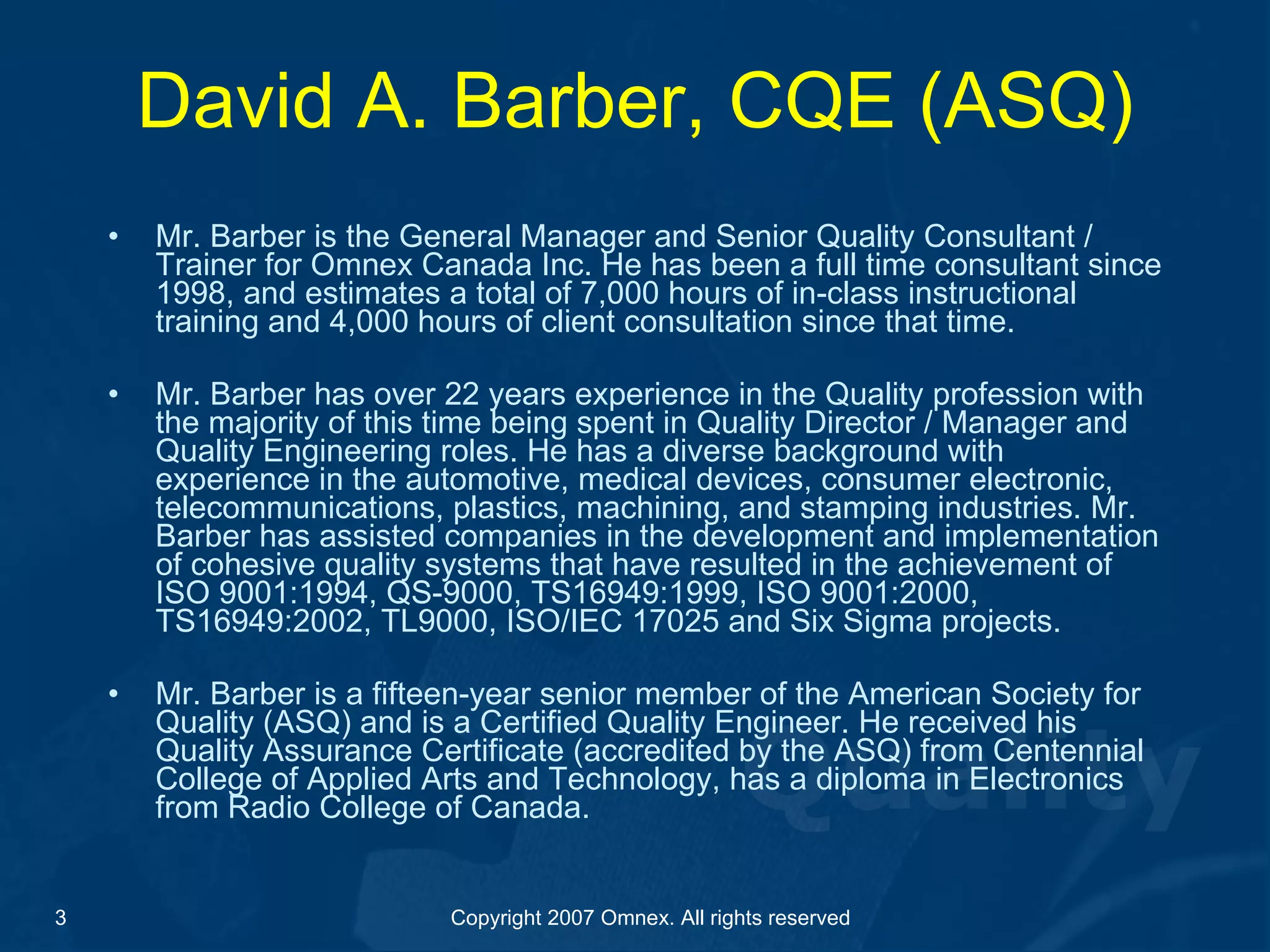
David A. Barber, CQE (ASQ) Mr. Barber is the General Manager and Senior Quality Consultant / Trainer for Omnex Canada Inc. He has been a full time consultant since 1998, and estimates a total of 7,000 hours of in-class instructional training and 4,000 hours of client consultation since that time.    Mr. Barber has over 22 years experience in the Quality profession with the majority of this time being spent in Quality Director / Manager and Quality Engineering roles. He has a diverse background with experience in the automotive, medical devices, consumer electronic, telecommunications, plastics, machining, and stamping industries. Mr. Barber has assisted companies in the development and implementation of cohesive quality systems that have resulted in the achievement of ISO 9001:1994, QS-9000, TS16949:1999, ISO 9001:2000, TS16949:2002, TL9000, ISO/IEC 17025 and Six Sigma projects.    Mr. Barber is a fifteen-year senior member of the American Society for Quality (ASQ) and is a Certified Quality Engineer. He received his Quality Assurance Certificate (accredited by the ASQ) from Centennial College of Applied Arts and Technology, has a diploma in Electronics from Radio College of Canada.
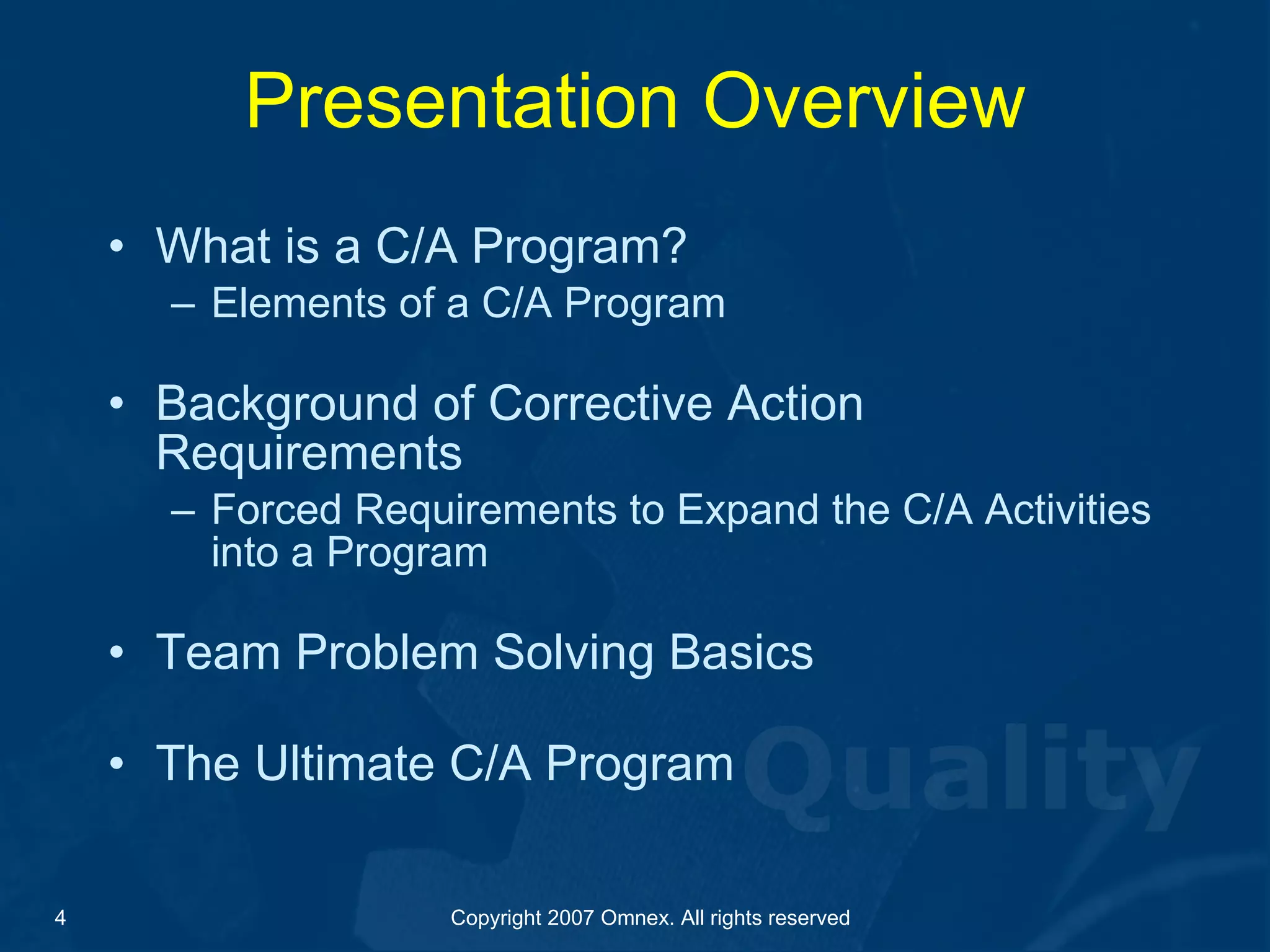
Presentation Overview What is a C/A Program? Elements of a C/A Program   Background of Corrective Action Requirements Forced Requirements to Expand the C/A Activities into a Program Team Problem Solving Basics The Ultimate C/A Program
What is a C/A Program?
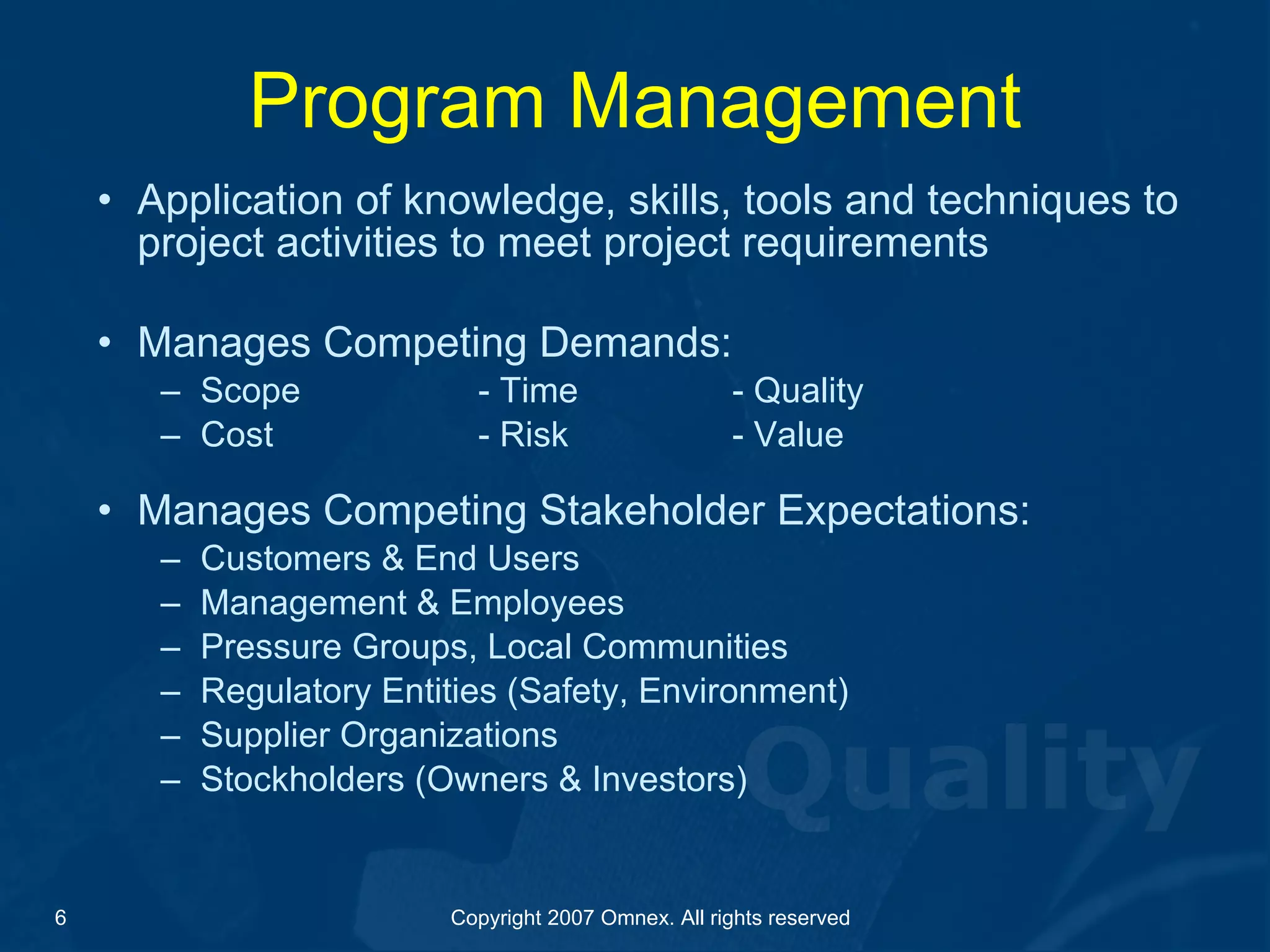
Program Management Application of knowledge, skills, tools and techniques to project activities to meet project requirements Manages Competing Demands: Scope - Time - Quality Cost - Risk - Value Manages Competing Stakeholder Expectations: Customers & End Users Management & Employees Pressure Groups, Local Communities Regulatory Entities (Safety, Environment) Supplier Organizations Stockholders (Owners & Investors)
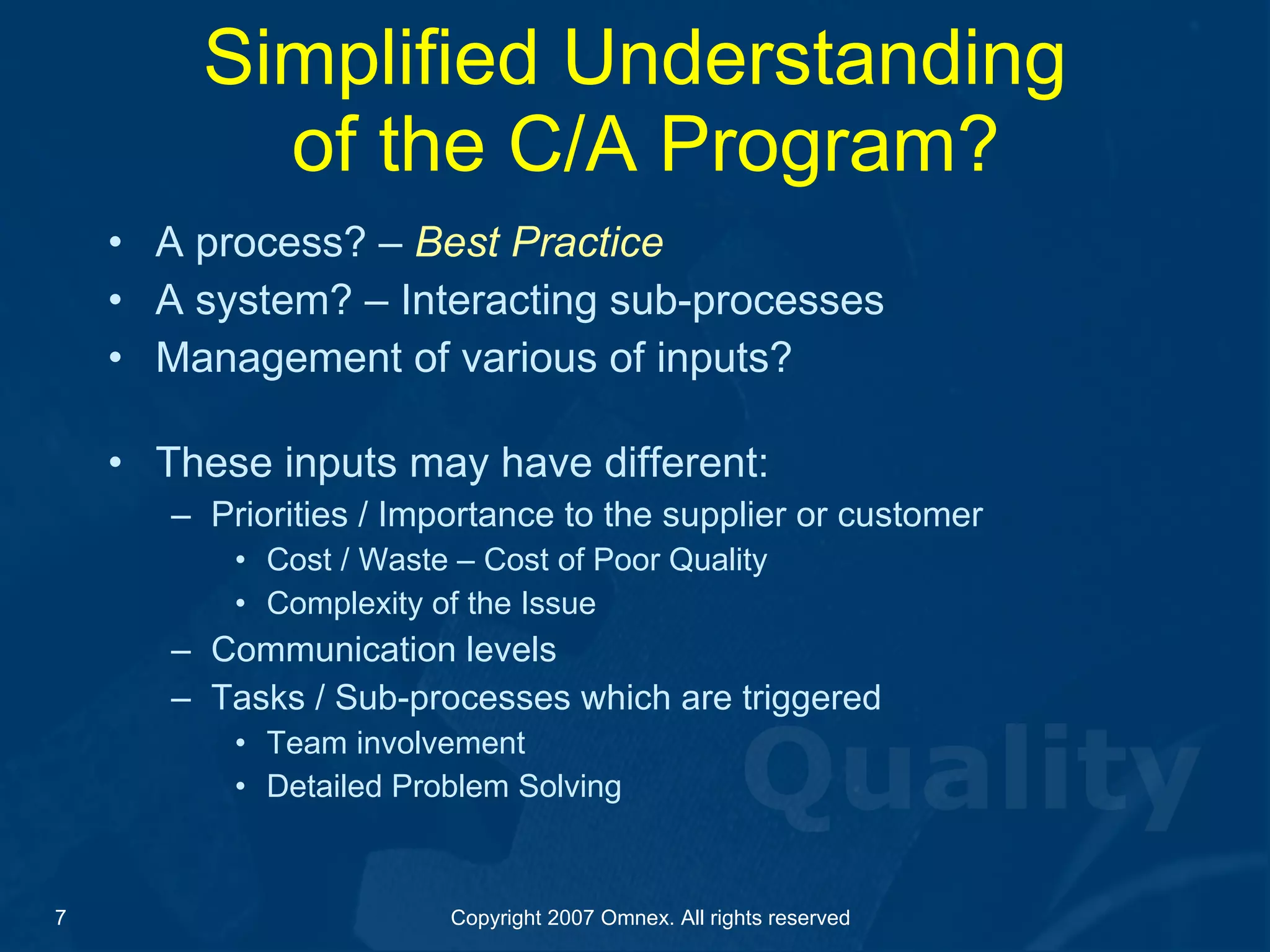
Simplified Understanding  of the C/A Program? A process? –  Best Practice A system? – Interacting sub-processes Management of various of inputs? These inputs may have different: Priorities / Importance to the supplier or customer Cost / Waste – Cost of Poor Quality Complexity of the Issue Communication levels Tasks / Sub-processes which are triggered Team involvement Detailed Problem Solving
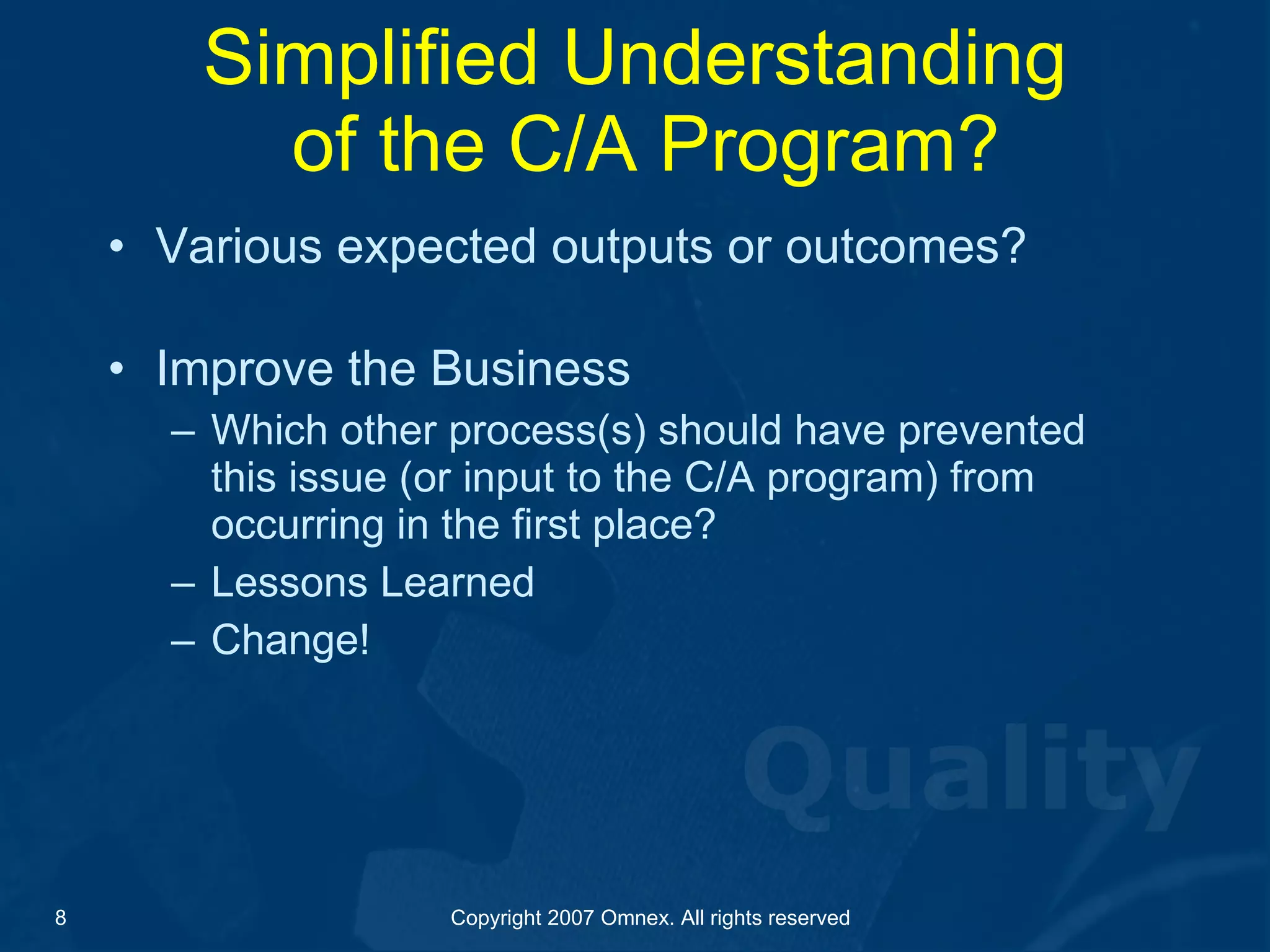
Simplified Understanding  of the C/A Program? Various expected outputs or outcomes? Improve the Business Which other process(s) should have prevented this issue (or input to the C/A program) from occurring in the first place? Lessons Learned Change!
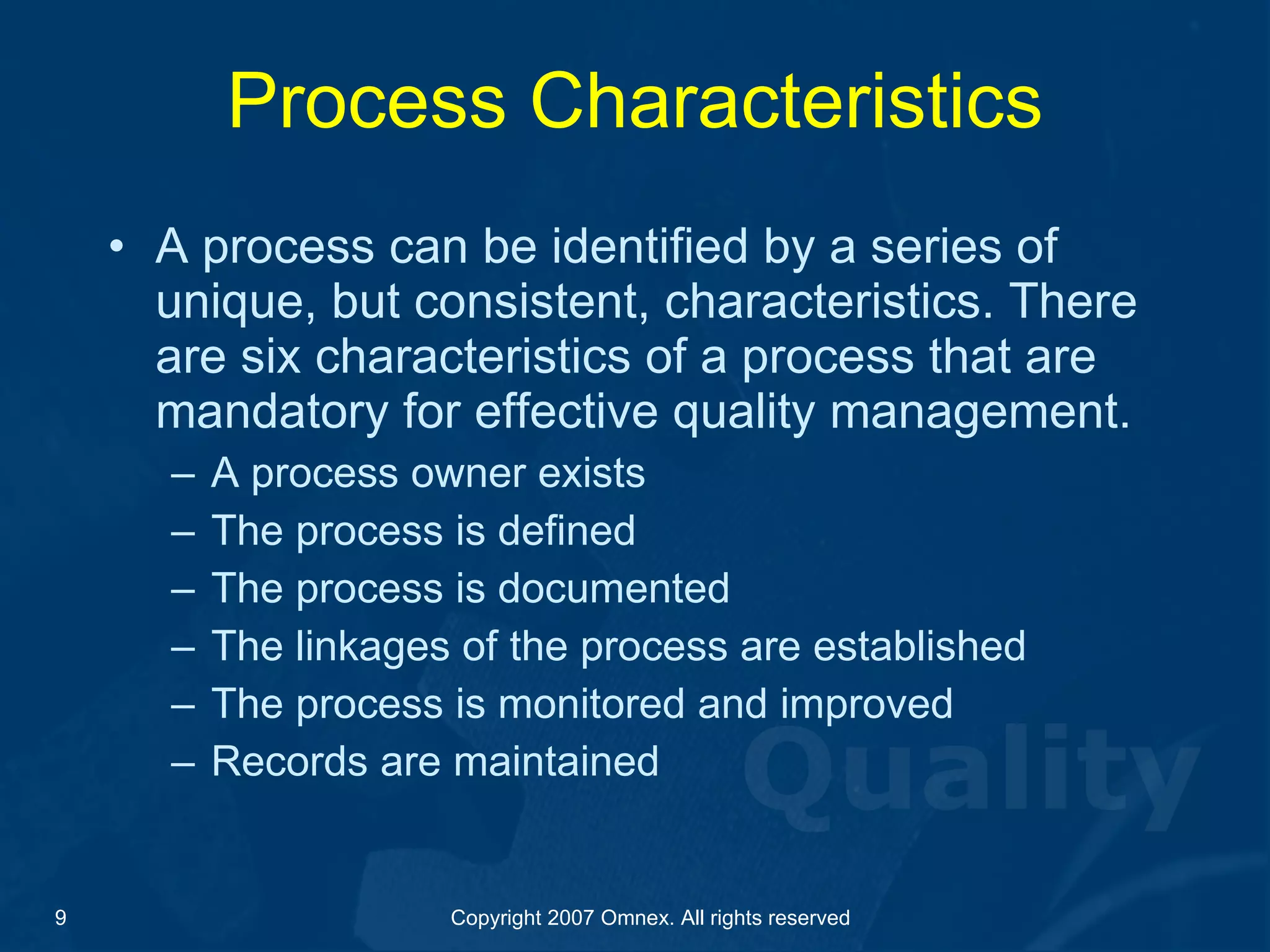
Process Characteristics A process can be identified by a series of unique, but consistent, characteristics. There are six characteristics of a process that are mandatory for effective quality management. A process owner exists The process is defined The process is documented The linkages of the process are established The process is monitored and improved Records are maintained
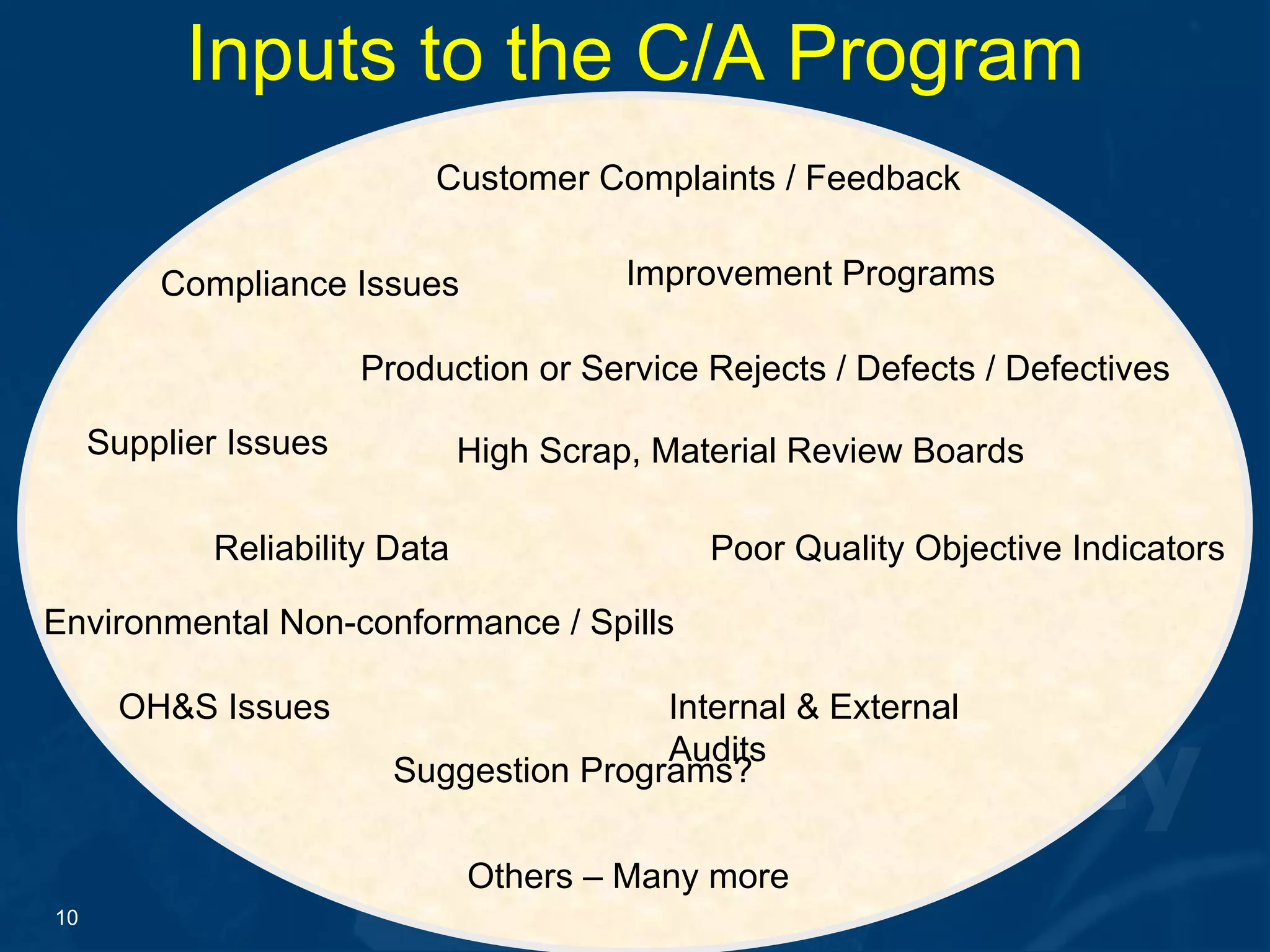
Inputs to the C/A Program Suggestion Programs? OH&S Issues   Environmental Non-conformance / Spills Internal & External Audits Poor Quality Objective Indicators Reliability Data High Scrap, Material Review Boards Production or Service Rejects / Defects / Defectives Supplier Issues Customer Complaints / Feedback Others – Many more Compliance Issues Improvement Programs
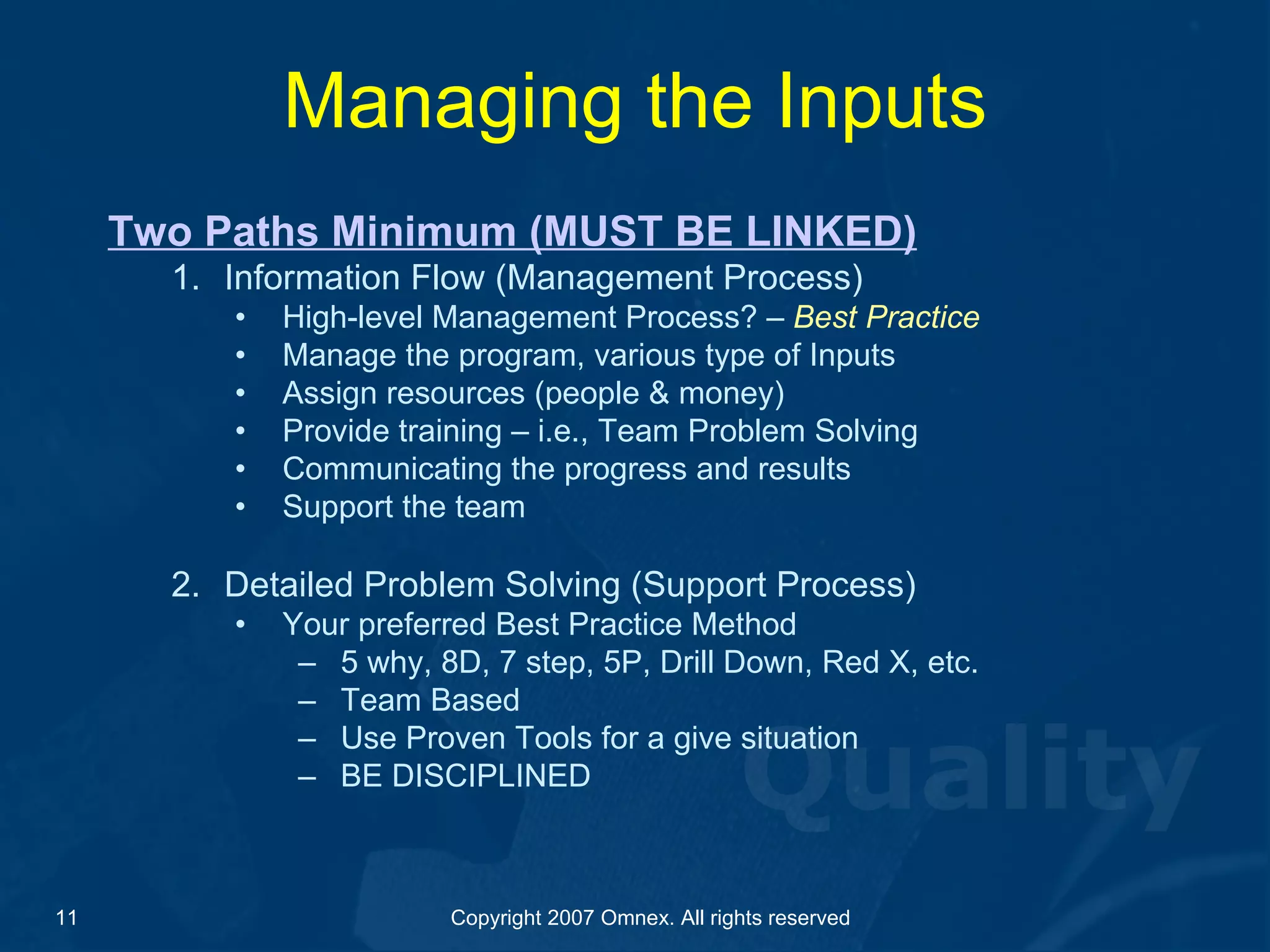
Managing the Inputs Two Paths Minimum (MUST BE LINKED) Information Flow (Management Process) High-level Management Process? –  Best Practice Manage the program, various type of Inputs Assign resources (people & money) Provide training – i.e., Team Problem Solving  Communicating the progress and results Support the team Detailed Problem Solving (Support Process) Your preferred Best Practice Method 5 why, 8D, 7 step, 5P, Drill Down, Red X, etc.  Team Based Use Proven Tools for a give situation  BE DISCIPLINED
Background of Corrective Action Requirements
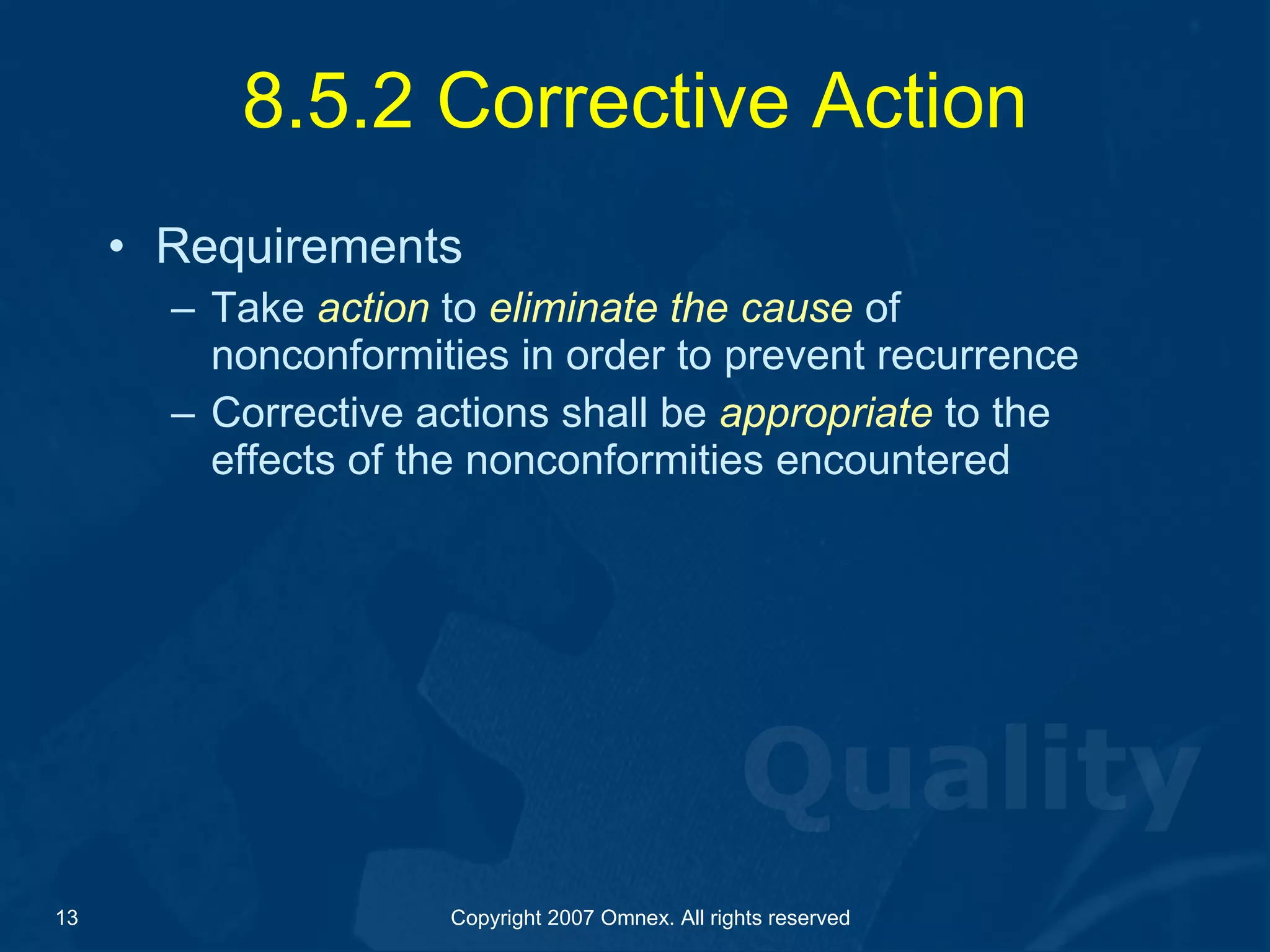
8.5.2 Corrective Action Requirements Take  action   to  eliminate the cause  of nonconformities in order to prevent recurrence Corrective actions shall be  appropriate  to the effects of the nonconformities encountered
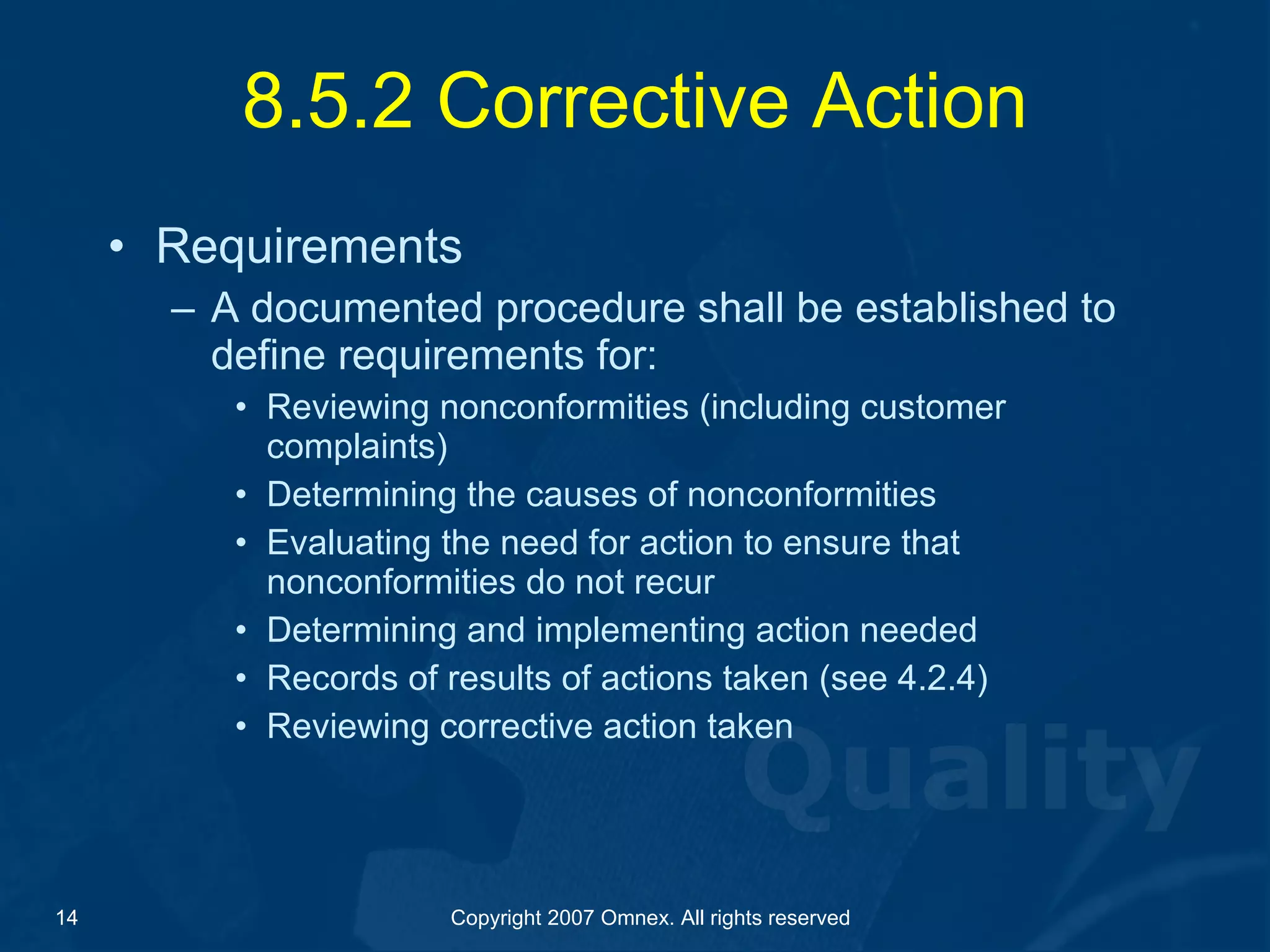
8.5.2 Corrective Action Requirements A documented procedure shall be established to define requirements for: Reviewing nonconformities (including customer complaints) Determining the causes of nonconformities Evaluating the need for action to ensure that nonconformities do not recur Determining and implementing action needed Records of results of actions taken (see 4.2.4) Reviewing corrective action taken
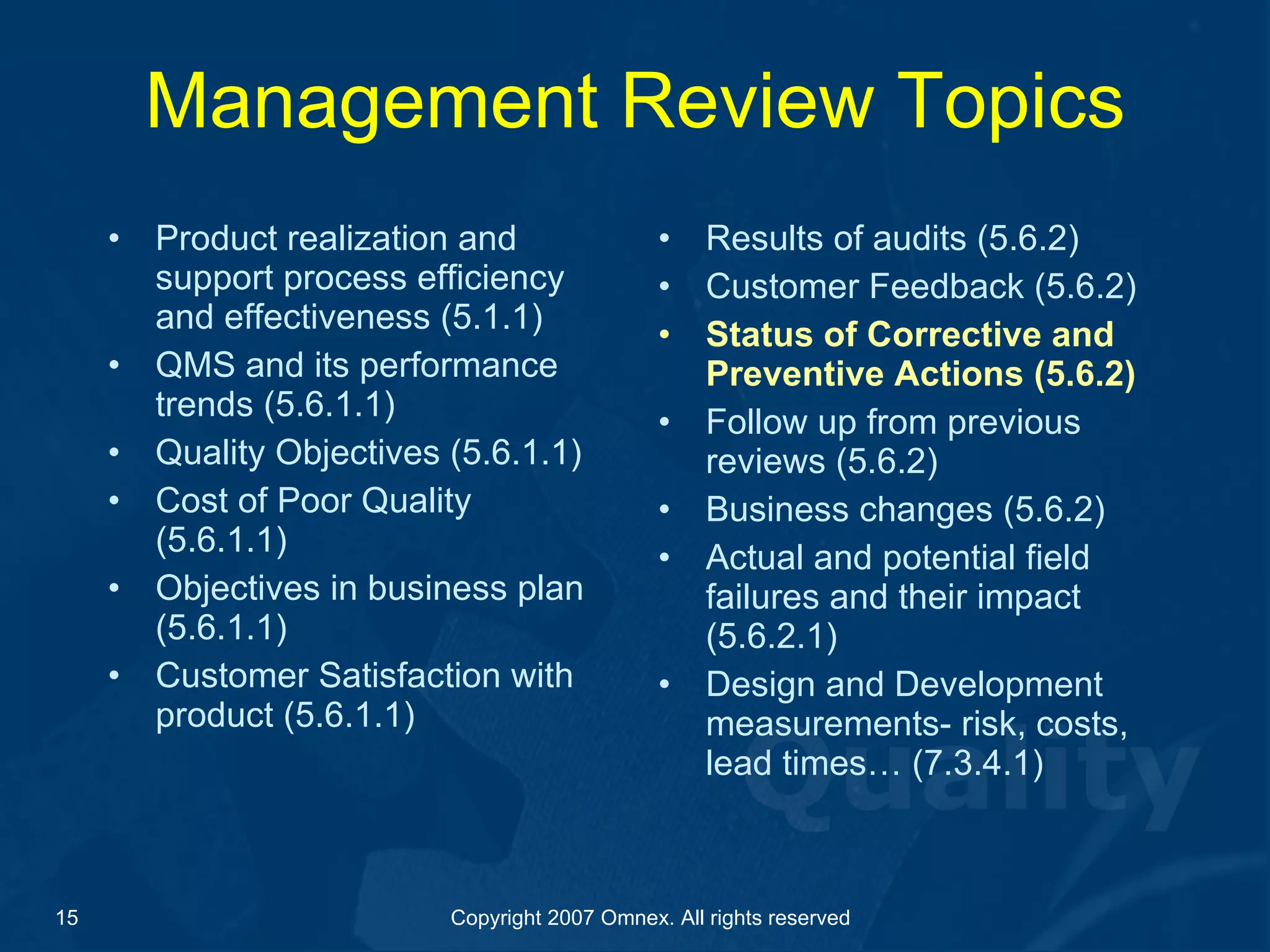
Management Review Topics Product realization and support process efficiency and effectiveness (5.1.1) QMS and its performance trends (5.6.1.1) Quality Objectives (5.6.1.1) Cost of Poor Quality (5.6.1.1) Objectives in business plan (5.6.1.1) Customer Satisfaction with product (5.6.1.1) Results of audits (5.6.2) Customer Feedback (5.6.2) Status of Corrective and Preventive Actions (5.6.2) Follow up from previous reviews (5.6.2) Business changes (5.6.2) Actual and potential field failures and their impact (5.6.2.1) Design and Development measurements- risk, costs, lead times… (7.3.4.1)
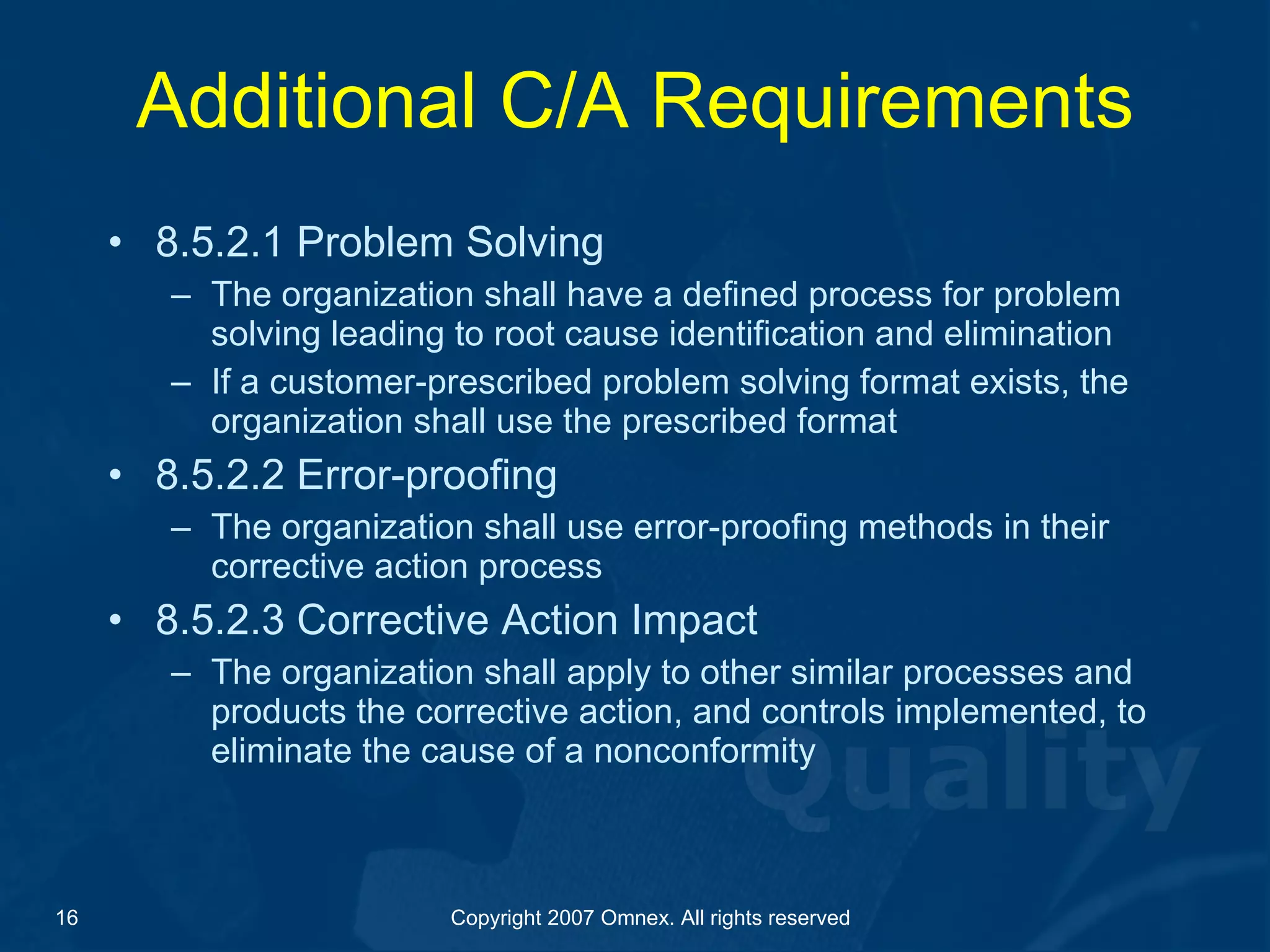
Additional C/A Requirements 8.5.2.1 Problem Solving The organization shall have a defined process for problem solving leading to root cause identification and elimination If a customer-prescribed problem solving format exists, the organization shall use the prescribed format 8.5.2.2 Error-proofing The organization shall use error-proofing methods in their corrective action process 8.5.2.3 Corrective Action Impact The organization shall apply to other similar processes and products the corrective action, and controls implemented, to eliminate the cause of a nonconformity
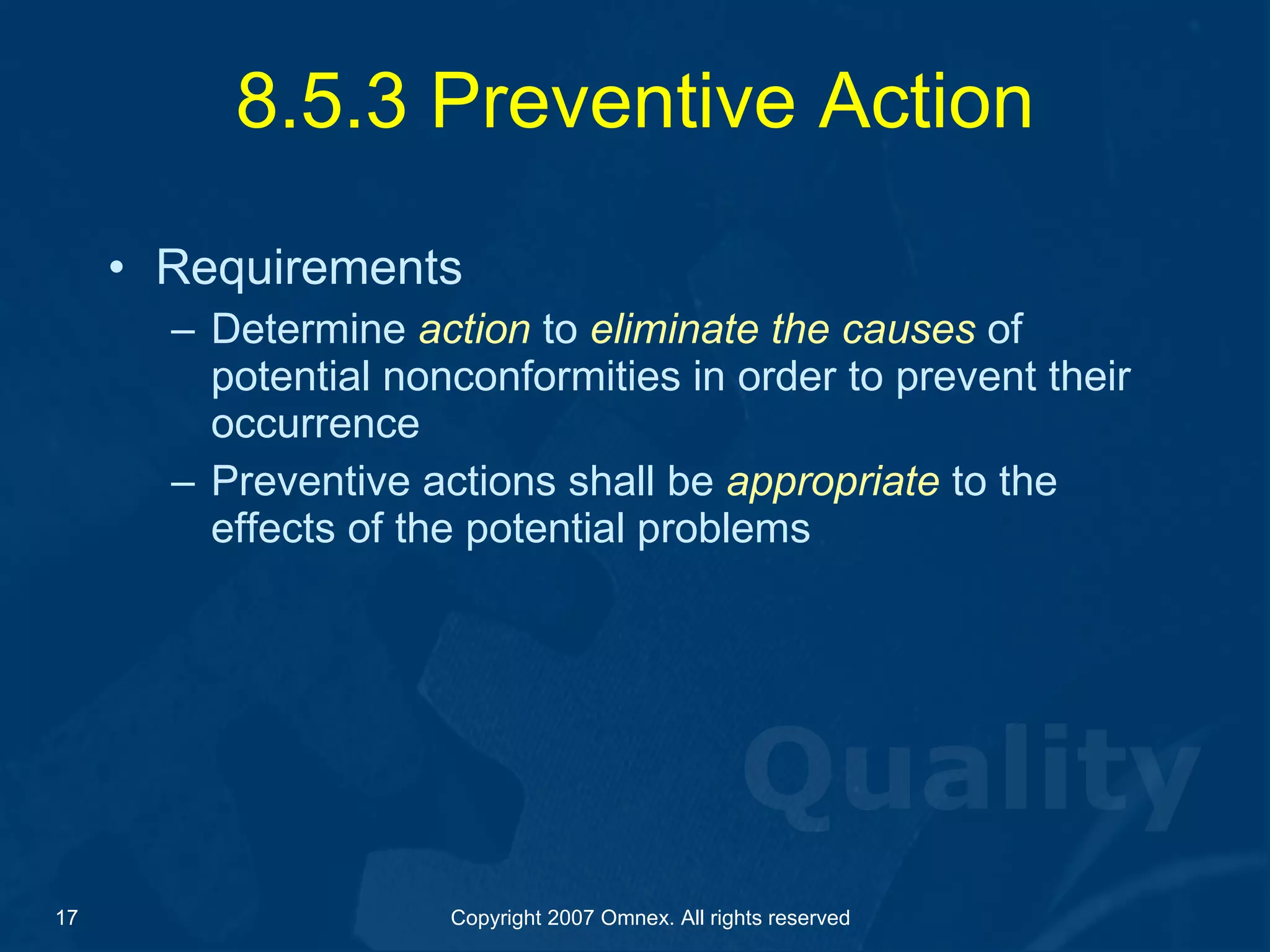
8.5.3 Preventive Action Requirements Determine  action  to  eliminate the causes  of potential nonconformities in order to prevent their occurrence  Preventive actions shall be  appropriate  to the effects of the potential problems
8.5.3 Preventive Action Requirements A   documented procedure  shall be established to define requirements for: Determining potential nonconformities and their causes Evaluating the need for action to prevent occurrence of nonconformities Determining and implementing action needed Records of results of actions taken (see 4.2.4), and  Reviewing preventive action taken
Team Problem Solving Basics
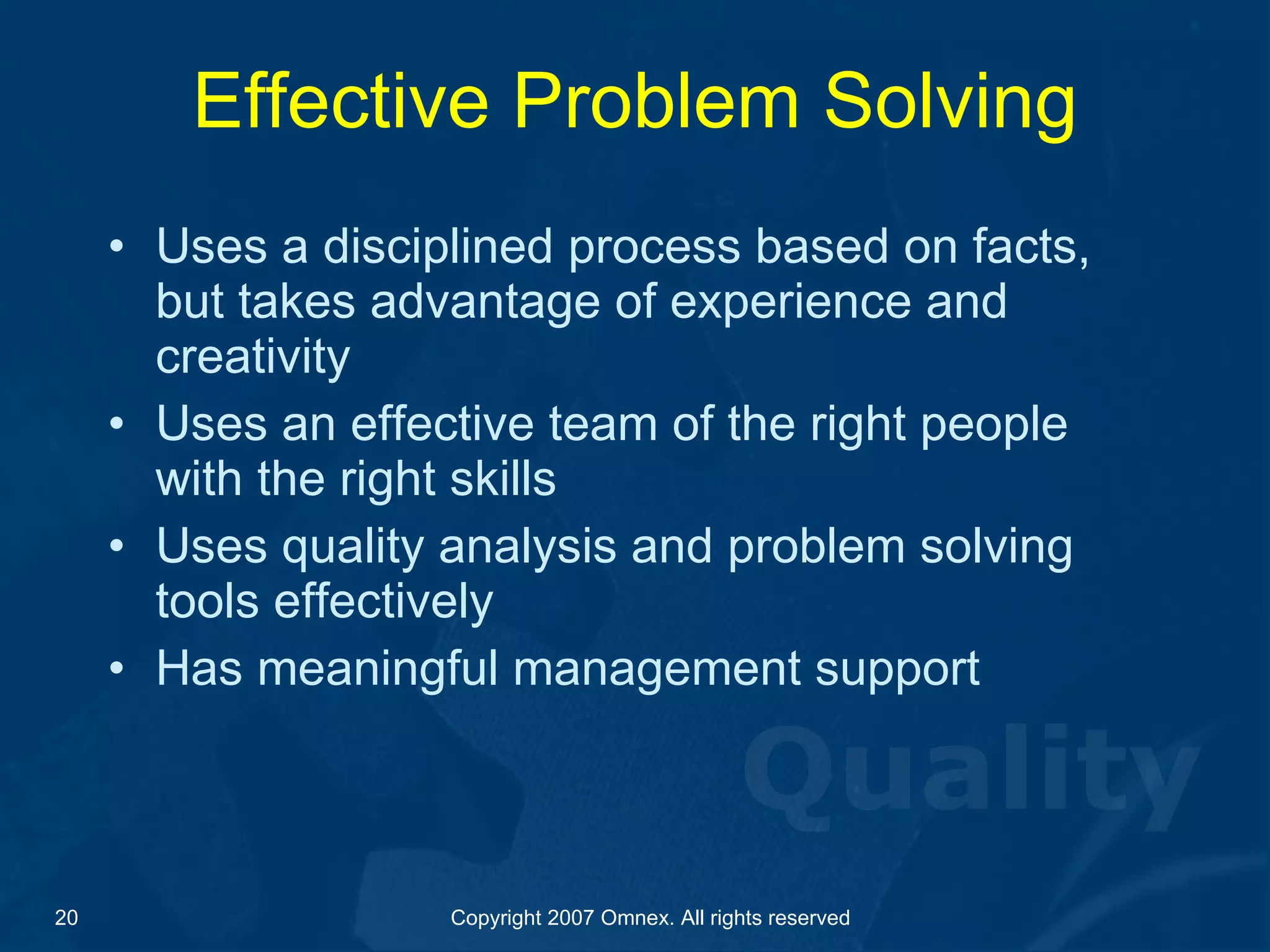
Effective Problem Solving Uses a disciplined process based on facts, but takes advantage of experience and creativity Uses an effective team of the right people with the right skills  Uses quality analysis and problem solving tools effectively Has meaningful management support
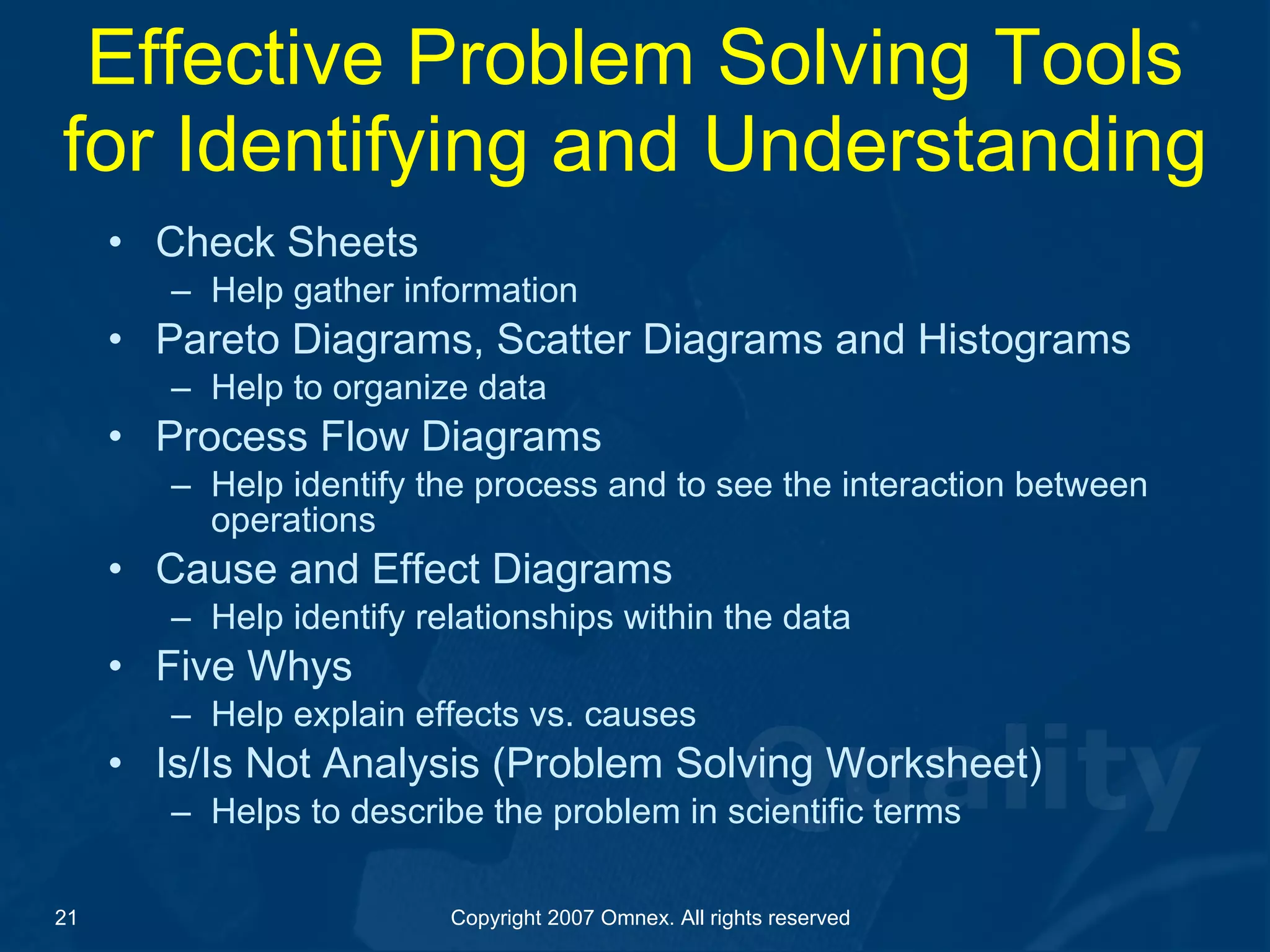
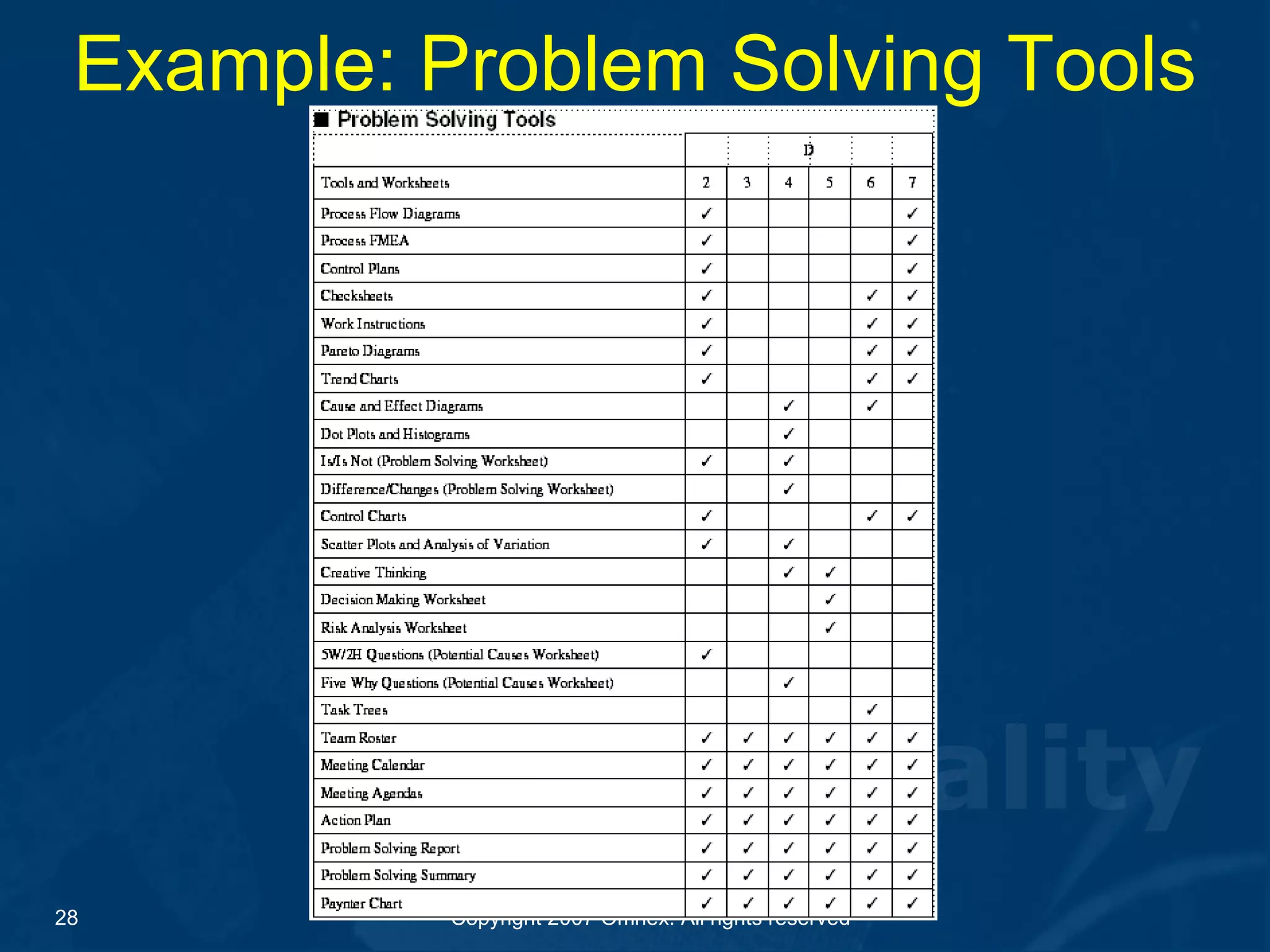
Effective Problem Solving Tools for Identifying and Understanding Check Sheets Help gather information Pareto Diagrams, Scatter Diagrams and Histograms Help to organize data Process Flow Diagrams Help identify the process and to see the interaction between operations Cause and Effect Diagrams Help identify relationships within the data Five Whys Help explain effects vs. causes Is/Is Not Analysis (Problem Solving Worksheet) Helps to describe the problem in scientific terms
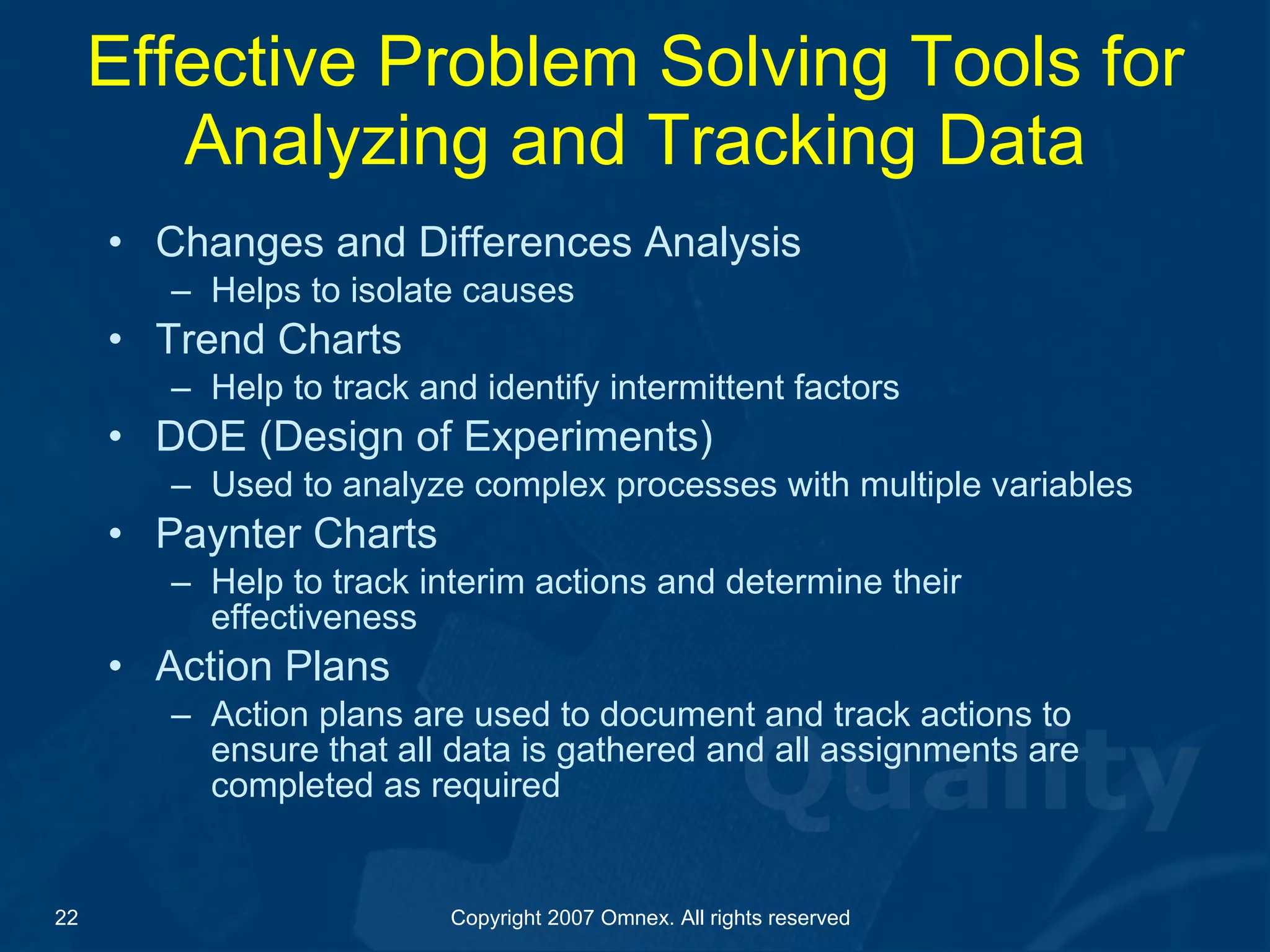
Effective Problem Solving Tools for Analyzing and Tracking Data Changes and Differences Analysis Helps to isolate causes Trend Charts  Help to track and identify intermittent factors DOE (Design of Experiments) Used to analyze complex processes with multiple variables Paynter Charts Help to track interim actions and determine their effectiveness Action Plans Action plans are used to document and track actions to ensure that all data is gathered and all assignments are completed as required
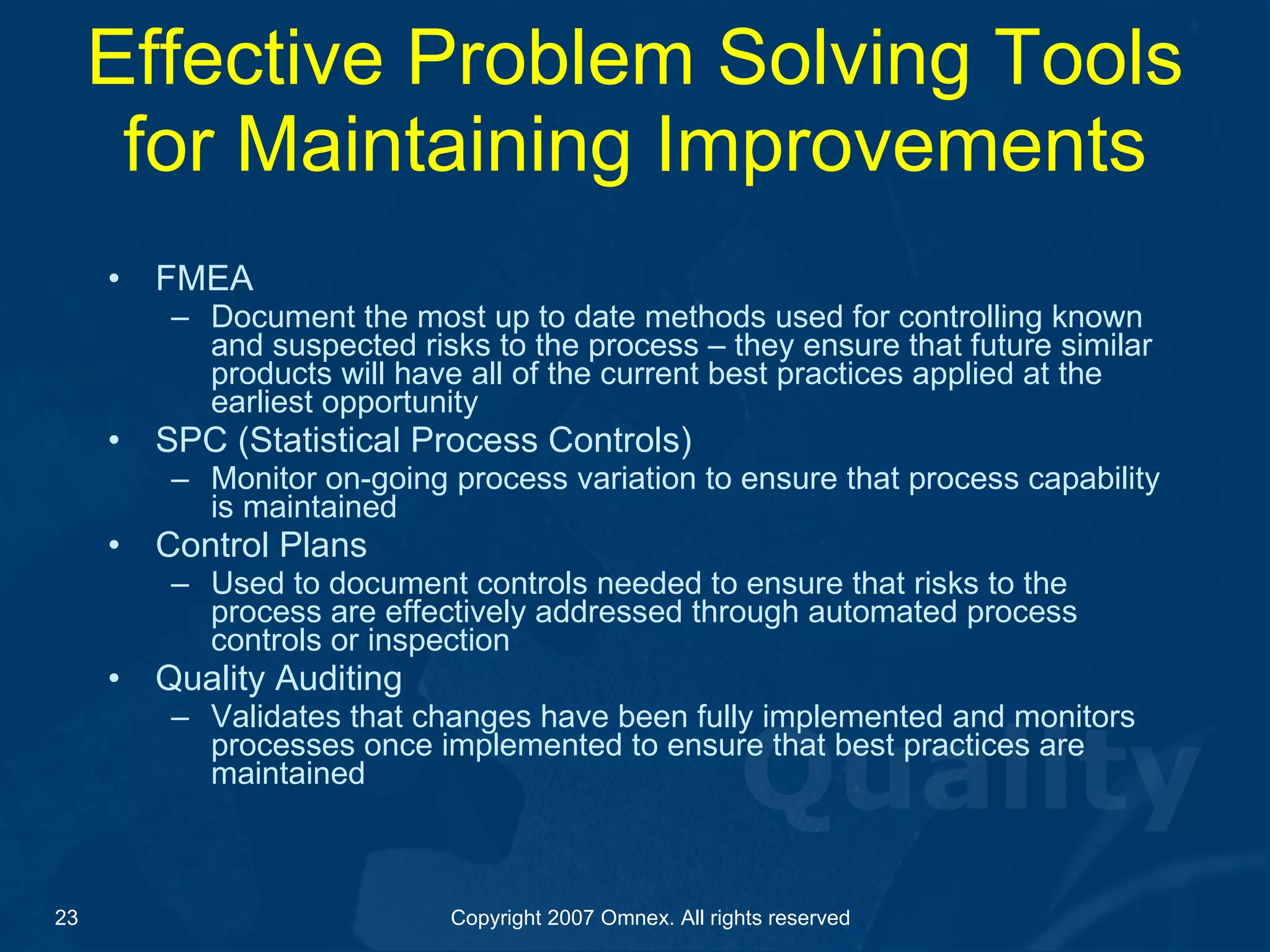
Effective Problem Solving Tools for Maintaining Improvements FMEA  Document the most up to date methods used for controlling known and suspected risks to the process – they ensure that future similar products will have all of the current best practices applied at the earliest opportunity SPC (Statistical Process Controls) Monitor on-going process variation to ensure that process capability is maintained Control Plans Used to document controls needed to ensure that risks to the process are effectively addressed through automated process controls or inspection Quality Auditing Validates that changes have been fully implemented and monitors processes once implemented to ensure that best practices are maintained
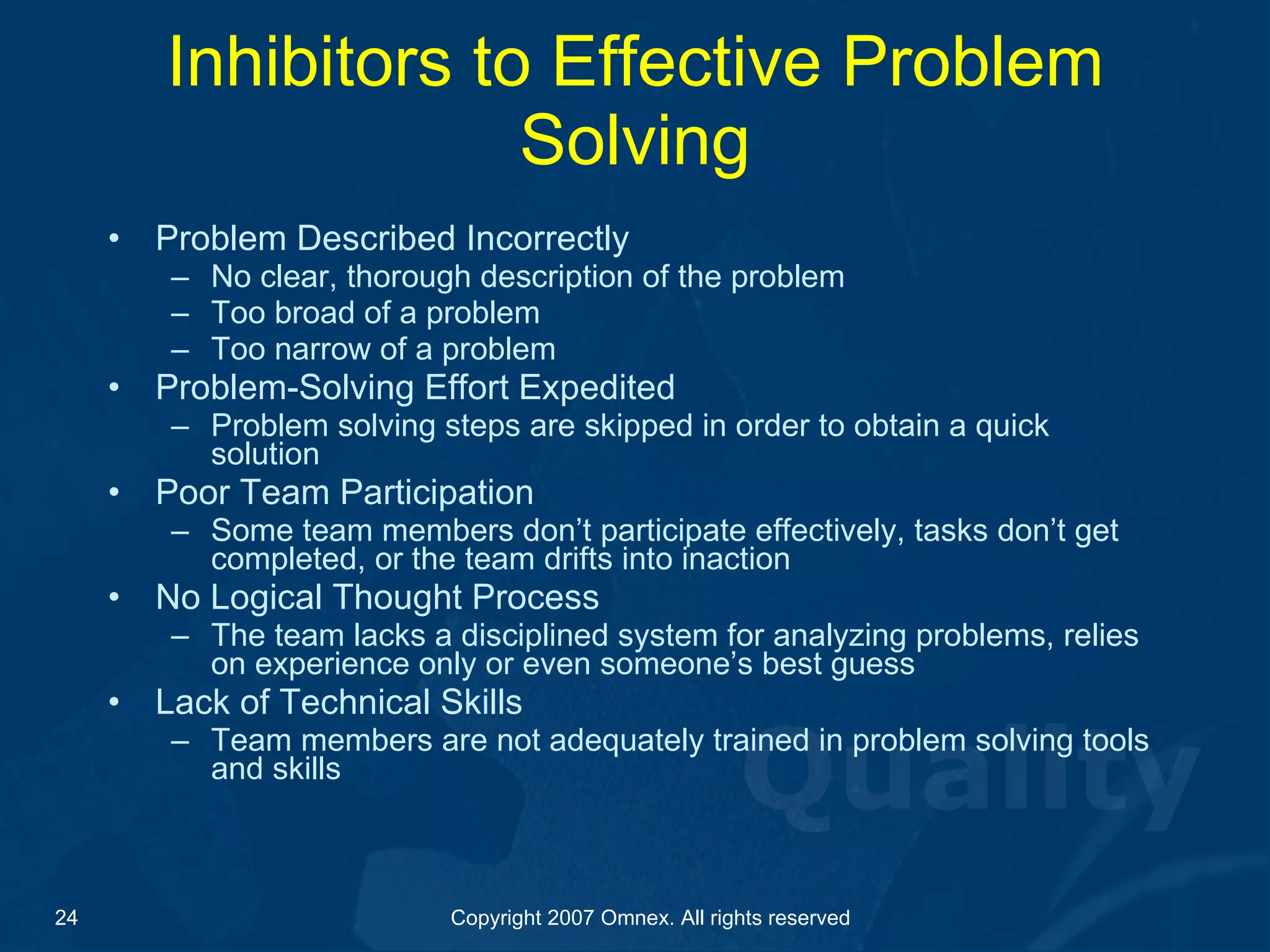
Inhibitors to Effective Problem Solving Problem Described Incorrectly No clear, thorough description of the problem  Too broad of a problem Too narrow of a problem  Problem-Solving Effort Expedited Problem solving steps are skipped in order to obtain a quick solution Poor Team Participation Some team members don’t participate effectively, tasks don’t get completed, or the team drifts into inaction No Logical Thought Process The team lacks a disciplined system for analyzing problems, relies on experience only or even someone’s best guess Lack of Technical Skills Team members are not adequately trained in problem solving tools and skills
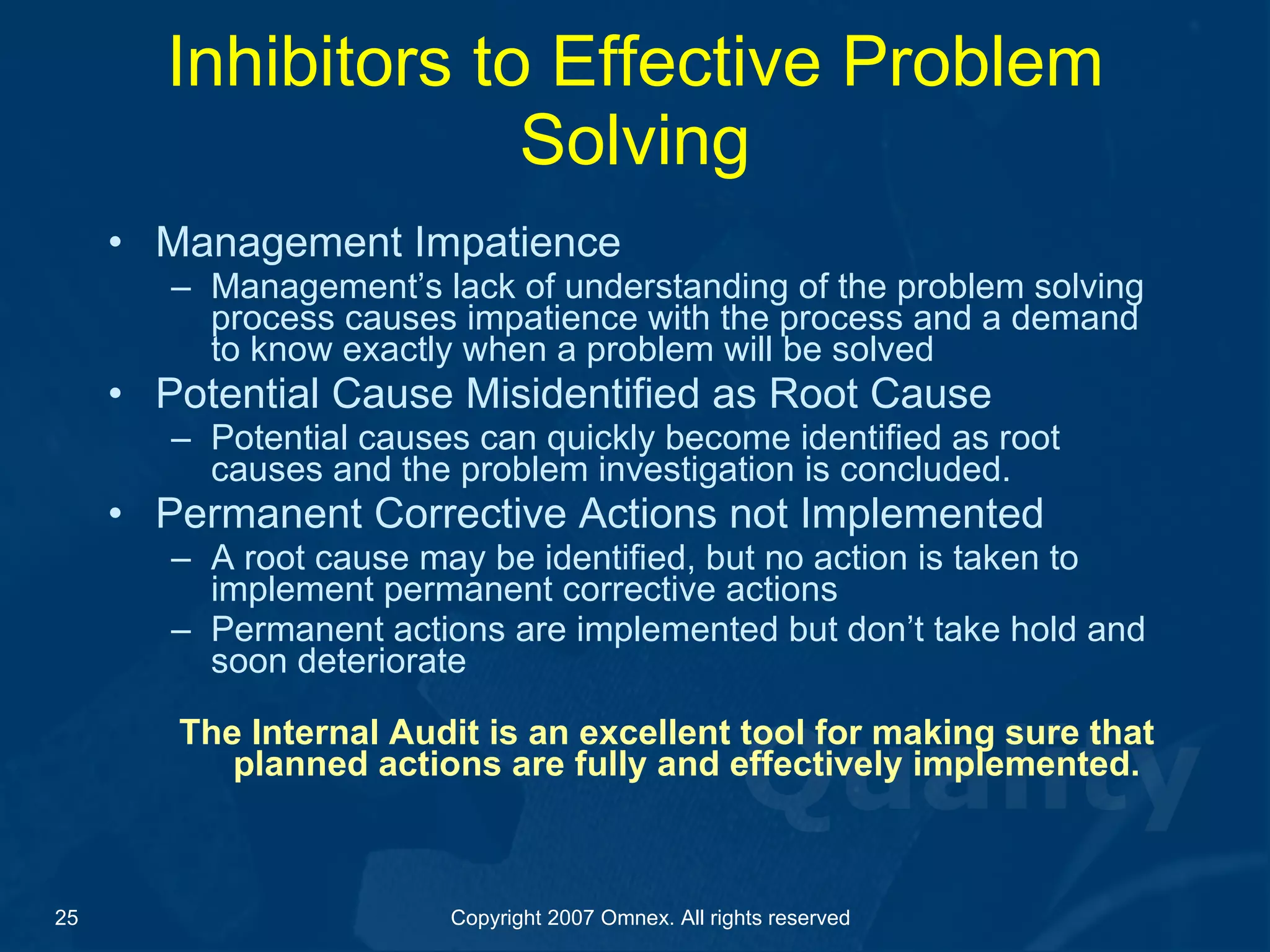
Inhibitors to Effective Problem Solving Management Impatience Management’s lack of understanding of the problem solving process causes impatience with the process and a demand to know exactly when a problem will be solved Potential Cause Misidentified as Root Cause Potential causes can quickly become identified as root causes and the problem investigation is concluded.  Permanent Corrective Actions not Implemented A root cause may be identified, but no action is taken to implement permanent corrective actions  Permanent actions are implemented but don’t take hold and soon deteriorate The Internal Audit is an excellent tool for making sure that planned actions are fully and effectively implemented.
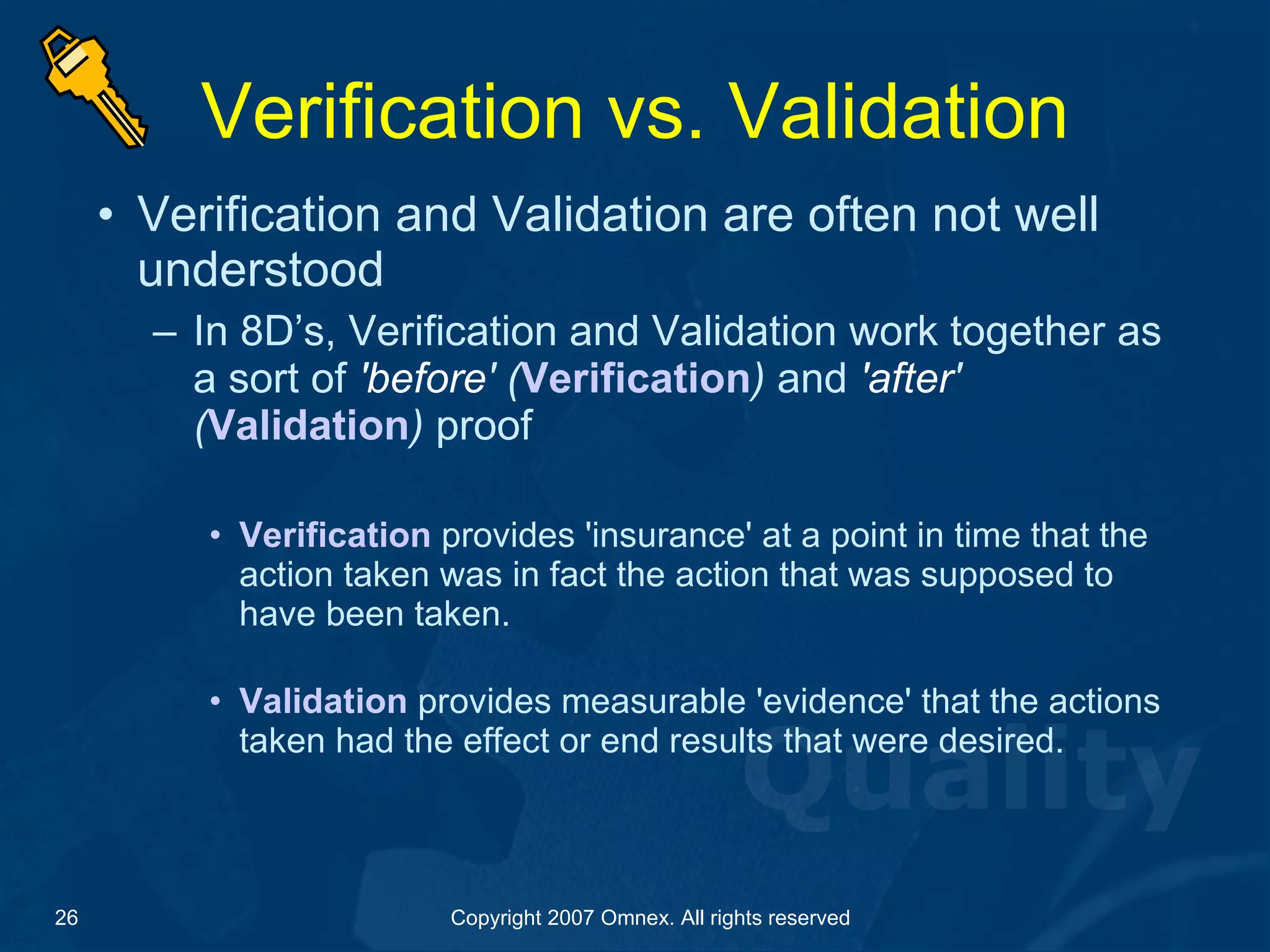
Verification vs. Validation Verification and Validation are often not well understood In 8D’s, Verification and Validation work together as a sort of  'before ' ( Verification )  and  'after ' ( Validation )  proof Verification  provides 'insurance' at a point in time that the action taken was in fact the action that was supposed to have been taken.   Validation  provides measurable 'evidence' that the actions taken had the effect or end results that were desired.
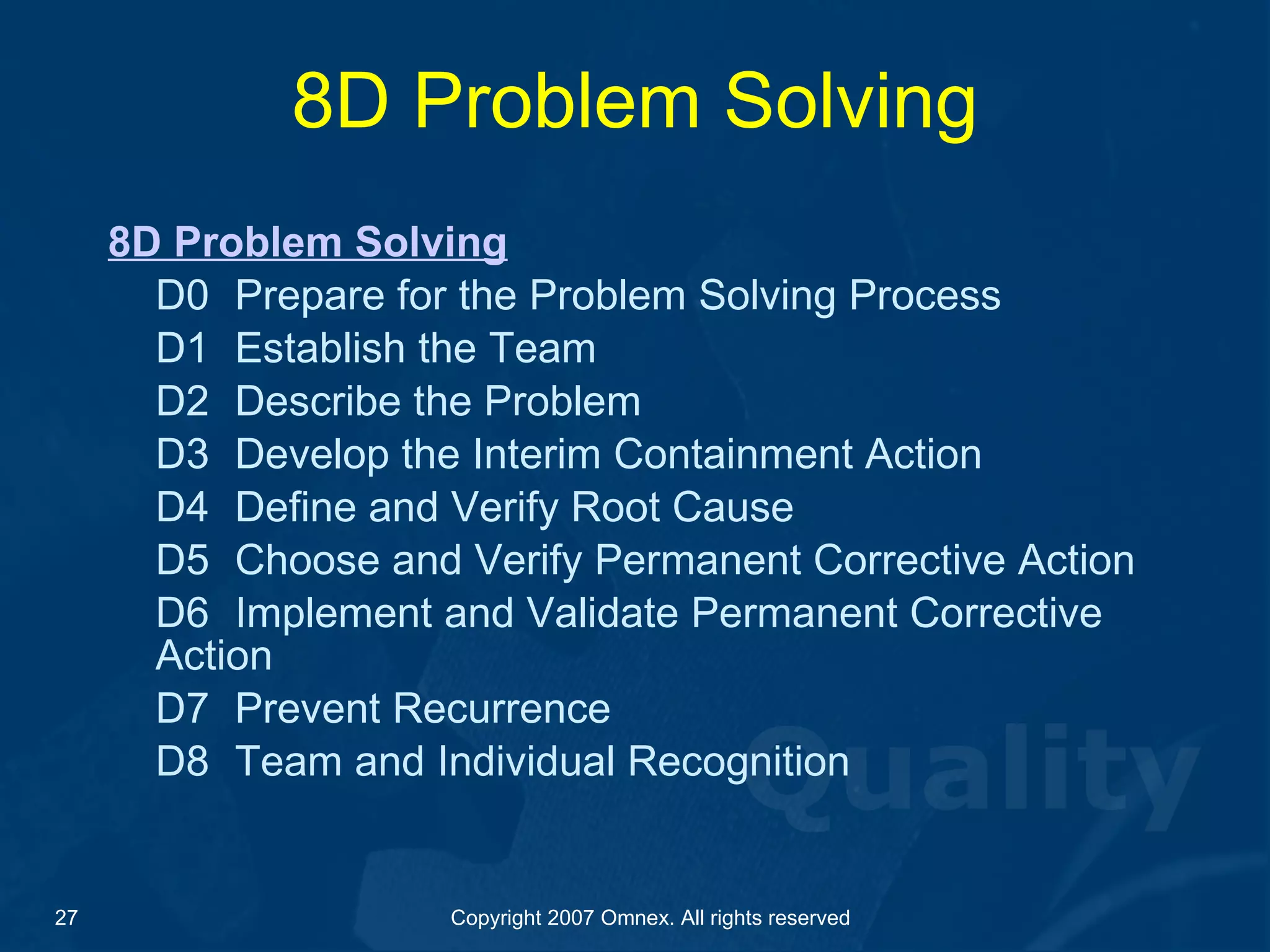
8D Problem Solving 8D Problem Solving D0  Prepare for the Problem Solving Process D1 Establish the Team D2 Describe the Problem D3 Develop the Interim Containment Action D4 Define and Verify Root Cause D5 Choose and Verify Permanent Corrective Action D6 Implement and Validate Permanent Corrective  Action D7 Prevent Recurrence D8 Team and Individual Recognition
Example: Problem Solving Tools
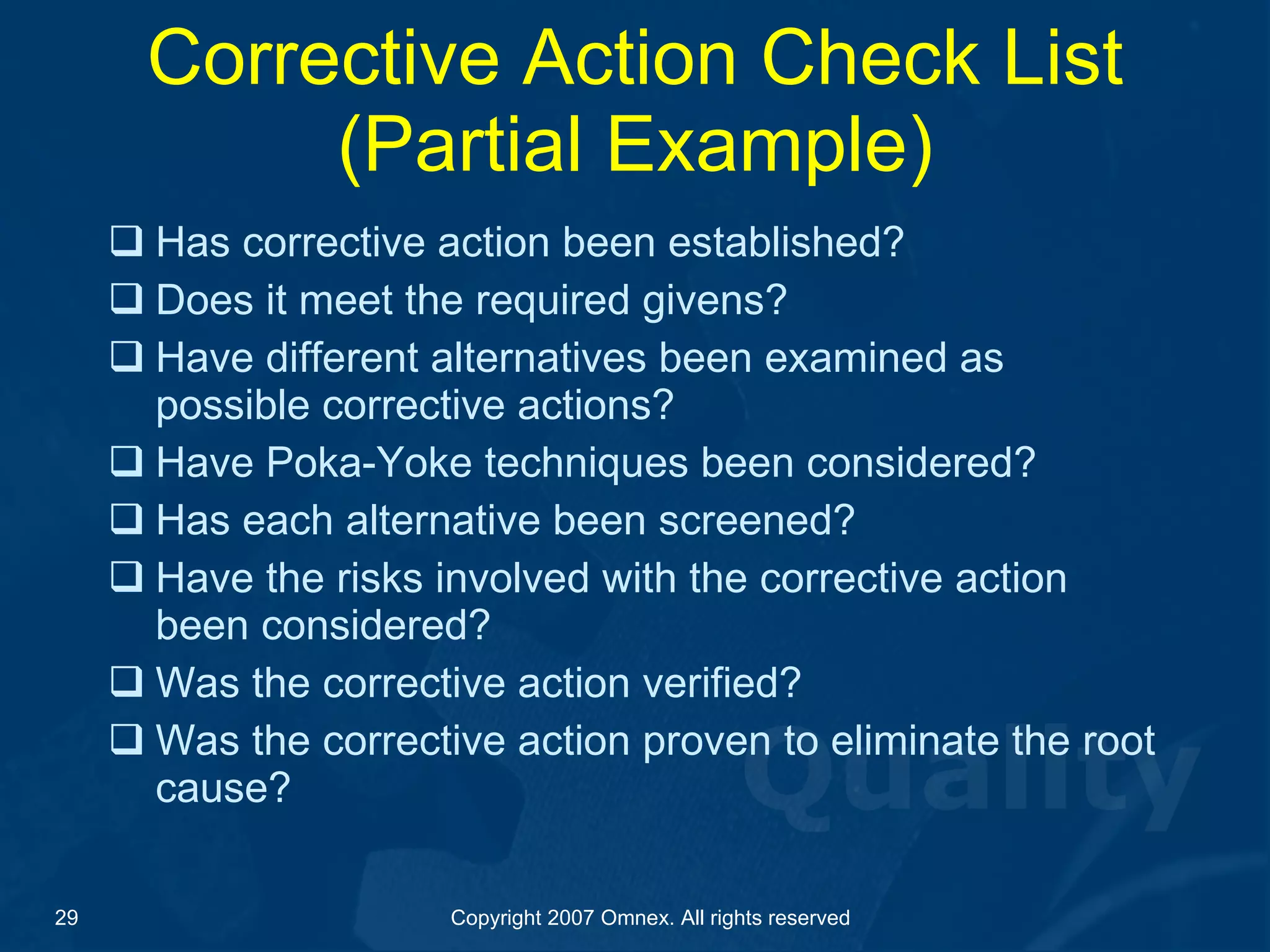
Corrective Action Check List (Partial Example) Has corrective action been established? Does it meet the required givens? Have different alternatives been examined as possible corrective actions? Have Poka-Yoke techniques been considered? Has each alternative been screened? Have the risks involved with the corrective action been considered? Was the corrective action verified? Was the corrective action proven to eliminate the root cause?
The Ultimate C/A Program
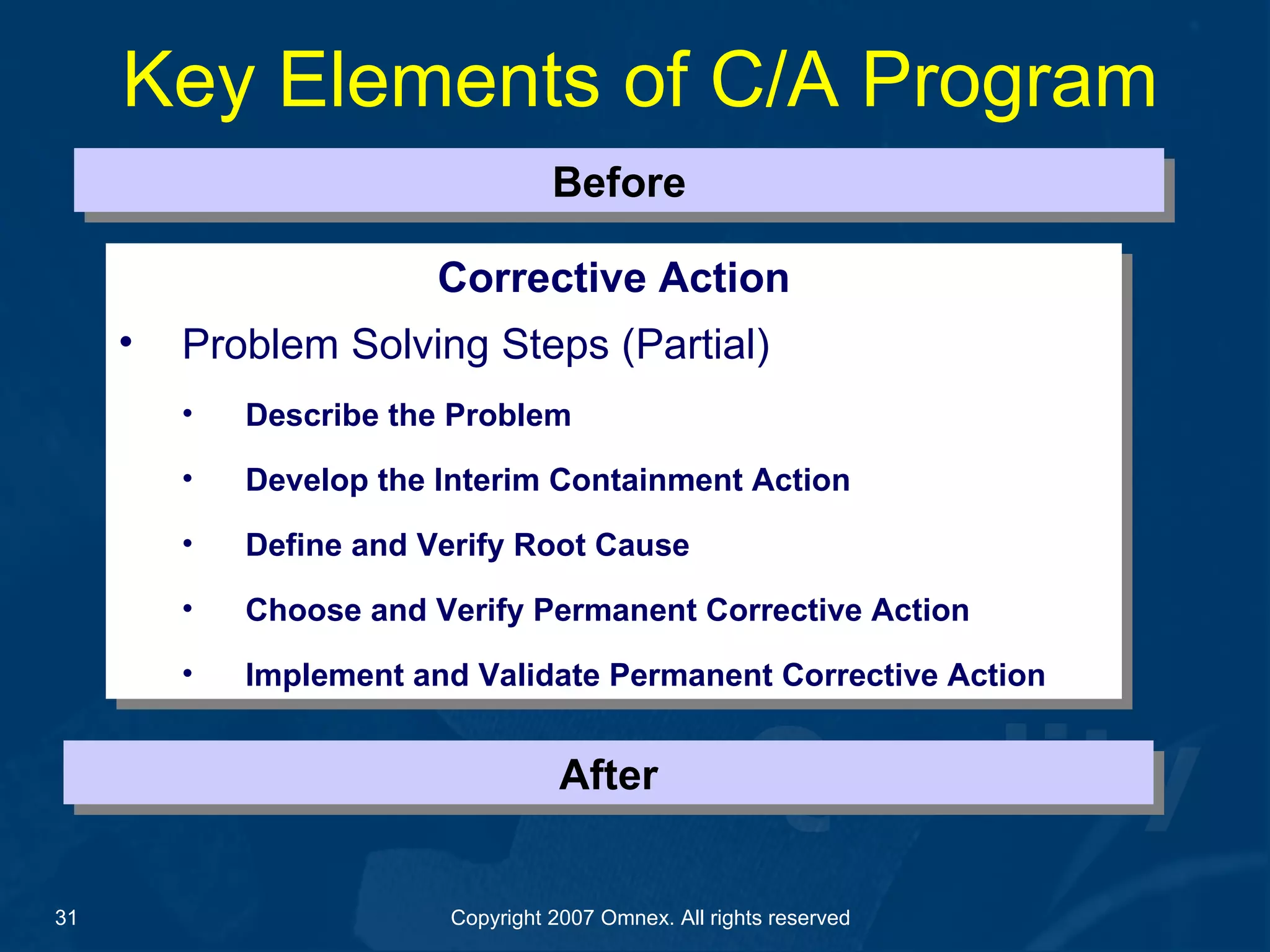
Key Elements of C/A Program Before Corrective Action Problem Solving Steps (Partial) Describe the Problem Develop the Interim Containment Action Define and Verify Root Cause Choose and Verify Permanent Corrective Action Implement and Validate Permanent Corrective Action After
The Ultimate C/A Program We need to focus on the “Before” and “After” when we are talking about a “Program” Note, with a poor “Team Problem Solving” process, there can be no Effective C/A Program
The Ultimate C/A Program BEFORE Realize that C/A Program is a Process Minimum of two unique processes This is a Management Process Drive a Company-wide Problem Solving Process  Make sure “Process Characteristics” are met? Communicate Consider a Enterprise-Wide Integrated Management System Software (web) Monitor Time & Money – “Cost of Quality” still works Understand when to use “Team Problem Solving” Train & monitor competency Spend the time now, next time will be easier! Prevent! Prevent! Prevent!
Company-wide Problem Solving Process Maintain Data Create and maintain a database of external and internal quality and process problems, and the result of previous corrective action efforts Set Priorities Use customer satisfaction, current process performance to identify, and select problems or improvement opportunities Manage the Process Use a defined process (PDSA) for: Identifying the need for corrective action  Assigning teams, for tracking projects  Analyzing the effectiveness of problem solving activities Implementing, verifying and validating the effectiveness of the project
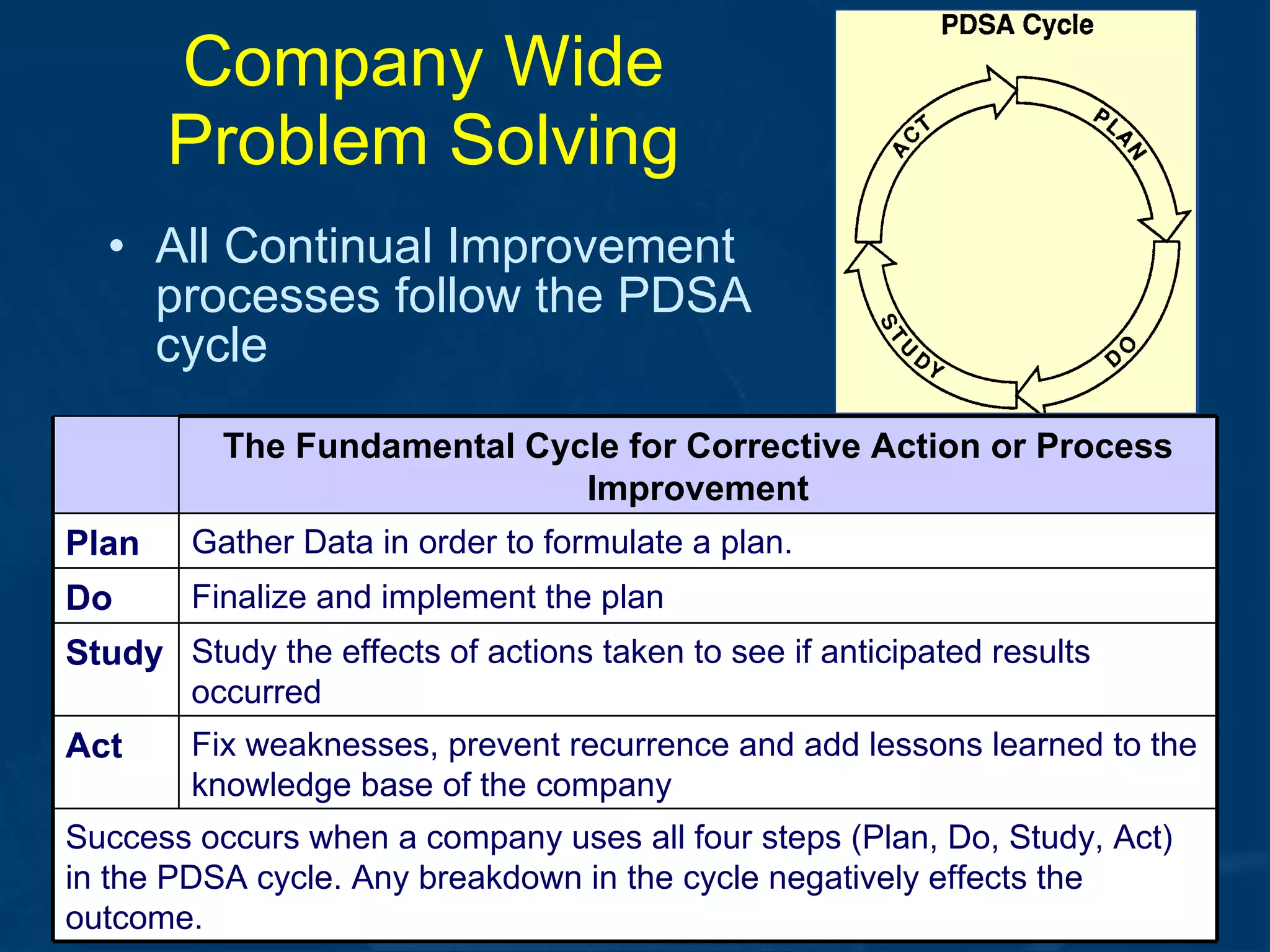
Company Wide Problem Solving All Continual Improvement processes follow the PDSA cycle Success occurs when a company uses all four steps (Plan, Do, Study, Act) in the PDSA cycle. Any breakdown in the cycle negatively effects the outcome. Fix weaknesses, prevent recurrence and add lessons learned to the knowledge base of the company Act Study the effects of actions taken to see if anticipated results occurred Study Finalize and implement the plan Do Gather Data in order to formulate a plan. Plan The Fundamental Cycle for Corrective Action or Process Improvement
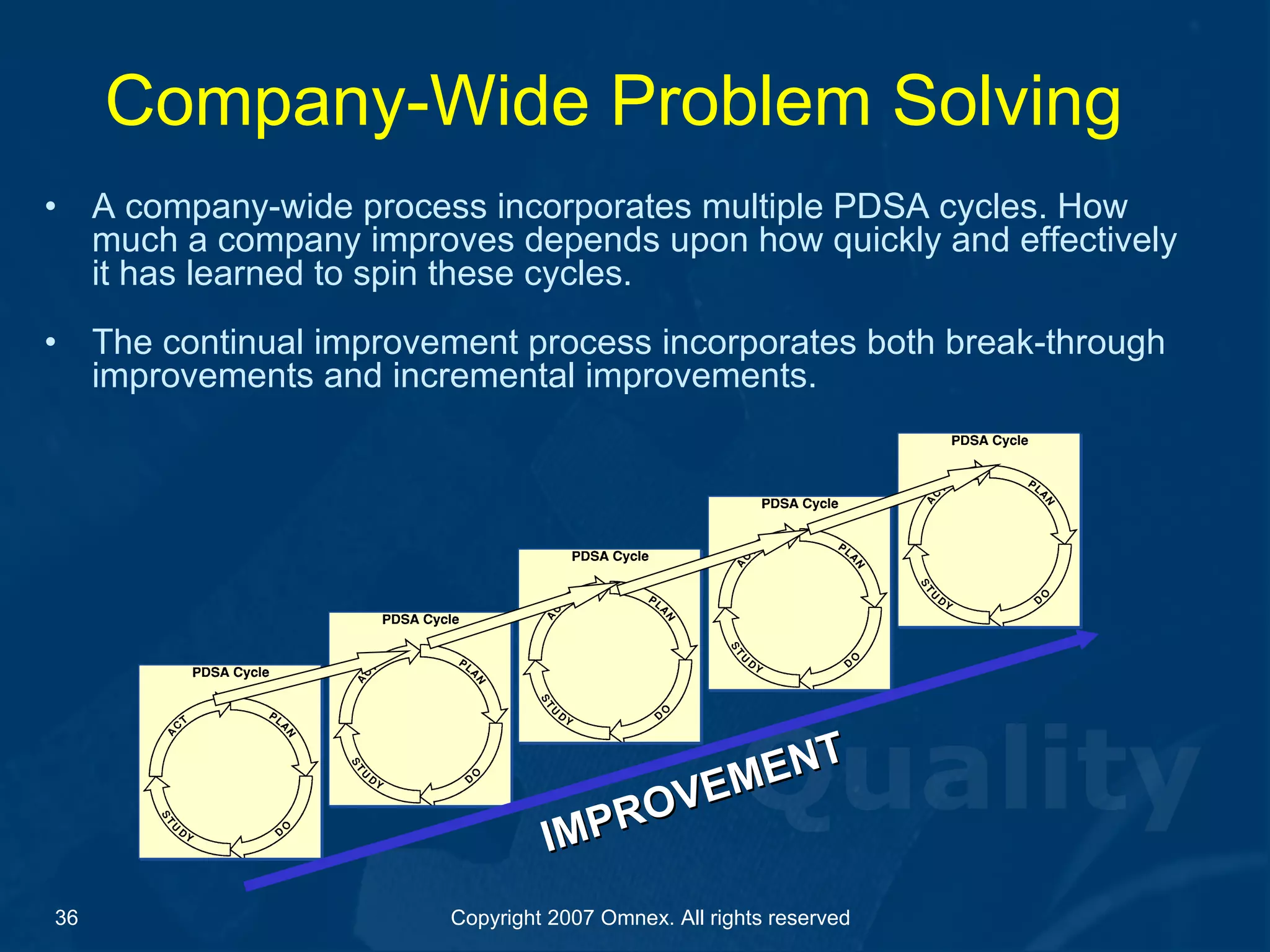
Company-Wide Problem Solving A company-wide process incorporates multiple PDSA cycles. How much a company improves depends upon how quickly and effectively it has learned to spin these cycles.   The continual improvement process incorporates both break-through improvements and incremental improvements. IMPROVEMENT
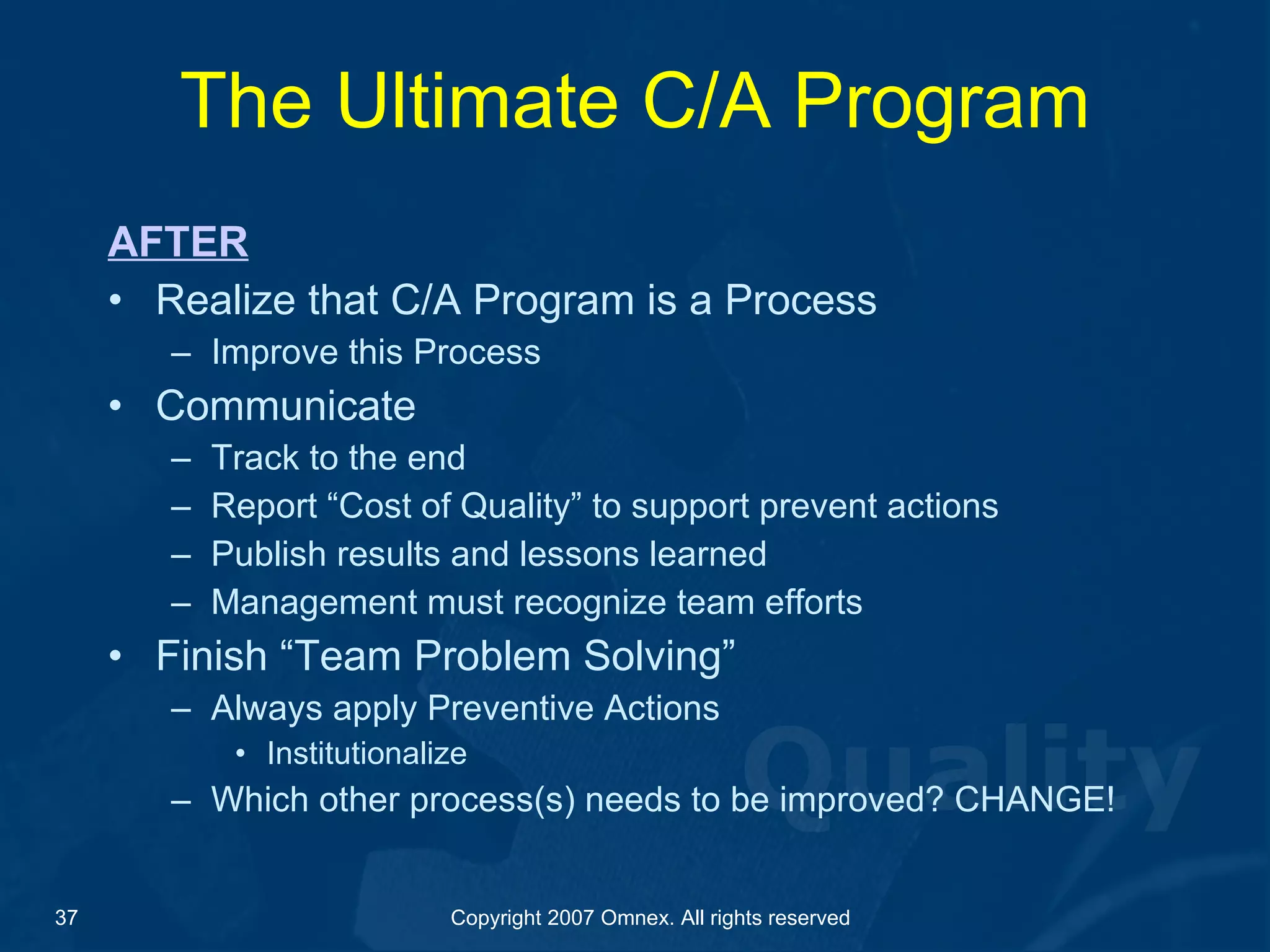
The Ultimate C/A Program AFTER Realize that C/A Program is a Process Improve this Process Communicate Track to the end Report “Cost of Quality” to support prevent actions Publish results and lessons learned Management must recognize team efforts Finish “Team Problem Solving” Always apply Preventive Actions Institutionalize Which other process(s) needs to be improved? CHANGE!
Summary & Review What is a C/A Program? Elements of a C/A Program   Background of Corrective Action Requirements Forced requirements to expand the C/A activities into a program Team Problem Solving Basics The Ultimate C/A Program
Thank You! Q & A!

Asq toronto10 jan2007effectcorraction

  • 1.
    Effective Corrective Action(C/A) Program Presented by David Barber, General Manager of Omnex Canada for ASQ, Toronto, January 10, 2007
  • 2.
    Omnex provides training,consulting and software to the international market with offices in the USA, Canada, Mexico, China (PRC), Germany, India, the Middle East and Thailand. Omnex offers over 55 training courses in business, quality, environmental, and health & safety management systems worldwide. Internet email: [email_address] Web: www.omnex.com
  • 3.
    David A. Barber,CQE (ASQ) Mr. Barber is the General Manager and Senior Quality Consultant / Trainer for Omnex Canada Inc. He has been a full time consultant since 1998, and estimates a total of 7,000 hours of in-class instructional training and 4,000 hours of client consultation since that time.   Mr. Barber has over 22 years experience in the Quality profession with the majority of this time being spent in Quality Director / Manager and Quality Engineering roles. He has a diverse background with experience in the automotive, medical devices, consumer electronic, telecommunications, plastics, machining, and stamping industries. Mr. Barber has assisted companies in the development and implementation of cohesive quality systems that have resulted in the achievement of ISO 9001:1994, QS-9000, TS16949:1999, ISO 9001:2000, TS16949:2002, TL9000, ISO/IEC 17025 and Six Sigma projects.   Mr. Barber is a fifteen-year senior member of the American Society for Quality (ASQ) and is a Certified Quality Engineer. He received his Quality Assurance Certificate (accredited by the ASQ) from Centennial College of Applied Arts and Technology, has a diploma in Electronics from Radio College of Canada.
  • 4.
    Presentation Overview Whatis a C/A Program? Elements of a C/A Program Background of Corrective Action Requirements Forced Requirements to Expand the C/A Activities into a Program Team Problem Solving Basics The Ultimate C/A Program
  • 5.
    What is aC/A Program?
  • 6.
    Program Management Applicationof knowledge, skills, tools and techniques to project activities to meet project requirements Manages Competing Demands: Scope - Time - Quality Cost - Risk - Value Manages Competing Stakeholder Expectations: Customers & End Users Management & Employees Pressure Groups, Local Communities Regulatory Entities (Safety, Environment) Supplier Organizations Stockholders (Owners & Investors)
  • 7.
    Simplified Understanding of the C/A Program? A process? – Best Practice A system? – Interacting sub-processes Management of various of inputs? These inputs may have different: Priorities / Importance to the supplier or customer Cost / Waste – Cost of Poor Quality Complexity of the Issue Communication levels Tasks / Sub-processes which are triggered Team involvement Detailed Problem Solving
  • 8.
    Simplified Understanding of the C/A Program? Various expected outputs or outcomes? Improve the Business Which other process(s) should have prevented this issue (or input to the C/A program) from occurring in the first place? Lessons Learned Change!
  • 9.
    Process Characteristics Aprocess can be identified by a series of unique, but consistent, characteristics. There are six characteristics of a process that are mandatory for effective quality management. A process owner exists The process is defined The process is documented The linkages of the process are established The process is monitored and improved Records are maintained
  • 10.
    Inputs to theC/A Program Suggestion Programs? OH&S Issues Environmental Non-conformance / Spills Internal & External Audits Poor Quality Objective Indicators Reliability Data High Scrap, Material Review Boards Production or Service Rejects / Defects / Defectives Supplier Issues Customer Complaints / Feedback Others – Many more Compliance Issues Improvement Programs
  • 11.
    Managing the InputsTwo Paths Minimum (MUST BE LINKED) Information Flow (Management Process) High-level Management Process? – Best Practice Manage the program, various type of Inputs Assign resources (people & money) Provide training – i.e., Team Problem Solving Communicating the progress and results Support the team Detailed Problem Solving (Support Process) Your preferred Best Practice Method 5 why, 8D, 7 step, 5P, Drill Down, Red X, etc. Team Based Use Proven Tools for a give situation BE DISCIPLINED
  • 12.
    Background of CorrectiveAction Requirements
  • 13.
    8.5.2 Corrective ActionRequirements Take action to eliminate the cause of nonconformities in order to prevent recurrence Corrective actions shall be appropriate to the effects of the nonconformities encountered
  • 14.
    8.5.2 Corrective ActionRequirements A documented procedure shall be established to define requirements for: Reviewing nonconformities (including customer complaints) Determining the causes of nonconformities Evaluating the need for action to ensure that nonconformities do not recur Determining and implementing action needed Records of results of actions taken (see 4.2.4) Reviewing corrective action taken
  • 15.
    Management Review TopicsProduct realization and support process efficiency and effectiveness (5.1.1) QMS and its performance trends (5.6.1.1) Quality Objectives (5.6.1.1) Cost of Poor Quality (5.6.1.1) Objectives in business plan (5.6.1.1) Customer Satisfaction with product (5.6.1.1) Results of audits (5.6.2) Customer Feedback (5.6.2) Status of Corrective and Preventive Actions (5.6.2) Follow up from previous reviews (5.6.2) Business changes (5.6.2) Actual and potential field failures and their impact (5.6.2.1) Design and Development measurements- risk, costs, lead times… (7.3.4.1)
  • 16.
    Additional C/A Requirements8.5.2.1 Problem Solving The organization shall have a defined process for problem solving leading to root cause identification and elimination If a customer-prescribed problem solving format exists, the organization shall use the prescribed format 8.5.2.2 Error-proofing The organization shall use error-proofing methods in their corrective action process 8.5.2.3 Corrective Action Impact The organization shall apply to other similar processes and products the corrective action, and controls implemented, to eliminate the cause of a nonconformity
  • 17.
    8.5.3 Preventive ActionRequirements Determine action to eliminate the causes of potential nonconformities in order to prevent their occurrence Preventive actions shall be appropriate to the effects of the potential problems
  • 18.
    8.5.3 Preventive ActionRequirements A documented procedure shall be established to define requirements for: Determining potential nonconformities and their causes Evaluating the need for action to prevent occurrence of nonconformities Determining and implementing action needed Records of results of actions taken (see 4.2.4), and Reviewing preventive action taken
  • 19.
  • 20.
    Effective Problem SolvingUses a disciplined process based on facts, but takes advantage of experience and creativity Uses an effective team of the right people with the right skills Uses quality analysis and problem solving tools effectively Has meaningful management support
  • 21.
    Effective Problem SolvingTools for Identifying and Understanding Check Sheets Help gather information Pareto Diagrams, Scatter Diagrams and Histograms Help to organize data Process Flow Diagrams Help identify the process and to see the interaction between operations Cause and Effect Diagrams Help identify relationships within the data Five Whys Help explain effects vs. causes Is/Is Not Analysis (Problem Solving Worksheet) Helps to describe the problem in scientific terms
  • 22.
    Effective Problem SolvingTools for Analyzing and Tracking Data Changes and Differences Analysis Helps to isolate causes Trend Charts Help to track and identify intermittent factors DOE (Design of Experiments) Used to analyze complex processes with multiple variables Paynter Charts Help to track interim actions and determine their effectiveness Action Plans Action plans are used to document and track actions to ensure that all data is gathered and all assignments are completed as required
  • 23.
    Effective Problem SolvingTools for Maintaining Improvements FMEA Document the most up to date methods used for controlling known and suspected risks to the process – they ensure that future similar products will have all of the current best practices applied at the earliest opportunity SPC (Statistical Process Controls) Monitor on-going process variation to ensure that process capability is maintained Control Plans Used to document controls needed to ensure that risks to the process are effectively addressed through automated process controls or inspection Quality Auditing Validates that changes have been fully implemented and monitors processes once implemented to ensure that best practices are maintained
  • 24.
    Inhibitors to EffectiveProblem Solving Problem Described Incorrectly No clear, thorough description of the problem Too broad of a problem Too narrow of a problem Problem-Solving Effort Expedited Problem solving steps are skipped in order to obtain a quick solution Poor Team Participation Some team members don’t participate effectively, tasks don’t get completed, or the team drifts into inaction No Logical Thought Process The team lacks a disciplined system for analyzing problems, relies on experience only or even someone’s best guess Lack of Technical Skills Team members are not adequately trained in problem solving tools and skills
  • 25.
    Inhibitors to EffectiveProblem Solving Management Impatience Management’s lack of understanding of the problem solving process causes impatience with the process and a demand to know exactly when a problem will be solved Potential Cause Misidentified as Root Cause Potential causes can quickly become identified as root causes and the problem investigation is concluded. Permanent Corrective Actions not Implemented A root cause may be identified, but no action is taken to implement permanent corrective actions Permanent actions are implemented but don’t take hold and soon deteriorate The Internal Audit is an excellent tool for making sure that planned actions are fully and effectively implemented.
  • 26.
    Verification vs. ValidationVerification and Validation are often not well understood In 8D’s, Verification and Validation work together as a sort of 'before ' ( Verification ) and 'after ' ( Validation ) proof Verification provides 'insurance' at a point in time that the action taken was in fact the action that was supposed to have been taken. Validation provides measurable 'evidence' that the actions taken had the effect or end results that were desired.
  • 27.
    8D Problem Solving8D Problem Solving D0 Prepare for the Problem Solving Process D1 Establish the Team D2 Describe the Problem D3 Develop the Interim Containment Action D4 Define and Verify Root Cause D5 Choose and Verify Permanent Corrective Action D6 Implement and Validate Permanent Corrective Action D7 Prevent Recurrence D8 Team and Individual Recognition
  • 28.
  • 29.
    Corrective Action CheckList (Partial Example) Has corrective action been established? Does it meet the required givens? Have different alternatives been examined as possible corrective actions? Have Poka-Yoke techniques been considered? Has each alternative been screened? Have the risks involved with the corrective action been considered? Was the corrective action verified? Was the corrective action proven to eliminate the root cause?
  • 30.
  • 31.
    Key Elements ofC/A Program Before Corrective Action Problem Solving Steps (Partial) Describe the Problem Develop the Interim Containment Action Define and Verify Root Cause Choose and Verify Permanent Corrective Action Implement and Validate Permanent Corrective Action After
  • 32.
    The Ultimate C/AProgram We need to focus on the “Before” and “After” when we are talking about a “Program” Note, with a poor “Team Problem Solving” process, there can be no Effective C/A Program
  • 33.
    The Ultimate C/AProgram BEFORE Realize that C/A Program is a Process Minimum of two unique processes This is a Management Process Drive a Company-wide Problem Solving Process Make sure “Process Characteristics” are met? Communicate Consider a Enterprise-Wide Integrated Management System Software (web) Monitor Time & Money – “Cost of Quality” still works Understand when to use “Team Problem Solving” Train & monitor competency Spend the time now, next time will be easier! Prevent! Prevent! Prevent!
  • 34.
    Company-wide Problem SolvingProcess Maintain Data Create and maintain a database of external and internal quality and process problems, and the result of previous corrective action efforts Set Priorities Use customer satisfaction, current process performance to identify, and select problems or improvement opportunities Manage the Process Use a defined process (PDSA) for: Identifying the need for corrective action Assigning teams, for tracking projects Analyzing the effectiveness of problem solving activities Implementing, verifying and validating the effectiveness of the project
  • 35.
    Company Wide ProblemSolving All Continual Improvement processes follow the PDSA cycle Success occurs when a company uses all four steps (Plan, Do, Study, Act) in the PDSA cycle. Any breakdown in the cycle negatively effects the outcome. Fix weaknesses, prevent recurrence and add lessons learned to the knowledge base of the company Act Study the effects of actions taken to see if anticipated results occurred Study Finalize and implement the plan Do Gather Data in order to formulate a plan. Plan The Fundamental Cycle for Corrective Action or Process Improvement
  • 36.
    Company-Wide Problem SolvingA company-wide process incorporates multiple PDSA cycles. How much a company improves depends upon how quickly and effectively it has learned to spin these cycles. The continual improvement process incorporates both break-through improvements and incremental improvements. IMPROVEMENT
  • 37.
    The Ultimate C/AProgram AFTER Realize that C/A Program is a Process Improve this Process Communicate Track to the end Report “Cost of Quality” to support prevent actions Publish results and lessons learned Management must recognize team efforts Finish “Team Problem Solving” Always apply Preventive Actions Institutionalize Which other process(s) needs to be improved? CHANGE!
  • 38.
    Summary & ReviewWhat is a C/A Program? Elements of a C/A Program Background of Corrective Action Requirements Forced requirements to expand the C/A activities into a program Team Problem Solving Basics The Ultimate C/A Program
  • 39.

Editor's Notes

  • #7 ____________________________________________________________________ ____________________________________________________________________ ____________________________________________________________________ ____________________________________________________________________ ____________________________________________________________________ ____________________________________________________________________ ____________________________________________________________________ ____________________________________________________________________ ____________________________________________________________________ ____________________________________________________________________ ____________________________________________________________________ ____________________________________________________________________ ____________________________________________________________________
  • #18 78 Identifying needs through FMEA, QFD and employee evaluation.