Problem solving techniques
Sandeep Bangera
17th May 2013
8D- Methodology
15/2/2012
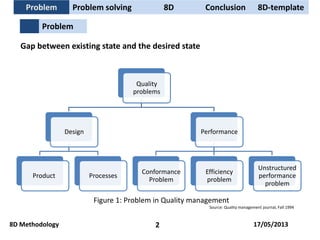
Gap between existing state and the desired state
Quality
problems
Design
Product Processes
Performance
Conformance
Problem
Efficiency
problem
Unstructured
performance
problem
Source: Quality management journal, Fall 1994
Figure 1: Problem in Quality management
Problem
Problem Problem solving 8D Conclusion 8D-template
8D Methodology 2 17/05/2013
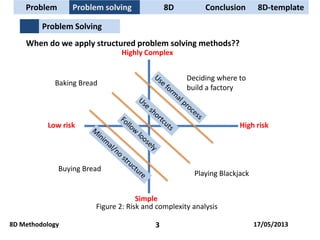
Low risk High risk
Simple
When do we apply structured problem solving methods??
Highly Complex
Buying Bread
Baking Bread
Playing Blackjack
Deciding where to
build a factory
Figure 2: Risk and complexity analysis
Problem Solving
Problem Problem solving 8D Conclusion
8D Methodology 3
8D-template
17/05/2013
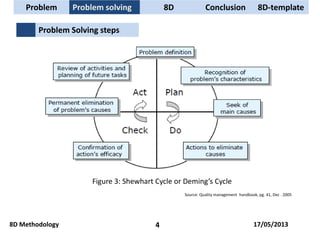
Figure 3: Shewhart Cycle or Deming’s Cycle
Source: Quality management handbook, pg. 41, Dec . 2005
Problem Solving steps
Problem Problem solving 8D Conclusion
8D Methodology 4
8D-template
17/05/2013
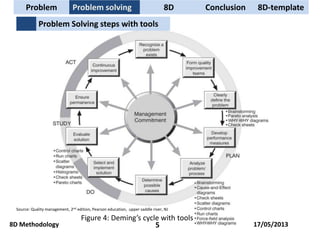
Source: Quality management, 2nd edition, Pearson education, upper saddle river, NJ
Figure 4: Deming’s cycle with tools
Problem Solving steps with tools
Problem Problem solving 8D Conclusion
8D Methodology 5
8D-template
17/05/2013
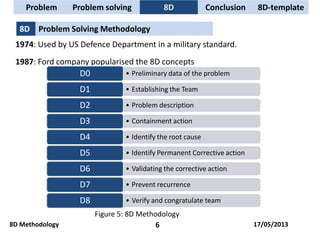
1974: Used by US Defence Department in a military standard.
1987: Ford company popularised the 8D concepts
• Preliminary data of the problemD0
• Establishing the TeamD1
• Problem descriptionD2
• Containment actionD3
• Identify the root causeD4
• Identify Permanent Corrective actionD5
• Validating the corrective actionD6
• Prevent recurrenceD7
• Verify and congratulate teamD8
Figure 5: 8D Methodology
Problem Solving Methodology8D
Problem Problem solving 8D Conclusion
8D Methodology 6
8D-template
17/05/2013
D1
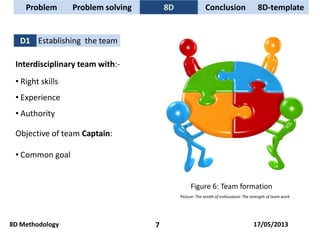
Interdisciplinary team with:-
• Right skills
• Experience
• Authority
Objective of team Captain:
• Common goal
Establishing the team
Picture: The zenith of enthusiasm: The strength of team work
Figure 6: Team formation
Problem Problem solving 8D Conclusion
8D Methodology 7
8D-template
17/05/2013
D2 Problem Description
“ A problem well described is half solved”
Problem must be:
• Clearly described
• Scale of problem
• Place of occurrence
• Measurable
• Well communicated
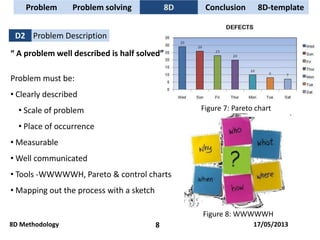
• Tools -WWWWWH, Pareto & control charts
• Mapping out the process with a sketch
Figure 7: Pareto chart
Figure 8: WWWWWH
Problem Problem solving 8D Conclusion
8D Methodology 8
8D-template
17/05/2013
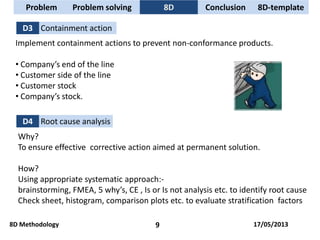
D3 Containment action
Implement containment actions to prevent non-conformance products.
• Company’s end of the line
• Customer side of the line
• Customer stock
• Company’s stock.
D4 Root cause analysis
Why?
To ensure effective corrective action aimed at permanent solution.
How?
Using appropriate systematic approach:-
brainstorming, FMEA, 5 why’s, CE , Is or Is not analysis etc. to identify root cause
Check sheet, histogram, comparison plots etc. to evaluate stratification factors
Problem Problem solving 8D Conclusion
8D Methodology 9
8D-template
17/05/2013
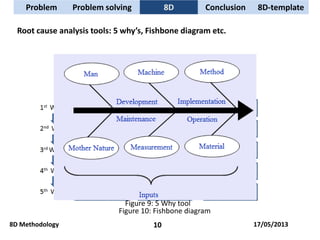
Figure 10: Fishbone diagram
Figure 9: 5 Why tool
Root cause analysis tools: 5 why’s, Fishbone diagram etc.
Problem Problem solving 8D Conclusion
8D Methodology 10
8D-template
17/05/2013
• Project management schedule
• Validation of PCA using SPC and FMEA under real test condition.
• If not, revisit step D2-D5.
D5 Identify permanent corrective action (PCA)
• Identify PCA on basis of the root cause analysis.
• Preparation of feasibility study for the PCA
How?
• Solution on basis of root cause.
• Statistical process control (SPC)
• FMEA
D6 Implement & Validating corrective action
Problem Problem solving 8D Conclusion
8D Methodology 11
8D-template
17/05/2013
D7 Prevent recurrence
• Revise the system flow and procedures
• Make system changes to prevent recurrence
• Standardize the new practices
• Notify all departments of the resolution
• Document lesson learnt and archive the document
D8 Congratulate team
• Celebrate your team success
Problem Problem solving 8D Conclusion
8D Methodology 12
8D-template
17/05/2013
Conclusion
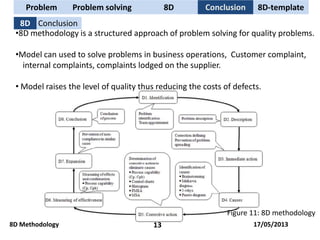
•8D methodology is a structured approach of problem solving for quality problems.
•Model can used to solve problems in business operations, Customer complaint,
internal complaints, complaints lodged on the supplier.
• Model raises the level of quality thus reducing the costs of defects.
8D
Problem Problem solving 8D Conclusion
8D Methodology 13
8D-template
Figure 11: 8D methodology
17/05/2013
8D Methodology 14
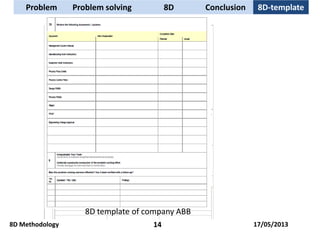
8D template of company ABB
Problem Problem solving 8D Conclusion 8D-template
17/05/2013
Problem Problem solving 8D Conclusion
8D Methodology 15
References
• Gerald F Smith, Quality problem solving, American society of quality, 1998.
• 6ixsigma.org, 8D book,
Available at: http://6ixsigma.org/8d-book.aspx [Accessed: 25 Apr 2013]
• Problem solving, Quality Management handbook, December 2005.
• Uzair Rajput, 8D- problem solving method, Quality management handbook
• Fideltronik, 8D-problem solving methodology
• Marjanca Krajnc, 8D-methodology, Journal of universal excellence, October 2012.
• Bill Arnott, 8D-problem solving methodology, Canada.
• ABB, 8D problem solving template, http://www05.abb.com/global[Accessed: 25 Apr 2013]
17/05/2013
Contact Details:
Email: Bangeraj.sandeep@gmail.com

8D problem solving

  • 1.
    Problem solving techniques SandeepBangera 17th May 2013 8D- Methodology
  • 2.
    15/2/2012 Gap between existingstate and the desired state Quality problems Design Product Processes Performance Conformance Problem Efficiency problem Unstructured performance problem Source: Quality management journal, Fall 1994 Figure 1: Problem in Quality management Problem Problem Problem solving 8D Conclusion 8D-template 8D Methodology 2 17/05/2013
  • 3.
    Low risk Highrisk Simple When do we apply structured problem solving methods?? Highly Complex Buying Bread Baking Bread Playing Blackjack Deciding where to build a factory Figure 2: Risk and complexity analysis Problem Solving Problem Problem solving 8D Conclusion 8D Methodology 3 8D-template 17/05/2013
  • 4.
    Figure 3: ShewhartCycle or Deming’s Cycle Source: Quality management handbook, pg. 41, Dec . 2005 Problem Solving steps Problem Problem solving 8D Conclusion 8D Methodology 4 8D-template 17/05/2013
  • 5.
    Source: Quality management,2nd edition, Pearson education, upper saddle river, NJ Figure 4: Deming’s cycle with tools Problem Solving steps with tools Problem Problem solving 8D Conclusion 8D Methodology 5 8D-template 17/05/2013
  • 6.
    1974: Used byUS Defence Department in a military standard. 1987: Ford company popularised the 8D concepts • Preliminary data of the problemD0 • Establishing the TeamD1 • Problem descriptionD2 • Containment actionD3 • Identify the root causeD4 • Identify Permanent Corrective actionD5 • Validating the corrective actionD6 • Prevent recurrenceD7 • Verify and congratulate teamD8 Figure 5: 8D Methodology Problem Solving Methodology8D Problem Problem solving 8D Conclusion 8D Methodology 6 8D-template 17/05/2013
  • 7.
    D1 Interdisciplinary team with:- •Right skills • Experience • Authority Objective of team Captain: • Common goal Establishing the team Picture: The zenith of enthusiasm: The strength of team work Figure 6: Team formation Problem Problem solving 8D Conclusion 8D Methodology 7 8D-template 17/05/2013
  • 8.
    D2 Problem Description “A problem well described is half solved” Problem must be: • Clearly described • Scale of problem • Place of occurrence • Measurable • Well communicated • Tools -WWWWWH, Pareto & control charts • Mapping out the process with a sketch Figure 7: Pareto chart Figure 8: WWWWWH Problem Problem solving 8D Conclusion 8D Methodology 8 8D-template 17/05/2013
  • 9.
    D3 Containment action Implementcontainment actions to prevent non-conformance products. • Company’s end of the line • Customer side of the line • Customer stock • Company’s stock. D4 Root cause analysis Why? To ensure effective corrective action aimed at permanent solution. How? Using appropriate systematic approach:- brainstorming, FMEA, 5 why’s, CE , Is or Is not analysis etc. to identify root cause Check sheet, histogram, comparison plots etc. to evaluate stratification factors Problem Problem solving 8D Conclusion 8D Methodology 9 8D-template 17/05/2013
  • 10.
    Figure 10: Fishbonediagram Figure 9: 5 Why tool Root cause analysis tools: 5 why’s, Fishbone diagram etc. Problem Problem solving 8D Conclusion 8D Methodology 10 8D-template 17/05/2013
  • 11.
    • Project managementschedule • Validation of PCA using SPC and FMEA under real test condition. • If not, revisit step D2-D5. D5 Identify permanent corrective action (PCA) • Identify PCA on basis of the root cause analysis. • Preparation of feasibility study for the PCA How? • Solution on basis of root cause. • Statistical process control (SPC) • FMEA D6 Implement & Validating corrective action Problem Problem solving 8D Conclusion 8D Methodology 11 8D-template 17/05/2013
  • 12.
    D7 Prevent recurrence •Revise the system flow and procedures • Make system changes to prevent recurrence • Standardize the new practices • Notify all departments of the resolution • Document lesson learnt and archive the document D8 Congratulate team • Celebrate your team success Problem Problem solving 8D Conclusion 8D Methodology 12 8D-template 17/05/2013
  • 13.
    Conclusion •8D methodology isa structured approach of problem solving for quality problems. •Model can used to solve problems in business operations, Customer complaint, internal complaints, complaints lodged on the supplier. • Model raises the level of quality thus reducing the costs of defects. 8D Problem Problem solving 8D Conclusion 8D Methodology 13 8D-template Figure 11: 8D methodology 17/05/2013
  • 14.
    8D Methodology 14 8Dtemplate of company ABB Problem Problem solving 8D Conclusion 8D-template 17/05/2013
  • 15.
    Problem Problem solving8D Conclusion 8D Methodology 15 References • Gerald F Smith, Quality problem solving, American society of quality, 1998. • 6ixsigma.org, 8D book, Available at: http://6ixsigma.org/8d-book.aspx [Accessed: 25 Apr 2013] • Problem solving, Quality Management handbook, December 2005. • Uzair Rajput, 8D- problem solving method, Quality management handbook • Fideltronik, 8D-problem solving methodology • Marjanca Krajnc, 8D-methodology, Journal of universal excellence, October 2012. • Bill Arnott, 8D-problem solving methodology, Canada. • ABB, 8D problem solving template, http://www05.abb.com/global[Accessed: 25 Apr 2013] 17/05/2013
  • 16.

Editor's Notes

  • #3 sing the PDCA method, your company will discover what processes need to improve.....  from what we “think” are the problems to what we “know” are the problems.  Through use of flowcharts and root cause analysis you will determine where the waste is, implement the changes, and set up measurement systems to create greater efficiencies and reduce the areas of waste.
  • #4 Standard defined problem solving methodology should be applied on the basis of the complexity of the task since it requires high amount of manpower and time.
  • #5 PDCA has a laid a systematical background to the problem solving but there are many problem solving tools :8DDMAICTRIZ ( German Standard for inventive problem solving) Rapid problem resolution (IT)Grow ( Goal, reality, obstacles and way forward) Math approachKepner-TregoeDMADV- Define, measure, Analyse, Design and VerifyLean Kaizen Six sigma tool box: Kano Model-customer requirement structuring
  • #6 The PDCA Cycle (figure 4) was originally conceived by Walter Shewhart(1930), and is often referred to as "the Shewhart Cycle". It was lateradopted and promoted for quality purposes very effectively by the famousQuality Management authority, W. Edwards Deming. The model provides aframework for the improvement of a process or system and is shaped byfours main steps: plan, do, check and act.
  • #7 D0-Gathered very shortly after defect was found ( info lost with time) like: m/c, operator, batch details, time of failure, processing conditions and special circumstances. 8D is extensively used when there is a defect. Application: AutoManfHealth careData processingSoftware developmentFinancial Services
  • #9 Gemba is a japanese word means the real place or job floor or production floor where the value addition activity wrt the customer takes place.
  • #11 ( Capability index, process centricity index, histograms, pareto graphs etc )
  • #12 e.g. specifications, training manuals, or “mistake proofing” the process