g We bring good things to life
What Is Six Sigma?
The Roadmap
to Customer
Impact
Making Customers Feel Six Sigma Quality
Globalization and instant access to information, products and services have changed the way
our customers conduct business — old business models no longer work. Today’s competitive
environment leaves no room for error. We must delight our customers and relentlessly look for
new ways to exceed their expectations. This is why Six Sigma Quality has become a part
of our culture.
What is Six Sigma?
First, what it is not. It is not a secret society, a slogan or a cliché. Six Sigma is a highly
disciplined process that helps us focus on developing and delivering near-perfect products
and services. Why ”Sigma“? The word is a statistical term that measures how far a given
process deviates from perfection. The central idea behind Six Sigma is that if you can
measure how many “defects” you have in a process, you can systematically figure out how
to eliminate them and get as close to “zero defects” as possible. Six Sigma has changed
the DNA of GE — it is now the way we work — in everything we do and in every prod-
uct we design.
GE’s Evolution Towards Quality
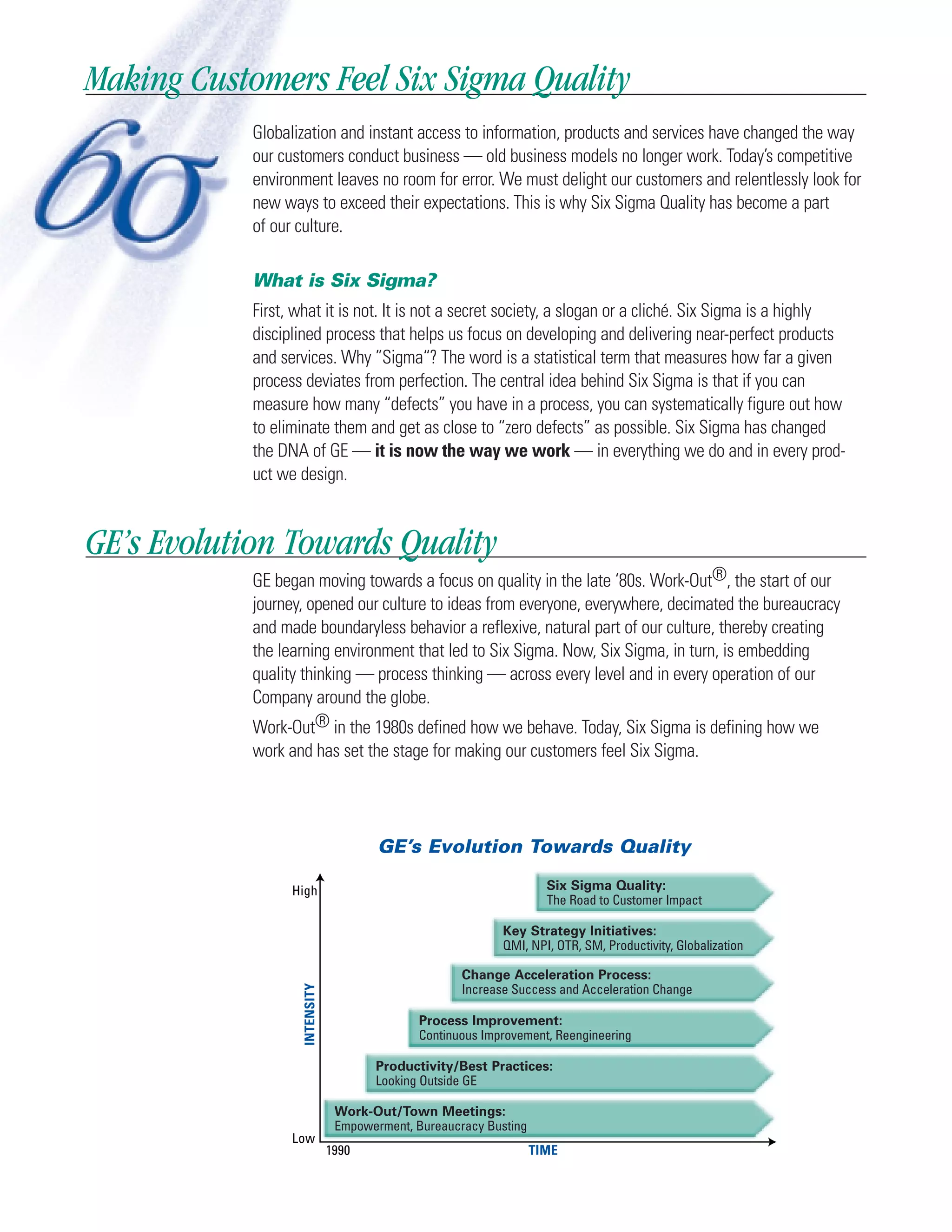
GE began moving towards a focus on quality in the late ‘80s. Work-Out®, the start of our
journey, opened our culture to ideas from everyone, everywhere, decimated the bureaucracy
and made boundaryless behavior a reflexive, natural part of our culture, thereby creating
the learning environment that led to Six Sigma. Now, Six Sigma, in turn, is embedding
quality thinking — process thinking — across every level and in every operation of our
Company around the globe.
Work-Out® in the 1980s defined how we behave. Today, Six Sigma is defining how we
work and has set the stage for making our customers feel Six Sigma.
1990 TIME
INTENSITY
High
Low
Six Sigma Quality:
The Road to Customer Impact
Key Strategy Initiatives:
QMI, NPI, OTR, SM, Productivity, Globalization
Change Acceleration Process:
Increase Success and Acceleration Change
Process Improvement:
Continuous Improvement, Reengineering
Productivity/Best Practices:
Looking Outside GE
Work-Out/Town Meetings:
Empowerment, Bureaucracy Busting
GE’s Evolution Towards Quality
Key Elements of Quality...Customer, Process and Employee
There are three key elements of quality: customer, process and employee. Everything we do to remain a world-class
quality company focuses on these three essential elements.
...the Customer
Delighting Customers
Customers are the center of GE’s universe: they define quality. They expect
performance, reliability, competitive prices, on-time delivery, service, clear and correct
transaction processing and more. In every attribute that influences customer perception,
we know that just being good is not enough. Delighting our customers is a necessity.
Because if we don’t do it, someone else will!
...the Process
Outside-In Thinking
Quality requires us to look at our business from the customer’s perspective, not ours. In other
words, we must look at our processes from the outside-in. By understanding the transaction
lifecycle from the customer’s needs
and processes, we can discover
what they are seeing and feeling.
With this knowledge, we can
identify areas where we can add
significant value or improvement
from their perspective.
...the Employee
Leadership Commitment
People create results. Involving all employees is essential to GE’s quality approach. GE is
committed to providing opportunities and incentives for employees to focus their talents and
energies on satisfying customers.
All GE employees are trained in the strategy, statistical tools and techniques of Six Sigma
quality. Training courses are offered at various levels:
ᮣ Quality Overview Seminars: basic Six Sigma awareness.
ᮣ Team Training: basic tool introduction to equip employees to participate on
Six Sigma teams.
ᮣ Master Black Belt, Black Belt and Green Belt Training: in-depth quality training
that includes high-level statistical tools, basic quality control tools, Change Acceleration
Process and Flow technology tools.
ᮣ Design for Six Sigma (DFSS) Training: prepares teams for the use of
statistical tools to design it right the first time.
Quality is the responsibility of every employee. Every employee must be involved, motivated
and knowledgeable if we are to succeed.
Customer
Process
GE Process
A B C
Customer’s
View of GE’s
Contribution
GE’s View
of Its
Contribution
The Six Sigma Strategy
To achieve Six Sigma quality, a process must produce no more than 3.4 defects per million opportunities. An “opportunity”
is defined as a chance for nonconformance, or not meeting the required specifications. This means we need to be nearly
flawless in executing our key processes. Six Sigma is a vision we strive toward and a philosophy that is part of our
business culture.
Key Concepts of Six Sigma
At its core, Six Sigma revolves around a few key concepts.
Critical to Quality: Attributes most important to the customer
Defect: Failing to deliver what the customer wants
Process Capability: What your process can deliver
Variation: What the customer sees and feels
Stable Operations:
Ensuring consistent, predictable processes to improve
what the customer sees and feels
Design for Six Sigma: Designing to meet customer needs and process capability
Our Customers Feel the Variance, Not the Mean
Often, our inside-out view of the business is based on average or mean-based measures of our recent past. Customers
don’t judge us on averages, they feel the variance in each transaction, each product we ship. Six Sigma focuses first on
reducing process variation and then on improving the process capability.
Customers value consistent, predictable business processes that deliver world-class levels of quality. This is what Six
Sigma strives to produce.
GE’s Commitment to Quality
GE’s success with Six Sigma has exceeded our most optimistic predictions. Across the Company, GE associates
embrace Six Sigma’s customer-focused, data-driven philosophy and apply it to everything we do. We are building
on these successes by sharing best practices across all of our businesses, putting the full power of GE behind our
quest for better, faster customer solutions.
Glossary of Terms and Definitions
Quality Approaches and Models
DFSS – (Design for Six Sigma) is a systematic metho-
dology utilizing tools, training and measurements to
enable us to design products and processes that meet
customer expectations and can be produced at Six Sigma
quality levels.
DMAIC – (Define, Measure, Analyze, Improve and
Control) is a process for continued improvement. It is
systematic, scientific and fact based. This closed-loop
process eliminates unproductive steps, often focuses
on new measurements, and applies technology for
improvement.
Six Sigma – A vision of quality which equates with only
3.4 defects per million opportunities for each product or
service transaction. Strives for perfection.
Quality Tools
Associates are exposed to various tools and terms
related to quality. Below are just a few of them.
Control Chart – Monitors variance in a process over
time and alerts the business to unexpected variance
which may cause defects.
Defect Measurement – Accounting for the number
or frequency of defects that cause lapses in product or
service quality.
Pareto Diagram – Focuses on efforts or the problems
that have the greatest potential for improvement by
showing relative frequency and/or size in a descending
bar graph. Based on the proven Pareto principle: 20% of
the sources cause 80% of any problems.
Process Mapping – Illustrated description of how
things get done, which enables participants to visualize
an entire process and identify areas of strength and
weaknesses. It helps reduce cycle time and defects while
recognizing the value of individual contributions.
Root Cause Analysis – Study of original reason for
nonconformance with a process. When the root cause
is removed or corrected, the nonconformance will be
eliminated.
Statistical Process Control – The application of statis-
tical methods to analyze data, study and monitor process
capability and performance.
Tree Diagram – Graphically shows any broad goal bro-
ken into different levels of detailed actions. It encourages
team members to expand their thinking when creating
solutions.
Quality Terms
Black Belt – Leaders of team responsible for measur-
ing, analyzing, improving and controlling key processes
that influence customer satisfaction and/or productivity
growth. Black Belts are full-time positions.
Control – The state of stability, normal variation and pre-
dictability. Process of regulating and guiding operations
and processes using quantitative data.
CTQ: Critical to Quality (Critical “Y”) – Element of
a process or practice which has a direct impact on its
perceived quality.
Customer Needs, Expectations – Needs, as defined
by customers, which meet their basic requirements and
standards.
Defects – Sources of customer irritation. Defects are
costly to both customers and to manufacturers or service
providers. Eliminating defects provides cost benefits.
Green Belt – Similar to Black Belt but not a full-time
position.
Master Black Belt – First and foremost teachers. They
also review and mentor Black Belts. Selection criteria for
Master Black Belts are quantitative skills and the ability
to teach and mentor. Master Black Belts are full-time
postions.
Variance – A change in a process or business practice
that may alter its expected outcome.
19991438-1
g We bring good things to life

Six sigma

  • 1.
    g We bringgood things to life What Is Six Sigma? The Roadmap to Customer Impact
  • 2.
    Making Customers FeelSix Sigma Quality Globalization and instant access to information, products and services have changed the way our customers conduct business — old business models no longer work. Today’s competitive environment leaves no room for error. We must delight our customers and relentlessly look for new ways to exceed their expectations. This is why Six Sigma Quality has become a part of our culture. What is Six Sigma? First, what it is not. It is not a secret society, a slogan or a cliché. Six Sigma is a highly disciplined process that helps us focus on developing and delivering near-perfect products and services. Why ”Sigma“? The word is a statistical term that measures how far a given process deviates from perfection. The central idea behind Six Sigma is that if you can measure how many “defects” you have in a process, you can systematically figure out how to eliminate them and get as close to “zero defects” as possible. Six Sigma has changed the DNA of GE — it is now the way we work — in everything we do and in every prod- uct we design. GE’s Evolution Towards Quality GE began moving towards a focus on quality in the late ‘80s. Work-Out®, the start of our journey, opened our culture to ideas from everyone, everywhere, decimated the bureaucracy and made boundaryless behavior a reflexive, natural part of our culture, thereby creating the learning environment that led to Six Sigma. Now, Six Sigma, in turn, is embedding quality thinking — process thinking — across every level and in every operation of our Company around the globe. Work-Out® in the 1980s defined how we behave. Today, Six Sigma is defining how we work and has set the stage for making our customers feel Six Sigma. 1990 TIME INTENSITY High Low Six Sigma Quality: The Road to Customer Impact Key Strategy Initiatives: QMI, NPI, OTR, SM, Productivity, Globalization Change Acceleration Process: Increase Success and Acceleration Change Process Improvement: Continuous Improvement, Reengineering Productivity/Best Practices: Looking Outside GE Work-Out/Town Meetings: Empowerment, Bureaucracy Busting GE’s Evolution Towards Quality
  • 3.
    Key Elements ofQuality...Customer, Process and Employee There are three key elements of quality: customer, process and employee. Everything we do to remain a world-class quality company focuses on these three essential elements. ...the Customer Delighting Customers Customers are the center of GE’s universe: they define quality. They expect performance, reliability, competitive prices, on-time delivery, service, clear and correct transaction processing and more. In every attribute that influences customer perception, we know that just being good is not enough. Delighting our customers is a necessity. Because if we don’t do it, someone else will! ...the Process Outside-In Thinking Quality requires us to look at our business from the customer’s perspective, not ours. In other words, we must look at our processes from the outside-in. By understanding the transaction lifecycle from the customer’s needs and processes, we can discover what they are seeing and feeling. With this knowledge, we can identify areas where we can add significant value or improvement from their perspective. ...the Employee Leadership Commitment People create results. Involving all employees is essential to GE’s quality approach. GE is committed to providing opportunities and incentives for employees to focus their talents and energies on satisfying customers. All GE employees are trained in the strategy, statistical tools and techniques of Six Sigma quality. Training courses are offered at various levels: ᮣ Quality Overview Seminars: basic Six Sigma awareness. ᮣ Team Training: basic tool introduction to equip employees to participate on Six Sigma teams. ᮣ Master Black Belt, Black Belt and Green Belt Training: in-depth quality training that includes high-level statistical tools, basic quality control tools, Change Acceleration Process and Flow technology tools. ᮣ Design for Six Sigma (DFSS) Training: prepares teams for the use of statistical tools to design it right the first time. Quality is the responsibility of every employee. Every employee must be involved, motivated and knowledgeable if we are to succeed. Customer Process GE Process A B C Customer’s View of GE’s Contribution GE’s View of Its Contribution
  • 4.
    The Six SigmaStrategy To achieve Six Sigma quality, a process must produce no more than 3.4 defects per million opportunities. An “opportunity” is defined as a chance for nonconformance, or not meeting the required specifications. This means we need to be nearly flawless in executing our key processes. Six Sigma is a vision we strive toward and a philosophy that is part of our business culture. Key Concepts of Six Sigma At its core, Six Sigma revolves around a few key concepts. Critical to Quality: Attributes most important to the customer Defect: Failing to deliver what the customer wants Process Capability: What your process can deliver Variation: What the customer sees and feels Stable Operations: Ensuring consistent, predictable processes to improve what the customer sees and feels Design for Six Sigma: Designing to meet customer needs and process capability Our Customers Feel the Variance, Not the Mean Often, our inside-out view of the business is based on average or mean-based measures of our recent past. Customers don’t judge us on averages, they feel the variance in each transaction, each product we ship. Six Sigma focuses first on reducing process variation and then on improving the process capability. Customers value consistent, predictable business processes that deliver world-class levels of quality. This is what Six Sigma strives to produce. GE’s Commitment to Quality GE’s success with Six Sigma has exceeded our most optimistic predictions. Across the Company, GE associates embrace Six Sigma’s customer-focused, data-driven philosophy and apply it to everything we do. We are building on these successes by sharing best practices across all of our businesses, putting the full power of GE behind our quest for better, faster customer solutions.
  • 5.
    Glossary of Termsand Definitions Quality Approaches and Models DFSS – (Design for Six Sigma) is a systematic metho- dology utilizing tools, training and measurements to enable us to design products and processes that meet customer expectations and can be produced at Six Sigma quality levels. DMAIC – (Define, Measure, Analyze, Improve and Control) is a process for continued improvement. It is systematic, scientific and fact based. This closed-loop process eliminates unproductive steps, often focuses on new measurements, and applies technology for improvement. Six Sigma – A vision of quality which equates with only 3.4 defects per million opportunities for each product or service transaction. Strives for perfection. Quality Tools Associates are exposed to various tools and terms related to quality. Below are just a few of them. Control Chart – Monitors variance in a process over time and alerts the business to unexpected variance which may cause defects. Defect Measurement – Accounting for the number or frequency of defects that cause lapses in product or service quality. Pareto Diagram – Focuses on efforts or the problems that have the greatest potential for improvement by showing relative frequency and/or size in a descending bar graph. Based on the proven Pareto principle: 20% of the sources cause 80% of any problems. Process Mapping – Illustrated description of how things get done, which enables participants to visualize an entire process and identify areas of strength and weaknesses. It helps reduce cycle time and defects while recognizing the value of individual contributions. Root Cause Analysis – Study of original reason for nonconformance with a process. When the root cause is removed or corrected, the nonconformance will be eliminated. Statistical Process Control – The application of statis- tical methods to analyze data, study and monitor process capability and performance. Tree Diagram – Graphically shows any broad goal bro- ken into different levels of detailed actions. It encourages team members to expand their thinking when creating solutions. Quality Terms Black Belt – Leaders of team responsible for measur- ing, analyzing, improving and controlling key processes that influence customer satisfaction and/or productivity growth. Black Belts are full-time positions. Control – The state of stability, normal variation and pre- dictability. Process of regulating and guiding operations and processes using quantitative data. CTQ: Critical to Quality (Critical “Y”) – Element of a process or practice which has a direct impact on its perceived quality. Customer Needs, Expectations – Needs, as defined by customers, which meet their basic requirements and standards. Defects – Sources of customer irritation. Defects are costly to both customers and to manufacturers or service providers. Eliminating defects provides cost benefits. Green Belt – Similar to Black Belt but not a full-time position. Master Black Belt – First and foremost teachers. They also review and mentor Black Belts. Selection criteria for Master Black Belts are quantitative skills and the ability to teach and mentor. Master Black Belts are full-time postions. Variance – A change in a process or business practice that may alter its expected outcome.
  • 6.
    19991438-1 g We bringgood things to life