ISO/TS 16949:2002 Implementation Challenges and Key Trends WEBINAR – May 17, 2005
Agenda 17 Transitional Challenges Process Focus Customer Focus Automotive Approach to Process Auditing What this means? Registrar Audit Key Changes Customer Specific Requirements and Core Tools Planning the Transition
Transitional Challenges
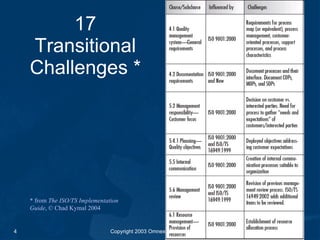
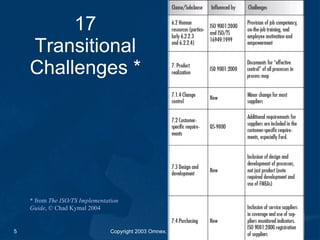
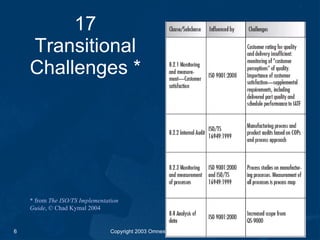
17 Transitional Challenges * * from  The ISO/TS Implementation Guide , © Chad Kymal 2004
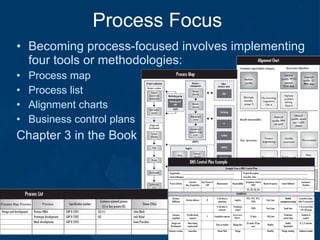
Process Focus Becoming process-focused involves implementing four tools or methodologies: Process map Process list Alignment charts Business control plans Chapter 3 in the Book
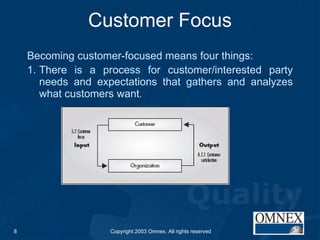
Customer Focus Becoming customer-focused means four things: 1. There is a process for customer/interested party needs and expectations that gathers and analyzes what customers want .
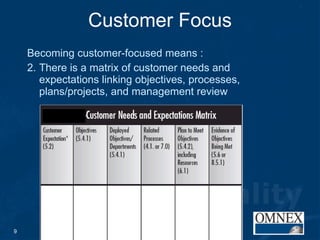
Customer Focus Becoming customer-focused means : 2. There is a matrix of customer needs and expectations linking objectives, processes, plans/projects, and management review
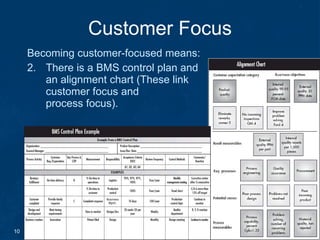
Customer Focus Becoming customer-focused means: There is a BMS control plan and an alignment chart (These link customer focus and  process focus).
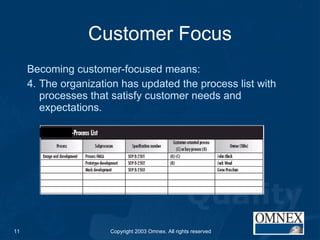
Customer Focus Becoming customer-focused means: 4. The organization has updated the process list with processes that satisfy customer needs and expectations.
Automotive Approach to Process Auditing What does this mean? Are you doing this?
Automotive Process Approach Auditing An Automotive Process Audit is FIVE STEPS: Identification of the organization’s processes: Provided by the organization during the Readiness Review Process maps, diagrams, etc. Look for sequence and interactions, especially where remote/supporting functions exist. Examples include: ISO/TS 16949:2002 clauses 4.1(a), 4.1(b) and 4.2.2(c). Evidence from the organization that all the requirements of ISO/TS 16949:2002 are addressed by their processes See Automotive Certification Scheme for ISO/TS 16949:2002 1.11(d)
Automotive Process Approach Auditing 2. Analysis of the organization’s processes according to: Products and/or services provided to the customer Only those that meet ISO/TS 16949:2002 applicability Risks to the customer Use customer complaints, rejections, scorecards, quality reports, etc. Interfaces (inputs/outputs) The #1 weakness in organization is process definition Drives the audit plan, especially with respect to remote/support functions Identification of group processes for an economical and effective audit Where can you visit an area only once?
Automotive Process Approach Auditing 3. Prioritization of audit activities considering: Customer requirements Includes customer-specific QMS requirements Follow-up issues of previous audits Previous certification body external audits Customer second party audits/visits Client internal audit results Customer satisfaction and complaints status, including customer reports and scorecards If there are any issues, these should drive the audit If there are no issues, then the audit plan will spend more time handling the general review of the processes Verify the client’s corrective actions for all significant customer rejections
Automotive Process Approach Auditing (cont’d) Prioritization of audit activities considering: Key indicator trends for the previous 12 months (minimum) What the client uses to manage their business Value (add) to the organization Issues with customer satisfaction always represent areas of potential value to the client
Automotive Process Approach Auditing 4. Finalization of the audit plan including: Sequence/process steps Sequence of the audit activity How does it audit the client process steps? Timing At least the minimum number of audit days Do not focus upon all things equally, but follow the prioritization you have just completed Interview partners From the site, you should interview top management to hourly workers Application of the Rules for Achieving IATF Recognition See Automotive Certification Scheme for ISO/TS  16949:2002 section 2 – Audit Process
Automotive Process Approach Auditing 5. Conducting the audit considering: The organization’s definition of their processes, including their sequence and interactions The #1 weakness in the organization process definition is interactions Audits generally follow any weakness in the organization’s definition Auditors need to investigate these weaknesses, even if the organization definition is poor
Automotive Process Approach Auditing (cont’d) Conducting the audit considering : Where practical, the auditor shall examine processes where they occur No conference room audits! The auditor should go where the activity takes place No large crowds following the auditor! The auditee should be in their natural, typical environment; if the auditee doesn’t usually work with a senior management of a crowd ‘looking over their shoulder’, then they should not be present during the audit Objective evidence of both compliance and noncompliance with requirements shall be recorded This is a requirement of Guide 62 3.1.4.e (5) Audit notes reviewed during office assessments often lack evidence of compliance and only list evidence of nonconformities
Automotive Process Approach Auditing During the creation of the audit plan, also consider: Using tools such as: Customer-oriented processes The “octopus” and “turtle” models The worksheet in the IATF Guidance to ISO/TS 16949:2002 To verify the completeness of the audit, use the Annex 5 reference table or equivalent List the organization’s processes Mark where the audit of that process addressed the ISO/TS 16949:2002 clauses as presented This purposely does not go to the sub sub-clause level and becomes part of the audit records
Registrar Audit Key Changes
Audit Steps Stage 1 – Readiness Review Customer Results, Policy, Performance Objectives and Targets Documentation Review and Process Focus Suspect Processes (Processes suspected of poor performance based on customer and performance data analysis) Process Analysis Prioritized Audit Plan Customized Checklist Stage 2 – On site Audit Conducting the Process Audit
Stage 2 Audit Expectations Performance-based audit plan Evidence of conformance Samples of implementation and effectiveness of practice Audit a cross section of employees from top management to engineers to hourly
Stage 2 Audit Expectations  (Cont’d) Examination of Processes to Determine: “ The stage 2 audit shall cover an examination of the organization’s processes which address at least the following: Information and evidence about conformity to all requirements of the applicable normative document; Performance monitoring, measuring, reporting and reviewing against key performance objectives and targets The system organization and performance as regards legal compliance; Operational control; Internal auditing and management review; Management responsibility for the client organization’s policies; Links between policy, performance objectives and targets.”* * Source:  IATF Automotive Certification Scheme for ISO/TS 16949:2002
Documentation Expectations This may be the biggest change in the Rules Document which became effective in Dec. 31, 2004 –  “ Evidence that all the requirements of ISO/TS 16949:2002 (Omnex – including Customer Specific Requirements) are addressed by the organization’s processes.”
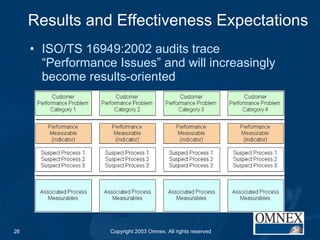
Results and Effectiveness Expectations ISO/TS 16949:2002 audits trace “Performance Issues” and will increasingly become results-oriented
Nonconformance Close Outs Another area of high expectations-  Non-conformances need to have root cause, corrective action, and system corrective action Increasingly, nonconformance corrective actions are becoming similar to 8-D exercises
Customer Specific Requirements
8 Subscribing OEMs GM Ford DCX Volkswagen Renault Fiat Peugot
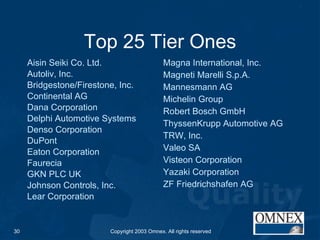
Top 25 Tier Ones Aisin Seiki Co. Ltd. Autoliv, Inc. Bridgestone/Firestone, Inc. Continental AG Dana Corporation Delphi Automotive Systems Denso Corporation DuPont Eaton Corporation Faurecia GKN PLC UK Johnson Controls, Inc. Lear Corporation Magna International, Inc. Magneti Marelli S.p.A. Mannesmann AG Michelin Group Robert Bosch GmbH ThyssenKrupp Automotive AG  TRW, Inc. Valeo SA Visteon Corporation Yazaki Corporation ZF Friedrichshafen AG
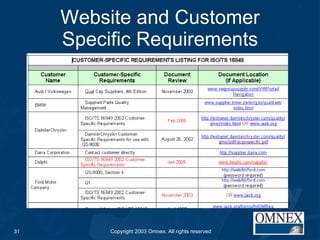
Website and Customer Specific Requirements
Do you Know your Customer Specific Requirements? Do your processes “address” the Customer Specific Requirements?
Planning the Transition Phase I - Planning Scope of the Implementation Performance Analysis and Performance Issues Opportunities for Improvement Process and Customer Focus Customer Satisfaction Customer Issues Quality, Cost, and Delivery Improvements Implementation Plan and Top Management Presentation
Planning the Transition Phase II - Implementation Process Focus Customer Focus Process Documentation Teams Process Flow and Process Analysis Process Review and Layered Audits Problem Solving Push
Planning the Transition Phase III – Roll Out, Audit & Standardization Company-wide Rollout Train Internal Auditor in Automotive Process Approach to Audits Conduct Audits Corrective Action Conduct Management Review Finishing Audit Conduct Registration Audit
Automotive Organizations Key Challenges Improvement! Improvement! Improvement! ISO/TS 16949:2002 and ISO 14001:2004 Deadlines Customer Issues and Improvement of Problem Solving Process including Problem Solving Approach Plant Floor Controls – Process Review and Layered Audits Six Sigma and Lean Methodologies in Business Processes and Manufacturing Process Focus and Customer Specific Requirements Core Tools Implementation
Webinar Summary Customer Focus and Process Focus represent the biggest transitional challenges (out of 17) in organizations implementing ISO/TS 16949:2002 The Automotive Process Approach to Auditing emphasizes performance auditing and process auditing Processes need to address “ISO/TS” requirements and Customer Specific Requirements We finally, discussed implementing ISO/TS so that organizations can derive value from their implementations

Iso ts-implementation-webinar5-17-05

  • 1.
    ISO/TS 16949:2002 ImplementationChallenges and Key Trends WEBINAR – May 17, 2005
  • 2.
    Agenda 17 TransitionalChallenges Process Focus Customer Focus Automotive Approach to Process Auditing What this means? Registrar Audit Key Changes Customer Specific Requirements and Core Tools Planning the Transition
  • 3.
  • 4.
    17 Transitional Challenges* * from The ISO/TS Implementation Guide , © Chad Kymal 2004
  • 5.
    17 Transitional Challenges* * from The ISO/TS Implementation Guide , © Chad Kymal 2004
  • 6.
    17 Transitional Challenges* * from The ISO/TS Implementation Guide , © Chad Kymal 2004
  • 7.
    Process Focus Becomingprocess-focused involves implementing four tools or methodologies: Process map Process list Alignment charts Business control plans Chapter 3 in the Book
  • 8.
    Customer Focus Becomingcustomer-focused means four things: 1. There is a process for customer/interested party needs and expectations that gathers and analyzes what customers want .
  • 9.
    Customer Focus Becomingcustomer-focused means : 2. There is a matrix of customer needs and expectations linking objectives, processes, plans/projects, and management review
  • 10.
    Customer Focus Becomingcustomer-focused means: There is a BMS control plan and an alignment chart (These link customer focus and process focus).
  • 11.
    Customer Focus Becomingcustomer-focused means: 4. The organization has updated the process list with processes that satisfy customer needs and expectations.
  • 12.
    Automotive Approach toProcess Auditing What does this mean? Are you doing this?
  • 13.
    Automotive Process ApproachAuditing An Automotive Process Audit is FIVE STEPS: Identification of the organization’s processes: Provided by the organization during the Readiness Review Process maps, diagrams, etc. Look for sequence and interactions, especially where remote/supporting functions exist. Examples include: ISO/TS 16949:2002 clauses 4.1(a), 4.1(b) and 4.2.2(c). Evidence from the organization that all the requirements of ISO/TS 16949:2002 are addressed by their processes See Automotive Certification Scheme for ISO/TS 16949:2002 1.11(d)
  • 14.
    Automotive Process ApproachAuditing 2. Analysis of the organization’s processes according to: Products and/or services provided to the customer Only those that meet ISO/TS 16949:2002 applicability Risks to the customer Use customer complaints, rejections, scorecards, quality reports, etc. Interfaces (inputs/outputs) The #1 weakness in organization is process definition Drives the audit plan, especially with respect to remote/support functions Identification of group processes for an economical and effective audit Where can you visit an area only once?
  • 15.
    Automotive Process ApproachAuditing 3. Prioritization of audit activities considering: Customer requirements Includes customer-specific QMS requirements Follow-up issues of previous audits Previous certification body external audits Customer second party audits/visits Client internal audit results Customer satisfaction and complaints status, including customer reports and scorecards If there are any issues, these should drive the audit If there are no issues, then the audit plan will spend more time handling the general review of the processes Verify the client’s corrective actions for all significant customer rejections
  • 16.
    Automotive Process ApproachAuditing (cont’d) Prioritization of audit activities considering: Key indicator trends for the previous 12 months (minimum) What the client uses to manage their business Value (add) to the organization Issues with customer satisfaction always represent areas of potential value to the client
  • 17.
    Automotive Process ApproachAuditing 4. Finalization of the audit plan including: Sequence/process steps Sequence of the audit activity How does it audit the client process steps? Timing At least the minimum number of audit days Do not focus upon all things equally, but follow the prioritization you have just completed Interview partners From the site, you should interview top management to hourly workers Application of the Rules for Achieving IATF Recognition See Automotive Certification Scheme for ISO/TS 16949:2002 section 2 – Audit Process
  • 18.
    Automotive Process ApproachAuditing 5. Conducting the audit considering: The organization’s definition of their processes, including their sequence and interactions The #1 weakness in the organization process definition is interactions Audits generally follow any weakness in the organization’s definition Auditors need to investigate these weaknesses, even if the organization definition is poor
  • 19.
    Automotive Process ApproachAuditing (cont’d) Conducting the audit considering : Where practical, the auditor shall examine processes where they occur No conference room audits! The auditor should go where the activity takes place No large crowds following the auditor! The auditee should be in their natural, typical environment; if the auditee doesn’t usually work with a senior management of a crowd ‘looking over their shoulder’, then they should not be present during the audit Objective evidence of both compliance and noncompliance with requirements shall be recorded This is a requirement of Guide 62 3.1.4.e (5) Audit notes reviewed during office assessments often lack evidence of compliance and only list evidence of nonconformities
  • 20.
    Automotive Process ApproachAuditing During the creation of the audit plan, also consider: Using tools such as: Customer-oriented processes The “octopus” and “turtle” models The worksheet in the IATF Guidance to ISO/TS 16949:2002 To verify the completeness of the audit, use the Annex 5 reference table or equivalent List the organization’s processes Mark where the audit of that process addressed the ISO/TS 16949:2002 clauses as presented This purposely does not go to the sub sub-clause level and becomes part of the audit records
  • 21.
  • 22.
    Audit Steps Stage1 – Readiness Review Customer Results, Policy, Performance Objectives and Targets Documentation Review and Process Focus Suspect Processes (Processes suspected of poor performance based on customer and performance data analysis) Process Analysis Prioritized Audit Plan Customized Checklist Stage 2 – On site Audit Conducting the Process Audit
  • 23.
    Stage 2 AuditExpectations Performance-based audit plan Evidence of conformance Samples of implementation and effectiveness of practice Audit a cross section of employees from top management to engineers to hourly
  • 24.
    Stage 2 AuditExpectations (Cont’d) Examination of Processes to Determine: “ The stage 2 audit shall cover an examination of the organization’s processes which address at least the following: Information and evidence about conformity to all requirements of the applicable normative document; Performance monitoring, measuring, reporting and reviewing against key performance objectives and targets The system organization and performance as regards legal compliance; Operational control; Internal auditing and management review; Management responsibility for the client organization’s policies; Links between policy, performance objectives and targets.”* * Source: IATF Automotive Certification Scheme for ISO/TS 16949:2002
  • 25.
    Documentation Expectations Thismay be the biggest change in the Rules Document which became effective in Dec. 31, 2004 – “ Evidence that all the requirements of ISO/TS 16949:2002 (Omnex – including Customer Specific Requirements) are addressed by the organization’s processes.”
  • 26.
    Results and EffectivenessExpectations ISO/TS 16949:2002 audits trace “Performance Issues” and will increasingly become results-oriented
  • 27.
    Nonconformance Close OutsAnother area of high expectations- Non-conformances need to have root cause, corrective action, and system corrective action Increasingly, nonconformance corrective actions are becoming similar to 8-D exercises
  • 28.
  • 29.
    8 Subscribing OEMsGM Ford DCX Volkswagen Renault Fiat Peugot
  • 30.
    Top 25 TierOnes Aisin Seiki Co. Ltd. Autoliv, Inc. Bridgestone/Firestone, Inc. Continental AG Dana Corporation Delphi Automotive Systems Denso Corporation DuPont Eaton Corporation Faurecia GKN PLC UK Johnson Controls, Inc. Lear Corporation Magna International, Inc. Magneti Marelli S.p.A. Mannesmann AG Michelin Group Robert Bosch GmbH ThyssenKrupp Automotive AG TRW, Inc. Valeo SA Visteon Corporation Yazaki Corporation ZF Friedrichshafen AG
  • 31.
    Website and CustomerSpecific Requirements
  • 32.
    Do you Knowyour Customer Specific Requirements? Do your processes “address” the Customer Specific Requirements?
  • 33.
    Planning the TransitionPhase I - Planning Scope of the Implementation Performance Analysis and Performance Issues Opportunities for Improvement Process and Customer Focus Customer Satisfaction Customer Issues Quality, Cost, and Delivery Improvements Implementation Plan and Top Management Presentation
  • 34.
    Planning the TransitionPhase II - Implementation Process Focus Customer Focus Process Documentation Teams Process Flow and Process Analysis Process Review and Layered Audits Problem Solving Push
  • 35.
    Planning the TransitionPhase III – Roll Out, Audit & Standardization Company-wide Rollout Train Internal Auditor in Automotive Process Approach to Audits Conduct Audits Corrective Action Conduct Management Review Finishing Audit Conduct Registration Audit
  • 36.
    Automotive Organizations KeyChallenges Improvement! Improvement! Improvement! ISO/TS 16949:2002 and ISO 14001:2004 Deadlines Customer Issues and Improvement of Problem Solving Process including Problem Solving Approach Plant Floor Controls – Process Review and Layered Audits Six Sigma and Lean Methodologies in Business Processes and Manufacturing Process Focus and Customer Specific Requirements Core Tools Implementation
  • 37.
    Webinar Summary CustomerFocus and Process Focus represent the biggest transitional challenges (out of 17) in organizations implementing ISO/TS 16949:2002 The Automotive Process Approach to Auditing emphasizes performance auditing and process auditing Processes need to address “ISO/TS” requirements and Customer Specific Requirements We finally, discussed implementing ISO/TS so that organizations can derive value from their implementations