CORRECTIVE & PREVENTIVE
ACTIONS (CAPA)
(QUALITY MANAGEMENT SYSTEM)
BY: Mr. Shoaib Jalbani
Lecturer LRIHS
1
2
DEFINITION :
Corrective and Preventative Action (CAPA) is a
system of quality procedures required to
eliminate the causes of an existing nonconformity
and to prevent recurrence of nonconforming
product, processes, and other quality problems.
WHAT IS CAPA ?
3
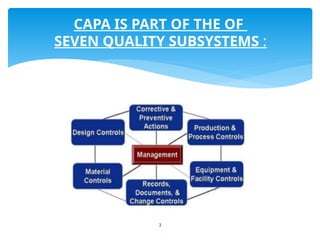
CAPA IS PART OF THE OF
SEVEN QUALITY SUBSYSTEMS :
4
Nonconforming Material or Process (Discrepancy) - Any
material or process that does not meet its required specifications or
documented procedure.
Correction – Refers to repair, rework, or adjustment and relates to
the disposition of an existing nonconformity.
Corrective Action - To identify and eliminate the causes of
existing nonconforming product and other quality problems.
Preventive Action - To identify and eliminate the causes of
potential nonconforming product and other quality problems.
TERMINOLOGY :
5
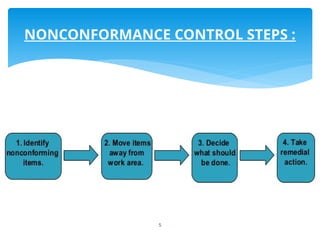
NONCONFORMANCE CONTROL STEPS :
6
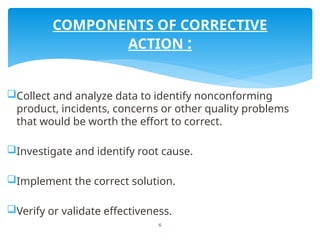
Collect and analyze data to identify nonconforming
product, incidents, concerns or other quality problems
that would be worth the effort to correct.
Investigate and identify root cause.
Implement the correct solution.
Verify or validate effectiveness.
COMPONENTS OF CORRECTIVE
ACTION :
7
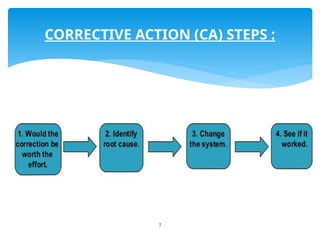
CORRECTIVE ACTION (CA) STEPS :
8
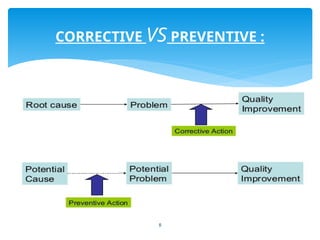
CORRECTIVE VS PREVENTIVE :
9
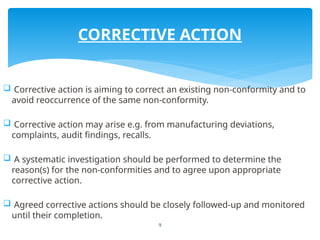
 Corrective action is aiming to correct an existing non-conformity and to
avoid reoccurrence of the same non-conformity.
 Corrective action may arise e.g. from manufacturing deviations,
complaints, audit findings, recalls.
 A systematic investigation should be performed to determine the
reason(s) for the non-conformities and to agree upon appropriate
corrective action.
 Agreed corrective actions should be closely followed-up and monitored
until their completion.
CORRECTIVE ACTION
10
 Preventive action is aiming to avoid the initial occurrence of a non-
conformity by proactively implementing improvements.
 Similar to corrective actions, agreed preventive actions should be closely
followed-up and monitored until their completion. Effectiveness of
preventive actions should be reviewed regularly, i.e. as part of the product
quality review (annual product review).
 Information regarding preventive actions including costs and cost savings
should be regularly subject to management review in support of
maintaining and improving the effectiveness of the Quality Management
System.
PREVENTIVE ACTION
11
12
13
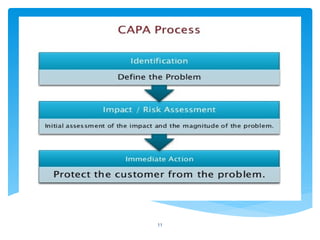
 To enable an efficient root cause investigation, the
problem has to be clearly defined.
 Collect all available information, ask questions: Who,
when, what, why, how
 Summarize the problem in a detailed and concise
description.
IDENTIFICATION
14
 The problem must be evaluated to determine the need for
immediate, corrective and preventive actions and the level of
action required, based on the impact and risk of the problem.
 The evaluation should include:
◦ Potential Impact of the problem.
◦ Risk to its customers and/or the company (i.e. risk to the
patient related to the quality, efficacy or safety of the product;
risk for the reputation of the company; risk of adverse
regulatory actions; financial risk)
◦ Immediate action that may be required Drug Regulations
IMPACT / RISK ASSESMENT
15
 Immediate action is necessary, when the quality, efficacy
or safety may be compromised by the problem.
 Examples for immediate action:•
◦ Product recall
◦ Blockage of the stock of a product
◦ Rejection of a batch
◦ Interruption of the production (i.e. until problem is
assessed and fixed)
IMMEDIATE ACTION
16
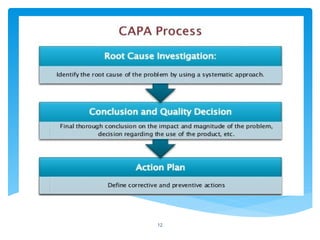
 A systematic approach should be applied to ensure that no
potential root cause is lost through focusing only on a few
assumed root causes.
 Tools can be applied to facilitate the investigation, i.e. ◦
Start with a brainstorming,I.e. using an Ishikawa diagram
(fishbone or cause and effect diagram)
 List all potential root causes and evaluate their likelihood
◦ Likely–
◦ Possible (but less likely)–
◦ Remote, unlikely
ROOT CAUSE INVESTIGATION
17
 If more than one root cause is likely, a simulation of the
potential root cause can help to prove the root cause.
 Finding the primary root cause is essential for
determining appropriate corrective and/or preventive
actions.
 These “root causes” suggest that the failure
investigation did not go far enough–
◦ Training, operator error or similar „obvious“ root causes
ROOT CAUSE INVESTIGATION
18
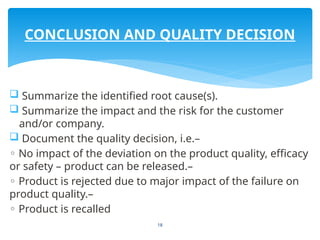
 Summarize the identified root cause(s).
 Summarize the impact and the risk for the customer
and/or company.
 Document the quality decision, i.e.–
◦ No impact of the deviation on the product quality, efficacy
or safety – product can be released.–
◦ Product is rejected due to major impact of the failure on
product quality.–
◦ Product is recalled
CONCLUSION AND QUALITY DECISION
19
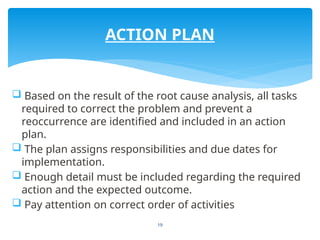
 Based on the result of the root cause analysis, all tasks
required to correct the problem and prevent a
reoccurrence are identified and included in an action
plan.
 The plan assigns responsibilities and due dates for
implementation.
 Enough detail must be included regarding the required
action and the expected outcome.
 Pay attention on correct order of activities
ACTION PLAN
20
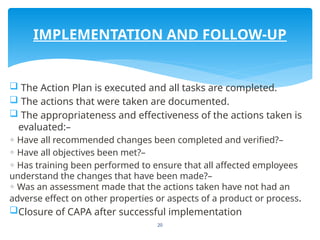
 The Action Plan is executed and all tasks are completed.
 The actions that were taken are documented.
 The appropriateness and effectiveness of the actions taken is
evaluated:–
◦ Have all recommended changes been completed and verified?–
◦ Have all objectives been met?–
◦ Has training been performed to ensure that all affected employees
understand the changes that have been made?–
Was an assessment made that the actions taken have not had an
◦
adverse effect on other properties or aspects of a product or process.
Closure of CAPA after successful implementation
IMPLEMENTATION AND FOLLOW-UP
21
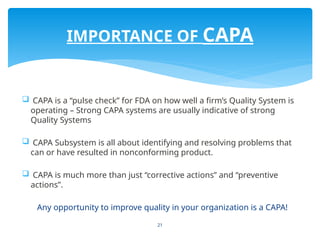
 CAPA is a “pulse check” for FDA on how well a firm’s Quality System is
operating – Strong CAPA systems are usually indicative of strong
Quality Systems
 CAPA Subsystem is all about identifying and resolving problems that
can or have resulted in nonconforming product.
 CAPA is much more than just “corrective actions” and “preventive
actions”.
Any opportunity to improve quality in your organization is a CAPA!
IMPORTANCE OF CAPA
22
Quality is never an accident; it is always the result of high
intention, sincere effort, intelligent direction and skillful
execution; it represents the wise choice of many
alternatives.”
- William A. Foster
THANK YOU !

corrective and preventive actions during surgery.pptx

  • 1.
    CORRECTIVE & PREVENTIVE ACTIONS(CAPA) (QUALITY MANAGEMENT SYSTEM) BY: Mr. Shoaib Jalbani Lecturer LRIHS 1
  • 2.
    2 DEFINITION : Corrective andPreventative Action (CAPA) is a system of quality procedures required to eliminate the causes of an existing nonconformity and to prevent recurrence of nonconforming product, processes, and other quality problems. WHAT IS CAPA ?
  • 3.
    3 CAPA IS PARTOF THE OF SEVEN QUALITY SUBSYSTEMS :
  • 4.
    4 Nonconforming Material orProcess (Discrepancy) - Any material or process that does not meet its required specifications or documented procedure. Correction – Refers to repair, rework, or adjustment and relates to the disposition of an existing nonconformity. Corrective Action - To identify and eliminate the causes of existing nonconforming product and other quality problems. Preventive Action - To identify and eliminate the causes of potential nonconforming product and other quality problems. TERMINOLOGY :
  • 5.
  • 6.
    6 Collect and analyzedata to identify nonconforming product, incidents, concerns or other quality problems that would be worth the effort to correct. Investigate and identify root cause. Implement the correct solution. Verify or validate effectiveness. COMPONENTS OF CORRECTIVE ACTION :
  • 7.
  • 8.
  • 9.
    9  Corrective actionis aiming to correct an existing non-conformity and to avoid reoccurrence of the same non-conformity.  Corrective action may arise e.g. from manufacturing deviations, complaints, audit findings, recalls.  A systematic investigation should be performed to determine the reason(s) for the non-conformities and to agree upon appropriate corrective action.  Agreed corrective actions should be closely followed-up and monitored until their completion. CORRECTIVE ACTION
  • 10.
    10  Preventive actionis aiming to avoid the initial occurrence of a non- conformity by proactively implementing improvements.  Similar to corrective actions, agreed preventive actions should be closely followed-up and monitored until their completion. Effectiveness of preventive actions should be reviewed regularly, i.e. as part of the product quality review (annual product review).  Information regarding preventive actions including costs and cost savings should be regularly subject to management review in support of maintaining and improving the effectiveness of the Quality Management System. PREVENTIVE ACTION
  • 11.
  • 12.
  • 13.
    13  To enablean efficient root cause investigation, the problem has to be clearly defined.  Collect all available information, ask questions: Who, when, what, why, how  Summarize the problem in a detailed and concise description. IDENTIFICATION
  • 14.
    14  The problemmust be evaluated to determine the need for immediate, corrective and preventive actions and the level of action required, based on the impact and risk of the problem.  The evaluation should include: ◦ Potential Impact of the problem. ◦ Risk to its customers and/or the company (i.e. risk to the patient related to the quality, efficacy or safety of the product; risk for the reputation of the company; risk of adverse regulatory actions; financial risk) ◦ Immediate action that may be required Drug Regulations IMPACT / RISK ASSESMENT
  • 15.
    15  Immediate actionis necessary, when the quality, efficacy or safety may be compromised by the problem.  Examples for immediate action:• ◦ Product recall ◦ Blockage of the stock of a product ◦ Rejection of a batch ◦ Interruption of the production (i.e. until problem is assessed and fixed) IMMEDIATE ACTION
  • 16.
    16  A systematicapproach should be applied to ensure that no potential root cause is lost through focusing only on a few assumed root causes.  Tools can be applied to facilitate the investigation, i.e. ◦ Start with a brainstorming,I.e. using an Ishikawa diagram (fishbone or cause and effect diagram)  List all potential root causes and evaluate their likelihood ◦ Likely– ◦ Possible (but less likely)– ◦ Remote, unlikely ROOT CAUSE INVESTIGATION
  • 17.
    17  If morethan one root cause is likely, a simulation of the potential root cause can help to prove the root cause.  Finding the primary root cause is essential for determining appropriate corrective and/or preventive actions.  These “root causes” suggest that the failure investigation did not go far enough– ◦ Training, operator error or similar „obvious“ root causes ROOT CAUSE INVESTIGATION
  • 18.
    18  Summarize theidentified root cause(s).  Summarize the impact and the risk for the customer and/or company.  Document the quality decision, i.e.– ◦ No impact of the deviation on the product quality, efficacy or safety – product can be released.– ◦ Product is rejected due to major impact of the failure on product quality.– ◦ Product is recalled CONCLUSION AND QUALITY DECISION
  • 19.
    19  Based onthe result of the root cause analysis, all tasks required to correct the problem and prevent a reoccurrence are identified and included in an action plan.  The plan assigns responsibilities and due dates for implementation.  Enough detail must be included regarding the required action and the expected outcome.  Pay attention on correct order of activities ACTION PLAN
  • 20.
    20  The ActionPlan is executed and all tasks are completed.  The actions that were taken are documented.  The appropriateness and effectiveness of the actions taken is evaluated:– ◦ Have all recommended changes been completed and verified?– ◦ Have all objectives been met?– ◦ Has training been performed to ensure that all affected employees understand the changes that have been made?– Was an assessment made that the actions taken have not had an ◦ adverse effect on other properties or aspects of a product or process. Closure of CAPA after successful implementation IMPLEMENTATION AND FOLLOW-UP
  • 21.
    21  CAPA isa “pulse check” for FDA on how well a firm’s Quality System is operating – Strong CAPA systems are usually indicative of strong Quality Systems  CAPA Subsystem is all about identifying and resolving problems that can or have resulted in nonconforming product.  CAPA is much more than just “corrective actions” and “preventive actions”. Any opportunity to improve quality in your organization is a CAPA! IMPORTANCE OF CAPA
  • 22.
    22 Quality is neveran accident; it is always the result of high intention, sincere effort, intelligent direction and skillful execution; it represents the wise choice of many alternatives.” - William A. Foster THANK YOU !