PRANEET SURTI
Quality Consultant
Lead Auditor ISO 9001:2015
B.E Mechanical
by
“A man learns from his mistakes”
CAPA helps us to simplify the above !
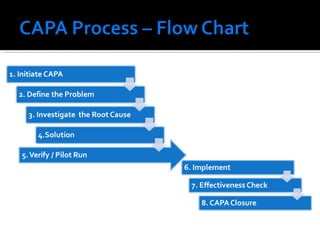
CAPA process is a structured, formalized way to
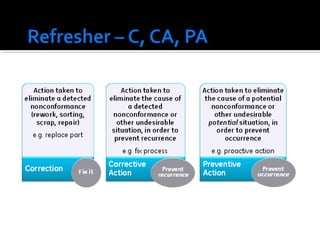
investigate NC and determine appropriate corrections,
corrective actions and preventative actions and
measure their effectiveness. (With records)
 A mature CAPA system can serve as a useful
tool for analyzing past events, correcting
existing non conformities and preventing
future events.
 A mature CAPA system goes beyond
regulatory compliance to positively impact
our customers by increasing the value of our
products and services.
  ISO 9001:2008 : Clause 8.5.2
“The organization shall take action to eliminate the cause of nonconformities in order to prevent recurrence.”
 ISO 9001:2015 : Clause 10.2 Nonconformity and corrective action
Clause 10.2.1 When a nonconformity occurs, including any arising from complaints, the organization shall:
a) react to the nonconformity and, as applicable: [Correction]
b) take action to control and correct it;
c) deal with the consequences;
[Nonconformity can be anything deviating from the standard requirements]
b) evaluate the need for action to eliminate the cause(s) of the nonconformity, in order that it does not recur
[Corrective Action] or occur [Preventive Action] elsewhere, by:
a) reviewing and analyzing the nonconformity; [Description of NC]
b) determining the causes of the nonconformity; [RCA of NC]
c) determining if similar non conformities exist, or could potentially occur; [Platforms at Risk]
d) implement any action needed; [Correction]
e) review the effectiveness of any corrective action taken; [Effectiveness Measure]
f) update risks and opportunities determined during planning, if necessary; [Update Risk Documented
Information]
g) Make changes to the quality management system, if necessary. [Update Changes in the Documented
Information]
h) Corrective actions shall be appropriate to the effects of the nonconformities encountered. [Effectiveness
Measure]
 Clause 10.2.2 The organization shall retain documented information as evidence of:
a) the nature of the nonconformities and any subsequent actions taken;
b) the results of any corrective action.
7
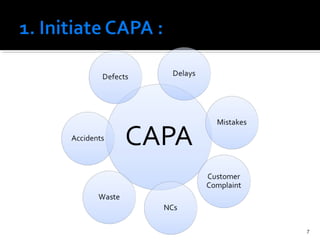
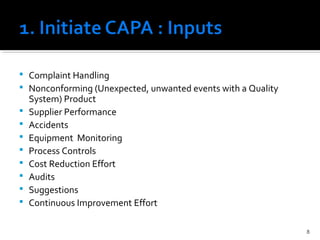
 Complaint Handling
 Nonconforming (Unexpected, unwanted events with a Quality
System) Product
 Supplier Performance
 Accidents
 Equipment Monitoring
 Process Controls
 Cost Reduction Effort
 Audits
 Suggestions
 Continuous Improvement Effort
8
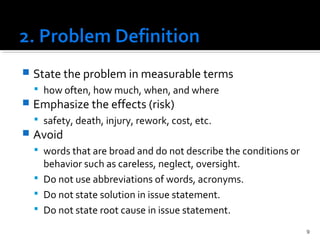
 State the problem in measurable terms
 how often, how much, when, and where
 Emphasize the effects (risk)
 safety, death, injury, rework, cost, etc.
 Avoid
 words that are broad and do not describe the conditions or
behavior such as careless, neglect, oversight.
 Do not use abbreviations of words, acronyms.
 Do not state solution in issue statement.
 Do not state root cause in issue statement.
9
 A root cause is the reason for a condition or an action at its
origin or source.
 In the context of problem solving, a root cause is one
considered to be far enough into the sequence of causes and
effects, that removing it will eliminate the effect completely
and permanently.
10
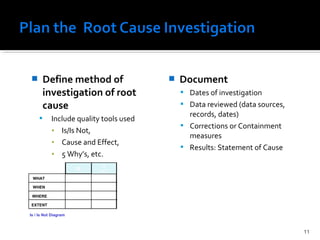
 Define method of
investigation of root
cause
 Include quality tools used
▪ Is/Is Not,
▪ Cause and Effect,
▪ 5 Why’s, etc.
 Document
 Dates of investigation
 Data reviewed (data sources,
records, dates)
 Corrections or Containment
measures
 Results: Statement of Cause
11
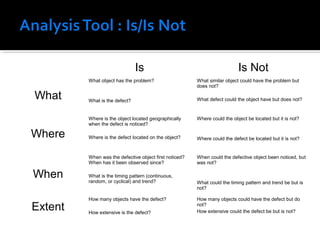
Is / Is Not Diagram
WHAT
WHEN
WHERE
EXTENT
IS
IS
NOT
Is Is Not
What
What object has the problem?
What is the defect?
What similar object could have the problem but
does not?
What defect could the object have but does not?
Where
Where is the object located geographically
when the defect is noticed?
Where is the defect located on the object?
Where could the object be located but it is not?
Where could the defect be located but it is not?
When
When was the defective object first noticed?
When has it been observed since?
What is the timing pattern (continuous,
random, or cyclical) and trend?
When could the defective object been noticed, but
was not?
What could the timing pattern and trend be but is
not?
Extent
How many objects have the defect?
How extensive is the defect?
How many objects could have the defect but do
not?
How extensive could the defect be but is not?
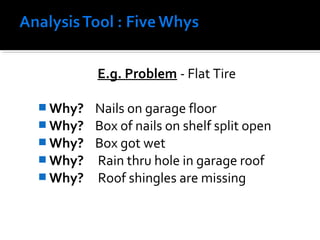
E.g. Problem - Flat Tire
 Why? Nails on garage floor
 Why? Box of nails on shelf split open
 Why? Box got wet
 Why? Rain thru hole in garage roof
 Why? Roof shingles are missing
14
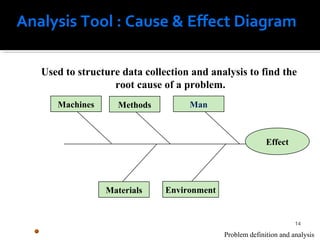
Used to structure data collection and analysis to find the
root cause of a problem.
Methods
EnvironmentMaterials
ManMachines
Problem definition and analysis
Analysis Tool : Cause & Effect Diagram
Effect
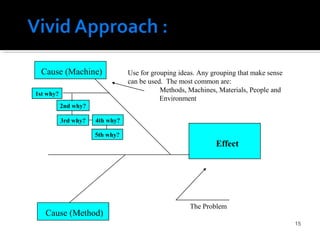
15
Effect
Cause (Machine) Use for grouping ideas. Any grouping that make sense
can be used. The most common are:
Methods, Machines, Materials, People and
Environment
The Problem
1st why?
2nd why?
3rd why? 4th why?
5th why?
Cause (Method)
The problem statement is the difference
between what isis and what should beshould be
 Focus on
 Facts finding, not fault finding !
 whatwhat is wrong, not whywhy it’s wrong
16
Implement a solution to address the cause not
the symptom
 Lists corrective and preventive actions (if applicable)
 Clearly addresses root causes
 Commensurate with the risk of the issue
 Identification of task owners and task due dates
 Implementation due date
 CAPA Monitoring
 Keep records
Implementing a verified solution
Testing during formation of action plan
Validate
Tracking (where, how many, who)
Keep records
CAPA is useful if and only when the
implemented action plan is effective, so
before freezing the CAPA the effectiveness
of the implemented plan is measured.
Monitor performance indicators and
compare “before” and “after” by assigning
a particular time frame
Achieve specific targets - achieving a pre-
determined PPM level
Statistical Data Analysis-Performance
must lie within a set of statistically derived
control limits
Emphasis should primarily be on
identifying the most effective fix
 Recurring issues
 Resources ($$$) are spent on “handling” failure
rather than learning from it and preventing
“more of the same”
 Field issues
22
 What to do when a effectiveness check fails,
and what are the consequences?
 Close the CAPA and open a new one?
 Get an extension?
 Leave the CAPA open and investigate why?
23
24
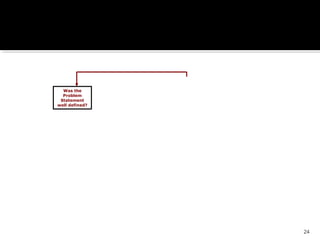
Was the
Problem
Statement
well defined?
Effectiveness Checks
 CAPA will be closed after measuring the
effectiveness set at the particular value.
 The effectiveness of CAPA with be discussed
with all personnel in team meetings
organized monthly.
25
 Reduction in quality issues
 A reduction in the severity of issues
 Better designed products/processes
 Improved customer satisfaction
 Better business results
26
“Your mistakes can be your
Stepping Stones
for Success if appropriate
actions are taken at proper time”
27
28
​PRANEET SURTI​
Management Auditor l Quality Consultant
[​Lead Auditor ISO 9001:2015, ​B.E Mechanical Engineering​]
ANM Strategic & Management Consultants Pvt. Ltd.​
​Raipur, Chhattisgarh IND​
Cell : +91 8109773774 (Personal), +91 7024154549 (Official)
​Gmail: praneetsurti20@gmail.com
​LinkedIn: http://in.linkedin.com/in/praneetsurti​
Twitter: twitter.com/praneet20
About the Trainer

Effective CAPA Implementation in a Management System - Praneet Surti

  • 1.
    PRANEET SURTI Quality Consultant LeadAuditor ISO 9001:2015 B.E Mechanical by
  • 2.
    “A man learnsfrom his mistakes” CAPA helps us to simplify the above !
  • 3.
    CAPA process isa structured, formalized way to investigate NC and determine appropriate corrections, corrective actions and preventative actions and measure their effectiveness. (With records)
  • 4.
     A matureCAPA system can serve as a useful tool for analyzing past events, correcting existing non conformities and preventing future events.  A mature CAPA system goes beyond regulatory compliance to positively impact our customers by increasing the value of our products and services.
  • 5.
      ISO 9001:2008 : Clause 8.5.2 “The organizationshall take action to eliminate the cause of nonconformities in order to prevent recurrence.”  ISO 9001:2015 : Clause 10.2 Nonconformity and corrective action Clause 10.2.1 When a nonconformity occurs, including any arising from complaints, the organization shall: a) react to the nonconformity and, as applicable: [Correction] b) take action to control and correct it; c) deal with the consequences; [Nonconformity can be anything deviating from the standard requirements] b) evaluate the need for action to eliminate the cause(s) of the nonconformity, in order that it does not recur [Corrective Action] or occur [Preventive Action] elsewhere, by: a) reviewing and analyzing the nonconformity; [Description of NC] b) determining the causes of the nonconformity; [RCA of NC] c) determining if similar non conformities exist, or could potentially occur; [Platforms at Risk] d) implement any action needed; [Correction] e) review the effectiveness of any corrective action taken; [Effectiveness Measure] f) update risks and opportunities determined during planning, if necessary; [Update Risk Documented Information] g) Make changes to the quality management system, if necessary. [Update Changes in the Documented Information] h) Corrective actions shall be appropriate to the effects of the nonconformities encountered. [Effectiveness Measure]  Clause 10.2.2 The organization shall retain documented information as evidence of: a) the nature of the nonconformities and any subsequent actions taken; b) the results of any corrective action.
  • 7.
  • 8.
     Complaint Handling Nonconforming (Unexpected, unwanted events with a Quality System) Product  Supplier Performance  Accidents  Equipment Monitoring  Process Controls  Cost Reduction Effort  Audits  Suggestions  Continuous Improvement Effort 8
  • 9.
     State theproblem in measurable terms  how often, how much, when, and where  Emphasize the effects (risk)  safety, death, injury, rework, cost, etc.  Avoid  words that are broad and do not describe the conditions or behavior such as careless, neglect, oversight.  Do not use abbreviations of words, acronyms.  Do not state solution in issue statement.  Do not state root cause in issue statement. 9
  • 10.
     A rootcause is the reason for a condition or an action at its origin or source.  In the context of problem solving, a root cause is one considered to be far enough into the sequence of causes and effects, that removing it will eliminate the effect completely and permanently. 10
  • 11.
     Define methodof investigation of root cause  Include quality tools used ▪ Is/Is Not, ▪ Cause and Effect, ▪ 5 Why’s, etc.  Document  Dates of investigation  Data reviewed (data sources, records, dates)  Corrections or Containment measures  Results: Statement of Cause 11 Is / Is Not Diagram WHAT WHEN WHERE EXTENT IS IS NOT
  • 12.
    Is Is Not What Whatobject has the problem? What is the defect? What similar object could have the problem but does not? What defect could the object have but does not? Where Where is the object located geographically when the defect is noticed? Where is the defect located on the object? Where could the object be located but it is not? Where could the defect be located but it is not? When When was the defective object first noticed? When has it been observed since? What is the timing pattern (continuous, random, or cyclical) and trend? When could the defective object been noticed, but was not? What could the timing pattern and trend be but is not? Extent How many objects have the defect? How extensive is the defect? How many objects could have the defect but do not? How extensive could the defect be but is not?
  • 13.
    E.g. Problem -Flat Tire  Why? Nails on garage floor  Why? Box of nails on shelf split open  Why? Box got wet  Why? Rain thru hole in garage roof  Why? Roof shingles are missing
  • 14.
    14 Used to structuredata collection and analysis to find the root cause of a problem. Methods EnvironmentMaterials ManMachines Problem definition and analysis Analysis Tool : Cause & Effect Diagram Effect
  • 15.
    15 Effect Cause (Machine) Usefor grouping ideas. Any grouping that make sense can be used. The most common are: Methods, Machines, Materials, People and Environment The Problem 1st why? 2nd why? 3rd why? 4th why? 5th why? Cause (Method)
  • 16.
    The problem statementis the difference between what isis and what should beshould be  Focus on  Facts finding, not fault finding !  whatwhat is wrong, not whywhy it’s wrong 16
  • 17.
    Implement a solutionto address the cause not the symptom  Lists corrective and preventive actions (if applicable)  Clearly addresses root causes  Commensurate with the risk of the issue  Identification of task owners and task due dates  Implementation due date  CAPA Monitoring  Keep records
  • 19.
    Implementing a verifiedsolution Testing during formation of action plan Validate Tracking (where, how many, who) Keep records
  • 20.
    CAPA is usefulif and only when the implemented action plan is effective, so before freezing the CAPA the effectiveness of the implemented plan is measured.
  • 21.
    Monitor performance indicatorsand compare “before” and “after” by assigning a particular time frame Achieve specific targets - achieving a pre- determined PPM level Statistical Data Analysis-Performance must lie within a set of statistically derived control limits Emphasis should primarily be on identifying the most effective fix
  • 22.
     Recurring issues Resources ($$$) are spent on “handling” failure rather than learning from it and preventing “more of the same”  Field issues 22
  • 23.
     What todo when a effectiveness check fails, and what are the consequences?  Close the CAPA and open a new one?  Get an extension?  Leave the CAPA open and investigate why? 23
  • 24.
  • 25.
     CAPA willbe closed after measuring the effectiveness set at the particular value.  The effectiveness of CAPA with be discussed with all personnel in team meetings organized monthly. 25
  • 26.
     Reduction inquality issues  A reduction in the severity of issues  Better designed products/processes  Improved customer satisfaction  Better business results 26
  • 27.
    “Your mistakes canbe your Stepping Stones for Success if appropriate actions are taken at proper time” 27
  • 28.
    28 ​PRANEET SURTI​ Management Auditor lQuality Consultant [​Lead Auditor ISO 9001:2015, ​B.E Mechanical Engineering​] ANM Strategic & Management Consultants Pvt. Ltd.​ ​Raipur, Chhattisgarh IND​ Cell : +91 8109773774 (Personal), +91 7024154549 (Official) ​Gmail: praneetsurti20@gmail.com ​LinkedIn: http://in.linkedin.com/in/praneetsurti​ Twitter: twitter.com/praneet20 About the Trainer

Editor's Notes

  • #15 Also known as Fishbone diagram or Ishikawa diagram Example: We discussed the problem of the PC board with unsoldered pins. We could construct a cause and effects analysis in which the problem stated is that 3 connector pins were unsoldered. We can examine the methods: Repair, instructions, etc. Machines: Connector insertion machine Manpower: Repair person, inspectors Materials: PC board, connector, etc.