ARTHROPOD BORNE DISEASES
PART 1
BY
DALIA BAHAA
Under supervision of
Prof dr MONA ABOSEREA
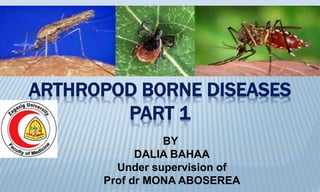
Arthropods form a major group of disease vectors with
mosquitoes, flies, sand flies, lice, fleas, ticks and mites
transmitting a huge number of diseases.
Many such vectors are haematophagous, which feed on
blood at some or all stages of their lives.
Viral
Yellow fever
Encephalitis
Dengue fever
Rift valley fever
Zika
Bacterial
Plague
Parasitic
Malaria
Filariasis
Leishmaniasis
Rickettsial
Typhus
Q fever
Spirochetal
Relapsing fever
ARTHROPOD-BORNE VIRAL
HEMORRHAGIC DISEASES
Acute febrile diseases with extensive external & internal
hge, usually serious & may be associated with shock & liver
damage with high case fatality.
Yellow
fever
Dengue
fever
Rift
valley
fever
West Nile
fever
YELLOW FEVER
A communicable arthropod-borne viral hemorrhagic quarantinable
acute disease of short duration & varying severity.
Causative agent: Yellow fever virus.
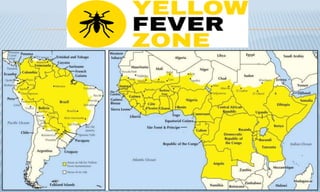
Endemic in Africa & South America in zone between 15° north & 100°
south latitude of equator
(Yellow fever belt).
RESERVOIR:
Sylvatic or Jungle yellow fever
• Main reservoir in forest area is vertebrates other than human mainly
monkeys
• Vector is forest mosquitoes (haemagogus species).
• Human has no essential role in transmission.
Urban yellow fever
• Reservoir is human
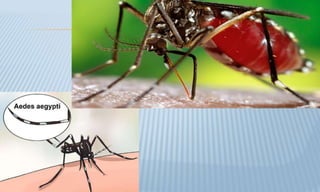
• Vector is Aedes aegypti mosquitoes.
HOW EGYPT IS PROTECTED FROM YELLOW FEVER:
Absence of yellow fever in Egypt & its rarity in other areas such as Eastern
Africa despite wide spread of vector aedes Egypti may be due to cross
immunity from other flavi virus (e.g. Dengue, West Nile, Japanese
encephalitis) in population which may be providing an (ecological barrier).
PERIOD OF COMMUNICABILITY:
Blood of man is infective to mosquito shortly during late IP &
during first 3-5 days of disease.
In mosquitoes after biting an infected person there is 9-12 days
extrinsic IP, then the mosquito becomes infective all over its life.
There is also trans-ovarian transmission which may contribute to
maintenance of infection.
No man-to-man transmission.
Mode of transmission
IP: 3-I0 days (6 days in international health regulation).
Urban YF: bite of infective
female Aedes aegypti
mosquitoes.
Sylvatic or jungle YF: bite of
several species of genus
Haemagogus.
SUSCEPTIBILITY & RESISTANCE:
Age & Sex
• All ages & both sexes
are susceptible.
Immunity
• Infection is followed
by absolute immunity
• 2nd attacks are
unknown.
• Transient passive
immunity to inborn
infant of immune
mother occurs for up to
6 ms.
Occupation
• Woodcutter
• Hunter.
CLINICAL FEATURES
Complications:
Liver & Renal failure
Fatality rate of jaundiced cases may reach 20-50%.
Mild form
• Sudden onset of fever, chills, headache,
muscle pain, nausea & vomiting.
• Faget sign: slow pulse out of proportion
of elevated temperature.
• Jaundice is moderate early in disease &
intensified later.
• Albuminuria or anuria may occur,
leucopenia.
• Most of the manifestations resolve after
5-7 days.
Sever form
• After a brief remission of hours to a day
some cases progress to severe form
• Hemorrhagic symptoms: epistaxis,
gingival bleeding, haematemesis (coffee
ground or black), melena.
DIAGNOSIS
C/P
Travel history
• Isolation of virus from blood by inoculation of suckling mice,
mosquito or cell culture.
• ELISA “viral antigen in blood”.
• PCR “viral genome in blood & liver tissue”.
• Serologic diagnosis “specific IgM in early sera or rise in titre of
specific antibodies”.
Lab investigations
PREVENTION:
General measures:
• A) Eradication or control of Aedes Aegypti:
• i. Anti-larval & anti-pupal measures
• ii. Anti-adult measures
• iii. Jungle mosquitoes “impractical”.
• B) Human protection against mosquitoes: e.g. protective clothing,
bed nets, repellents.
Environmental sanitation:
• Modes of transmission.
Health education:
Specific measures:
1) Immunization:
a) Active Immunization: “most effective preventive measure”
17 D
vaccine
• Live attenuated vaccine “stored at -25°C”.
• Single dose, 0.5ml, S.C. injection.
• 99% immunity: International health regulation considered vaccine effectiveness to start
after 10 days & persists for 10 years & then re-immunization is required.
• No or minimal reaction “1st 4ms of life may rarely lead to vaccine associated encephalitis”.
Dakar
vaccine
• Live attenuated neurotropic virus.
• Administered by cutaneous scarification.
• Not approved by WHO for international use as it leads to encephalitis.
17 D VACCINE
Recommended
• International travelers
coming from or going to
endemic countries.
• Since 1989 WHO has
recommended that at risk
countries in Africa that
fall in the endemic belt
should incorporate it into
their routine childhood
immunization program
after 6 month.
NOT recommended
• Allergy to a vaccine
component
• Age <6 months
• Symptomatic HIV
infection
• Thymus disorder
associated with abnormal
immune function
• 1ry immunodeficiencies
• Malignant neoplasms
• Transplantation
• Immunosuppressive &
immunomodulatory
therapies
Cautiously after medical
advice
• Age 6 to 8 months
• Age ≥ 60 years
• Asymptomatic HIV
infection
• Pregnancy
• Breastfeeding
INTERNATIONAL MEASURES:
Following measures should be done to prevent introduction of yellow fever
from endemic area (Yellow Fever belt) into receptive area (areas free of yellow
fever, but the vector is present & population is susceptible e.g. in Egypt):
Notification within 24 hs to WHO. Valid vaccination certificate
Disinfection of any aircraft leaving
an endemic area for receptive area,
by aerosol spray of suitable
insecticide, shortly before departure
and also on arrival.
Quarantine of imported monkeys.
VALID VACCINATION CERTIFICATE:
a. All international travelers including children coming from or going
to endemic areas "Yellow Fever belt".
b. Validity starts 10 days after primo-vaccination & lasts for 10 ys.
c. Validity starts on same day after re-vaccination & lasts for 10 ys.
d. If no certificate is available: traveler is isolated for 6 days from
date of leaving endemic area.
e. If traveler arrives before 10 days of vaccination, i.e. certificate is
not valid yet: traveler is isolated until certificate becomes valid or
until end of international IP calculated from day of leaving last
endemic area.
f. Traveler is quarantined in mosquito-proof accommodation in
airport.
g. This certificate is required by many countries including Egypt.
DENGUE FEVER
(BREAK BONE FEVER)
Causative agent: viruses of dengue fever: 1, 2, 3 & 4 types.
• It is endemic in south Asia.
• Dengue 1, 2, 3, 4 are now endemic in Africa.
• In recent years outbreaks of dengue fever has occurred on east coast of
Africa from Mozambique to Ethiopia to Saudi Arabia.
Reservoir:
Man-mosquito cycle in tropical urban centers.
A monkey-mosquito cycle may serve as a reservoir in south Asia & West Africa.
Mode of transmission: bite of infective Aedes aegypti mosquito.
No man-to-man transmission
SUSCEPTIBILITY & RESISTANCE
Once infection by one of dengue viruses, immunity will develop to
that virus but infection by the other 3 viruses can still occur.
CLINICAL PICTURE:
IP: 4-7 days
Complications:
Generalized bleeding & lymphadenopathy
Generalized erythema
& Maculopapular rash
DIAGNOSIS
C/P
Travel history
• Serologic diagnosis “specific IgM in early sera or
rise in titre of specific antibodies”.
Lab investigations
PREVENTION:
General measures:
• A) Eradication or control of Aedes Aegypti:
• i. Anti-larval & anti-pupal measures
• ii. Anti-adult measures
• iii. Jungle mosquitoes “impractical”.
• B) Human protection against mosquitoes: e.g. protective clothing,
bed nets, repellents.
Environmental sanitation:
• Modes of transmission.
Health education:
RIFT VALLEY FEVER
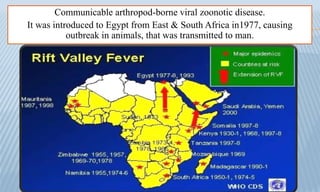
Communicable arthropod-borne viral zoonotic disease.
It was introduced to Egypt from East & South Africa in1977, causing
outbreak in animals, that was transmitted to man.
Mode of transmission:
- Bite of some infective Aedes &
Culex species.
- Handling diseased animals &
their tissues, blood, body fluids.
- No man-to-man transmission
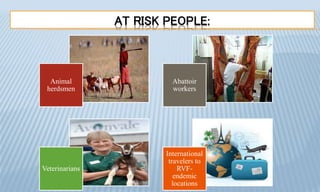
AT RISK PEOPLE:
Animal
herdsmen
Abattoir
workers
Veterinarians
International
travelers to
RVF-
endemic
locations
CLINICAL PICTURE:
Mild form
• Fever
• Influenza like picture
• Recovery
Severe form (8%)
• Hemorrhagic fever
• Liver necrosis.
• Damage of retina
• Blurred & decreased vision “1-
3weeks after initial infection”
Complications:
50% of sever cases will have permanent vision loss.
Encephalitis
DIAGNOSIS
C/P
Animal contact history.
• Serologic diagnosis “specific IgM in early sera or
rise in titre of specific antibodies”.
Lab investigations
PREVENTION & CONTROL
• Prevention & control of disease in animals, including
vaccination
• Quarantine of imported animals from endemic areas.
Measures for animal reservoir
General measures for vector & man
protection
VIRAL ENCEPHALITIS
West Nile
encephalitis
Eastern equine
encephalitis
Western equine
encephalitis
Japanese B
encephalitis
Causative
organism
specific arbovirus
Occurrence Africa & Middle
East
East U.S.A West U.S.A Japan, Korea, India
Philippines
Reservoir Birds and some wild and domestic animals
Vector Mosquitoes & some by ticks. In Egypt, West Nile virus is transmitted by culex.
C/P Usually mild
Serious outbreaks: with involvement of the brain, spinal cord and meninges.
Prevention - Eradication or control of vector.
- Protection of man from vector
- Quarantine measures for imported birds and animals
1947: 1st identified in
Uganda in monkeys.
1952: Identified in humans in
Uganda & Tanzania.
1960s-1980s: Outbreaks in
Africa, the Americas, Asia
and the Pacific “mild
illness”.
2007: 1st large
outbreak.
2015: Brazil reported an
association with Guillain-Barré
syndrome & Microcephaly.
TRANSMISSION
Aedes aegypti in tropical regions “usually bite during the day,
peaking during early morning & late afternoon/evening”.
IP: not clear, but is likely to be a few days.
Usually mild & last for 2-7 days.
COMPLICATIONS
Congenital
brain
abnormalities,
including
microcephaly.
Trigger of
Guillain-
Barré
syndrome.
Miscarriage,
stillbirth, and
other birth
defects.
Neurological
disorders
“under
research”.
DIAGNOSIS
C/P
Recent history of travel
Lab tests: blood or other
body fluids “urine, saliva
or semen”.
WHO RESPONSE

Arthropod. borne part 1

  • 1.
    ARTHROPOD BORNE DISEASES PART1 BY DALIA BAHAA Under supervision of Prof dr MONA ABOSEREA
  • 2.
    Arthropods form amajor group of disease vectors with mosquitoes, flies, sand flies, lice, fleas, ticks and mites transmitting a huge number of diseases. Many such vectors are haematophagous, which feed on blood at some or all stages of their lives.
  • 3.
    Viral Yellow fever Encephalitis Dengue fever Riftvalley fever Zika Bacterial Plague Parasitic Malaria Filariasis Leishmaniasis Rickettsial Typhus Q fever Spirochetal Relapsing fever
  • 4.
  • 5.
    Acute febrile diseaseswith extensive external & internal hge, usually serious & may be associated with shock & liver damage with high case fatality. Yellow fever Dengue fever Rift valley fever West Nile fever
  • 6.
  • 7.
    A communicable arthropod-borneviral hemorrhagic quarantinable acute disease of short duration & varying severity. Causative agent: Yellow fever virus.
  • 8.
    Endemic in Africa& South America in zone between 15° north & 100° south latitude of equator (Yellow fever belt).
  • 10.
    RESERVOIR: Sylvatic or Jungleyellow fever • Main reservoir in forest area is vertebrates other than human mainly monkeys • Vector is forest mosquitoes (haemagogus species). • Human has no essential role in transmission. Urban yellow fever • Reservoir is human • Vector is Aedes aegypti mosquitoes.
  • 12.
    HOW EGYPT ISPROTECTED FROM YELLOW FEVER: Absence of yellow fever in Egypt & its rarity in other areas such as Eastern Africa despite wide spread of vector aedes Egypti may be due to cross immunity from other flavi virus (e.g. Dengue, West Nile, Japanese encephalitis) in population which may be providing an (ecological barrier).
  • 13.
    PERIOD OF COMMUNICABILITY: Bloodof man is infective to mosquito shortly during late IP & during first 3-5 days of disease. In mosquitoes after biting an infected person there is 9-12 days extrinsic IP, then the mosquito becomes infective all over its life. There is also trans-ovarian transmission which may contribute to maintenance of infection. No man-to-man transmission.
  • 14.
    Mode of transmission IP:3-I0 days (6 days in international health regulation). Urban YF: bite of infective female Aedes aegypti mosquitoes. Sylvatic or jungle YF: bite of several species of genus Haemagogus.
  • 15.
    SUSCEPTIBILITY & RESISTANCE: Age& Sex • All ages & both sexes are susceptible. Immunity • Infection is followed by absolute immunity • 2nd attacks are unknown. • Transient passive immunity to inborn infant of immune mother occurs for up to 6 ms. Occupation • Woodcutter • Hunter.
  • 16.
    CLINICAL FEATURES Complications: Liver &Renal failure Fatality rate of jaundiced cases may reach 20-50%. Mild form • Sudden onset of fever, chills, headache, muscle pain, nausea & vomiting. • Faget sign: slow pulse out of proportion of elevated temperature. • Jaundice is moderate early in disease & intensified later. • Albuminuria or anuria may occur, leucopenia. • Most of the manifestations resolve after 5-7 days. Sever form • After a brief remission of hours to a day some cases progress to severe form • Hemorrhagic symptoms: epistaxis, gingival bleeding, haematemesis (coffee ground or black), melena.
  • 18.
    DIAGNOSIS C/P Travel history • Isolationof virus from blood by inoculation of suckling mice, mosquito or cell culture. • ELISA “viral antigen in blood”. • PCR “viral genome in blood & liver tissue”. • Serologic diagnosis “specific IgM in early sera or rise in titre of specific antibodies”. Lab investigations
  • 19.
    PREVENTION: General measures: • A)Eradication or control of Aedes Aegypti: • i. Anti-larval & anti-pupal measures • ii. Anti-adult measures • iii. Jungle mosquitoes “impractical”. • B) Human protection against mosquitoes: e.g. protective clothing, bed nets, repellents. Environmental sanitation: • Modes of transmission. Health education:
  • 20.
    Specific measures: 1) Immunization: a)Active Immunization: “most effective preventive measure” 17 D vaccine • Live attenuated vaccine “stored at -25°C”. • Single dose, 0.5ml, S.C. injection. • 99% immunity: International health regulation considered vaccine effectiveness to start after 10 days & persists for 10 years & then re-immunization is required. • No or minimal reaction “1st 4ms of life may rarely lead to vaccine associated encephalitis”. Dakar vaccine • Live attenuated neurotropic virus. • Administered by cutaneous scarification. • Not approved by WHO for international use as it leads to encephalitis.
  • 21.
    17 D VACCINE Recommended •International travelers coming from or going to endemic countries. • Since 1989 WHO has recommended that at risk countries in Africa that fall in the endemic belt should incorporate it into their routine childhood immunization program after 6 month. NOT recommended • Allergy to a vaccine component • Age <6 months • Symptomatic HIV infection • Thymus disorder associated with abnormal immune function • 1ry immunodeficiencies • Malignant neoplasms • Transplantation • Immunosuppressive & immunomodulatory therapies Cautiously after medical advice • Age 6 to 8 months • Age ≥ 60 years • Asymptomatic HIV infection • Pregnancy • Breastfeeding
  • 24.
    INTERNATIONAL MEASURES: Following measuresshould be done to prevent introduction of yellow fever from endemic area (Yellow Fever belt) into receptive area (areas free of yellow fever, but the vector is present & population is susceptible e.g. in Egypt): Notification within 24 hs to WHO. Valid vaccination certificate Disinfection of any aircraft leaving an endemic area for receptive area, by aerosol spray of suitable insecticide, shortly before departure and also on arrival. Quarantine of imported monkeys.
  • 25.
    VALID VACCINATION CERTIFICATE: a.All international travelers including children coming from or going to endemic areas "Yellow Fever belt". b. Validity starts 10 days after primo-vaccination & lasts for 10 ys. c. Validity starts on same day after re-vaccination & lasts for 10 ys. d. If no certificate is available: traveler is isolated for 6 days from date of leaving endemic area. e. If traveler arrives before 10 days of vaccination, i.e. certificate is not valid yet: traveler is isolated until certificate becomes valid or until end of international IP calculated from day of leaving last endemic area. f. Traveler is quarantined in mosquito-proof accommodation in airport. g. This certificate is required by many countries including Egypt.
  • 27.
  • 28.
    Causative agent: virusesof dengue fever: 1, 2, 3 & 4 types. • It is endemic in south Asia. • Dengue 1, 2, 3, 4 are now endemic in Africa. • In recent years outbreaks of dengue fever has occurred on east coast of Africa from Mozambique to Ethiopia to Saudi Arabia.
  • 30.
    Reservoir: Man-mosquito cycle intropical urban centers. A monkey-mosquito cycle may serve as a reservoir in south Asia & West Africa. Mode of transmission: bite of infective Aedes aegypti mosquito. No man-to-man transmission
  • 31.
    SUSCEPTIBILITY & RESISTANCE Onceinfection by one of dengue viruses, immunity will develop to that virus but infection by the other 3 viruses can still occur.
  • 32.
    CLINICAL PICTURE: IP: 4-7days Complications: Generalized bleeding & lymphadenopathy Generalized erythema & Maculopapular rash
  • 33.
    DIAGNOSIS C/P Travel history • Serologicdiagnosis “specific IgM in early sera or rise in titre of specific antibodies”. Lab investigations
  • 34.
    PREVENTION: General measures: • A)Eradication or control of Aedes Aegypti: • i. Anti-larval & anti-pupal measures • ii. Anti-adult measures • iii. Jungle mosquitoes “impractical”. • B) Human protection against mosquitoes: e.g. protective clothing, bed nets, repellents. Environmental sanitation: • Modes of transmission. Health education:
  • 36.
  • 38.
    Communicable arthropod-borne viralzoonotic disease. It was introduced to Egypt from East & South Africa in1977, causing outbreak in animals, that was transmitted to man.
  • 40.
    Mode of transmission: -Bite of some infective Aedes & Culex species. - Handling diseased animals & their tissues, blood, body fluids. - No man-to-man transmission
  • 41.
  • 42.
    CLINICAL PICTURE: Mild form •Fever • Influenza like picture • Recovery Severe form (8%) • Hemorrhagic fever • Liver necrosis. • Damage of retina • Blurred & decreased vision “1- 3weeks after initial infection” Complications: 50% of sever cases will have permanent vision loss. Encephalitis
  • 43.
    DIAGNOSIS C/P Animal contact history. •Serologic diagnosis “specific IgM in early sera or rise in titre of specific antibodies”. Lab investigations
  • 44.
    PREVENTION & CONTROL •Prevention & control of disease in animals, including vaccination • Quarantine of imported animals from endemic areas. Measures for animal reservoir General measures for vector & man protection
  • 45.
  • 46.
    West Nile encephalitis Eastern equine encephalitis Westernequine encephalitis Japanese B encephalitis Causative organism specific arbovirus Occurrence Africa & Middle East East U.S.A West U.S.A Japan, Korea, India Philippines Reservoir Birds and some wild and domestic animals Vector Mosquitoes & some by ticks. In Egypt, West Nile virus is transmitted by culex. C/P Usually mild Serious outbreaks: with involvement of the brain, spinal cord and meninges. Prevention - Eradication or control of vector. - Protection of man from vector - Quarantine measures for imported birds and animals
  • 49.
    1947: 1st identifiedin Uganda in monkeys. 1952: Identified in humans in Uganda & Tanzania. 1960s-1980s: Outbreaks in Africa, the Americas, Asia and the Pacific “mild illness”. 2007: 1st large outbreak. 2015: Brazil reported an association with Guillain-Barré syndrome & Microcephaly.
  • 51.
    TRANSMISSION Aedes aegypti intropical regions “usually bite during the day, peaking during early morning & late afternoon/evening”.
  • 52.
    IP: not clear,but is likely to be a few days. Usually mild & last for 2-7 days.
  • 55.
  • 56.
    DIAGNOSIS C/P Recent history oftravel Lab tests: blood or other body fluids “urine, saliva or semen”.
  • 57.

Editor's Notes

  • #17 Faget sign may be seen in yellow fever, typhoid fever, brucellosis, Colorado tick fever
  • #21 17 d prepared from nonvirulent strain cultivated on the chick empryo and subsequently freeze dried
  • #33 Sudden onset of fever for 3-5 days, intense headache, rash Minor bleeding as epistaxix, petichea, gum bleeding
  • #50 Guillian barre is sudden onset of muscle weakness caused by immune system damaging the peripheral nervous system
  • #54 Who has concluded that zika virus infection during pregnancy is a cause of congenital brain malformations including microcephaly and is trigger to guillian barre syndrome, also associated with miscarriage, stillbirth and other birth defects.
  • #55 Protection against mosquitos is the key measure to prevent zika virus