DENGUE FEVER
BY
DR GANESH JADHAO
MD MEDICINE
ASSOCIATE PROFESSOR
DEPARTMENT OF MEDICINE
SVNGMC, YAVATMAL
INTRODUCTION
Dengue is a mosquito-borne disease caused by any one of four
closely related dengue viruses (DENV-1, -2, -3, and -4).
Infection with one serotype of DENV provides immunity to that
serotype for life, but provides no long-term immunity to other
serotypes.
Thus, a person can be infected as many as four times, once with
each serotype.
Dengue viruses are transmitted from person to person by Aedes
mosquitoes (most often Aedes aegypti) in the domestic
environment.
‘Break-bone fever’ / dandy fever
(Haddi tod bukhar)
History
• Dr Benjamin Rush a professor of chemistry and medical
theory at UPEN, during Philadelphia epidemic 1779-1780,
first described the dramatic symptom of dengue as
breakbone fever
• In 1930s World War facilitated spread of dengue through
Asia/pacific region and until 1970 epidemics were limited to
9 tropical countries.
• But later on unplanned urbanization in tropical countries,
modern transportation lack of effective mosquito control and
globalization there is alarming rise in cases with incidence
increasing thirty fold in past fifty years.
• so that dengue had became endemic in hundred countries
in tropical and subtropical region.
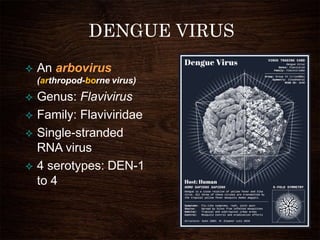
DENGUE VIRUS
 An arbovirus
(arthropod-borne virus)
 Genus: Flavivirus
 Family: Flaviviridae
 Single-stranded
RNA virus
 4 serotypes: DEN-1
to 4
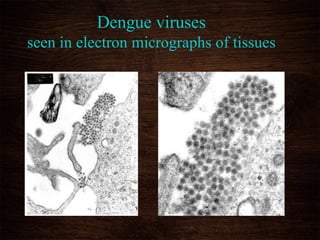
Dengue viruses
seen in electron micrographs of tissues
VECTOR
Principal mosquito vector is Aedes aegypti
.
The mosquito is black with white strips
 Breeds in clean water: empty vessels,
coconut shells, plastic containers, flower
pots, discarded tires, wet shower floors,
uncovered barrels, buckets, toilet tanks
 Bites during the day, particularly in the
early morning and in the evening
Other diseases spread by Aedes Mosquito –
 Yellow fever
 Chikungunya
Differentiating from Other Species
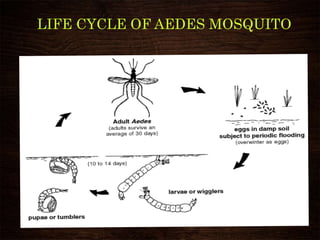
LIFE CYCLE OF AEDES MOSQUITO
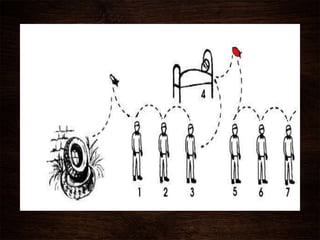
TRANSMISSION CYCLE
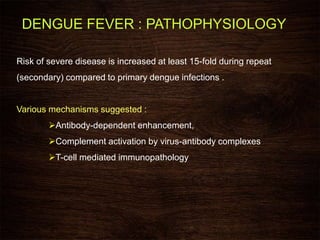
Risk of severe disease is increased at least 15-fold during repeat
(secondary) compared to primary dengue infections .
Various mechanisms suggested :
Antibody-dependent enhancement,
Complement activation by virus-antibody complexes
T-cell mediated immunopathology
DENGUE FEVER : PATHOPHYSIOLOGY
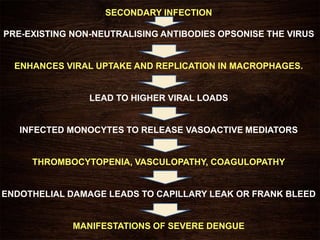
SECONDARY INFECTION
PRE-EXISTING NON-NEUTRALISING ANTIBODIES OPSONISE THE VIRUS
ENHANCES VIRAL UPTAKE AND REPLICATION IN MACROPHAGES.
LEAD TO HIGHER VIRAL LOADS
INFECTED MONOCYTES TO RELEASE VASOACTIVE MEDIATORS
THROMBOCYTOPENIA, VASCULOPATHY, COAGULOPATHY
ENDOTHELIAL DAMAGE LEADS TO CAPILLARY LEAK OR FRANK BLEED
MANIFESTATIONS OF SEVERE DENGUE
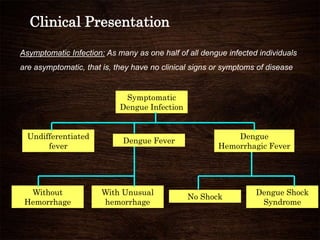
Symptomatic
Dengue Infection
Undifferentiated
fever
Dengue Fever
Dengue
Hemorrhagic Fever
Without
Hemorrhage
With Unusual
hemorrhage
No Shock
Dengue Shock
Syndrome
Clinical Presentation
Asymptomatic Infection: As many as one half of all dengue infected individuals
are asymptomatic, that is, they have no clinical signs or symptoms of disease
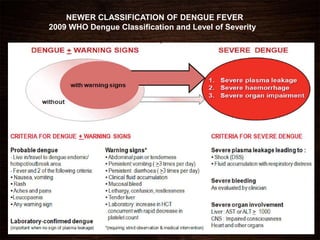
NEWER CLASSIFICATION OF DENGUE FEVER
2009 WHO Dengue Classification and Level of Severity
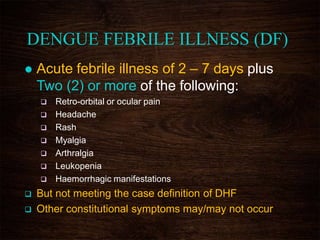
DENGUE FEBRILE ILLNESS (DF)
 Acute febrile illness of 2 – 7 days plus
Two (2) or more of the following:
 Retro-orbital or ocular pain
 Headache
 Rash
 Myalgia
 Arthralgia
 Leukopenia
 Haemorrhagic manifestations
 But not meeting the case definition of DHF
 Other constitutional symptoms may/may not occur
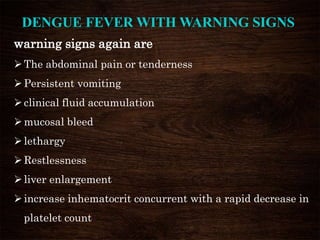
warning signs again are
The abdominal pain or tenderness
Persistent vomiting
clinical fluid accumulation
mucosal bleed
lethargy
Restlessness
liver enlargement
increase inhematocrit concurrent with a rapid decrease in
platelet count
DENGUE FEVER WITH WARNING SIGNS
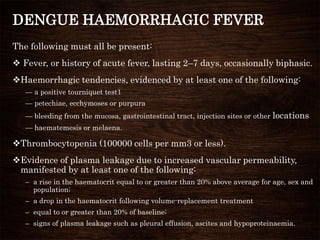
DENGUE HAEMORRHAGIC FEVER
The following must all be present:
 Fever, or history of acute fever, lasting 2–7 days, occasionally biphasic.
Haemorrhagic tendencies, evidenced by at least one of the following:
— a positive tourniquet test1
— petechiae, ecchymoses or purpura
— bleeding from the mucosa, gastrointestinal tract, injection sites or other locations
— haematemesis or melaena.
Thrombocytopenia (100000 cells per mm3 or less).
Evidence of plasma leakage due to increased vascular permeability,
manifested by at least one of the following:
– a rise in the haematocrit equal to or greater than 20% above average for age, sex and
population;
– a drop in the haematocrit following volume-replacement treatment
– equal to or greater than 20% of baseline;
– signs of plasma leakage such as pleural effusion, ascites and hypoproteinaemia.
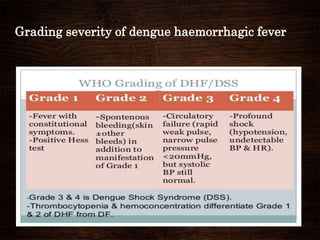
Grading severity of dengue haemorrhagic fever
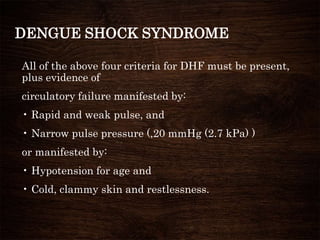
DENGUE SHOCK SYNDROME
All of the above four criteria for DHF must be present,
plus evidence of
circulatory failure manifested by:
• Rapid and weak pulse, and
• Narrow pulse pressure (,20 mmHg (2.7 kPa) )
or manifested by:
• Hypotension for age and
• Cold, clammy skin and restlessness.
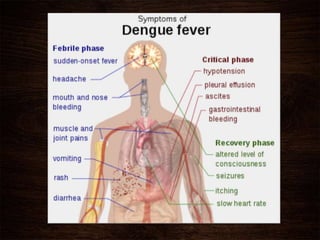
CLINICAL FEATURES
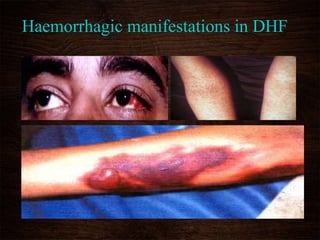
Haemorrhagic manifestations in DHF
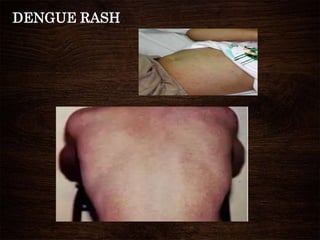
DENGUE RASH
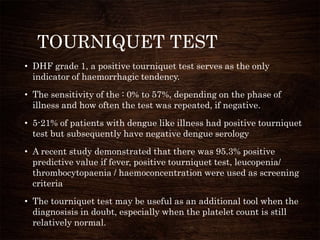
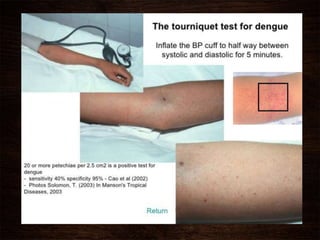
TOURNIQUET TEST
• DHF grade 1, a positive tourniquet test serves as the only
indicator of haemorrhagic tendency.
• The sensitivity of the : 0% to 57%, depending on the phase of
illness and how often the test was repeated, if negative.
• 5-21% of patients with dengue like illness had positive tourniquet
test but subsequently have negative dengue serology
• A recent study demonstrated that there was 95.3% positive
predictive value if fever, positive tourniquet test, leucopenia/
thrombocytopaenia / haemoconcentration were used as screening
criteria
• The tourniquet test may be useful as an additional tool when the
diagnosisis in doubt, especially when the platelet count is still
relatively normal.
CLINICAL COURSE
AND
DIAGNOSIS
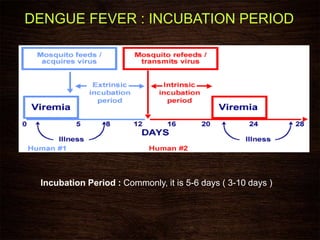
Incubation Period : Commonly, it is 5-6 days ( 3-10 days )
DENGUE FEVER : INCUBATION PERIOD
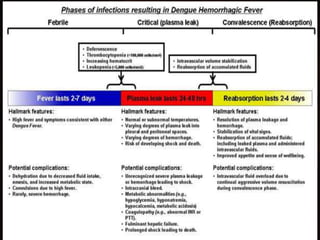
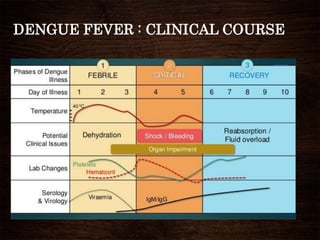
DENGUE FEVER : CLINICAL COURSE
Diagnosis
 Medical history
 Physical examination
 Laboratory tests
 Radiological test
Physical examination
 fever
 rash
 haemorrhagic manifestations
 Petechiae
 Purpura/ ecchymosis
 Epistaxis
 Gum bleeding
 Blood in vomitus, urine, or stool
 Vaginal bleeding
 Positive tourniquet test
 hypotension
 evidence of circulatory failure
Physical examination
 EVALUATE: HR, capillary refill, skin
colour, temperature, BP, PP
 LOOK FOR: evidence of bleeding on
the skin and other sites
 LOOK FOR: evidence of increased
vascular permeability
 MEASURE and ask about urine output
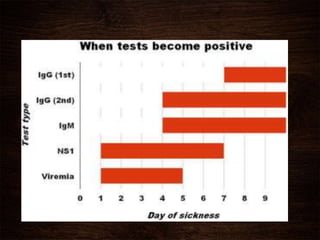
Diagnostic tests
 Direct – By Detection of viral component
 RT PCR
 NS1 Ag Detection
 Indirectly
 By serology dengue IgM & IgG Rapid Strip test
(serial/paired)
 Labouratory parameters
 Hematology - (Leukopenia,
thrombocytopenia, Hct changes);
 low serum protein; clotting time
• VIRUS ISOLATION –
– takes 2 week to complete & expensive
• POLYMERASE CHAIN REACTION (PCR) –
– ability to determine dengue serotypes, but limited centres
with facilities, expensive, special storage temperatures and
short transportation, time between collection and extraction
• Dengue IgM
– The IgM antibody capture ELISA is especially useful in the
diagnosis of recent infection.
– IgM antibodies are relatively specific for dengue, but do not
distinguish between various serotypes.
– Rising titre of IgM antibodies is much more specific.
NON-STRUCTURAL PROTEIN-1 (NS1 Antigen)
 a hallmark of flavivirus infecting mammalian cells and can be
found in dengue infection as well as in yellow fever and West
Nile virus infection.
 Present high concentrations in the sera of dengue infected
patients during the early phase of the disease. not useful in the
convalescence phase. However,this test is still undergoing
evaluation
 The dengue NS1 antigen-capture ELISA gave an overall
sensitivity of 70-93.4% and a specificity of 100%.
 The sensitivity was significantly higher in acute primary
dengue (97.3%) than in acute secondary dengue (70.0%).
 The positive predictive value of the dengue NS1 antigen-
capture ELISA was 100% and negative predictive value was
97%.
MANAGEMENT
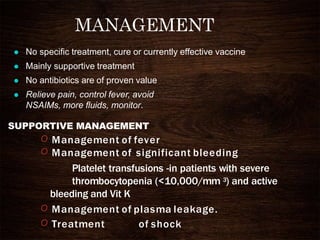
 No specific treatment, cure or currently effective vaccine
 Mainly supportive treatment
 No antibiotics are of proven value
 Relieve pain, control fever, avoid
NSAIMs, more fluids, monitor.
SUPPORTIVE MANAGEMENT
O Management of fever
O Management of significant bleeding
Platelet transfusions -in patients with severe
thrombocytopenia (<10,000/mm 3) and active
bleeding and Vit K
O Management of plasma leakage.
O Treatment of shock
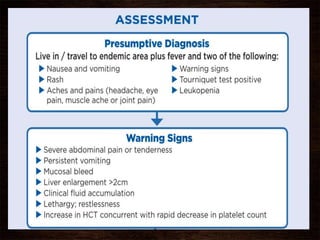
WARNING SIGNS
During the febrile phase (may last 2–7 days) and subsequent critical phase (1–
2 days), your clinic should
▶Follow CBCs
▶Watch for dehydration
▶ Watch for warning signs, including decreasing platelet count and
increasinghematocrit
▶Watch for defervescence (indicating beginning of critical phase)
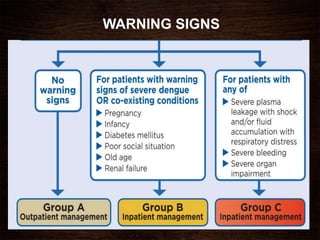
Group A
Outpatient Management
Control the fever
▶ Give acetaminophen every 6 hours(maximum 4 doses per day). Do
not give ibuprofen, aspirin, or aspirin-containing drugs.
▶ Sponge patient’s skin with tepidwater when temperature is high.
Prevent dehydration which occurs when a person loses too much fluid (from
high fever, vomiting, or poor oral intake).
Give plenty of fluids (not only water) and watch for signs of dehydration.
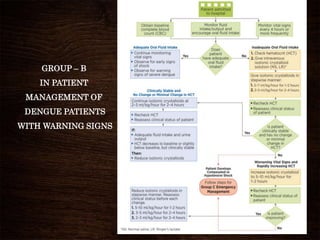
GROUP – B
IN PATIENT
MANAGEMENT OF
DENGUE PATIENTS
WITH WARNING SIGNS
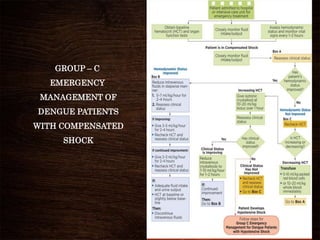
GROUP – C
EMERGENCY
MANAGEMENT OF
DENGUE PATIENTS
WITH COMPENSATED
SHOCK
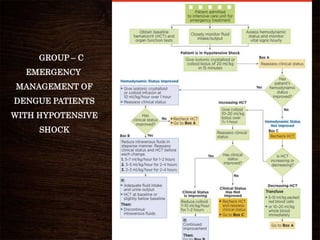
GROUP – C
EMERGENCY
MANAGEMENT OF
DENGUE PATIENTS
WITH HYPOTENSIVE
SHOCK
Mosquito Control
 Do not allow empty vessels, coconut shells, plastic containers,
flower pots, tires etc to collect rain water in them
 Frequently (once in 2-3 days) empty all water storage containers
 Cover your over tanks to prevent
mosquitoes breeding in fresh water
prevent mosquito bites
 Screen your homes with wire mesh
 Wear full clothing – long sleeves
 Apply mosquito repellents
 Keep Dengue fever patient under mosquito net
 True community participation is key
 Integrated vector management
PREVENTION
THANKS

Dengue fever

  • 1.
    DENGUE FEVER BY DR GANESHJADHAO MD MEDICINE ASSOCIATE PROFESSOR DEPARTMENT OF MEDICINE SVNGMC, YAVATMAL
  • 2.
    INTRODUCTION Dengue is amosquito-borne disease caused by any one of four closely related dengue viruses (DENV-1, -2, -3, and -4). Infection with one serotype of DENV provides immunity to that serotype for life, but provides no long-term immunity to other serotypes. Thus, a person can be infected as many as four times, once with each serotype. Dengue viruses are transmitted from person to person by Aedes mosquitoes (most often Aedes aegypti) in the domestic environment. ‘Break-bone fever’ / dandy fever (Haddi tod bukhar)
  • 3.
    History • Dr BenjaminRush a professor of chemistry and medical theory at UPEN, during Philadelphia epidemic 1779-1780, first described the dramatic symptom of dengue as breakbone fever • In 1930s World War facilitated spread of dengue through Asia/pacific region and until 1970 epidemics were limited to 9 tropical countries. • But later on unplanned urbanization in tropical countries, modern transportation lack of effective mosquito control and globalization there is alarming rise in cases with incidence increasing thirty fold in past fifty years. • so that dengue had became endemic in hundred countries in tropical and subtropical region.
  • 4.
    DENGUE VIRUS  Anarbovirus (arthropod-borne virus)  Genus: Flavivirus  Family: Flaviviridae  Single-stranded RNA virus  4 serotypes: DEN-1 to 4
  • 5.
    Dengue viruses seen inelectron micrographs of tissues
  • 6.
    VECTOR Principal mosquito vectoris Aedes aegypti . The mosquito is black with white strips  Breeds in clean water: empty vessels, coconut shells, plastic containers, flower pots, discarded tires, wet shower floors, uncovered barrels, buckets, toilet tanks  Bites during the day, particularly in the early morning and in the evening Other diseases spread by Aedes Mosquito –  Yellow fever  Chikungunya
  • 7.
  • 9.
    LIFE CYCLE OFAEDES MOSQUITO
  • 10.
  • 11.
    Risk of severedisease is increased at least 15-fold during repeat (secondary) compared to primary dengue infections . Various mechanisms suggested : Antibody-dependent enhancement, Complement activation by virus-antibody complexes T-cell mediated immunopathology DENGUE FEVER : PATHOPHYSIOLOGY
  • 12.
    SECONDARY INFECTION PRE-EXISTING NON-NEUTRALISINGANTIBODIES OPSONISE THE VIRUS ENHANCES VIRAL UPTAKE AND REPLICATION IN MACROPHAGES. LEAD TO HIGHER VIRAL LOADS INFECTED MONOCYTES TO RELEASE VASOACTIVE MEDIATORS THROMBOCYTOPENIA, VASCULOPATHY, COAGULOPATHY ENDOTHELIAL DAMAGE LEADS TO CAPILLARY LEAK OR FRANK BLEED MANIFESTATIONS OF SEVERE DENGUE
  • 13.
    Symptomatic Dengue Infection Undifferentiated fever Dengue Fever Dengue HemorrhagicFever Without Hemorrhage With Unusual hemorrhage No Shock Dengue Shock Syndrome Clinical Presentation Asymptomatic Infection: As many as one half of all dengue infected individuals are asymptomatic, that is, they have no clinical signs or symptoms of disease
  • 14.
    NEWER CLASSIFICATION OFDENGUE FEVER 2009 WHO Dengue Classification and Level of Severity
  • 15.
    DENGUE FEBRILE ILLNESS(DF)  Acute febrile illness of 2 – 7 days plus Two (2) or more of the following:  Retro-orbital or ocular pain  Headache  Rash  Myalgia  Arthralgia  Leukopenia  Haemorrhagic manifestations  But not meeting the case definition of DHF  Other constitutional symptoms may/may not occur
  • 16.
    warning signs againare The abdominal pain or tenderness Persistent vomiting clinical fluid accumulation mucosal bleed lethargy Restlessness liver enlargement increase inhematocrit concurrent with a rapid decrease in platelet count DENGUE FEVER WITH WARNING SIGNS
  • 17.
    DENGUE HAEMORRHAGIC FEVER Thefollowing must all be present:  Fever, or history of acute fever, lasting 2–7 days, occasionally biphasic. Haemorrhagic tendencies, evidenced by at least one of the following: — a positive tourniquet test1 — petechiae, ecchymoses or purpura — bleeding from the mucosa, gastrointestinal tract, injection sites or other locations — haematemesis or melaena. Thrombocytopenia (100000 cells per mm3 or less). Evidence of plasma leakage due to increased vascular permeability, manifested by at least one of the following: – a rise in the haematocrit equal to or greater than 20% above average for age, sex and population; – a drop in the haematocrit following volume-replacement treatment – equal to or greater than 20% of baseline; – signs of plasma leakage such as pleural effusion, ascites and hypoproteinaemia.
  • 18.
    Grading severity ofdengue haemorrhagic fever
  • 20.
    DENGUE SHOCK SYNDROME Allof the above four criteria for DHF must be present, plus evidence of circulatory failure manifested by: • Rapid and weak pulse, and • Narrow pulse pressure (,20 mmHg (2.7 kPa) ) or manifested by: • Hypotension for age and • Cold, clammy skin and restlessness.
  • 21.
  • 23.
  • 24.
  • 25.
    TOURNIQUET TEST • DHFgrade 1, a positive tourniquet test serves as the only indicator of haemorrhagic tendency. • The sensitivity of the : 0% to 57%, depending on the phase of illness and how often the test was repeated, if negative. • 5-21% of patients with dengue like illness had positive tourniquet test but subsequently have negative dengue serology • A recent study demonstrated that there was 95.3% positive predictive value if fever, positive tourniquet test, leucopenia/ thrombocytopaenia / haemoconcentration were used as screening criteria • The tourniquet test may be useful as an additional tool when the diagnosisis in doubt, especially when the platelet count is still relatively normal.
  • 27.
  • 28.
    Incubation Period :Commonly, it is 5-6 days ( 3-10 days ) DENGUE FEVER : INCUBATION PERIOD
  • 29.
    DENGUE FEVER :CLINICAL COURSE
  • 30.
    Diagnosis  Medical history Physical examination  Laboratory tests  Radiological test
  • 31.
    Physical examination  fever rash  haemorrhagic manifestations  Petechiae  Purpura/ ecchymosis  Epistaxis  Gum bleeding  Blood in vomitus, urine, or stool  Vaginal bleeding  Positive tourniquet test  hypotension  evidence of circulatory failure
  • 32.
    Physical examination  EVALUATE:HR, capillary refill, skin colour, temperature, BP, PP  LOOK FOR: evidence of bleeding on the skin and other sites  LOOK FOR: evidence of increased vascular permeability  MEASURE and ask about urine output
  • 33.
    Diagnostic tests  Direct– By Detection of viral component  RT PCR  NS1 Ag Detection  Indirectly  By serology dengue IgM & IgG Rapid Strip test (serial/paired)  Labouratory parameters  Hematology - (Leukopenia, thrombocytopenia, Hct changes);  low serum protein; clotting time
  • 35.
    • VIRUS ISOLATION– – takes 2 week to complete & expensive • POLYMERASE CHAIN REACTION (PCR) – – ability to determine dengue serotypes, but limited centres with facilities, expensive, special storage temperatures and short transportation, time between collection and extraction • Dengue IgM – The IgM antibody capture ELISA is especially useful in the diagnosis of recent infection. – IgM antibodies are relatively specific for dengue, but do not distinguish between various serotypes. – Rising titre of IgM antibodies is much more specific.
  • 36.
    NON-STRUCTURAL PROTEIN-1 (NS1Antigen)  a hallmark of flavivirus infecting mammalian cells and can be found in dengue infection as well as in yellow fever and West Nile virus infection.  Present high concentrations in the sera of dengue infected patients during the early phase of the disease. not useful in the convalescence phase. However,this test is still undergoing evaluation  The dengue NS1 antigen-capture ELISA gave an overall sensitivity of 70-93.4% and a specificity of 100%.  The sensitivity was significantly higher in acute primary dengue (97.3%) than in acute secondary dengue (70.0%).  The positive predictive value of the dengue NS1 antigen- capture ELISA was 100% and negative predictive value was 97%.
  • 37.
    MANAGEMENT  No specifictreatment, cure or currently effective vaccine  Mainly supportive treatment  No antibiotics are of proven value  Relieve pain, control fever, avoid NSAIMs, more fluids, monitor. SUPPORTIVE MANAGEMENT O Management of fever O Management of significant bleeding Platelet transfusions -in patients with severe thrombocytopenia (<10,000/mm 3) and active bleeding and Vit K O Management of plasma leakage. O Treatment of shock
  • 39.
  • 40.
    During the febrilephase (may last 2–7 days) and subsequent critical phase (1– 2 days), your clinic should ▶Follow CBCs ▶Watch for dehydration ▶ Watch for warning signs, including decreasing platelet count and increasinghematocrit ▶Watch for defervescence (indicating beginning of critical phase) Group A Outpatient Management Control the fever ▶ Give acetaminophen every 6 hours(maximum 4 doses per day). Do not give ibuprofen, aspirin, or aspirin-containing drugs. ▶ Sponge patient’s skin with tepidwater when temperature is high. Prevent dehydration which occurs when a person loses too much fluid (from high fever, vomiting, or poor oral intake). Give plenty of fluids (not only water) and watch for signs of dehydration.
  • 41.
    GROUP – B INPATIENT MANAGEMENT OF DENGUE PATIENTS WITH WARNING SIGNS
  • 42.
    GROUP – C EMERGENCY MANAGEMENTOF DENGUE PATIENTS WITH COMPENSATED SHOCK
  • 43.
    GROUP – C EMERGENCY MANAGEMENTOF DENGUE PATIENTS WITH HYPOTENSIVE SHOCK
  • 44.
    Mosquito Control  Donot allow empty vessels, coconut shells, plastic containers, flower pots, tires etc to collect rain water in them  Frequently (once in 2-3 days) empty all water storage containers  Cover your over tanks to prevent mosquitoes breeding in fresh water prevent mosquito bites  Screen your homes with wire mesh  Wear full clothing – long sleeves  Apply mosquito repellents  Keep Dengue fever patient under mosquito net  True community participation is key  Integrated vector management PREVENTION
  • 45.