EPIDEMIOLOGY OF NON
COMMUNICABLE DISEASES
(NCDS) PART2
By Alaa Nouh
Under supervision
Of
Prof Dr. Mona Aboserea
Zagazig university
ACCIDENTS
It is unexpected, unplanned event that produces injury, death,
property loss or damage.
• An increasing problem in both developed & developing countries.
• It is the 2nd leading cause of deaths in developing countries
Road traffic accidents Home accidents Occupational accidents Natural disaster
Birth injuries Sport injuries War accidents
ROAD TRAFFIC ACCIDENTS
Injuries such as laceration, contusions, bleeding, paralysis,
fractures, and amputation are common.
Death is commonly associated with road traffic accidents.
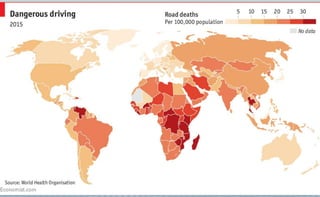
Egypt loses about 12 000 lives due to road traffic crashes every year.
It has a road traffic fatality rate of 42 deaths per 100 000 population.
RISK FACTORS
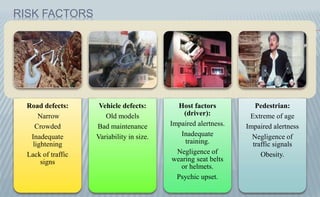
Road defects:
Narrow
Crowded
Inadequate
lightening
Lack of traffic
signs
Vehicle defects:
Old models
Bad maintenance
Variability in size.
Host factors
(driver):
Impaired alertness.
Inadequate
training.
Negligence of
wearing seat belts
or helmets.
Psychic upset.
Pedestrian:
Extreme of age
Impaired alertness
Negligence of
traffic signals
Obesity.
PREVENTION OF ROAD TRAFFIC ACCIDENTS
Roads:
Town planning.
Good lightening.
Sufficient traffic
signals.
Drivers:
Proper medical
examination
before license.
Sufficient
training.
Using seat belt,
wearing helmets.
Pedestrians:
Raising
awareness.
Vehicles:
Periodic
maintenance.
Strict
legislations.
HOME ACCIDENTS
Burns
• Fire
• Boiling fluids
• Matches.
Falls
• On stairs
• Striking against
furniture
• Slippery floor.
Electric
shock
• Neglected
maintenance
• Exposed wire.
Wounds
• Sharp knives
• Pointed articles.
Chemical
poisoning
• Drugs
• Caustic soda
• Detergents.
Collapse of
old
buildings.
Animal bites
RISK FACTORS
Extreme of age. Epilepsy
Fainting
Loss of
consciousness.
Over
confidence in
repairing
electric
appliance.
Unsafe building
Bad
illumination
Slippery floor
or stairs.
PREVENTION
Storage of medications
& toxic substance in
closed places.
Close windows &
balcony
Matches, sharp knives
should be put in
hidden places.
Children should not
stay with mothers in
kitchens.
Proper arrangement of
furniture & using non
slippery tiles.
First aid must be
present in every house
Drying floor. Cover the electric plug
opening in the wall
OCCUPATIONAL ACCIDENTS
Accidents
occurring
during work
including acts
of violence
which result in
• a) fatal injury
• b) non-fatal
injury.
At risk group
• Construction
workers,
agricultural
workers, miners,
industrial
workers etc…
Common
body parts
injured
• Upper & lower
limbs, trunk,
back, head &
neck.
Injury nature
• Cuts, lacerations,
contusions,
sprains, strains,
fractures, &
burns.
Personal
factors
• Age
• Sex
• Lack of training
• Negligence of
wearing PPE
• Poor physical &
mental health
Environmental
factors
• Poor ventilation
• Poor illumination
• ↑ or ↓
temperature
• Noise
• Crowded places.
Machinery
factors
• Unshielded
• Exposed
electricity
• Poor maintenance
• Lack of safety
measures.
Working
conditions
• Prolonged
working hours &
inadequate rest
hours.
• Lack of training.
• Lack of
supervision.
• Poor
communication
INDICATORS OF OCCUPATIONAL ACCIDENTS
IMPACT OF ACCIDENTS ON WORKERS, INDUSTRY, AND
ECONOMY
Impaired
health,
disability &
handicapping,
& death.
Psychic
problems
(PTSD).
↑ absenteeism
& ↓
productivity.
↑ expenses on
medical care,
rehabilitation
&
compensation.
PREVENTION OF OCCUPATIONAL ACCIDENTS
• Improving work environment.
• Good machinery design, safety & good maintenance.
• Health education of workers & proper training before work
• Prevention of fatigue & solving psychological troubles.
• ttt of any illness & good nutrition.
• Research studies.
1ry prevention
• 1st aid & emergency services for proper management of injuries at all work places.
2ry prevention
• Change the job of injured worker & proper training
• Artificial limb in amputation & special aids for handicapped workers.
3ry prevention
IMPORTANCE OF MENTAL HEALTH
Nearly ½ the world's populations are
affected by mental illness (WHO)
Impact on their self-esteem,
relationships & ability to function in
everyday life.
Everyday stress & even rapid
technological advances make most
people under marked stress
Good mental health can enhance
one’s life, while poor mental health
can prevent someone from living a
normal life.
Mental Health
• State of well-being in which the
individual:
• Realizes his own abilities,
• Cope with normal stresses of life,
• Can work productively
• Able to make a contribution to
community.
Mental Illness
• Any disease or conditions that
affect way a person
• Thinks,
• Feels,
• Behaves
• Ability to relate to others & to
surroundings
CRITERIA OF INDIVIDUALS WITH GOOD MENTAL
HEALTH
Emotional
balance.
Social
adjustment.
Perceiving
things the way
they are.
Achievements
consistent
with the
individual's
abilities &
opportunities.
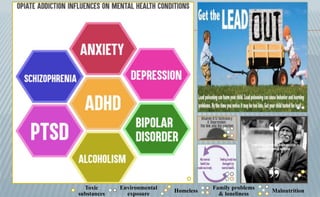
RISK FACTORS OF MENTAL DISORDERS
Sex Infections Genetic predisposition Age
Toxic
substances
Environmental
exposure
Homeless
Family problems
& loneliness
Malnutrition
 ↓ Iodine during pregnancy & ↓ O2 at birth, injuries & early childhood brain
infections → MR.
 Nutritional deficiencies “PEM” → MR.
 Depression interacts with CVDs & vice versa.
 Anxiety, depression & substance abuse can also complicate existing physical
disorders.
INTERACTION BETWEEN PHYSICAL & MENTAL HEALTH
PROBLEMS
Schizophrenia
Psychosis &
depression
Behavioral disorders as
maladjustment & absenteeism.
Psychopathic disorders:
aggressive antisocial acts
Impaired
intelligence
TYPESOFMENTALDISORDERS
 Mental illness & poor mental health are public problems
 Great impact on:
THE IMPACT OF MENTAL DISORDERS
Individuals
• Distressing symptoms.
• Unable to participate in
work & leisure.
• Poor QoL: stigma &
discrimination.
Family
• Economic burden
• Disruption of house
hold routine &
restricted social
activities.
• Lost work & social
opportunities.
Community
• Cost of providing care.
• Loss of productivity.
• Legal problems
including violence.
2ry
3ry
1ry
Prevention of Mental Illness
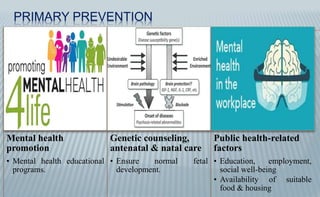
PRIMARY PREVENTION
Mental health
promotion
• Mental health educational
programs.
Genetic counseling,
antenatal & natal care
• Ensure normal fetal
development.
Public health-related
factors
• Education, employment,
social well-being
• Availability of suitable
food & housing
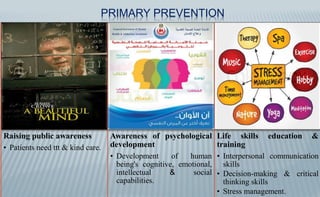
PRIMARY PREVENTION
Raising public awareness
• Patients need ttt & kind care.
Awareness of psychological
development
• Development of human
being's cognitive, emotional,
intellectual & social
capabilities.
Life skills education &
training
• Interpersonal communication
skills
• Decision-making & critical
thinking skills
• Stress management.
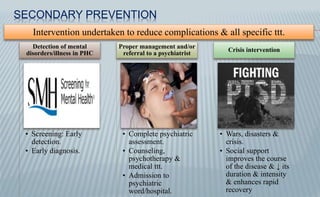
• Screening: Early
detection.
• Early diagnosis.
Detection of mental
disorders/illness in PHC
• Complete psychiatric
assessment.
• Counseling,
psychotherapy &
medical ttt.
• Admission to
psychiatric
word/hospital.
Proper management and/or
referral to a psychiatrist
• Wars, disasters &
crisis.
• Social support
improves the course
of the disease & ↓ its
duration & intensity
& enhances rapid
recovery
Crisis intervention
Intervention undertaken to reduce complications & all specific ttt.
SECONDARY PREVENTION
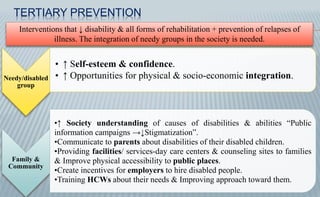
Needy/disabled
group
• ↑ Self-esteem & confidence.
• ↑ Opportunities for physical & socio-economic integration.
Family &
Community
•↑ Society understanding of causes of disabilities & abilities “Public
information campaigns →↓Stigmatization”.
•Communicate to parents about disabilities of their disabled children.
•Providing facilities/ services-day care centers & counseling sites to families
& Improve physical accessibility to public places.
•Create incentives for employers to hire disabled people.
•Training HCWs about their needs & Improving approach toward them.
Interventions that ↓ disability & all forms of rehabilitation + prevention of relapses of
illness. The integration of needy groups in the society is needed.
TERTIARY PREVENTION
MENTAL HEALTH PROGRAM IN EGYPT:
In Egypt the national mental health program focuses on:
Decentralization of MH care
& community care in
different governorates.
Inclusion of mental health in
PHC.
Training of family doctors to
deal with main mental
disorders.
Awareness-raising among
public regarding recognition
of mental disorders &
methods of referral.
The new policy may ↓ no. of psychiatric inpatients.
After-care services are still limited because of the poor understanding of most
people
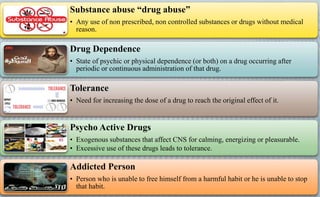
SUBSTANCE ABUSE
Substance abuse “drug abuse”
• Any use of non prescribed, non controlled substances or drugs without medical
reason.
Drug Dependence
• State of psychic or physical dependence (or both) on a drug occurring after
periodic or continuous administration of that drug.
Tolerance
• Need for increasing the dose of a drug to reach the original effect of it.
Psycho Active Drugs
• Exogenous substances that affect CNS for calming, energizing or pleasurable.
• Excessive use of these drugs leads to tolerance.
Addicted Person
• Person who is unable to free himself from a harmful habit or he is unable to stop
that habit.
 In Egypt, drug abuse is considered one of the most serious public health
problems, especially among the young people at working ages.
 In Middle Eastern Arab countries, there is scarce information on mental
health issues, including drug dependence. This is related to the context
of the conservative nature of these societies that reject disclosing about
drug intake as well as to stigmatization.
Magnitude of the problem
Narcotics
• Morphine, Heroin & Codeine
• Strong psychic dependence & early physical
dependence & tolerance.
• Euphoria, ↓pain perception, nausea, constipation,
RC depression & visual disturbance.
Depressant
• Alcohol & Barbiturates.
• Psychic dependence, sedation, hypnosis,
anesthesia, muscle relaxation & sleep
Stimulants
• Amphetamine & Cocaine.
• Excitatory for CNS, alertness, euphoria,
motor activity, depression of appetite & large
doses cause convulsions
Hallucinogens
• LSD & Mascaline
• Distort perception of time & distance, induce
delusions & hallucination.
• Alter mood & may cause psychotic episodes
Cannabis
• Hashish & Marijuana & Bango.
• Affect cognition, memory & mood
• Deterioration of self perception & sensation of
time
TYPES OF PSYCHO ACTIVE DRUGS
Risk factors of drug addiction
Drug pharmacological
effects, “highly
addictive drug”.
Availability & easy
accessibility of drugs.
Gender.
Psychic & neurological
illness.
Family history of
addiction.
Lack of family
involvement.
Anxiety, depression
and loneliness.
Peer pressure.
IMPACTS OF DRUG ABUSE
Health problems &
Communicable disease
“HIV, HBV”.
↑ Accidents.
Unconsciousness, coma &
sudden death.
↑ Crime & Violence &
Suicide.
Family problems.
↓School performance &
motivation.
↓ Work performance + ↑
Absenteeism
Financial problems
PATTERN OF SUBSTANCE ABUSE IN EGYPT
• Cannabis, Opium, Hypnoseditives, Heroin, and Cocaine.
1980s
• Cannabis, Alcoholic beverages, Synthetic psychoactive drug.
1990s
• Cannabis became prevalent in the form of Bango “leaves of Cannabis sativa”.
• This plant is increasingly widely cultivated in Egypt, especially in Sinai Peninsula.
2nd half of the 1990s
• Tramadol “Scheduled drug”, milder synthetic opioid painkiller similar to morphine.
• Easily accessible at cheap costs from the black market
• 30% of males “14-30 years” “Students, laborers & professionals” use it regularly “For
Premature ejaculation & for extended orgasm & increase sexual pleasure”
Since 2007
70 % of admissions to the addiction wing of Cairo’s massive Qasr el-Aini
hospital were linked to tramadol in 2014 alone.
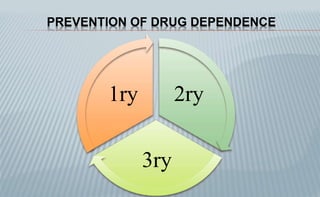
PREVENTION OF DRUG DEPENDENCE
2ry
3ry
1ry
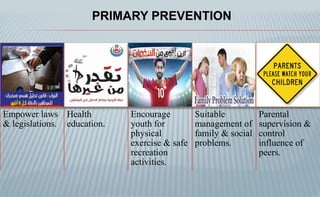
PRIMARY PREVENTION
Empower laws
& legislations.
Health
education.
Encourage
youth for
physical
exercise & safe
recreation
activities.
Suitable
management of
family & social
problems.
Parental
supervision &
control
influence of
peers.
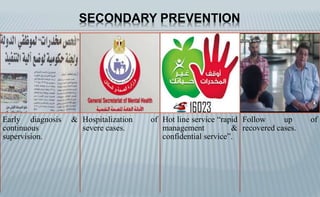
SECONDARY PREVENTION
Early diagnosis &
continuous
supervision.
Hospitalization of
severe cases.
Hot line service “rapid
management &
confidential service”.
Follow up of
recovered cases.
TERTIARY PREVENTION
Rehabilitation of addicts, find suitable jobs & no community
stigma
Ncds part 2

Ncds part 2

  • 1.
    EPIDEMIOLOGY OF NON COMMUNICABLEDISEASES (NCDS) PART2 By Alaa Nouh Under supervision Of Prof Dr. Mona Aboserea Zagazig university
  • 2.
  • 3.
    It is unexpected,unplanned event that produces injury, death, property loss or damage. • An increasing problem in both developed & developing countries. • It is the 2nd leading cause of deaths in developing countries Road traffic accidents Home accidents Occupational accidents Natural disaster Birth injuries Sport injuries War accidents
  • 4.
    ROAD TRAFFIC ACCIDENTS Injuriessuch as laceration, contusions, bleeding, paralysis, fractures, and amputation are common. Death is commonly associated with road traffic accidents. Egypt loses about 12 000 lives due to road traffic crashes every year. It has a road traffic fatality rate of 42 deaths per 100 000 population.
  • 9.
    RISK FACTORS Road defects: Narrow Crowded Inadequate lightening Lackof traffic signs Vehicle defects: Old models Bad maintenance Variability in size. Host factors (driver): Impaired alertness. Inadequate training. Negligence of wearing seat belts or helmets. Psychic upset. Pedestrian: Extreme of age Impaired alertness Negligence of traffic signals Obesity.
  • 10.
    PREVENTION OF ROADTRAFFIC ACCIDENTS Roads: Town planning. Good lightening. Sufficient traffic signals. Drivers: Proper medical examination before license. Sufficient training. Using seat belt, wearing helmets. Pedestrians: Raising awareness. Vehicles: Periodic maintenance. Strict legislations.
  • 11.
    HOME ACCIDENTS Burns • Fire •Boiling fluids • Matches. Falls • On stairs • Striking against furniture • Slippery floor. Electric shock • Neglected maintenance • Exposed wire. Wounds • Sharp knives • Pointed articles. Chemical poisoning • Drugs • Caustic soda • Detergents. Collapse of old buildings. Animal bites
  • 12.
    RISK FACTORS Extreme ofage. Epilepsy Fainting Loss of consciousness. Over confidence in repairing electric appliance. Unsafe building Bad illumination Slippery floor or stairs.
  • 13.
    PREVENTION Storage of medications &toxic substance in closed places. Close windows & balcony Matches, sharp knives should be put in hidden places. Children should not stay with mothers in kitchens. Proper arrangement of furniture & using non slippery tiles. First aid must be present in every house Drying floor. Cover the electric plug opening in the wall
  • 14.
    OCCUPATIONAL ACCIDENTS Accidents occurring during work includingacts of violence which result in • a) fatal injury • b) non-fatal injury. At risk group • Construction workers, agricultural workers, miners, industrial workers etc… Common body parts injured • Upper & lower limbs, trunk, back, head & neck. Injury nature • Cuts, lacerations, contusions, sprains, strains, fractures, & burns.
  • 16.
    Personal factors • Age • Sex •Lack of training • Negligence of wearing PPE • Poor physical & mental health Environmental factors • Poor ventilation • Poor illumination • ↑ or ↓ temperature • Noise • Crowded places. Machinery factors • Unshielded • Exposed electricity • Poor maintenance • Lack of safety measures. Working conditions • Prolonged working hours & inadequate rest hours. • Lack of training. • Lack of supervision. • Poor communication
  • 17.
  • 18.
    IMPACT OF ACCIDENTSON WORKERS, INDUSTRY, AND ECONOMY Impaired health, disability & handicapping, & death. Psychic problems (PTSD). ↑ absenteeism & ↓ productivity. ↑ expenses on medical care, rehabilitation & compensation.
  • 19.
    PREVENTION OF OCCUPATIONALACCIDENTS • Improving work environment. • Good machinery design, safety & good maintenance. • Health education of workers & proper training before work • Prevention of fatigue & solving psychological troubles. • ttt of any illness & good nutrition. • Research studies. 1ry prevention • 1st aid & emergency services for proper management of injuries at all work places. 2ry prevention • Change the job of injured worker & proper training • Artificial limb in amputation & special aids for handicapped workers. 3ry prevention
  • 21.
    IMPORTANCE OF MENTALHEALTH Nearly ½ the world's populations are affected by mental illness (WHO) Impact on their self-esteem, relationships & ability to function in everyday life. Everyday stress & even rapid technological advances make most people under marked stress Good mental health can enhance one’s life, while poor mental health can prevent someone from living a normal life.
  • 22.
    Mental Health • Stateof well-being in which the individual: • Realizes his own abilities, • Cope with normal stresses of life, • Can work productively • Able to make a contribution to community. Mental Illness • Any disease or conditions that affect way a person • Thinks, • Feels, • Behaves • Ability to relate to others & to surroundings
  • 23.
    CRITERIA OF INDIVIDUALSWITH GOOD MENTAL HEALTH Emotional balance. Social adjustment. Perceiving things the way they are. Achievements consistent with the individual's abilities & opportunities.
  • 24.
    RISK FACTORS OFMENTAL DISORDERS Sex Infections Genetic predisposition Age
  • 25.
  • 26.
     ↓ Iodineduring pregnancy & ↓ O2 at birth, injuries & early childhood brain infections → MR.  Nutritional deficiencies “PEM” → MR.  Depression interacts with CVDs & vice versa.  Anxiety, depression & substance abuse can also complicate existing physical disorders. INTERACTION BETWEEN PHYSICAL & MENTAL HEALTH PROBLEMS
  • 27.
    Schizophrenia Psychosis & depression Behavioral disordersas maladjustment & absenteeism. Psychopathic disorders: aggressive antisocial acts Impaired intelligence TYPESOFMENTALDISORDERS
  • 28.
     Mental illness& poor mental health are public problems  Great impact on: THE IMPACT OF MENTAL DISORDERS
  • 29.
    Individuals • Distressing symptoms. •Unable to participate in work & leisure. • Poor QoL: stigma & discrimination. Family • Economic burden • Disruption of house hold routine & restricted social activities. • Lost work & social opportunities. Community • Cost of providing care. • Loss of productivity. • Legal problems including violence.
  • 30.
  • 31.
    PRIMARY PREVENTION Mental health promotion •Mental health educational programs. Genetic counseling, antenatal & natal care • Ensure normal fetal development. Public health-related factors • Education, employment, social well-being • Availability of suitable food & housing
  • 32.
    PRIMARY PREVENTION Raising publicawareness • Patients need ttt & kind care. Awareness of psychological development • Development of human being's cognitive, emotional, intellectual & social capabilities. Life skills education & training • Interpersonal communication skills • Decision-making & critical thinking skills • Stress management.
  • 33.
    • Screening: Early detection. •Early diagnosis. Detection of mental disorders/illness in PHC • Complete psychiatric assessment. • Counseling, psychotherapy & medical ttt. • Admission to psychiatric word/hospital. Proper management and/or referral to a psychiatrist • Wars, disasters & crisis. • Social support improves the course of the disease & ↓ its duration & intensity & enhances rapid recovery Crisis intervention Intervention undertaken to reduce complications & all specific ttt. SECONDARY PREVENTION
  • 34.
    Needy/disabled group • ↑ Self-esteem& confidence. • ↑ Opportunities for physical & socio-economic integration. Family & Community •↑ Society understanding of causes of disabilities & abilities “Public information campaigns →↓Stigmatization”. •Communicate to parents about disabilities of their disabled children. •Providing facilities/ services-day care centers & counseling sites to families & Improve physical accessibility to public places. •Create incentives for employers to hire disabled people. •Training HCWs about their needs & Improving approach toward them. Interventions that ↓ disability & all forms of rehabilitation + prevention of relapses of illness. The integration of needy groups in the society is needed. TERTIARY PREVENTION
  • 35.
    MENTAL HEALTH PROGRAMIN EGYPT: In Egypt the national mental health program focuses on: Decentralization of MH care & community care in different governorates. Inclusion of mental health in PHC. Training of family doctors to deal with main mental disorders. Awareness-raising among public regarding recognition of mental disorders & methods of referral. The new policy may ↓ no. of psychiatric inpatients. After-care services are still limited because of the poor understanding of most people
  • 36.
  • 38.
    Substance abuse “drugabuse” • Any use of non prescribed, non controlled substances or drugs without medical reason. Drug Dependence • State of psychic or physical dependence (or both) on a drug occurring after periodic or continuous administration of that drug. Tolerance • Need for increasing the dose of a drug to reach the original effect of it. Psycho Active Drugs • Exogenous substances that affect CNS for calming, energizing or pleasurable. • Excessive use of these drugs leads to tolerance. Addicted Person • Person who is unable to free himself from a harmful habit or he is unable to stop that habit.
  • 40.
     In Egypt,drug abuse is considered one of the most serious public health problems, especially among the young people at working ages.  In Middle Eastern Arab countries, there is scarce information on mental health issues, including drug dependence. This is related to the context of the conservative nature of these societies that reject disclosing about drug intake as well as to stigmatization. Magnitude of the problem
  • 42.
    Narcotics • Morphine, Heroin& Codeine • Strong psychic dependence & early physical dependence & tolerance. • Euphoria, ↓pain perception, nausea, constipation, RC depression & visual disturbance. Depressant • Alcohol & Barbiturates. • Psychic dependence, sedation, hypnosis, anesthesia, muscle relaxation & sleep Stimulants • Amphetamine & Cocaine. • Excitatory for CNS, alertness, euphoria, motor activity, depression of appetite & large doses cause convulsions Hallucinogens • LSD & Mascaline • Distort perception of time & distance, induce delusions & hallucination. • Alter mood & may cause psychotic episodes Cannabis • Hashish & Marijuana & Bango. • Affect cognition, memory & mood • Deterioration of self perception & sensation of time TYPES OF PSYCHO ACTIVE DRUGS
  • 44.
    Risk factors ofdrug addiction Drug pharmacological effects, “highly addictive drug”. Availability & easy accessibility of drugs. Gender. Psychic & neurological illness. Family history of addiction. Lack of family involvement. Anxiety, depression and loneliness. Peer pressure.
  • 46.
    IMPACTS OF DRUGABUSE Health problems & Communicable disease “HIV, HBV”. ↑ Accidents. Unconsciousness, coma & sudden death. ↑ Crime & Violence & Suicide. Family problems. ↓School performance & motivation. ↓ Work performance + ↑ Absenteeism Financial problems
  • 47.
    PATTERN OF SUBSTANCEABUSE IN EGYPT • Cannabis, Opium, Hypnoseditives, Heroin, and Cocaine. 1980s • Cannabis, Alcoholic beverages, Synthetic psychoactive drug. 1990s • Cannabis became prevalent in the form of Bango “leaves of Cannabis sativa”. • This plant is increasingly widely cultivated in Egypt, especially in Sinai Peninsula. 2nd half of the 1990s • Tramadol “Scheduled drug”, milder synthetic opioid painkiller similar to morphine. • Easily accessible at cheap costs from the black market • 30% of males “14-30 years” “Students, laborers & professionals” use it regularly “For Premature ejaculation & for extended orgasm & increase sexual pleasure” Since 2007
  • 48.
    70 % ofadmissions to the addiction wing of Cairo’s massive Qasr el-Aini hospital were linked to tramadol in 2014 alone.
  • 49.
    PREVENTION OF DRUGDEPENDENCE 2ry 3ry 1ry
  • 50.
    PRIMARY PREVENTION Empower laws &legislations. Health education. Encourage youth for physical exercise & safe recreation activities. Suitable management of family & social problems. Parental supervision & control influence of peers.
  • 52.
    SECONDARY PREVENTION Early diagnosis& continuous supervision. Hospitalization of severe cases. Hot line service “rapid management & confidential service”. Follow up of recovered cases.
  • 53.
    TERTIARY PREVENTION Rehabilitation ofaddicts, find suitable jobs & no community stigma

Editor's Notes

  • #25 Although the precise cause of mental illness isn't known, certain factors may increase risk of developing mental health problems, including:
  • #26 Although the precise cause of mental illness isn't known, certain factors may increase risk of developing mental health problems, including:
  • #51 All efforts should be involved in the treatment and prevention of addiction. Support from all agencies, health and social, religion, educators and community leaders.