MCQ on food borne diseases
By dr Doaa Mohamdy
Under supervision of
Prof Dr Mona ABOSEREA
1-prevention of human brucellosisdependsprimarilyon
a-pasteurizationof dairy products derived from goats ,sheeporcows
b- treatment of human cases
c- control of the insect vector
d-Immunization of farmers
e-Destruction of infected animals
2- which of the following complications has been associated with the recall of
rotavirus vaccine ?
a-guillain-barr syndrome
b-hemolytic anemia
c-febrile seizures
d-intussusception
e-neutropenia
3- you are contacted by a local physician who wishes to inform you that she
diagnosed and confirmed a case of hepatitis A in one of her patients .a5-year old
who attends apreschool center .she is concerned about the staff and children
attending the schoolcenter .which is the most propermanagement of susceptible
contacts?
a-immuneglobulin to all staff and children
b-vaccine to all staff and children
C- immuneglobulin and vaccine to all staff and children
d- immunoglobulin only to classroomcontacts
4. Case fatality rate can be as high as 20% if acute infection occurs during the third
trimester of pregnancy.
a. Hepatitis A virus (HAV)
b. Hepatitis B virus (HBV)
c. Hepatitis C virus (HCV)
d. Hepatitis E virus (HEV)
5- A 36 – year old man is scheduled to travel to Mexico city for a meeting
and is concerned about traveler diarrhea .in addition to advising the patient
about food safety ,you should recommend which of the following ?
a-ciprofloxacin 500 mg daily throughout the trip
b- doxycycline 100 mg daily throughout the trip
c-amoxicilin 250 mg 3 times daily for 5 days if diarrhea develops
d- ciprofloxacin500 mg twice daily for 3 days if diarrhea develops
6-the mechanisms by which cholera might be maintained during the
intervals between peak cholera seasons is
a-Carrier status in animals
b-Carrier status in man
c-An environmental reservoir
d-Continuous transmissionin man
7-following are constituents of oral rehydration fluid according to WHO
except
a-NaHCO3 c-KCL
b-MgCL2 d-NaCL
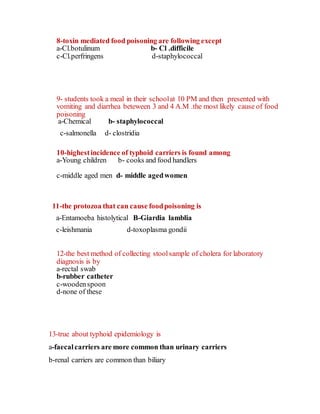
8-toxin mediated food poisoning are following except
a-Cl.botulinum b- Cl .difficile
c-Cl.perfringens d-staphylococcal
9- students took a meal in their schoolat 10 PM and then presented with
vomiting and diarrhea beteween 3 and 4 A.M .the most likely cause of food
poisoning
a-Chemical b- staphylococcal
c-salmonella d- clostridia
10-highestincidence of typhoid carriers is found among
a-Young children b- cooks and food handlers
c-middle aged men d- middle agedwomen
11-the protozoa that can cause foodpoisoning is
a-Entamoeba histolytical B-Giardia lamblia
c-leishmania d-toxoplasma gondii
12-the best method of collecting stoolsample of cholera for laboratory
diagnosis is by
a-rectal swab
b-rubber catheter
c-woodenspoon
d-none of these
13-true about typhoid epidemiology is
a-faecalcarriers are more common than urinary carriers
b-renal carriers are common than biliary
c-chronic urinary carrier not associated with urinary abnormality
14-healthy carriers are seen in the following except
a-pertussis b-typhoid
c-cholera d-diphtheria
15-cholera toxin
a-inhibits the sodium pump system
b-damages the intestinal mucosa
c-stimulates the adenyl cyclase adenosine monophosphate pathway
d-prevents absorption of water and electrolytes from the gut mucosa
16-cholera epidemic true is all except
a-disinfection of excreta
b-immunization of susceptibles
c-chemoprophylaxis
d-isolation of cases
17-practical way to treat chronic carriers of typhoid
a-chemotherapy
b-vaccine
c-cholecystectomy
d-none of the above
18-true about carrier state of cholera is
a-the duration of contact carrier state is more than 10 days
b-a chronic carrier state is frequently found
c-carrierstate may persistfor 2-3 weeks afteran attack
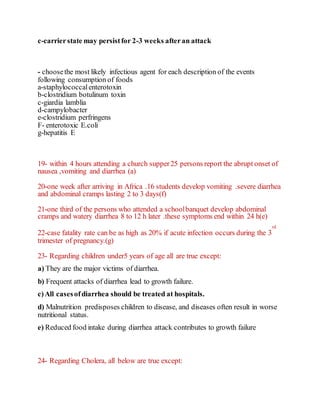
- choosethe most likely infectious agent for each description of the events
following consumption of foods
a-staphylococcalenterotoxin
b-clostridium botulinum toxin
c-giardia lamblia
d-campylobacter
e-clostridium perfringens
F- enterotoxic E.coli
g-hepatitis E
19- within 4 hours attending a church supper25 persons report the abrupt onset of
nausea ,vomiting and diarrhea (a)
20-one week after arriving in Africa .16 students develop vomiting .severe diarrhea
and abdominal cramps lasting 2 to 3 days(f)
21-one third of the persons who attended a schoolbanquet develop abdominal
cramps and watery diarrhea 8 to 12 h later .these symptoms end within 24 h(e)
22-case fatality rate can be as high as 20% if acute infection occurs during the 3
rd
trimester of pregnancy.(g)
23- Regarding children under5 years of age all are true except:
a) They are the major victims of diarrhea.
b) Frequent attacks of diarrhea lead to growth failure.
c)All casesofdiarrhea should be treated at hospitals.
d) Malnutrition predisposes children to disease, and diseases often result in worse
nutritional status.
e) Reduced food intake during diarrhea attack contributes to growth failure
24- Regarding Cholera, all below are true except:
a) Is characterized in its most severe form by a suddenonset of acute watery
diarrhoea that can lead to death by severe dehydration and kidney failure.
b) Incubation period - two hours to five days.
c) Cholera remains a global threat to public health and one of the key indicators of
social development.
d) The use of the parenteralcholera vaccine has been recommendedby WHO
due to its high protective efficacyand no adverse reactions.
e) With proper treatment, the fatality rate should stay below 1%.
25- Concerning Amebiases, all is true except :
a) The causative agent Entamoeba histolytica higher incidence occurs in areas of
poorsanitation.
b) In areas with good sanitations, amebic infections tend to cluster in households
and institution.
c) Transmission mainly through ingestion of fecally contaminated food or water
d) Period of communicability: may continue for months. e) A& B
26- most outbreaks of paralytic polio due to
a-type 1 virus b-type 2 virus
c-type 3 virus d-all of the above
27- which is the following is not true about polio
a-Man is the only reservoir
b-subclinical infection play adominant role in spread of infection
c-females are more commonly affected
d-most vulnerable age is 6 months to 3 years.
28- which is the following host factor promotes cholera infection ?
a-coexisting viral infection
b-coexisting ambeiasis
c-decreasedgastric acidity
d-all of the above
29-the following are features of cholera due to EL tor biotype except
a-higher incidence of milder infection
b-occuranceof chronic carrier state
c-more resistant than classical vibrois
d-more secondarycasesin affectedfamilies
30-an effective step to stop spread infection during an epidemic of polio
a-chlorination of water
b-isolation of cases
c-administration of OPVto all children
d-administration of IPV to all children
31- The amount of bleaching powder necessary to disinfect choleric stools, is
(a) 50 gm/lit (b) 75 gm/lit (c) 90 gm/lit (d) 100 gm/lit
32-true regarding transmission of hepatitis A virus
a-1week before and1week afteronsetof symptoms
b-2week before and 2week after onset of symptoms
c-2 week before onset of symptoms
d-2week after onset of symptoms
33-following a cholera epidemic ,an area is declared free of cholera
a-if no case is reported during the last 48 hours
b-if no death has occurred during the last 48 hours
c-when 10 days have elapsedsince the death,recoveryor isolationof last case
d-when no case or death has occurred for aperiod of
34-the intermediate host involved in transmission of Cysticercosis.
a. Snail
b. Swine
c. Fish
d. Crab
35-choosethe most effective or principal means of control typhoid fever ..
a. Rat control
b. Sanitation
c. Immunization
d. Vector control
e. Deer control
Following multiple reports of cases of Cryptosporidium parvum diagnosed by
private physicians, as medical director of City XYZ Health Department, you
conductan +epidemic investigation leading to the conclusion that the city drinking
water supply is contaminated withC. Parvum
36. Which persons in your city are at highest risk of developing severe infection?
a. The elderly
b. Newborns and young children
c. Diabetics
d. HIV-infected persons
e. Pregnant women
37. What public health advisory measure would you announce to prevent ingestion
of contaminated water?
a. Drink bottled water only
b. Use faucet filters capable of removing particles of 2.0 microns
c. Boilwaterfor 1 minute
d. Disinfect with chlorination
e. Freeze and use thawed water
38. A 10-year-old boywith sicklecell disease presents with headache, anorexia, and
fever. He complains of pain in the right tibia and local inflammation is noted.
Osteomyelitis is diagnosed. The most likely etiologic agent is
a. Listeria
b. Salmonella
c. Shigellosis
d. Cryptosporidium
e. Campylobacter
39- the reservoir for brucellosis is
a. Cattle
b. Humans
c. Rodents
d. Ticks
40. An 8-year-old child is brought to the emergency room with profuse, bloody
diarrhea. The symptoms started about three days ago, but gradually worsened. He
has no fever. His platelet count is 40,000. The most likely source of the enteric
infection is
a. Fish
b. Chicken
c. Milk
d. Eggs
e. Beef
41-Which of the following is the drug of choice for chemoprophylaxis of
cholera?
(a) Tetracycline
(b) Doxycycline
(c) Furazolidone
(d) Co-trimoxazole
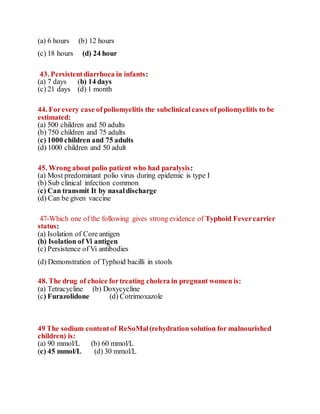
42. The freshly preparedORS (Oral Rehydration Solution) should not be used
after:
(a) 6 hours (b) 12 hours
(c) 18 hours (d) 24 hour
43. Persistentdiarrhoea in infants:
(a) 7 days (b) 14 days
(c) 21 days (d) 1 month
44. Forevery case ofpoliomyelitis the subclinicalcases ofpoliomyelitis to be
estimated:
(a) 500 children and 50 adults
(b) 750 children and 75 adults
(c) 1000 children and 75 adults
(d) 1000 children and 50 adult
45. Wrong about polio patient who had paralysis:
(a) Most predominant polio virus during epidemic is type I
(b) Sub clinical infection common
(c) Can transmit It by nasaldischarge
(d) Can be given vaccine
47-Which one of the following gives strong evidence of Typhoid Fevercarrier
status:
(a) Isolation of Core antigen
(b) Isolation of Vi antigen
(c) Persistence of Vi antibodies
(d) Demonstration of Typhoid bacilli in stools
48. The drug of choice fortreating cholera in pregnant women is:
(a) Tetracycline (b) Doxycycline
(c) Furazolidone (d) Cotrimoxazole
49 The sodium contentof ReSoMal(rehydration solution for malnourished
children) is:
(a) 90 mmol/L (b) 60 mmol/L
(c) 45 mmol/L (d) 30 mmol/L
50. Intermediate host for Hydatid disease is:
(a) Man
(b) Dog
(c) Cat
(d) Fox
51. A5 year old boy passed18 loose stools in last24 hours and vomited twice
in last 4 hours. He is irritable but drinking fluids. The optimal therapy for this
child is:
(a) Intravenous fluids
(b) Oral rehydration therapy
(c) Intravenous fluid initially for 4 hours followed by oral fluids
(d) Plain water add libitum

Mcqs food borne

  • 1.
    MCQ on foodborne diseases By dr Doaa Mohamdy Under supervision of Prof Dr Mona ABOSEREA 1-prevention of human brucellosisdependsprimarilyon a-pasteurizationof dairy products derived from goats ,sheeporcows b- treatment of human cases c- control of the insect vector d-Immunization of farmers e-Destruction of infected animals 2- which of the following complications has been associated with the recall of rotavirus vaccine ? a-guillain-barr syndrome b-hemolytic anemia c-febrile seizures d-intussusception e-neutropenia 3- you are contacted by a local physician who wishes to inform you that she diagnosed and confirmed a case of hepatitis A in one of her patients .a5-year old
  • 2.
    who attends apreschoolcenter .she is concerned about the staff and children attending the schoolcenter .which is the most propermanagement of susceptible contacts? a-immuneglobulin to all staff and children b-vaccine to all staff and children C- immuneglobulin and vaccine to all staff and children d- immunoglobulin only to classroomcontacts 4. Case fatality rate can be as high as 20% if acute infection occurs during the third trimester of pregnancy. a. Hepatitis A virus (HAV) b. Hepatitis B virus (HBV) c. Hepatitis C virus (HCV) d. Hepatitis E virus (HEV) 5- A 36 – year old man is scheduled to travel to Mexico city for a meeting and is concerned about traveler diarrhea .in addition to advising the patient about food safety ,you should recommend which of the following ? a-ciprofloxacin 500 mg daily throughout the trip b- doxycycline 100 mg daily throughout the trip c-amoxicilin 250 mg 3 times daily for 5 days if diarrhea develops d- ciprofloxacin500 mg twice daily for 3 days if diarrhea develops 6-the mechanisms by which cholera might be maintained during the intervals between peak cholera seasons is a-Carrier status in animals b-Carrier status in man c-An environmental reservoir d-Continuous transmissionin man 7-following are constituents of oral rehydration fluid according to WHO except a-NaHCO3 c-KCL b-MgCL2 d-NaCL
  • 3.
    8-toxin mediated foodpoisoning are following except a-Cl.botulinum b- Cl .difficile c-Cl.perfringens d-staphylococcal 9- students took a meal in their schoolat 10 PM and then presented with vomiting and diarrhea beteween 3 and 4 A.M .the most likely cause of food poisoning a-Chemical b- staphylococcal c-salmonella d- clostridia 10-highestincidence of typhoid carriers is found among a-Young children b- cooks and food handlers c-middle aged men d- middle agedwomen 11-the protozoa that can cause foodpoisoning is a-Entamoeba histolytical B-Giardia lamblia c-leishmania d-toxoplasma gondii 12-the best method of collecting stoolsample of cholera for laboratory diagnosis is by a-rectal swab b-rubber catheter c-woodenspoon d-none of these 13-true about typhoid epidemiology is a-faecalcarriers are more common than urinary carriers b-renal carriers are common than biliary
  • 4.
    c-chronic urinary carriernot associated with urinary abnormality 14-healthy carriers are seen in the following except a-pertussis b-typhoid c-cholera d-diphtheria 15-cholera toxin a-inhibits the sodium pump system b-damages the intestinal mucosa c-stimulates the adenyl cyclase adenosine monophosphate pathway d-prevents absorption of water and electrolytes from the gut mucosa 16-cholera epidemic true is all except a-disinfection of excreta b-immunization of susceptibles c-chemoprophylaxis d-isolation of cases 17-practical way to treat chronic carriers of typhoid a-chemotherapy b-vaccine c-cholecystectomy d-none of the above 18-true about carrier state of cholera is a-the duration of contact carrier state is more than 10 days b-a chronic carrier state is frequently found
  • 5.
    c-carrierstate may persistfor2-3 weeks afteran attack - choosethe most likely infectious agent for each description of the events following consumption of foods a-staphylococcalenterotoxin b-clostridium botulinum toxin c-giardia lamblia d-campylobacter e-clostridium perfringens F- enterotoxic E.coli g-hepatitis E 19- within 4 hours attending a church supper25 persons report the abrupt onset of nausea ,vomiting and diarrhea (a) 20-one week after arriving in Africa .16 students develop vomiting .severe diarrhea and abdominal cramps lasting 2 to 3 days(f) 21-one third of the persons who attended a schoolbanquet develop abdominal cramps and watery diarrhea 8 to 12 h later .these symptoms end within 24 h(e) 22-case fatality rate can be as high as 20% if acute infection occurs during the 3 rd trimester of pregnancy.(g) 23- Regarding children under5 years of age all are true except: a) They are the major victims of diarrhea. b) Frequent attacks of diarrhea lead to growth failure. c)All casesofdiarrhea should be treated at hospitals. d) Malnutrition predisposes children to disease, and diseases often result in worse nutritional status. e) Reduced food intake during diarrhea attack contributes to growth failure 24- Regarding Cholera, all below are true except:
  • 6.
    a) Is characterizedin its most severe form by a suddenonset of acute watery diarrhoea that can lead to death by severe dehydration and kidney failure. b) Incubation period - two hours to five days. c) Cholera remains a global threat to public health and one of the key indicators of social development. d) The use of the parenteralcholera vaccine has been recommendedby WHO due to its high protective efficacyand no adverse reactions. e) With proper treatment, the fatality rate should stay below 1%. 25- Concerning Amebiases, all is true except : a) The causative agent Entamoeba histolytica higher incidence occurs in areas of poorsanitation. b) In areas with good sanitations, amebic infections tend to cluster in households and institution. c) Transmission mainly through ingestion of fecally contaminated food or water d) Period of communicability: may continue for months. e) A& B 26- most outbreaks of paralytic polio due to a-type 1 virus b-type 2 virus c-type 3 virus d-all of the above 27- which is the following is not true about polio a-Man is the only reservoir b-subclinical infection play adominant role in spread of infection c-females are more commonly affected d-most vulnerable age is 6 months to 3 years. 28- which is the following host factor promotes cholera infection ? a-coexisting viral infection b-coexisting ambeiasis
  • 7.
    c-decreasedgastric acidity d-all ofthe above 29-the following are features of cholera due to EL tor biotype except a-higher incidence of milder infection b-occuranceof chronic carrier state c-more resistant than classical vibrois d-more secondarycasesin affectedfamilies 30-an effective step to stop spread infection during an epidemic of polio a-chlorination of water b-isolation of cases c-administration of OPVto all children d-administration of IPV to all children 31- The amount of bleaching powder necessary to disinfect choleric stools, is (a) 50 gm/lit (b) 75 gm/lit (c) 90 gm/lit (d) 100 gm/lit 32-true regarding transmission of hepatitis A virus a-1week before and1week afteronsetof symptoms b-2week before and 2week after onset of symptoms c-2 week before onset of symptoms d-2week after onset of symptoms 33-following a cholera epidemic ,an area is declared free of cholera a-if no case is reported during the last 48 hours b-if no death has occurred during the last 48 hours c-when 10 days have elapsedsince the death,recoveryor isolationof last case d-when no case or death has occurred for aperiod of
  • 8.
    34-the intermediate hostinvolved in transmission of Cysticercosis. a. Snail b. Swine c. Fish d. Crab 35-choosethe most effective or principal means of control typhoid fever .. a. Rat control b. Sanitation c. Immunization d. Vector control e. Deer control Following multiple reports of cases of Cryptosporidium parvum diagnosed by private physicians, as medical director of City XYZ Health Department, you conductan +epidemic investigation leading to the conclusion that the city drinking water supply is contaminated withC. Parvum 36. Which persons in your city are at highest risk of developing severe infection? a. The elderly b. Newborns and young children c. Diabetics d. HIV-infected persons e. Pregnant women 37. What public health advisory measure would you announce to prevent ingestion of contaminated water? a. Drink bottled water only b. Use faucet filters capable of removing particles of 2.0 microns c. Boilwaterfor 1 minute d. Disinfect with chlorination e. Freeze and use thawed water 38. A 10-year-old boywith sicklecell disease presents with headache, anorexia, and fever. He complains of pain in the right tibia and local inflammation is noted. Osteomyelitis is diagnosed. The most likely etiologic agent is a. Listeria
  • 9.
    b. Salmonella c. Shigellosis d.Cryptosporidium e. Campylobacter 39- the reservoir for brucellosis is a. Cattle b. Humans c. Rodents d. Ticks 40. An 8-year-old child is brought to the emergency room with profuse, bloody diarrhea. The symptoms started about three days ago, but gradually worsened. He has no fever. His platelet count is 40,000. The most likely source of the enteric infection is a. Fish b. Chicken c. Milk d. Eggs e. Beef 41-Which of the following is the drug of choice for chemoprophylaxis of cholera? (a) Tetracycline (b) Doxycycline (c) Furazolidone (d) Co-trimoxazole 42. The freshly preparedORS (Oral Rehydration Solution) should not be used after:
  • 10.
    (a) 6 hours(b) 12 hours (c) 18 hours (d) 24 hour 43. Persistentdiarrhoea in infants: (a) 7 days (b) 14 days (c) 21 days (d) 1 month 44. Forevery case ofpoliomyelitis the subclinicalcases ofpoliomyelitis to be estimated: (a) 500 children and 50 adults (b) 750 children and 75 adults (c) 1000 children and 75 adults (d) 1000 children and 50 adult 45. Wrong about polio patient who had paralysis: (a) Most predominant polio virus during epidemic is type I (b) Sub clinical infection common (c) Can transmit It by nasaldischarge (d) Can be given vaccine 47-Which one of the following gives strong evidence of Typhoid Fevercarrier status: (a) Isolation of Core antigen (b) Isolation of Vi antigen (c) Persistence of Vi antibodies (d) Demonstration of Typhoid bacilli in stools 48. The drug of choice fortreating cholera in pregnant women is: (a) Tetracycline (b) Doxycycline (c) Furazolidone (d) Cotrimoxazole 49 The sodium contentof ReSoMal(rehydration solution for malnourished children) is: (a) 90 mmol/L (b) 60 mmol/L (c) 45 mmol/L (d) 30 mmol/L
  • 11.
    50. Intermediate hostfor Hydatid disease is: (a) Man (b) Dog (c) Cat (d) Fox 51. A5 year old boy passed18 loose stools in last24 hours and vomited twice in last 4 hours. He is irritable but drinking fluids. The optimal therapy for this child is: (a) Intravenous fluids (b) Oral rehydration therapy (c) Intravenous fluid initially for 4 hours followed by oral fluids (d) Plain water add libitum