Major vectors-borne diseases in
KSA(1): Viral Hemorrhagic Fevers
Objectives
Define vectors and vector-borne diseases.
List the common vectors that can transmit
infectious diseases to human.
Define and discuss the importance of Viral
Hemorrhagic Fevers(VHFs).
Discuss the epidemiology of viral H fevers in KSA.
06/29/18
Prepared by Dr. Sana Abnawf
MD community medicine 2
Vector-borne Diseases-
(Introduction)
Vector-borne diseases are considered the most
serious diseases.
The seriousness of vectors because of their ability
to transmit the disease at a large scale in shorter
time, than other infectious diseases that
necessitate human-to-human contact.
06/29/18
Prepared by Dr. Sana Abnawf
MD community medicine 3
Vector-borne Diseases-
(Introduction)
Vectors can transmit diseases among different
living beings (mice, rats, monkeys, birds, dogs,
etc.) and humans.
Treatment of vector-borne diseases is difficult,
and the prevention essentially necessitates the
elimination of the vector.
06/29/18
Prepared by Dr. Sana Abnawf
MD community medicine 4
Vector-borne Diseases
What are vectors?
Vectors are living organisms that can transmit
infectious diseases between humans, or from animals to
humans.
06/29/18
Prepared by Dr. Sana Abnawf
MD community medicine 5
Vector-Borne Biseases
Vector-borne diseases:-
 Are the diseases caused by disease-vectors.
Often found in tropical regions, where insects prevail,
and access to drinking water and sanitation is not safe.
06/29/18
Prepared by Dr. Sana Abnawf
MD community medicine 6
Disease-vectors
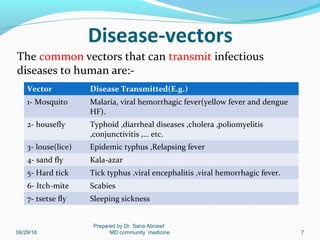
The common vectors that can transmit infectious
diseases to human are:-
06/29/18
Prepared by Dr. Sana Abnawf
MD community medicine 7
Vector Disease Transmitted(E.g.)
1- Mosquito Malaria, viral hemorrhagic fever(yellow fever and dengue
HF).
2- housefly Typhoid ,diarrheal diseases ,cholera ,poliomyelitis
,conjunctivitis ,… etc.
3- louse(lice) Epidemic typhus ,Relapsing fever
4- sand fly Kala-azar
5- Hard tick Tick typhus ,viral encephalitis ,viral hemorrhagic fever.
6- Itch-mite Scabies
7- tsetse fly Sleeping sickness
Mosquito
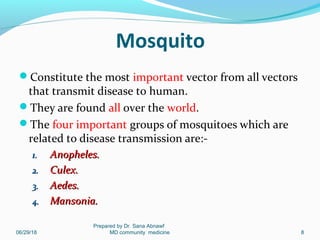
Constitute the most important vector from all vectors
that transmit disease to human.
They are found all over the world.
The four important groups of mosquitoes which are
related to disease transmission are:-
1.1. Anopheles.Anopheles.
2.2. Culex.Culex.
3.3. Aedes.Aedes.
4.4. Mansonia.Mansonia.
06/29/18
Prepared by Dr. Sana Abnawf
MD community medicine 8
Mosquito-borne diseases
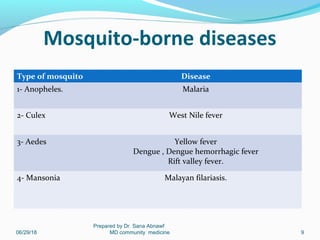
Type of mosquito Disease
1- Anopheles. Malaria
2- Culex West Nile fever
3- Aedes Yellow fever
Dengue , Dengue hemorrhagic fever
Rift valley fever.
4- Mansonia Malayan filariasis.
06/29/18
Prepared by Dr. Sana Abnawf
MD community medicine 9
Viral Hemorrhagic Fevers(VHFs)
VHFs refers to a group of diseases, Caused by several
families of viruses that affect humans and animals.
characterized by:-
oAcute febrile syndrome.
oHemorrhagic manifestations.
oHigh mortality rates.
oEndemic in certain geographical regions.
oSometimes cause major outbreaks.
06/29/18 Prepared by Dr. Sana Abnawf
MD community medicine
10
Viral Hemorrhagic Fevers(VHFs)
The VHFs include infections caused by viruses of the
families :
Flaviviridae (dengue fever, yellow fever, Omsk
hemorrhagic fever, Kyasanur Forest disease, Alkhurma
hemorrhagic fever [AHF]).
Bunyaviridae (Crimean-Congo hemorrhagic fever
[CCHF], Rift Valley fever [RVF], and Hantavirus
diseases).
Arenaviridae (Argentine, Bolivian, Brazilian, and
Venezuelan hemorrhagic fevers and Lassa fever),
Filoviridae (Ebola and Marburg hemorrhagic fevers).
06/29/18
Prepared by Dr. Sana Abnawf
MD community medicine 11
Viral Hemorrhagic Fevers in KSA
The history of hemorrhagic fevers in the Arabian
Peninsula refers to 19th century . The first
recorded outbreak of a dengue-like disease, which
occurred from 1870 to 1873.
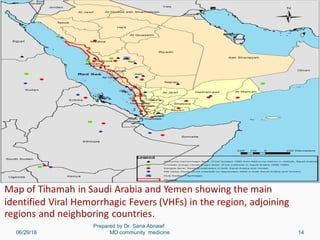
Most outbreaks were reported in the :Tihamah
region—The Red Sea coastal plain in the west and
southwest of Saudi Arabia and Yemen.
06/29/18
Prepared by Dr. Sana Abnawf
MD community medicine 12
Viral Hemorrhagic Fevers in KSA
The most common in Saudi Arabia are:-
Dengue fever.
Rift Valley fever.
Alkhurma hemorrhagic fever.
And Crimean-Congo hemorrhagic fever
(CCHF).
06/29/18
Prepared by Dr. Sana Abnawf
MD community medicine 13
06/29/18
Prepared by Dr. Sana Abnawf
MD community medicine 14
Dengue fever and dengue
hemorrhagic fever
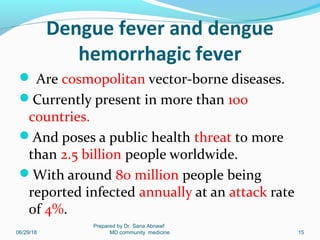
 Are cosmopolitan vector-borne diseases.
Currently present in more than 100
countries.
And poses a public health threat to more
than 2.5 billion people worldwide.
With around 80 million people being
reported infected annually at an attack rate
of 4%.
06/29/18
Prepared by Dr. Sana Abnawf
MD community medicine 15
Dengue fever and dengue
hemorrhagic fever
Dengue virus is the most common arbovirus infection that
belongs to the family Flaviviridae/genus Flavivirus .
Can be transmitted by the bite of infective female
mosquitoes of the species Aedes aegypti ; and, to a lesser
extent, A. albopictus.
There are four serotypes dengue virus (DENV1–4).
But infection with one of them does not provide cross-
protective immunity against the other serotypes.
06/29/18
Prepared by Dr. Sana Abnawf
MD community medicine 16
Dengue fever and dengue
hemorrhagic fever
After an incubation period of two to five
days, dengue virus may cause:
Mild flu-like illness.
Or quickly progresses to serious dengue
hemorrhagic fever–dengue shock syndrome.
06/29/18
Prepared by Dr. Sana Abnawf
MD community medicine 17
Dengue fever and dengue
hemorrhagic fever in KSA
In the some parts of Saudi Arabia, Dengue fever
has:
Major effect on human populations' wellbeing.
 And the country's economy.
Specifically in Jeddah city, which is one of the
main entry points to Saudi Arabia.
06/29/18
Prepared by Dr. Sana Abnawf
MD community medicine 18
History of Dengue in KSA
In 1990 an outbreak was reported for the first time in
Jeddah.
From 1994 to 2002,the refer laboratory in Jeddah reported
319 cases.
Next , two peaks were reported in 2005/2006,and another
two in 2008.
Dengue is now endemic in the western and southern
regions of KSA.
06/29/18
Prepared by Dr. Sana Abnawf
MD community medicine 19
Alkhurma hemorrhagic fever
Alkhurma hemorrhagic fever is caused by Alkhurma
hemorrhagic fever virus (AHFV) which is :-
A tick-borne encephalitis Flavivirus .
Can be transmitted by the bite of soft and
hard ticks (found in camels and sheep) .
06/29/18
Prepared by Dr. Sana Abnawf
MD community medicine 20
Alkhurma hemorrhagic fever
Alkhurma hemorrhagic fever virus (AHFV) :-
It was first isolated in Saudi Arabia and described
as a unique viral agent of Arabian Peninsula .
Significantly, AHFV shares a high similarity with
Kyasanur Forest disease virus, which was isolated in
India
06/29/18
Prepared by Dr. Sana Abnawf
MD community medicine 21
Alkhurma hemorrhagic fever
AHF is a zoonotic disease and clinical cases
have been attributed to exposure to
livestock (camels and sheep).
AHFV is not isolated yet from such
animals.
06/29/18
Prepared by Dr. Sana Abnawf
MD community medicine 22
Alkhurma hemorrhagic fever
After an incubation period of two to four days, the
disease presents initially with nonspecific influenza
like symptoms, including fever, anorexia, malaise,
diarrhea, and vomiting.
A second phase includes neurologic and hemorrhagic
symptoms in severe form.
Multi-organ failure leads to fatal outcomes.
06/29/18
Prepared by Dr. Sana Abnawf
MD community medicine 23
Alkhurma hemorrhagic fever
in KSA
It was isolated for the first time in 1995 in Jeddah from six
patients in Alkhurma district .
Since its first description, several hundred cases have been
reported in different western Saudi governorates.
AHFV was identified in Mecca from 2001 to 2003.
Several sporadic cases were recorded in Najran from 2003
to 2009.
Cases peaking in spring and summer.
06/29/18
Prepared by Dr. Sana Abnawf
MD community medicine 24
Bobbie Rae Erickson (center, in black) of CDC's Special Pathogens
Branch meets with Saudi and other scientists near a goat pen to learn
about Alkhurma virus transmission in livestock.
06/29/18
Prepared by Dr. Sana Abnawf
MD community medicine 25
Pierre Rollin (center) and Adam MacNeil (right) of CDC's Special
Pathogens Branch inspect a camel for ticks carrying the Alkhurma
virus.
06/29/18
Prepared by Dr. Sana Abnawf
MD community medicine 26
Crimean-Congo hemorrhagic fever
CCHF is caused by infection with a tick-borne
virus Nairovirus.
It is the most widespread tick-borne viral infection of
humans.
And the second most widespread of all medically
important arboviruses after dengue viruses.
CCHFV causes a subclinical disease in most livestock.
06/29/18
Prepared by Dr. Sana Abnawf
MD community medicine 27
Crimean-Congo hemorrhagic fever
CCHF virus was first recognized in Crimea in southeastern
in the mid-1940s and named Crimean hemorrhagic fever .
Then, it was isolated in Congo in 1969.
Thus resulting in the name of the disease.
Currently, CCHF is endemic in many countries in Africa,
Europe, and Asia.
The CCHF is related to Eid-al-Adha feast due to lack of
controlling livestock movements in and between countries
06/29/18 Prepared by Dr. Sana Abnawf
MD community medicine
28
Crimean-Congo hemorrhagic fever
in KSA
Outbreaks of CCHF have been reported in western
Saudi Arabia (1989–1990) .
It was suspected that the CCHF virus was introduced
to Saudi Arabia by infected ticks on imported
livestock (camels, cattle, sheep, goats, and buffaloes),
arriving to the Jeddah seaport.
The main risk factor was the exposure to the blood or
tissue of livestock in abattoirs, but not tick bites .
06/29/18
Prepared by Dr. Sana Abnawf
MD community medicine 29
Rift Valley fever
RVF is a vector-borne zoonotic disease .
Caused by a Phlebovirus .
RVF virus is:
Transmitted by Culex and A. aegypti mosquitoes.
 resulting in large epizootics in livestock, which causes
abortion in pregnant ruminants and rapid death in
neonates.
06/29/18
Prepared by Dr. Sana Abnawf
MD community medicine 30
Rift Valley fever
Humans are incidentally infected when:-
They are bitten by infected mosquitoes.
Contact with aborted or infected animal tissues.
Or drink unpasteurized milk.
RVF virus is also a potential bioterrorism agent.
06/29/18
Prepared by Dr. Sana Abnawf
MD community medicine 31
Rift Valley fever
Humans suffering from RVF suffer influenza-like
symptoms .
After the initial febrile stage, in some cases, can
develop into ;
hemorrhagic fever.
 encephalitis.
 and death.
06/29/18
Prepared by Dr. Sana Abnawf
MD community medicine 32
Rift Valley fever in KSA
RVF was historically restricted to the Africa.
In 2000, RVF virus caused two simultaneous outbreaks in
Yemen and Saudi Arabia.
On September 15, 2000, the US Centers for Disease
Control and Prevention (CDC) isolated RVF virus from
Saudi Arabia.
Saudi Arabia reported 882 human cases and 124 deaths.
06/29/18
Prepared by Dr. Sana Abnawf
MD community medicine 33
Prevention of vector borne
diseases
Precautions for Protection against Disease-vectors:
Fight the vectors that transmit such diseases, as well as the
places where their larvae exist, by using proper insecticides.
Removing things that could probably provide a place for
water rafting.
Putting on long-sleeved wears, and covering legs at places
where insects exist, and using insect repellants.
06/29/18
Prepared by Dr. Sana Abnawf
MD community medicine 34
Prevention of vector borne
diseases
Precautions for Protection against Disease-vectors:
 Using nets at doors and windows to prevent the entrance
of insects.
Using mosquito nets when sleeping outdoors.
Paying attention to the cleanliness of animals and animal
pens.
Maintaining personal hygiene .
06/29/18
Prepared by Dr. Sana Abnawf
MD community medicine 35
Prevention of vector borne
diseases
Precautions for Protection against Disease-vectors:
Avoiding travelling to the countries / places
stricken by vector-borne diseases
And making sure to take the necessary preventive
drugs and vaccines when travelling .
06/29/18
Prepared by Dr. Sana Abnawf
MD community medicine 36
References
Preventive and social medicine- k . PARK.
Epidemiology Leon Gordis .
https://www.cdc.gov.
https://www.moh.gov.sa.
https:// www.who.int.
06/29/18
Prepared by Dr. Sana Abnawf
MD community medicine 37

Vectors borne diseases 1

  • 1.
    Major vectors-borne diseasesin KSA(1): Viral Hemorrhagic Fevers
  • 2.
    Objectives Define vectors andvector-borne diseases. List the common vectors that can transmit infectious diseases to human. Define and discuss the importance of Viral Hemorrhagic Fevers(VHFs). Discuss the epidemiology of viral H fevers in KSA. 06/29/18 Prepared by Dr. Sana Abnawf MD community medicine 2
  • 3.
    Vector-borne Diseases- (Introduction) Vector-borne diseasesare considered the most serious diseases. The seriousness of vectors because of their ability to transmit the disease at a large scale in shorter time, than other infectious diseases that necessitate human-to-human contact. 06/29/18 Prepared by Dr. Sana Abnawf MD community medicine 3
  • 4.
    Vector-borne Diseases- (Introduction) Vectors cantransmit diseases among different living beings (mice, rats, monkeys, birds, dogs, etc.) and humans. Treatment of vector-borne diseases is difficult, and the prevention essentially necessitates the elimination of the vector. 06/29/18 Prepared by Dr. Sana Abnawf MD community medicine 4
  • 5.
    Vector-borne Diseases What arevectors? Vectors are living organisms that can transmit infectious diseases between humans, or from animals to humans. 06/29/18 Prepared by Dr. Sana Abnawf MD community medicine 5
  • 6.
    Vector-Borne Biseases Vector-borne diseases:- Are the diseases caused by disease-vectors. Often found in tropical regions, where insects prevail, and access to drinking water and sanitation is not safe. 06/29/18 Prepared by Dr. Sana Abnawf MD community medicine 6
  • 7.
    Disease-vectors The common vectorsthat can transmit infectious diseases to human are:- 06/29/18 Prepared by Dr. Sana Abnawf MD community medicine 7 Vector Disease Transmitted(E.g.) 1- Mosquito Malaria, viral hemorrhagic fever(yellow fever and dengue HF). 2- housefly Typhoid ,diarrheal diseases ,cholera ,poliomyelitis ,conjunctivitis ,… etc. 3- louse(lice) Epidemic typhus ,Relapsing fever 4- sand fly Kala-azar 5- Hard tick Tick typhus ,viral encephalitis ,viral hemorrhagic fever. 6- Itch-mite Scabies 7- tsetse fly Sleeping sickness
  • 8.
    Mosquito Constitute the mostimportant vector from all vectors that transmit disease to human. They are found all over the world. The four important groups of mosquitoes which are related to disease transmission are:- 1.1. Anopheles.Anopheles. 2.2. Culex.Culex. 3.3. Aedes.Aedes. 4.4. Mansonia.Mansonia. 06/29/18 Prepared by Dr. Sana Abnawf MD community medicine 8
  • 9.
    Mosquito-borne diseases Type ofmosquito Disease 1- Anopheles. Malaria 2- Culex West Nile fever 3- Aedes Yellow fever Dengue , Dengue hemorrhagic fever Rift valley fever. 4- Mansonia Malayan filariasis. 06/29/18 Prepared by Dr. Sana Abnawf MD community medicine 9
  • 10.
    Viral Hemorrhagic Fevers(VHFs) VHFsrefers to a group of diseases, Caused by several families of viruses that affect humans and animals. characterized by:- oAcute febrile syndrome. oHemorrhagic manifestations. oHigh mortality rates. oEndemic in certain geographical regions. oSometimes cause major outbreaks. 06/29/18 Prepared by Dr. Sana Abnawf MD community medicine 10
  • 11.
    Viral Hemorrhagic Fevers(VHFs) TheVHFs include infections caused by viruses of the families : Flaviviridae (dengue fever, yellow fever, Omsk hemorrhagic fever, Kyasanur Forest disease, Alkhurma hemorrhagic fever [AHF]). Bunyaviridae (Crimean-Congo hemorrhagic fever [CCHF], Rift Valley fever [RVF], and Hantavirus diseases). Arenaviridae (Argentine, Bolivian, Brazilian, and Venezuelan hemorrhagic fevers and Lassa fever), Filoviridae (Ebola and Marburg hemorrhagic fevers). 06/29/18 Prepared by Dr. Sana Abnawf MD community medicine 11
  • 12.
    Viral Hemorrhagic Feversin KSA The history of hemorrhagic fevers in the Arabian Peninsula refers to 19th century . The first recorded outbreak of a dengue-like disease, which occurred from 1870 to 1873. Most outbreaks were reported in the :Tihamah region—The Red Sea coastal plain in the west and southwest of Saudi Arabia and Yemen. 06/29/18 Prepared by Dr. Sana Abnawf MD community medicine 12
  • 13.
    Viral Hemorrhagic Feversin KSA The most common in Saudi Arabia are:- Dengue fever. Rift Valley fever. Alkhurma hemorrhagic fever. And Crimean-Congo hemorrhagic fever (CCHF). 06/29/18 Prepared by Dr. Sana Abnawf MD community medicine 13
  • 14.
    06/29/18 Prepared by Dr.Sana Abnawf MD community medicine 14
  • 15.
    Dengue fever anddengue hemorrhagic fever  Are cosmopolitan vector-borne diseases. Currently present in more than 100 countries. And poses a public health threat to more than 2.5 billion people worldwide. With around 80 million people being reported infected annually at an attack rate of 4%. 06/29/18 Prepared by Dr. Sana Abnawf MD community medicine 15
  • 16.
    Dengue fever anddengue hemorrhagic fever Dengue virus is the most common arbovirus infection that belongs to the family Flaviviridae/genus Flavivirus . Can be transmitted by the bite of infective female mosquitoes of the species Aedes aegypti ; and, to a lesser extent, A. albopictus. There are four serotypes dengue virus (DENV1–4). But infection with one of them does not provide cross- protective immunity against the other serotypes. 06/29/18 Prepared by Dr. Sana Abnawf MD community medicine 16
  • 17.
    Dengue fever anddengue hemorrhagic fever After an incubation period of two to five days, dengue virus may cause: Mild flu-like illness. Or quickly progresses to serious dengue hemorrhagic fever–dengue shock syndrome. 06/29/18 Prepared by Dr. Sana Abnawf MD community medicine 17
  • 18.
    Dengue fever anddengue hemorrhagic fever in KSA In the some parts of Saudi Arabia, Dengue fever has: Major effect on human populations' wellbeing.  And the country's economy. Specifically in Jeddah city, which is one of the main entry points to Saudi Arabia. 06/29/18 Prepared by Dr. Sana Abnawf MD community medicine 18
  • 19.
    History of Denguein KSA In 1990 an outbreak was reported for the first time in Jeddah. From 1994 to 2002,the refer laboratory in Jeddah reported 319 cases. Next , two peaks were reported in 2005/2006,and another two in 2008. Dengue is now endemic in the western and southern regions of KSA. 06/29/18 Prepared by Dr. Sana Abnawf MD community medicine 19
  • 20.
    Alkhurma hemorrhagic fever Alkhurmahemorrhagic fever is caused by Alkhurma hemorrhagic fever virus (AHFV) which is :- A tick-borne encephalitis Flavivirus . Can be transmitted by the bite of soft and hard ticks (found in camels and sheep) . 06/29/18 Prepared by Dr. Sana Abnawf MD community medicine 20
  • 21.
    Alkhurma hemorrhagic fever Alkhurmahemorrhagic fever virus (AHFV) :- It was first isolated in Saudi Arabia and described as a unique viral agent of Arabian Peninsula . Significantly, AHFV shares a high similarity with Kyasanur Forest disease virus, which was isolated in India 06/29/18 Prepared by Dr. Sana Abnawf MD community medicine 21
  • 22.
    Alkhurma hemorrhagic fever AHFis a zoonotic disease and clinical cases have been attributed to exposure to livestock (camels and sheep). AHFV is not isolated yet from such animals. 06/29/18 Prepared by Dr. Sana Abnawf MD community medicine 22
  • 23.
    Alkhurma hemorrhagic fever Afteran incubation period of two to four days, the disease presents initially with nonspecific influenza like symptoms, including fever, anorexia, malaise, diarrhea, and vomiting. A second phase includes neurologic and hemorrhagic symptoms in severe form. Multi-organ failure leads to fatal outcomes. 06/29/18 Prepared by Dr. Sana Abnawf MD community medicine 23
  • 24.
    Alkhurma hemorrhagic fever inKSA It was isolated for the first time in 1995 in Jeddah from six patients in Alkhurma district . Since its first description, several hundred cases have been reported in different western Saudi governorates. AHFV was identified in Mecca from 2001 to 2003. Several sporadic cases were recorded in Najran from 2003 to 2009. Cases peaking in spring and summer. 06/29/18 Prepared by Dr. Sana Abnawf MD community medicine 24
  • 25.
    Bobbie Rae Erickson(center, in black) of CDC's Special Pathogens Branch meets with Saudi and other scientists near a goat pen to learn about Alkhurma virus transmission in livestock. 06/29/18 Prepared by Dr. Sana Abnawf MD community medicine 25
  • 26.
    Pierre Rollin (center)and Adam MacNeil (right) of CDC's Special Pathogens Branch inspect a camel for ticks carrying the Alkhurma virus. 06/29/18 Prepared by Dr. Sana Abnawf MD community medicine 26
  • 27.
    Crimean-Congo hemorrhagic fever CCHFis caused by infection with a tick-borne virus Nairovirus. It is the most widespread tick-borne viral infection of humans. And the second most widespread of all medically important arboviruses after dengue viruses. CCHFV causes a subclinical disease in most livestock. 06/29/18 Prepared by Dr. Sana Abnawf MD community medicine 27
  • 28.
    Crimean-Congo hemorrhagic fever CCHFvirus was first recognized in Crimea in southeastern in the mid-1940s and named Crimean hemorrhagic fever . Then, it was isolated in Congo in 1969. Thus resulting in the name of the disease. Currently, CCHF is endemic in many countries in Africa, Europe, and Asia. The CCHF is related to Eid-al-Adha feast due to lack of controlling livestock movements in and between countries 06/29/18 Prepared by Dr. Sana Abnawf MD community medicine 28
  • 29.
    Crimean-Congo hemorrhagic fever inKSA Outbreaks of CCHF have been reported in western Saudi Arabia (1989–1990) . It was suspected that the CCHF virus was introduced to Saudi Arabia by infected ticks on imported livestock (camels, cattle, sheep, goats, and buffaloes), arriving to the Jeddah seaport. The main risk factor was the exposure to the blood or tissue of livestock in abattoirs, but not tick bites . 06/29/18 Prepared by Dr. Sana Abnawf MD community medicine 29
  • 30.
    Rift Valley fever RVFis a vector-borne zoonotic disease . Caused by a Phlebovirus . RVF virus is: Transmitted by Culex and A. aegypti mosquitoes.  resulting in large epizootics in livestock, which causes abortion in pregnant ruminants and rapid death in neonates. 06/29/18 Prepared by Dr. Sana Abnawf MD community medicine 30
  • 31.
    Rift Valley fever Humansare incidentally infected when:- They are bitten by infected mosquitoes. Contact with aborted or infected animal tissues. Or drink unpasteurized milk. RVF virus is also a potential bioterrorism agent. 06/29/18 Prepared by Dr. Sana Abnawf MD community medicine 31
  • 32.
    Rift Valley fever Humanssuffering from RVF suffer influenza-like symptoms . After the initial febrile stage, in some cases, can develop into ; hemorrhagic fever.  encephalitis.  and death. 06/29/18 Prepared by Dr. Sana Abnawf MD community medicine 32
  • 33.
    Rift Valley feverin KSA RVF was historically restricted to the Africa. In 2000, RVF virus caused two simultaneous outbreaks in Yemen and Saudi Arabia. On September 15, 2000, the US Centers for Disease Control and Prevention (CDC) isolated RVF virus from Saudi Arabia. Saudi Arabia reported 882 human cases and 124 deaths. 06/29/18 Prepared by Dr. Sana Abnawf MD community medicine 33
  • 34.
    Prevention of vectorborne diseases Precautions for Protection against Disease-vectors: Fight the vectors that transmit such diseases, as well as the places where their larvae exist, by using proper insecticides. Removing things that could probably provide a place for water rafting. Putting on long-sleeved wears, and covering legs at places where insects exist, and using insect repellants. 06/29/18 Prepared by Dr. Sana Abnawf MD community medicine 34
  • 35.
    Prevention of vectorborne diseases Precautions for Protection against Disease-vectors:  Using nets at doors and windows to prevent the entrance of insects. Using mosquito nets when sleeping outdoors. Paying attention to the cleanliness of animals and animal pens. Maintaining personal hygiene . 06/29/18 Prepared by Dr. Sana Abnawf MD community medicine 35
  • 36.
    Prevention of vectorborne diseases Precautions for Protection against Disease-vectors: Avoiding travelling to the countries / places stricken by vector-borne diseases And making sure to take the necessary preventive drugs and vaccines when travelling . 06/29/18 Prepared by Dr. Sana Abnawf MD community medicine 36
  • 37.
    References Preventive and socialmedicine- k . PARK. Epidemiology Leon Gordis . https://www.cdc.gov. https://www.moh.gov.sa. https:// www.who.int. 06/29/18 Prepared by Dr. Sana Abnawf MD community medicine 37