Environmental aspects of
Emerging diseases
NEETHU ASOKAN
Emerging infectious disease
Newly identified & previously unknown
infectious agents that cause public health problems
either locally or internationally
Re-emerging infectious disease
Infectious agents that have been known for
some time, had fallen to such low levels that they
were no longer considered public health problems &
are now showing upward trends in incidence or
prevalence worldwide
Definition
NEETHU ASOKAN
Factors studied Examples
1. Biological----------Genes, microbes, medicines, vaccines, blood
and organ transplants, rapid microbial adaptation and resistance to
antibiotics
2. Environment: physical--------Air, water, toxins, radiation,
pollution, noise, agricultural development, climate change,
technology
3. Environment: social ---------Housing, education,
employment, and working conditions
NEETHU ASOKAN
 Inhalation
 Ingestion
 Sneezing
 Coughing
 Food, water, soil
 Percutaneous inoculation
 Exposure to blood and body
fluids
 Direct animal contact
NEETHU ASOKAN
Science: Pathways for Diseases in Humans
Infectious
Pets Livestock
Wild
animals Insects Food Water Air
Fetus and babies
Other humans Humans
NEETHU ASOKAN
Examples of recent
emerging diseases
NEETHU ASOKAN
 Ebola virus disease (formerly known as Ebola hemorrhagic
fever) is:
 A disease caused by the Ebola virus
 Is severe- fatality rate 90%
 Affects human and non human primates
NEETHU ASOKAN
History of Ebola virus
• Ebola first appeared in 1976 in two simultaneous
outbreaks.
- Near the Ebola River in the Democratic
Republic of Congo
- A remote area of Sudan.
• 1975 cases
• 1069 deaths
• From Guinea, Liberia, Nigeria, and
Sierra Leone ( WHO 2014/8/14)
NEETHU ASOKAN
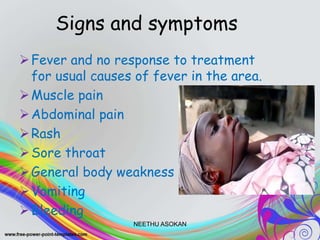
Signs and symptoms
Fever and no response to treatment
for usual causes of fever in the area.
Muscle pain
Abdominal pain
Rash
Sore throat
General body weakness
Vomiting
Bleeding
NEETHU ASOKAN
Ebola Hemorrhagic Fever
Ebola (5 species)
• Sudan
• Zaire
• Ivory Coast
• Reston Agent
• Uganda
First appearance in 1976
Sporadic outbreaks
NEETHU ASOKAN
Country
Total Cases (Suspected,
Probable, and Confirmed)
Laboratory-Confirmed
Cases Total Deaths
Guinea 3175 2781 2101
Liberia 9265 3153 4057
Sierra Leone 11341 8308 3479
Total 23781 14242 9637
2014 Ebola Outbreak in West
Africa - Case Counts
NEETHU ASOKAN
EBOLA
• This is a severe viral illness caused by the
Ebola virus (Filoviridae family) with its
reservoir in Fruit bats ,chimpanzees and
gorillas
• Symptoms: sudden onset of fever, myalgia,
headache, followed by vomiting, diarrhea,
and rash.
• Mortality: from 50 to 90 % in Africa
• Complications: In severe forms, multi organ
failure occurs, primarily hemorrhagic and
pulmonary complications
NEETHU ASOKAN
 The virus is transmitted to people
from wild animals and spreads in the
human population through human-to-
human transmission.
 Fruit bats of the Pteropodidae family
are considered to be the natural host
of the Ebola virus.
Fruit bats transmitted to people
NEETHU ASOKAN
EBOLA
• Mode of transmission: handling
infected wild animals
• Incubation period: 2 to 21 days
• Transmission: may be spread person
to person by contact with body
secretions
• Treatment: supportive
• Prevention: caution in contact with
infected monkeys and Fruit batsNEETHU ASOKAN
Swine Flu
Influenza A (H1N1)
NEETHU ASOKAN
 H1N1, which caused Spanish Flu in 1918, and Swine Flu in
2009
 H2N2, which caused Asian Flu in 1957
 H3N2, which caused Hong Kong Flu in 1968
 H5N1, which caused Bird Flu in 2004
 H7N7, which has unusual zoonotic potential[35]
 H1N2, endemic in humans, pigs and birds
 H9N2
 H7N2
 H7N3
 H10N7
 H7N9
Influenzavirus A
Influenzavirus B
Influenzavirus A
Influenzavirus C
NEETHU ASOKAN
Neuraminidase (N)
Hemagglutinin (H)
RNA
(highly mutagenic)
M2 protein
(only on type A)
Influenza Surface
Proteins
NEETHU ASOKAN
Highly Pathogenic Avian
Influenza (H5N1)
NEETHU ASOKAN
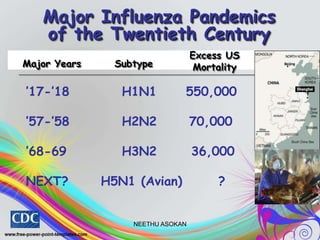
Major Influenza Pandemics
of the Twentieth Century
Major Years Subtype
Excess US
Mortality
’17-’18 H1N1 550,000
’57-’58 H2N2 70,000
’68-69 H3N2 36,000
NEXT? H5N1 (Avian) ?
NEETHU ASOKAN
SARS
(SEVERE ACUTE RESPIRATORY SYNDROME)
NEETHU ASOKAN
SARS-BASIC FACTS
• SARS is an illness which can vary in
severity and is caused by a Corona virus
most likely of animal origin, e. g. civet
• The disease is spread by large respiratory
droplets from sneezing and coughing within
a radius of 6 to 8 feet.
• Incubation period-3 to 10 days
• It can survive on surfaces up to 3 days but
is easily killed by standard disinfectantsNEETHU ASOKAN
Treatment
Antibiotic therapy
 Levofloaxacin 500 mg daily once
 Clarithromycin 500 mg daily twice
Antiviral therapy
 Ribavirin
NEETHU ASOKAN
WEST NILE VIRUS
NEETHU ASOKAN
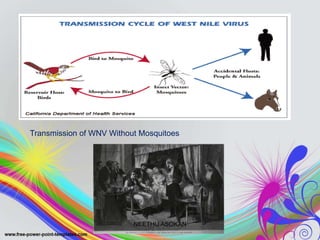
FACTS ABOUT WNV
• West Nile Fever is a “flu-like” illness of
sudden onset, caused by a subgroup of
viruses called Flavoviruses
• Symptoms: fever, sore throat, headache,
malaise, arthralgia or myalgia. Rash is
common.
• Complications: meningitis or encephalitis
(inflammation of the brain tissue or the
covering of the brain) can occur. The
disease is then named West Nile
neuroinvasive disease
• Reservoir: certain birdsNEETHU ASOKAN
Transmission of WNV Without Mosquitoes
NEETHU ASOKAN
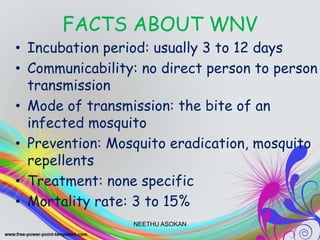
FACTS ABOUT WNV
• Incubation period: usually 3 to 12 days
• Communicability: no direct person to person
transmission
• Mode of transmission: the bite of an
infected mosquito
• Prevention: Mosquito eradication, mosquito
repellents
• Treatment: none specific
• Mortality rate: 3 to 15%
NEETHU ASOKAN
MONKEY POX
NEETHU ASOKAN
MONKEY POX
• Monkey pox, an Orthopox virus caused
infection, closely resembles small pox
clinically
• Recently transmitted to humans by prairie
dogs infected by a Gambian giant rat
imported from Africa
• Symptoms: fever, rash, muscle aches, cough
• Mortality: 1 to 10% in Africa, none in the
US
NEETHU ASOKAN
MONKEY POX
• Transmission: person to person has
occurred
• Treatment: antibiotics, small pox
vaccination if early in the course of the
disease
• Prevention: small pox vaccination is
partially successful, public education
about the dangers of illegally imported
pets
NEETHU ASOKAN
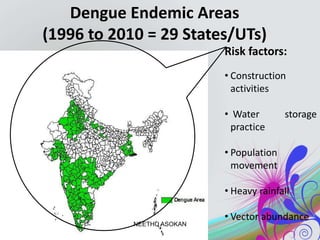
Dengue Endemic Areas
(1996 to 2010 = 29 States/UTs)
Risk factors:
• Construction
activities
• Water storage
practice
• Population
movement
• Heavy rainfall
• Vector abundance
NEETHU ASOKAN
NEETHU ASOKAN
WHAT IS DENDUE ?
 Dengue is a viral disease
 It is transmitted by the infective bite of female Aedes
Aegypti mosquito
 Man develops disease after 5-6 days of being bitten by an
infective mosquito
 It occurs in two forms: Dengue Fever and Dengue
Haemorrhagic Fever(DHF)
 Dengue Fever is a severe, flu-like illness (Influenza)
 Dengue Haemorrhagic Fever (DHF) is a more severe form of
disease, which may cause death
 Person suspected of having dengue fever or DHF must see a
doctor at once NEETHU ASOKAN
NEETHU ASOKAN
Chikungunya
 Chikungunya is an infection caused by the chikungunya virus. The
disease features the sudden onset of fever two to four days
after exposure.
 Chikungunya virus, also referred to as CHIKV, is a member of
the alphavirus genus, and Togaviridae family. It is an RNA
virus with apositive-sense single-stranded genome of about
11.6kb.
 The fever usually lasts two to seven days, while
accompanying joint pains typically last weeks or months but
sometimes years.
NEETHU ASOKAN
Transmission
 Chikungunya is generally transmitted from mosquitoes to humans. Less
common modes of transmission include vertical transmission, transmission
from mother to child during pregnancy or at birth.
 Transmission via infected blood products and through organ donation is
also theoretically possible during times of outbreak, though no cases have
yet been documented.
 Chikungunya is related to mosquitoes, their environments, and human
behavior.
 Chikungunya is spread through bites from Aedes mosquitoes, and the
species A. aegypti was identified as the most common vector, though the
virus has recently been associated with many other species, including A.
albopictus.[
NEETHU ASOKAN
Vaccine
 Currently, no approved vaccines are available. A phase-II vaccine trial
used a live, attenuated virus, to develop viral resistance in 98% of those
tested after 28 days and 85% still showed resistance after one year.
Treatment
 Currently, no specific treatment for chikungunya is available.
 Supportive care is recommended, and symptomatic treatment of fever
and joint swelling includes the use ofnonsteroidal anti-inflammatory
drugs such as naproxen, non-aspirin analgesics such
as paracetamol (acetaminophen) and fluids.
NEETHU ASOKAN
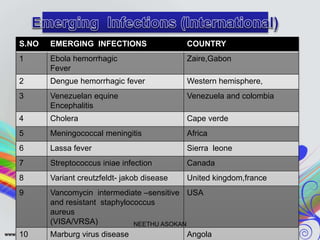
S.NO EMERGING INFECTIONS COUNTRY
1 Ebola hemorrhagic
Fever
Zaire,Gabon
2 Dengue hemorrhagic fever Western hemisphere,
3 Venezuelan equine
Encephalitis
Venezuela and colombia
4 Cholera Cape verde
5 Meningococcal meningitis Africa
6 Lassa fever Sierra leone
7 Streptococcus iniae infection Canada
8 Variant creutzfeldt- jakob disease United kingdom,france
9 Vancomycin intermediate –sensitive
and resistant staphylococcus
aureus
(VISA/VRSA)
USA
10 Marburg virus disease Angola
NEETHU ASOKAN
S.NO Year Infections Location
1 1990 Multidrug –resistant (ACCo) salmonella typhi Most Indian states
2 1991 Vibrio cholerae o139 Suoth India,west Bengal
3 1994 Plague Maharashtra and Gujarat
4 1996 Dengue hemorrhagic fever North india
5 2000 Faciolopsiasis Azamgarh, UP
6 2001 Acinetobacter baumannii Manipal, Delhi
7 2001 Pichia anomala Chandigarh
8 2001 Rotavirus G4P8 Kolkata
9 2001 Low level penicillin resistance in streptococcus
pneumoniae
Pondicherry, Delhi,Vellore
10 2002 West Nile virus Maharashtra,Rajasthan,Goa,Orissa
11 2003 Nalidixic acid –resistant Salmonella typhi Delhi, Mumbai
12 2005 Meningococcal meningitis Delhi,
13 2006 Avian influenza H5N1 Maharashtra
14 2006 Chikungunya AP, Karnataka,TamilnaduNEETHU ASOKAN
NEETHU ASOKAN

Emerging diseases

  • 1.
    Environmental aspects of Emergingdiseases NEETHU ASOKAN
  • 2.
    Emerging infectious disease Newlyidentified & previously unknown infectious agents that cause public health problems either locally or internationally Re-emerging infectious disease Infectious agents that have been known for some time, had fallen to such low levels that they were no longer considered public health problems & are now showing upward trends in incidence or prevalence worldwide Definition NEETHU ASOKAN
  • 3.
    Factors studied Examples 1.Biological----------Genes, microbes, medicines, vaccines, blood and organ transplants, rapid microbial adaptation and resistance to antibiotics 2. Environment: physical--------Air, water, toxins, radiation, pollution, noise, agricultural development, climate change, technology 3. Environment: social ---------Housing, education, employment, and working conditions NEETHU ASOKAN
  • 4.
     Inhalation  Ingestion Sneezing  Coughing  Food, water, soil  Percutaneous inoculation  Exposure to blood and body fluids  Direct animal contact NEETHU ASOKAN
  • 5.
    Science: Pathways forDiseases in Humans Infectious Pets Livestock Wild animals Insects Food Water Air Fetus and babies Other humans Humans NEETHU ASOKAN
  • 6.
    Examples of recent emergingdiseases NEETHU ASOKAN
  • 7.
     Ebola virusdisease (formerly known as Ebola hemorrhagic fever) is:  A disease caused by the Ebola virus  Is severe- fatality rate 90%  Affects human and non human primates NEETHU ASOKAN
  • 8.
    History of Ebolavirus • Ebola first appeared in 1976 in two simultaneous outbreaks. - Near the Ebola River in the Democratic Republic of Congo - A remote area of Sudan. • 1975 cases • 1069 deaths • From Guinea, Liberia, Nigeria, and Sierra Leone ( WHO 2014/8/14) NEETHU ASOKAN
  • 9.
    Signs and symptoms Feverand no response to treatment for usual causes of fever in the area. Muscle pain Abdominal pain Rash Sore throat General body weakness Vomiting Bleeding NEETHU ASOKAN
  • 10.
    Ebola Hemorrhagic Fever Ebola(5 species) • Sudan • Zaire • Ivory Coast • Reston Agent • Uganda First appearance in 1976 Sporadic outbreaks NEETHU ASOKAN
  • 11.
    Country Total Cases (Suspected, Probable,and Confirmed) Laboratory-Confirmed Cases Total Deaths Guinea 3175 2781 2101 Liberia 9265 3153 4057 Sierra Leone 11341 8308 3479 Total 23781 14242 9637 2014 Ebola Outbreak in West Africa - Case Counts NEETHU ASOKAN
  • 12.
    EBOLA • This isa severe viral illness caused by the Ebola virus (Filoviridae family) with its reservoir in Fruit bats ,chimpanzees and gorillas • Symptoms: sudden onset of fever, myalgia, headache, followed by vomiting, diarrhea, and rash. • Mortality: from 50 to 90 % in Africa • Complications: In severe forms, multi organ failure occurs, primarily hemorrhagic and pulmonary complications NEETHU ASOKAN
  • 13.
     The virusis transmitted to people from wild animals and spreads in the human population through human-to- human transmission.  Fruit bats of the Pteropodidae family are considered to be the natural host of the Ebola virus. Fruit bats transmitted to people NEETHU ASOKAN
  • 14.
    EBOLA • Mode oftransmission: handling infected wild animals • Incubation period: 2 to 21 days • Transmission: may be spread person to person by contact with body secretions • Treatment: supportive • Prevention: caution in contact with infected monkeys and Fruit batsNEETHU ASOKAN
  • 15.
    Swine Flu Influenza A(H1N1) NEETHU ASOKAN
  • 16.
     H1N1, whichcaused Spanish Flu in 1918, and Swine Flu in 2009  H2N2, which caused Asian Flu in 1957  H3N2, which caused Hong Kong Flu in 1968  H5N1, which caused Bird Flu in 2004  H7N7, which has unusual zoonotic potential[35]  H1N2, endemic in humans, pigs and birds  H9N2  H7N2  H7N3  H10N7  H7N9 Influenzavirus A Influenzavirus B Influenzavirus A Influenzavirus C NEETHU ASOKAN
  • 17.
    Neuraminidase (N) Hemagglutinin (H) RNA (highlymutagenic) M2 protein (only on type A) Influenza Surface Proteins NEETHU ASOKAN
  • 18.
  • 19.
    Major Influenza Pandemics ofthe Twentieth Century Major Years Subtype Excess US Mortality ’17-’18 H1N1 550,000 ’57-’58 H2N2 70,000 ’68-69 H3N2 36,000 NEXT? H5N1 (Avian) ? NEETHU ASOKAN
  • 20.
    SARS (SEVERE ACUTE RESPIRATORYSYNDROME) NEETHU ASOKAN
  • 21.
    SARS-BASIC FACTS • SARSis an illness which can vary in severity and is caused by a Corona virus most likely of animal origin, e. g. civet • The disease is spread by large respiratory droplets from sneezing and coughing within a radius of 6 to 8 feet. • Incubation period-3 to 10 days • It can survive on surfaces up to 3 days but is easily killed by standard disinfectantsNEETHU ASOKAN
  • 22.
    Treatment Antibiotic therapy  Levofloaxacin500 mg daily once  Clarithromycin 500 mg daily twice Antiviral therapy  Ribavirin NEETHU ASOKAN
  • 23.
  • 24.
    FACTS ABOUT WNV •West Nile Fever is a “flu-like” illness of sudden onset, caused by a subgroup of viruses called Flavoviruses • Symptoms: fever, sore throat, headache, malaise, arthralgia or myalgia. Rash is common. • Complications: meningitis or encephalitis (inflammation of the brain tissue or the covering of the brain) can occur. The disease is then named West Nile neuroinvasive disease • Reservoir: certain birdsNEETHU ASOKAN
  • 25.
    Transmission of WNVWithout Mosquitoes NEETHU ASOKAN
  • 26.
    FACTS ABOUT WNV •Incubation period: usually 3 to 12 days • Communicability: no direct person to person transmission • Mode of transmission: the bite of an infected mosquito • Prevention: Mosquito eradication, mosquito repellents • Treatment: none specific • Mortality rate: 3 to 15% NEETHU ASOKAN
  • 27.
  • 28.
    MONKEY POX • Monkeypox, an Orthopox virus caused infection, closely resembles small pox clinically • Recently transmitted to humans by prairie dogs infected by a Gambian giant rat imported from Africa • Symptoms: fever, rash, muscle aches, cough • Mortality: 1 to 10% in Africa, none in the US NEETHU ASOKAN
  • 29.
    MONKEY POX • Transmission:person to person has occurred • Treatment: antibiotics, small pox vaccination if early in the course of the disease • Prevention: small pox vaccination is partially successful, public education about the dangers of illegally imported pets NEETHU ASOKAN
  • 30.
    Dengue Endemic Areas (1996to 2010 = 29 States/UTs) Risk factors: • Construction activities • Water storage practice • Population movement • Heavy rainfall • Vector abundance NEETHU ASOKAN
  • 31.
  • 32.
    WHAT IS DENDUE?  Dengue is a viral disease  It is transmitted by the infective bite of female Aedes Aegypti mosquito  Man develops disease after 5-6 days of being bitten by an infective mosquito  It occurs in two forms: Dengue Fever and Dengue Haemorrhagic Fever(DHF)  Dengue Fever is a severe, flu-like illness (Influenza)  Dengue Haemorrhagic Fever (DHF) is a more severe form of disease, which may cause death  Person suspected of having dengue fever or DHF must see a doctor at once NEETHU ASOKAN
  • 33.
  • 34.
    Chikungunya  Chikungunya isan infection caused by the chikungunya virus. The disease features the sudden onset of fever two to four days after exposure.  Chikungunya virus, also referred to as CHIKV, is a member of the alphavirus genus, and Togaviridae family. It is an RNA virus with apositive-sense single-stranded genome of about 11.6kb.  The fever usually lasts two to seven days, while accompanying joint pains typically last weeks or months but sometimes years. NEETHU ASOKAN
  • 35.
    Transmission  Chikungunya isgenerally transmitted from mosquitoes to humans. Less common modes of transmission include vertical transmission, transmission from mother to child during pregnancy or at birth.  Transmission via infected blood products and through organ donation is also theoretically possible during times of outbreak, though no cases have yet been documented.  Chikungunya is related to mosquitoes, their environments, and human behavior.  Chikungunya is spread through bites from Aedes mosquitoes, and the species A. aegypti was identified as the most common vector, though the virus has recently been associated with many other species, including A. albopictus.[ NEETHU ASOKAN
  • 36.
    Vaccine  Currently, noapproved vaccines are available. A phase-II vaccine trial used a live, attenuated virus, to develop viral resistance in 98% of those tested after 28 days and 85% still showed resistance after one year. Treatment  Currently, no specific treatment for chikungunya is available.  Supportive care is recommended, and symptomatic treatment of fever and joint swelling includes the use ofnonsteroidal anti-inflammatory drugs such as naproxen, non-aspirin analgesics such as paracetamol (acetaminophen) and fluids. NEETHU ASOKAN
  • 37.
    S.NO EMERGING INFECTIONSCOUNTRY 1 Ebola hemorrhagic Fever Zaire,Gabon 2 Dengue hemorrhagic fever Western hemisphere, 3 Venezuelan equine Encephalitis Venezuela and colombia 4 Cholera Cape verde 5 Meningococcal meningitis Africa 6 Lassa fever Sierra leone 7 Streptococcus iniae infection Canada 8 Variant creutzfeldt- jakob disease United kingdom,france 9 Vancomycin intermediate –sensitive and resistant staphylococcus aureus (VISA/VRSA) USA 10 Marburg virus disease Angola NEETHU ASOKAN
  • 38.
    S.NO Year InfectionsLocation 1 1990 Multidrug –resistant (ACCo) salmonella typhi Most Indian states 2 1991 Vibrio cholerae o139 Suoth India,west Bengal 3 1994 Plague Maharashtra and Gujarat 4 1996 Dengue hemorrhagic fever North india 5 2000 Faciolopsiasis Azamgarh, UP 6 2001 Acinetobacter baumannii Manipal, Delhi 7 2001 Pichia anomala Chandigarh 8 2001 Rotavirus G4P8 Kolkata 9 2001 Low level penicillin resistance in streptococcus pneumoniae Pondicherry, Delhi,Vellore 10 2002 West Nile virus Maharashtra,Rajasthan,Goa,Orissa 11 2003 Nalidixic acid –resistant Salmonella typhi Delhi, Mumbai 12 2005 Meningococcal meningitis Delhi, 13 2006 Avian influenza H5N1 Maharashtra 14 2006 Chikungunya AP, Karnataka,TamilnaduNEETHU ASOKAN
  • 39.