BY:MARIA ARSHAD
YOUTUBE CHANNEL:CHEMISTRY PHILICS
LET’S MAKE CHEMISTRY EASY AND LOVEABLE BY HAVING STRONG
CCONCEPTS
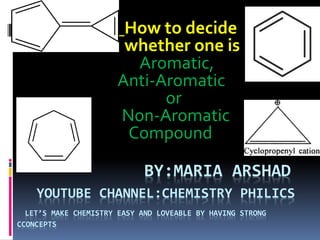
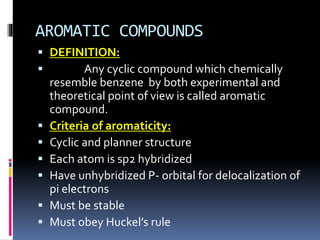
How to decide
whether one is
Aromatic,
Anti-Aromatic
or
Non-Aromatic
Compound
AROMATIC COMPOUNDS
 DEFINITION:
 Any cyclic compound which chemically
resemble benzene by both experimental and
theoretical point of view is called aromatic
compound.
 Criteria of aromaticity:
 Cyclic and planner structure
 Each atom is sp2 hybridized
 Have unhybridized P- orbital for delocalization of
pi electrons
 Must be stable
 Must obey Huckel’s rule
Huckel’s rule
 All those cyclic ,planar,conjugated
compounds are aromatic which contain
(4n+2)π electrons.
 (4n+2)π eletrons where: n=0,1,2,3,4,5…
 n=0 (4(0)+2) =2π e-
 n=1 (4(1)+2) =6 π e-
 n=2 (4(2)+2) =10 π e-
 n=3 (4(3)+2) =14 π e-
FOR EXAMPLE:
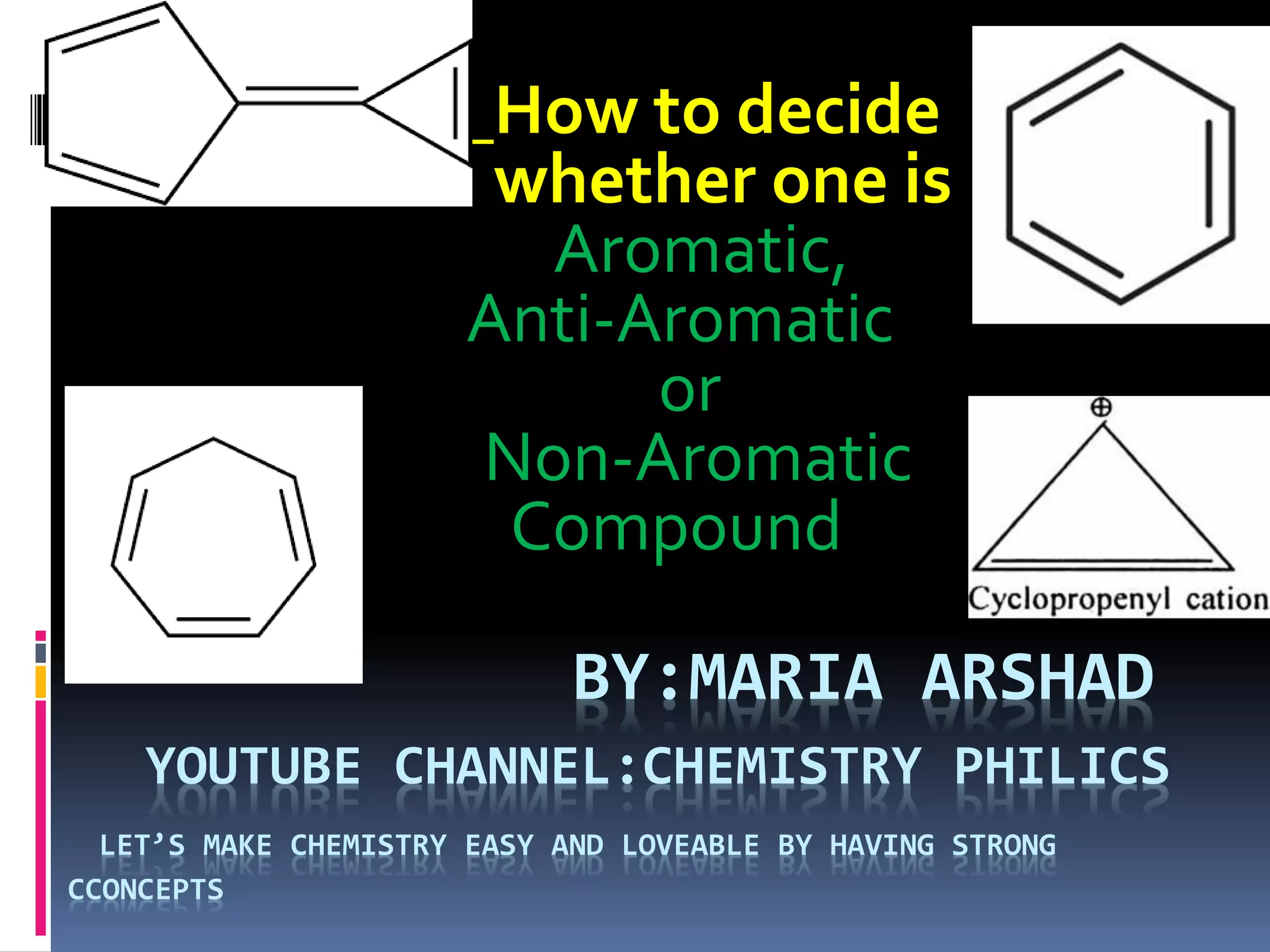
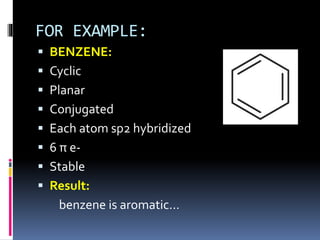
 BENZENE:
 Cyclic
 Planar
 Conjugated
 Each atom sp2 hybridized
 6 π e-
 Stable
 Result:
benzene is aromatic…
ANTI-AROMATIC
 Definition:
 All cyclic, planar conjugated compounds
which contain 4n π e- in rings
 4n π e- where n=1,2,3,4…..
 4(1) 4 π e-
 4(2) 8 π e-
 4(3) 12 π e-
 4(4) 16 π e-
FOR-EXAMPLE:
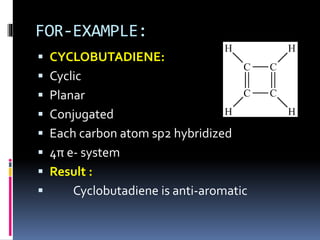
 CYCLOBUTADIENE:
 Cyclic
 Planar
 Conjugated
 Each carbon atom sp2 hybridized
 4π e- system
 Result :
 Cyclobutadiene is anti-aromatic
Non-aromatic
 Which do not follow one or more of the above criteria
 DIFFERENCE
 AROMATIC ANTI-AROMATIC NON-AROMATIC
 Cyclic cyclic cyclicacyclic
 Planar planar planarnonplanar
 Conjugated conjugated conjugatednon
 Every atom every atom sp2 at least one atom is
Sp2 hybridized hybridized sp3 hybridized
 (4n+2)πe- (4n)π e- 3,5,7,9… e-
2,6,10,14… 4,8,12,16…
 Stable unstable regular
PRACTICE:
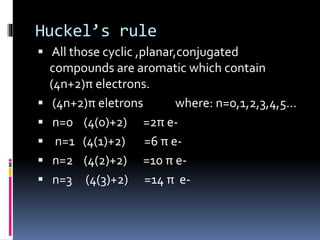
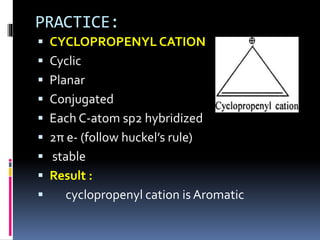
 CYCLOPROPENYL CATION
 Cyclic
 Planar
 Conjugated
 Each C-atom sp2 hybridized
 2π e- (follow huckel’s rule)
 stable
 Result :
 cyclopropenyl cation is Aromatic
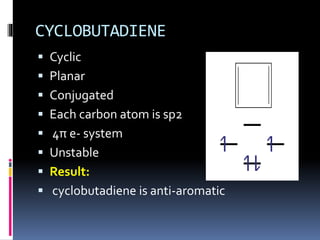
CYCLOBUTADIENE
 Cyclic
 Planar
 Conjugated
 Each carbon atom is sp2
 4π e- system
 Unstable
 Result:
 cyclobutadiene is anti-aromatic
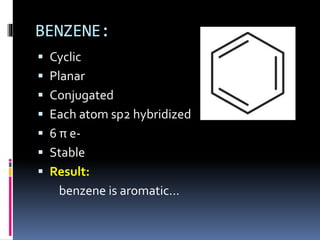
BENZENE:
 Cyclic
 Planar
 Conjugated
 Each atom sp2 hybridized
 6 π e-
 Stable
 Result:
benzene is aromatic…
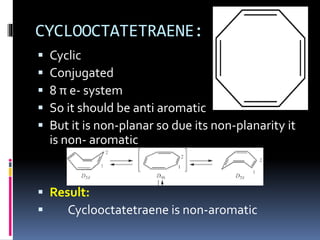
CYCLOOCTATETRAENE:
 Cyclic
 Conjugated
 8 π e- system
 So it should be anti aromatic
 But it is non-planar so due its non-planarity it
is non- aromatic
 Result:
 Cyclooctatetraene is non-aromatic
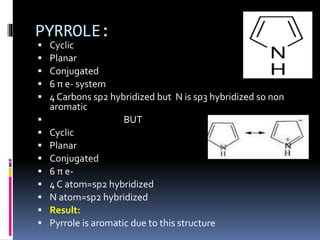
PYRROLE:
 Cyclic
 Planar
 Conjugated
 6 π e- system
 4 Carbons sp2 hybridized but N is sp3 hybridized so non
aromatic
 BUT
 Cyclic
 Planar
 Conjugated
 6 π e-
 4 C atom=sp2 hybridized
 N atom=sp2 hybridized
 Result:
 Pyrrole is aromatic due to this structure
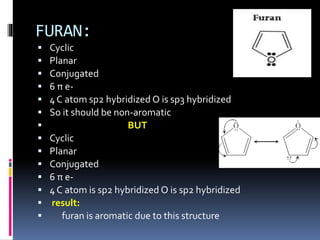
FURAN:
 Cyclic
 Planar
 Conjugated
 6 π e-
 4 C atom sp2 hybridized O is sp3 hybridized
 So it should be non-aromatic
 BUT
 Cyclic
 Planar
 Conjugated
 6 π e-
 4 C atom is sp2 hybridized O is sp2 hybridized
 result:
 furan is aromatic due to this structure
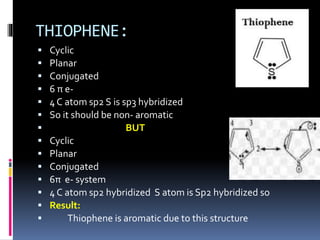
THIOPHENE:
 Cyclic
 Planar
 Conjugated
 6 π e-
 4 C atom sp2 S is sp3 hybridized
 So it should be non- aromatic
 BUT
 Cyclic
 Planar
 Conjugated
 6π e- system
 4 C atom sp2 hybridized S atom is Sp2 hybridized so
 Result:
 Thiophene is aromatic due to this structure
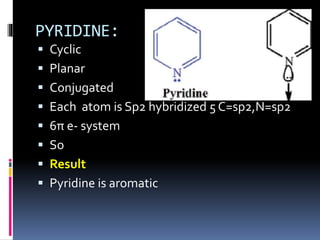
PYRIDINE:
 Cyclic
 Planar
 Conjugated
 Each atom is Sp2 hybridized 5 C=sp2,N=sp2
 6π e- system
 So
 Result
 Pyridine is aromatic
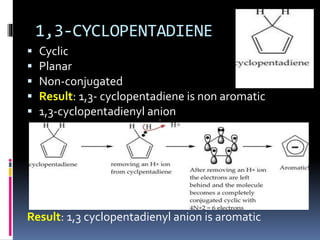
1,3-CYCLOPENTADIENE
 Cyclic
 Planar
 Non-conjugated
 Result: 1,3- cyclopentadiene is non aromatic
 1,3-cyclopentadienyl anion
Result: 1,3 cyclopentadienyl anion is aromatic
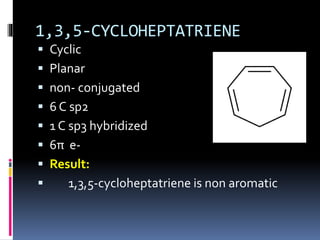
1,3,5-CYCLOHEPTATRIENE
 Cyclic
 Planar
 non- conjugated
 6 C sp2
 1 C sp3 hybridized
 6π e-
 Result:
 1,3,5-cycloheptatriene is non aromatic
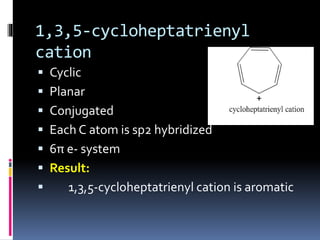
1,3,5-cycloheptatrienyl
cation
 Cyclic
 Planar
 Conjugated
 Each C atom is sp2 hybridized
 6π e- system
 Result:
 1,3,5-cycloheptatrienyl cation is aromatic
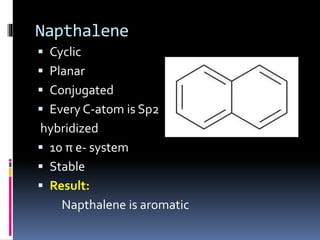
Napthalene
 Cyclic
 Planar
 Conjugated
 Every C-atom is Sp2
hybridized
 10 π e- system
 Stable
 Result:
Napthalene is aromatic
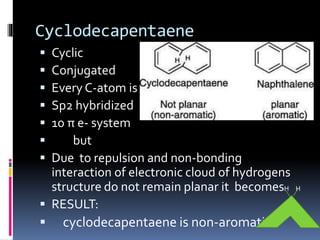
Cyclodecapentaene
 Cyclic
 Conjugated
 Every C-atom is
 Sp2 hybridized
 10 π e- system
 but
 Due to repulsion and non-bonding
interaction of electronic cloud of hydrogens
structure do not remain planar it becomesH H
 RESULT:
 cyclodecapentaene is non-aromatic
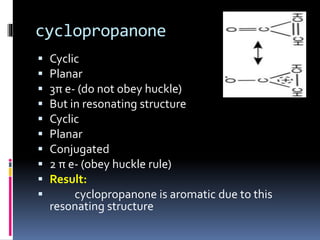
cyclopropanone
 Cyclic
 Planar
 3π e- (do not obey huckle)
 But in resonating structure
 Cyclic
 Planar
 Conjugated
 2 π e- (obey huckle rule)
 Result:
 cyclopropanone is aromatic due to this
resonating structure
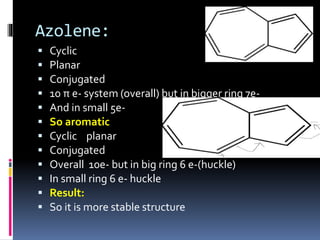
Azolene:
 Cyclic
 Planar
 Conjugated
 10 π e- system (overall) but in bigger ring 7e-
 And in small 5e-
 So aromatic
 Cyclic planar
 Conjugated
 Overall 10e- but in big ring 6 e-(huckle)
 In small ring 6 e- huckle
 Result:
 So it is more stable structure
THANK YOU

aromatic,Anti-aromatic and non-aromartic compounds

  • 1.
    BY:MARIA ARSHAD YOUTUBE CHANNEL:CHEMISTRYPHILICS LET’S MAKE CHEMISTRY EASY AND LOVEABLE BY HAVING STRONG CCONCEPTS How to decide whether one is Aromatic, Anti-Aromatic or Non-Aromatic Compound
  • 2.
    AROMATIC COMPOUNDS  DEFINITION: Any cyclic compound which chemically resemble benzene by both experimental and theoretical point of view is called aromatic compound.  Criteria of aromaticity:  Cyclic and planner structure  Each atom is sp2 hybridized  Have unhybridized P- orbital for delocalization of pi electrons  Must be stable  Must obey Huckel’s rule
  • 3.
    Huckel’s rule  Allthose cyclic ,planar,conjugated compounds are aromatic which contain (4n+2)π electrons.  (4n+2)π eletrons where: n=0,1,2,3,4,5…  n=0 (4(0)+2) =2π e-  n=1 (4(1)+2) =6 π e-  n=2 (4(2)+2) =10 π e-  n=3 (4(3)+2) =14 π e-
  • 4.
    FOR EXAMPLE:  BENZENE: Cyclic  Planar  Conjugated  Each atom sp2 hybridized  6 π e-  Stable  Result: benzene is aromatic…
  • 5.
    ANTI-AROMATIC  Definition:  Allcyclic, planar conjugated compounds which contain 4n π e- in rings  4n π e- where n=1,2,3,4…..  4(1) 4 π e-  4(2) 8 π e-  4(3) 12 π e-  4(4) 16 π e-
  • 6.
    FOR-EXAMPLE:  CYCLOBUTADIENE:  Cyclic Planar  Conjugated  Each carbon atom sp2 hybridized  4π e- system  Result :  Cyclobutadiene is anti-aromatic
  • 7.
    Non-aromatic  Which donot follow one or more of the above criteria  DIFFERENCE  AROMATIC ANTI-AROMATIC NON-AROMATIC  Cyclic cyclic cyclicacyclic  Planar planar planarnonplanar  Conjugated conjugated conjugatednon  Every atom every atom sp2 at least one atom is Sp2 hybridized hybridized sp3 hybridized  (4n+2)πe- (4n)π e- 3,5,7,9… e- 2,6,10,14… 4,8,12,16…  Stable unstable regular
  • 8.
    PRACTICE:  CYCLOPROPENYL CATION Cyclic  Planar  Conjugated  Each C-atom sp2 hybridized  2π e- (follow huckel’s rule)  stable  Result :  cyclopropenyl cation is Aromatic
  • 9.
    CYCLOBUTADIENE  Cyclic  Planar Conjugated  Each carbon atom is sp2  4π e- system  Unstable  Result:  cyclobutadiene is anti-aromatic
  • 10.
    BENZENE:  Cyclic  Planar Conjugated  Each atom sp2 hybridized  6 π e-  Stable  Result: benzene is aromatic…
  • 11.
    CYCLOOCTATETRAENE:  Cyclic  Conjugated 8 π e- system  So it should be anti aromatic  But it is non-planar so due its non-planarity it is non- aromatic  Result:  Cyclooctatetraene is non-aromatic
  • 12.
    PYRROLE:  Cyclic  Planar Conjugated  6 π e- system  4 Carbons sp2 hybridized but N is sp3 hybridized so non aromatic  BUT  Cyclic  Planar  Conjugated  6 π e-  4 C atom=sp2 hybridized  N atom=sp2 hybridized  Result:  Pyrrole is aromatic due to this structure
  • 13.
    FURAN:  Cyclic  Planar Conjugated  6 π e-  4 C atom sp2 hybridized O is sp3 hybridized  So it should be non-aromatic  BUT  Cyclic  Planar  Conjugated  6 π e-  4 C atom is sp2 hybridized O is sp2 hybridized  result:  furan is aromatic due to this structure
  • 14.
    THIOPHENE:  Cyclic  Planar Conjugated  6 π e-  4 C atom sp2 S is sp3 hybridized  So it should be non- aromatic  BUT  Cyclic  Planar  Conjugated  6π e- system  4 C atom sp2 hybridized S atom is Sp2 hybridized so  Result:  Thiophene is aromatic due to this structure
  • 15.
    PYRIDINE:  Cyclic  Planar Conjugated  Each atom is Sp2 hybridized 5 C=sp2,N=sp2  6π e- system  So  Result  Pyridine is aromatic
  • 16.
    1,3-CYCLOPENTADIENE  Cyclic  Planar Non-conjugated  Result: 1,3- cyclopentadiene is non aromatic  1,3-cyclopentadienyl anion Result: 1,3 cyclopentadienyl anion is aromatic
  • 17.
    1,3,5-CYCLOHEPTATRIENE  Cyclic  Planar non- conjugated  6 C sp2  1 C sp3 hybridized  6π e-  Result:  1,3,5-cycloheptatriene is non aromatic
  • 18.
    1,3,5-cycloheptatrienyl cation  Cyclic  Planar Conjugated  Each C atom is sp2 hybridized  6π e- system  Result:  1,3,5-cycloheptatrienyl cation is aromatic
  • 19.
    Napthalene  Cyclic  Planar Conjugated  Every C-atom is Sp2 hybridized  10 π e- system  Stable  Result: Napthalene is aromatic
  • 20.
    Cyclodecapentaene  Cyclic  Conjugated Every C-atom is  Sp2 hybridized  10 π e- system  but  Due to repulsion and non-bonding interaction of electronic cloud of hydrogens structure do not remain planar it becomesH H  RESULT:  cyclodecapentaene is non-aromatic
  • 21.
    cyclopropanone  Cyclic  Planar 3π e- (do not obey huckle)  But in resonating structure  Cyclic  Planar  Conjugated  2 π e- (obey huckle rule)  Result:  cyclopropanone is aromatic due to this resonating structure
  • 22.
    Azolene:  Cyclic  Planar Conjugated  10 π e- system (overall) but in bigger ring 7e-  And in small 5e-  So aromatic  Cyclic planar  Conjugated  Overall 10e- but in big ring 6 e-(huckle)  In small ring 6 e- huckle  Result:  So it is more stable structure
  • 23.