Aromaticity
Introduction:
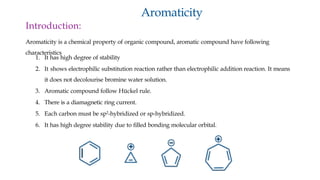
1. It has high degree of stability
2. It shows electrophilic substitution reaction rather than electrophilic addition reaction. It means
it does not decolourise bromine water solution.
3. Aromatic compound follow Hückel rule.
4. There is a diamagnetic ring current.
5. Each carbon must be sp2
-hybridized or sp-hybridized.
6. It has high degree stability due to filled bonding molecular orbital.
Aromaticity is a chemical property of organic compound, aromatic compound have following
characteristics
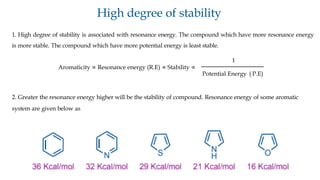
1. High degree of stability is associated with resonance energy. The compound which have more resonance energy
is more stable. The compound which have more potential energy is least stable.
High degree of stability
Aromaticity Resonance energy (R.E) Stability
∝ ∝ ∝
1
Potential Energy ( P.E)
2. Greater the resonance energy higher will be the stability of compound. Resonance energy of some aromatic
system are given below as
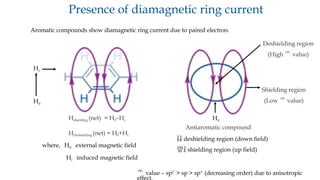
Aromatic compounds show diamagnetic ring current due to paired electron.
Presence of diamagnetic ring current
Hshielding (net) = H0–Hi
HDeshielding (net) = H0+Hi
where, H0 external magnetic field
Hi induced magnetic field
H0
Hi
H0
Deshielding region
(High  value)
Shielding region
(Low  value)
Antiaromatic compound
 deshielding region (down field)
 shielding region (up field)
 value – sp2
> sp > sp3
(decreasing order) due to anisotropic
effect.
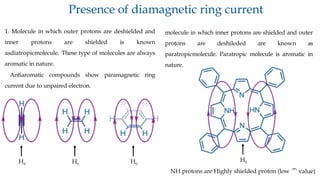
1. Molecule in which outer protons are deshielded and
inner protons are shielded is known
asdiatropicmolecule. These type of molecules are always
aromatic in nature.
Antiaromatic compounds show paramagnetic ring
current due to unpaired electron.
Presence of diamagnetic ring current
H0 H0 H0
H0
molecule in which inner protons are shielded and outer
protons are deshileded are known as
paratropicmolecule. Paratropic molecule is aromatic in
nature.
NH protons are Highly shielded proton (low  value)
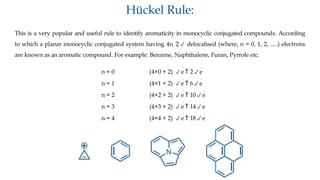
Hückel Rule:
This is a very popular and useful rule to identify aromaticity in monocyclic conjugated compounds. According
to which a planar monocyclic conjugated system having 4n 2 delocalised (where, n = 0, 1, 2, .....) electrons
are known as an aromatic compound. For example: Benzene, Naphthalene, Furan, Pyrrole etc.
n = 0 (4×0 + 2) e

 2e
n = 1 (4×1 + 2) e

 6e
n = 2 (4×2 + 2) e

 10e
n = 3 (4×3 + 2) e

 14e
n = 4 (4×4 + 2) e

 18e
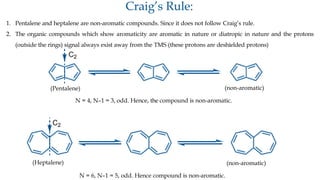
(non-aromatic)
(Pentalene)
N = 4, N–1 = 3, odd. Hence, the compound is non-aromatic.
(non-aromatic)
(Heptalene)
N = 6, N–1 = 5, odd. Hence compound is non-aromatic.
1. Pentalene and heptalene are non-aromatic compounds. Since it does not follow Craig’s rule.
2. The organic compounds which show aromaticity are aromatic in nature or diatropic in nature and the protons
(outside the rings) signal always exist away from the TMS (these protons are deshielded protons)
Craig’s Rule:
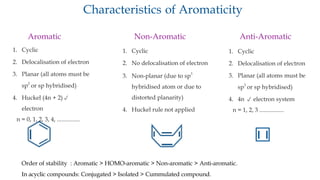
Characteristics of Aromaticity
1. Cyclic
2. Delocalisation of electron
3. Planar (all atoms must be
sp2
or sp hybridised)
4. Huckel (4n + 2)
electron
n = 0, 1, 2, 3, 4, ...............
1. Cyclic
2. No delocalisation of electron
3. Non-planar (due to sp
3
hybridised atom or due to
distorted planarity)
4. Huckel rule not applied
1. Cyclic
2. Delocalisation of electron
3. Planar (all atoms must be
sp
2
or sp hybridised)
4. 4n  electron system
n = 1, 2, 3 ................
Aromatic Non-Aromatic Anti-Aromatic
Order of stability : Aromatic > HOMO-aromatic > Non-aromatic > Anti-aromatic.
In acyclic compounds: Conjugated > Isolated > Cummulated compound.
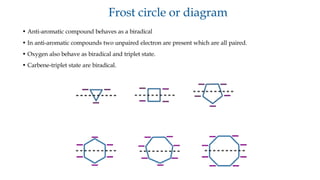
Frost circle or diagram
1. Energy level of aromatic and anti-aromatic compounds can be shown by usingfrost circleor diagram.
2. Energy levels of regular planar polygonic molecules with an even number of atoms form a
symmetricalpattern
as shown below.
If all bonding energy levels are filled then it is aromatic [Hückel criterion also required].
Antibonding energy level
Bonding energy level
E Non-bonding energy level
• Anti-aromatic compound behaves as a biradical
• In anti-aromatic compounds two unpaired electron are present which are all paired.
• Oxygen also behave as biradical and triplet state.
• Carbene-triplet state are biradical.
Frost circle or diagram
Types of Aromatic
Compounds
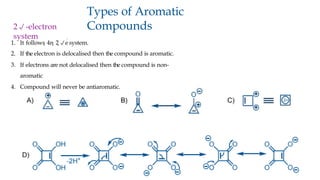
2-electron
system
1. It follows 4n 2e
system.
2. If the electron is delocalised then the compound is aromatic.
3. If electrons are not delocalised then the compound is non-
aromatic
4. Compound will never be antiaromatic.
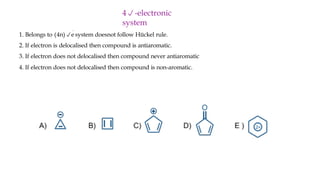
4-electronic
system
1. Belongs to (4n)e
system doesnot follow Hückel rule.
2. If electron is delocalised then compound is antiaromatic.
3. If electron does not delocalised then compound never antiaromatic
4. If electron does not delocalised then compound is non-aromatic.
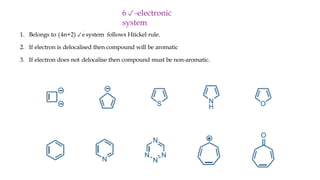
6-electronic
system
1. Belongs to (4n+2)e
system follows Hückel rule.
2. If electron is delocalised then compound will be aromatic
3. If electron does not delocalise then compound must be non-aromatic.
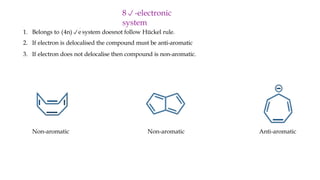
8-electronic
system
1. Belongs to (4n)e
system doesnot follow Hückel rule.
2. If electron is delocalised the compound must be anti-aromatic
3. If electron does not delocalise then compound is non-aromatic.
Non-aromatic Anti-aromatic
Non-aromatic
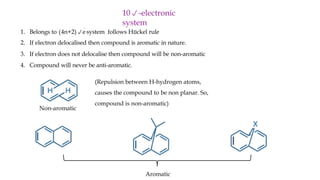
1. Belongs to (4n+2)e
system follows Hückel rule
2. If electron delocalised then compound is aromatic in nature.
3. If electron does not delocalise then compound will be non-aromatic
4. Compound will never be anti-aromatic.
10-electronic
system
(Repulsion between H-hydrogen atoms,
causes the compound to be non planar. So,
compound is non-aromatic)
Aromatic
Non-aromatic
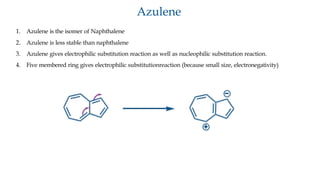
Azulene
1. Azulene is the isomer of Naphthalene
2. Azulene is less stable than naphthalene
3. Azulene gives electrophilic substitution reaction as well as nucleophilic substitution reaction.
4. Five membered ring gives electrophilic substitutionreaction (because small size, electronegativity)
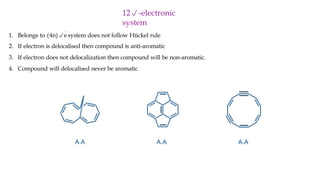
1. Belongs to (4n)e
system does not follow Hückel rule
2. If electron is delocalised then compound is anti-aromatic
3. If electron does not delocalization then compound will be non-aromatic.
4. Compound will delocalised never be aromatic
12-electronic
system
Aromatic Aromatic
Aromatic
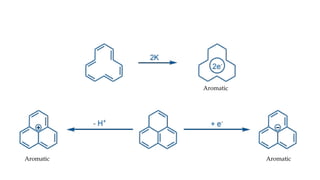
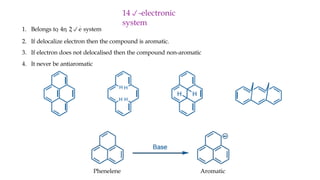
1. Belongs to 4n 2e
system
2. If delocalize electron then the compound is aromatic.
3. If electron does not delocalised then the compound non-aromatic
4. It never be antiaromatic
14-electronic
system
Phenelene Aromatic
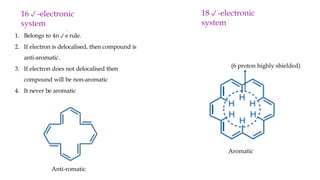
1. Belongs to 4ne
rule.
2. If electron is delocalised, then compound is
anti-aromatic.
3. If electron does not delocalised then
compound will be non-aromatic
4. It never be aromatic
16-electronic
system
18-electronic
system
(6 proton highly shielded)
Aromatic
Anti-romatic
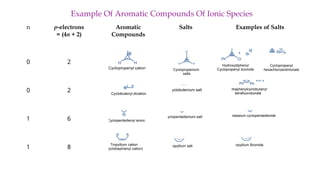
Example Of Aromatic Compounds Of Ionic Species
n p-electrons
= (4n + 2)
Aromatic
Compounds
Salts Examples of Salts
0 2
0 2
1 6
1 8
Cyclopropenyl cation
H H
H
Cyclopropenium
salts
H H
H
Hydroxydiphenyl
Cyclopropenyl bromide
Ph Cl
Ph
Br
Cyclopropenyl
hexachloroantimonate
SbCl6
Cyclobutenyl dication
Cyclobutenium salt Tetraphenylcyclobutanyl
tetrafluoroborate
Ph Ph
Ph Ph
2BF4
Cyclopentedienyl anion
Cyclopentadienium salt Potassium cyclopentadienide
K
Tropyllium cation
(Cycloheptrienyl cation)
Tropyllium salt Tropyllium Bromide
Br
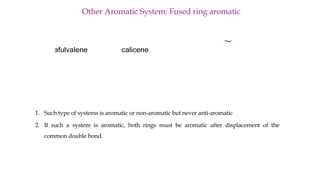
Other Aromatic System: Fused ring aromatic
triafulvalene calicene
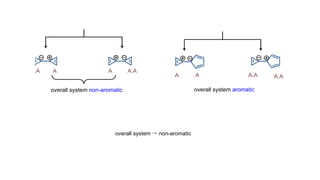
1. Such type of systems is aromatic or non-aromatic but never anti-aromatic
2. If such a system is aromatic, both rings must be aromatic after displacement of the
common double bond.
A.A A A A.A
overall system non-aromatic
A A.A A.A
overall system aromatic
A
overall system  non-aromatic
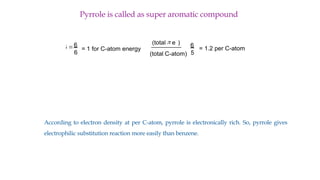
Pyrrole is called as super aromatic compound
According to electron density at per C-atom, pyrrole is electronically rich. So, pyrrole gives
electrophilic substitution reaction more easily than benzene.
6
6
36 = = 1 for C-atom energy
(total p e
-
)
(total C-atom)
6
5
= 1.2 per C-atom
N
N
H
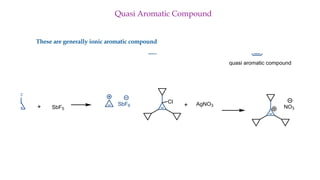
These are generally ionic aromatic compound
Quasi Aromatic Compound
O
ENu
OE
Nu
O
HClO4
OH
ClO4
quasi aromatic compound
F
SbF5
SbF6
Cl AgNO3 NO3
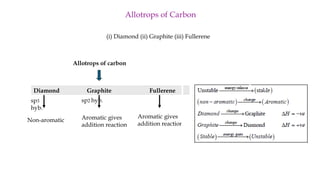
Allotrops of carbon
(i) Diamond (ii) Graphite (iii) Fullerene
Allotrops of Carbon
Diamond Graphite Fullerene
Non-aromatic Aromatic gives
addition reaction
Aromatic gives
addition reaction
sp3
hyb.
sp2 hyb.
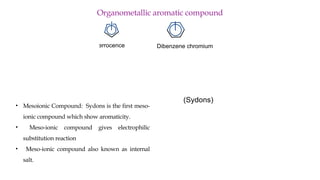
Organometallic aromatic compound
Fe
Ferrocence Dibenzene chromium
Cr
• Mesoionic Compound: Sydons is the first meso-
ionic compound which show aromaticity.
• Meso-ionic compound gives electrophilic
substitution reaction
• Meso-ionic compound also known as internal
salt.
N
N O
H
C
C
R
O
º N
N O
C
H
C
R
O
(Sydons)
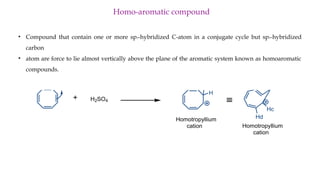
Homo-aromatic compound
• Compound that contain one or more sp3-hybridized C-atom in a conjugate cycle but sp3-hybridized
carbon
• atom are force to lie almost vertically above the plane of the aromatic system known as homoaromatic
compounds.
H2SO4
H
H
Homotropyllium
cation
Hb
Ha
Hc
Hd
Homotropyllium
cation
º
3
C2H5OH K+
Bu-
CHCl3
Na/NH3
H
H
DDQ
H
H
Homoaromatic
compound
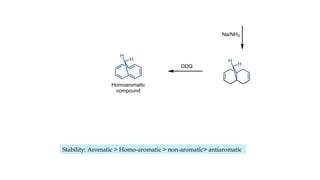
Stability: Aromatic > Homo-aromatic > non-aromatic> antiaromatic
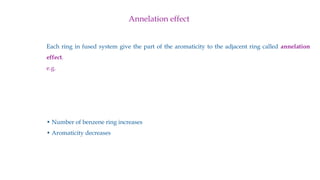
Each ring in fused system give the part of the aromaticity to the adjacent ring called annelation
effect.
e.g.
• Number of benzene ring increases
• Aromaticity decreases
Annelation effect

aromaticity basics of aromatic compounds

  • 1.
    Aromaticity Introduction: 1. It hashigh degree of stability 2. It shows electrophilic substitution reaction rather than electrophilic addition reaction. It means it does not decolourise bromine water solution. 3. Aromatic compound follow Hückel rule. 4. There is a diamagnetic ring current. 5. Each carbon must be sp2 -hybridized or sp-hybridized. 6. It has high degree stability due to filled bonding molecular orbital. Aromaticity is a chemical property of organic compound, aromatic compound have following characteristics
  • 2.
    1. High degreeof stability is associated with resonance energy. The compound which have more resonance energy is more stable. The compound which have more potential energy is least stable. High degree of stability Aromaticity Resonance energy (R.E) Stability ∝ ∝ ∝ 1 Potential Energy ( P.E) 2. Greater the resonance energy higher will be the stability of compound. Resonance energy of some aromatic system are given below as
  • 3.
    Aromatic compounds showdiamagnetic ring current due to paired electron. Presence of diamagnetic ring current Hshielding (net) = H0–Hi HDeshielding (net) = H0+Hi where, H0 external magnetic field Hi induced magnetic field H0 Hi H0 Deshielding region (High  value) Shielding region (Low  value) Antiaromatic compound  deshielding region (down field)  shielding region (up field)  value – sp2 > sp > sp3 (decreasing order) due to anisotropic effect.
  • 4.
    1. Molecule inwhich outer protons are deshielded and inner protons are shielded is known asdiatropicmolecule. These type of molecules are always aromatic in nature. Antiaromatic compounds show paramagnetic ring current due to unpaired electron. Presence of diamagnetic ring current H0 H0 H0 H0 molecule in which inner protons are shielded and outer protons are deshileded are known as paratropicmolecule. Paratropic molecule is aromatic in nature. NH protons are Highly shielded proton (low  value)
  • 5.
    Hückel Rule: This isa very popular and useful rule to identify aromaticity in monocyclic conjugated compounds. According to which a planar monocyclic conjugated system having 4n 2 delocalised (where, n = 0, 1, 2, .....) electrons are known as an aromatic compound. For example: Benzene, Naphthalene, Furan, Pyrrole etc. n = 0 (4×0 + 2) e   2e n = 1 (4×1 + 2) e   6e n = 2 (4×2 + 2) e   10e n = 3 (4×3 + 2) e   14e n = 4 (4×4 + 2) e   18e
  • 6.
    (non-aromatic) (Pentalene) N = 4,N–1 = 3, odd. Hence, the compound is non-aromatic. (non-aromatic) (Heptalene) N = 6, N–1 = 5, odd. Hence compound is non-aromatic. 1. Pentalene and heptalene are non-aromatic compounds. Since it does not follow Craig’s rule. 2. The organic compounds which show aromaticity are aromatic in nature or diatropic in nature and the protons (outside the rings) signal always exist away from the TMS (these protons are deshielded protons) Craig’s Rule:
  • 7.
    Characteristics of Aromaticity 1.Cyclic 2. Delocalisation of electron 3. Planar (all atoms must be sp2 or sp hybridised) 4. Huckel (4n + 2) electron n = 0, 1, 2, 3, 4, ............... 1. Cyclic 2. No delocalisation of electron 3. Non-planar (due to sp 3 hybridised atom or due to distorted planarity) 4. Huckel rule not applied 1. Cyclic 2. Delocalisation of electron 3. Planar (all atoms must be sp 2 or sp hybridised) 4. 4n  electron system n = 1, 2, 3 ................ Aromatic Non-Aromatic Anti-Aromatic Order of stability : Aromatic > HOMO-aromatic > Non-aromatic > Anti-aromatic. In acyclic compounds: Conjugated > Isolated > Cummulated compound.
  • 8.
    Frost circle ordiagram 1. Energy level of aromatic and anti-aromatic compounds can be shown by usingfrost circleor diagram. 2. Energy levels of regular planar polygonic molecules with an even number of atoms form a symmetricalpattern as shown below. If all bonding energy levels are filled then it is aromatic [Hückel criterion also required]. Antibonding energy level Bonding energy level E Non-bonding energy level
  • 9.
    • Anti-aromatic compoundbehaves as a biradical • In anti-aromatic compounds two unpaired electron are present which are all paired. • Oxygen also behave as biradical and triplet state. • Carbene-triplet state are biradical. Frost circle or diagram
  • 10.
    Types of Aromatic Compounds 2-electron system 1.It follows 4n 2e system. 2. If the electron is delocalised then the compound is aromatic. 3. If electrons are not delocalised then the compound is non- aromatic 4. Compound will never be antiaromatic.
  • 11.
    4-electronic system 1. Belongs to(4n)e system doesnot follow Hückel rule. 2. If electron is delocalised then compound is antiaromatic. 3. If electron does not delocalised then compound never antiaromatic 4. If electron does not delocalised then compound is non-aromatic.
  • 12.
    6-electronic system 1. Belongs to(4n+2)e system follows Hückel rule. 2. If electron is delocalised then compound will be aromatic 3. If electron does not delocalise then compound must be non-aromatic.
  • 13.
    8-electronic system 1. Belongs to(4n)e system doesnot follow Hückel rule. 2. If electron is delocalised the compound must be anti-aromatic 3. If electron does not delocalise then compound is non-aromatic. Non-aromatic Anti-aromatic Non-aromatic
  • 14.
    1. Belongs to(4n+2)e system follows Hückel rule 2. If electron delocalised then compound is aromatic in nature. 3. If electron does not delocalise then compound will be non-aromatic 4. Compound will never be anti-aromatic. 10-electronic system (Repulsion between H-hydrogen atoms, causes the compound to be non planar. So, compound is non-aromatic) Aromatic Non-aromatic
  • 15.
    Azulene 1. Azulene isthe isomer of Naphthalene 2. Azulene is less stable than naphthalene 3. Azulene gives electrophilic substitution reaction as well as nucleophilic substitution reaction. 4. Five membered ring gives electrophilic substitutionreaction (because small size, electronegativity)
  • 16.
    1. Belongs to(4n)e system does not follow Hückel rule 2. If electron is delocalised then compound is anti-aromatic 3. If electron does not delocalization then compound will be non-aromatic. 4. Compound will delocalised never be aromatic 12-electronic system
  • 17.
  • 18.
    1. Belongs to4n 2e system 2. If delocalize electron then the compound is aromatic. 3. If electron does not delocalised then the compound non-aromatic 4. It never be antiaromatic 14-electronic system Phenelene Aromatic
  • 19.
    1. Belongs to4ne rule. 2. If electron is delocalised, then compound is anti-aromatic. 3. If electron does not delocalised then compound will be non-aromatic 4. It never be aromatic 16-electronic system 18-electronic system (6 proton highly shielded) Aromatic Anti-romatic
  • 20.
    Example Of AromaticCompounds Of Ionic Species n p-electrons = (4n + 2) Aromatic Compounds Salts Examples of Salts 0 2 0 2 1 6 1 8 Cyclopropenyl cation H H H Cyclopropenium salts H H H Hydroxydiphenyl Cyclopropenyl bromide Ph Cl Ph Br Cyclopropenyl hexachloroantimonate SbCl6 Cyclobutenyl dication Cyclobutenium salt Tetraphenylcyclobutanyl tetrafluoroborate Ph Ph Ph Ph 2BF4 Cyclopentedienyl anion Cyclopentadienium salt Potassium cyclopentadienide K Tropyllium cation (Cycloheptrienyl cation) Tropyllium salt Tropyllium Bromide Br
  • 21.
    Other Aromatic System:Fused ring aromatic triafulvalene calicene 1. Such type of systems is aromatic or non-aromatic but never anti-aromatic 2. If such a system is aromatic, both rings must be aromatic after displacement of the common double bond.
  • 22.
    A.A A AA.A overall system non-aromatic A A.A A.A overall system aromatic A overall system  non-aromatic
  • 23.
    Pyrrole is calledas super aromatic compound According to electron density at per C-atom, pyrrole is electronically rich. So, pyrrole gives electrophilic substitution reaction more easily than benzene. 6 6 36 = = 1 for C-atom energy (total p e - ) (total C-atom) 6 5 = 1.2 per C-atom N N H
  • 24.
    These are generallyionic aromatic compound Quasi Aromatic Compound O ENu OE Nu O HClO4 OH ClO4 quasi aromatic compound F SbF5 SbF6 Cl AgNO3 NO3
  • 25.
    Allotrops of carbon (i)Diamond (ii) Graphite (iii) Fullerene Allotrops of Carbon Diamond Graphite Fullerene Non-aromatic Aromatic gives addition reaction Aromatic gives addition reaction sp3 hyb. sp2 hyb.
  • 26.
    Organometallic aromatic compound Fe FerrocenceDibenzene chromium Cr • Mesoionic Compound: Sydons is the first meso- ionic compound which show aromaticity. • Meso-ionic compound gives electrophilic substitution reaction • Meso-ionic compound also known as internal salt. N N O H C C R O º N N O C H C R O (Sydons)
  • 27.
    Homo-aromatic compound • Compoundthat contain one or more sp3-hybridized C-atom in a conjugate cycle but sp3-hybridized carbon • atom are force to lie almost vertically above the plane of the aromatic system known as homoaromatic compounds. H2SO4 H H Homotropyllium cation Hb Ha Hc Hd Homotropyllium cation º
  • 28.
  • 29.
    Each ring infused system give the part of the aromaticity to the adjacent ring called annelation effect. e.g. • Number of benzene ring increases • Aromaticity decreases Annelation effect