PHOTO-REDUCTION
SAMEEN FATIMA
ROLL NO: 908529
CONTENT
 PHOTOREDUCTION IN ORGANIC COMPOUNDS
 CARBONYL COMPOUNDS
 PHOTOREDUCTION IN KETONES
 NITRO COMPOUNDS
 PHOTOREDUCTION IN AROMATIC
COMPOUNDS
 PHOTO-REDUCTION/PHOTOHALOGENATION
 POLYMERIZATION VIA PHOTOREDUCTION
 DEFINITION
DEFINITION
• The chemical reduction which is influenced by under control
of photons / light energy is called photo reduction. 1
• A reduction reaction induced by light. 2
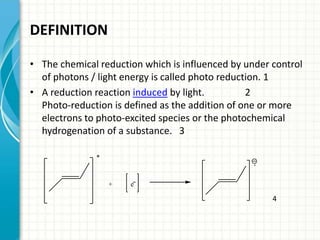
Photo-reduction is defined as the addition of one or more
electrons to photo-excited species or the photochemical
hydrogenation of a substance. 3
4
Photoreduction in ketones: Ketones photoreduction can be take
place by hydrogen atom donars for example secondary alcohol
and tertiary amines. In these reactions the photoexcited specie
reacts with a suitable hydrogen donor (like alcohol with α
hydrogen, toluene, even cyclohexane). The radical formed may
react with other hydrogen donor to form alcohol or other
reaction partner.
CARBONYL COMPOUNDS: Photo-reduction
5
When H2Se used in the photoreduction of carbonyl
compound.
6
Nitro compounds:
In the photo-reduction of nitro compounds the hydrogen
donor is needed, if hydrogen donor is not present then the
photo-fragmentation is done instead of photo reduction.
MECHANISM:
7
COMPOUNDS: The following example is the classical
reaction that is done by photochemical process, the
preparation of the formation of 1, 1, 2, 2-tetraphenyl-
1,2-ethanediol ((3), benzopinacol).
PHOTOREDUCTION IN AROMATIC
8
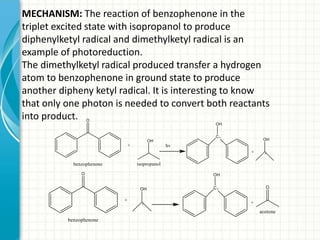
MECHANISM: The reaction of benzophenone in the
triplet excited state with isopropanol to produce
diphenylketyl radical and dimethylketyl radical is an
example of photoreduction.
The dimethylketyl radical produced transfer a hydrogen
atom to benzophenone in ground state to produce
another dipheny ketyl radical. It is interesting to know
that only one photon is needed to convert both reactants
into product.
9
Many hydrocarbons benzene, naphthalene, anthracene,
biphenyls react with amine to give reduction product. The
above example is the best photo-reduced product in aromatic
compounds. Mostly these reactions are initiated by the
transfer of electron lone pair orbital from nitrogen to the half-
filled highest bonding molecular orbital of excited aromatic
compound.
10
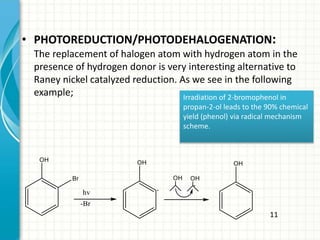
• PHOTOREDUCTION/PHOTODEHALOGENATION:
The replacement of halogen atom with hydrogen atom in the
presence of hydrogen donor is very interesting alternative to
Raney nickel catalyzed reduction. As we see in the following
example; Irradiation of 2-bromophenol in
propan-2-ol leads to the 90% chemical
yield (phenol) via radical mechanism
scheme.
11
Polymerization via photo-reduction: The
photoreduction is used in the polymerization in such a
way that the initiator is produced by this reduction that is
further react with the monomer to form the polymer.
12
REFERENCE
1. Photoreduction Definition & Meaning - Merriam-Webster
2. https://www.collinsdictionary.com/dictionary/english/photoreduction
3. https://www.slideshare.net/RabiaAziz6/photo-redox-reactions
4. Postgraduate chemistry series: Photochemistry of Organic Compounds: From
Concepts to Practice by Petr Klan and Jakob Wirz, pg # 230
5. Postgraduate chemistry series: Photochemistry of Organic Compounds: From
Concepts to Practice by Petr Klan and Jakob Wirz, pg # 296
6. https://www.slideshare.net/RabiaAziz6/photo-redox-reactions
7. Postgraduate chemistry series: Photochemistry of Organic Compounds: From
Concepts to Practice by Petr Klan and Jakob Wirz, pg # 362
8. https://chem.libretexts.org/Bookshelves/Organic_Chemistry/Basic_Principles_
of_Organic_Chemistry_(Roberts_and_Caserio)/28%3A_Photochemistry/28.03
%3A_Organic_Photochemistry#:~:text=Photoreduction%20of%20Diaryl%20Ket
ones,-
9. https://slideplayer.com/slide/13159506/
10. Photochemistry and pericyclic reaction, 3rd addition by Jagdamba Singh and
Jaya Singh pg # 263
11. Postgraduate chemistry series: Photochemistry of Organic Compounds: From
Concepts to Practice by Petr Klan and Jakob Wirz, pg # 399
12. Postgraduate chemistry series: Photochemistry of Organic Compounds: From
Concepts to Practice by Petr Klan and Jakob Wirz, pg # 434 and 435
THANK YOU

PHOTO-REDUCTION.pptx

  • 1.
  • 2.
    CONTENT  PHOTOREDUCTION INORGANIC COMPOUNDS  CARBONYL COMPOUNDS  PHOTOREDUCTION IN KETONES  NITRO COMPOUNDS  PHOTOREDUCTION IN AROMATIC COMPOUNDS  PHOTO-REDUCTION/PHOTOHALOGENATION  POLYMERIZATION VIA PHOTOREDUCTION  DEFINITION
  • 3.
    DEFINITION • The chemicalreduction which is influenced by under control of photons / light energy is called photo reduction. 1 • A reduction reaction induced by light. 2 Photo-reduction is defined as the addition of one or more electrons to photo-excited species or the photochemical hydrogenation of a substance. 3 4
  • 4.
    Photoreduction in ketones:Ketones photoreduction can be take place by hydrogen atom donars for example secondary alcohol and tertiary amines. In these reactions the photoexcited specie reacts with a suitable hydrogen donor (like alcohol with α hydrogen, toluene, even cyclohexane). The radical formed may react with other hydrogen donor to form alcohol or other reaction partner. CARBONYL COMPOUNDS: Photo-reduction 5
  • 5.
    When H2Se usedin the photoreduction of carbonyl compound. 6
  • 6.
    Nitro compounds: In thephoto-reduction of nitro compounds the hydrogen donor is needed, if hydrogen donor is not present then the photo-fragmentation is done instead of photo reduction.
  • 7.
  • 8.
    COMPOUNDS: The followingexample is the classical reaction that is done by photochemical process, the preparation of the formation of 1, 1, 2, 2-tetraphenyl- 1,2-ethanediol ((3), benzopinacol). PHOTOREDUCTION IN AROMATIC 8
  • 9.
    MECHANISM: The reactionof benzophenone in the triplet excited state with isopropanol to produce diphenylketyl radical and dimethylketyl radical is an example of photoreduction. The dimethylketyl radical produced transfer a hydrogen atom to benzophenone in ground state to produce another dipheny ketyl radical. It is interesting to know that only one photon is needed to convert both reactants into product.
  • 10.
    9 Many hydrocarbons benzene,naphthalene, anthracene, biphenyls react with amine to give reduction product. The above example is the best photo-reduced product in aromatic compounds. Mostly these reactions are initiated by the transfer of electron lone pair orbital from nitrogen to the half- filled highest bonding molecular orbital of excited aromatic compound.
  • 11.
  • 12.
    • PHOTOREDUCTION/PHOTODEHALOGENATION: The replacementof halogen atom with hydrogen atom in the presence of hydrogen donor is very interesting alternative to Raney nickel catalyzed reduction. As we see in the following example; Irradiation of 2-bromophenol in propan-2-ol leads to the 90% chemical yield (phenol) via radical mechanism scheme. 11
  • 13.
    Polymerization via photo-reduction:The photoreduction is used in the polymerization in such a way that the initiator is produced by this reduction that is further react with the monomer to form the polymer. 12
  • 14.
    REFERENCE 1. Photoreduction Definition& Meaning - Merriam-Webster 2. https://www.collinsdictionary.com/dictionary/english/photoreduction 3. https://www.slideshare.net/RabiaAziz6/photo-redox-reactions 4. Postgraduate chemistry series: Photochemistry of Organic Compounds: From Concepts to Practice by Petr Klan and Jakob Wirz, pg # 230 5. Postgraduate chemistry series: Photochemistry of Organic Compounds: From Concepts to Practice by Petr Klan and Jakob Wirz, pg # 296 6. https://www.slideshare.net/RabiaAziz6/photo-redox-reactions 7. Postgraduate chemistry series: Photochemistry of Organic Compounds: From Concepts to Practice by Petr Klan and Jakob Wirz, pg # 362 8. https://chem.libretexts.org/Bookshelves/Organic_Chemistry/Basic_Principles_ of_Organic_Chemistry_(Roberts_and_Caserio)/28%3A_Photochemistry/28.03 %3A_Organic_Photochemistry#:~:text=Photoreduction%20of%20Diaryl%20Ket ones,- 9. https://slideplayer.com/slide/13159506/ 10. Photochemistry and pericyclic reaction, 3rd addition by Jagdamba Singh and Jaya Singh pg # 263 11. Postgraduate chemistry series: Photochemistry of Organic Compounds: From Concepts to Practice by Petr Klan and Jakob Wirz, pg # 399 12. Postgraduate chemistry series: Photochemistry of Organic Compounds: From Concepts to Practice by Petr Klan and Jakob Wirz, pg # 434 and 435
  • 15.