Prosthetic heart valve
short review
DR MAHENDRA
CARDIOLOGY,JIPMER
1
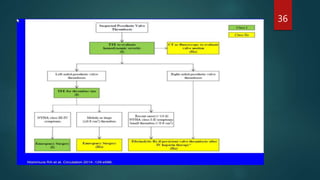
Introduction
 The introduction of valve replacement surgery in the early 1960s has
dramatically improved the outcome of patients with valvular heart disease.
 Despite the improvements in prosthetic valve design and surgical
procedures , valve replacement does not provide a definitive cure. Instead,
native valve disease is traded for “prosthetic valve disease”.
2
Types of prosthetic valves
 Prosthetic Valves are classified as tissue or mechanical
 Tissue:
 Made of biologic tissue from an animal (bioprosthesis or heterograft) or human
(homograft or autograft) source
 Mechanical
 Made of non biologic material (pyrolitic carbon, polymeric silicone substances,
or titanium)
 Blood flow characteristics, hemodynamics, durability, and thromboembolic
tendency vary depending on the type and size of the prosthesis and
characteristics of the patient
3
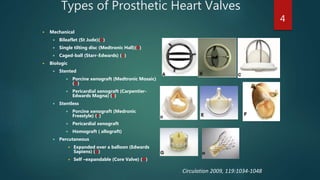
Types of Prosthetic Heart Valves
 Mechanical
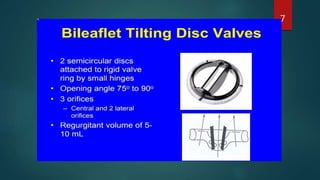
 Bileaflet (St Jude)(A)
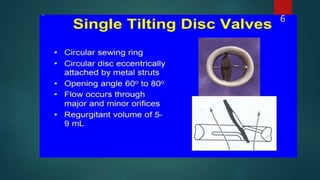
 Single tilting disc (Medtronic Hall)(B)
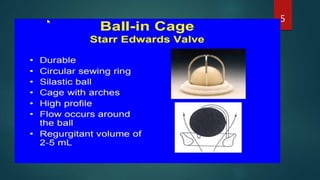
 Caged-ball (Starr-Edwards) (C)
 Biologic
 Stented
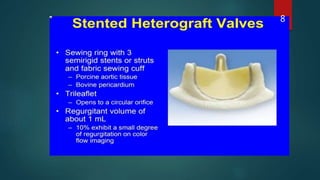
 Porcine xenograft (Medtronic Mosaic)
(D)
 Pericardial xenograft (Carpentier-
Edwards Magna) (E)
 Stentless
 Porcine xenograft (Medronic
Freestyle) (F)
 Pericardial xenograft
 Homograft ( allograft)
 Percutaneous
 Expanded over a balloon (Edwards
Sapiens) (G)
 Self –expandable (Core Valve) (H)
Circulation 2009, 119:1034-1048
4
5
6
7
8
Mechanical Valves
 Extremely durable with overall survival rates of 94% at 10 years
 Primary structural abnormalities are rare
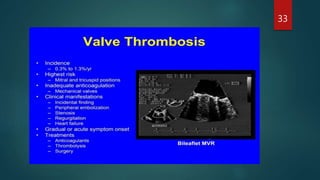
 Most malfunctions are secondary to perivalvular leak and thrombosis
 Chronic anticoagulation required in all
 With adequate anticoagulation, rate of thrombosis is 0.6% to 1.8% per
patient-year for bileaflet valves.
9
Biological Valves
 Stented bioprostheses
 Primary mechanical failure at 10 years is 15-20%
 Preferred in patients over age 70
 Subject to progressive calcific degeneration & failure after 6-8 years
 Stentless bioprostheses
 Absence of stent & sewing cuff allow implantation of larger valve for given
annular size->greater EOA
 Uses the patient’s own aortic root as the stent, absorbing the stress induced
during the cardiac cycle
10
Biologic Valves Continued
 Homografts
 Harvested from cadaveric human hearts
 Advantages: resistance to infection, lack of need for anticoagulation, excellent
hemodynamic profile (in smaller aortic root sizes)
 More difficult surgical procedure limits its use
 Autograft
 Ross Procedure
11
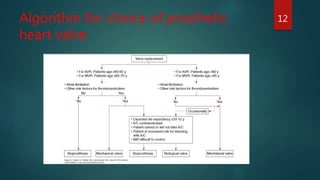
Algorithm for choice of prosthetic
heart valve
12
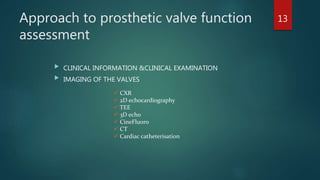
Approach to prosthetic valve function
assessment
 CLINICAL INFORMATION &CLINICAL EXAMINATION
 IMAGING OF THE VALVES
 CXR
 2D echocardiography
 TEE
 3D echo
 CineFluoro
 CT
 Cardiac catheterisation
13
14
15
16
CXR
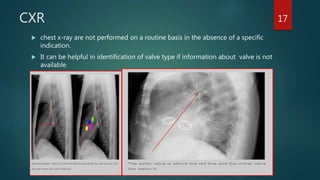
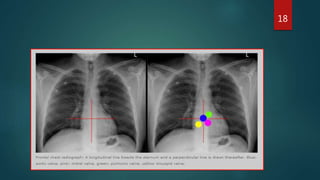
 chest x-ray are not performed on a routine basis in the absence of a specific
indication.
 It can be helpful in identification of valve type if information about valve is not
available.
17
18
Echo evaluation
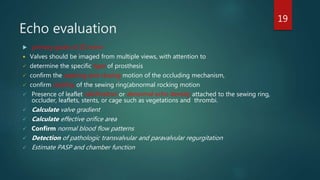
 primary goals of 2D echo-
 Valves should be imaged from multiple views, with attention to
 determine the specific type of prosthesis
 confirm the opening and closing motion of the occluding mechanism,
 confirm stability of the sewing ring(abnormal rocking motion
 Presence of leaflet calcification or abnormal echo density attached to the sewing ring,
occluder, leaflets, stents, or cage such as vegetations and thrombi.
 Calculate valve gradient
 Calculate effective orifice area
 Confirm normal blood flow patterns
 Detection of pathologic transvalvular and paravalvular regurgitation
 Estimate PASP and chamber function
19
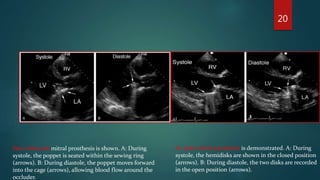
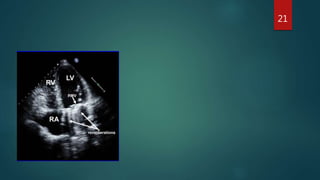
St. Jude mitral prosthesis is demonstrated. A: During
systole, the hemidisks are shown in the closed position
(arrows). B: During diastole, the two disks are recorded
in the open position (arrows).
Starr-Edwards mitral prosthesis is shown. A: During
systole, the poppet is seated within the sewing ring
(arrows). B: During diastole, the poppet moves forward
into the cage (arrows), allowing blood flow around the
occluder.
20
21
Assessment of Flow Characteristics
of Prosthetic Valves
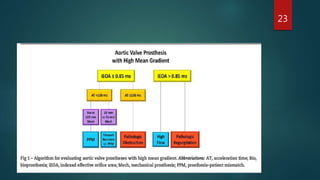
Valve type Flow Characteristics
Ball-in-cage prosthetic valve (Starr-Edwards,
Edwards Lifescience)
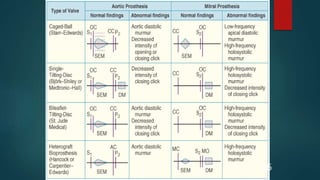
much obstruction and little leakage.
Tilting disc prosthetic valve (Björk-Shiley;
Omniscience; Medtronic Hall)
less obstruction and more leakage.
Bileaflet prosthetic valves (St. Jude
Medical; Sorin Bicarbon; Carbomedics)
Less obstruction and more leakage.
Bioprostheses. little or no leakage
Homografts, pulmonary autografts, and
unstented bioprosthetic valves (Medtronic
Freestyle,
Toronto, Ontario, Canada)
almost unobstructive to blood flow.
Stented bioprostheses (leaflets suspended
within a frame)
obstructive to flow.
22
23
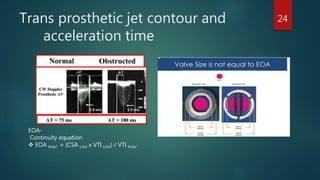
Trans prosthetic jet contour and
acceleration time
EOA-
Continuity equation
 EOA PrAV = (CSA LVO x VTI LVO) / VTI PrAV
24
25
26
27
28
29
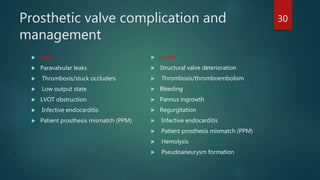
Prosthetic valve complication and
management
 Early
 Paravalvular leaks
 Thrombosis/stuck occluders
 Low output state
 LVOT obstruction
 Infective endocarditis
 Patient prosthesis mismatch (PPM)
 • Late
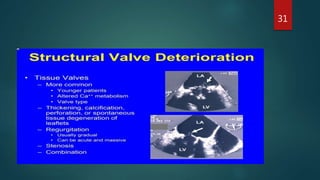
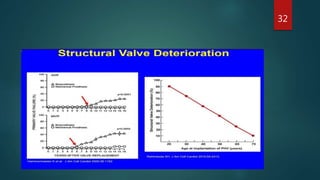
 Structural valve deterioration
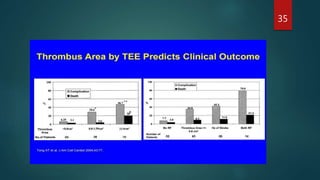
 Thrombosis/thromboembolism
 Bleeding
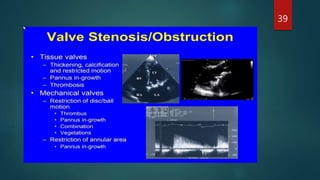
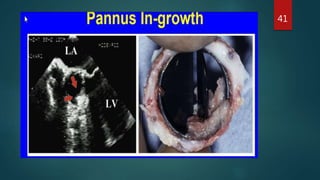
 Pannus ingrowth
 Regurgitation
 Infective endocarditis
 Patient prosthesis mismatch (PPM)
 Hemolysis
 Pseudoaneurysm formation
30
31
32
33
34
35
36
37
38
39
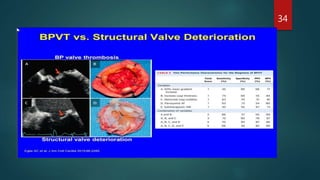
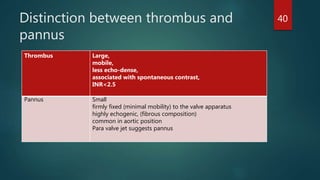
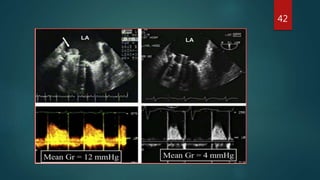
Distinction between thrombus and
pannus
Thrombus Large,
mobile,
less echo-dense,
associated with spontaneous contrast,
INR<2.5
Pannus Small
firmly fixed (minimal mobility) to the valve apparatus
highly echogenic, (fibrous composition)
common in aortic position
Para valve jet suggests pannus
40
41
42
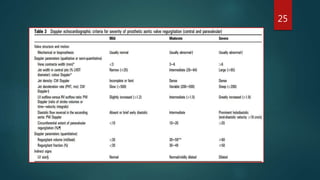
Prosthetic valve regurgitation
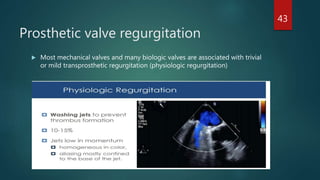
 Most mechanical valves and many biologic valves are associated with trivial
or mild transprosthetic regurgitation (physiologic regurgitation)
43
Pathologic Prosthetic Regurgitation
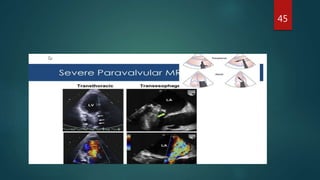
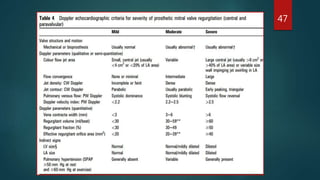
 Pathologic regurgitation is either
 central
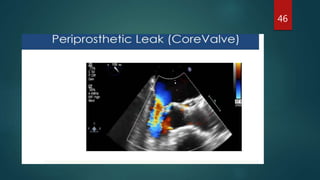
 paravalvular.
 Most pathologic central valvular regurgitation is seen with biologic valves,
whereas paravalvular regurgita-tion is seen with either valve type and is
frequently the site of regurgitation in mechanical valves.
 Pathologic jets tend to be high velocity,
intense, broad, and highly aliased.
44
45
46
47
48
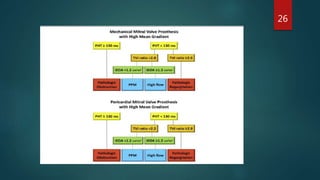
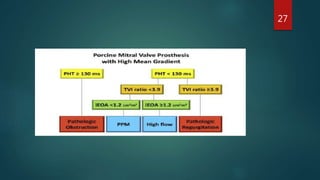
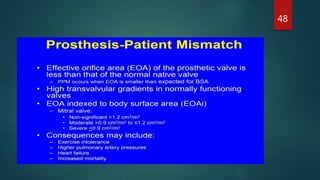
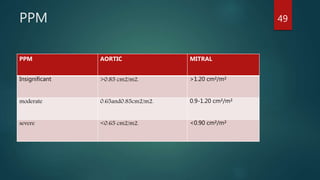
PPM
.
PPM AORTIC MITRAL
Insignificant >0.85 cm2/m2. >1.20 cm²/m²
moderate 0.65and0.85cm2/m2. 0.9-1.20 cm²/m²
severe <0.65 cm2/m2. <0.90 cm²/m²
49
TEE in prosthetic valve
TEE evaluation immediately after valve replacement
1. Verify that all leaflets or occluders move normally.
2. Verify the absence of paravalvular regurgitation.
3. Verify that there is no left ventricular outflow tract obstruction by
struts or subvalvular apparatus.
TEE diagnosis of prosthetic valve dysfunction
1. Identification of prosthetic valve type.
2. Detection and quantification of transvalvular or paravalvular
regurgitation.
3. Detection of annular dehiscence.
4. Detection of vegetations consistent with endocarditis.
5. Detection of thrombosis or pannus formation on the valve.
6. Detection and quantification of valve stenosis.
7. Detection of tissue degeneration or calcification.
50
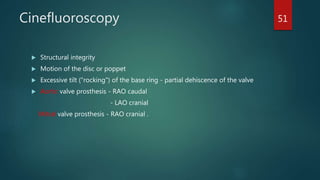
Cinefluoroscopy
 Structural integrity
 Motion of the disc or poppet
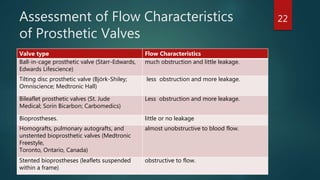
 Excessive tilt ("rocking") of the base ring - partial dehiscence of the valve
 Aortic valve prosthesis - RAO caudal
- LAO cranial
Mitral valve prosthesis - RAO cranial .
51
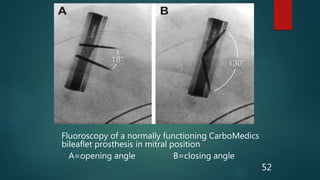
Fluoroscopy of a normally functioning CarboMedics
bileaflet prosthesis in mitral position
A=opening angle B=closing angle
52
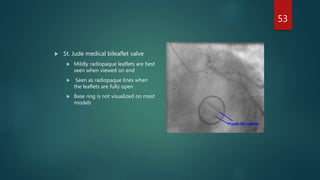
 St. Jude medical bileaflet valve
 Mildly radiopaque leaflets are best
seen when viewed on end
 Seen as radiopaque lines when
the leaflets are fully open
 Base ring is not visualized on most
models
53
THANK YOU
54

prosthetic heart valve evalaution

  • 1.
    Prosthetic heart valve shortreview DR MAHENDRA CARDIOLOGY,JIPMER 1
  • 2.
    Introduction  The introductionof valve replacement surgery in the early 1960s has dramatically improved the outcome of patients with valvular heart disease.  Despite the improvements in prosthetic valve design and surgical procedures , valve replacement does not provide a definitive cure. Instead, native valve disease is traded for “prosthetic valve disease”. 2
  • 3.
    Types of prostheticvalves  Prosthetic Valves are classified as tissue or mechanical  Tissue:  Made of biologic tissue from an animal (bioprosthesis or heterograft) or human (homograft or autograft) source  Mechanical  Made of non biologic material (pyrolitic carbon, polymeric silicone substances, or titanium)  Blood flow characteristics, hemodynamics, durability, and thromboembolic tendency vary depending on the type and size of the prosthesis and characteristics of the patient 3
  • 4.
    Types of ProstheticHeart Valves  Mechanical  Bileaflet (St Jude)(A)  Single tilting disc (Medtronic Hall)(B)  Caged-ball (Starr-Edwards) (C)  Biologic  Stented  Porcine xenograft (Medtronic Mosaic) (D)  Pericardial xenograft (Carpentier- Edwards Magna) (E)  Stentless  Porcine xenograft (Medronic Freestyle) (F)  Pericardial xenograft  Homograft ( allograft)  Percutaneous  Expanded over a balloon (Edwards Sapiens) (G)  Self –expandable (Core Valve) (H) Circulation 2009, 119:1034-1048 4
  • 5.
  • 6.
  • 7.
  • 8.
  • 9.
    Mechanical Valves  Extremelydurable with overall survival rates of 94% at 10 years  Primary structural abnormalities are rare  Most malfunctions are secondary to perivalvular leak and thrombosis  Chronic anticoagulation required in all  With adequate anticoagulation, rate of thrombosis is 0.6% to 1.8% per patient-year for bileaflet valves. 9
  • 10.
    Biological Valves  Stentedbioprostheses  Primary mechanical failure at 10 years is 15-20%  Preferred in patients over age 70  Subject to progressive calcific degeneration & failure after 6-8 years  Stentless bioprostheses  Absence of stent & sewing cuff allow implantation of larger valve for given annular size->greater EOA  Uses the patient’s own aortic root as the stent, absorbing the stress induced during the cardiac cycle 10
  • 11.
    Biologic Valves Continued Homografts  Harvested from cadaveric human hearts  Advantages: resistance to infection, lack of need for anticoagulation, excellent hemodynamic profile (in smaller aortic root sizes)  More difficult surgical procedure limits its use  Autograft  Ross Procedure 11
  • 12.
    Algorithm for choiceof prosthetic heart valve 12
  • 13.
    Approach to prostheticvalve function assessment  CLINICAL INFORMATION &CLINICAL EXAMINATION  IMAGING OF THE VALVES  CXR  2D echocardiography  TEE  3D echo  CineFluoro  CT  Cardiac catheterisation 13
  • 14.
  • 15.
  • 16.
  • 17.
    CXR  chest x-rayare not performed on a routine basis in the absence of a specific indication.  It can be helpful in identification of valve type if information about valve is not available. 17
  • 18.
  • 19.
    Echo evaluation  primarygoals of 2D echo-  Valves should be imaged from multiple views, with attention to  determine the specific type of prosthesis  confirm the opening and closing motion of the occluding mechanism,  confirm stability of the sewing ring(abnormal rocking motion  Presence of leaflet calcification or abnormal echo density attached to the sewing ring, occluder, leaflets, stents, or cage such as vegetations and thrombi.  Calculate valve gradient  Calculate effective orifice area  Confirm normal blood flow patterns  Detection of pathologic transvalvular and paravalvular regurgitation  Estimate PASP and chamber function 19
  • 20.
    St. Jude mitralprosthesis is demonstrated. A: During systole, the hemidisks are shown in the closed position (arrows). B: During diastole, the two disks are recorded in the open position (arrows). Starr-Edwards mitral prosthesis is shown. A: During systole, the poppet is seated within the sewing ring (arrows). B: During diastole, the poppet moves forward into the cage (arrows), allowing blood flow around the occluder. 20
  • 21.
  • 22.
    Assessment of FlowCharacteristics of Prosthetic Valves Valve type Flow Characteristics Ball-in-cage prosthetic valve (Starr-Edwards, Edwards Lifescience) much obstruction and little leakage. Tilting disc prosthetic valve (Björk-Shiley; Omniscience; Medtronic Hall) less obstruction and more leakage. Bileaflet prosthetic valves (St. Jude Medical; Sorin Bicarbon; Carbomedics) Less obstruction and more leakage. Bioprostheses. little or no leakage Homografts, pulmonary autografts, and unstented bioprosthetic valves (Medtronic Freestyle, Toronto, Ontario, Canada) almost unobstructive to blood flow. Stented bioprostheses (leaflets suspended within a frame) obstructive to flow. 22
  • 23.
  • 24.
    Trans prosthetic jetcontour and acceleration time EOA- Continuity equation  EOA PrAV = (CSA LVO x VTI LVO) / VTI PrAV 24
  • 25.
  • 26.
  • 27.
  • 28.
  • 29.
  • 30.
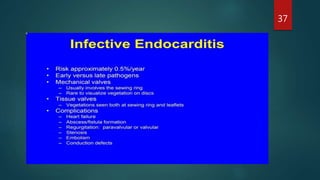
    Prosthetic valve complicationand management  Early  Paravalvular leaks  Thrombosis/stuck occluders  Low output state  LVOT obstruction  Infective endocarditis  Patient prosthesis mismatch (PPM)  • Late  Structural valve deterioration  Thrombosis/thromboembolism  Bleeding  Pannus ingrowth  Regurgitation  Infective endocarditis  Patient prosthesis mismatch (PPM)  Hemolysis  Pseudoaneurysm formation 30
  • 31.
  • 32.
  • 33.
  • 34.
  • 35.
  • 36.
  • 37.
  • 38.
  • 39.
  • 40.
    Distinction between thrombusand pannus Thrombus Large, mobile, less echo-dense, associated with spontaneous contrast, INR<2.5 Pannus Small firmly fixed (minimal mobility) to the valve apparatus highly echogenic, (fibrous composition) common in aortic position Para valve jet suggests pannus 40
  • 41.
  • 42.
  • 43.
    Prosthetic valve regurgitation Most mechanical valves and many biologic valves are associated with trivial or mild transprosthetic regurgitation (physiologic regurgitation) 43
  • 44.
    Pathologic Prosthetic Regurgitation Pathologic regurgitation is either  central  paravalvular.  Most pathologic central valvular regurgitation is seen with biologic valves, whereas paravalvular regurgita-tion is seen with either valve type and is frequently the site of regurgitation in mechanical valves.  Pathologic jets tend to be high velocity, intense, broad, and highly aliased. 44
  • 45.
  • 46.
  • 47.
  • 48.
  • 49.
    PPM . PPM AORTIC MITRAL Insignificant>0.85 cm2/m2. >1.20 cm²/m² moderate 0.65and0.85cm2/m2. 0.9-1.20 cm²/m² severe <0.65 cm2/m2. <0.90 cm²/m² 49
  • 50.
    TEE in prostheticvalve TEE evaluation immediately after valve replacement 1. Verify that all leaflets or occluders move normally. 2. Verify the absence of paravalvular regurgitation. 3. Verify that there is no left ventricular outflow tract obstruction by struts or subvalvular apparatus. TEE diagnosis of prosthetic valve dysfunction 1. Identification of prosthetic valve type. 2. Detection and quantification of transvalvular or paravalvular regurgitation. 3. Detection of annular dehiscence. 4. Detection of vegetations consistent with endocarditis. 5. Detection of thrombosis or pannus formation on the valve. 6. Detection and quantification of valve stenosis. 7. Detection of tissue degeneration or calcification. 50
  • 51.
    Cinefluoroscopy  Structural integrity Motion of the disc or poppet  Excessive tilt ("rocking") of the base ring - partial dehiscence of the valve  Aortic valve prosthesis - RAO caudal - LAO cranial Mitral valve prosthesis - RAO cranial . 51
  • 52.
    Fluoroscopy of anormally functioning CarboMedics bileaflet prosthesis in mitral position A=opening angle B=closing angle 52
  • 53.
     St. Judemedical bileaflet valve  Mildly radiopaque leaflets are best seen when viewed on end  Seen as radiopaque lines when the leaflets are fully open  Base ring is not visualized on most models 53
  • 54.

Editor's Notes

  • #21 Starr-Edwards mitral prosthesis is shown. A: During systole, the poppet is seated within the sewing ring (arrows). B: During diastole, the poppet moves forward into the cage (arrows), allowing blood flow around the occluder.