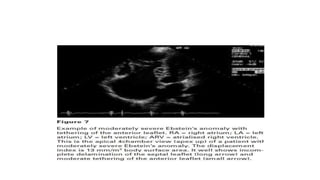
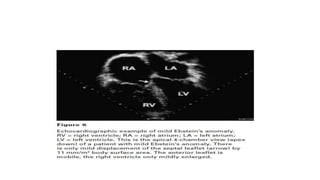
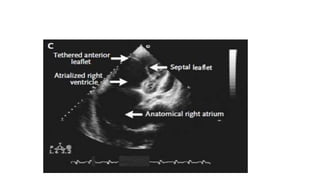
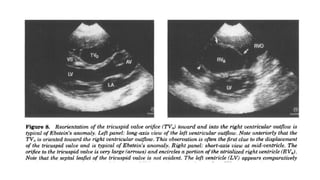
Ebstein anomaly
short review
DR MAHENDRA
CARDIOLOGY,JIPMER
Epidemiology
• First described by Wilhelm Ebstein in 1866.
• 0.3-0.8% of all CHD
• Prevalence as high as 2.4 per 10000 live births.
• Equal male: female occurrence.
• 20% to 40% of all neonates diagnosed with Ebstein’s anomaly will not survive 1
month.
DEFINITION
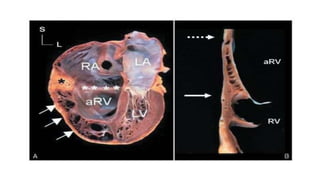
• Malformation of the TV and RV.
• Characterized by-
• (1) adherence of the septal and posterior leaflets to the underlying
myocardium (failure of delamination)
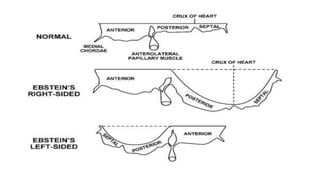
• (2) downward(apical) displacement of the functional annulus
(septal/posterior)
• (3) dilation of the “atrialized” portion of the right ventricle, with various
degrees of hypertrophy and thinning of the wall.
• (4) redundancy, fenestrations, and tethering of the anterior leaflet and
dilation of the right atrioventricular junction (true tricuspid annulus)
Pathologic anatomy of TV
• Origin of TV from AV ring & its chordal attachments are malpositioned.
• Leaflets are malformed, dysplastic (thickened & distorted), enlarged or reduced in
size.
• Septal leaflet always affected, posterior leaflet nearly always, and anterior leaflet
seldom.
• Septal & posterior leaflets displaced , maximal displacement is usually at the
commissure.
• Anterior leaflet is almost always attached to AV junction.
• Adherence create characteristic displacement of valve toward RV apex and even
RVOT.
• normally, downward displacement of the septal and posterior leaflets is less
than 8 mm/m2 body surface area.
• anterior leaflet is generally redundant and may contain several fenestrations and
Its chordae tendinae are generally short and poorly formed.
• only mobile leaflet tissue is displaced into the right ventricular outflow tract,
where it may cause obstruction or form a large sail-like intracavitary curtain.
Pathologic anatomy of RV
• Proximal (atrialized RV)
• Atrialized and dilated
• When thin moves paradoxically during systole
• Electrical potentials are ventricular, but pressure pulse is atrial
contoured.
• Distal
• Smaller than normal RV
• RV dilatation and dysfunction is universal
• Functional portion is infundibulum, trabeculated apex, portion
beneath anterior cusp
• Thinner walled with fewer muscles.
Etiology
• Congenital disease of often uncertain cause.
• Most cases are sporadic, familial Ebstein’s anomaly is rare.
• Environmental factors
• Maternal ingestion of lithium in first trimester
• Maternal benzodiazepine use
• Maternal exposure to varnishing substances
• Maternal history of previous fetal loss
• Risk is higher in whites than in other races.
Genetic factors
• most case are sporadic
• Rare cases of NKX2.5 mutations, 10p13-p14 deletion, and 1p34.3-p36.11
deletion have been described.
• Recently, Eight were found to have a mutation in the gene MYH7 and six of the
eight patients also had left ventricular noncompaction.
emanuel R, O’Brien K, Ng R. Ebstein’s anomaly: genetic study of 26 fami-lies. Br Heart J 1976;38:5–
7.
Associated defects
• Commonly associated with:
• ASD or PFO (90%)
• bicuspid or atretic aortic valves
• subaortic stenosis
• coarctation
• mitral valve prolapse
• accessory mitral valve tissue or muscle bands of the left ventricle
• VSD, AV canal defect
• Pulmonary stenosis/atresia (20-25%)
• Wolff-Parkinson-White
• Syndromes:
• Down, Marfan, Noonan
summer RG, Jacoby WJ Jr, Tucker DH. Ebstein’s anomaly associated with Car-diomyopathy and Pulmonary Hypertension. Circulation 1964;30:578–
587.
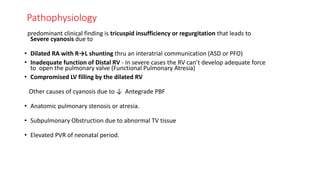
predominant clinical finding is tricuspid insufficiency or regurgitation that leads to
Severe cyanosis due to
• Dilated RA with R→L shunting thru an interatrial communication (ASD or PFO)
• Inadequate function of Distal RV - In severe cases the RV can’t develop adequate force
to open the pulmonary valve (Functional Pulmonary Atresia)
• Compromised LV filling by the dilated RV
Other causes of cyanosis due to ↓ Antegrade PBF
• Anatomic pulmonary stenosis or atresia.
• Subpulmonary Obstruction due to abnormal TV tissue
• Elevated PVR of neonatal period.
Pathophysiology
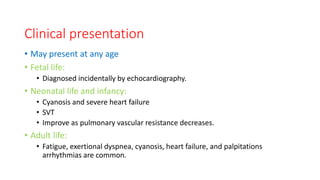
Clinical presentation
• May present at any age
• Fetal life:
• Diagnosed incidentally by echocardiography.
• Neonatal life and infancy:
• Cyanosis and severe heart failure
• SVT
• Improve as pulmonary vascular resistance decreases.
• Adult life:
• Fatigue, exertional dyspnea, cyanosis, heart failure, and palpitations
arrhythmias are common.
Physical examination
• Normal
• Cynosis/clubbing
• Displaced apical impulse
• Normal JVP
• Holosytolic murmur( TR)
• Quadruple rhythm
• Hepatomegaly
Carpentier’s classification
• In 1988, Carpentier et al. proposed the following classification of Ebstein’s
anomaly -
Type A: The volume of the true RV is adequate
Type B: A large atrialized component of the RV exists, but the anterior leaflet of
the TV moves freely.
Type C: The anterior leaflet is severely restricted in its movement and may cause
significant obstruction of the RVOT
Type D: Almost complete atrialization of the ventricle except for a small
infundibular component.
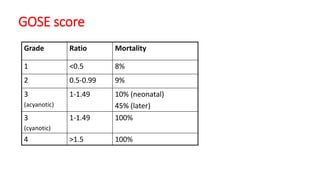
Celermajer Index
• Celermajer et al. described an echocardiographic grading score for neonates with
Ebstein’s anomaly, Great Ormond Street Echocardiography (GOSE) score, with
grades 1 to 4.
• The ratio of the combined area of the RA and atrialized RV is compared to the
functional RV and left heart(LA+LV). This classification is particularly helpful with
neonatal Ebstein’s anomaly.
Grade 1: ratio <0.5
Grade 2: ratio of 0.5 to 0.99
Grade 3: ratio of 1.0 to 1.49
Grade 4: ratio ≥ 1.5
Celermajer DS, Bull C, Till JA, et al. Ebstein’s anomaly: presentation and outcome from fetus to adult J
Am Coll Cardiol 1994;23:170–176.
GOSE score
Grade Ratio Mortality
1 <0.5 8%
2 0.5-0.99 9%
3
(acyanotic)
1-1.49 10% (neonatal)
45% (later)
3
(cyanotic)
1-1.49 100%
4 >1.5 100%
Natural history
• 18% of symptomatic newborn die in neonatal period
• 30% die before age of 10 yr due to CHF
• Median age of death 20 yr.
• Less severe anomaly pt remain asymptomatic or mildly symptomatic.
• Sudden unexpected death due to arrhythmia.
• Park 5th edition
• Predictors of cardiac-related death:
Cardiothoracic ratio of ≥ 0.65
Increasing severity of TV displacement on echocardiography
New York Heart Association (NYHA) class III or IV
Cyanosis
Severe TR
Younger age at diagnosis
Routine investigation protocol
12-lead ECG
• Rarely normal
• Abnormal P waves consistent with right atrial enlargement – “Himalayan P waves”.
• RBBB in 75-92%
• PR prolongation is common due to RA enlargement.
• Ventricular preexcitation in 10-30%.
Chest X-Ray
• Cardiomegaly
( Rounded or Box-like contour)
• Small aortic root and main
pulmonary artery shadow
• Decreased pulmonary
vasculature
• Large right atrium
Echocardiogram
• Gold standard for diagnosis.
• Two-dimensional
• Apical displacement of the septal leaflet of greater than 8 mm/m2.
• Abnormalities in morphology and septal attachment of the septal and
anterior tricuspid leaflets
• Eccentric leaflet coaptation.
• Dilated right atrium.
• Dilated right ventricle with decreased contractile performance.
• Various left heart structural abnormalities.
• Tethering of anterior leaflet
Echocardiogram
• Doppler studies
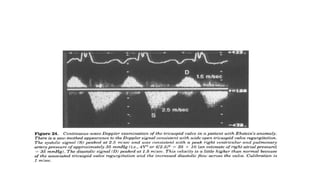
• Varying degrees of tricuspid regurgitation
• Excludes associated shunts.
• Differentiate between true and functional pulmonary atresia.
Echocardiogram
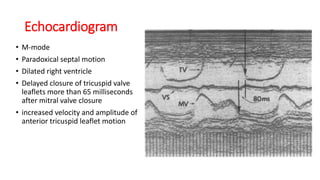
• M-mode
• Paradoxical septal motion
• Dilated right ventricle
• Delayed closure of tricuspid valve
leaflets more than 65 milliseconds
after mitral valve closure
• increased velocity and amplitude of
anterior tricuspid leaflet motion
Echocardiogram
• Assessment of severity and surgical options
• Functional right ventricular area less than 35% of total right ventricular area or
an atrialized to functional right ventricular ratio greater than 0.5 associated with
unfavorable prognosis
• Functional right ventricular size
• Degree of septal leaflet displacement.
• Amount of leaflet tethering.
• Magnitude of leaflet deformity and dysplasia.
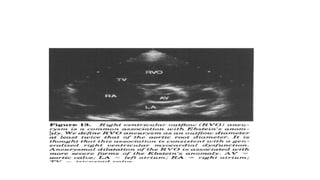
• Aneurysmal dilatation of right ventricular outflow tract (right ventricular
outflow tract-to-aortic root ratio of >2:1 on parasternal short axis view)
• Moderate-to-severe TR
Cardiac Catheterization
• No longer required to make/confirm the diagnosis
• The most diagnostic characteristic- Typical atrial pressure & ventricular intracardiac ECG in the
atrialized portion of the RV
• Elevated RAP
• R-L atrial shunting with systemic desaturation
• Elevated RVEDP.
Management
• Severity Assessment
• Guideline/Indications
• Medical management
• Surgical management
• Post operative functional status
ACC/AHA recommendation for adult Pts With
ebstein’s anomaly
• Class I
• All pts with Ebstein’s anomaly should have periodic evaluation in a center with expertise
in ACHD. (Level of Evidence: C)
• Class I
• 1. ECG, chest x-ray, and echocardiography-Doppler are recommended for the diagnostic
evaluation of Ebstein’s anomaly in adult pts. (Level of Evidence: C)
• Class IIa
• 1. Pulse oximetry at rest and/or during exercise can be useful in the diagnostic evaluation
of Ebstein’s anomaly in adult pts. (Level of Evidence: C)
• 2. EP study can be useful in the diagnostic evaluation of Ebstein’s anomaly in adult pts if
a supraventricular arrhythmia is documented or suspected (subsequent radiofrequency
catheter ablation should be considered if clinically feasible). (Level of Evidence: C)
• additional diagnostic tests can be useful for comprehensive evaluation of
Ebstein’s anomaly in adult pts:
• a. Doppler TEE examination if the anatomic information is not provided by
transthoracic imaging. (Level of Evidence: B)
• b. Holter monitoring. (Level of Evidence: B)
• c. EP study for history or ECG evidence of accessory pathway. (Level of Evidence:
B)
• d. CAG when surgical repair is planned, if there is a suspicion of coronary artery
disease, and in men 35 years or older, premenopausal women 35 years or older
who have coronary risk factors, and postmenopausal women. (Level of Evidence:
B)
• Recommendation for Medical Therapy-
• Class I
• 1. Anticoagulation with warfarin is recommended for patients with Ebstein’s anomaly with a history of
paradoxical embolus or atrial fibrillation. (Level of Evidence: C) .
• Recommendation for Catheter Interventions for Adults With Ebstein’s Anomaly
• Class I
• 1. Adults with Ebstein’s anomaly should have catheterization performed at centers with expertise in
catheterization and management of such patients. (Level of Evidence: C)
• Recommendation for Electrophysiology Testing/Pacing Issues in Ebstein’s Anomaly
• Class IIa
• 1. Catheter ablation can be beneficial for treatment of recurrent supraventricular tachycardia in some
patients with Ebstein’s anomaly. (Level of Evidence: B)
indication of sx
Class I
The following situations warrant intervention:
• Limited exercise capacity (New York Heart Association class greater than II) (Level of
Evidence: B)
• Increasing heart size (cardiothoracic ratio greater than 65%) (Level of Evidence: B)
• cyanosis (resting oxygen saturations < 90%) (Level of Evidence: B)
• Severe tricuspid regurgitation with symptoms (Level of Evidence: B)
• Transient ischemic attack or stroke (Level of Evidence: B)
• Prior to significant LV/RV dysfunction.
Every effort should be made to preserve the native TV. (Level of Evidence: C)
Presentation at Annual CCS Meeting in Edmonton 2009
• Surgeons with training and expertise in CHD should perform concomitant
arrhythmia surgery in pts with Ebstein’s anomaly and the following indications:
• a. Appearance/progression of atrial and/or ventricular arrhythmias not amenable to
percutaneous treatment. (Level of Evidence: B)
• b. Ventricular preexcitation not successfully treated in the electrophysiology laboratory. (Level of
Evidence: B)
• rerepair or replacement of the tricuspid valve is recommended
in adults with Ebstein’s anomaly with the following indications:
• Symptoms, deteriorating exercise capacity, or New York Heart Association functional
class III or IV. (Level of Evidence: B)
• Severe TR after repair with progressive RV dilation, reduction of RV systolic function, or
appearance/ progression of atrial and/or ventricular arrhythmias. (Level of Evidence: B)
• Bioprosthetic tricuspid valve dysfunction with significant mixed regurgitation and
stenosis. (Level of Evidence: B)
• Predominant bioprosthetic valve stenosis (mean gradient greater than 12 to 15 mm Hg).
(Level of Evidence: B)
• Operation can be considered earlier with lesser degrees of bioprosthetic stenosis with
symptoms or decreased exercise tolerance. (Level of Evidence: B).
• Recommendation for Reproduction
• Class I
• 1. Women with Ebstein’s anomaly should undertake prepregnancy counseling with a physician
with expertise in ACHD. (Level of Evidence: C)
• Most women have a successful pregnancy with proper care.
• increased risk of low birth weight and fetal loss if significant cyanosis is present.
• The risk of CHD in the offspring (in the absence of a family history) is approximately 6%.
• Recommendation for Endocarditis Prophylaxis
• Class IIa
• Antibiotic prophylaxis before dental procedures is reasonable in cyanotic patients with Ebstein’s
anomaly and postoperative patients with a prosthetic cardiac valve. (Level of Evidence: C)
Arrhythmia management
• Atrioventricular reentrant tachycardia related to accessory pathways can occur in
children with EA.
• anterograde fast conduction over an accessory pathway may lead to rapid
ventricular activation and potentially degenerate into ventricular fibrillation.
• adolescents and adults, arrhythmia symptoms are the most common
presentation of EA (42 %).
• accessory pathway or nodal atrioventricoular reentrant tachycardia being more
common at a younger age.
• later in life, atrial tachycardiaand atrial fibrillation have a higher prevalence.
• Normal hearts, the compact node is located at the apex of the triangle of Koch.
• in EA AV node is compressed and the central fibrous body malformed, can be
closer to the orifice of the coronary sinus.
• This peculiarity extremely important trans catheter ablation of atrioventricular
nodal reentrant tachycardia,
• targets the nodal slow pathway located at the base of the triangle of Koch in the
proximity of the coronary sinus ostium.
• prevalence of preexcitation in neonates with EA has been reported to be
• around 10 %.
• in different series, 5–25 % of EA patients have an accessory pathways.
• 6–30 % of cases the connections are multiple.
• displacement of the septal tricuspid valve leaflet is associated with a discontinuity
of the atrioventricular junction leading to muscular connections between the
right atrium and ventricle.
• localization of almost all accessory pathways around the orifi ce of the malformed
tricuspid valve, and the majority of them being located in the region between the
mid-septal and the posterolateral tricuspid annulus.
EP challenges in EA
• first issue is the localization of the accessory pathway.
• identify the true atrioventricular groove is difficult because of the distortion of
the normal anatomy of the right chambers.
• right coronary artery runs in the true atrioventricular grove,an angiography may
help to identify this anatomical landmark.
• atrialized right ventricle can be characterized by abnormal fragmented
electrograms, rendering the interpretation of recorded signals around the target
area difficult.
• catheter manipulation is often more difficult in these patients because of the
dilatation of the right chambers.
• All these technical consideration explain lower success rate.
Antiarrhythmic Drug
• class IC drugs are used with great concern secondary to their negative inotropic
and possible proarrhythmic effect
• Amiodarone is less proarrhythmic and has a less negative inotropic effect.
• Beta-blockers and sotalol are often used to control arrhythmia.
Principle of surgical management
• complete or subtotal closure of intra atrial communication.
• Tricuspid valve repair or replacement
• Elimination of arrhythmias
• Selective plication of atrialized RV
• Right reduction atrioplasty
• Repair of associated defects.
• Palliative procedure-for critically ill neonate
• A)BT shunt (with enlargement of ASD)-
• Obstructive lesion between RV and PA
• Good LV function required
• Fontan later
• B)starnes operation(pericardial closure of TV or plication of large RA,enlargement
of ASD, and BT shunt)
• If LV is pancaked by RV/RA
• Fontan later
• Definitive procedure-
• patient with good size RV and function are candidate for biventricular repair
with TV repair or replacement.
• 1.Danielson monocusp repair-
• Creation of monocusp valve using anterior leaflet to coapt withventricular septum
• Atrialized RV free wall transverse plication
• Posterior tricuspid anuloplasty
• Right reduction atrioplasty
• 30 days mortality 5.9%,survival 85% at 10 yrs,71% at 20 yrs.
Moss and Adams 9th edition
• Carpentier repair-
• type of monocusp repair
• 1987 - 1991, 13 pts was treated with Carpentier's type of repair
• mean age 16.3 yrs.
• three hospital deaths.
• Follow-up ranged from 49 to 105 months,no late deaths and all patients were in NYHA functional
class I or II.
G Ital Cardiol. 1996 Dec;26(12):1415-20
• Cone reconstruction(CR)-
• Most anatomically correction
• Tricuspid valve replacement
• Repair is preferred in most pts.
• If not feasible then porcine bioprosthatic valve replacement is good alternative in
older pts
• Bioprosthatic valve is preferred over mechanical due to relatively good durability
and lack of need for anticoagulation.
• Bidirectional cavopulmonary connection adjunct to tricuspid repair-
• Reduce 1/3 of venous return to dysfunctional RV
• Provide sufficient preload to LV to maintain adequate systemic perfusion.
• Indication of BDCPA-
• Severe RV enlargement or dysfunction
• Compression of LV due shifting of IVS
• Moderate TS(mean >8) after CR
• RA to LA pressure ration >1.5
• Disadvantage of BDCPA-
• Pulsatility in head and neck vein
• Facial swelling
• Development of veno-veno collateral/pulmonary AV fistula
• Limitation of access to heart from IJV.
• Preop LVEDP<12 mmhg, tranpulmonary gradient <10, MPAP <16mmhg predict successful
outcome of BDCPA.
• Transplantation-
• rarely required
• Presence of severe biventricular dysfunction with EF <25%.
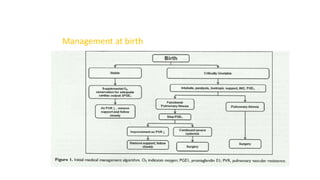
Management at birth
conclusion
• Rare congenital malformation of TV.
• Two dimensional echocardiography is essential to identify the abnormal tricuspid
valvar complex and to guide management.
• Broad spectrum of clinical presentation, Presented as asymptomatic to CHF,
cyanosis and arrhythmias
• Associated with multiple APs.
• Once diagnosis periodic evaluation is needed for better management and risk
assessment.
• Timing and the type of surgery are variable, surgical techniques range from
biventricular or univentricular repair to tricuspid valve replacement.
• No definitive surgery but con reconstruction had better result in recent study.
Thank you

Ebstein anomaly

  • 1.
    Ebstein anomaly short review DRMAHENDRA CARDIOLOGY,JIPMER
  • 2.
    Epidemiology • First describedby Wilhelm Ebstein in 1866. • 0.3-0.8% of all CHD • Prevalence as high as 2.4 per 10000 live births. • Equal male: female occurrence. • 20% to 40% of all neonates diagnosed with Ebstein’s anomaly will not survive 1 month.
  • 3.
    DEFINITION • Malformation ofthe TV and RV. • Characterized by- • (1) adherence of the septal and posterior leaflets to the underlying myocardium (failure of delamination) • (2) downward(apical) displacement of the functional annulus (septal/posterior) • (3) dilation of the “atrialized” portion of the right ventricle, with various degrees of hypertrophy and thinning of the wall. • (4) redundancy, fenestrations, and tethering of the anterior leaflet and dilation of the right atrioventricular junction (true tricuspid annulus)
  • 5.
    Pathologic anatomy ofTV • Origin of TV from AV ring & its chordal attachments are malpositioned. • Leaflets are malformed, dysplastic (thickened & distorted), enlarged or reduced in size. • Septal leaflet always affected, posterior leaflet nearly always, and anterior leaflet seldom. • Septal & posterior leaflets displaced , maximal displacement is usually at the commissure. • Anterior leaflet is almost always attached to AV junction. • Adherence create characteristic displacement of valve toward RV apex and even RVOT.
  • 6.
    • normally, downwarddisplacement of the septal and posterior leaflets is less than 8 mm/m2 body surface area. • anterior leaflet is generally redundant and may contain several fenestrations and Its chordae tendinae are generally short and poorly formed. • only mobile leaflet tissue is displaced into the right ventricular outflow tract, where it may cause obstruction or form a large sail-like intracavitary curtain.
  • 10.
    Pathologic anatomy ofRV • Proximal (atrialized RV) • Atrialized and dilated • When thin moves paradoxically during systole • Electrical potentials are ventricular, but pressure pulse is atrial contoured. • Distal • Smaller than normal RV • RV dilatation and dysfunction is universal • Functional portion is infundibulum, trabeculated apex, portion beneath anterior cusp • Thinner walled with fewer muscles.
  • 11.
    Etiology • Congenital diseaseof often uncertain cause. • Most cases are sporadic, familial Ebstein’s anomaly is rare. • Environmental factors • Maternal ingestion of lithium in first trimester • Maternal benzodiazepine use • Maternal exposure to varnishing substances • Maternal history of previous fetal loss • Risk is higher in whites than in other races.
  • 12.
    Genetic factors • mostcase are sporadic • Rare cases of NKX2.5 mutations, 10p13-p14 deletion, and 1p34.3-p36.11 deletion have been described. • Recently, Eight were found to have a mutation in the gene MYH7 and six of the eight patients also had left ventricular noncompaction. emanuel R, O’Brien K, Ng R. Ebstein’s anomaly: genetic study of 26 fami-lies. Br Heart J 1976;38:5– 7.
  • 13.
    Associated defects • Commonlyassociated with: • ASD or PFO (90%) • bicuspid or atretic aortic valves • subaortic stenosis • coarctation • mitral valve prolapse • accessory mitral valve tissue or muscle bands of the left ventricle • VSD, AV canal defect • Pulmonary stenosis/atresia (20-25%) • Wolff-Parkinson-White • Syndromes: • Down, Marfan, Noonan summer RG, Jacoby WJ Jr, Tucker DH. Ebstein’s anomaly associated with Car-diomyopathy and Pulmonary Hypertension. Circulation 1964;30:578– 587.
  • 14.
    predominant clinical findingis tricuspid insufficiency or regurgitation that leads to Severe cyanosis due to • Dilated RA with R→L shunting thru an interatrial communication (ASD or PFO) • Inadequate function of Distal RV - In severe cases the RV can’t develop adequate force to open the pulmonary valve (Functional Pulmonary Atresia) • Compromised LV filling by the dilated RV Other causes of cyanosis due to ↓ Antegrade PBF • Anatomic pulmonary stenosis or atresia. • Subpulmonary Obstruction due to abnormal TV tissue • Elevated PVR of neonatal period. Pathophysiology
  • 16.
    Clinical presentation • Maypresent at any age • Fetal life: • Diagnosed incidentally by echocardiography. • Neonatal life and infancy: • Cyanosis and severe heart failure • SVT • Improve as pulmonary vascular resistance decreases. • Adult life: • Fatigue, exertional dyspnea, cyanosis, heart failure, and palpitations arrhythmias are common.
  • 17.
    Physical examination • Normal •Cynosis/clubbing • Displaced apical impulse • Normal JVP • Holosytolic murmur( TR) • Quadruple rhythm • Hepatomegaly
  • 18.
    Carpentier’s classification • In1988, Carpentier et al. proposed the following classification of Ebstein’s anomaly - Type A: The volume of the true RV is adequate Type B: A large atrialized component of the RV exists, but the anterior leaflet of the TV moves freely. Type C: The anterior leaflet is severely restricted in its movement and may cause significant obstruction of the RVOT Type D: Almost complete atrialization of the ventricle except for a small infundibular component.
  • 19.
    Celermajer Index • Celermajeret al. described an echocardiographic grading score for neonates with Ebstein’s anomaly, Great Ormond Street Echocardiography (GOSE) score, with grades 1 to 4. • The ratio of the combined area of the RA and atrialized RV is compared to the functional RV and left heart(LA+LV). This classification is particularly helpful with neonatal Ebstein’s anomaly. Grade 1: ratio <0.5 Grade 2: ratio of 0.5 to 0.99 Grade 3: ratio of 1.0 to 1.49 Grade 4: ratio ≥ 1.5 Celermajer DS, Bull C, Till JA, et al. Ebstein’s anomaly: presentation and outcome from fetus to adult J Am Coll Cardiol 1994;23:170–176.
  • 20.
    GOSE score Grade RatioMortality 1 <0.5 8% 2 0.5-0.99 9% 3 (acyanotic) 1-1.49 10% (neonatal) 45% (later) 3 (cyanotic) 1-1.49 100% 4 >1.5 100%
  • 21.
    Natural history • 18%of symptomatic newborn die in neonatal period • 30% die before age of 10 yr due to CHF • Median age of death 20 yr. • Less severe anomaly pt remain asymptomatic or mildly symptomatic. • Sudden unexpected death due to arrhythmia. • Park 5th edition
  • 22.
    • Predictors ofcardiac-related death: Cardiothoracic ratio of ≥ 0.65 Increasing severity of TV displacement on echocardiography New York Heart Association (NYHA) class III or IV Cyanosis Severe TR Younger age at diagnosis
  • 23.
  • 24.
    12-lead ECG • Rarelynormal • Abnormal P waves consistent with right atrial enlargement – “Himalayan P waves”. • RBBB in 75-92% • PR prolongation is common due to RA enlargement. • Ventricular preexcitation in 10-30%.
  • 26.
    Chest X-Ray • Cardiomegaly (Rounded or Box-like contour) • Small aortic root and main pulmonary artery shadow • Decreased pulmonary vasculature • Large right atrium
  • 27.
    Echocardiogram • Gold standardfor diagnosis. • Two-dimensional • Apical displacement of the septal leaflet of greater than 8 mm/m2. • Abnormalities in morphology and septal attachment of the septal and anterior tricuspid leaflets • Eccentric leaflet coaptation. • Dilated right atrium. • Dilated right ventricle with decreased contractile performance. • Various left heart structural abnormalities.
  • 34.
    • Tethering ofanterior leaflet
  • 36.
    Echocardiogram • Doppler studies •Varying degrees of tricuspid regurgitation • Excludes associated shunts. • Differentiate between true and functional pulmonary atresia.
  • 40.
    Echocardiogram • M-mode • Paradoxicalseptal motion • Dilated right ventricle • Delayed closure of tricuspid valve leaflets more than 65 milliseconds after mitral valve closure • increased velocity and amplitude of anterior tricuspid leaflet motion
  • 41.
    Echocardiogram • Assessment ofseverity and surgical options • Functional right ventricular area less than 35% of total right ventricular area or an atrialized to functional right ventricular ratio greater than 0.5 associated with unfavorable prognosis • Functional right ventricular size • Degree of septal leaflet displacement. • Amount of leaflet tethering. • Magnitude of leaflet deformity and dysplasia. • Aneurysmal dilatation of right ventricular outflow tract (right ventricular outflow tract-to-aortic root ratio of >2:1 on parasternal short axis view) • Moderate-to-severe TR
  • 43.
    Cardiac Catheterization • Nolonger required to make/confirm the diagnosis • The most diagnostic characteristic- Typical atrial pressure & ventricular intracardiac ECG in the atrialized portion of the RV • Elevated RAP • R-L atrial shunting with systemic desaturation • Elevated RVEDP.
  • 45.
    Management • Severity Assessment •Guideline/Indications • Medical management • Surgical management • Post operative functional status
  • 46.
    ACC/AHA recommendation foradult Pts With ebstein’s anomaly • Class I • All pts with Ebstein’s anomaly should have periodic evaluation in a center with expertise in ACHD. (Level of Evidence: C) • Class I • 1. ECG, chest x-ray, and echocardiography-Doppler are recommended for the diagnostic evaluation of Ebstein’s anomaly in adult pts. (Level of Evidence: C) • Class IIa • 1. Pulse oximetry at rest and/or during exercise can be useful in the diagnostic evaluation of Ebstein’s anomaly in adult pts. (Level of Evidence: C) • 2. EP study can be useful in the diagnostic evaluation of Ebstein’s anomaly in adult pts if a supraventricular arrhythmia is documented or suspected (subsequent radiofrequency catheter ablation should be considered if clinically feasible). (Level of Evidence: C)
  • 47.
    • additional diagnostictests can be useful for comprehensive evaluation of Ebstein’s anomaly in adult pts: • a. Doppler TEE examination if the anatomic information is not provided by transthoracic imaging. (Level of Evidence: B) • b. Holter monitoring. (Level of Evidence: B) • c. EP study for history or ECG evidence of accessory pathway. (Level of Evidence: B) • d. CAG when surgical repair is planned, if there is a suspicion of coronary artery disease, and in men 35 years or older, premenopausal women 35 years or older who have coronary risk factors, and postmenopausal women. (Level of Evidence: B)
  • 48.
    • Recommendation forMedical Therapy- • Class I • 1. Anticoagulation with warfarin is recommended for patients with Ebstein’s anomaly with a history of paradoxical embolus or atrial fibrillation. (Level of Evidence: C) . • Recommendation for Catheter Interventions for Adults With Ebstein’s Anomaly • Class I • 1. Adults with Ebstein’s anomaly should have catheterization performed at centers with expertise in catheterization and management of such patients. (Level of Evidence: C) • Recommendation for Electrophysiology Testing/Pacing Issues in Ebstein’s Anomaly • Class IIa • 1. Catheter ablation can be beneficial for treatment of recurrent supraventricular tachycardia in some patients with Ebstein’s anomaly. (Level of Evidence: B)
  • 49.
    indication of sx ClassI The following situations warrant intervention: • Limited exercise capacity (New York Heart Association class greater than II) (Level of Evidence: B) • Increasing heart size (cardiothoracic ratio greater than 65%) (Level of Evidence: B) • cyanosis (resting oxygen saturations < 90%) (Level of Evidence: B) • Severe tricuspid regurgitation with symptoms (Level of Evidence: B) • Transient ischemic attack or stroke (Level of Evidence: B) • Prior to significant LV/RV dysfunction. Every effort should be made to preserve the native TV. (Level of Evidence: C) Presentation at Annual CCS Meeting in Edmonton 2009
  • 50.
    • Surgeons withtraining and expertise in CHD should perform concomitant arrhythmia surgery in pts with Ebstein’s anomaly and the following indications: • a. Appearance/progression of atrial and/or ventricular arrhythmias not amenable to percutaneous treatment. (Level of Evidence: B) • b. Ventricular preexcitation not successfully treated in the electrophysiology laboratory. (Level of Evidence: B)
  • 51.
    • rerepair orreplacement of the tricuspid valve is recommended in adults with Ebstein’s anomaly with the following indications: • Symptoms, deteriorating exercise capacity, or New York Heart Association functional class III or IV. (Level of Evidence: B) • Severe TR after repair with progressive RV dilation, reduction of RV systolic function, or appearance/ progression of atrial and/or ventricular arrhythmias. (Level of Evidence: B) • Bioprosthetic tricuspid valve dysfunction with significant mixed regurgitation and stenosis. (Level of Evidence: B) • Predominant bioprosthetic valve stenosis (mean gradient greater than 12 to 15 mm Hg). (Level of Evidence: B) • Operation can be considered earlier with lesser degrees of bioprosthetic stenosis with symptoms or decreased exercise tolerance. (Level of Evidence: B).
  • 52.
    • Recommendation forReproduction • Class I • 1. Women with Ebstein’s anomaly should undertake prepregnancy counseling with a physician with expertise in ACHD. (Level of Evidence: C) • Most women have a successful pregnancy with proper care. • increased risk of low birth weight and fetal loss if significant cyanosis is present. • The risk of CHD in the offspring (in the absence of a family history) is approximately 6%.
  • 53.
    • Recommendation forEndocarditis Prophylaxis • Class IIa • Antibiotic prophylaxis before dental procedures is reasonable in cyanotic patients with Ebstein’s anomaly and postoperative patients with a prosthetic cardiac valve. (Level of Evidence: C)
  • 54.
    Arrhythmia management • Atrioventricularreentrant tachycardia related to accessory pathways can occur in children with EA. • anterograde fast conduction over an accessory pathway may lead to rapid ventricular activation and potentially degenerate into ventricular fibrillation. • adolescents and adults, arrhythmia symptoms are the most common presentation of EA (42 %). • accessory pathway or nodal atrioventricoular reentrant tachycardia being more common at a younger age. • later in life, atrial tachycardiaand atrial fibrillation have a higher prevalence.
  • 55.
    • Normal hearts,the compact node is located at the apex of the triangle of Koch. • in EA AV node is compressed and the central fibrous body malformed, can be closer to the orifice of the coronary sinus. • This peculiarity extremely important trans catheter ablation of atrioventricular nodal reentrant tachycardia, • targets the nodal slow pathway located at the base of the triangle of Koch in the proximity of the coronary sinus ostium. • prevalence of preexcitation in neonates with EA has been reported to be • around 10 %. • in different series, 5–25 % of EA patients have an accessory pathways. • 6–30 % of cases the connections are multiple.
  • 56.
    • displacement ofthe septal tricuspid valve leaflet is associated with a discontinuity of the atrioventricular junction leading to muscular connections between the right atrium and ventricle. • localization of almost all accessory pathways around the orifi ce of the malformed tricuspid valve, and the majority of them being located in the region between the mid-septal and the posterolateral tricuspid annulus.
  • 57.
    EP challenges inEA • first issue is the localization of the accessory pathway. • identify the true atrioventricular groove is difficult because of the distortion of the normal anatomy of the right chambers. • right coronary artery runs in the true atrioventricular grove,an angiography may help to identify this anatomical landmark. • atrialized right ventricle can be characterized by abnormal fragmented electrograms, rendering the interpretation of recorded signals around the target area difficult. • catheter manipulation is often more difficult in these patients because of the dilatation of the right chambers. • All these technical consideration explain lower success rate.
  • 58.
    Antiarrhythmic Drug • classIC drugs are used with great concern secondary to their negative inotropic and possible proarrhythmic effect • Amiodarone is less proarrhythmic and has a less negative inotropic effect. • Beta-blockers and sotalol are often used to control arrhythmia.
  • 59.
    Principle of surgicalmanagement • complete or subtotal closure of intra atrial communication. • Tricuspid valve repair or replacement • Elimination of arrhythmias • Selective plication of atrialized RV • Right reduction atrioplasty • Repair of associated defects.
  • 60.
    • Palliative procedure-forcritically ill neonate • A)BT shunt (with enlargement of ASD)- • Obstructive lesion between RV and PA • Good LV function required • Fontan later • B)starnes operation(pericardial closure of TV or plication of large RA,enlargement of ASD, and BT shunt) • If LV is pancaked by RV/RA • Fontan later
  • 61.
    • Definitive procedure- •patient with good size RV and function are candidate for biventricular repair with TV repair or replacement. • 1.Danielson monocusp repair- • Creation of monocusp valve using anterior leaflet to coapt withventricular septum • Atrialized RV free wall transverse plication • Posterior tricuspid anuloplasty • Right reduction atrioplasty • 30 days mortality 5.9%,survival 85% at 10 yrs,71% at 20 yrs. Moss and Adams 9th edition
  • 62.
    • Carpentier repair- •type of monocusp repair • 1987 - 1991, 13 pts was treated with Carpentier's type of repair • mean age 16.3 yrs. • three hospital deaths. • Follow-up ranged from 49 to 105 months,no late deaths and all patients were in NYHA functional class I or II. G Ital Cardiol. 1996 Dec;26(12):1415-20
  • 63.
    • Cone reconstruction(CR)- •Most anatomically correction
  • 64.
    • Tricuspid valvereplacement • Repair is preferred in most pts. • If not feasible then porcine bioprosthatic valve replacement is good alternative in older pts • Bioprosthatic valve is preferred over mechanical due to relatively good durability and lack of need for anticoagulation.
  • 65.
    • Bidirectional cavopulmonaryconnection adjunct to tricuspid repair- • Reduce 1/3 of venous return to dysfunctional RV • Provide sufficient preload to LV to maintain adequate systemic perfusion. • Indication of BDCPA- • Severe RV enlargement or dysfunction • Compression of LV due shifting of IVS • Moderate TS(mean >8) after CR • RA to LA pressure ration >1.5
  • 66.
    • Disadvantage ofBDCPA- • Pulsatility in head and neck vein • Facial swelling • Development of veno-veno collateral/pulmonary AV fistula • Limitation of access to heart from IJV. • Preop LVEDP<12 mmhg, tranpulmonary gradient <10, MPAP <16mmhg predict successful outcome of BDCPA. • Transplantation- • rarely required • Presence of severe biventricular dysfunction with EF <25%.
  • 67.
  • 71.
    conclusion • Rare congenitalmalformation of TV. • Two dimensional echocardiography is essential to identify the abnormal tricuspid valvar complex and to guide management. • Broad spectrum of clinical presentation, Presented as asymptomatic to CHF, cyanosis and arrhythmias • Associated with multiple APs. • Once diagnosis periodic evaluation is needed for better management and risk assessment. • Timing and the type of surgery are variable, surgical techniques range from biventricular or univentricular repair to tricuspid valve replacement. • No definitive surgery but con reconstruction had better result in recent study.
  • 72.

Editor's Notes

  • #21 Involves calculating the ratio of the combined area of the RA and atrialized RV to that of the functional RV and L heart in a 4 chamber view at end diastole Even grade 3 carries with it a separate, late risk of death even in the acyanotic neonate