Coronary Imaging
Dr. Mahendra
Cardiology,JIPMER
Coronary angiography
 Gold standard for evaluating CAD
 Guide both PCI and CABG
 Provides highly useful picture of the vessel lumen
 Indirect information about the arterial wall
2
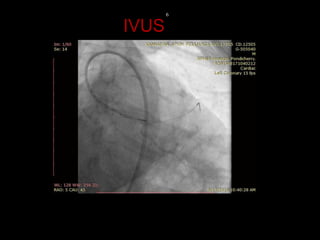
57/M ,old IWMI, CSA3
4
5
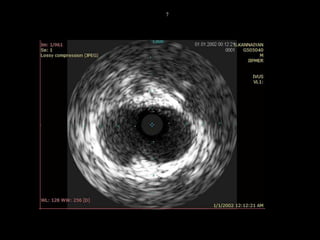
IVUS
6
7
8
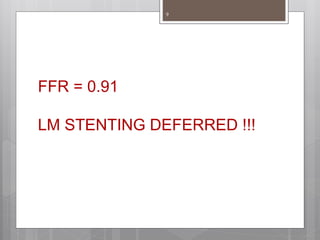
FFR = 0.91
LM STENTING DEFERRED !!!
9
10
11
12
Anatomical assessment
Intracoronary imaging
Functional assessment
FFR
?
13
Muller et al., The Year in Intracoronary Imaging
J A C C : C A R D I O V A S C U L A R I M A G I N G ,
V O L . 3 , N O . 8 , 2 0 1 0
A U G U S T 2 0 1 0 : 8 8 1 – 9 1
14
IVUS
 Image integrity should be
checked before inserting
 No coronary preparation is
needed
 Iv Heparin 5000-10000U ;
Ic NTG 100-200 µ
 Standard coronary
interventional techniques and
equipment (guiding catheter
and 0.014 inch angioplasty
guidewire)
 Automated pullback device
(usually at a rate of 0.5–1.0
mm/s for any length) or by
manual operator pull back
15
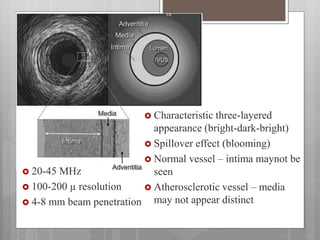
 Characteristic three-layered
appearance (bright-dark-bright)
 Spillover effect (blooming)
 Normal vessel – intima maynot be
seen
 Atherosclerotic vessel – media
may not appear distinct
 20-45 MHz
 100-200 µ resolution
 4-8 mm beam penetration
16
17
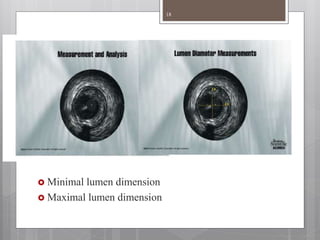
 Minimal lumen dimension
 Maximal lumen dimension
18
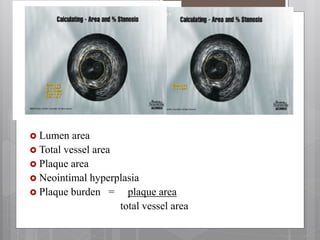
 Lumen area
 Total vessel area
 Plaque area
 Neointimal hyperplasia
 Plaque burden = plaque area
total vessel area
19
20
 Reference segment – most normal looking (largest
lumen with smallest plaque burden) within 10 mm
from the lesion with no intervening side branches
 Arterial remodelling (Glagov et al)
-Positive remodelling (adaptive);RI >1
-Negative remodelling(constrictive);RI<1
-Intermediate remodelling
 Remodelling Index = EEM surface area (lesion site)
EEM surface area (reference site)
21
22
Gray scale IVUS
 Soft plaque – echogenicity less than the
surrounding adventitia
 Fibrous plaque – intermediate echogenicity
between those of soft plaques and highly
echogenic calcium plaques
 Calcified plaques – high echogenicity with
acoustic shadowing (superficial or deep)
23
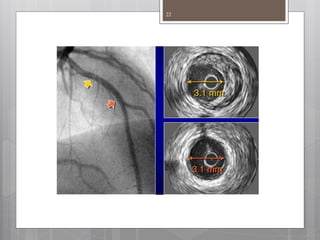
Plaque characterization
24
25
Dark green - fibrous
Light green - fibrofatty
White- calcium
Red - necrotic
Green – fibrous
Yellow – dense fibrous
Blue- lipid pool
Red- calcium
Green - fibrotic
Yellow- lipidic
Light blue- calcium
Pink - necrotic
26
Abnormal lesion morphology
27
Interventional applications
 Angiographically intermediate lesions
 Calcified lesions – degree and location
 High risk lesions for distal embolisaton –lipid pool and
thrombus containing
 Left main lesions (<6 mm2) – LITRO
 Bifurcation lesions
 CTO
 ISR
 Optimal device sizing (angiographic normal reference
segment vs IVUS reference segment) – CLOUT, BEST,
STILLR
 Opimal stent expansion – CRUISE, AVID
 Acute stent problems ( Incomplete expansion, malapposition,
marginal tears )
28
Vulnerable plaque
 Hypoechoic plaques without a well formed fibrous
caps
29
Plaque rupture
 Hypoechoic cavity within the plaque is connected
within the lumen and a remnant of fibrous cap is
observed at the connecting site
 Often eccentric, less calcified, large plaque burden,
positively remodelled, and a/w thrombus
 Extensive positive remodelling – most consistent
feature reported in GS-IVUS predicting plaque
instability
30
Ability of IVUS to predict future coronary events
- PROSPECT trial
 Three vessel VH-IVUS in 697 ACS patients
 Three baseline IVUS characteristics that
independently predicted future events
1) Plaque burden > 70 %
2) TCFA
3) MLA < 4 mm2
31
Safety
 Most frequent acute complication – transient
coronary spasm 1-3%
 Major complications <0.5% (Dissections,
thrombosis, abrupt closure)
Batkoff BW, Linker DT, Safety of intracoronary ultrasound:
data from a Multicenter European Registry, Cathet
Cardiovasc Diagn, 1996;38:238–41.
32
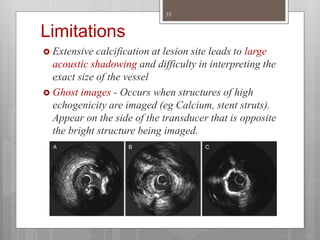
Limitations
 Extensive calcification at lesion site leads to large
acoustic shadowing and difficulty in interpreting the
exact size of the vessel
 Ghost images - Occurs when structures of high
echogenicity are imaged (eg Calcium, stent struts).
Appear on the side of the transducer that is opposite
the bright structure being imaged.
33
 A case with spontaneous dissection. Optical coherence
tomography (C) visualized spontaneous dissection that could not
be found with angiography (A) or intravascular ultrasound (B).
34
OCT
 Optical analogue of IVUS
 Significantly higher resolution (10 times more) but
lesser penetration
 Uses near infrared rays- 1.3 microns
 OCT measures the time delay of the light that is
reflected or backscattered from tissue, and that is
collected by the catheter, by using a technique
known as interferometry.
35
IMAGING WIRE AND CATHETER
36
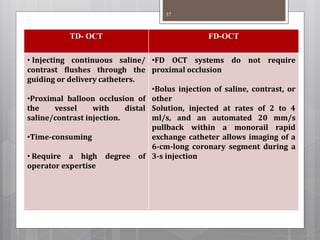
TD- OCT FD-OCT
• Injecting continuous saline/
contrast flushes through the
guiding or delivery catheters.
•Proximal balloon occlusion of
the vessel with distal
saline/contrast injection.
•Time-consuming
• Require a high degree of
operator expertise
•FD OCT systems do not require
proximal occlusion
•Bolus injection of saline, contrast, or
other
Solution, injected at rates of 2 to 4
ml/s, and an automated 20 mm/s
pullback within a monorail rapid
exchange catheter allows imaging of a
6-cm-long coronary segment during a
3-s injection
37
NORMAL ARTERIAL WALL IN OCT
38
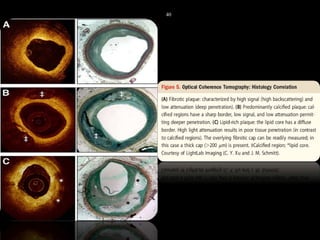
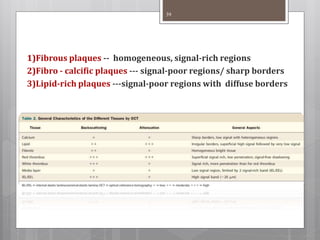
1)Fibrous plaques -- homogeneous, signal-rich regions
2)Fibro - calcific plaques --- signal-poor regions/ sharp borders
3)Lipid-rich plaques ---signal-poor regions with diffuse borders
39
40
 Ex vivo validations --- OCT superior to conventional and
integrated backscatter IVUS for the characterisation of
coronary atherosclerotic plaque composition.
 In vivo, OCT is superior for the identification of lipid
pools
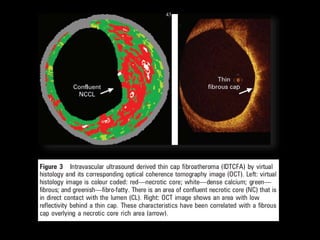
 Thin capped fibroatheromas (TCFA) - defined pathologically
by the triad of:
 Lipid core.
 Fibrous cap with a thickness < 65 micron m.
 Cell infiltration of the fibrous cap.
 OCT for in vivo assessment of fibrous cap thickness ----
Unique ability to image superficial detail.
 OCT can quantify macrophages within the fibrous cap.
41
42
43
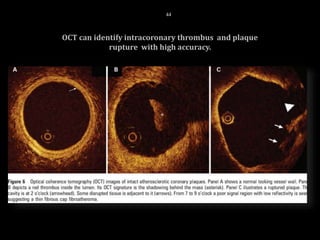
OCT can identify intracoronary thrombus and plaque
rupture with high accuracy.
44
OCT AND PCI
 Fine resolution at a superficial depth, OCT allows a
uniquely detailed image of the effects of stent
implantation on the vessel wall.
 OCT allows:
 Examination of the target vessel both pre- and post-
intervention
 Defining stent struts readily
 Tissue prolapse between stent struts immediately
(97.5%)
 Tissue characterization of plaque before and after
stent placement
 Intrastent dissection (86.3%)
45
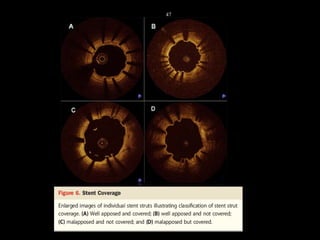
 3-point classification defines stent strut
apposition.
 Embedded ----- the leading edge is buried
within the intima by more than one-half its
thickness
 Protrusion --- stent strut is apposed but not
embedded
 Malapposed ---- there is no intimal contact
46
47
 Primary imaging modalities for follow-up evaluation of
several bioabsorbable vascular scaffolds (BVS), which are
being studied in clinical trials (ABSORB)
 OCT has been increasingly used as an endpoint in clinical
trials of newer generation DES (LEADERS)
 OCT helps to predict no reflow post-PCI, based on the
presence of TCFA
48
49
50
SAFETY
 The relatively low energy used in OCT (5.0–8.0 mW)
does not cause functional or structural damage to the
coronary tissue.
 Use of a contrast bolus in coronary preparation is a
concern but studies have shown that no patients
suffered contrast-induced nephropathy,
 Small risk of coronary spasm and electrocardiogram
(ECG) changes during contrast administration.
51
LIMITATIONS
 Need to displace blood or dilute the hematocrit, either with
saline or contrast flush injection, or a combination of the two.
 Shallow image penetration of 1 to 2.5 mm. This prevents
assessments of cross-sectional plaque area ---- OCT has only
a limited role in the assessment of left main stem and
Saphenous vein graft atherosclerosis severity.
 The differentiation of calcific areas from lipid pools can be
problematic . both result in a low attenuation signal.
 Imaging of Left main ostium
 Imaging in patients with decreased creatinine clearance
 Image artifacts
52
53
54
The 2011(ACCF)/(AHA)/ (SCAI)
guidelines for PCI
1) IVUS for the evaluation of angiographically indeterminate left
main lesions and angiographically indeterminate (50–70 % stenosis)
non-left main coronary lesions (Class IIa LOE B)
2) IVUS to evaluate the aetiology of stent restenosis and stent
thrombosis (Class IIa, Level of Evidence C).
3)The routine use of IVUS for evaluation of lesions when PCI is not
planned was given a Class III recommendation
4) Currently neither the American nor European (ESC) guidelines
provide recommendations for the routine use of OCT in clinical
practice
5) More recent guidelines published in February 2014 by NICE
suggest that the evidence on the safety of OCT to guide PCI showed
no major concerns
IVUS reveals need of postdilatation
55
CONCLUSION
 IVUS and OCT - useful image guiding tools during stent
implantation.
 Intracoronary imaging may prove to be useful in reducing
complications by 1) improving the techniques of stent sizing and
placement, 2) identifying the role of necrotic-core plaque as a cause
of stent complications, and 3) assessing stent coverage and
thrombosis.
 OCT - higher resolution and adds more information particularly
distinguishing thrombus formation, coronary dissection and
incomplete stent apposition following implantation.But not clear
whether this additional information helps to improve patient outcome
 At present, IVUS remains the more trusted and validated imaging
modality and is the first-choice modality to guide optimal stent
implantation.
56
Thank you !!!
57
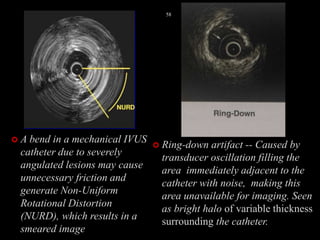
 A bend in a mechanical IVUS
catheter due to severely
angulated lesions may cause
unnecessary friction and
generate Non-Uniform
Rotational Distortion
(NURD), which results in a
smeared image
 Ring-down artifact -- Caused by
transducer oscillation filling the
area immediately adjacent to the
catheter with noise, making this
area unavailable for imaging. Seen
as bright halo of variable thickness
surrounding the catheter.
58
Residual blood “sunflower” effect or
“merry-go-round” effect .
Saturation Artifact
59
Bubble Artifact
Fold-over Artifacts
Sew-up Artifacts
60

coronary imaging

  • 1.
  • 2.
    Coronary angiography  Goldstandard for evaluating CAD  Guide both PCI and CABG  Provides highly useful picture of the vessel lumen  Indirect information about the arterial wall 2
  • 3.
  • 4.
  • 5.
  • 6.
  • 7.
  • 8.
  • 9.
    FFR = 0.91 LMSTENTING DEFERRED !!! 9
  • 10.
  • 11.
  • 12.
  • 13.
  • 14.
    Muller et al.,The Year in Intracoronary Imaging J A C C : C A R D I O V A S C U L A R I M A G I N G , V O L . 3 , N O . 8 , 2 0 1 0 A U G U S T 2 0 1 0 : 8 8 1 – 9 1 14
  • 15.
    IVUS  Image integrityshould be checked before inserting  No coronary preparation is needed  Iv Heparin 5000-10000U ; Ic NTG 100-200 µ  Standard coronary interventional techniques and equipment (guiding catheter and 0.014 inch angioplasty guidewire)  Automated pullback device (usually at a rate of 0.5–1.0 mm/s for any length) or by manual operator pull back 15
  • 16.
     Characteristic three-layered appearance(bright-dark-bright)  Spillover effect (blooming)  Normal vessel – intima maynot be seen  Atherosclerotic vessel – media may not appear distinct  20-45 MHz  100-200 µ resolution  4-8 mm beam penetration 16
  • 17.
  • 18.
     Minimal lumendimension  Maximal lumen dimension 18
  • 19.
     Lumen area Total vessel area  Plaque area  Neointimal hyperplasia  Plaque burden = plaque area total vessel area 19
  • 20.
  • 21.
     Reference segment– most normal looking (largest lumen with smallest plaque burden) within 10 mm from the lesion with no intervening side branches  Arterial remodelling (Glagov et al) -Positive remodelling (adaptive);RI >1 -Negative remodelling(constrictive);RI<1 -Intermediate remodelling  Remodelling Index = EEM surface area (lesion site) EEM surface area (reference site) 21
  • 22.
  • 23.
    Gray scale IVUS Soft plaque – echogenicity less than the surrounding adventitia  Fibrous plaque – intermediate echogenicity between those of soft plaques and highly echogenic calcium plaques  Calcified plaques – high echogenicity with acoustic shadowing (superficial or deep) 23
  • 24.
  • 25.
  • 26.
    Dark green -fibrous Light green - fibrofatty White- calcium Red - necrotic Green – fibrous Yellow – dense fibrous Blue- lipid pool Red- calcium Green - fibrotic Yellow- lipidic Light blue- calcium Pink - necrotic 26
  • 27.
  • 28.
    Interventional applications  Angiographicallyintermediate lesions  Calcified lesions – degree and location  High risk lesions for distal embolisaton –lipid pool and thrombus containing  Left main lesions (<6 mm2) – LITRO  Bifurcation lesions  CTO  ISR  Optimal device sizing (angiographic normal reference segment vs IVUS reference segment) – CLOUT, BEST, STILLR  Opimal stent expansion – CRUISE, AVID  Acute stent problems ( Incomplete expansion, malapposition, marginal tears ) 28
  • 29.
    Vulnerable plaque  Hypoechoicplaques without a well formed fibrous caps 29
  • 30.
    Plaque rupture  Hypoechoiccavity within the plaque is connected within the lumen and a remnant of fibrous cap is observed at the connecting site  Often eccentric, less calcified, large plaque burden, positively remodelled, and a/w thrombus  Extensive positive remodelling – most consistent feature reported in GS-IVUS predicting plaque instability 30
  • 31.
    Ability of IVUSto predict future coronary events - PROSPECT trial  Three vessel VH-IVUS in 697 ACS patients  Three baseline IVUS characteristics that independently predicted future events 1) Plaque burden > 70 % 2) TCFA 3) MLA < 4 mm2 31
  • 32.
    Safety  Most frequentacute complication – transient coronary spasm 1-3%  Major complications <0.5% (Dissections, thrombosis, abrupt closure) Batkoff BW, Linker DT, Safety of intracoronary ultrasound: data from a Multicenter European Registry, Cathet Cardiovasc Diagn, 1996;38:238–41. 32
  • 33.
    Limitations  Extensive calcificationat lesion site leads to large acoustic shadowing and difficulty in interpreting the exact size of the vessel  Ghost images - Occurs when structures of high echogenicity are imaged (eg Calcium, stent struts). Appear on the side of the transducer that is opposite the bright structure being imaged. 33
  • 34.
     A casewith spontaneous dissection. Optical coherence tomography (C) visualized spontaneous dissection that could not be found with angiography (A) or intravascular ultrasound (B). 34
  • 35.
    OCT  Optical analogueof IVUS  Significantly higher resolution (10 times more) but lesser penetration  Uses near infrared rays- 1.3 microns  OCT measures the time delay of the light that is reflected or backscattered from tissue, and that is collected by the catheter, by using a technique known as interferometry. 35
  • 36.
    IMAGING WIRE ANDCATHETER 36
  • 37.
    TD- OCT FD-OCT •Injecting continuous saline/ contrast flushes through the guiding or delivery catheters. •Proximal balloon occlusion of the vessel with distal saline/contrast injection. •Time-consuming • Require a high degree of operator expertise •FD OCT systems do not require proximal occlusion •Bolus injection of saline, contrast, or other Solution, injected at rates of 2 to 4 ml/s, and an automated 20 mm/s pullback within a monorail rapid exchange catheter allows imaging of a 6-cm-long coronary segment during a 3-s injection 37
  • 38.
  • 39.
    1)Fibrous plaques --homogeneous, signal-rich regions 2)Fibro - calcific plaques --- signal-poor regions/ sharp borders 3)Lipid-rich plaques ---signal-poor regions with diffuse borders 39
  • 40.
  • 41.
     Ex vivovalidations --- OCT superior to conventional and integrated backscatter IVUS for the characterisation of coronary atherosclerotic plaque composition.  In vivo, OCT is superior for the identification of lipid pools  Thin capped fibroatheromas (TCFA) - defined pathologically by the triad of:  Lipid core.  Fibrous cap with a thickness < 65 micron m.  Cell infiltration of the fibrous cap.  OCT for in vivo assessment of fibrous cap thickness ---- Unique ability to image superficial detail.  OCT can quantify macrophages within the fibrous cap. 41
  • 42.
  • 43.
  • 44.
    OCT can identifyintracoronary thrombus and plaque rupture with high accuracy. 44
  • 45.
    OCT AND PCI Fine resolution at a superficial depth, OCT allows a uniquely detailed image of the effects of stent implantation on the vessel wall.  OCT allows:  Examination of the target vessel both pre- and post- intervention  Defining stent struts readily  Tissue prolapse between stent struts immediately (97.5%)  Tissue characterization of plaque before and after stent placement  Intrastent dissection (86.3%) 45
  • 46.
     3-point classificationdefines stent strut apposition.  Embedded ----- the leading edge is buried within the intima by more than one-half its thickness  Protrusion --- stent strut is apposed but not embedded  Malapposed ---- there is no intimal contact 46
  • 47.
  • 48.
     Primary imagingmodalities for follow-up evaluation of several bioabsorbable vascular scaffolds (BVS), which are being studied in clinical trials (ABSORB)  OCT has been increasingly used as an endpoint in clinical trials of newer generation DES (LEADERS)  OCT helps to predict no reflow post-PCI, based on the presence of TCFA 48
  • 49.
  • 50.
  • 51.
    SAFETY  The relativelylow energy used in OCT (5.0–8.0 mW) does not cause functional or structural damage to the coronary tissue.  Use of a contrast bolus in coronary preparation is a concern but studies have shown that no patients suffered contrast-induced nephropathy,  Small risk of coronary spasm and electrocardiogram (ECG) changes during contrast administration. 51
  • 52.
    LIMITATIONS  Need todisplace blood or dilute the hematocrit, either with saline or contrast flush injection, or a combination of the two.  Shallow image penetration of 1 to 2.5 mm. This prevents assessments of cross-sectional plaque area ---- OCT has only a limited role in the assessment of left main stem and Saphenous vein graft atherosclerosis severity.  The differentiation of calcific areas from lipid pools can be problematic . both result in a low attenuation signal.  Imaging of Left main ostium  Imaging in patients with decreased creatinine clearance  Image artifacts 52
  • 53.
  • 54.
  • 55.
    The 2011(ACCF)/(AHA)/ (SCAI) guidelinesfor PCI 1) IVUS for the evaluation of angiographically indeterminate left main lesions and angiographically indeterminate (50–70 % stenosis) non-left main coronary lesions (Class IIa LOE B) 2) IVUS to evaluate the aetiology of stent restenosis and stent thrombosis (Class IIa, Level of Evidence C). 3)The routine use of IVUS for evaluation of lesions when PCI is not planned was given a Class III recommendation 4) Currently neither the American nor European (ESC) guidelines provide recommendations for the routine use of OCT in clinical practice 5) More recent guidelines published in February 2014 by NICE suggest that the evidence on the safety of OCT to guide PCI showed no major concerns IVUS reveals need of postdilatation 55
  • 56.
    CONCLUSION  IVUS andOCT - useful image guiding tools during stent implantation.  Intracoronary imaging may prove to be useful in reducing complications by 1) improving the techniques of stent sizing and placement, 2) identifying the role of necrotic-core plaque as a cause of stent complications, and 3) assessing stent coverage and thrombosis.  OCT - higher resolution and adds more information particularly distinguishing thrombus formation, coronary dissection and incomplete stent apposition following implantation.But not clear whether this additional information helps to improve patient outcome  At present, IVUS remains the more trusted and validated imaging modality and is the first-choice modality to guide optimal stent implantation. 56
  • 57.
  • 58.
     A bendin a mechanical IVUS catheter due to severely angulated lesions may cause unnecessary friction and generate Non-Uniform Rotational Distortion (NURD), which results in a smeared image  Ring-down artifact -- Caused by transducer oscillation filling the area immediately adjacent to the catheter with noise, making this area unavailable for imaging. Seen as bright halo of variable thickness surrounding the catheter. 58
  • 59.
    Residual blood “sunflower”effect or “merry-go-round” effect . Saturation Artifact 59
  • 60.