And Have Strong Bones!
Some slides adapted from University of Nebraska Lincoln (lancaster.unl.edu) and MyPyramid.gov
Why Worry About Calcium?
Calcium
• Helps control muscle
contraction
• Need to build and maintain
strong bone throughout life
• Medical complications may
occur as bone strength
decreases due to lack of
calcium - bones compress
and naturally break
Bone Mass
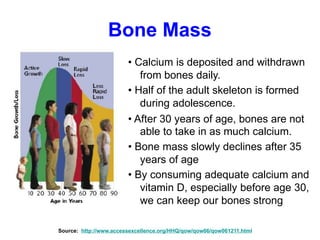
• Calcium is deposited and withdrawn
from bones daily.
• Half of the adult skeleton is formed
during adolescence.
• After 30 years of age, bones are not
able to take in as much calcium.
• Bone mass slowly declines after 35
years of age
• By consuming adequate calcium and
vitamin D, especially before age 30,
we can keep our bones strong
Source: http://www.accessexcellence.org/HHQ/qow/qow06/qow061211.html
Osteoporosis
• Osteoporosis is a disease that
weakens bones, causing them
to become weak
• Brittle bones are due to a loss
of calcium
• While it happens often in
elderly women, osteoporosis
can occur at any age and
gender if the diet is
inadequate
• It is preventable!
Source: The 2004 Surgeon General’s Report on Bone Health and Osteoporosis:
What It Means to You at http://www.surgeongeneral.gov/library/bonehealth
Normal Bone with
Bone Osteoporosis
Simple Prevention Steps
1. Get the recommended
amount of calcium and
vitamin D
2. Engage in physical activity,
including weight-bearing
activity. For example:
- Weight lifting
- Running/jogging
3. Avoid smoking and
excessive alcohol intake
What’s the Recommendation for
Calcium?
Age Calcium needed per
day (mg)
0 to 6 months 200
7 to 12 months 260
1 to 3 years 700
4 to 8 years 1000
9 to 18 years 1,300
19 to 50 years 1,000
Growth
spurt
Over 50 years 1,200
Source: The 2004 Surgeon General’s Report on Bone Health and Osteoporosis:
What It Means to You at http://www.surgeongeneral.gov/library/bonehealth
Food and Supplement Labels
Percent Daily Value is used to show
how much calcium is in a food
compared to what is recommended,
based on 100% (1,000mg)
100% DV for calcium = 1000
milligrams (mg)
Teens 14-18 years need 1300mg
which is 130% DV
For this label there is 30% DV of Calcium
How many mg would that be?
Do the math:
30% = 0.3, so 0.3 X 1000 = 300 mg
Calcium Sources: Dairy Group
Dairy foods are typically our
best sources of calcium
MyPlate recommends 3
cups of Dairy per day
What Counts as a Cup?
• 1 cup low-fat or fat-free milk
• 1 cup fortified soy beverage
• 1 cup low-fat or fat-free
yogurt
• 1.5 oz natural cheese
• 2 oz. processed cheese
• 2 cups cottage cheese
Calcium Sources:
Grains & Protein Foods Groups
Grains Group
• Cereal, calcium- fortified
Serving size and amount of
calcium varies—check label
Protein Foods Group
• Baked beans
1 cup = 140mg (14% DV)
• Salmon, canned, with edible
bones
3 oz. = 180mg (18% DV)
• Sardines, canned, in oil, with
edible bones
3 oz. = 320mg (32% DV)
• Soybeans, cooked
1 cup = 260mg (26% DV)
• Tofu, firm, with calcium
½ cup = 200mg (20mg% DV);
check label
Calcium Sources:
Fruits & Vegetables Groups
Fruit Group
• Calcium-fortified orange
juice and other calcium-
fortified beverages
6 oz. = 200mg to 300mg (20-
30% DV, varies — check label)
Vegetable Group
• Broccoli, raw
1 cup = 90mg (9% DV)
• Collard greens, cooked
½ cup = 200mg (20% DV)
• Turnip greens, boiled
½ cup = 100mg (10% DV)
• Spinach, cooked
½ cup = 120mg(12% DV)
Vitamin D: Why and How Much?
• Helps the body
more easily absorb Age Vitamin D needed
calcium in the
digestive tract.
• Promotes bone
formation and
mineralization
• Works with calcium
to build a stronger
more intact bone
per day
Up to 70 years 15 mcg Å
old
70 years and 20 mcg
older
You need more Vitamin D as you age
to reduce the risk of fractures and
other bone injuries
Good Sources of Vitamin D
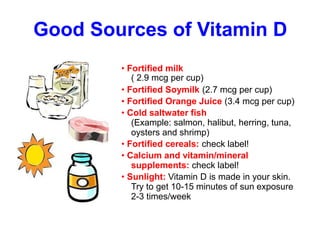
• Fortified milk
( 2.9 mcg per cup)
• Fortified Soymilk (2.7 mcg per cup)
• Fortified Orange Juice (3.4 mcg per cup)
• Cold saltwater fish
(Example: salmon, halibut, herring, tuna,
oysters and shrimp)
• Fortified cereals: check label!
• Calcium and vitamin/mineral
supplements: check label!
• Sunlight: Vitamin D is made in your skin.
Try to get 10-15 minutes of sun exposure
2-3 times/week
Summarize what you’ve learned by
writing a 5-8 sentence paragraph:
Ls calcium ppt

Ls calcium ppt

  • 1.
    And Have StrongBones! Some slides adapted from University of Nebraska Lincoln (lancaster.unl.edu) and MyPyramid.gov
  • 2.
    Why Worry AboutCalcium? Calcium • Helps control muscle contraction • Need to build and maintain strong bone throughout life • Medical complications may occur as bone strength decreases due to lack of calcium - bones compress and naturally break
  • 3.
    Bone Mass • Calciumis deposited and withdrawn from bones daily. • Half of the adult skeleton is formed during adolescence. • After 30 years of age, bones are not able to take in as much calcium. • Bone mass slowly declines after 35 years of age • By consuming adequate calcium and vitamin D, especially before age 30, we can keep our bones strong Source: http://www.accessexcellence.org/HHQ/qow/qow06/qow061211.html
  • 4.
    Osteoporosis • Osteoporosis isa disease that weakens bones, causing them to become weak • Brittle bones are due to a loss of calcium • While it happens often in elderly women, osteoporosis can occur at any age and gender if the diet is inadequate • It is preventable! Source: The 2004 Surgeon General’s Report on Bone Health and Osteoporosis: What It Means to You at http://www.surgeongeneral.gov/library/bonehealth Normal Bone with Bone Osteoporosis
  • 5.
    Simple Prevention Steps 1.Get the recommended amount of calcium and vitamin D 2. Engage in physical activity, including weight-bearing activity. For example: - Weight lifting - Running/jogging 3. Avoid smoking and excessive alcohol intake
  • 6.
    What’s the Recommendationfor Calcium? Age Calcium needed per day (mg) 0 to 6 months 200 7 to 12 months 260 1 to 3 years 700 4 to 8 years 1000 9 to 18 years 1,300 19 to 50 years 1,000 Growth spurt Over 50 years 1,200 Source: The 2004 Surgeon General’s Report on Bone Health and Osteoporosis: What It Means to You at http://www.surgeongeneral.gov/library/bonehealth
  • 7.
    Food and SupplementLabels Percent Daily Value is used to show how much calcium is in a food compared to what is recommended, based on 100% (1,000mg) 100% DV for calcium = 1000 milligrams (mg) Teens 14-18 years need 1300mg which is 130% DV For this label there is 30% DV of Calcium How many mg would that be? Do the math: 30% = 0.3, so 0.3 X 1000 = 300 mg
  • 8.
    Calcium Sources: DairyGroup Dairy foods are typically our best sources of calcium MyPlate recommends 3 cups of Dairy per day What Counts as a Cup? • 1 cup low-fat or fat-free milk • 1 cup fortified soy beverage • 1 cup low-fat or fat-free yogurt • 1.5 oz natural cheese • 2 oz. processed cheese • 2 cups cottage cheese
  • 9.
    Calcium Sources: Grains &Protein Foods Groups Grains Group • Cereal, calcium- fortified Serving size and amount of calcium varies—check label Protein Foods Group • Baked beans 1 cup = 140mg (14% DV) • Salmon, canned, with edible bones 3 oz. = 180mg (18% DV) • Sardines, canned, in oil, with edible bones 3 oz. = 320mg (32% DV) • Soybeans, cooked 1 cup = 260mg (26% DV) • Tofu, firm, with calcium ½ cup = 200mg (20mg% DV); check label
  • 10.
    Calcium Sources: Fruits &Vegetables Groups Fruit Group • Calcium-fortified orange juice and other calcium- fortified beverages 6 oz. = 200mg to 300mg (20- 30% DV, varies — check label) Vegetable Group • Broccoli, raw 1 cup = 90mg (9% DV) • Collard greens, cooked ½ cup = 200mg (20% DV) • Turnip greens, boiled ½ cup = 100mg (10% DV) • Spinach, cooked ½ cup = 120mg(12% DV)
  • 11.
    Vitamin D: Whyand How Much? • Helps the body more easily absorb Age Vitamin D needed calcium in the digestive tract. • Promotes bone formation and mineralization • Works with calcium to build a stronger more intact bone per day Up to 70 years 15 mcg Å old 70 years and 20 mcg older You need more Vitamin D as you age to reduce the risk of fractures and other bone injuries
  • 12.
    Good Sources ofVitamin D • Fortified milk ( 2.9 mcg per cup) • Fortified Soymilk (2.7 mcg per cup) • Fortified Orange Juice (3.4 mcg per cup) • Cold saltwater fish (Example: salmon, halibut, herring, tuna, oysters and shrimp) • Fortified cereals: check label! • Calcium and vitamin/mineral supplements: check label! • Sunlight: Vitamin D is made in your skin. Try to get 10-15 minutes of sun exposure 2-3 times/week
  • 13.
    Summarize what you’velearned by writing a 5-8 sentence paragraph: