CHRONIC DIARRHOEA
Dr. Virendra Kumar Gupta
Assistant Professor
Department Of Pediatric Gastroentero-hepatology &
Liver Transplantation
NIMS Medical College & Hospital , Jaipur
DIARRHOEA
 Diarrhoea defined as excessive loss of fluid and
electrolyte in stool.
 For infants stool output >10 ml/kg/24 hr and
>200g/24hr for older children.
When there is an  in frequency, volume or liquidity
(Recent change in consistency) of the bowel
movement relative to the usual habit of each individual
Nelson Textbook of Pediatrics, 20th ed
• Acute diarrhea
Duration <2 wks, usually of infectious origin
• Prolonged diarrhea
Diarrhea of duration 7-14 days of presumed infectious
etiology. It may be an indicator for children with a high risk
of progression to Persistent diarrhea
• Chronic diarrhea
Diarrhea of more than 2 weeks duration.
• Dysentry
Bloody diarrhea, visible blood and mucus present.
Nelson Textbook of Pediatrics, 20th ed
DEFINITIONS
Persistent diarrhea
 Persistent diarrhea (PD) is an episode of diarrhea of
presumed infectious etiology, which starts acutely but
lasts for more than 14 days, and excludes chronic or
recurrent diarrheal disorders such as tropical sprue,
gluten sensitive enteropathy or other hereditary
disorders[WHO] (INDIAN PEDIATRICS, JAN 2011)
 passage of >=3 watery stools per day for >2 weeks in
a child who either fails to gain weight or loses
weight.(ESPGHAN)
Chronic Diarrhoea
 Diarrhoea lasting for more than 2
weeks
 Mainly non infections causes
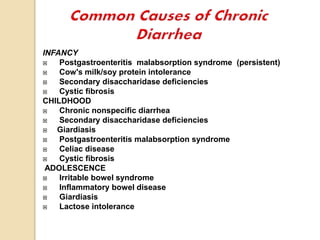
INFANCY
 Postgastroenteritis malabsorption syndrome (persistent)
 Cow's milk/soy protein intolerance
 Secondary disaccharidase deficiencies
 Cystic fibrosis
CHILDHOOD
 Chronic nonspecific diarrhea
 Secondary disaccharidase deficiencies
 Giardiasis
 Postgastroenteritis malabsorption syndrome
 Celiac disease
 Cystic fibrosis
ADOLESCENCE
 Irritable bowel syndrome
 Inflammatory bowel disease
 Giardiasis
 Lactose intolerance
Pathogenesis
1. Secretory causes
2. Osmotic causes
3. Steatorrheal causes
4. Inflamatory causes
5. Dysmotility causes
6. Factitial causes
Secretory causes
 Derangements in fluid and electrolyte transport
across entero colonic mucosa
 Watery, large volume fecal output, painless and
persits with fasting
1)medications—ethanol,laxatives
2)bowel resection,mucosal d/s,enterocolic
resection—idiopathic secretory diarrhoea
3)hormones- serotonin,prostaglandins,kinins
4)congenital defects in Fe absorption
Osmotic causes
 Osmotically active solutes
1)osmotic laxatives—Mg2+,(po4)3-,(so4)2-
2)carbohydrate malabsorption—lactase
deficiency
Differential Diagnosis of
Osmotic Vs Secretory Diarrhea
OSMOTIC DIARRHEA
SECRETORY
DIARRHEA
Volume of stool <200 mL/24 hr >200 mL/24 hr
Response to fasting Diarrhea stops Diarrhea continues
Stool Na+ <70 mEq/L >70 mEq/L
Reducing substances[*] Positive Negative
Stool pH <5 >6
Steatorrheal
causes
1) intraluminal maldigestion—Ch. pancreatitis,
fibrosis,pancreatic duct obstruction
2)mucosal malabsorption—celiac d/s,tropical
spure,whipples d/s
3)post mucosal lymphatic obstruction—congenital
intestinal lymphangiectasia,acquired lymphatic
obstruction(trauma,tumour)
Inflamatory
causes
 Pain,fever,bleeding,other manifestations
ofinflamation
eg: IBD,
immunodeficiencies
eosinophilic gastrits
Dysmotility
causes
 Hyper motility
 Diabetic diarrhoea—peripheral andgeneralised
autonomic neuropathy
Factitial causes
 15% of unexplained diarrhoea
 Eg: munchausen syndrome, eating disorders
(psychiatric illness)
 Proper history and physical examination very
important
 HISTORY—onset,duration,pattern,aggrevating and
relieving factors etc
wt.loss,pain,exposures(travel,medications etc)
.FAMILY HISTORY—ibd,sprue
Approach To Patient
PHYSICAL EXAMINATION
-- anemia,edema,clubbing(features of
malabsorption,IBD)
--muco cutaneous manifestations of systemic
d/s(dermatitis herpetiformis,erythema
nodosum,oral ulcers etc)
--abdominal mass or tenderness
--abnormalities of rectal mucosa,rectal defects
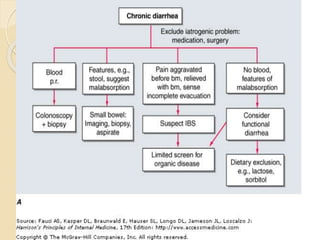
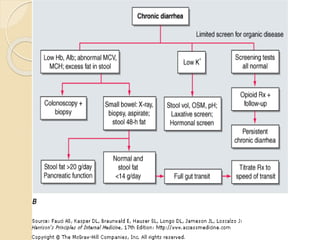
 Diagnostic evaluation directed by a careful history
and physical examination
 If not revealing triage tests required to direct the
choice of complex investigations
Traetment
 Curative,suppressive,empirical
1)curative—antibiotic for whipples
d/s,discontinuation of drug
2)suppressive—elimination of dietry lactose,PPI for
gastrinoma,pancreatic enzyme replacement
3)emperical—mild
opiates(loperamide),clonidine,fluid and electrolyte
replition
Chronic diarrhoea in children

Chronic diarrhoea in children

  • 1.
    CHRONIC DIARRHOEA Dr. VirendraKumar Gupta Assistant Professor Department Of Pediatric Gastroentero-hepatology & Liver Transplantation NIMS Medical College & Hospital , Jaipur
  • 2.
    DIARRHOEA  Diarrhoea definedas excessive loss of fluid and electrolyte in stool.  For infants stool output >10 ml/kg/24 hr and >200g/24hr for older children. When there is an  in frequency, volume or liquidity (Recent change in consistency) of the bowel movement relative to the usual habit of each individual Nelson Textbook of Pediatrics, 20th ed
  • 3.
    • Acute diarrhea Duration<2 wks, usually of infectious origin • Prolonged diarrhea Diarrhea of duration 7-14 days of presumed infectious etiology. It may be an indicator for children with a high risk of progression to Persistent diarrhea • Chronic diarrhea Diarrhea of more than 2 weeks duration. • Dysentry Bloody diarrhea, visible blood and mucus present. Nelson Textbook of Pediatrics, 20th ed DEFINITIONS
  • 4.
    Persistent diarrhea  Persistentdiarrhea (PD) is an episode of diarrhea of presumed infectious etiology, which starts acutely but lasts for more than 14 days, and excludes chronic or recurrent diarrheal disorders such as tropical sprue, gluten sensitive enteropathy or other hereditary disorders[WHO] (INDIAN PEDIATRICS, JAN 2011)  passage of >=3 watery stools per day for >2 weeks in a child who either fails to gain weight or loses weight.(ESPGHAN)
  • 5.
    Chronic Diarrhoea  Diarrhoealasting for more than 2 weeks  Mainly non infections causes
  • 6.
    INFANCY  Postgastroenteritis malabsorptionsyndrome (persistent)  Cow's milk/soy protein intolerance  Secondary disaccharidase deficiencies  Cystic fibrosis CHILDHOOD  Chronic nonspecific diarrhea  Secondary disaccharidase deficiencies  Giardiasis  Postgastroenteritis malabsorption syndrome  Celiac disease  Cystic fibrosis ADOLESCENCE  Irritable bowel syndrome  Inflammatory bowel disease  Giardiasis  Lactose intolerance
  • 7.
    Pathogenesis 1. Secretory causes 2.Osmotic causes 3. Steatorrheal causes 4. Inflamatory causes 5. Dysmotility causes 6. Factitial causes
  • 8.
    Secretory causes  Derangementsin fluid and electrolyte transport across entero colonic mucosa  Watery, large volume fecal output, painless and persits with fasting 1)medications—ethanol,laxatives 2)bowel resection,mucosal d/s,enterocolic resection—idiopathic secretory diarrhoea 3)hormones- serotonin,prostaglandins,kinins 4)congenital defects in Fe absorption
  • 9.
    Osmotic causes  Osmoticallyactive solutes 1)osmotic laxatives—Mg2+,(po4)3-,(so4)2- 2)carbohydrate malabsorption—lactase deficiency
  • 10.
    Differential Diagnosis of OsmoticVs Secretory Diarrhea OSMOTIC DIARRHEA SECRETORY DIARRHEA Volume of stool <200 mL/24 hr >200 mL/24 hr Response to fasting Diarrhea stops Diarrhea continues Stool Na+ <70 mEq/L >70 mEq/L Reducing substances[*] Positive Negative Stool pH <5 >6
  • 11.
    Steatorrheal causes 1) intraluminal maldigestion—Ch.pancreatitis, fibrosis,pancreatic duct obstruction 2)mucosal malabsorption—celiac d/s,tropical spure,whipples d/s 3)post mucosal lymphatic obstruction—congenital intestinal lymphangiectasia,acquired lymphatic obstruction(trauma,tumour)
  • 12.
  • 13.
    Dysmotility causes  Hyper motility Diabetic diarrhoea—peripheral andgeneralised autonomic neuropathy
  • 14.
    Factitial causes  15%of unexplained diarrhoea  Eg: munchausen syndrome, eating disorders (psychiatric illness)
  • 15.
     Proper historyand physical examination very important  HISTORY—onset,duration,pattern,aggrevating and relieving factors etc wt.loss,pain,exposures(travel,medications etc) .FAMILY HISTORY—ibd,sprue Approach To Patient
  • 16.
    PHYSICAL EXAMINATION -- anemia,edema,clubbing(featuresof malabsorption,IBD) --muco cutaneous manifestations of systemic d/s(dermatitis herpetiformis,erythema nodosum,oral ulcers etc) --abdominal mass or tenderness --abnormalities of rectal mucosa,rectal defects
  • 17.
     Diagnostic evaluationdirected by a careful history and physical examination  If not revealing triage tests required to direct the choice of complex investigations
  • 20.
    Traetment  Curative,suppressive,empirical 1)curative—antibiotic forwhipples d/s,discontinuation of drug 2)suppressive—elimination of dietry lactose,PPI for gastrinoma,pancreatic enzyme replacement 3)emperical—mild opiates(loperamide),clonidine,fluid and electrolyte replition