INTRODUCTION
 Total body content = 1 – 1.5 kg
 99% present in bone and 1% in
extracellular fluid
Body Distribution
 25-35 mols(100g-170g)
 99% in bones (exists carbonate or
phosphate of calcium)
 0.5% in soft tissue
 0.1% in ECF
 Plasma level- 9-11mg/dl
 ionized calcium
 protein bound calcium
 complexed calcium
Dietary sources
 Best sources- milk and milk products
 Good sources- egg-yolk, beans, lentils,
nuts, figs, cabbage, leafy vegetables,
fish
Dietary requirements
Adults- 800mg/day
Pregnancy and Lactation- 1.5gm/day
Children (1-18yrs)- 0.8-1.2gm/day
Infants (<1yrs) – 300-500mg/day
Absorption
 present as calcium phosphate, carbonate and
tartarate in diet
 40% of average dietary calcium is absorbed
from gut
 principally from duodenum and first half of
jejunum against electrical and concentration
gradient
 Simple diffusion
 An “active” transport
FACTORS AFFECTING ABSORPTION
 pH of intestinal milieu
 Composition of Diet
○ High Protein Diet
○ Fatty acids
○ Phytic acid
○ Oxalates
○ Fibres
○ Minerals
○ Vitamin D
 State of health of the individual and aging
 Hormonal
FUNCTIONS
 Intracellular calcium
 Muscle contraction
 Release of hormones, neurotransmitter and
neuromodulators
 Activation of number of enzymes
 Glycogen metabolism
 Cell division
 Second messanger
 Extracellular calcium
 Maintenance of calcium level
 Formation of bone and teeth
 Blood coagulations
 Plasma membrane potential
 Membrane excitability
 Cardiac activity
 Hydrolysis of casein of milk
Plasma Calcium
 Serum level- 9-11mg/dl (4.5-5.5mEq/l)
 Half (5mg/dl) – ionized form
(functionally most active)
 1o% (1mg/dl) - association with citrate,
bicarbonate and/or phosphate
 40% (4-5mg/dl) – bound to protein,
mostly with albumin and partly with
globulin
Factor regulating plasma
calcium level
 Parathyroid Hormone
 Calcitonin
 Calcitriol
Excretion of Calcium
 Partly through kidney
 Mostly through Intestine
 Renal threshold = 10mg/dl
Clinical Disorders
Hypercalcaemia (> 11mg/dl)
1. Primary hyperparathyroidism
2. Malignant diseases
Clinical features
 Neurological symptoms such as depression,
confusion, inability to concentrate
 Muscle weakness
 GI problems such as anorexia, abdominal
pain, nausea, vomiting and constipation
 Polyuria and polydypsia
 Cardiac arrhythmias
Hypocalcaemia (< 8.5mg/dl)
1. Reduction in serum albumin
2. Hypoparathyroidism
3. Renal Disease and Renal Failure
4. Pseudohypoparathyroidism
5. Vitamin D deficiency
Clinical features
 Enhanced neuromuscular irritability
 Neurological features such as tingling, tetany,
numbness
 Muscle cramps
 Abnormal ECG
 cataracts
INTRODUCTION
 Total body content is about 1 kg
 80% is seen in bone and teeth
 10% in muscles
 Mainly intracellular and is seen in all cells
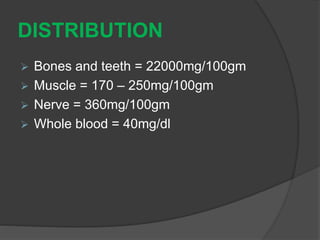
DISTRIBUTION
 Bones and teeth = 22000mg/100gm
 Muscle = 170 – 250mg/100gm
 Nerve = 360mg/100gm
 Whole blood = 40mg/dl
SOURCE
 Milk (good source)
 Cereals, Nuts and meat (moderate sources)
DAILY REQUIREMENT
 Infants = 240 – 400mg
 Children = 800 – 1200mg
 Adults = 800mg
 Women during pregnancy and lactation =
1.2gms
ABSORPTION
 90% of dietary phosphate is absorbed
 Mainly from duedenum
 Moderate amounts of fat or acid favour
absorption of phosphorus
 Stimulated by both PTH and Vit D3
 Ca:P ratio affects the absorption as well
as excretion of phosphorus
 High calcium diet and phytic acid
decrease absorption
FUNCTIONS
 is the constituent of bone and teeth
 Energy storage and transfer
 Acid-base balance
 Enzyme action
 constituent of phospholipids,
nucleotides/nucleic acids, lipoproteins,
 Regulation of enzyme activity
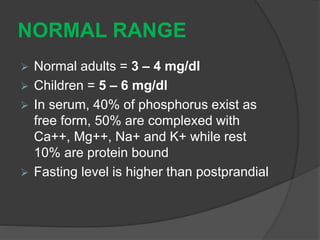
NORMAL RANGE
 Normal adults = 3 – 4 mg/dl
 Children = 5 – 6 mg/dl
 In serum, 40% of phosphorus exist as
free form, 50% are complexed with
Ca++, Mg++, Na+ and K+ while rest
10% are protein bound
 Fasting level is higher than postprandial
EXCRETION
 excreted in urine and feces
 urine excretion = 0.8 to 2.0 gm/24hr
 On a balanced diet, urine constitute
60% of total excretion
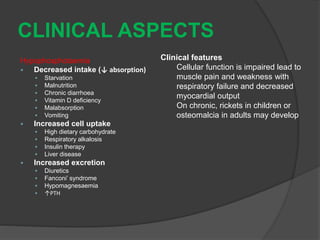
CLINICAL ASPECTS
Hypophosphotaemia
 Decreased intake (↓ absorption)
 Starvation
 Malnutrition
 Chronic diarrhoea
 Vitamin D deficiency
 Malabsorption
 Vomiting
 Increased cell uptake
 High dietary carbohydrate
 Respiratory alkalosis
 Insulin therapy
 Liver disease
 Increased excretion
 Diuretics
 Fanconi’ syndrome
 Hypomagnesaemia
 ↑PTH
Clinical features
Cellular function is impaired lead to
muscle pain and weakness with
respiratory failure and decreased
myocardial output
On chronic, rickets in children or
osteomalcia in adults may develop
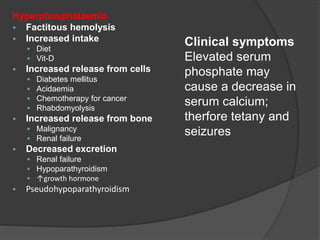
Hyperphosphataemia
 Factitous hemolysis
 Increased intake
 Diet
 Vit-D
 Increased release from cells
 Diabetes mellitus
 Acidaemia
 Chemotherapy for cancer
 Rhabdomyolysis
 Increased release from bone
 Malignancy
 Renal failure
 Decreased excretion
 Renal failure
 Hypoparathyroidism
 ↑growth hormone
 Pseudohypoparathyroidism
Clinical symptoms
Elevated serum
phosphate may
cause a decrease in
serum calcium;
therfore tetany and
seizures
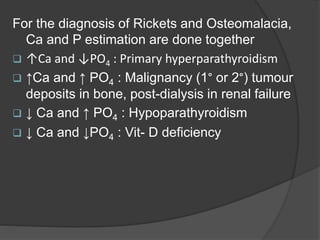
For the diagnosis of Rickets and Osteomalacia,
Ca and P estimation are done together
 ↑Ca and ↓PO4 : Primary hyperparathyroidism
 ↑Ca and ↑ PO4 : Malignancy (1° or 2°) tumour
deposits in bone, post-dialysis in renal failure
 ↓ Ca and ↑ PO4 : Hypoparathyroidism
 ↓ Ca and ↓PO4 : Vit- D deficiency

CaP metabolism.pptx

  • 2.
    INTRODUCTION  Total bodycontent = 1 – 1.5 kg  99% present in bone and 1% in extracellular fluid
  • 3.
    Body Distribution  25-35mols(100g-170g)  99% in bones (exists carbonate or phosphate of calcium)  0.5% in soft tissue  0.1% in ECF  Plasma level- 9-11mg/dl  ionized calcium  protein bound calcium  complexed calcium
  • 4.
    Dietary sources  Bestsources- milk and milk products  Good sources- egg-yolk, beans, lentils, nuts, figs, cabbage, leafy vegetables, fish
  • 5.
    Dietary requirements Adults- 800mg/day Pregnancyand Lactation- 1.5gm/day Children (1-18yrs)- 0.8-1.2gm/day Infants (<1yrs) – 300-500mg/day
  • 6.
    Absorption  present ascalcium phosphate, carbonate and tartarate in diet  40% of average dietary calcium is absorbed from gut  principally from duodenum and first half of jejunum against electrical and concentration gradient  Simple diffusion  An “active” transport
  • 7.
    FACTORS AFFECTING ABSORPTION pH of intestinal milieu  Composition of Diet ○ High Protein Diet ○ Fatty acids ○ Phytic acid ○ Oxalates ○ Fibres ○ Minerals ○ Vitamin D  State of health of the individual and aging  Hormonal
  • 8.
    FUNCTIONS  Intracellular calcium Muscle contraction  Release of hormones, neurotransmitter and neuromodulators  Activation of number of enzymes  Glycogen metabolism  Cell division  Second messanger
  • 9.
     Extracellular calcium Maintenance of calcium level  Formation of bone and teeth  Blood coagulations  Plasma membrane potential  Membrane excitability  Cardiac activity  Hydrolysis of casein of milk
  • 10.
    Plasma Calcium  Serumlevel- 9-11mg/dl (4.5-5.5mEq/l)  Half (5mg/dl) – ionized form (functionally most active)  1o% (1mg/dl) - association with citrate, bicarbonate and/or phosphate  40% (4-5mg/dl) – bound to protein, mostly with albumin and partly with globulin
  • 11.
    Factor regulating plasma calciumlevel  Parathyroid Hormone  Calcitonin  Calcitriol
  • 12.
    Excretion of Calcium Partly through kidney  Mostly through Intestine  Renal threshold = 10mg/dl
  • 13.
    Clinical Disorders Hypercalcaemia (>11mg/dl) 1. Primary hyperparathyroidism 2. Malignant diseases Clinical features  Neurological symptoms such as depression, confusion, inability to concentrate  Muscle weakness  GI problems such as anorexia, abdominal pain, nausea, vomiting and constipation  Polyuria and polydypsia  Cardiac arrhythmias
  • 14.
    Hypocalcaemia (< 8.5mg/dl) 1.Reduction in serum albumin 2. Hypoparathyroidism 3. Renal Disease and Renal Failure 4. Pseudohypoparathyroidism 5. Vitamin D deficiency Clinical features  Enhanced neuromuscular irritability  Neurological features such as tingling, tetany, numbness  Muscle cramps  Abnormal ECG  cataracts
  • 16.
    INTRODUCTION  Total bodycontent is about 1 kg  80% is seen in bone and teeth  10% in muscles  Mainly intracellular and is seen in all cells
  • 17.
    DISTRIBUTION  Bones andteeth = 22000mg/100gm  Muscle = 170 – 250mg/100gm  Nerve = 360mg/100gm  Whole blood = 40mg/dl
  • 18.
    SOURCE  Milk (goodsource)  Cereals, Nuts and meat (moderate sources)
  • 19.
    DAILY REQUIREMENT  Infants= 240 – 400mg  Children = 800 – 1200mg  Adults = 800mg  Women during pregnancy and lactation = 1.2gms
  • 20.
    ABSORPTION  90% ofdietary phosphate is absorbed  Mainly from duedenum  Moderate amounts of fat or acid favour absorption of phosphorus  Stimulated by both PTH and Vit D3  Ca:P ratio affects the absorption as well as excretion of phosphorus  High calcium diet and phytic acid decrease absorption
  • 21.
    FUNCTIONS  is theconstituent of bone and teeth  Energy storage and transfer  Acid-base balance  Enzyme action  constituent of phospholipids, nucleotides/nucleic acids, lipoproteins,  Regulation of enzyme activity
  • 22.
    NORMAL RANGE  Normaladults = 3 – 4 mg/dl  Children = 5 – 6 mg/dl  In serum, 40% of phosphorus exist as free form, 50% are complexed with Ca++, Mg++, Na+ and K+ while rest 10% are protein bound  Fasting level is higher than postprandial
  • 23.
    EXCRETION  excreted inurine and feces  urine excretion = 0.8 to 2.0 gm/24hr  On a balanced diet, urine constitute 60% of total excretion
  • 24.
    CLINICAL ASPECTS Hypophosphotaemia  Decreasedintake (↓ absorption)  Starvation  Malnutrition  Chronic diarrhoea  Vitamin D deficiency  Malabsorption  Vomiting  Increased cell uptake  High dietary carbohydrate  Respiratory alkalosis  Insulin therapy  Liver disease  Increased excretion  Diuretics  Fanconi’ syndrome  Hypomagnesaemia  ↑PTH Clinical features Cellular function is impaired lead to muscle pain and weakness with respiratory failure and decreased myocardial output On chronic, rickets in children or osteomalcia in adults may develop
  • 25.
    Hyperphosphataemia  Factitous hemolysis Increased intake  Diet  Vit-D  Increased release from cells  Diabetes mellitus  Acidaemia  Chemotherapy for cancer  Rhabdomyolysis  Increased release from bone  Malignancy  Renal failure  Decreased excretion  Renal failure  Hypoparathyroidism  ↑growth hormone  Pseudohypoparathyroidism Clinical symptoms Elevated serum phosphate may cause a decrease in serum calcium; therfore tetany and seizures
  • 26.
    For the diagnosisof Rickets and Osteomalacia, Ca and P estimation are done together  ↑Ca and ↓PO4 : Primary hyperparathyroidism  ↑Ca and ↑ PO4 : Malignancy (1° or 2°) tumour deposits in bone, post-dialysis in renal failure  ↓ Ca and ↑ PO4 : Hypoparathyroidism  ↓ Ca and ↓PO4 : Vit- D deficiency