Vitamin D deficiency
Rickets
Prof. Imran Iqbal
Fellowship in Pediatric Neurology (Australia)
Prof of Paediatrics (2003-2018)
Prof of Pediatrics Emeritus, CHICH
Prof of Pediatrics, CIMS
Multan, Pakistan
Verily, WE have created man from an extraction of clay.
Then WE set him as a drop in a secure place.
Then from the drop, WE created a clot;
And from the clot, WE created tissues;
And from the tissues, WE created bones;
And the bones, WE clothed in flesh.
Then WE produced him as new creation
So blessed is ALLAH, the best of creators.
(Al-Quran 23:12-14)
Development of Fetus (Al-Quran 23:13-14)
CLINICAL PROBLEM
What is your diagnosis ?
• A two year old child seen by you for the complaint of not
able to stand or walk.
• He started sitting at 10 months of age.
What is your diagnosis ?
• A two year old child seen by you for the complaint of not
able to stand or walk.
• He started sitting at 10 months of age.
• What further information is needed ?
Clinical History
• A two year old child seen by you for the complaint of not
able to stand or walk. He started sitting at 10 months of
age.
• He is able to speak small sentences of two to three
words.
• Child was born normally and was breast fed for one year.
After this he was shifted to usual family diet.
• The family lives in Karachi in a small apartment in a
multistory building.
• On examination,
Clinical Examination
• On examination, child is having an open anterior
fontanel, wide wrists, narrow chest, abdominal distention
and prominent costo-chondral junctions.
NUTRITIONAL RICKETS
RICKETS
RICKETS = twisted
This is the term employed to identify
Failure in Mineralisation
(deposition of calcium and phosphorous)
Of the Growing Bone
EMBRYOLOGY
• Long bones are made in cartilage
• Ossification of bone ends occurs in first few years of life
• Deposition of calcium and phosphorous in bones
precedes ossification
• After deposition of calcium, cartilage stops growing and
bone is gradually formed
Physiology
• Adequate calcium and phosphorous is essential for the
mineralization of bones
• Lack of calcium and phosphorous results in overgrowth
of cartilage and softening of bones
• Vitamin D is needed to maintain adequate serum
calcium and phosphate levels
Physiology of Vitamin D
Functions of vitamin D
• Maintain levels of calcium and phosphorous in blood
• Promote Bone mineralization
• Increases muscle strength (deficiency cause muscle
pain)
• Promotes cell proliferation and differentiation
• Increases immune responses against infections
• Reduces inflammation
Bone Functions of vitamin D
• GIT Increased absorption of calcium and phosphorous
• KIDNEYS Increased re-absorption of calcium and
phosphorous
• BLOOD Increased levels of calcium and phosphorous
• BONE Deposition of calcium and phosphorous
ABSENCE of vitamin D
• GIT Decreased absorption of calcium and phosphorous
• KIDNEYS Decreased re-absorption of calcium and
phosphorous
• BLOOD Decreased levels of calcium and phosphorous.
PTH levels increased which take out calcium from bones
• BONE Lack of Deposition of calcium and phosphorus
• PTH mobilizes calcium and phosphorus from bones
Functions of PTH
• GIT Increased absorption of calcium and phosphorous
• KIDNEYS Increased absorption of calcium and
excretion of phosphorous
• BLOOD Increased levels of calcium and decreased of
phosphorous
• BONE Resorption of calcium and phosphorous
Bone Pathology
 IN THE ABSENCE OF VITAMIN D:
• Calcium and phosphorous are not deposited in bones
• Cartilage keeps growing and expands
• Bone becomes soft and bend under pressure
Clinical Features of Rickets
• Delayed closure of anterior fontanel
• Enlarged ends of long bones
• Prominent costo-chondral junctions
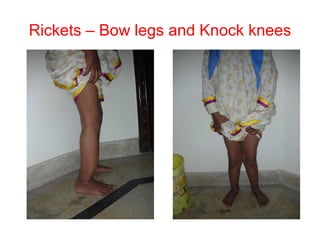
• Bowlegs and knock-knees
• Greenstick fractures
• Short stature
• Hypotonia
Rickets – Wide wrists and Knock knees
Rickets – Bow legs and Knock knees
Bowing of soft legs above ankle
Diagnosis of Rickets
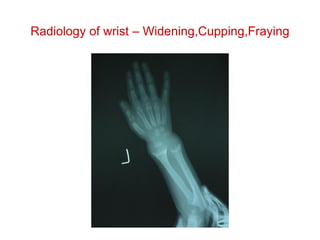
• Radiological changes – X-ray Wrist
• Serum Calcium – low or normal
• Serum Phosphate – low
• Serum Alkaline Phosphatase – increased
• Serum vitamin D (25 OHD3) – decreased
X- Rays changes in Rickets
at lower end of Radius
• Widening
Normal Rickets
• Cupping
• Fraying
Radiology of wrist – Widening,Cupping,Fraying
Diagnosis of Vitamin D deficiency
• Clinical Diagnosis
• Symptoms – muscle pains, frequent infections
• Signs – Rickets
• Serum Vitamin D (25-OHD) levels help in diagnosis:
Normal = 30 – 100 ng/ml
Insufficiency = 20 – 30 ng/ml
Deficiency < 20 ng/ml
• Vitamin D Toxicity > 150 ng/ml
Complications of
Vitamin D deficiency
COMPLICATIONS
• Delayed motor development (walking)
• Bone deformities
• Osteomalacia and Osteoporosis
• Repeated infections (mainly respiratory infections)
• Increased mortality in infections
• Vitamin D deficiency has been associated with increased
mortality in Covid 19 infection
Epidemiology of
Vitamin D deficiency
Vitamin D deficiency in Pakistan
Pakistan National Nutrition Survey – 2018
• Vitamin D deficiency in children < 5 years = 62.7 %
• Severe Vitamin D deficiency in children = 13.2 %
• Vitamin D deficiency in women = 79.7 %
• Severe Vitamin D deficiency in women = 25.7 %
Causes of
Vitamin D deficiency
Causes of Vitamin D deficiency
• Dietary deficiency of Vitamin D
• Lack of sunlight
Minimum Requirement :
30 min of body exposure / wk
OR
120 min of head exposure / wk
• Malabsorption, Celiac disease
• Chronic Liver Diseases
Body Requirements for Vitamin D
• Daily Requirement =
• Vitamin D = 10 – 20 ug / d = 400 – 800 IU/d
• 1ug Cholecalciferol = 40 IU
• Fat – soluble vitamin
• Stored in liver for long time providing daily needs
• Mega (large) doses can be given every six months
Sources of Vitamin D
• Sunlight falling on the skin – 80% (less in dark skins)
• Diet – 20 %
• Animal liver
• Fish liver oils
• Egg yolk
• Fortified Milk
• Pharmaceutical sources
• Vitamin D drops / ampoules
(1 – 2 drops daily)
• Multi-vitamins
How to treat a child with
Vitamin D deficiency ?
Treatment of Vitamin D deficiency / Rickets
• Vitamin D 2000 – 4000 IU daily
OR
• Vitamin D 200000 units once ORAL or injection
– repeat after one month (available as ampoules)
• Adequate Calcium intake
Treatment of Rickets
Follow up X - ray after 4 weeks
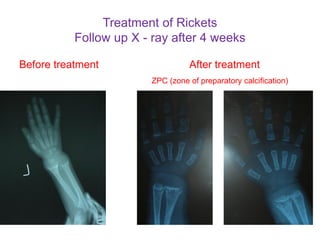
Before treatment After treatment
ZPC (zone of preparatory calcification)
Resistant (non-nutritional) Rickets
• No improvement after Vitamin D therapy
• Rare
• Congenital metabolic errors
• Acquired Gastro-intestinal, Hepatic or Renal diseases
Causes of Resistant (non-nutritional) Rickets
• Malabsorption (diarrhea, abdominal distention)
• Renal failure / Renal osteo-dystrophy (BUN, creatinine)
• Chronic Liver Disease (LFTs)
• Hypo-phosphatemic Rickets (impaired phosphate
absorption in renal tubules, X-linked dominant)
• Vitamin D dependent rickets (lack of alpha hydroxylation
of Vitamin D in kidneys, autosomal recessive)
• Renal tubular acidosis (RTA – proximal and distal)
What is your diagnosis ?
Hypo-calcemic Tetany
Resistant Rickets (severe hypocalcemia)
Toxicity of Vitamin D
• Frequent high doses of Vitamin D can result in toxicity
• Toxic serum levels are > 150 ng/dl
• It can result in hypercalcemia
• Symptoms include vomiting, constipation, weakness and
confusion
• Renal stones can develop
How to prevent Vitamin D
deficiency in children ?
Prevention of Nutritional Rickets
• Vitamin D supplementation –
• Vitamin D 400 – 800 IU daily (start at two weeks age)
OR
• Vitamin D 200000 units once every six months
(for older children > 5 years of age and adults)
• Symptoms or signs of Vitamin D deficiency
OR
low Vitamin D blood levels
• Vitamin D 200000 units once, repeat after one month
Children living in Slum Areas

Vit d deficiency rickets 2021

  • 1.
    Vitamin D deficiency Rickets Prof.Imran Iqbal Fellowship in Pediatric Neurology (Australia) Prof of Paediatrics (2003-2018) Prof of Pediatrics Emeritus, CHICH Prof of Pediatrics, CIMS Multan, Pakistan
  • 3.
    Verily, WE havecreated man from an extraction of clay. Then WE set him as a drop in a secure place. Then from the drop, WE created a clot; And from the clot, WE created tissues; And from the tissues, WE created bones; And the bones, WE clothed in flesh. Then WE produced him as new creation So blessed is ALLAH, the best of creators. (Al-Quran 23:12-14)
  • 4.
    Development of Fetus(Al-Quran 23:13-14)
  • 5.
  • 6.
    What is yourdiagnosis ? • A two year old child seen by you for the complaint of not able to stand or walk. • He started sitting at 10 months of age.
  • 7.
    What is yourdiagnosis ? • A two year old child seen by you for the complaint of not able to stand or walk. • He started sitting at 10 months of age. • What further information is needed ?
  • 8.
    Clinical History • Atwo year old child seen by you for the complaint of not able to stand or walk. He started sitting at 10 months of age. • He is able to speak small sentences of two to three words. • Child was born normally and was breast fed for one year. After this he was shifted to usual family diet. • The family lives in Karachi in a small apartment in a multistory building. • On examination,
  • 9.
    Clinical Examination • Onexamination, child is having an open anterior fontanel, wide wrists, narrow chest, abdominal distention and prominent costo-chondral junctions.
  • 10.
  • 11.
    RICKETS RICKETS = twisted Thisis the term employed to identify Failure in Mineralisation (deposition of calcium and phosphorous) Of the Growing Bone
  • 12.
    EMBRYOLOGY • Long bonesare made in cartilage • Ossification of bone ends occurs in first few years of life • Deposition of calcium and phosphorous in bones precedes ossification • After deposition of calcium, cartilage stops growing and bone is gradually formed
  • 13.
    Physiology • Adequate calciumand phosphorous is essential for the mineralization of bones • Lack of calcium and phosphorous results in overgrowth of cartilage and softening of bones • Vitamin D is needed to maintain adequate serum calcium and phosphate levels
  • 14.
  • 15.
    Functions of vitaminD • Maintain levels of calcium and phosphorous in blood • Promote Bone mineralization • Increases muscle strength (deficiency cause muscle pain) • Promotes cell proliferation and differentiation • Increases immune responses against infections • Reduces inflammation
  • 16.
    Bone Functions ofvitamin D • GIT Increased absorption of calcium and phosphorous • KIDNEYS Increased re-absorption of calcium and phosphorous • BLOOD Increased levels of calcium and phosphorous • BONE Deposition of calcium and phosphorous
  • 17.
    ABSENCE of vitaminD • GIT Decreased absorption of calcium and phosphorous • KIDNEYS Decreased re-absorption of calcium and phosphorous • BLOOD Decreased levels of calcium and phosphorous. PTH levels increased which take out calcium from bones • BONE Lack of Deposition of calcium and phosphorus • PTH mobilizes calcium and phosphorus from bones
  • 18.
    Functions of PTH •GIT Increased absorption of calcium and phosphorous • KIDNEYS Increased absorption of calcium and excretion of phosphorous • BLOOD Increased levels of calcium and decreased of phosphorous • BONE Resorption of calcium and phosphorous
  • 20.
    Bone Pathology  INTHE ABSENCE OF VITAMIN D: • Calcium and phosphorous are not deposited in bones • Cartilage keeps growing and expands • Bone becomes soft and bend under pressure
  • 21.
    Clinical Features ofRickets • Delayed closure of anterior fontanel • Enlarged ends of long bones • Prominent costo-chondral junctions • Bowlegs and knock-knees • Greenstick fractures • Short stature • Hypotonia
  • 22.
    Rickets – Widewrists and Knock knees
  • 23.
    Rickets – Bowlegs and Knock knees
  • 24.
    Bowing of softlegs above ankle
  • 25.
    Diagnosis of Rickets •Radiological changes – X-ray Wrist • Serum Calcium – low or normal • Serum Phosphate – low • Serum Alkaline Phosphatase – increased • Serum vitamin D (25 OHD3) – decreased
  • 26.
    X- Rays changesin Rickets at lower end of Radius • Widening Normal Rickets • Cupping • Fraying
  • 27.
    Radiology of wrist– Widening,Cupping,Fraying
  • 28.
    Diagnosis of VitaminD deficiency • Clinical Diagnosis • Symptoms – muscle pains, frequent infections • Signs – Rickets • Serum Vitamin D (25-OHD) levels help in diagnosis: Normal = 30 – 100 ng/ml Insufficiency = 20 – 30 ng/ml Deficiency < 20 ng/ml • Vitamin D Toxicity > 150 ng/ml
  • 29.
  • 30.
    COMPLICATIONS • Delayed motordevelopment (walking) • Bone deformities • Osteomalacia and Osteoporosis • Repeated infections (mainly respiratory infections) • Increased mortality in infections • Vitamin D deficiency has been associated with increased mortality in Covid 19 infection
  • 31.
  • 32.
    Vitamin D deficiencyin Pakistan Pakistan National Nutrition Survey – 2018 • Vitamin D deficiency in children < 5 years = 62.7 % • Severe Vitamin D deficiency in children = 13.2 % • Vitamin D deficiency in women = 79.7 % • Severe Vitamin D deficiency in women = 25.7 %
  • 33.
  • 34.
    Causes of VitaminD deficiency • Dietary deficiency of Vitamin D • Lack of sunlight Minimum Requirement : 30 min of body exposure / wk OR 120 min of head exposure / wk • Malabsorption, Celiac disease • Chronic Liver Diseases
  • 35.
    Body Requirements forVitamin D • Daily Requirement = • Vitamin D = 10 – 20 ug / d = 400 – 800 IU/d • 1ug Cholecalciferol = 40 IU • Fat – soluble vitamin • Stored in liver for long time providing daily needs • Mega (large) doses can be given every six months
  • 36.
    Sources of VitaminD • Sunlight falling on the skin – 80% (less in dark skins) • Diet – 20 % • Animal liver • Fish liver oils • Egg yolk • Fortified Milk • Pharmaceutical sources • Vitamin D drops / ampoules (1 – 2 drops daily) • Multi-vitamins
  • 37.
    How to treata child with Vitamin D deficiency ?
  • 38.
    Treatment of VitaminD deficiency / Rickets • Vitamin D 2000 – 4000 IU daily OR • Vitamin D 200000 units once ORAL or injection – repeat after one month (available as ampoules) • Adequate Calcium intake
  • 39.
    Treatment of Rickets Followup X - ray after 4 weeks Before treatment After treatment ZPC (zone of preparatory calcification)
  • 40.
    Resistant (non-nutritional) Rickets •No improvement after Vitamin D therapy • Rare • Congenital metabolic errors • Acquired Gastro-intestinal, Hepatic or Renal diseases
  • 41.
    Causes of Resistant(non-nutritional) Rickets • Malabsorption (diarrhea, abdominal distention) • Renal failure / Renal osteo-dystrophy (BUN, creatinine) • Chronic Liver Disease (LFTs) • Hypo-phosphatemic Rickets (impaired phosphate absorption in renal tubules, X-linked dominant) • Vitamin D dependent rickets (lack of alpha hydroxylation of Vitamin D in kidneys, autosomal recessive) • Renal tubular acidosis (RTA – proximal and distal)
  • 42.
    What is yourdiagnosis ?
  • 43.
  • 44.
    Toxicity of VitaminD • Frequent high doses of Vitamin D can result in toxicity • Toxic serum levels are > 150 ng/dl • It can result in hypercalcemia • Symptoms include vomiting, constipation, weakness and confusion • Renal stones can develop
  • 45.
    How to preventVitamin D deficiency in children ?
  • 46.
    Prevention of NutritionalRickets • Vitamin D supplementation – • Vitamin D 400 – 800 IU daily (start at two weeks age) OR • Vitamin D 200000 units once every six months (for older children > 5 years of age and adults) • Symptoms or signs of Vitamin D deficiency OR low Vitamin D blood levels • Vitamin D 200000 units once, repeat after one month
  • 47.