*Gas Laws*
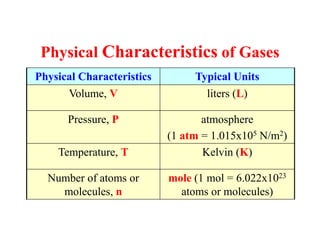
Physical Characteristics of Gases
Physical Characteristics Typical Units
Volume, V liters (L)
Pressure, P atmosphere
(1 atm = 1.015x10⁵ N/m2)
Temperature, T Kelvin (K)
Number of atoms or
molecules, n
mole (1 mol = 6.022x10²³
atoms or molecules)
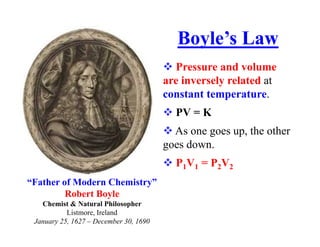
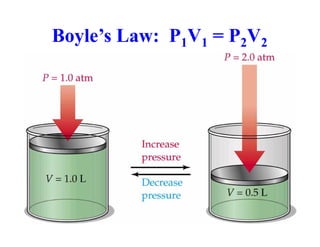
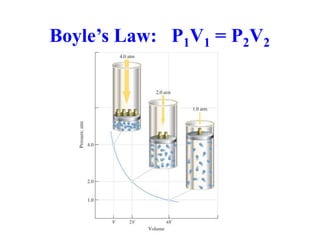
 Pressure and volume
are inversely related at
constant temperature.
 PV = K
 As one goes up, the other
goes down.
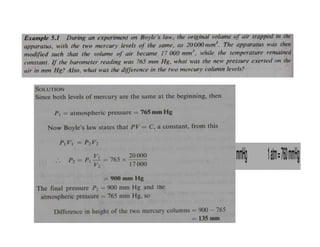
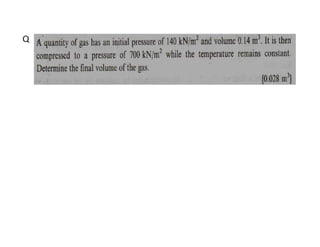
 P1V1 = P2V2
Boyle’s Law
“Father of Modern Chemistry”
Robert Boyle
Chemist & Natural Philosopher
Listmore, Ireland
January 25, 1627 – December 30, 1690
Boyle’s Law: P1V1 = P2V2
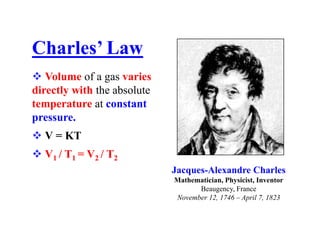
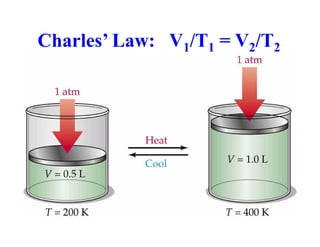
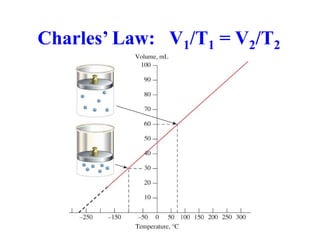
 Volume of a gas varies
directly with the absolute
temperature at constant
pressure.
 V = KT
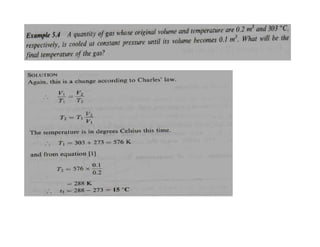
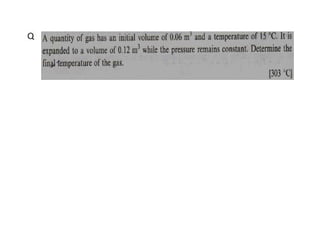
 V1 / T1 = V2 / T2
Charles’ Law
Jacques-Alexandre Charles
Mathematician, Physicist, Inventor
Beaugency, France
November 12, 1746 – April 7, 1823
Charles’ Law: V1/T1 = V2/T2
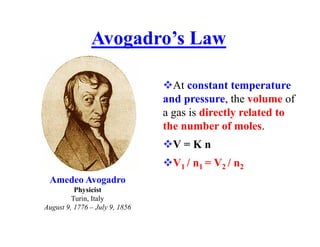
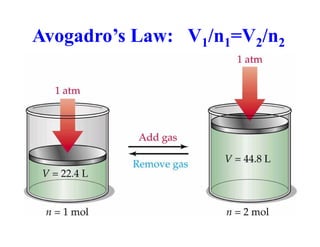
At constant temperature
and pressure, the volume of
a gas is directly related to
the number of moles.
V = K n
V1 / n1 = V2 / n2
Avogadro’s Law
Amedeo Avogadro
Physicist
Turin, Italy
August 9, 1776 – July 9, 1856
Avogadro’s Law: V1/n1=V2/n2
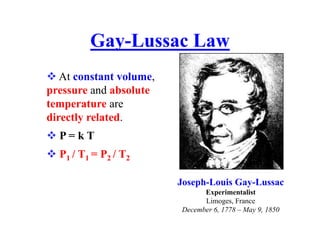
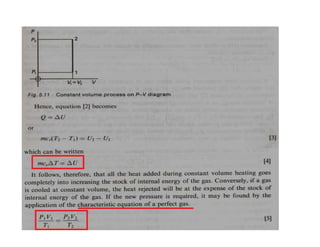
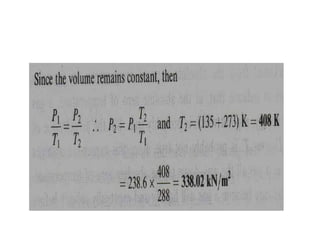
 At constant volume,
pressure and absolute
temperature are
directly related.
 P = k T
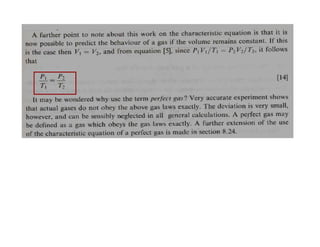
 P1 / T1 = P2 / T2
Gay-Lussac Law
Joseph-Louis Gay-Lussac
Experimentalist
Limoges, France
December 6, 1778 – May 9, 1850
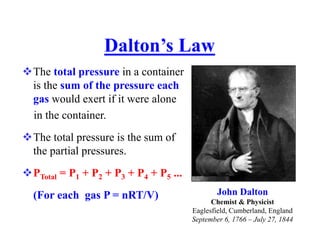
The total pressure in a container
is the sum of the pressure each
gas would exert if it were alone
in the container.
The total pressure is the sum of
the partial pressures.
PTotal = P1 + P2 + P3 + P4 + P5 ...
(For each gas P = nRT/V)
Dalton’s Law
John Dalton
Chemist & Physicist
Eaglesfield, Cumberland, England
September 6, 1766 – July 27, 1844
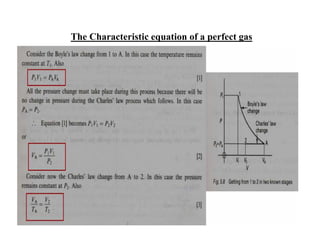
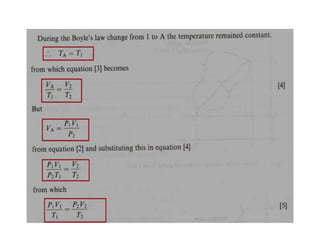
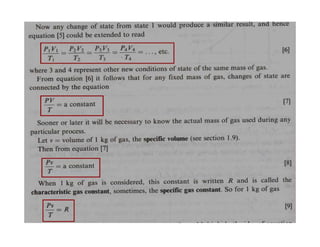
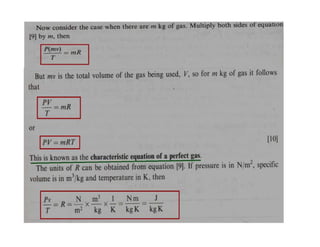
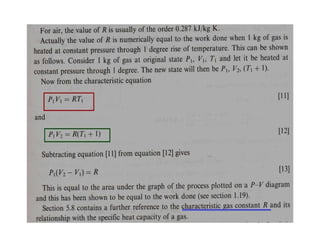
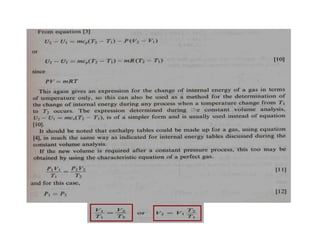
The Characteristic equation of a perfect gas
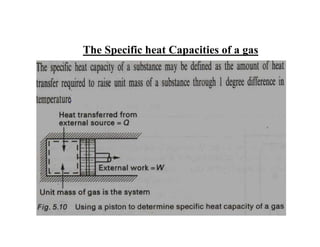
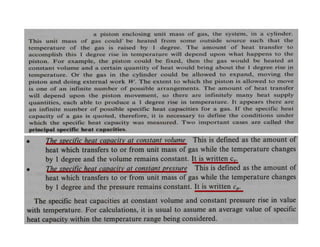
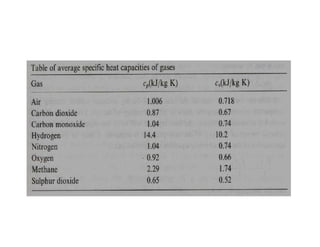
The Specific heat Capacities of a gas
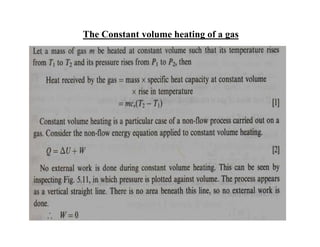
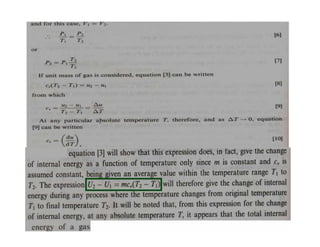
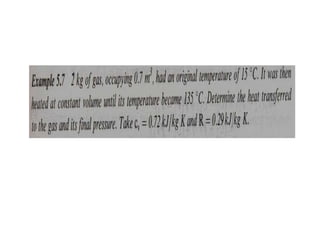
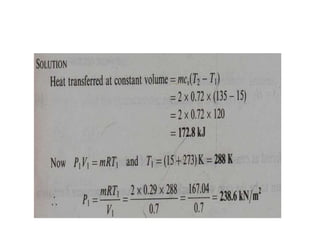
The Constant volume heating of a gas
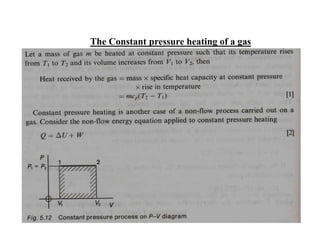
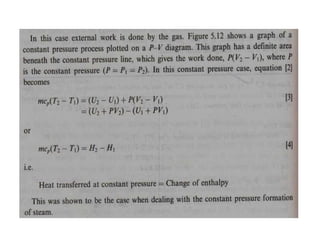
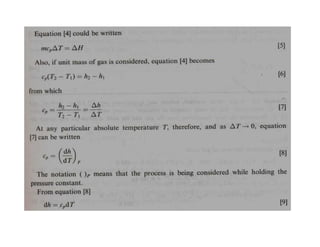
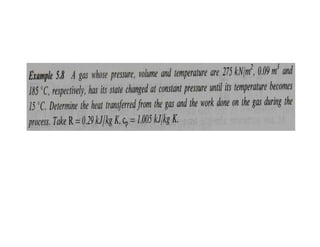
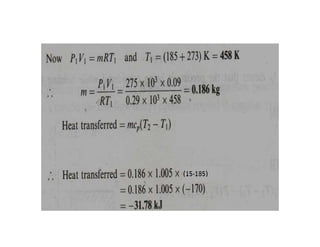
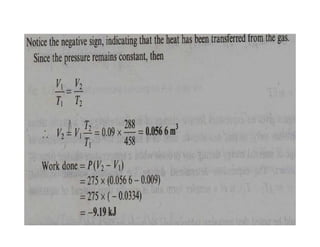
The Constant pressure heating of a gas
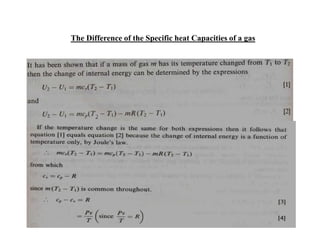
The Difference of the Specific heat Capacities of a gas
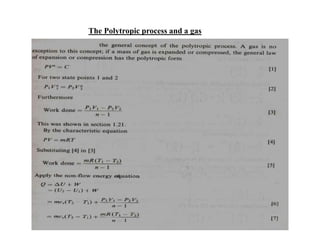
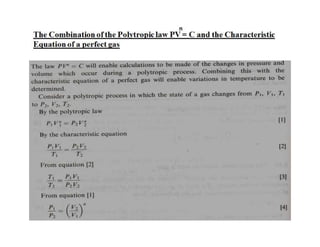
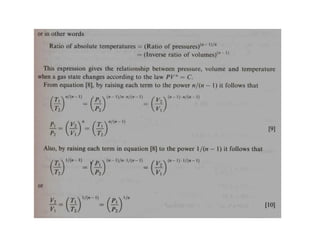
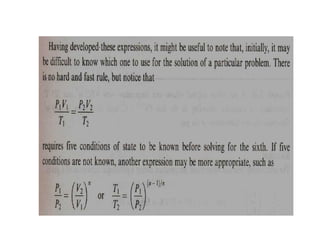
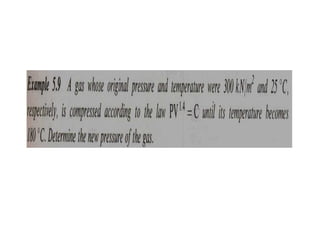
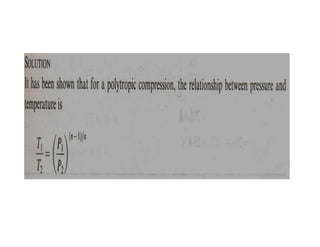
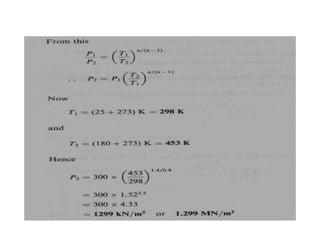
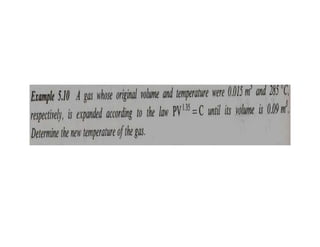
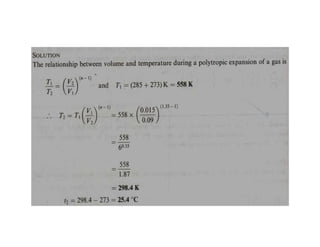
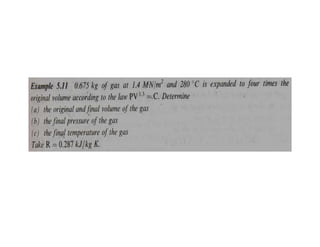
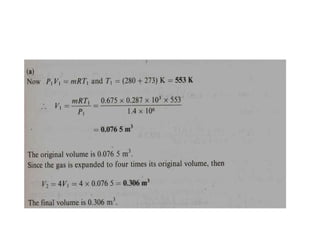
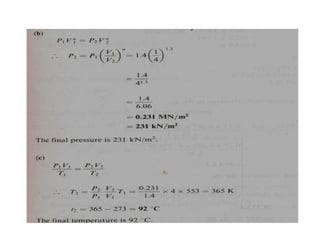
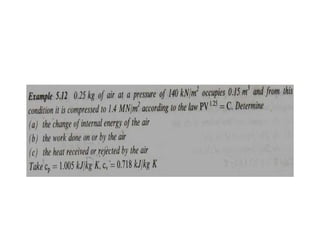
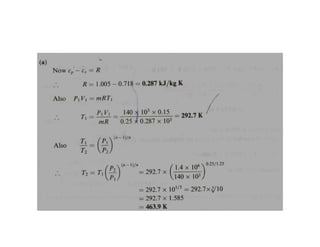
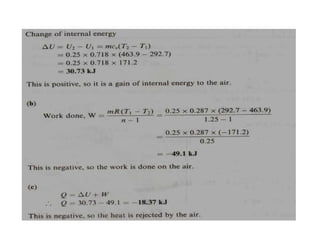
The Polytropic process and a gas
Applied thermodynamics(lecture 4)gas laws

Applied thermodynamics(lecture 4)gas laws

  • 1.
  • 2.
    Physical Characteristics ofGases Physical Characteristics Typical Units Volume, V liters (L) Pressure, P atmosphere (1 atm = 1.015x10⁵ N/m2) Temperature, T Kelvin (K) Number of atoms or molecules, n mole (1 mol = 6.022x10²³ atoms or molecules)
  • 3.
     Pressure andvolume are inversely related at constant temperature.  PV = K  As one goes up, the other goes down.  P1V1 = P2V2 Boyle’s Law “Father of Modern Chemistry” Robert Boyle Chemist & Natural Philosopher Listmore, Ireland January 25, 1627 – December 30, 1690
  • 4.
  • 5.
  • 9.
     Volume ofa gas varies directly with the absolute temperature at constant pressure.  V = KT  V1 / T1 = V2 / T2 Charles’ Law Jacques-Alexandre Charles Mathematician, Physicist, Inventor Beaugency, France November 12, 1746 – April 7, 1823
  • 10.
  • 11.
  • 15.
    At constant temperature andpressure, the volume of a gas is directly related to the number of moles. V = K n V1 / n1 = V2 / n2 Avogadro’s Law Amedeo Avogadro Physicist Turin, Italy August 9, 1776 – July 9, 1856
  • 16.
  • 17.
     At constantvolume, pressure and absolute temperature are directly related.  P = k T  P1 / T1 = P2 / T2 Gay-Lussac Law Joseph-Louis Gay-Lussac Experimentalist Limoges, France December 6, 1778 – May 9, 1850
  • 19.
    The total pressurein a container is the sum of the pressure each gas would exert if it were alone in the container. The total pressure is the sum of the partial pressures. PTotal = P1 + P2 + P3 + P4 + P5 ... (For each gas P = nRT/V) Dalton’s Law John Dalton Chemist & Physicist Eaglesfield, Cumberland, England September 6, 1766 – July 27, 1844
  • 20.
  • 30.
    The Specific heatCapacities of a gas
  • 33.
    The Constant volumeheating of a gas
  • 39.
    The Constant pressureheating of a gas
  • 46.
    The Difference ofthe Specific heat Capacities of a gas
  • 47.