Perceiving and Believing
 5th Session
 Actively selecting, organizing & interpreting
sensations
 What factors shape perceptions?
 Course Facilitator: Ms. Qazi Safia Hussain
Perceiving
“The process of becoming aware of your world
through your senses is known as perceiving”
Actively selecting, Organizing and
Interpreting Sensations
 When you actively perceive the sensations
you are experiencing, you are engaged in
three distinct activities
 Selecting certain sensations to pay attention to
 Organizing these sensations into a design or
pattern
 Interpreting what this design or pattern means to
you
Actively selecting, Organizing and
Interpreting Sensations
You are normally unaware that you are
performing these operations because they are
so rapid and automatic. This chapter is designed
to help you slow down this normally automatic
process of perceiving so that you can
understand how the process works.
Actively selecting, Organizing and
Interpreting Sensations
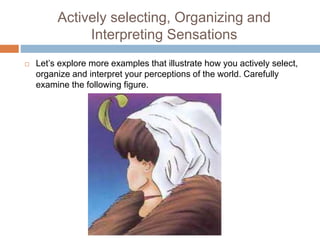
 Let’s explore more examples that illustrate how you actively select,
organize and interpret your perceptions of the world. Carefully
examine the following figure.
Actively selecting, Organizing and
Interpreting Sensations
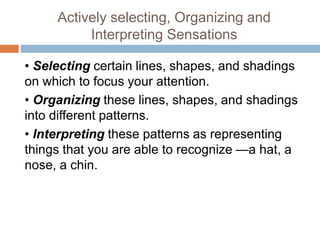
• Selecting certain lines, shapes, and shadings
on which to focus your attention.
• Organizing these lines, shapes, and shadings
into different patterns.
• Interpreting these patterns as representing
things that you are able to recognize —a hat, a
nose, a chin.
Actively selecting, Organizing and
Interpreting Sensations
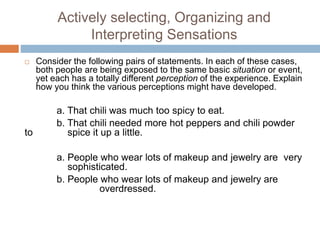
 Consider the following pairs of statements. In each of these cases,
both people are being exposed to the same basic situation or event,
yet each has a totally different perception of the experience. Explain
how you think the various perceptions might have developed.
a. That chili was much too spicy to eat.
b. That chili needed more hot peppers and chili powder
to spice it up a little.
a. People who wear lots of makeup and jewelry are very
sophisticated.
b. People who wear lots of makeup and jewelry are
overdressed.
What factors Shape
Perceptions
 Your perceptions of the world are dramatically
influenced by your;
 Past Experiences
 the way you were brought up,
 the relationships you have had
 Your training and education
Example: Two persons watching a game of football.
One has no knowledge and interest. Other is crazy
about this sports. Now, they both will have a different
point of view over the game.
Experiences Shape your
perceptions
Your ways of viewing the world are developed over a long
period of time through the experiences you have and your
thinking about these experiences. As you think critically
about your perceptions, you learn more from your
experiences and about how you make sense of the world.
Example
 After Trade Center attack of 9/11, Americans were
scared of public gatherings, events. They fear of bomb
attacks and they started taking strong precautions.
 During Moharram, our government focused on more
tight security plans to avoid any wrong incident.

Perceiving and believing

  • 1.
    Perceiving and Believing 5th Session  Actively selecting, organizing & interpreting sensations  What factors shape perceptions?  Course Facilitator: Ms. Qazi Safia Hussain
  • 2.
    Perceiving “The process ofbecoming aware of your world through your senses is known as perceiving”
  • 3.
    Actively selecting, Organizingand Interpreting Sensations  When you actively perceive the sensations you are experiencing, you are engaged in three distinct activities  Selecting certain sensations to pay attention to  Organizing these sensations into a design or pattern  Interpreting what this design or pattern means to you
  • 4.
    Actively selecting, Organizingand Interpreting Sensations You are normally unaware that you are performing these operations because they are so rapid and automatic. This chapter is designed to help you slow down this normally automatic process of perceiving so that you can understand how the process works.
  • 5.
    Actively selecting, Organizingand Interpreting Sensations  Let’s explore more examples that illustrate how you actively select, organize and interpret your perceptions of the world. Carefully examine the following figure.
  • 6.
    Actively selecting, Organizingand Interpreting Sensations • Selecting certain lines, shapes, and shadings on which to focus your attention. • Organizing these lines, shapes, and shadings into different patterns. • Interpreting these patterns as representing things that you are able to recognize —a hat, a nose, a chin.
  • 7.
    Actively selecting, Organizingand Interpreting Sensations  Consider the following pairs of statements. In each of these cases, both people are being exposed to the same basic situation or event, yet each has a totally different perception of the experience. Explain how you think the various perceptions might have developed. a. That chili was much too spicy to eat. b. That chili needed more hot peppers and chili powder to spice it up a little. a. People who wear lots of makeup and jewelry are very sophisticated. b. People who wear lots of makeup and jewelry are overdressed.
  • 8.
    What factors Shape Perceptions Your perceptions of the world are dramatically influenced by your;  Past Experiences  the way you were brought up,  the relationships you have had  Your training and education Example: Two persons watching a game of football. One has no knowledge and interest. Other is crazy about this sports. Now, they both will have a different point of view over the game.
  • 9.
    Experiences Shape your perceptions Yourways of viewing the world are developed over a long period of time through the experiences you have and your thinking about these experiences. As you think critically about your perceptions, you learn more from your experiences and about how you make sense of the world. Example  After Trade Center attack of 9/11, Americans were scared of public gatherings, events. They fear of bomb attacks and they started taking strong precautions.  During Moharram, our government focused on more tight security plans to avoid any wrong incident.