APPLIED THERMODYNAMICS
EL 325 (3+0)
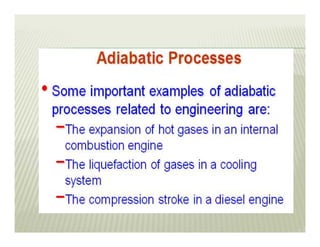
ADIABATIC PROCESSES
If a process is carried out in a system such that there
is no heat transferred into or out of the system (i.e.
Q=0) then the process is said to be adiabatic.
Liquefaction of gases is the process by which substances in their
gaseous state are converted to the liquid state. When pressure on a gas is
increased, its molecules closer together, and its temperature is reduced, which
removes enough energy to make it change from the gaseous to the liquid state.
A combustion engine is an engine which generates mechanical power by
combustion of a fuel. Combustion engines are of two general types
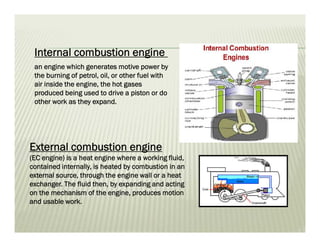
External combustion engine
(EC engine) is a heat engine where a working fluid,
contained internally, is heated by combustion in an
external source, through the engine wall or a heat
exchanger. The fluid then, by expanding and acting
on the mechanism of the engine, produces motion
and usable work.
an engine which generates motive power by
the burning of petrol, oil, or other fuel with
air inside the engine, the hot gases
produced being used to drive a piston or do
other work as they expand.
Internal combustion engine
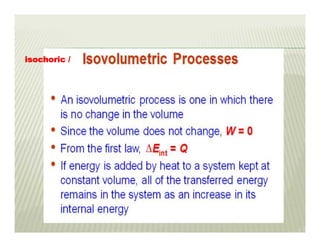
isochoric /
Systems
ENERGY:
It is that capacity a body or substance possess which
can result in the performance of work.
The presence of energy can only be observed by its
effects and these can appear in many different forms.
ENERGY FORMS IN THERMODYNAMICS
SYSTEMS:
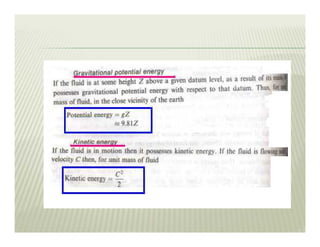
Kinetic Energy:
If the fluid is in motion then it possesses Kinetic Energy. For a unit
mass:
Internal Energy:
The energy associated with the disordered, random motion of
molecules is called Internal Energy. It is separated in scale from the
macroscopic ordered energy associated with moving objects; it
refers to the invisible microscopic energy on the atomic and
molecular scale. Internal energy is independent of the path.
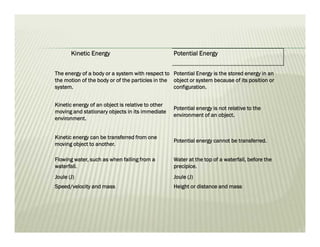
Kinetic Energy Potential Energy
The energy of a body or a system with respect to
the motion of the body or of the particles in the
system.
Potential Energy is the stored energy in an
object or system because of its position or
configuration.
Kinetic energy of an object is relative to other
moving and stationary objects in its immediate
environment.
Potential energy is not relative to the
environment of an object.
Kinetic energy can be transferred from one
moving object to another.
Potential energy cannot be transferred.
Flowing water, such as when falling from a
waterfall.
Water at the top of a waterfall, before the
precipice.
Joule (J) Joule (J)
Speed/velocity and mass Height or distance and mass
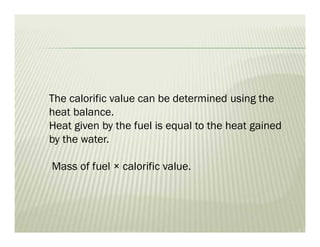
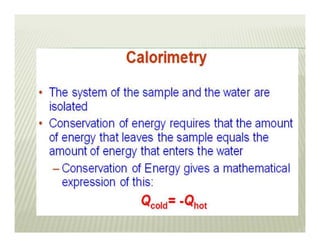
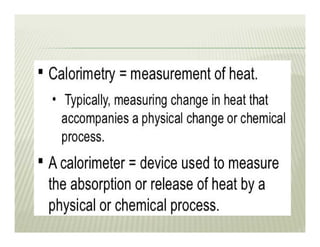
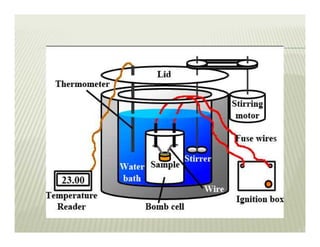
The calorific value can be determined using the
heat balance.
Heat given by the fuel is equal to the heat gained
by the water.
Mass of fuel × calorific value.
Flow or Displacement Energy:
Any volume of fluid entering or leaving a system must
displace an equal volume ahead of itself in order to
enter or leave the system.
The displacing mass must do a work on the mass being
displaced.
Since the movement of any mass can only be achieved
at the expense of work.
This is called flow or displacement work
At entry it is energy received by the system.
At exit it is energy lost by the system.
W o r k d o n e f
F o r c e P A
W P A l
A l v
W P v
 
 



Heat Received or rejected:
In any system:
If heat is received Q is +ve.
If heat is rejected Q is –ve.
If heat is neither received nor rejected then Q=0.
External work done:
If the external work is done by the fluid then W is
positive.
If the external wok is done on the fluid then W is
negative.
If no external work is done on or by the fluid then W=0.
THE CONSERVATION OF ENERGY
One form of energy can be transformed into another.
E.g.
 A battery converts stored chemical energy to electrical
energy
Principle:
This states that energy can neither be created nor
destroyed; it can only changed in form.
In an Equation:
Initial energy + Energy entering = Final energy of + Energy leaving
of the system the system the system the system
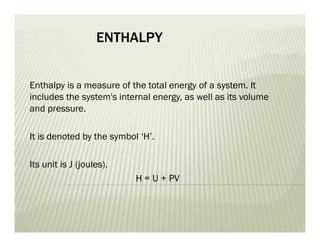
ENTHALPY
Enthalpy is a measure of the total energy of a system. It
includes the system's internal energy, as well as its volume
and pressure.
It is denoted by the symbol ‘H’.
Its unit is J (joules).
H = U + PV
Types of Thermodynamic systems
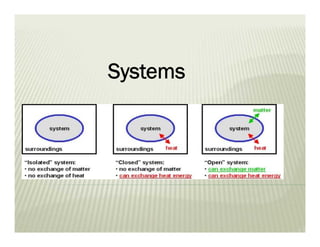
Closed systems are able to
exchange energy (heat and
work) but not matter with
their environment.
If a process is carried on a closed system then by the principle
of conservation of energy:
Initial energy + Energy entering = Final energy of + Energy leaving
of the system the system the system the system
Q is assumed positive means it is transferred into the system.
W is taken positive means work done by the system.
is the change in the total energy.
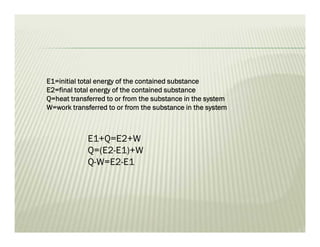
E1=initial total energy of the contained substance
E2=final total energy of the contained substance
Q=heat transferred to or from the substance in the system
W=work transferred to or from the substance in the system
E1+Q=E2+W
Q=(E2-E1)+W
Q-W=E2-E1
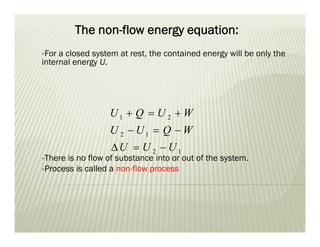
The non-flow energy equation:
For a closed system at rest, the contained energy will be only the
internal energy U.
There is no flow of substance into or out of the system.
Process is called a non-flow process
1 2
2 1
2 1
U Q U W
U U Q W
U U U
  
  
  
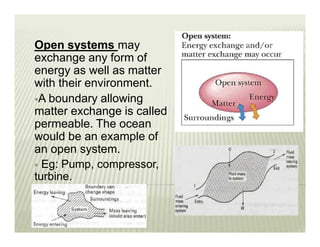
Open systems may
exchange any form of
energy as well as matter
with their environment.
A boundary allowing
matter exchange is called
permeable. The ocean
would be an example of
an open system.
 Eg: Pump, compressor,
turbine.
Two flow energy equation:
It is an open system in which an equal mass of fluid per
unit time is both entering and leaving the system. Also
called continuity of mass flow.
The form of energy associated with moving fluid entering
the system will be:
Internal Energy = U1
Displacement or flow energy = P1V1
Kinetic energy=KE1
Gravitational potential energy=PE1
As the fluid enters the system, let the total energy of the
fluid mass actually in the system = ES1
The form of energy associated with the fluid mass leaving the
system will be:
Internal Energy = U2
Displacement or flow energy = P2V2
Kinetic energy=KE2
Gravitational potential energy=PE2
After passing through the system, as the fluid leaves the
system, let the total energy of the fluid mass remaining in the
system = ES2
ES1+U1+P1V1+KE1+PE1+Q = ES2+ U2+P2V2+ KE2+PE2+ W
U+PV=H=Enthalpy
ES1+H1+KE1+PE1+Q = ES2+ H2+ KE2+PE2+ W
Q - W= (ES2 - ES1) + (H2 - H1) + (KE2 - KE1) +(PE2 - PE1)
The steady – flow energy equation:
Steady flow system, it is considered that the mass flow
rate of the fluid or substance through out the system is
constant.
Also, the total energy of the fluid mass in the system
remains constant.
So,
ES2 =ES1
ES2 - ES1=0
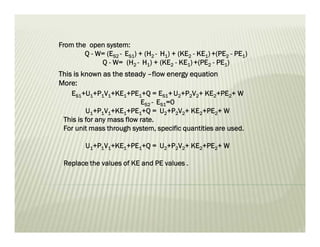
From the open system:
Q - W= (ES2 - ES1) + (H2 - H1) + (KE2 - KE1)+(PE2 - PE1)
Q - W= (H2 - H1) + (KE2 - KE1)+(PE2 - PE1)
This is known as the steady –flow energy equation
More:
ES1+U1+P1V1+KE1+PE1+Q = ES1+U2+P2V2+ KE2+PE2+ W
ES2 - ES1=0
U1+P1V1+KE1+PE1+Q = U2+P2V2+ KE2+PE2+ W
This is for any mass flow rate.
For unit mass through system, specific quantities are used.
U1+P1V1+KE1+PE1+Q = U2+P2V2+ KE2+PE2+ W
Replace the values of KE and PE values .
Continuity of mass flow rate:
For a fluid substance flowing through a steady flow open
system, the mass flow rate through any section in the system
must be constant.
At any section in the system,
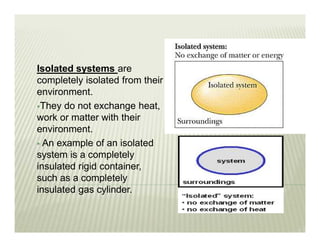
Isolated systems are
completely isolated from their
environment.
They do not exchange heat,
work or matter with their
environment.
 An example of an isolated
system is a completely
insulated rigid container,
such as a completely
insulated gas cylinder.
THANK YOU

Applied thermodynamics(lecture 2)

  • 1.
  • 2.
    ADIABATIC PROCESSES If aprocess is carried out in a system such that there is no heat transferred into or out of the system (i.e. Q=0) then the process is said to be adiabatic.
  • 6.
    Liquefaction of gasesis the process by which substances in their gaseous state are converted to the liquid state. When pressure on a gas is increased, its molecules closer together, and its temperature is reduced, which removes enough energy to make it change from the gaseous to the liquid state. A combustion engine is an engine which generates mechanical power by combustion of a fuel. Combustion engines are of two general types
  • 7.
    External combustion engine (ECengine) is a heat engine where a working fluid, contained internally, is heated by combustion in an external source, through the engine wall or a heat exchanger. The fluid then, by expanding and acting on the mechanism of the engine, produces motion and usable work. an engine which generates motive power by the burning of petrol, oil, or other fuel with air inside the engine, the hot gases produced being used to drive a piston or do other work as they expand. Internal combustion engine
  • 10.
  • 15.
  • 16.
    ENERGY: It is thatcapacity a body or substance possess which can result in the performance of work. The presence of energy can only be observed by its effects and these can appear in many different forms.
  • 17.
    ENERGY FORMS INTHERMODYNAMICS SYSTEMS:
  • 18.
    Kinetic Energy: If thefluid is in motion then it possesses Kinetic Energy. For a unit mass: Internal Energy: The energy associated with the disordered, random motion of molecules is called Internal Energy. It is separated in scale from the macroscopic ordered energy associated with moving objects; it refers to the invisible microscopic energy on the atomic and molecular scale. Internal energy is independent of the path.
  • 19.
    Kinetic Energy PotentialEnergy The energy of a body or a system with respect to the motion of the body or of the particles in the system. Potential Energy is the stored energy in an object or system because of its position or configuration. Kinetic energy of an object is relative to other moving and stationary objects in its immediate environment. Potential energy is not relative to the environment of an object. Kinetic energy can be transferred from one moving object to another. Potential energy cannot be transferred. Flowing water, such as when falling from a waterfall. Water at the top of a waterfall, before the precipice. Joule (J) Joule (J) Speed/velocity and mass Height or distance and mass
  • 25.
    The calorific valuecan be determined using the heat balance. Heat given by the fuel is equal to the heat gained by the water. Mass of fuel × calorific value.
  • 34.
    Flow or DisplacementEnergy: Any volume of fluid entering or leaving a system must displace an equal volume ahead of itself in order to enter or leave the system. The displacing mass must do a work on the mass being displaced. Since the movement of any mass can only be achieved at the expense of work.
  • 35.
    This is calledflow or displacement work At entry it is energy received by the system. At exit it is energy lost by the system. W o r k d o n e f F o r c e P A W P A l A l v W P v       
  • 36.
    Heat Received orrejected: In any system: If heat is received Q is +ve. If heat is rejected Q is –ve. If heat is neither received nor rejected then Q=0. External work done: If the external work is done by the fluid then W is positive. If the external wok is done on the fluid then W is negative. If no external work is done on or by the fluid then W=0.
  • 37.
    THE CONSERVATION OFENERGY One form of energy can be transformed into another. E.g.  A battery converts stored chemical energy to electrical energy
  • 38.
    Principle: This states thatenergy can neither be created nor destroyed; it can only changed in form. In an Equation: Initial energy + Energy entering = Final energy of + Energy leaving of the system the system the system the system
  • 39.
    ENTHALPY Enthalpy is ameasure of the total energy of a system. It includes the system's internal energy, as well as its volume and pressure. It is denoted by the symbol ‘H’. Its unit is J (joules). H = U + PV
  • 40.
    Types of Thermodynamicsystems Closed systems are able to exchange energy (heat and work) but not matter with their environment.
  • 41.
    If a processis carried on a closed system then by the principle of conservation of energy: Initial energy + Energy entering = Final energy of + Energy leaving of the system the system the system the system Q is assumed positive means it is transferred into the system. W is taken positive means work done by the system. is the change in the total energy.
  • 42.
    E1=initial total energyof the contained substance E2=final total energy of the contained substance Q=heat transferred to or from the substance in the system W=work transferred to or from the substance in the system E1+Q=E2+W Q=(E2-E1)+W Q-W=E2-E1
  • 45.
    The non-flow energyequation: For a closed system at rest, the contained energy will be only the internal energy U. There is no flow of substance into or out of the system. Process is called a non-flow process 1 2 2 1 2 1 U Q U W U U Q W U U U         
  • 49.
    Open systems may exchangeany form of energy as well as matter with their environment. A boundary allowing matter exchange is called permeable. The ocean would be an example of an open system.  Eg: Pump, compressor, turbine.
  • 50.
    Two flow energyequation: It is an open system in which an equal mass of fluid per unit time is both entering and leaving the system. Also called continuity of mass flow. The form of energy associated with moving fluid entering the system will be: Internal Energy = U1 Displacement or flow energy = P1V1 Kinetic energy=KE1 Gravitational potential energy=PE1 As the fluid enters the system, let the total energy of the fluid mass actually in the system = ES1
  • 51.
    The form ofenergy associated with the fluid mass leaving the system will be: Internal Energy = U2 Displacement or flow energy = P2V2 Kinetic energy=KE2 Gravitational potential energy=PE2 After passing through the system, as the fluid leaves the system, let the total energy of the fluid mass remaining in the system = ES2 ES1+U1+P1V1+KE1+PE1+Q = ES2+ U2+P2V2+ KE2+PE2+ W
  • 52.
    U+PV=H=Enthalpy ES1+H1+KE1+PE1+Q = ES2+H2+ KE2+PE2+ W Q - W= (ES2 - ES1) + (H2 - H1) + (KE2 - KE1) +(PE2 - PE1)
  • 53.
    The steady –flow energy equation: Steady flow system, it is considered that the mass flow rate of the fluid or substance through out the system is constant. Also, the total energy of the fluid mass in the system remains constant. So, ES2 =ES1 ES2 - ES1=0
  • 54.
    From the opensystem: Q - W= (ES2 - ES1) + (H2 - H1) + (KE2 - KE1)+(PE2 - PE1) Q - W= (H2 - H1) + (KE2 - KE1)+(PE2 - PE1) This is known as the steady –flow energy equation More: ES1+U1+P1V1+KE1+PE1+Q = ES1+U2+P2V2+ KE2+PE2+ W ES2 - ES1=0 U1+P1V1+KE1+PE1+Q = U2+P2V2+ KE2+PE2+ W This is for any mass flow rate. For unit mass through system, specific quantities are used. U1+P1V1+KE1+PE1+Q = U2+P2V2+ KE2+PE2+ W Replace the values of KE and PE values .
  • 57.
    Continuity of massflow rate: For a fluid substance flowing through a steady flow open system, the mass flow rate through any section in the system must be constant. At any section in the system,
  • 63.
    Isolated systems are completelyisolated from their environment. They do not exchange heat, work or matter with their environment.  An example of an isolated system is a completely insulated rigid container, such as a completely insulated gas cylinder.
  • 64.