Work and Heat
Dr. Rohit Singh Lather
Forms of Energy
Energy
Macroscopic Microscopic
Kinetic Potential
Sensible
(translational + rotational + vibrational)
Latent
(inter molecular phase change)
Chemical
(Atomic Bonds)
Atomic
(bonds within nucleolus of atoms)
Summation	of	all	the	microscopic	energies	is	called	Internal	Energy	
E=	U+KE+PE	(kJ)
Low	Grade	 High	GradeHeat Work
24/08/16 Dr.	Rohit	Singh	Lather	- Engineering	Thermodynamics 2
Introduction
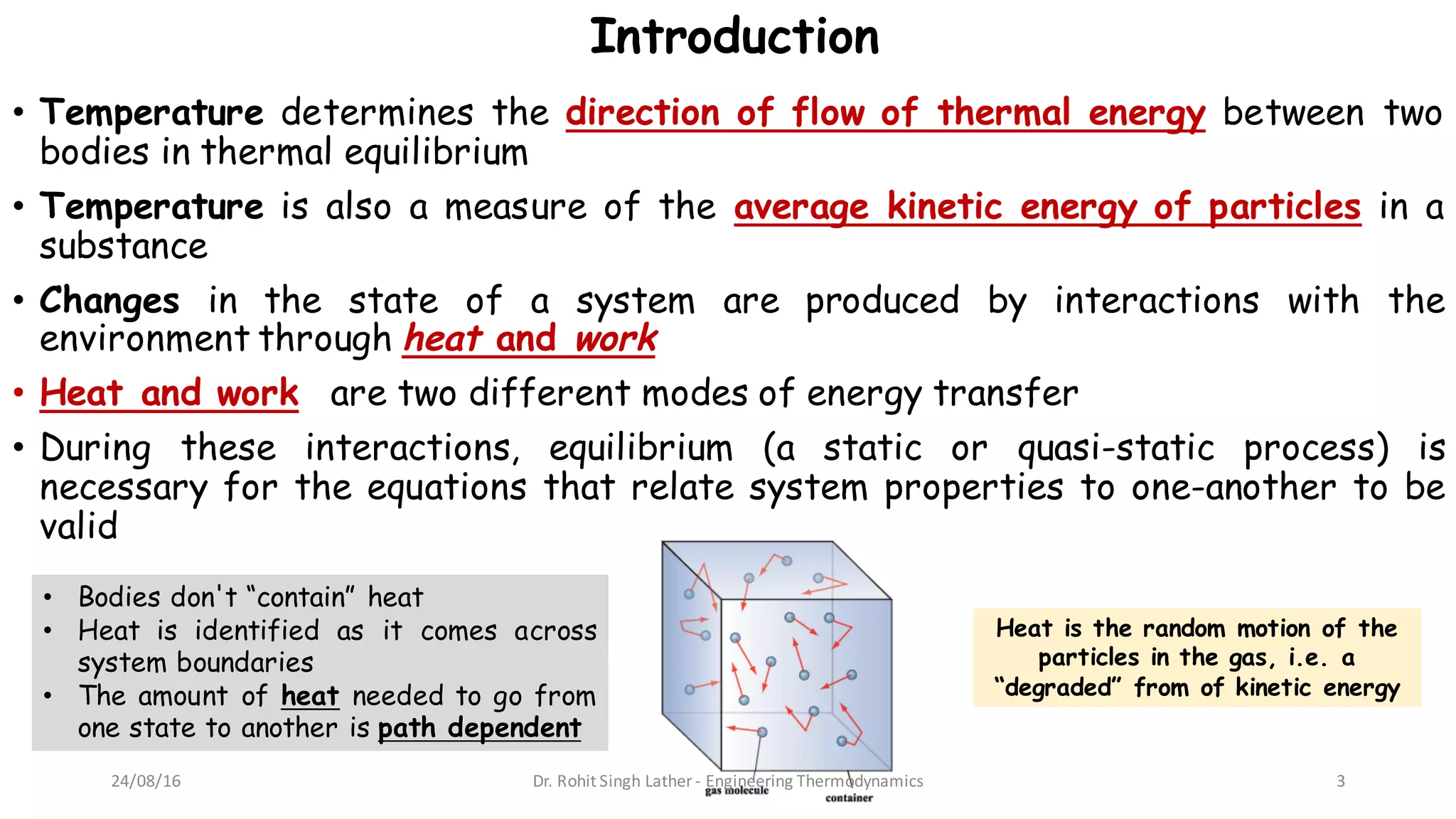
• Temperature determines the direction of flow of thermal energy between two
bodies in thermal equilibrium
• Temperature is also a measure of the average kinetic energy of particles in a
substance
• Changes in the state of a system are produced by interactions with the
environment through heat and work
• Heat and work are two different modes of energy transfer
• During these interactions, equilibrium (a static or quasi-static process) is
necessary for the equations that relate system properties to one-another to be
valid
Heat is the random motion of the
particles in the gas, i.e. a
“degraded” from of kinetic energy
• Bodies don't “contain” heat
• Heat is identified as it comes across
system boundaries
• The amount of heat needed to go from
one state to another is path dependent
24/08/16 Dr.	Rohit	Singh	Lather	- Engineering	Thermodynamics 3
System
Surroundings
SystemSystem
Surroundings Surroundings
System at higher temperature
looses energy as heat
System and surrounding at
same temperature, no energy
is transferred as heat
System at lower temperature
gains energy as heat
0,0
,
=Δ=Δ
↑Δ↑Δ
ΔΔ
UTif
UTif
TU α
All of the energy inside a system is called INTERNAL ENERGY
When you add HEAT (Q), you are adding energy and the internal energy INCREASES
QReleased = Negative (-) QAbsorbed = Positive (+)
24/08/16 Dr.	Rohit	Singh	Lather	- Engineering	Thermodynamics 4
Specific Heat
• Note: It is easy to change the temperature of some things (e.g. air) and hard to change the
temperature of others (e.g. water, block of steel)
• The amount of heat (Q) added into a body of mass m to change its temperature an amount is given
by
Q= m.C.∆T = m.C.(Tf – Ti)
C is called the specific heat and depends on the material
Note: Temperature in either Kelvin or Celsius
⎟⎟
⎠
⎞
⎜⎜
⎝
⎛
=⎟⎟
⎠
⎞
⎜⎜
⎝
⎛
=
Δ
=
Ckg
J
Cg
cal
Tm
Q
C oo
The heat capacity C of an object is the proportionality constant between the heat Q
that the object absorbs or loses and the resulting temperature change ΔT of the object
# It is important to distinguish the heat transfer is done with constant volume or constant pressure
The specific heat is different for different processes, particular for gases
24/08/16 Dr.	Rohit	Singh	Lather	- Engineering	Thermodynamics 5
Heat of Transformation
When the phase change is between liquid to gas, the heat of transformation is called the
heat of vaporization LV
(# sublimation: transition from solid directly to gas phases)
The amount of energy per unit mass that must be transferred as heat when a sample completely
undergoes a phase change is called the heat of transformation L (or latent heat)
When a sample of mass m completely undergoes a phase change, the total energy transferred is:
When the phase change is between solid to liquid, the heat of transformation is called the
heat of fusion LF
24/08/16 Dr.	Rohit	Singh	Lather	- Engineering	Thermodynamics 6
Source: Yunus A. Cengel and Michael A. Boles Thermodynamics: An Engineering Approach, McGraw Hill, 8th Edition
• The amount of energy needed to raise the temperature of a unit of mass of a substance by one
degree is called the specific heat at constant volume Cv for a constant-volume process:
• The amount of energy needed to raise the temperature of a unit of mass of a substance by one
degree is called the specific heat at constant pressure Cp for a constant pressure process:
3-31Heat Capacities at Constant Volume and Constant Pressure
• For ideal gases u, h, Cv, and Cp are functions of temperature alone
Source: Yunus A. Cengel and Michael A. Boles Thermodynamics: An Engineering Approach, McGraw Hill, 8th Edition
24/08/16 Dr.	Rohit	Singh	Lather	- Engineering	Thermodynamics 7
Experimental apparatus used by Joule
It has been demonstrated mathematically and experimentally (Joule, 1843) that for an ideal gas the
internal energy is a function of the temperature only. That is, u = u(T)
Water
EvacuatedAir
(high pressure)
Thermometer
• Joule’s reasoned, the internal energy is a function of temperature only and not a function of
pressure or specific volume
• Later Joule’s showed that for gases that deviate significantly from ideal- gas behavior, the
internal energy is not a function of temperature alone
• Using the definition of enthalpy and the equation of state of an ideal gas, we have is also a
function of temperature only h = h(T)
Since u and h depend only on temperature for an ideal gas, the specific heats cv and cp also depend,
at most, on temperature only.
Therefore, at a given temperature, u, h, cv, and cp of an ideal gas have fixed values regard- less of
the specific volume or pressure
Thus, for ideal gases, the partial derivatives in Eqs. 4–19 and 4–20 can be replaced by ordinary
derivatives. Then, the differential changes in the internal energy and enthalpy of an ideal gas can be
expressed as
u = u(T) For ideal gases, u, h, cv, and cp vary with temperature only
du = cv(T) dT
• For ideal gases Cv, and Cp are related by: Cp = Cv + R [kJ / (kg.K)]
• The specific heat ratio 𝛾 is defined as: 𝛾 =
𝑪 𝒑
𝑪 𝒗
• For incompressible substances (liquids and solids), both the constant-pressure and
constant-volume specific heats are identical and denoted by C:
Cp = Cv = C [kJ / (kg.K)]
Source: Yunus A. Cengel and Michael A. Boles Thermodynamics: An Engineering Approach, McGraw Hill, 8th Edition
Cp > Cv In an isobaric process system is heated and work is performed
CV CP
Monoatomic Gases %
&
R
%
&
R
Diatomic Gases %
&
R
%
&
R
Triatomic Gases %
&
R
%
&
R
24/08/16 Dr.	Rohit	Singh	Lather	- Engineering	Thermodynamics 10
Heat Transfer Mechanisms
Conduction: (solids--mostly)
Heat transfer without mass transfer
Radiation
Heat transfer through electromagnetic waves
Convection: (liquids/gas)
Heat transfer with mass
transfer due to motion
Source: Yunus A. Cengel and Michael A. Boles Thermodynamics: An Engineering Approach, McGraw Hill, 8th Edition
24/08/16 Dr.	Rohit	Singh	Lather	- Engineering	Thermodynamics 11
Conduction
If Q be the energy that is transferred as heat through the
slab, from its hot face to its cold face, in time t, then the
conduction rate Pcond (the amount of energy transferred per
unit time) isTH
Hot
Reservoir
TC
Cold
Reservoir
Q
Slab of face area A &
Thermal conductivity k
Thickness L
We assume steady state
of heat transfer
Here k, called the thermal conductivity, is a constant
that depends on the material of which the slab is made
Source: Yunus A. Cengel and Michael A. Boles Thermodynamics: An Engineering Approach, McGraw Hill, 8th Edition
24/08/16 Dr.	Rohit	Singh	Lather	- Engineering	Thermodynamics 12
Convection
• In convection, thermal energy is transferred by bulk motion of materials from regions of high to
low temperatures
• This occurs when in a fluid a large temperature difference is formed within a short vertical
distance (the temperature gradient is large)
• Typically very complicated
• Very efficient way to transfer energy
Source: Yunus A. Cengel and Michael A. Boles Thermodynamics: An Engineering Approach, McGraw Hill, 8th Edition
24/08/16 Dr.	Rohit	Singh	Lather	- Engineering	Thermodynamics 13
Radiation
• Everything that has a temperature radiates energy
• Method that energy from sun reaches the earth
• In radiation, an object and its environment can exchange energy as heat via electromagnetic waves
• Energy transferred in this way is called thermal radiation
• The rate Prad at which an object emits energy via electromagnetic radiation depends on the
object’s surface area A and the temperature T of that area in K, and is given by
• Note: if we double the temperature, the power radiated goes up by 24 =16
• If we triple the temperature, the radiated power goes up by 34=81
Stefan–Boltzmann constant
5.6704 x10⁻⁸ W/m2 K4
Emissivity
If the rate at which an object absorbs energy via
thermal radiation from its environment is Pabs, then
the object’s net rate Pnet of energy exchange due
to thermal radiation is
Source: Yunus A. Cengel and Michael A. Boles Thermodynamics: An Engineering Approach, McGraw Hill, 8th Edition
24/08/16 Dr.	Rohit	Singh	Lather	- Engineering	Thermodynamics 14
Quasi-Static Process
• Arbitrarily slow process such that system always stays stays arbitrarily close to thermodynamic
equilibrium
• Infinite slowness is the characteristics of a quasi-static process
• It is a succession of equilibrium states
• A quasi-static process is also reversible process
Dots indicate
equilibrium states
Pressure
1
2
Volume
Every state passed through by the
system will be an equilibrium state
Such a process is locus of all the
equilibrium points passed through by
the system
System	Boundary
Piston
Weight
Final	State
Initial	State
Multiple
Weights
Final	State
Initial	State
Piston
dv
dp
24/08/16 Dr.	Rohit	Singh	Lather	- Engineering	Thermodynamics 15
Work
• Heat is a way of changing the energy of a system by virtue of a temperature
difference only
• Other means for changing the energy of a system is called work
• We can have push-pull work
- (e.g. in a piston-cylinder, lifting a weight)
- electric and magnetic work (e.g. an electric motor)
- chemical work, surface tension work, elastic work, etc.
• In defining work, we focus on the effects that the system (e.g. an engine) has on
its surroundings
If work is done on the system
the work is negative
(energy added to the system)
Work as being positive when the system
does work on the surroundings
(energy leaves the system)
24/08/16 Dr.	Rohit	Singh	Lather	- Engineering	Thermodynamics 16
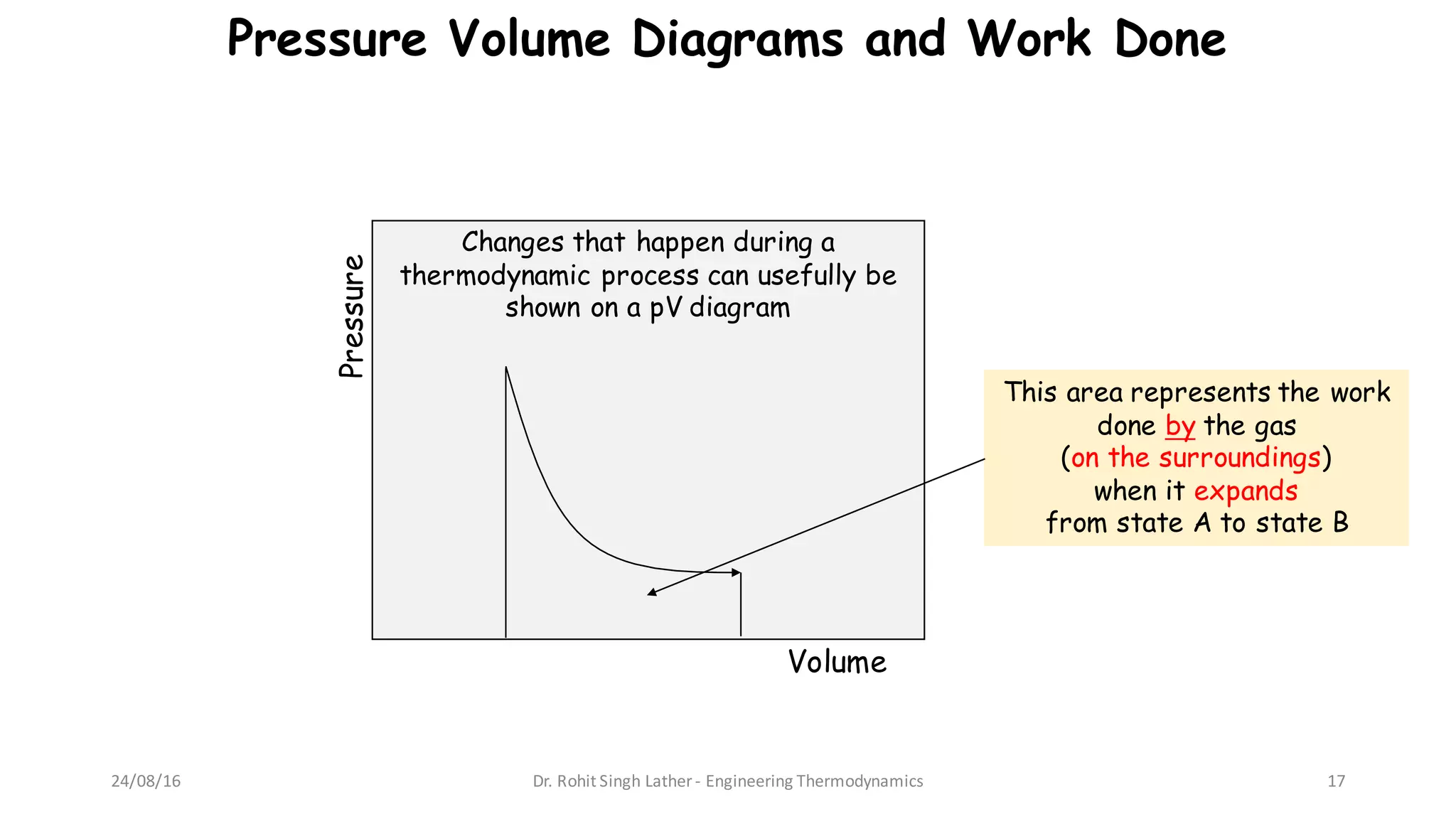
Pressure Volume Diagrams and Work Done
This area represents the work
done by the gas
(on the surroundings)
when it expands
from state A to state B
Pressure
Volume
Changes that happen during a
thermodynamic process can usefully be
shown on a pV diagram
24/08/16 Dr.	Rohit	Singh	Lather	- Engineering	Thermodynamics 17
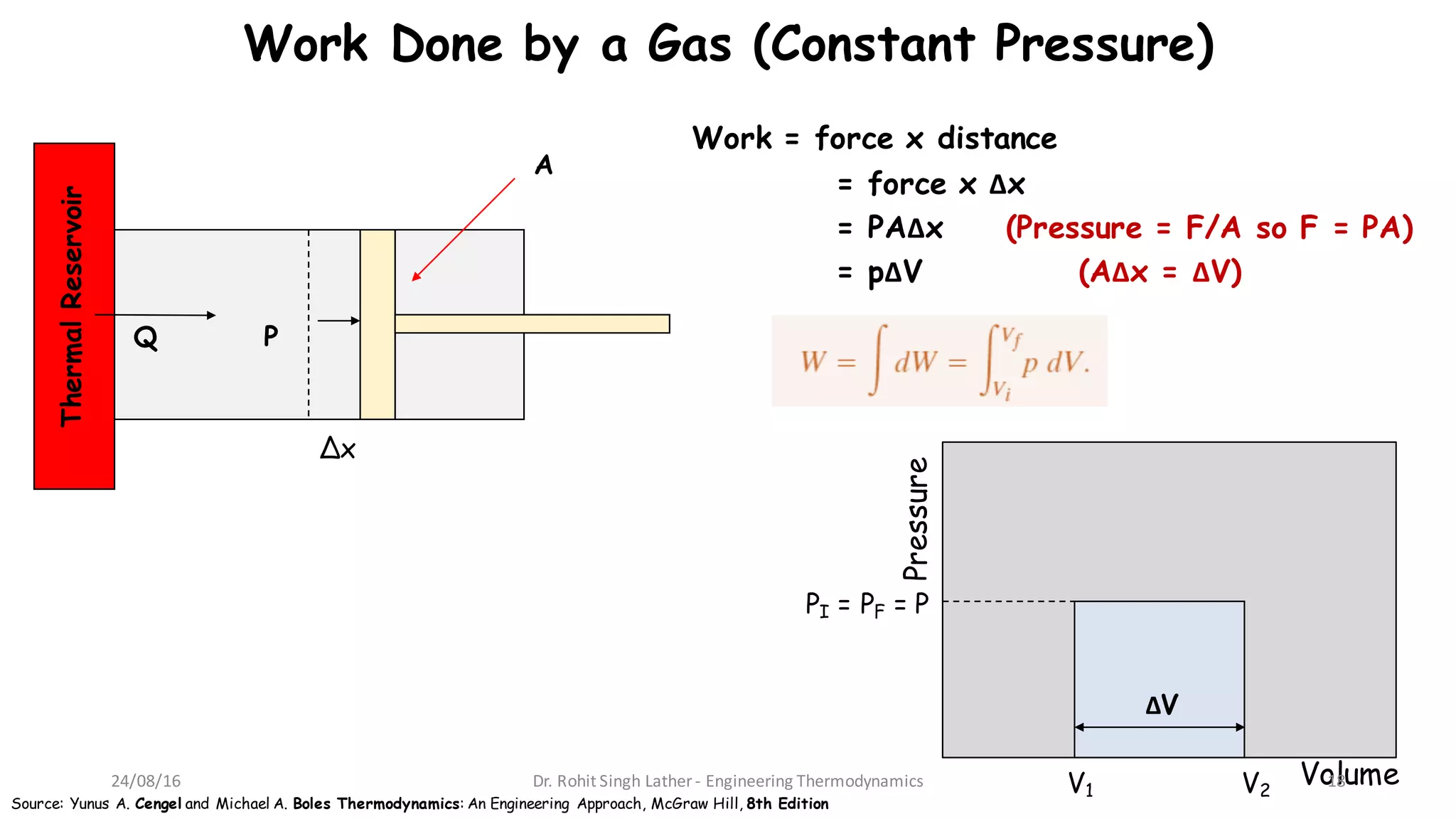
Work Done by a Gas (Constant Pressure)
Work = force x distance
= force x Δx
= PAΔx (Pressure = F/A so F = PA)
= pΔV (AΔx = ΔV)
Q P
Δx
A
ThermalReservoir
ΔV
Pressure
VolumeV1 V2
PI = PF = P
24/08/16 Dr.	Rohit	Singh	Lather	- Engineering	Thermodynamics 18
Source: Yunus A. Cengel and Michael A. Boles Thermodynamics: An Engineering Approach, McGraw Hill, 8th Edition
• The “negative” sign in the equation for WORK is often misunderstood
• Since work done by a gas has a positive volume change we must understand that the gas itself is
USING UP ENERGY or in other words, it is losing energy, thus the negative sign
• When work is done ON a gas the change in volume is negative, this cancels out the negative sign in
the equation, this makes sense as some EXTERNAL agent is ADDING energy to the gas
W = - P ΔV
ΔV = Positive + Work done by System
ΔV = Negative (-) done on system
Work done by System is Negative (-)
Work done on system is Positive (+)
24/08/16 Dr.	Rohit	Singh	Lather	- Engineering	Thermodynamics 19
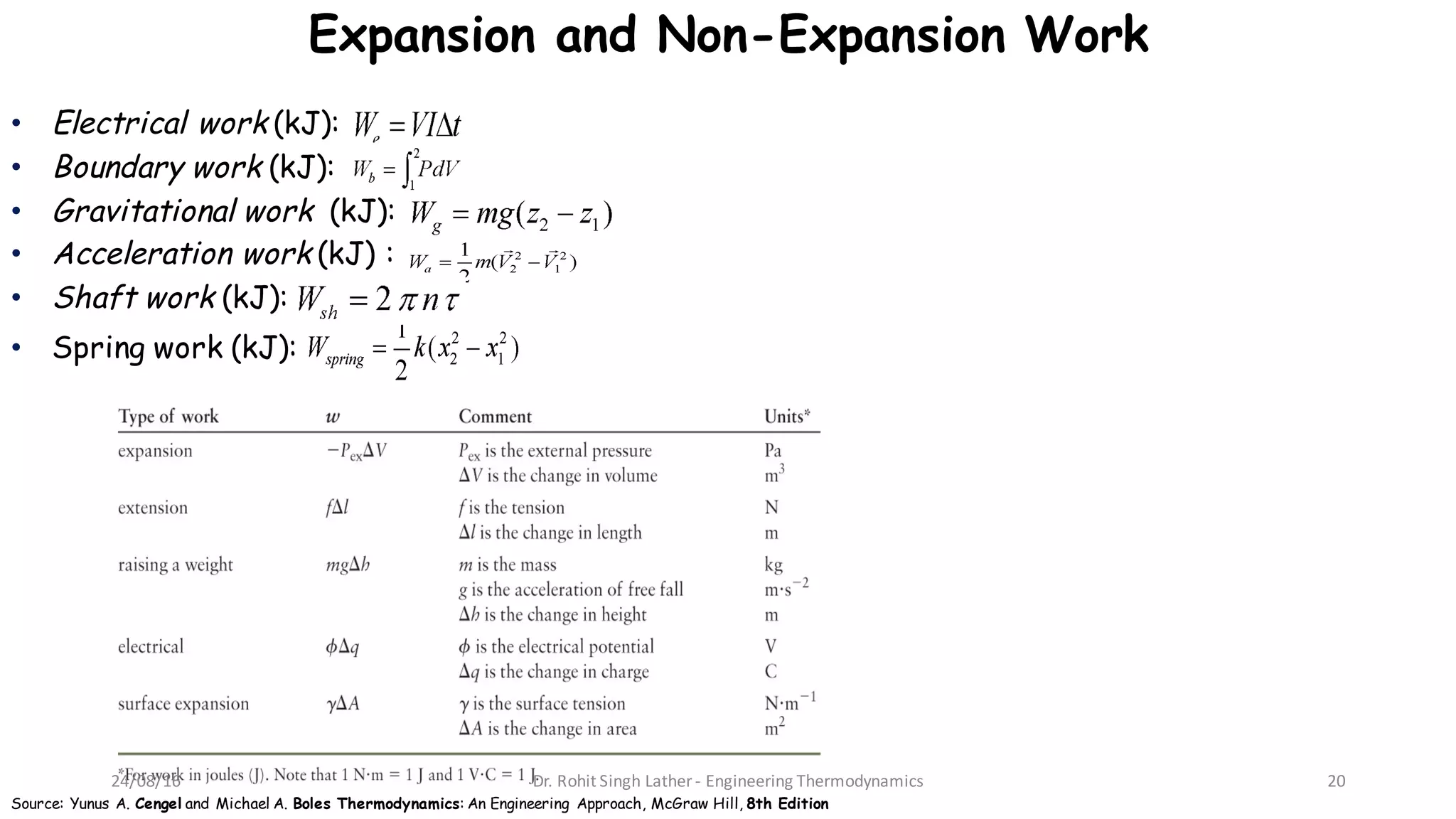
Expansion and Non-Expansion Work
• Electrical work (kJ):
• Boundary work (kJ):
• Gravitational work (kJ):
• Acceleration work (kJ) :
• Shaft work (kJ):
• Spring work (kJ):
Source: Yunus A. Cengel and Michael A. Boles Thermodynamics: An Engineering Approach, McGraw Hill, 8th Edition
24/08/16 Dr.	Rohit	Singh	Lather	- Engineering	Thermodynamics 20
POSITIVE WORK
LESS WORK
NEGATIVE WORK
MORE WORK
VolumePressureVolume
Pressure
W > 0
W > 0
Volume
Pressure
1
2
W > 0
Volume
1
2
W < 0
Pressure24/08/16 Dr.	Rohit	Singh	Lather	- Engineering	Thermodynamics 21
Volume
Pressure
1
2
CYCLIC POSITIVE NET WORK
The work done on a system during a closed cycle can be non-zero
• To go from the state (Vi, Pi) by the path (a) to the state (Vf, Pf) requires a different amount of
work then by path (b).
• To return to the initial point (1) requires the work to be nonzero
Wnet > 0
Volume
Pressure
CONTROL WORK
The work done on a system depends on the path taken in the PV diagram
24/08/16 Dr.	Rohit	Singh	Lather	- Engineering	Thermodynamics 22
How do you change Internal Energy (∆U)
Q
Thermal Reservoir
Change in Volume
∆U = Q + W ∆U = Q - W Won the gas = – Wby the gas
Supplying Heat
Work
OR AS
The first law of thermodynamics (closed system) states that the change in internal energy (DU)
is the sum of the work and heat changes: it is applicable to any process that begins and ends
in equilibrium states
All the energies received are turned into the energy of the system: this is a form of the
energy conservation law
24/08/16 Dr.	Rohit	Singh	Lather	- Engineering	Thermodynamics 23
• Internal Energy (U) is a state function: a property that depends only on the current
state of the system and is independent of how that state was prepared
• Energy can cross the boundaries of a closed system in the form of heat or work
• If the energy transfer across the boundaries of a closed system is due
to a temperature difference, it is heat; otherwise, it is work
Source: Yunus A. Cengel and Michael A. Boles Thermodynamics: An Engineering Approach, McGraw Hill, 8th Edition
24/08/16 Dr.	Rohit	Singh	Lather	- Engineering	Thermodynamics 24
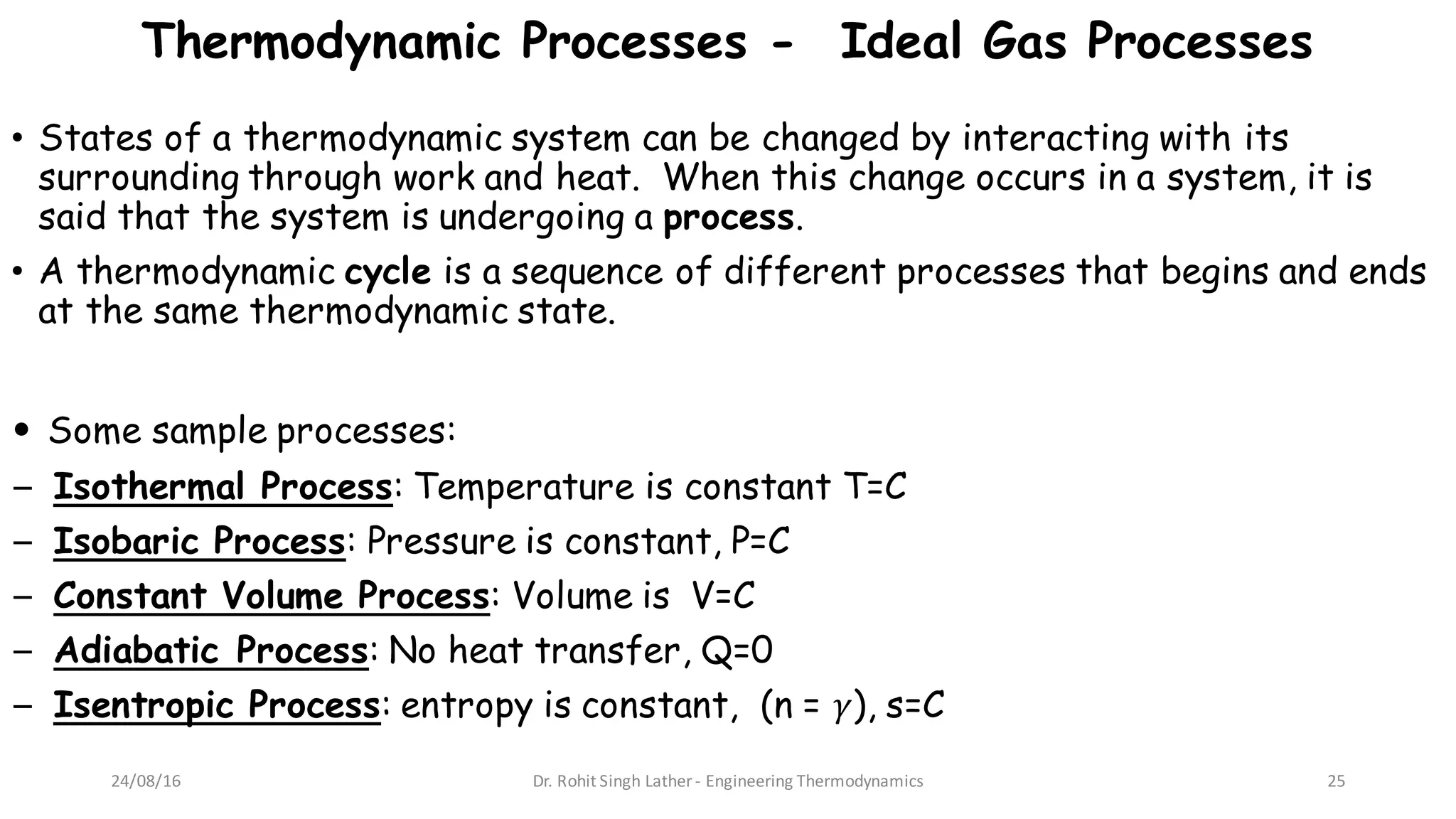
Thermodynamic Processes - Ideal Gas Processes
• States of a thermodynamic system can be changed by interacting with its
surrounding through work and heat. When this change occurs in a system, it is
said that the system is undergoing a process.
• A thermodynamic cycle is a sequence of different processes that begins and ends
at the same thermodynamic state.
• Some sample processes:
− Isothermal Process: Temperature is constant T=C
− Isobaric Process: Pressure is constant, P=C
− Constant Volume Process: Volume is V=C
− Adiabatic Process: No heat transfer, Q=0
− Isentropic Process: entropy is constant, (n = 𝛾), s=C
24/08/16 Dr.	Rohit	Singh	Lather	- Engineering	Thermodynamics 25
Isothermal Process
Q = W
W = ∫ 𝑷𝒅𝑽
𝟐
𝟏
W = ∫
𝒎𝑹𝑻
𝑽
𝒅𝑽
𝟐
𝟏
W = mRT∫
𝒅𝑽
𝑽
𝟐
𝟏
Assumptions: Ideal gas
(closed system)
W = mRT In
	𝑽 𝟐		
𝑽 𝟏
W = mRT In
	𝑷 𝟏		
𝑷 𝟐
ΔT = 0, then ΔU = 0
ΔU = Q - WWork done by System
Q = WWork done by System
Isotherm
Pressure
1
2
VolumeV1 V2
To keep the temperature constant both the
pressure and volume change to compensate (Volume
goes up, pressure goes down)
“BOYLES’ LAW”
T2 = T1
Q
W
V1
V2
Internal Energy
Does not Change
24/08/16 Dr.	Rohit	Singh	Lather	- Engineering	Thermodynamics 26
Reversible process can be reversed by an infinitesimal change in a variable
E.g. reversible, isothermal expansion of an ideal gas
Work done is the area beneath the ideal
gas isotherm lying between the initial and
the final volumes
Pi
Pf
P=nRT/V
Vi Vf
Pressure
Volume
w
24/08/16 Dr.	Rohit	Singh	Lather	- Engineering	Thermodynamics 27
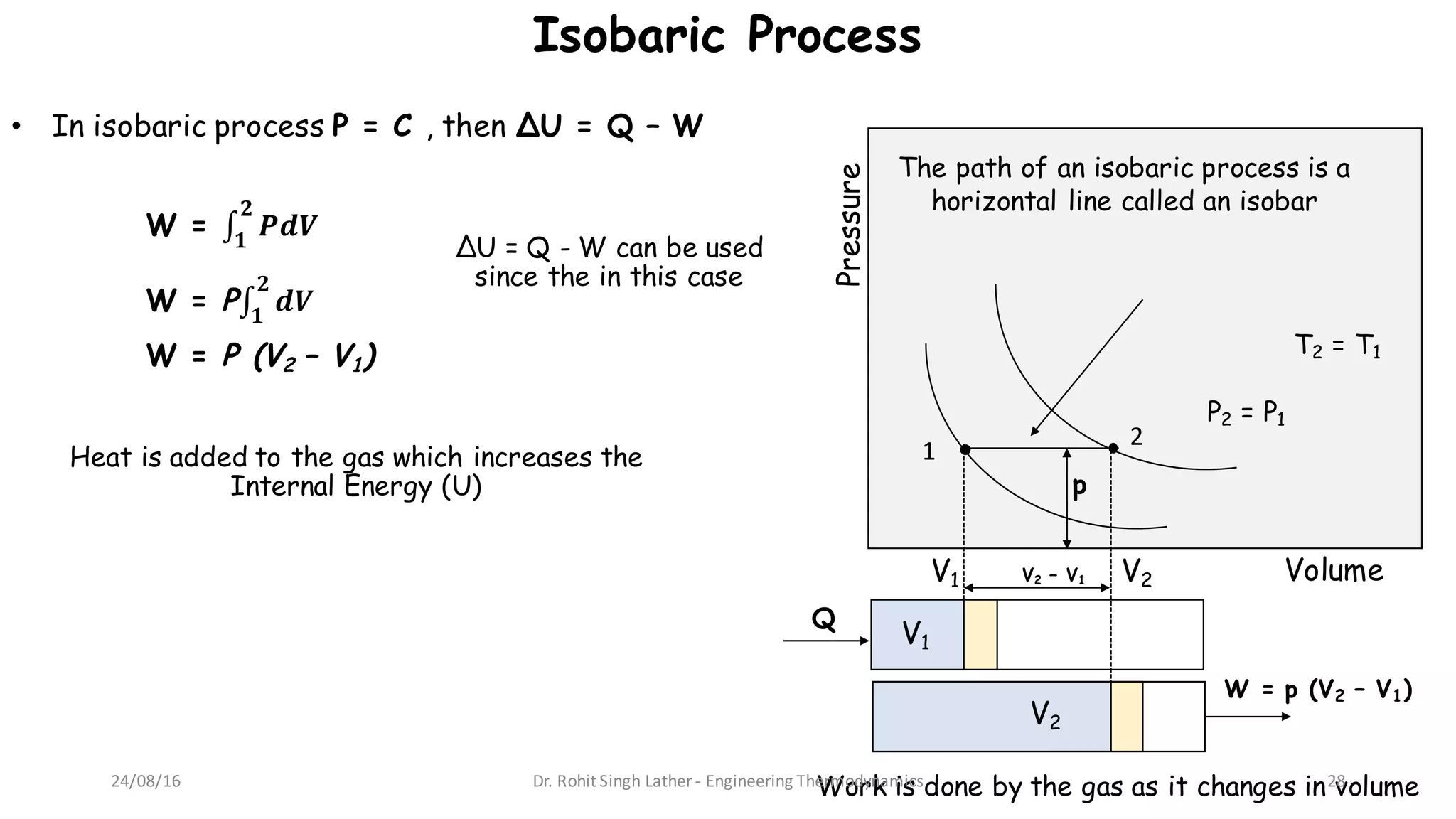
Isobaric Process
• In isobaric process P = C , then ∆U = Q – W
W = ∫ 𝑷𝒅𝑽
𝟐
𝟏
W = P∫ 𝒅𝑽
𝟐
𝟏
W = P (V2 – V1)
Heat is added to the gas which increases the
Internal Energy (U)
∆U = Q - W can be used
since the in this case
Pressure
1
2
VolumeV1 V2
P2 = P1
Q
W = p (V2 – V1)
V1
V2
The path of an isobaric process is a
horizontal line called an isobar
V2 – V1
p
Work is done by the gas as it changes in volume
T2 = T1
24/08/16 Dr.	Rohit	Singh	Lather	- Engineering	Thermodynamics 28
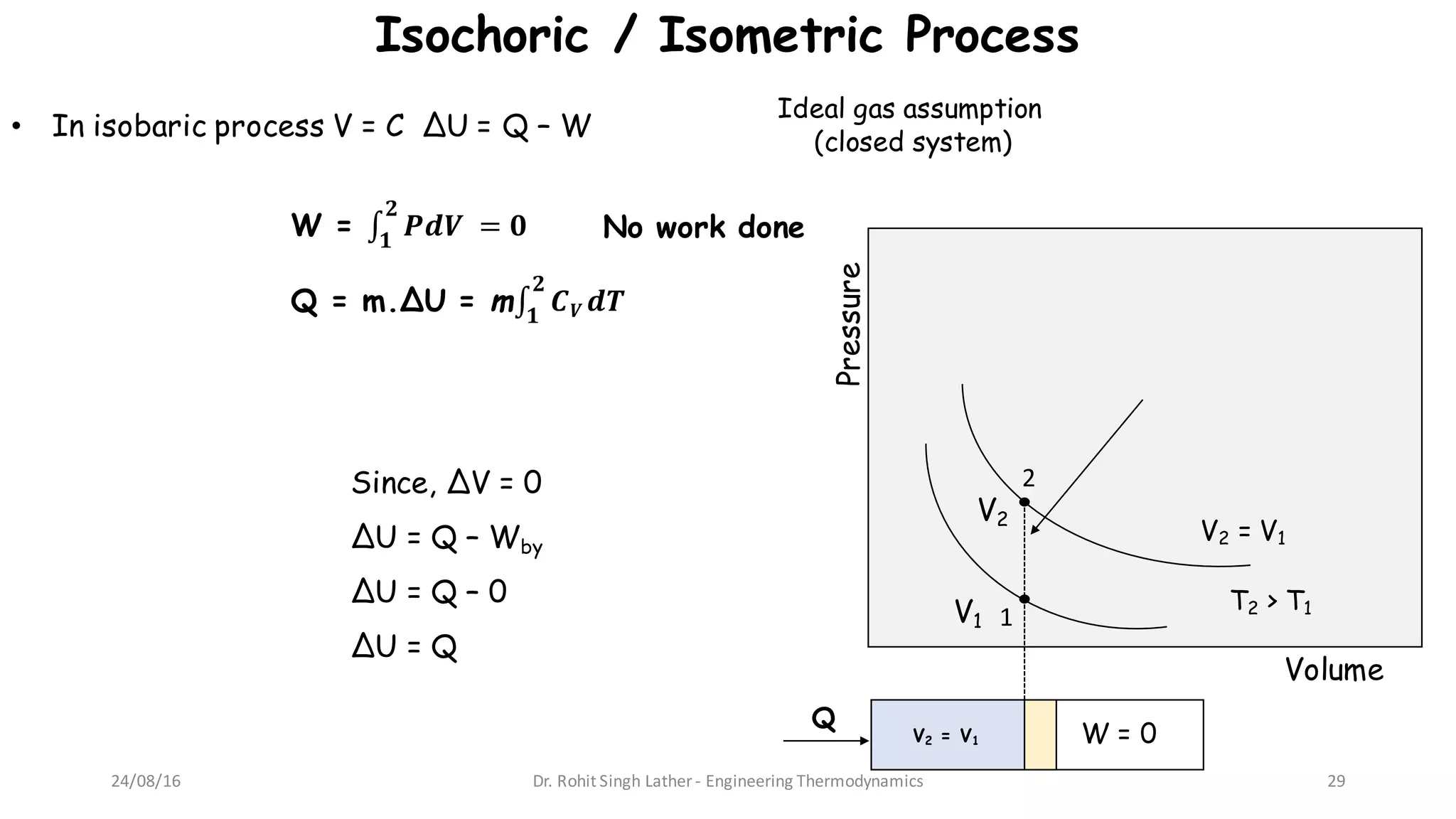
Isochoric / Isometric Process
• In isobaric process V = C ∆U = Q – W
W = ∫ 𝑷𝒅𝑽	 = 𝟎
𝟐
𝟏
Ideal gas assumption
(closed system)
Q = m.∆U = m∫ 𝑪 𝑽	
𝒅𝑻	
𝟐
𝟏
No work done
Since, ∆V = 0
∆U = Q – Wby
∆U = Q – 0
∆U = Q
Pressure
1
2
Volume
V1
V2
V2 = V1
Q
V2 = V1 W = 0
T2 > T1
24/08/16 Dr.	Rohit	Singh	Lather	- Engineering	Thermodynamics 29
Adiabatic Process
• Adiabatic process Q = 0 ∆U = Q – W
∆U = - W
dW = dU
Ideal gas assumption
(closed system)
dU + PdV = 0
m.CV.dT + (
345
6
) dV = 0
CV.dT + (
45
6
) dV = 0
5&
57
= (
𝑉1		
𝑉2
)
(𝛾− 1)
Integrate and R = Cp - CvCv lnT + R lnV = C
(
;<
;=
- 1)	InV + In T = C
(𝛾 - 1)	In V + In T = C
InV (𝛾- 1)	+ In T = C
In (T V (𝛾- 1)	) = C
T V (𝛾- 1)	= C
T1 V1
(𝛾- 1)	 = T2 V2
(𝛾- 1)	
(infinitesimal increment
of work and energy)
Pressure
1
2
VolumeV1 V2
Q = 0 V1
V2
T1 > T2
P,V, T Change
Adiabat
T1
T2
Wby = - ∆U
Loosing internal energy
24/08/16 Dr.	Rohit	Singh	Lather	- Engineering	Thermodynamics 30
5&
57
= (
𝑉1		
𝑉2
)
(𝛾− 1)
PV= nRT T = PV/nRT1 V1
(𝛾- 1)	= T2 V2
(𝛾- 1)	
>767
?4
V1
(𝛾- 1)	=
>&6&
?4
V2
(𝛾- 1)	
P1V1
𝛾 = P2V2
𝛾
Relation of Temperature with Volume
Relation of Pressure with Volume
24/08/16 Dr.	Rohit	Singh	Lather	- Engineering	Thermodynamics 31
Polytropic Process
• ”Polytropic" describes any reversible process on any open or closed system of gas or vapor which
involves both heat and work transfer, such that a specified combination of properties were
maintained constant throughout the process
• The expression relating the properties of the system throughout the process is called
the Polytropic path
• Polytropic Process: its P-V relation can be expressed as
PVn = Constant (c)
Where, n is a constant for a specific process
- Isothermal, T = constant, if the gas is an ideal gas then P.V = R.T = constant, n = 1
- Isobaric, P = constant, n = 0 (for all substances)
- Constant-volume, V = constant, V = constant(P)(1/n), n =∞, (for all substances)
- Adiabatic Process, n = k for an ideal gas
24/08/16 Dr.	Rohit	Singh	Lather	- Engineering	Thermodynamics 32
PV Diagram for various Polytropic Processes
P1 V1
𝛾 = P2 V2
𝛾		
= PVn
W = ∫ 𝑷𝒅𝑽					
𝟐
𝟏
W = ∫ 𝑷𝑽 𝒏 𝑽⁻ 𝒏 𝒅𝑽	
𝟐
𝟏
W = 𝑷𝑽 𝒏
∫ 𝑽⁻ 𝒏 𝒅𝑽	
𝟐
𝟏
W =
𝑷𝑽 𝒏
𝟏	B	𝒏
	(𝑽 𝟐
𝟏B𝒏 	−	𝑽 𝟏
𝟏B𝒏)
W =
𝑷 𝟐 𝑽 𝟐		
−		 𝑷 𝟏 𝑽 𝟏
			
𝟏	B	𝒏
Pressure
Volume
n = 0
n = infinity
n > 1
n = 1
n < 1
E
𝑪
𝑽 𝒏
𝟐
𝟏
𝐝𝐕
24/08/16 Dr.	Rohit	Singh	Lather	- Engineering	Thermodynamics 33
Polytropic
Adiabatic
Isothermal
Isobaric
Isochoric
In Summary
Process Important Point to Remember Gas Law that identifies it
Isothermal Constant T, dU = 0, Q = W Boyles Law
Isochoric Constant V, W = 0, dU = Q Charles Law
Isobaric Constant P, dU = Q – ( - PdV) Gay – Lussac’s Law
Adiabatic Nothing is Constant , Q = 0, dU = - W Combined Gas Law
24/08/16 Dr.	Rohit	Singh	Lather	- Engineering	Thermodynamics 34
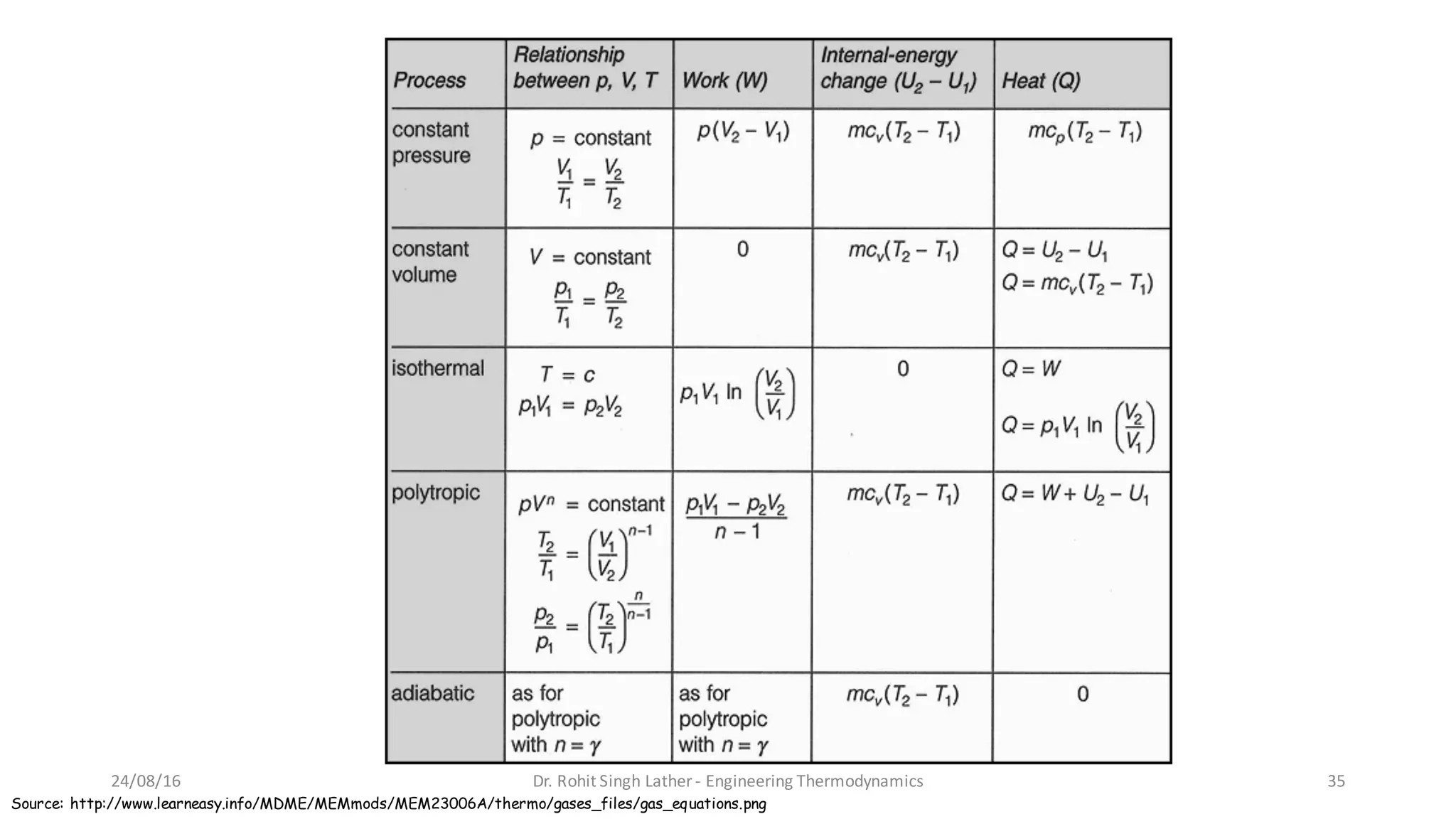
Source: http://www.learneasy.info/MDME/MEMmods/MEM23006A/thermo/gases_files/gas_equations.png
24/08/16 Dr.	Rohit	Singh	Lather	- Engineering	Thermodynamics 35

Work and heat

  • 1.
    Work and Heat Dr.Rohit Singh Lather
  • 2.
    Forms of Energy Energy MacroscopicMicroscopic Kinetic Potential Sensible (translational + rotational + vibrational) Latent (inter molecular phase change) Chemical (Atomic Bonds) Atomic (bonds within nucleolus of atoms) Summation of all the microscopic energies is called Internal Energy E= U+KE+PE (kJ) Low Grade High GradeHeat Work 24/08/16 Dr. Rohit Singh Lather - Engineering Thermodynamics 2
  • 3.
    Introduction • Temperature determinesthe direction of flow of thermal energy between two bodies in thermal equilibrium • Temperature is also a measure of the average kinetic energy of particles in a substance • Changes in the state of a system are produced by interactions with the environment through heat and work • Heat and work are two different modes of energy transfer • During these interactions, equilibrium (a static or quasi-static process) is necessary for the equations that relate system properties to one-another to be valid Heat is the random motion of the particles in the gas, i.e. a “degraded” from of kinetic energy • Bodies don't “contain” heat • Heat is identified as it comes across system boundaries • The amount of heat needed to go from one state to another is path dependent 24/08/16 Dr. Rohit Singh Lather - Engineering Thermodynamics 3
  • 4.
    System Surroundings SystemSystem Surroundings Surroundings System athigher temperature looses energy as heat System and surrounding at same temperature, no energy is transferred as heat System at lower temperature gains energy as heat 0,0 , =Δ=Δ ↑Δ↑Δ ΔΔ UTif UTif TU α All of the energy inside a system is called INTERNAL ENERGY When you add HEAT (Q), you are adding energy and the internal energy INCREASES QReleased = Negative (-) QAbsorbed = Positive (+) 24/08/16 Dr. Rohit Singh Lather - Engineering Thermodynamics 4
  • 5.
    Specific Heat • Note:It is easy to change the temperature of some things (e.g. air) and hard to change the temperature of others (e.g. water, block of steel) • The amount of heat (Q) added into a body of mass m to change its temperature an amount is given by Q= m.C.∆T = m.C.(Tf – Ti) C is called the specific heat and depends on the material Note: Temperature in either Kelvin or Celsius ⎟⎟ ⎠ ⎞ ⎜⎜ ⎝ ⎛ =⎟⎟ ⎠ ⎞ ⎜⎜ ⎝ ⎛ = Δ = Ckg J Cg cal Tm Q C oo The heat capacity C of an object is the proportionality constant between the heat Q that the object absorbs or loses and the resulting temperature change ΔT of the object # It is important to distinguish the heat transfer is done with constant volume or constant pressure The specific heat is different for different processes, particular for gases 24/08/16 Dr. Rohit Singh Lather - Engineering Thermodynamics 5
  • 6.
    Heat of Transformation Whenthe phase change is between liquid to gas, the heat of transformation is called the heat of vaporization LV (# sublimation: transition from solid directly to gas phases) The amount of energy per unit mass that must be transferred as heat when a sample completely undergoes a phase change is called the heat of transformation L (or latent heat) When a sample of mass m completely undergoes a phase change, the total energy transferred is: When the phase change is between solid to liquid, the heat of transformation is called the heat of fusion LF 24/08/16 Dr. Rohit Singh Lather - Engineering Thermodynamics 6 Source: Yunus A. Cengel and Michael A. Boles Thermodynamics: An Engineering Approach, McGraw Hill, 8th Edition
  • 7.
    • The amountof energy needed to raise the temperature of a unit of mass of a substance by one degree is called the specific heat at constant volume Cv for a constant-volume process: • The amount of energy needed to raise the temperature of a unit of mass of a substance by one degree is called the specific heat at constant pressure Cp for a constant pressure process: 3-31Heat Capacities at Constant Volume and Constant Pressure • For ideal gases u, h, Cv, and Cp are functions of temperature alone Source: Yunus A. Cengel and Michael A. Boles Thermodynamics: An Engineering Approach, McGraw Hill, 8th Edition 24/08/16 Dr. Rohit Singh Lather - Engineering Thermodynamics 7
  • 8.
    Experimental apparatus usedby Joule It has been demonstrated mathematically and experimentally (Joule, 1843) that for an ideal gas the internal energy is a function of the temperature only. That is, u = u(T) Water EvacuatedAir (high pressure) Thermometer
  • 9.
    • Joule’s reasoned,the internal energy is a function of temperature only and not a function of pressure or specific volume • Later Joule’s showed that for gases that deviate significantly from ideal- gas behavior, the internal energy is not a function of temperature alone • Using the definition of enthalpy and the equation of state of an ideal gas, we have is also a function of temperature only h = h(T) Since u and h depend only on temperature for an ideal gas, the specific heats cv and cp also depend, at most, on temperature only. Therefore, at a given temperature, u, h, cv, and cp of an ideal gas have fixed values regard- less of the specific volume or pressure Thus, for ideal gases, the partial derivatives in Eqs. 4–19 and 4–20 can be replaced by ordinary derivatives. Then, the differential changes in the internal energy and enthalpy of an ideal gas can be expressed as u = u(T) For ideal gases, u, h, cv, and cp vary with temperature only du = cv(T) dT
  • 10.
    • For idealgases Cv, and Cp are related by: Cp = Cv + R [kJ / (kg.K)] • The specific heat ratio 𝛾 is defined as: 𝛾 = 𝑪 𝒑 𝑪 𝒗 • For incompressible substances (liquids and solids), both the constant-pressure and constant-volume specific heats are identical and denoted by C: Cp = Cv = C [kJ / (kg.K)] Source: Yunus A. Cengel and Michael A. Boles Thermodynamics: An Engineering Approach, McGraw Hill, 8th Edition Cp > Cv In an isobaric process system is heated and work is performed CV CP Monoatomic Gases % & R % & R Diatomic Gases % & R % & R Triatomic Gases % & R % & R 24/08/16 Dr. Rohit Singh Lather - Engineering Thermodynamics 10
  • 11.
    Heat Transfer Mechanisms Conduction:(solids--mostly) Heat transfer without mass transfer Radiation Heat transfer through electromagnetic waves Convection: (liquids/gas) Heat transfer with mass transfer due to motion Source: Yunus A. Cengel and Michael A. Boles Thermodynamics: An Engineering Approach, McGraw Hill, 8th Edition 24/08/16 Dr. Rohit Singh Lather - Engineering Thermodynamics 11
  • 12.
    Conduction If Q bethe energy that is transferred as heat through the slab, from its hot face to its cold face, in time t, then the conduction rate Pcond (the amount of energy transferred per unit time) isTH Hot Reservoir TC Cold Reservoir Q Slab of face area A & Thermal conductivity k Thickness L We assume steady state of heat transfer Here k, called the thermal conductivity, is a constant that depends on the material of which the slab is made Source: Yunus A. Cengel and Michael A. Boles Thermodynamics: An Engineering Approach, McGraw Hill, 8th Edition 24/08/16 Dr. Rohit Singh Lather - Engineering Thermodynamics 12
  • 13.
    Convection • In convection,thermal energy is transferred by bulk motion of materials from regions of high to low temperatures • This occurs when in a fluid a large temperature difference is formed within a short vertical distance (the temperature gradient is large) • Typically very complicated • Very efficient way to transfer energy Source: Yunus A. Cengel and Michael A. Boles Thermodynamics: An Engineering Approach, McGraw Hill, 8th Edition 24/08/16 Dr. Rohit Singh Lather - Engineering Thermodynamics 13
  • 14.
    Radiation • Everything thathas a temperature radiates energy • Method that energy from sun reaches the earth • In radiation, an object and its environment can exchange energy as heat via electromagnetic waves • Energy transferred in this way is called thermal radiation • The rate Prad at which an object emits energy via electromagnetic radiation depends on the object’s surface area A and the temperature T of that area in K, and is given by • Note: if we double the temperature, the power radiated goes up by 24 =16 • If we triple the temperature, the radiated power goes up by 34=81 Stefan–Boltzmann constant 5.6704 x10⁻⁸ W/m2 K4 Emissivity If the rate at which an object absorbs energy via thermal radiation from its environment is Pabs, then the object’s net rate Pnet of energy exchange due to thermal radiation is Source: Yunus A. Cengel and Michael A. Boles Thermodynamics: An Engineering Approach, McGraw Hill, 8th Edition 24/08/16 Dr. Rohit Singh Lather - Engineering Thermodynamics 14
  • 15.
    Quasi-Static Process • Arbitrarilyslow process such that system always stays stays arbitrarily close to thermodynamic equilibrium • Infinite slowness is the characteristics of a quasi-static process • It is a succession of equilibrium states • A quasi-static process is also reversible process Dots indicate equilibrium states Pressure 1 2 Volume Every state passed through by the system will be an equilibrium state Such a process is locus of all the equilibrium points passed through by the system System Boundary Piston Weight Final State Initial State Multiple Weights Final State Initial State Piston dv dp 24/08/16 Dr. Rohit Singh Lather - Engineering Thermodynamics 15
  • 16.
    Work • Heat isa way of changing the energy of a system by virtue of a temperature difference only • Other means for changing the energy of a system is called work • We can have push-pull work - (e.g. in a piston-cylinder, lifting a weight) - electric and magnetic work (e.g. an electric motor) - chemical work, surface tension work, elastic work, etc. • In defining work, we focus on the effects that the system (e.g. an engine) has on its surroundings If work is done on the system the work is negative (energy added to the system) Work as being positive when the system does work on the surroundings (energy leaves the system) 24/08/16 Dr. Rohit Singh Lather - Engineering Thermodynamics 16
  • 17.
    Pressure Volume Diagramsand Work Done This area represents the work done by the gas (on the surroundings) when it expands from state A to state B Pressure Volume Changes that happen during a thermodynamic process can usefully be shown on a pV diagram 24/08/16 Dr. Rohit Singh Lather - Engineering Thermodynamics 17
  • 18.
    Work Done bya Gas (Constant Pressure) Work = force x distance = force x Δx = PAΔx (Pressure = F/A so F = PA) = pΔV (AΔx = ΔV) Q P Δx A ThermalReservoir ΔV Pressure VolumeV1 V2 PI = PF = P 24/08/16 Dr. Rohit Singh Lather - Engineering Thermodynamics 18 Source: Yunus A. Cengel and Michael A. Boles Thermodynamics: An Engineering Approach, McGraw Hill, 8th Edition
  • 19.
    • The “negative”sign in the equation for WORK is often misunderstood • Since work done by a gas has a positive volume change we must understand that the gas itself is USING UP ENERGY or in other words, it is losing energy, thus the negative sign • When work is done ON a gas the change in volume is negative, this cancels out the negative sign in the equation, this makes sense as some EXTERNAL agent is ADDING energy to the gas W = - P ΔV ΔV = Positive + Work done by System ΔV = Negative (-) done on system Work done by System is Negative (-) Work done on system is Positive (+) 24/08/16 Dr. Rohit Singh Lather - Engineering Thermodynamics 19
  • 20.
    Expansion and Non-ExpansionWork • Electrical work (kJ): • Boundary work (kJ): • Gravitational work (kJ): • Acceleration work (kJ) : • Shaft work (kJ): • Spring work (kJ): Source: Yunus A. Cengel and Michael A. Boles Thermodynamics: An Engineering Approach, McGraw Hill, 8th Edition 24/08/16 Dr. Rohit Singh Lather - Engineering Thermodynamics 20
  • 21.
    POSITIVE WORK LESS WORK NEGATIVEWORK MORE WORK VolumePressureVolume Pressure W > 0 W > 0 Volume Pressure 1 2 W > 0 Volume 1 2 W < 0 Pressure24/08/16 Dr. Rohit Singh Lather - Engineering Thermodynamics 21
  • 22.
    Volume Pressure 1 2 CYCLIC POSITIVE NETWORK The work done on a system during a closed cycle can be non-zero • To go from the state (Vi, Pi) by the path (a) to the state (Vf, Pf) requires a different amount of work then by path (b). • To return to the initial point (1) requires the work to be nonzero Wnet > 0 Volume Pressure CONTROL WORK The work done on a system depends on the path taken in the PV diagram 24/08/16 Dr. Rohit Singh Lather - Engineering Thermodynamics 22
  • 23.
    How do youchange Internal Energy (∆U) Q Thermal Reservoir Change in Volume ∆U = Q + W ∆U = Q - W Won the gas = – Wby the gas Supplying Heat Work OR AS The first law of thermodynamics (closed system) states that the change in internal energy (DU) is the sum of the work and heat changes: it is applicable to any process that begins and ends in equilibrium states All the energies received are turned into the energy of the system: this is a form of the energy conservation law 24/08/16 Dr. Rohit Singh Lather - Engineering Thermodynamics 23
  • 24.
    • Internal Energy(U) is a state function: a property that depends only on the current state of the system and is independent of how that state was prepared • Energy can cross the boundaries of a closed system in the form of heat or work • If the energy transfer across the boundaries of a closed system is due to a temperature difference, it is heat; otherwise, it is work Source: Yunus A. Cengel and Michael A. Boles Thermodynamics: An Engineering Approach, McGraw Hill, 8th Edition 24/08/16 Dr. Rohit Singh Lather - Engineering Thermodynamics 24
  • 25.
    Thermodynamic Processes -Ideal Gas Processes • States of a thermodynamic system can be changed by interacting with its surrounding through work and heat. When this change occurs in a system, it is said that the system is undergoing a process. • A thermodynamic cycle is a sequence of different processes that begins and ends at the same thermodynamic state. • Some sample processes: − Isothermal Process: Temperature is constant T=C − Isobaric Process: Pressure is constant, P=C − Constant Volume Process: Volume is V=C − Adiabatic Process: No heat transfer, Q=0 − Isentropic Process: entropy is constant, (n = 𝛾), s=C 24/08/16 Dr. Rohit Singh Lather - Engineering Thermodynamics 25
  • 26.
    Isothermal Process Q =W W = ∫ 𝑷𝒅𝑽 𝟐 𝟏 W = ∫ 𝒎𝑹𝑻 𝑽 𝒅𝑽 𝟐 𝟏 W = mRT∫ 𝒅𝑽 𝑽 𝟐 𝟏 Assumptions: Ideal gas (closed system) W = mRT In 𝑽 𝟐 𝑽 𝟏 W = mRT In 𝑷 𝟏 𝑷 𝟐 ΔT = 0, then ΔU = 0 ΔU = Q - WWork done by System ΔU = Q - WWork done by System Q = WWork done by System Isotherm Pressure 1 2 VolumeV1 V2 To keep the temperature constant both the pressure and volume change to compensate (Volume goes up, pressure goes down) “BOYLES’ LAW” T2 = T1 Q W V1 V2 Internal Energy Does not Change 24/08/16 Dr. Rohit Singh Lather - Engineering Thermodynamics 26
  • 27.
    Reversible process canbe reversed by an infinitesimal change in a variable E.g. reversible, isothermal expansion of an ideal gas Work done is the area beneath the ideal gas isotherm lying between the initial and the final volumes Pi Pf P=nRT/V Vi Vf Pressure Volume w 24/08/16 Dr. Rohit Singh Lather - Engineering Thermodynamics 27
  • 28.
    Isobaric Process • Inisobaric process P = C , then ∆U = Q – W W = ∫ 𝑷𝒅𝑽 𝟐 𝟏 W = P∫ 𝒅𝑽 𝟐 𝟏 W = P (V2 – V1) Heat is added to the gas which increases the Internal Energy (U) ∆U = Q - W can be used since the in this case Pressure 1 2 VolumeV1 V2 P2 = P1 Q W = p (V2 – V1) V1 V2 The path of an isobaric process is a horizontal line called an isobar V2 – V1 p Work is done by the gas as it changes in volume T2 = T1 24/08/16 Dr. Rohit Singh Lather - Engineering Thermodynamics 28
  • 29.
    Isochoric / IsometricProcess • In isobaric process V = C ∆U = Q – W W = ∫ 𝑷𝒅𝑽 = 𝟎 𝟐 𝟏 Ideal gas assumption (closed system) Q = m.∆U = m∫ 𝑪 𝑽 𝒅𝑻 𝟐 𝟏 No work done Since, ∆V = 0 ∆U = Q – Wby ∆U = Q – 0 ∆U = Q Pressure 1 2 Volume V1 V2 V2 = V1 Q V2 = V1 W = 0 T2 > T1 24/08/16 Dr. Rohit Singh Lather - Engineering Thermodynamics 29
  • 30.
    Adiabatic Process • Adiabaticprocess Q = 0 ∆U = Q – W ∆U = - W dW = dU Ideal gas assumption (closed system) dU + PdV = 0 m.CV.dT + ( 345 6 ) dV = 0 CV.dT + ( 45 6 ) dV = 0 5& 57 = ( 𝑉1 𝑉2 ) (𝛾− 1) Integrate and R = Cp - CvCv lnT + R lnV = C ( ;< ;= - 1) InV + In T = C (𝛾 - 1) In V + In T = C InV (𝛾- 1) + In T = C In (T V (𝛾- 1) ) = C T V (𝛾- 1) = C T1 V1 (𝛾- 1) = T2 V2 (𝛾- 1) (infinitesimal increment of work and energy) Pressure 1 2 VolumeV1 V2 Q = 0 V1 V2 T1 > T2 P,V, T Change Adiabat T1 T2 Wby = - ∆U Loosing internal energy 24/08/16 Dr. Rohit Singh Lather - Engineering Thermodynamics 30
  • 31.
    5& 57 = ( 𝑉1 𝑉2 ) (𝛾− 1) PV=nRT T = PV/nRT1 V1 (𝛾- 1) = T2 V2 (𝛾- 1) >767 ?4 V1 (𝛾- 1) = >&6& ?4 V2 (𝛾- 1) P1V1 𝛾 = P2V2 𝛾 Relation of Temperature with Volume Relation of Pressure with Volume 24/08/16 Dr. Rohit Singh Lather - Engineering Thermodynamics 31
  • 32.
    Polytropic Process • ”Polytropic"describes any reversible process on any open or closed system of gas or vapor which involves both heat and work transfer, such that a specified combination of properties were maintained constant throughout the process • The expression relating the properties of the system throughout the process is called the Polytropic path • Polytropic Process: its P-V relation can be expressed as PVn = Constant (c) Where, n is a constant for a specific process - Isothermal, T = constant, if the gas is an ideal gas then P.V = R.T = constant, n = 1 - Isobaric, P = constant, n = 0 (for all substances) - Constant-volume, V = constant, V = constant(P)(1/n), n =∞, (for all substances) - Adiabatic Process, n = k for an ideal gas 24/08/16 Dr. Rohit Singh Lather - Engineering Thermodynamics 32
  • 33.
    PV Diagram forvarious Polytropic Processes P1 V1 𝛾 = P2 V2 𝛾 = PVn W = ∫ 𝑷𝒅𝑽 𝟐 𝟏 W = ∫ 𝑷𝑽 𝒏 𝑽⁻ 𝒏 𝒅𝑽 𝟐 𝟏 W = 𝑷𝑽 𝒏 ∫ 𝑽⁻ 𝒏 𝒅𝑽 𝟐 𝟏 W = 𝑷𝑽 𝒏 𝟏 B 𝒏 (𝑽 𝟐 𝟏B𝒏 − 𝑽 𝟏 𝟏B𝒏) W = 𝑷 𝟐 𝑽 𝟐 − 𝑷 𝟏 𝑽 𝟏 𝟏 B 𝒏 Pressure Volume n = 0 n = infinity n > 1 n = 1 n < 1 E 𝑪 𝑽 𝒏 𝟐 𝟏 𝐝𝐕 24/08/16 Dr. Rohit Singh Lather - Engineering Thermodynamics 33 Polytropic Adiabatic Isothermal Isobaric Isochoric
  • 34.
    In Summary Process ImportantPoint to Remember Gas Law that identifies it Isothermal Constant T, dU = 0, Q = W Boyles Law Isochoric Constant V, W = 0, dU = Q Charles Law Isobaric Constant P, dU = Q – ( - PdV) Gay – Lussac’s Law Adiabatic Nothing is Constant , Q = 0, dU = - W Combined Gas Law 24/08/16 Dr. Rohit Singh Lather - Engineering Thermodynamics 34
  • 35.