Presented by:
M. Hammad Latif
Presented to:
Dr. Qandeel Fatima
Protein sorting in
Golgi Bodies
Protein targeting or protein sorting is the biological
mechanism by which proteins are transported to the
appropriate destinations in the cell or outside of
it. Proteins can be targeted to the inner space of an
organelle, different intracellular membranes, plasma
membrane, or to exterior of the cell via secretion.
Protein Sorting
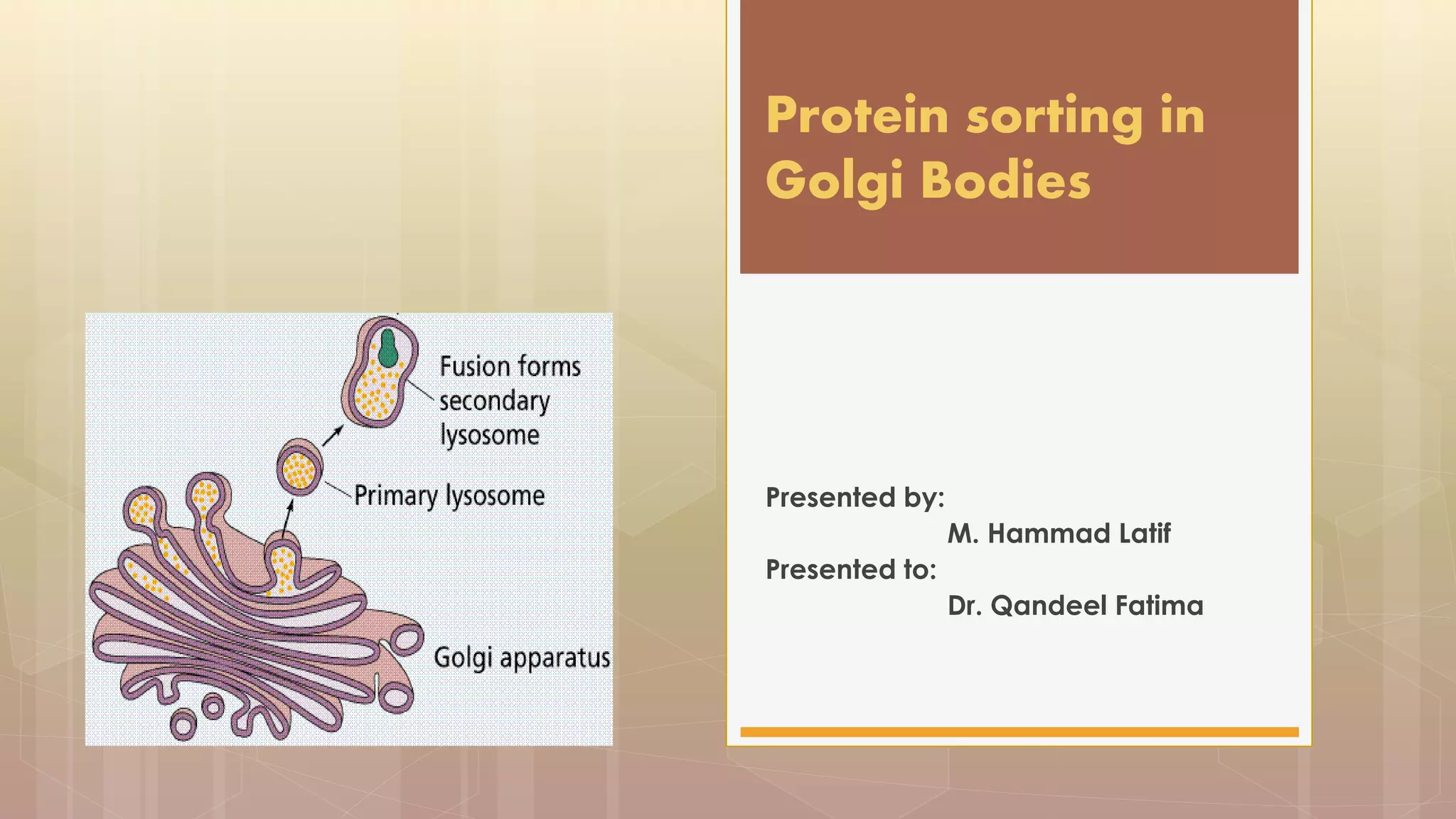
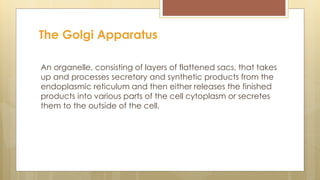
An organelle, consisting of layers of flattened sacs, that takes
up and processes secretory and synthetic products from the
endoplasmic reticulum and then either releases the finished
products into various parts of the cell cytoplasm or secretes
them to the outside of the cell.
The Golgi Apparatus
Morphologically the Golgi is composed of flattened
membrane-enclosed sacs (cisternae) and associated
vesicles.
Proteins from the ER enter at its cis face (entry face), which is
convex and usually oriented toward the nucleus. They are
then transported through the Golgi and exit from its
concave trans face (exit face). As they pass through the
Golgi, proteins are modified and sorted for transport to their
eventual destinations within the cell.
Organization of the Golgi Apparatus
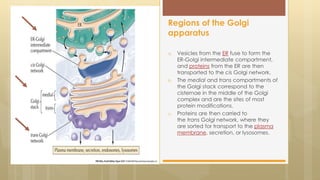
a. Vesicles from the ER fuse to form the
ER-Golgi intermediate compartment,
and proteins from the ER are then
transported to the cis Golgi network.
b. The medial and trans compartments of
the Golgi stack correspond to the
cisternae in the middle of the Golgi
complex and are the sites of most
protein modifications.
c. Proteins are then carried to
the trans Golgi network, where they
are sorted for transport to the plasma
membrane, secretion, or lysosomes.
Regions of the Golgi
apparatus
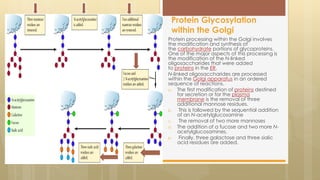
Protein processing within the Golgi involves
the modification and synthesis of
the carbohydrate portions of glycoproteins.
One of the major aspects of this processing is
the modification of the N-linked
oligosaccharides that were added
to proteins in the ER.
N-linked oligosaccharides are processed
within the Golgi apparatus in an ordered
sequence of reactions.
a. The first modification of proteins destined
for secretion or for the plasma
membrane is the removal of three
additional mannose residues.
b. This is followed by the sequential addition
of an N-acetylglucosamine
c. The removal of two more mannoses
d. The addition of a fucose and two more N-
acetylglucosamines.
e. Finally, three galactose and three sialic
acid residues are added.
Protein Glycosylation
within the Golgi
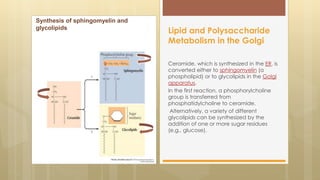
Ceramide, which is synthesized in the ER, is
converted either to sphingomyelin (a
phospholipid) or to glycolipids in the Golgi
apparatus.
In the first reaction, a phosphorylcholine
group is transferred from
phosphatidylcholine to ceramide.
Alternatively, a variety of different
glycolipids can be synthesized by the
addition of one or more sugar residues
(e.g., glucose).
Lipid and Polysaccharide
Metabolism in the Golgi
Synthesis of sphingomyelin and
glycolipids
Proteins, as well as lipids and polysaccharides, are
transported from the Golgi apparatus to their final
destinations through the secretory pathway. This involves the
sorting of proteins into different kinds of transport vesicles,
which bud from the trans Golgi network and deliver their
contents to the appropriate cellular locations.
Protein Sorting and Export from the Golgi
Apparatus
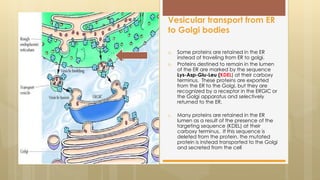
a. Some proteins are retained in the ER
instead of traveling from ER to golgi.
b. Proteins destined to remain in the lumen
of the ER are marked by the sequence
Lys-Asp-Glu-Leu (KDEL) at their carboxy
terminus. These proteins are exported
from the ER to the Golgi, but they are
recognized by a receptor in the ERGIC or
the Golgi apparatus and selectively
returned to the ER.
c. Many proteins are retained in the ER
lumen as a result of the presence of the
targeting sequence (KDEL) at their
carboxy terminus. If this sequence is
deleted from the protein, the mutated
protein is instead transported to the Golgi
and secreted from the cell
Vesicular transport from ER
to Golgi bodies
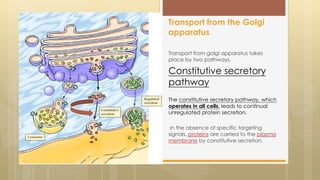
Transport from golgi apparatus takes
place by two pathways.
Constitutive secretory
pathway
The constitutive secretory pathway, which
operates in all cells, leads to continual
unregulated protein secretion.
In the absence of specific targeting
signals, proteins are carried to the plasma
membrane by constitutive secretion.
Transport from the Golgi
apparatus
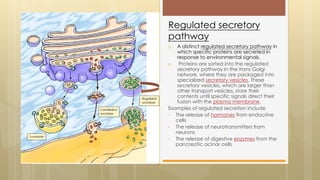
a. A distinct regulated secretory pathway in
which specific proteins are secreted in
response to environmental signals.
b. Proteins are sorted into the regulated
secretory pathway in the trans Golgi
network, where they are packaged into
specialized secretory vesicles. These
secretory vesicles, which are larger than
other transport vesicles, store their
contents until specific signals direct their
fusion with the plasma membrane.
Examples of regulated secretion include
• The release of hormones from endocrine
cells
• The release of neurotransmitters from
neurons
• The release of digestive enzymes from the
pancreatic acinar cells
Regulated secretory
pathway
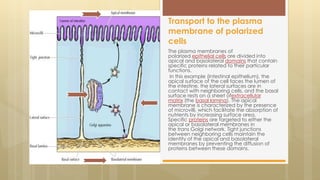
The plasma membranes of
polarized epithelial cells are divided into
apical and basolateral domains that contain
specific proteins related to their particular
functions.
In this example (intestinal epithelium), the
apical surface of the cell faces the lumen of
the intestine, the lateral surfaces are in
contact with neighboring cells, and the basal
surface rests on a sheet ofextracellular
matrix (the basal lamina). The apical
membrane is characterized by the presence
of microvilli, which facilitate the absorption of
nutrients by increasing surface area.
Specific proteins are targeted to either the
apical or basolateral membranes in
the trans Golgi network. Tight junctions
between neighboring cells maintain the
identity of the apical and basolateral
membranes by preventing the diffusion of
proteins between these domains.
Transport to the plasma
membrane of polarized
cells
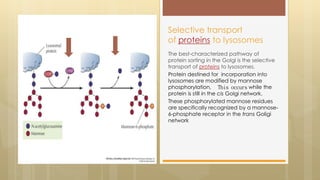
The best-characterized pathway of
protein sorting in the Golgi is the selective
transport of proteins to lysosomes.
Protein destined for incorporation into
lysosomes are modified by mannose
phosphorylation. This occurs while the
protein is still in the cis Golgi network.
These phosphorylated mannose residues
are specifically recognized by a mannose-
6-phosphate receptor in the trans Goligi
network
Selective transport
of proteins to lysosomes
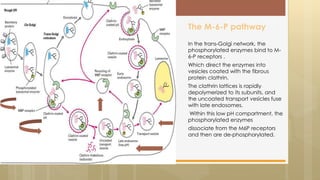
In the trans-Golgi network, the
phosphorylated enzymes bind to M-
6-P receptors .
Which direct the enzymes into
vesicles coated with the fibrous
protein clathrin.
The clathrin lattices is rapidly
depolymerized to its subunits, and
the uncoated transport vesicles fuse
with late endosomes.
Within this low pH compartment, the
phosphorylated enzymes
dissociate from the M6P receptors
and then are de-phosphorylated.
The M-6-P pathway
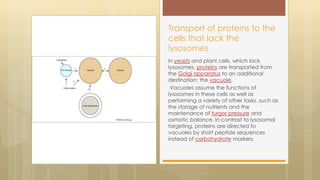
In yeasts and plant cells, which lack
lysosomes, proteins are transported from
the Golgi apparatus to an additional
destination: the vacuole.
Vacuoles assume the functions of
lysosomes in these cells as well as
performing a variety of other tasks, such as
the storage of nutrients and the
maintenance of turgor pressure and
osmotic balance. In contrast to lysosomal
targeting, proteins are directed to
vacuoles by short peptide sequences
instead of carbohydrate markers.
Transport of proteins to the
cells that lack the
lysosomes

Protein sorting in golgi bodies

  • 1.
    Presented by: M. HammadLatif Presented to: Dr. Qandeel Fatima Protein sorting in Golgi Bodies
  • 2.
    Protein targeting orprotein sorting is the biological mechanism by which proteins are transported to the appropriate destinations in the cell or outside of it. Proteins can be targeted to the inner space of an organelle, different intracellular membranes, plasma membrane, or to exterior of the cell via secretion. Protein Sorting
  • 3.
    An organelle, consistingof layers of flattened sacs, that takes up and processes secretory and synthetic products from the endoplasmic reticulum and then either releases the finished products into various parts of the cell cytoplasm or secretes them to the outside of the cell. The Golgi Apparatus
  • 4.
    Morphologically the Golgiis composed of flattened membrane-enclosed sacs (cisternae) and associated vesicles. Proteins from the ER enter at its cis face (entry face), which is convex and usually oriented toward the nucleus. They are then transported through the Golgi and exit from its concave trans face (exit face). As they pass through the Golgi, proteins are modified and sorted for transport to their eventual destinations within the cell. Organization of the Golgi Apparatus
  • 5.
    a. Vesicles fromthe ER fuse to form the ER-Golgi intermediate compartment, and proteins from the ER are then transported to the cis Golgi network. b. The medial and trans compartments of the Golgi stack correspond to the cisternae in the middle of the Golgi complex and are the sites of most protein modifications. c. Proteins are then carried to the trans Golgi network, where they are sorted for transport to the plasma membrane, secretion, or lysosomes. Regions of the Golgi apparatus
  • 6.
    Protein processing withinthe Golgi involves the modification and synthesis of the carbohydrate portions of glycoproteins. One of the major aspects of this processing is the modification of the N-linked oligosaccharides that were added to proteins in the ER. N-linked oligosaccharides are processed within the Golgi apparatus in an ordered sequence of reactions. a. The first modification of proteins destined for secretion or for the plasma membrane is the removal of three additional mannose residues. b. This is followed by the sequential addition of an N-acetylglucosamine c. The removal of two more mannoses d. The addition of a fucose and two more N- acetylglucosamines. e. Finally, three galactose and three sialic acid residues are added. Protein Glycosylation within the Golgi
  • 7.
    Ceramide, which issynthesized in the ER, is converted either to sphingomyelin (a phospholipid) or to glycolipids in the Golgi apparatus. In the first reaction, a phosphorylcholine group is transferred from phosphatidylcholine to ceramide. Alternatively, a variety of different glycolipids can be synthesized by the addition of one or more sugar residues (e.g., glucose). Lipid and Polysaccharide Metabolism in the Golgi Synthesis of sphingomyelin and glycolipids
  • 8.
    Proteins, as wellas lipids and polysaccharides, are transported from the Golgi apparatus to their final destinations through the secretory pathway. This involves the sorting of proteins into different kinds of transport vesicles, which bud from the trans Golgi network and deliver their contents to the appropriate cellular locations. Protein Sorting and Export from the Golgi Apparatus
  • 9.
    a. Some proteinsare retained in the ER instead of traveling from ER to golgi. b. Proteins destined to remain in the lumen of the ER are marked by the sequence Lys-Asp-Glu-Leu (KDEL) at their carboxy terminus. These proteins are exported from the ER to the Golgi, but they are recognized by a receptor in the ERGIC or the Golgi apparatus and selectively returned to the ER. c. Many proteins are retained in the ER lumen as a result of the presence of the targeting sequence (KDEL) at their carboxy terminus. If this sequence is deleted from the protein, the mutated protein is instead transported to the Golgi and secreted from the cell Vesicular transport from ER to Golgi bodies
  • 10.
    Transport from golgiapparatus takes place by two pathways. Constitutive secretory pathway The constitutive secretory pathway, which operates in all cells, leads to continual unregulated protein secretion. In the absence of specific targeting signals, proteins are carried to the plasma membrane by constitutive secretion. Transport from the Golgi apparatus
  • 11.
    a. A distinctregulated secretory pathway in which specific proteins are secreted in response to environmental signals. b. Proteins are sorted into the regulated secretory pathway in the trans Golgi network, where they are packaged into specialized secretory vesicles. These secretory vesicles, which are larger than other transport vesicles, store their contents until specific signals direct their fusion with the plasma membrane. Examples of regulated secretion include • The release of hormones from endocrine cells • The release of neurotransmitters from neurons • The release of digestive enzymes from the pancreatic acinar cells Regulated secretory pathway
  • 12.
    The plasma membranesof polarized epithelial cells are divided into apical and basolateral domains that contain specific proteins related to their particular functions. In this example (intestinal epithelium), the apical surface of the cell faces the lumen of the intestine, the lateral surfaces are in contact with neighboring cells, and the basal surface rests on a sheet ofextracellular matrix (the basal lamina). The apical membrane is characterized by the presence of microvilli, which facilitate the absorption of nutrients by increasing surface area. Specific proteins are targeted to either the apical or basolateral membranes in the trans Golgi network. Tight junctions between neighboring cells maintain the identity of the apical and basolateral membranes by preventing the diffusion of proteins between these domains. Transport to the plasma membrane of polarized cells
  • 13.
    The best-characterized pathwayof protein sorting in the Golgi is the selective transport of proteins to lysosomes. Protein destined for incorporation into lysosomes are modified by mannose phosphorylation. This occurs while the protein is still in the cis Golgi network. These phosphorylated mannose residues are specifically recognized by a mannose- 6-phosphate receptor in the trans Goligi network Selective transport of proteins to lysosomes
  • 14.
    In the trans-Golginetwork, the phosphorylated enzymes bind to M- 6-P receptors . Which direct the enzymes into vesicles coated with the fibrous protein clathrin. The clathrin lattices is rapidly depolymerized to its subunits, and the uncoated transport vesicles fuse with late endosomes. Within this low pH compartment, the phosphorylated enzymes dissociate from the M6P receptors and then are de-phosphorylated. The M-6-P pathway
  • 15.
    In yeasts andplant cells, which lack lysosomes, proteins are transported from the Golgi apparatus to an additional destination: the vacuole. Vacuoles assume the functions of lysosomes in these cells as well as performing a variety of other tasks, such as the storage of nutrients and the maintenance of turgor pressure and osmotic balance. In contrast to lysosomal targeting, proteins are directed to vacuoles by short peptide sequences instead of carbohydrate markers. Transport of proteins to the cells that lack the lysosomes