Living Free
Moving From Anxiety to Mastery
  Presentation by Dr. Changaris
What is Anxiety?

 Fear: The feeling that happens when we are in actual danger.
  Anxiety: The feelings and thoughts that occur when we are
  worried about a difficult thing that “might” happen.

 Worries: Thoughts about bad things that “might happen.”

 Anything that makes us feel good, relaxed or happy helps us
  move from stress back
  to our “zone.”

 Stress: What happens when we have anxiety and worries for a
  long time with out feeling good and relaxed.
Power of Play
  A pioneer in research on play, Dr. Stuart
  Brown says humor, games, roughhousing,
  flirtation and fantasy are more than just
  fun. Plenty of play in childhood makes for
  happy, smart adults -- and keeping it up
  can make us smarter at any age.

  He started studying murders and found
  the vital role of play in happiness!
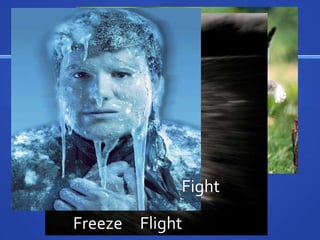
Fight

Freeze Flight
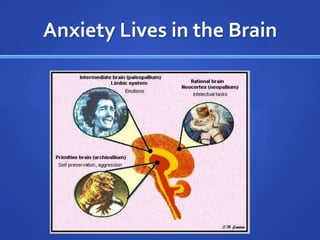
Anxiety Lives in the Brain
Deficient prefrontal attentional control in late-life generalized anxiety disorder:
an fMRI investigation

R B Price, D A Eldreth and J Mohlman
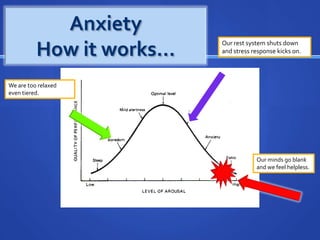
Anxiety
          How it works…   Our rest system shuts down
                          and stress response kicks on.


We are too relaxed
even tiered.


                                      Our minds go blank
                                      and we feel helpless.
Anxiety is a
Sticky Gear
   Shift!

 Remember When
 You Are Stuck to
   Shift Gears!

 It is good for the
body and the        !
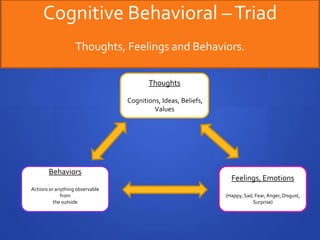
Cognitive Behavioral – Triad
                   Thoughts, Feelings and Behaviors.

                                        Thoughts

                                 Cognitions, Ideas, Beliefs,
                                          Values


       Behaviors
                                                                 Feelings, Emotions
Actions or anything observable
             from                                              (Happy, Sad, Fear, Anger, Disgust,
          the outside                                                      Surprise)
Negative Thought Cycle

          Thought
“Something Bad Might Happen.”

          Feeling
    “Worried or Anxious.”

           Behavior
   “Avoid trying new things.”
Write Words to
            Describe Anxiety on
           the Lines and Draw a
             Line to Where You
            Feel Anxiety in Your
                   Body…
Anxiety   ________________________
          _____Tight Chest _____

Effects   ________________________
          ________________________
          ________________________
Our       _______Butterflies_____
          ________________________
          ________________________
Bodies    ________________________
          ________________________
          ________________________
          ________________________
          ________________________
          ________________________
          ________________________
          ________________________
          ________________________
Rest/Digest - Fight/Flight
Herbert Benson, M.D.
 founder of the Mind/Body Medical Institute a
Massachusetts General Hospital. Harvard Medical
               School graduate.
Making the Most of
Positive Emotions a Three Step Plan

1.   Do or remember an enjoyable or
     funny event.
2.   Notice how it makes you feel in your
     body.
3.   Take a moment and be grateful for
     the good feeling.
Key Skills to Manage Anxiety
 Change the thought to change how you         Riding the wave: Emotions have a
                                                 beginning a middle and an end.
   feel: How we think changes how we             They do not last forever. You can
   feel. Create a “new thought” be a good        just ride the wave if you do the
   coach or a cheerleader for yourself! Use      emotion will end and you will feel
   a coaching thought.                           better again!

                                               Distraction: Distract your self! Get
 Improve the moment you are in: Make            your mind off the feelings.
  the moment more tolerable. If life             Distract with (activities,
  hands you lemons make lemon-aid. If            contributions, thoughts,
                                                 sensations, and emotions)
  things are just going to be tuff, accept it
  and make the best of it by doing one         Soothing in the five senses: Find an
  thing to make yourself feel better!           activity that makes you feel good
                                                and do it! A good way to think of
                                                one is use the “five senses rule.”
 Turning your mind: You can make the           Think of one of your senses and
  shift. If you are focusing on things that     find an activity that would make
  are worrying you turn your mind! Take         you feel good.
  control with using a tool or changing
  your thoughts.

Anxiety in Elders

  • 1.
    Living Free Moving FromAnxiety to Mastery Presentation by Dr. Changaris
  • 2.
    What is Anxiety? Fear: The feeling that happens when we are in actual danger. Anxiety: The feelings and thoughts that occur when we are worried about a difficult thing that “might” happen.  Worries: Thoughts about bad things that “might happen.”  Anything that makes us feel good, relaxed or happy helps us move from stress back to our “zone.”  Stress: What happens when we have anxiety and worries for a long time with out feeling good and relaxed.
  • 3.
    Power of Play A pioneer in research on play, Dr. Stuart Brown says humor, games, roughhousing, flirtation and fantasy are more than just fun. Plenty of play in childhood makes for happy, smart adults -- and keeping it up can make us smarter at any age. He started studying murders and found the vital role of play in happiness!
  • 4.
  • 5.
  • 6.
    Deficient prefrontal attentionalcontrol in late-life generalized anxiety disorder: an fMRI investigation R B Price, D A Eldreth and J Mohlman
  • 7.
    Anxiety How it works… Our rest system shuts down and stress response kicks on. We are too relaxed even tiered. Our minds go blank and we feel helpless.
  • 8.
    Anxiety is a StickyGear Shift! Remember When You Are Stuck to Shift Gears! It is good for the body and the !
  • 9.
    Cognitive Behavioral –Triad Thoughts, Feelings and Behaviors. Thoughts Cognitions, Ideas, Beliefs, Values Behaviors Feelings, Emotions Actions or anything observable from (Happy, Sad, Fear, Anger, Disgust, the outside Surprise)
  • 10.
    Negative Thought Cycle Thought “Something Bad Might Happen.” Feeling “Worried or Anxious.” Behavior “Avoid trying new things.”
  • 11.
    Write Words to Describe Anxiety on the Lines and Draw a Line to Where You Feel Anxiety in Your Body… Anxiety ________________________ _____Tight Chest _____ Effects ________________________ ________________________ ________________________ Our _______Butterflies_____ ________________________ ________________________ Bodies ________________________ ________________________ ________________________ ________________________ ________________________ ________________________ ________________________ ________________________ ________________________
  • 12.
  • 13.
    Herbert Benson, M.D. founder of the Mind/Body Medical Institute a Massachusetts General Hospital. Harvard Medical School graduate.
  • 14.
    Making the Mostof Positive Emotions a Three Step Plan 1. Do or remember an enjoyable or funny event. 2. Notice how it makes you feel in your body. 3. Take a moment and be grateful for the good feeling.
  • 15.
    Key Skills toManage Anxiety  Change the thought to change how you  Riding the wave: Emotions have a beginning a middle and an end. feel: How we think changes how we They do not last forever. You can feel. Create a “new thought” be a good just ride the wave if you do the coach or a cheerleader for yourself! Use emotion will end and you will feel a coaching thought. better again!  Distraction: Distract your self! Get  Improve the moment you are in: Make your mind off the feelings. the moment more tolerable. If life Distract with (activities, hands you lemons make lemon-aid. If contributions, thoughts, sensations, and emotions) things are just going to be tuff, accept it and make the best of it by doing one  Soothing in the five senses: Find an thing to make yourself feel better! activity that makes you feel good and do it! A good way to think of one is use the “five senses rule.”  Turning your mind: You can make the Think of one of your senses and shift. If you are focusing on things that find an activity that would make are worrying you turn your mind! Take you feel good. control with using a tool or changing your thoughts.

Editor's Notes

  • #7 gions exhibiting greater activation to negative words than neutral in the NAC group (red), lesser activation to negative words than neutral in the GAD group (green) and greater negative>neutral contrast values in the NAC group than in the GAD group (yellow). Middle panel shows overlapping red and yellow clusters. Images are displayed in neurological convention (right=right). All voxels shown are significant at P<0.005, uncorrected and P<0.05, corrected. (b) Surface rendering of the regions shown in panel a. Image is shown in radiological convention (left=right). NAC, non-anxious control; GAD, generalized anxiety disorder.