Dialectical Behavioral Therapy:
 Creating a Life Worth Living
     Presented by Niki Serravalle
What to expect….
• The theory
  – Quick overview
• The skills
  – Few examples
• How it relates to
  us and what we
  do

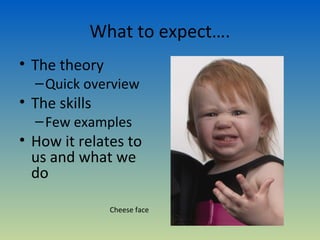
               Cheese face
What is DBT:
       Dialectical Behavioral Therapy
• Developed by Dr. Linehan,
  Washington University to
  treat persons with
  Borderline Personality
  Disorders. (1991)
• A combination of CBT and
  Eastern meditative
  practices.
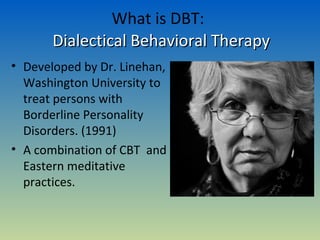
Marsha Linehan
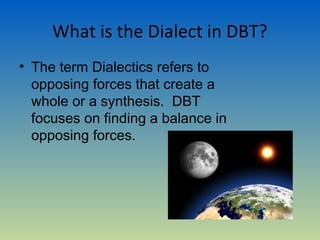
What is the Dialect in DBT?
• The term Dialectics refers to
  opposing forces that create a
  whole or a synthesis. DBT
  focuses on finding a balance in
  opposing forces.
More on Dialects
DBT makes three basic assumptions:
   – (1) all things are interconnected
   – (2) change is constant and inevitable and
   – (3) opposites can be integrated to form a closer
      approximation of the truth.
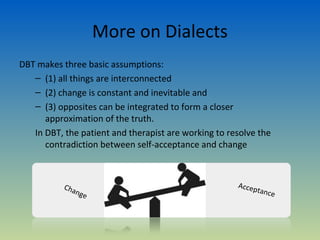
   In DBT, the patient and therapist are working to resolve the
      contradiction between self-acceptance and change


           Cha                                        Accep
               nge                                            tance
The theory
   Individuals are born with a biological
         predisposition for emotional
    dysregulation who are then subjected
    to an invalidating environment where
  they learn maladaptive behaviors which
           are reinforced over time.
Treatment that specifically designed for persons with
   BPD and high suicidal behaviors
Symptoms of a person with BDP
•Make frantic efforts to avoid real or imagined abandonment.
•Have a pattern of difficult relationships caused by alternating between
extremes of intense admiration and hatred of others.
•Have an unstable self-image or be unsure of his or her own identity.
•Act impulsively in ways that are self-damaging
•Have recurring suicidal thoughts, make repeated suicide attempts, or
cause self-injury through mutilation, such as cutting or burning himself or
herself.
•Have frequent emotional overreactions or intense mood swings, including
feeling depressed, irritable, or anxious.
•Have long-term feelings of emptiness.
•Have inappropriate, fierce anger or problems controlling anger. The
person may often display temper tantrums or get into physical fights.
•Have temporary episodes of feeling suspicious of others without reason
(paranoia) or losing a sense of reality.
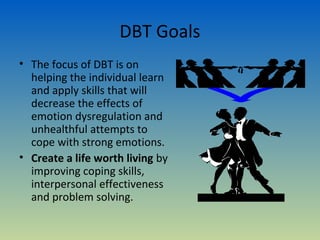
DBT Goals
• The focus of DBT is on
  helping the individual learn
  and apply skills that will
  decrease the effects of
  emotion dysregulation and
  unhealthful attempts to
  cope with strong emotions.
• Create a life worth living by
  improving coping skills,
  interpersonal effectiveness
  and problem solving.
The hierarchy
DBT targets behaviors in a descending hierarchy:
• decreasing high-risk suicidal behaviors
• decreasing responses or behaviors (by either therapist
  or patient) that interfere with therapy
• decreasing behaviors that interfere with/reduce
  quality of life
• decreasing and dealing with post-traumatic stress
  responses
• enhancing respect for self
• acquisition of the behavioral skills taught in group
• additional goals set by patient
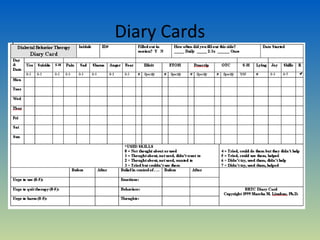
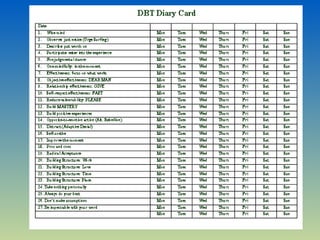
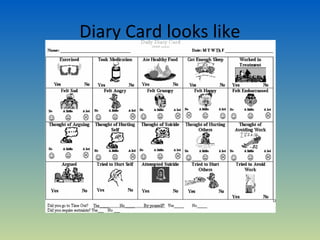
Diary Cards
How DBT Works…
• Individual session that improving the client’s motivation to work
  toward obtaining a life worth living
• DBT focuses on group skills training to enhance Mindfulness,
  Interpersonal Effectiveness and Distress Tolerance and Emotional
  Regulation.
• Telephone consultation is to ensure generalization of skills and
  effective problem-solving strategies in daily living
• The commitment to therapy is imperative to success in treatment.
  Individual and therapist commit to goals prior to beginning.
• A weekly consultation team meeting is held between DBT therapists
  for the purpose of enhancing each therapist’s own motivation and
  capability to effectively treat BPD clients
The Contract States…
• To accept a dialectical philosophy (at least 1 year
  of therapy)
• The individual will participate in therapy and
  follow all given directives. Even when they don’t
  want to. (Irreverence)
• The therapist believes that the individual is doing
  the best they can at all times, that behavior is a
  result of their past experiences, and there is a
  willingness to change. (Dialect)
   – No one can fail at DBT, the treatment fails.
Therapy Interfering Behaviors (TIB)
•   arrives late
•   leaves early
•   passive or helpless
•   not do diary card (homework)
•   excessively talks (hard for therapist to talk)
•   complains but does not work in session
•   excessively angry
•   excessively judgmental/critical of therapist
Assumptions….
• Clients are doing the best they can
• Clients want to improve
• Clients needs to do better, try harder and be
  motivated to change
• Clients have not caused their problems, but they are
  forced to solve them
• Their lives are unbearable (suicidal)
• Clients must learn new behaviors
• Clients can not fail in therapy
• Therapists need support (interdisciplinary: staff
  meetings a MUST)
Core Concepts (skill models)
• Mindfulness: Paying attention on purpose
• Distress tolerance: Bear pain skillfully
• Emotional regulation: Manage emotions
  instead of being managed by them
• Interpersonal effectiveness: All the skills come
  together in a synergistic way
State of our Mind
• Emotional Mind: thoughts are being
  controlled by our emotions. Unable to be
  reasonable.
• Reasonable Mind: think logically, be rational
  about what is occurring. No emotions.
• Wise Mind: The balance of emotional mind
  and reasonable mind. Goal of DBT
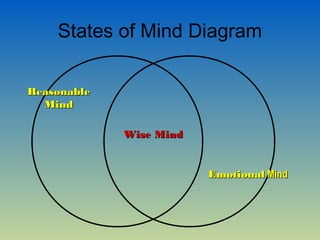
States of Mind Diagram

Reasonable
  Mind

             Wise Mind


                         Emotional Mind
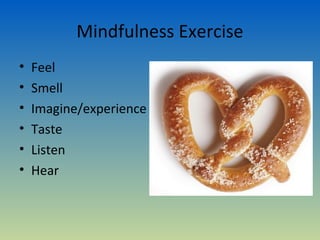
Mindfulness Exercise
•   Feel
•   Smell
•   Imagine/experience
•   Taste
•   Listen
•   Hear
Mindfulness
• Is paying attention on
  purpose
• Being non-judgmental
• In the moment, present,
  in the here and now
• Increases awareness of
  all senses
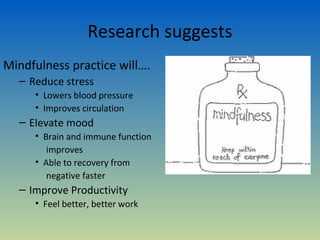
Research suggests
Mindfulness practice will….
  – Reduce stress
     • Lowers blood pressure
     • Improves circulation
  – Elevate mood
     • Brain and immune function
        improves
     • Able to recovery from
        negative faster
  – Improve Productivity
     • Feel better, better work
Mindfulness Skills
 The “What” Skills                  The “How” Skills

• Observe: attending to           • Non-judgmentally:
emotions/behavior without         experiencing the world around
trying to end (increases          us without judgments; separate
awareness)                        our thoughts and feelings from
• Describe: apply verbal labels   what's actually going on
to behavioral and                 • Effectively: Use the skills that
environmental events              you are learning; do what works.
(separates emotion from           • One-mindfully: sustained
thought)                          attention on the present
•Participate: action with         moment; do one thing at a time
attention, not mindless
participation
Emotional Regulation
Emotions can frequently be very intense and labile, which means they change often.
Emotions often drive behavior (problems to be solved). A lot of the behavior
focuses around finding ways to get those emotions validated or to get rid of the pain.
DBT teaches skills to manage these emotions more effectively. In the past they
learned to not feel emotions because they were taught to (smile and be nice even
when you feel angry or upset-invalidating environment). These emotions are a
secondary response to a primary emotion (feels ashamed because I was angry).
Emotional Regulation Skills
1.   Identifying and labeling emotions
2.   Understanding the function of emotions
3.   Identifying obstacles to changing emotions
4.   Reducing vulnerability to “emotion mind”
5.   Increasing positive emotional events
6.   Increasing mindfulness to current emotions
7.   Taking opposite action
Emotional Regulation Skills:
             Identifying and Labeling Emotions
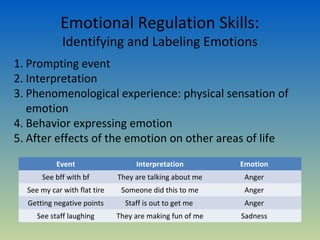
1. Prompting event
2. Interpretation
3. Phenomenological experience: physical sensation of
   emotion
4. Behavior expressing emotion
5. After effects of the emotion on other areas of life
           Event                   Interpretation         Emotion
      See bff with bf         They are talking about me    Anger
  See my car with flat tire    Someone did this to me      Anger
  Getting negative points       Staff is out to get me     Anger
     See staff laughing       They are making fun of me   Sadness
Emotional Regulation Skills
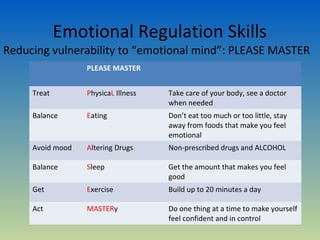
Reducing vulnerability to “emotional mind”: PLEASE MASTER
                  PLEASE MASTER


     Treat        PhysicaL Illness   Take care of your body, see a doctor
                                     when needed
     Balance      Eating             Don’t eat too much or too little, stay
                                     away from foods that make you feel
                                     emotional
     Avoid mood   Altering Drugs     Non-prescribed drugs and ALCOHOL

     Balance      Sleep              Get the amount that makes you feel
                                     good
     Get          Exercise           Build up to 20 minutes a day

     Act          MASTERy            Do one thing at a time to make yourself
                                     feel confident and in control
Distress Tolerance
• Acceptance of reality is not equivalent to
  approval of reality.
• DBT assumes pain and distress are a part of life;
  they cannot be entirely avoided or removed.
  Therefore one has to learn to tolerate and
  survive. Accept life as it is in the moment.
• DBT teaches how to bear pain skillfully.
• Distress Tolerance skills address impulsivity in
  high risk behaviors.
Distress Tolerance Skills
•    Distracting
•    Self-soothing
•    Improving the moment
•    Thinking of the pros/cons

    The most important aspect of these skills is the
          radical acceptance of the dialect…
Distracting…
• WISE mind accepts:
  Activities
  Contributing (changes focus from self to others, creates a
    sense of meaning in life, giving back)
  Comparisons (changes focus from self to others by
    examining how others cope)
  Emotions (replace with positive ones)
  Pushing away (leave situation causing stress, blocking, only
    used in ER)
  Thoughts (fill head with thoughts that provide powerful,
    positive physical reactions)

  Sensations (hold ice cubes, snap the bands)
Improving the Moment
• IMPROVE:
    Imagery: Imagine relaxing scenes, things going well, or other things
      that please you
    Meaning: Find some purpose or meaning in what you are feeling
    Prayer: Either pray to whomever you worship, or, if not religious, chant a
      personal mantra, LET GO
    Relaxation: practice deep breathing, use self soothing
    One thing in the moment: stay present
    Vacation: take a brief break, allow yourself to be taken care of
    Encouragement: cheerlead yourself
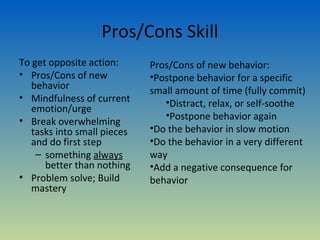
Pros/Cons Skill
To get opposite action:      Pros/Cons of new behavior:
• Pros/Cons of new           •Postpone behavior for a specific
   behavior                  small amount of time (fully commit)
• Mindfulness of current        •Distract, relax, or self-soothe
   emotion/urge
                                •Postpone behavior again
• Break overwhelming
   tasks into small pieces   •Do the behavior in slow motion
   and do first step         •Do the behavior in a very different
    – something always       way
      better than nothing    •Add a negative consequence for
• Problem solve; Build       behavior
   mastery
Interpersonal Effectiveness
The interpersonal effectiveness module focuses on
situations where the objective is to change something
(e.g., requesting that someone do something) or to
resist changes someone else is trying to make (e.g.,
saying no). The skills taught are intended to maximize
the chances that a person’s goals in a specific situation
will be met, while at the same time not damaging
either the relationship or the person’s self-respect.
Interpersonal Effectiveness Skills
Focuses on developing skills that address problem solving. They
balance the dialect between maintaining the relationship and
maintaining self respect. Difficult to do with populations that
vacillate between all or nothing (avoidance of conflict and intense
confrontation).

1.Objectives effectiveness- prioritizing achievable objective goals
2.Relationship effectiveness- prioritizing a conflict-free relationship
3.Self-respect effectiveness- prioritizing acting within your own
principles so that you feel comfortable with how you approached
the situation
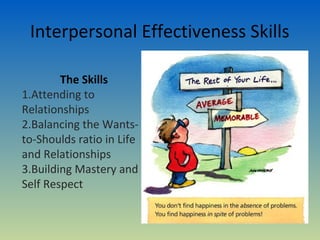
Interpersonal Effectiveness Skills

        The Skills
1.Attending to
Relationships
2.Balancing the Wants-
to-Shoulds ratio in Life
and Relationships
3.Building Mastery and
Self Respect
Interpersonal Effectiveness Skills
                      GIVE
               Skill for maintaining relationships
Gentle: Use appropriate language, no verbal or physical attacks, no put downs,
avoid sarcasm unless you are sure the person is alright with it, and be courteous
and non-judgmental.
Interested: When the person you are speaking to is talking about something, act
interested in what they are saying. Maintain eye contact, ask questions, etc. Do not use your
cell phone while having a conversation with another person!
Validate: Show that you understand a person’s situation and sympathize with them.
Validation can be shown through words, body language and/or facial expressions.
Easy Manner: Be calm and comfortable during conversation, use humor, smile.
Interpersonal Effectiveness
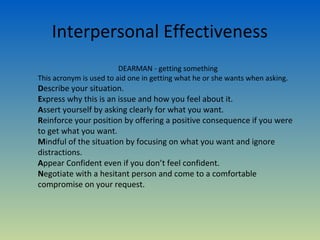
                         DEARMAN - getting something
This acronym is used to aid one in getting what he or she wants when asking.
Describe your situation.
Express why this is an issue and how you feel about it.
Assert yourself by asking clearly for what you want.
Reinforce your position by offering a positive consequence if you were
to get what you want.
Mindful of the situation by focusing on what you want and ignore
distractions.
Appear Confident even if you don’t feel confident.
Negotiate with a hesitant person and come to a comfortable
compromise on your request.
Interpersonal Effectiveness
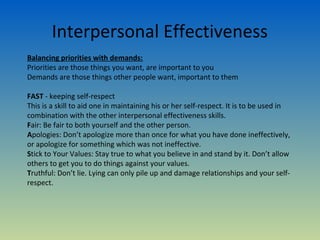
Balancing priorities with demands:
Priorities are those things you want, are important to you
Demands are those things other people want, important to them

FAST - keeping self-respect
This is a skill to aid one in maintaining his or her self-respect. It is to be used in
combination with the other interpersonal effectiveness skills.
Fair: Be fair to both yourself and the other person.
Apologies: Don’t apologize more than once for what you have done ineffectively,
or apologize for something which was not ineffective.
Stick to Your Values: Stay true to what you believe in and stand by it. Don’t allow
others to get you to do things against your values.
Truthful: Don’t lie. Lying can only pile up and damage relationships and your self-
respect.
Skills applied…
Problem solving and change strategies are
again balanced dialectically by the use of
validation. It is important at every stage to
convey to the individual that their behavior,
including thoughts feelings and actions are
understandable, even though they may be
maladaptive or unhelpful.
Therapist skills
• Radical Acceptance
• Validation: communicates validation by listening,
  reflecting, and highlighting the valid or “kernel of
  truth” in the client’s phenomenal experience
• Reciprocal communication: being responsive,
  warm, and engaged; using self-disclosure; and
  being genuine.
• Irreverent communications aim to get the
  patient’s attention, shift the response, and help
  the patient see a different point of view.
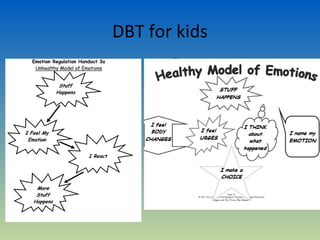
DBT for kids
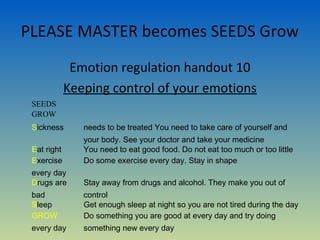
PLEASE MASTER becomes SEEDS Grow
              Emotion regulation handout 10
             Keeping control of your emotions
 SEEDS
 GROW
 Sickness       needs to be treated You need to take care of yourself and
                your body. See your doctor and take your medicine
 Eat right      You need to eat good food. Do not eat too much or too little
 Exercise       Do some exercise every day. Stay in shape
 every day
 Drugs are      Stay away from drugs and alcohol. They make you out of
 bad            control
 Sleep          Get enough sleep at night so you are not tired during the day
 GROW           Do something you are good at every day and try doing
 every day      something new every day
Diary Card looks like
THANK YOU

Questions….

Dialectical behavioral therapy2

  • 1.
    Dialectical Behavioral Therapy: Creating a Life Worth Living Presented by Niki Serravalle
  • 2.
    What to expect…. •The theory – Quick overview • The skills – Few examples • How it relates to us and what we do Cheese face
  • 3.
    What is DBT: Dialectical Behavioral Therapy • Developed by Dr. Linehan, Washington University to treat persons with Borderline Personality Disorders. (1991) • A combination of CBT and Eastern meditative practices.
  • 4.
  • 5.
    What is theDialect in DBT? • The term Dialectics refers to opposing forces that create a whole or a synthesis. DBT focuses on finding a balance in opposing forces.
  • 6.
    More on Dialects DBTmakes three basic assumptions: – (1) all things are interconnected – (2) change is constant and inevitable and – (3) opposites can be integrated to form a closer approximation of the truth. In DBT, the patient and therapist are working to resolve the contradiction between self-acceptance and change Cha Accep nge tance
  • 7.
    The theory Individuals are born with a biological predisposition for emotional dysregulation who are then subjected to an invalidating environment where they learn maladaptive behaviors which are reinforced over time. Treatment that specifically designed for persons with BPD and high suicidal behaviors
  • 8.
    Symptoms of aperson with BDP •Make frantic efforts to avoid real or imagined abandonment. •Have a pattern of difficult relationships caused by alternating between extremes of intense admiration and hatred of others. •Have an unstable self-image or be unsure of his or her own identity. •Act impulsively in ways that are self-damaging •Have recurring suicidal thoughts, make repeated suicide attempts, or cause self-injury through mutilation, such as cutting or burning himself or herself. •Have frequent emotional overreactions or intense mood swings, including feeling depressed, irritable, or anxious. •Have long-term feelings of emptiness. •Have inappropriate, fierce anger or problems controlling anger. The person may often display temper tantrums or get into physical fights. •Have temporary episodes of feeling suspicious of others without reason (paranoia) or losing a sense of reality.
  • 9.
    DBT Goals • Thefocus of DBT is on helping the individual learn and apply skills that will decrease the effects of emotion dysregulation and unhealthful attempts to cope with strong emotions. • Create a life worth living by improving coping skills, interpersonal effectiveness and problem solving.
  • 10.
    The hierarchy DBT targetsbehaviors in a descending hierarchy: • decreasing high-risk suicidal behaviors • decreasing responses or behaviors (by either therapist or patient) that interfere with therapy • decreasing behaviors that interfere with/reduce quality of life • decreasing and dealing with post-traumatic stress responses • enhancing respect for self • acquisition of the behavioral skills taught in group • additional goals set by patient
  • 11.
  • 13.
    How DBT Works… •Individual session that improving the client’s motivation to work toward obtaining a life worth living • DBT focuses on group skills training to enhance Mindfulness, Interpersonal Effectiveness and Distress Tolerance and Emotional Regulation. • Telephone consultation is to ensure generalization of skills and effective problem-solving strategies in daily living • The commitment to therapy is imperative to success in treatment. Individual and therapist commit to goals prior to beginning. • A weekly consultation team meeting is held between DBT therapists for the purpose of enhancing each therapist’s own motivation and capability to effectively treat BPD clients
  • 14.
    The Contract States… •To accept a dialectical philosophy (at least 1 year of therapy) • The individual will participate in therapy and follow all given directives. Even when they don’t want to. (Irreverence) • The therapist believes that the individual is doing the best they can at all times, that behavior is a result of their past experiences, and there is a willingness to change. (Dialect) – No one can fail at DBT, the treatment fails.
  • 15.
    Therapy Interfering Behaviors(TIB) • arrives late • leaves early • passive or helpless • not do diary card (homework) • excessively talks (hard for therapist to talk) • complains but does not work in session • excessively angry • excessively judgmental/critical of therapist
  • 16.
    Assumptions…. • Clients aredoing the best they can • Clients want to improve • Clients needs to do better, try harder and be motivated to change • Clients have not caused their problems, but they are forced to solve them • Their lives are unbearable (suicidal) • Clients must learn new behaviors • Clients can not fail in therapy • Therapists need support (interdisciplinary: staff meetings a MUST)
  • 17.
    Core Concepts (skillmodels) • Mindfulness: Paying attention on purpose • Distress tolerance: Bear pain skillfully • Emotional regulation: Manage emotions instead of being managed by them • Interpersonal effectiveness: All the skills come together in a synergistic way
  • 18.
    State of ourMind • Emotional Mind: thoughts are being controlled by our emotions. Unable to be reasonable. • Reasonable Mind: think logically, be rational about what is occurring. No emotions. • Wise Mind: The balance of emotional mind and reasonable mind. Goal of DBT
  • 19.
    States of MindDiagram Reasonable Mind Wise Mind Emotional Mind
  • 20.
    Mindfulness Exercise • Feel • Smell • Imagine/experience • Taste • Listen • Hear
  • 21.
    Mindfulness • Is payingattention on purpose • Being non-judgmental • In the moment, present, in the here and now • Increases awareness of all senses
  • 22.
    Research suggests Mindfulness practicewill…. – Reduce stress • Lowers blood pressure • Improves circulation – Elevate mood • Brain and immune function improves • Able to recovery from negative faster – Improve Productivity • Feel better, better work
  • 23.
    Mindfulness Skills The“What” Skills The “How” Skills • Observe: attending to • Non-judgmentally: emotions/behavior without experiencing the world around trying to end (increases us without judgments; separate awareness) our thoughts and feelings from • Describe: apply verbal labels what's actually going on to behavioral and • Effectively: Use the skills that environmental events you are learning; do what works. (separates emotion from • One-mindfully: sustained thought) attention on the present •Participate: action with moment; do one thing at a time attention, not mindless participation
  • 24.
    Emotional Regulation Emotions canfrequently be very intense and labile, which means they change often. Emotions often drive behavior (problems to be solved). A lot of the behavior focuses around finding ways to get those emotions validated or to get rid of the pain. DBT teaches skills to manage these emotions more effectively. In the past they learned to not feel emotions because they were taught to (smile and be nice even when you feel angry or upset-invalidating environment). These emotions are a secondary response to a primary emotion (feels ashamed because I was angry).
  • 25.
    Emotional Regulation Skills 1. Identifying and labeling emotions 2. Understanding the function of emotions 3. Identifying obstacles to changing emotions 4. Reducing vulnerability to “emotion mind” 5. Increasing positive emotional events 6. Increasing mindfulness to current emotions 7. Taking opposite action
  • 26.
    Emotional Regulation Skills: Identifying and Labeling Emotions 1. Prompting event 2. Interpretation 3. Phenomenological experience: physical sensation of emotion 4. Behavior expressing emotion 5. After effects of the emotion on other areas of life Event Interpretation Emotion See bff with bf They are talking about me Anger See my car with flat tire Someone did this to me Anger Getting negative points Staff is out to get me Anger See staff laughing They are making fun of me Sadness
  • 27.
    Emotional Regulation Skills Reducingvulnerability to “emotional mind”: PLEASE MASTER PLEASE MASTER Treat PhysicaL Illness Take care of your body, see a doctor when needed Balance Eating Don’t eat too much or too little, stay away from foods that make you feel emotional Avoid mood Altering Drugs Non-prescribed drugs and ALCOHOL Balance Sleep Get the amount that makes you feel good Get Exercise Build up to 20 minutes a day Act MASTERy Do one thing at a time to make yourself feel confident and in control
  • 28.
    Distress Tolerance • Acceptanceof reality is not equivalent to approval of reality. • DBT assumes pain and distress are a part of life; they cannot be entirely avoided or removed. Therefore one has to learn to tolerate and survive. Accept life as it is in the moment. • DBT teaches how to bear pain skillfully. • Distress Tolerance skills address impulsivity in high risk behaviors.
  • 29.
    Distress Tolerance Skills • Distracting • Self-soothing • Improving the moment • Thinking of the pros/cons The most important aspect of these skills is the radical acceptance of the dialect…
  • 30.
    Distracting… • WISE mindaccepts: Activities Contributing (changes focus from self to others, creates a sense of meaning in life, giving back) Comparisons (changes focus from self to others by examining how others cope) Emotions (replace with positive ones) Pushing away (leave situation causing stress, blocking, only used in ER) Thoughts (fill head with thoughts that provide powerful, positive physical reactions) Sensations (hold ice cubes, snap the bands)
  • 31.
    Improving the Moment •IMPROVE: Imagery: Imagine relaxing scenes, things going well, or other things that please you Meaning: Find some purpose or meaning in what you are feeling Prayer: Either pray to whomever you worship, or, if not religious, chant a personal mantra, LET GO Relaxation: practice deep breathing, use self soothing One thing in the moment: stay present Vacation: take a brief break, allow yourself to be taken care of Encouragement: cheerlead yourself
  • 32.
    Pros/Cons Skill To getopposite action: Pros/Cons of new behavior: • Pros/Cons of new •Postpone behavior for a specific behavior small amount of time (fully commit) • Mindfulness of current •Distract, relax, or self-soothe emotion/urge •Postpone behavior again • Break overwhelming tasks into small pieces •Do the behavior in slow motion and do first step •Do the behavior in a very different – something always way better than nothing •Add a negative consequence for • Problem solve; Build behavior mastery
  • 33.
    Interpersonal Effectiveness The interpersonaleffectiveness module focuses on situations where the objective is to change something (e.g., requesting that someone do something) or to resist changes someone else is trying to make (e.g., saying no). The skills taught are intended to maximize the chances that a person’s goals in a specific situation will be met, while at the same time not damaging either the relationship or the person’s self-respect.
  • 34.
    Interpersonal Effectiveness Skills Focuseson developing skills that address problem solving. They balance the dialect between maintaining the relationship and maintaining self respect. Difficult to do with populations that vacillate between all or nothing (avoidance of conflict and intense confrontation). 1.Objectives effectiveness- prioritizing achievable objective goals 2.Relationship effectiveness- prioritizing a conflict-free relationship 3.Self-respect effectiveness- prioritizing acting within your own principles so that you feel comfortable with how you approached the situation
  • 35.
    Interpersonal Effectiveness Skills The Skills 1.Attending to Relationships 2.Balancing the Wants- to-Shoulds ratio in Life and Relationships 3.Building Mastery and Self Respect
  • 36.
    Interpersonal Effectiveness Skills GIVE Skill for maintaining relationships Gentle: Use appropriate language, no verbal or physical attacks, no put downs, avoid sarcasm unless you are sure the person is alright with it, and be courteous and non-judgmental. Interested: When the person you are speaking to is talking about something, act interested in what they are saying. Maintain eye contact, ask questions, etc. Do not use your cell phone while having a conversation with another person! Validate: Show that you understand a person’s situation and sympathize with them. Validation can be shown through words, body language and/or facial expressions. Easy Manner: Be calm and comfortable during conversation, use humor, smile.
  • 37.
    Interpersonal Effectiveness DEARMAN - getting something This acronym is used to aid one in getting what he or she wants when asking. Describe your situation. Express why this is an issue and how you feel about it. Assert yourself by asking clearly for what you want. Reinforce your position by offering a positive consequence if you were to get what you want. Mindful of the situation by focusing on what you want and ignore distractions. Appear Confident even if you don’t feel confident. Negotiate with a hesitant person and come to a comfortable compromise on your request.
  • 38.
    Interpersonal Effectiveness Balancing prioritieswith demands: Priorities are those things you want, are important to you Demands are those things other people want, important to them FAST - keeping self-respect This is a skill to aid one in maintaining his or her self-respect. It is to be used in combination with the other interpersonal effectiveness skills. Fair: Be fair to both yourself and the other person. Apologies: Don’t apologize more than once for what you have done ineffectively, or apologize for something which was not ineffective. Stick to Your Values: Stay true to what you believe in and stand by it. Don’t allow others to get you to do things against your values. Truthful: Don’t lie. Lying can only pile up and damage relationships and your self- respect.
  • 39.
    Skills applied… Problem solvingand change strategies are again balanced dialectically by the use of validation. It is important at every stage to convey to the individual that their behavior, including thoughts feelings and actions are understandable, even though they may be maladaptive or unhelpful.
  • 40.
    Therapist skills • RadicalAcceptance • Validation: communicates validation by listening, reflecting, and highlighting the valid or “kernel of truth” in the client’s phenomenal experience • Reciprocal communication: being responsive, warm, and engaged; using self-disclosure; and being genuine. • Irreverent communications aim to get the patient’s attention, shift the response, and help the patient see a different point of view.
  • 41.
  • 42.
    PLEASE MASTER becomesSEEDS Grow Emotion regulation handout 10 Keeping control of your emotions SEEDS GROW Sickness needs to be treated You need to take care of yourself and your body. See your doctor and take your medicine Eat right You need to eat good food. Do not eat too much or too little Exercise Do some exercise every day. Stay in shape every day Drugs are Stay away from drugs and alcohol. They make you out of bad control Sleep Get enough sleep at night so you are not tired during the day GROW Do something you are good at every day and try doing every day something new every day
  • 43.
  • 44.